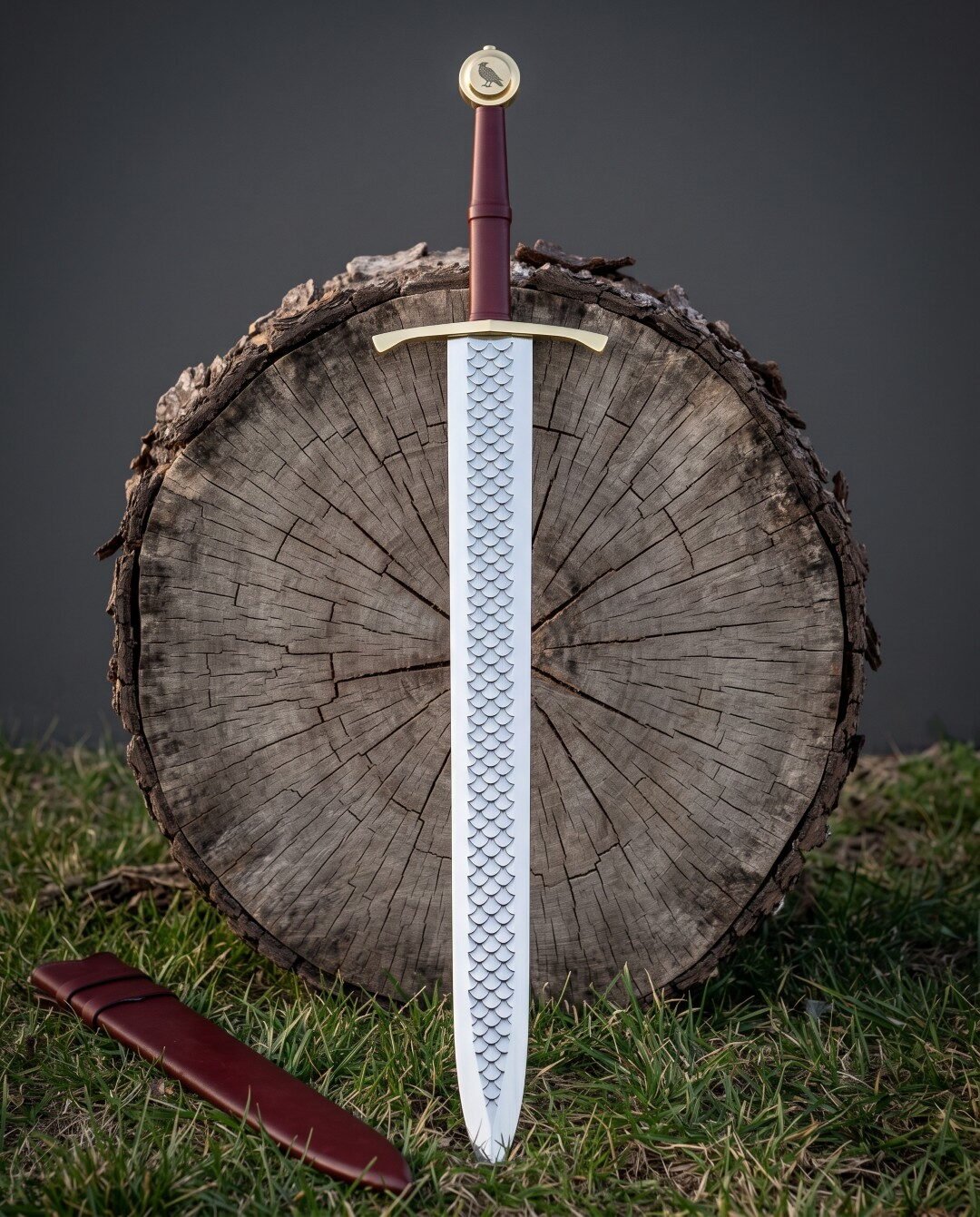
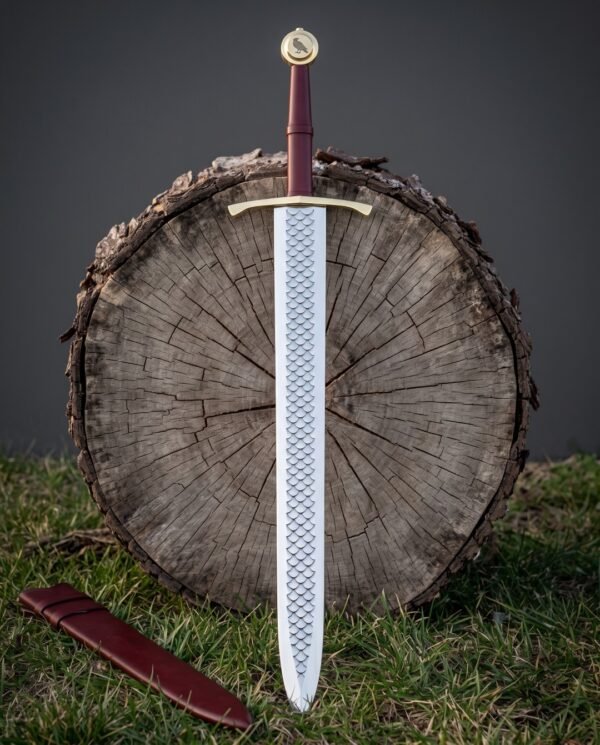
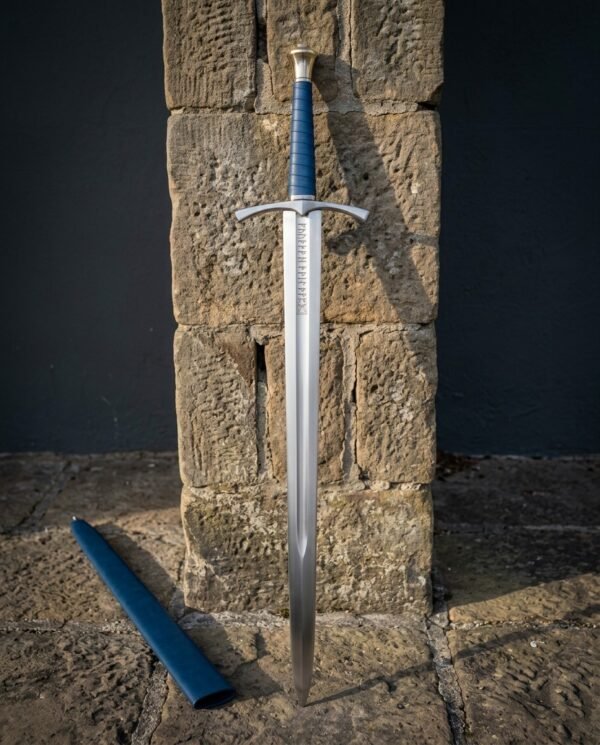
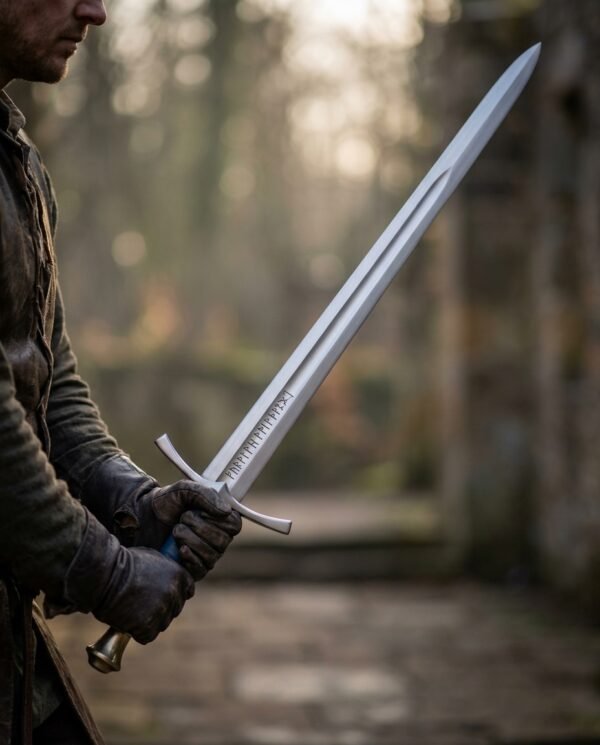
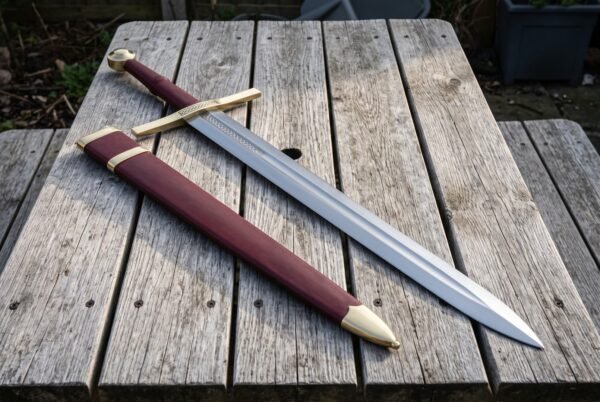
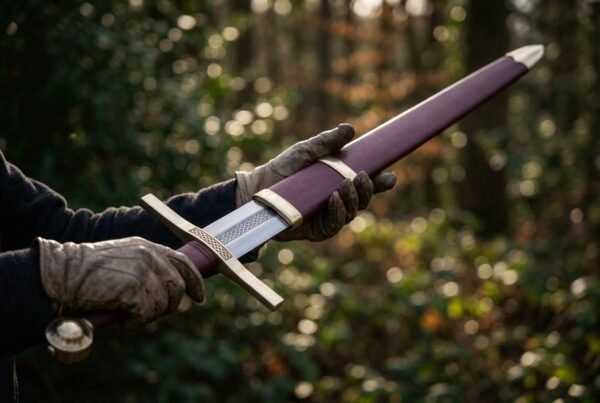
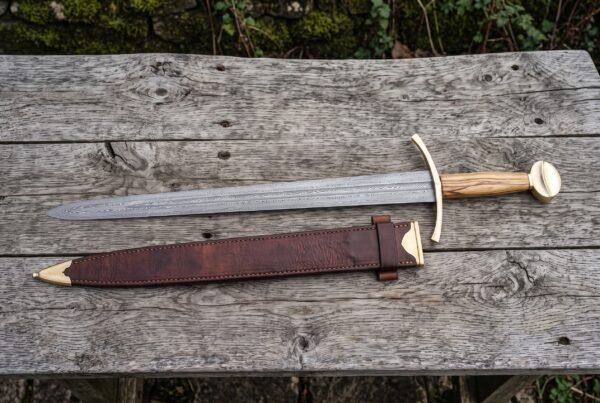
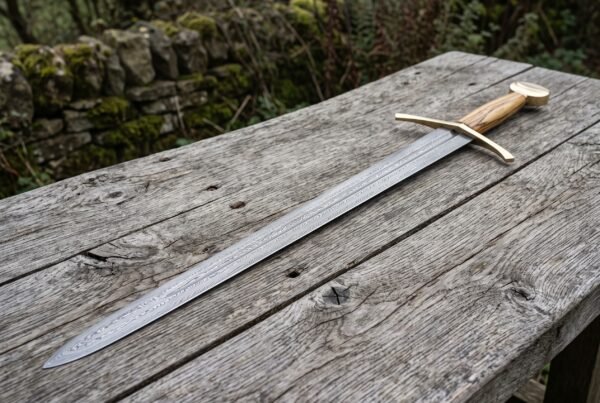
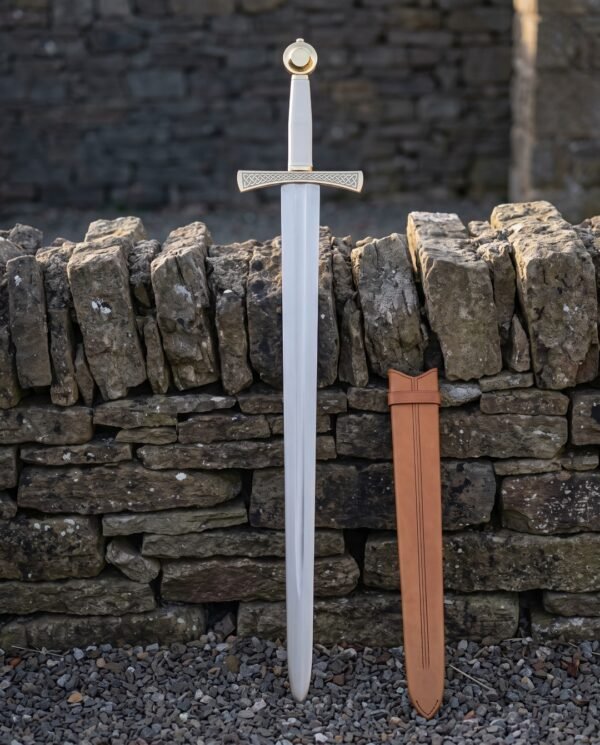
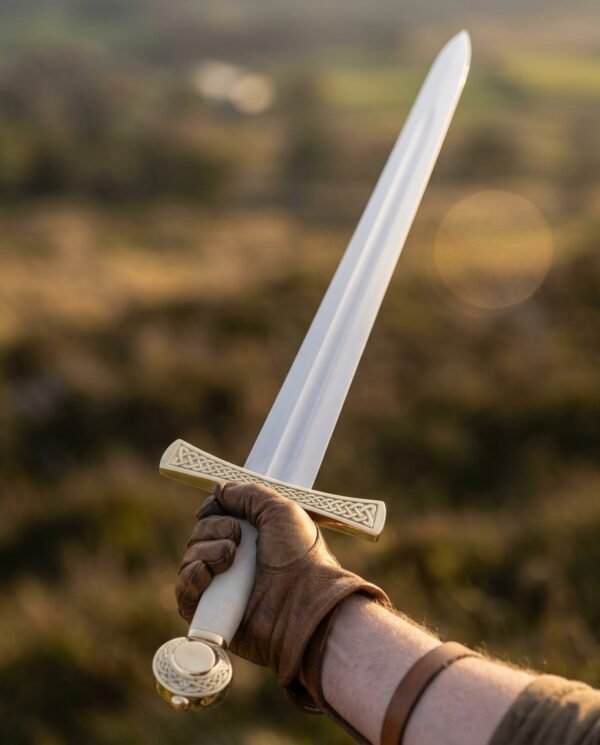
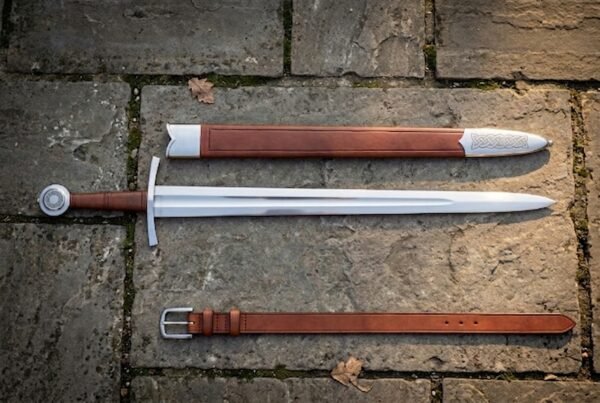
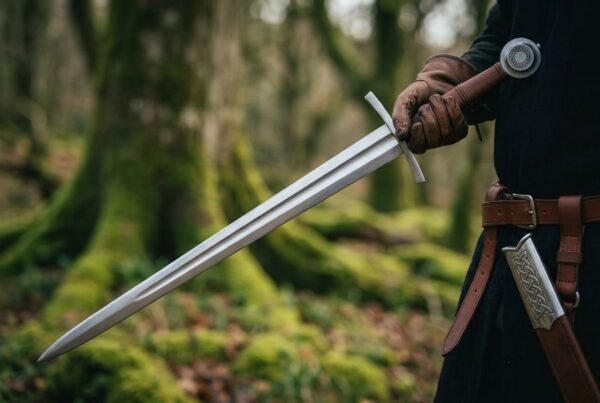
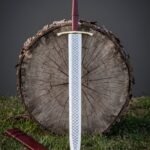
The Plumescale is an arming sword with a raven engraved into a brass disc pommel and a blade etched from guard to point with overlapping scales. The scale pattern is deep enough to catch a fingernail and it runs the full length of the blade rather than sitting as a panel near the ricasso. The guard is a plain brass cross, the grip is wrapped in oxblood leather, and a matching oxblood scabbard is made to the blade.
Ravens follow Odin through the whole of Norse literature and they are always a pair. Grimnismal names them Huginn and Muninn, thought and memory, and has Odin admit that he worries every day about whether they will come back, and worries more about Muninn than about Huginn. That is a strange and very human thing for a god to say and it is one of the reasons the passage sticks. Ravens also went into the field as a device. The Anglo Saxon Chronicle records a Danish banner captured at Cynwit in 878 that carried a raven, and the sagas talk about raven banners as though everyone knew what they were. We carry, grind, heat treat, etch and fit these by hand in the Czech Republic, and each sword ships with the scabbard shown and our lifetime warranty against defects in forging, grind, heat treat and fittings.
If you have seen the phrase battle ready and wondered what it covers, display or battle ready explains it. The raven is Odin’s bird before it is anything else, and the two ravens sets out the sources. The medieval helmets are the obvious thing to hang beside it.
Specifications
| Material | 1095 high carbon steel, hardened to 54 to 58 HRC |
|---|
| Overall length | About 34 inches |
|---|
| Blade length | About 27 inches |
|---|
| Blade type | Double edged with a full length etched scale pattern |
|---|
| Handle | Oxblood leather wrap over a shaped core, about 7 inches of grip |
|---|
| Guard | Plain brass crossguard |
|---|
| Pommel | Brass disc with a raven engraved on the face |
|---|
| Finish | Satin polished steel with a deep etched scale field and polished brass |
|---|
| Scabbard | Oxblood leather, fitted to the blade |
|---|
| Included | Sword and scabbard |
|---|
| SKU | RK-1965 |
|---|
Odin’s ravens and what they were doing on blades
Huginn and Muninn fly out over the world every morning and return to Odin’s shoulders by evening to tell him what they have seen. The names are usually rendered as thought and memory, though muninn is closer to mind or that which is remembered, and scholars have argued about it for a century. What matters is the shape of the idea. Odin is the god of knowledge gained at a cost, and his two birds are the mechanism by which he gets it.
Ravens on the battlefield were a much blunter idea. Ravens and wolves are the beasts of battle in Old English and Old Norse poetry, the animals that arrive after a fight, and putting one on a banner or a hilt was a promise about what the bearer intended to leave behind. The raven banner in the Anglo Saxon Chronicle entry for 878 is the earliest hard reference. Later sagas made it a magical object that flapped when its side was going to win and hung still when it was going to lose, which is exactly the kind of story that grows around a real thing.
On this sword the raven sits on the pommel, which is the part of a sword an onlooker sees when it is worn at the hip and the part the owner sees every time they draw it.
The scale etched blade
The scale field is acid etched into the steel, not printed and not stamped. The process is straightforward to describe and slow to do well. The whole blade is coated in an acid resistant resist, the scale pattern is cut through that resist so bare steel is exposed, and the blade is then bathed in a mordant that eats down into the exposed steel. When the resist is stripped, the untouched areas stand proud and the etched areas sit lower and darker. Depth is controlled by time in the bath, and a pattern this deep needs several passes with the resist repaired between them.
Two things follow from that. The first is that the pattern is part of the blade and cannot rub off or peel. The second is that an etched surface is textured, and texture holds moisture and fingerprints in a way a polished surface does not. That makes oiling more important on this sword than on a plain one, and it is covered below.
The steel underneath is 1095 high carbon at 54 to 58 HRC. Etching removes a very small amount of material from the flats and none from the edge bevels, so the cutting geometry is unaffected. The brass furniture is soft enough that it will never mark the blade sitting against it in the scabbard throat, which is one of the reasons brass became the standard for sword furniture in the first place.
Engraving, runes and your own design
Use the rune converter on this page to turn a name, a date or a short phrase into Elder Futhark and we will cut it into the steel, the leather or the wood. If you would rather have a Viking pattern than a rune line, choose your own design in the engraving option above the add to cart button and tell us where it goes. Where a piece already carries an engraved design, your chosen engraving replaces it rather than sitting alongside it. On the Plumescale the raven on the pommel face is the existing design, and swapping it for a name or a date is straightforward. The scale field covers the blade flats, so if you want to keep the raven the oxblood scabbard leather is the best place for a stamped rune line. See the engraving page.
Handling and balance
Brass is denser than steel, so a brass disc pommel of this size carries real weight and it sits directly behind the hand. That drags the balance point back to roughly three inches ahead of the guard and makes a twenty seven inch blade feel considerably shorter than it looks lying on a table. It rolls from cut to cut on wrist movement.
The grip runs long enough to take a second hand behind the first if you want more control, which is a genuine medieval configuration rather than a modern compromise. The plain brass cross gives basic hand cover and nothing more, which is correct for the type.
This is a sharp forged blade. It is not for sparring and it is not permitted in contact reenactment. Do not use it against another person or another blade. Cutting practice against soft targets is the right use for it.
Care
The etched field needs more attention than a plain blade. Wipe the whole blade after every handling and keep a light film of mineral, camellia or gun oil across it, working the oil into the scale texture with a cloth rather than just wiping over the top. Rust starts in the low points of an etch where a cloth does not reach, and once it is in there it is hard to get out without dulling the pattern. Our full notes are in the steel care guide.
Do not use abrasive on the scale field. It will flatten the high points and grey the whole pattern out. If a spot of corrosion appears, oil it and work it very gently with a cork or a brass brush. The brass will dull to a soft yellow over months and comes back with brass polish. Feed the oxblood leather twice a year, keep it out of strong sun and do not store the sword sheathed for long stretches.
If it is going on a wall, hanging swords and axes safely covers mounts, fixings and what not to do.
Made in the Czech Republic
This is a handmade piece from the Czech Republic, made in a workshop that still forges, grinds and finishes by hand instead of stamping parts out. The smiths there have kept the older way of working, and the wood, horn and leather are shaped and fitted by hand as well. Two pieces of the same design will never be identical, and that is part of what you are buying.
Ransack Viking is a United States company. We handle the import ourselves, look over every piece when it lands and ship from our warehouse in Chicago, Illinois. Engraving is done in the United States after the piece arrives, so your design goes on before we send it out.
A note on handmade variation
Each of these is hand made and not machine made or bulk produced, so what arrives will not be a pixel for pixel copy of the photograph. Etching is a chemical process and the depth and contrast of the scale field depend on temperature, bath strength and time, so the pattern will read a little lighter or darker on yours. The raven is engraved one pommel at a time. Leather takes dye unevenly, so the oxblood will vary in tone between the grip and the scabbard and between one sword and the next. The length, the steel, the heat treat and the build stay the same. The character does not.
Frequently asked questions
Is the scale pattern etched or printed
Etched into the steel through a resist, in several passes. You can feel it with a fingernail. There is nothing on the surface to wear off.
Does the etching weaken the blade
No. The etch takes a small amount of material off the flats where the blade has steel to spare, and none off the edge bevels, so cutting geometry and edge strength are unchanged.
Is the pommel solid brass
Yes, solid brass, with the raven cut into the face. It is not plated, so it will patina rather than wear through.
Can it be used with two hands
The grip is long enough for a second hand behind the first, so yes, though it is designed to be used one handed with the pommel against the palm.
Is the sword sharpened
Yes, on both edges, with a working edge rather than a razor edge. It is not a blunt and cannot be used as one.
When will it arrive
One to two weeks of processing and then transit, free inside the United States. Engraving adds a few days.
What is in the box
- Plumescale raven pommel sword in 1095 high carbon steel with a full length etched scale blade
- Oxblood leather scabbard fitted to the blade
- Protective oil film on the blade for transit
- Care card and lifetime warranty against defects in forging, grind, heat treat and fittings
- Forged and finished in the Czech Republic
Explore the range
More in arming swords, Viking swords and engraved and personalised pieces, or read the guides on etching, finishes and blade care.
Also in this part of the catalogue
If this one is not quite right, there is the Awecrown arming sword, 36 inches overall. Also in this group is the Pitchknot arming sword, 32 inches overall. Sitting beside it in the catalogue is the Garnetward arming sword, 38 inches overall.
From the same corner of the shop, there is the Wolfmark Viking sword. Or start from a blank sheet on the custom Viking sword page.
Anyone moving from display pieces to sparring can start with the Norvakt rondel dagger trainer, and our intro to HEMA fills in the rest.

So happy I finally pulled the trigger on this one. Fit and finish is museum quality. You can tell real craftsmen made this by hand. Leather sheath is thick and well stitched. Not the cheap stuff you usually get. Already telling my friends to check this out.
This is exactly what I wanted and then some. This is going straight into my display case.
Showed up right on time and looked even better than the photos. Edge retention has been great even after regular use. Even the small engravings are crisp and clean. 1095 Steel blade holds a razor edge right out of the box. Shipping was fast and everything arrived well packaged.