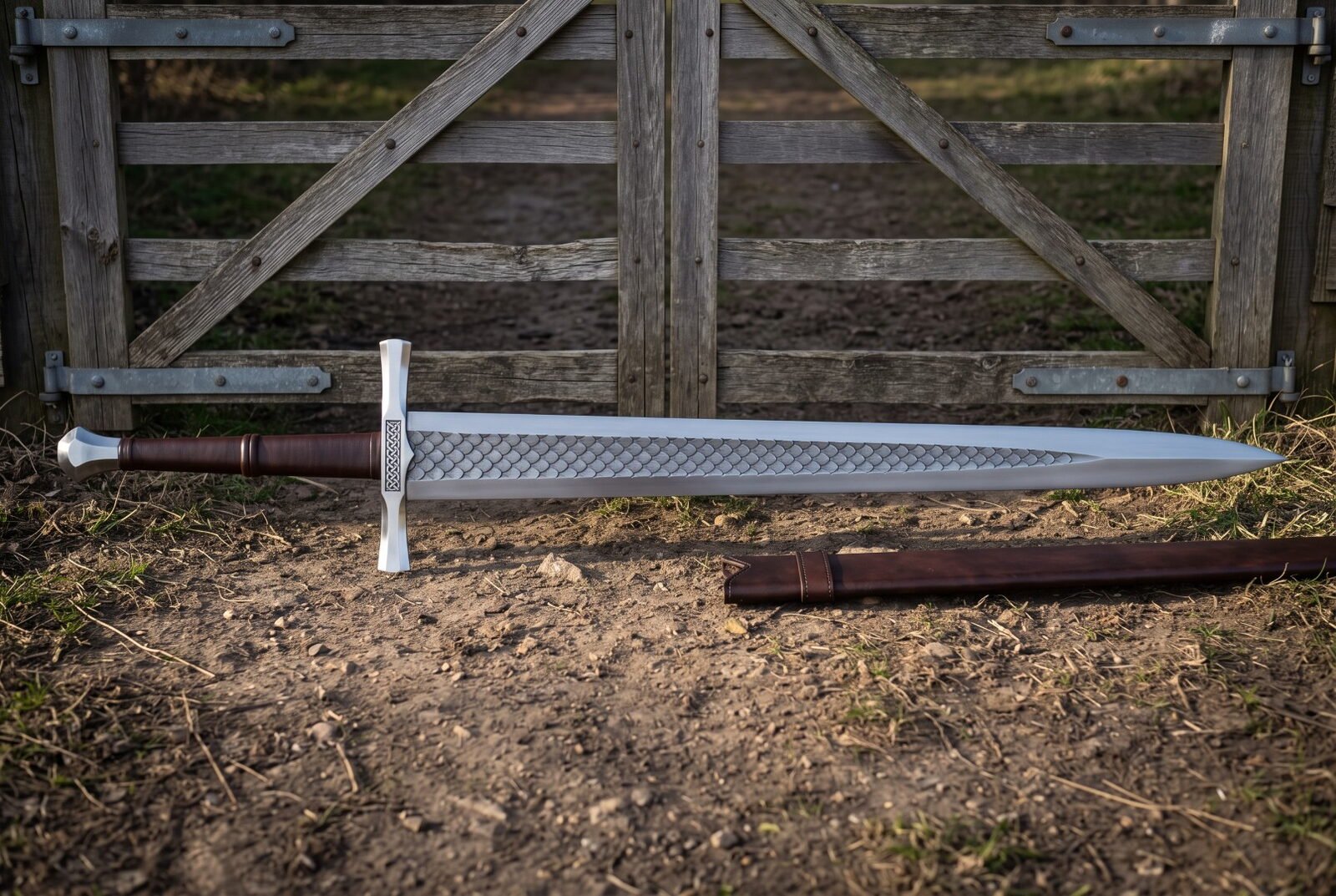
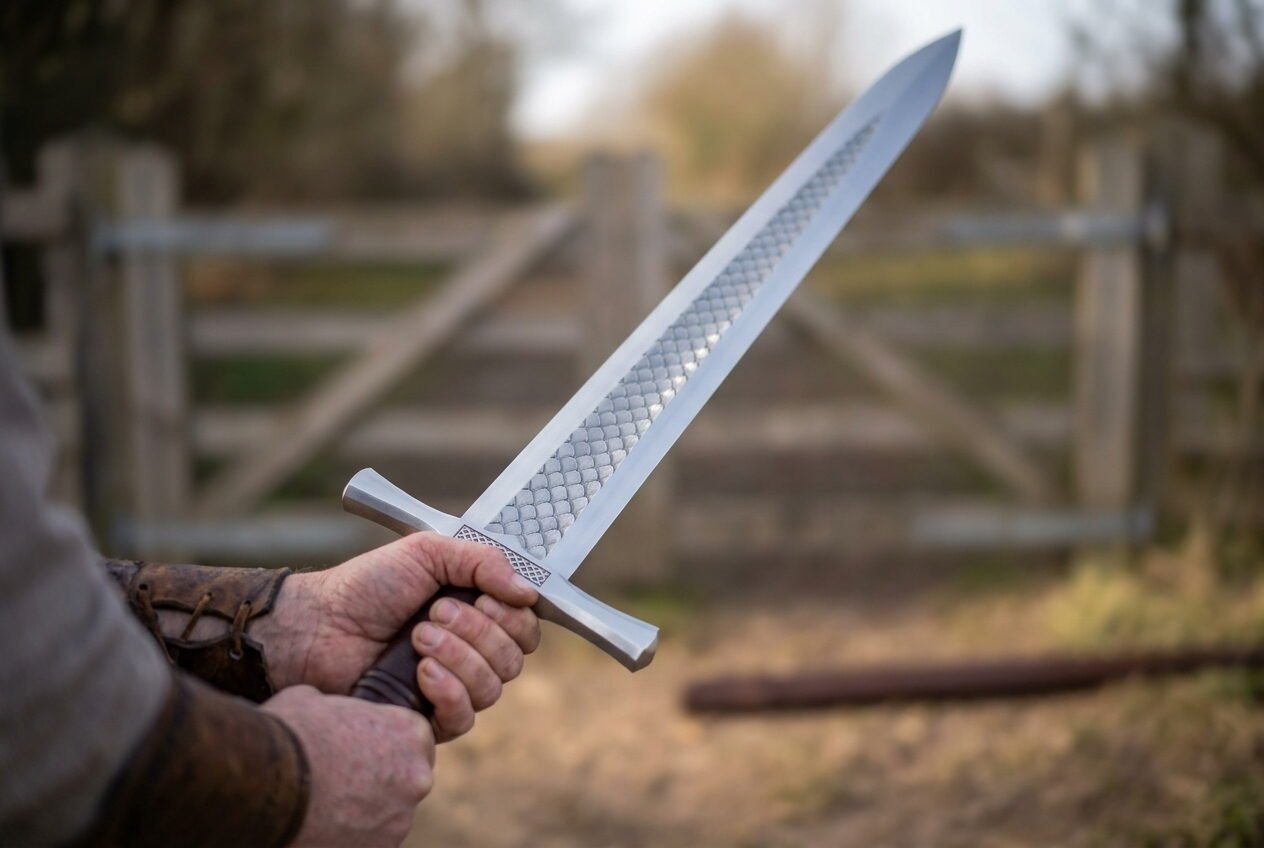
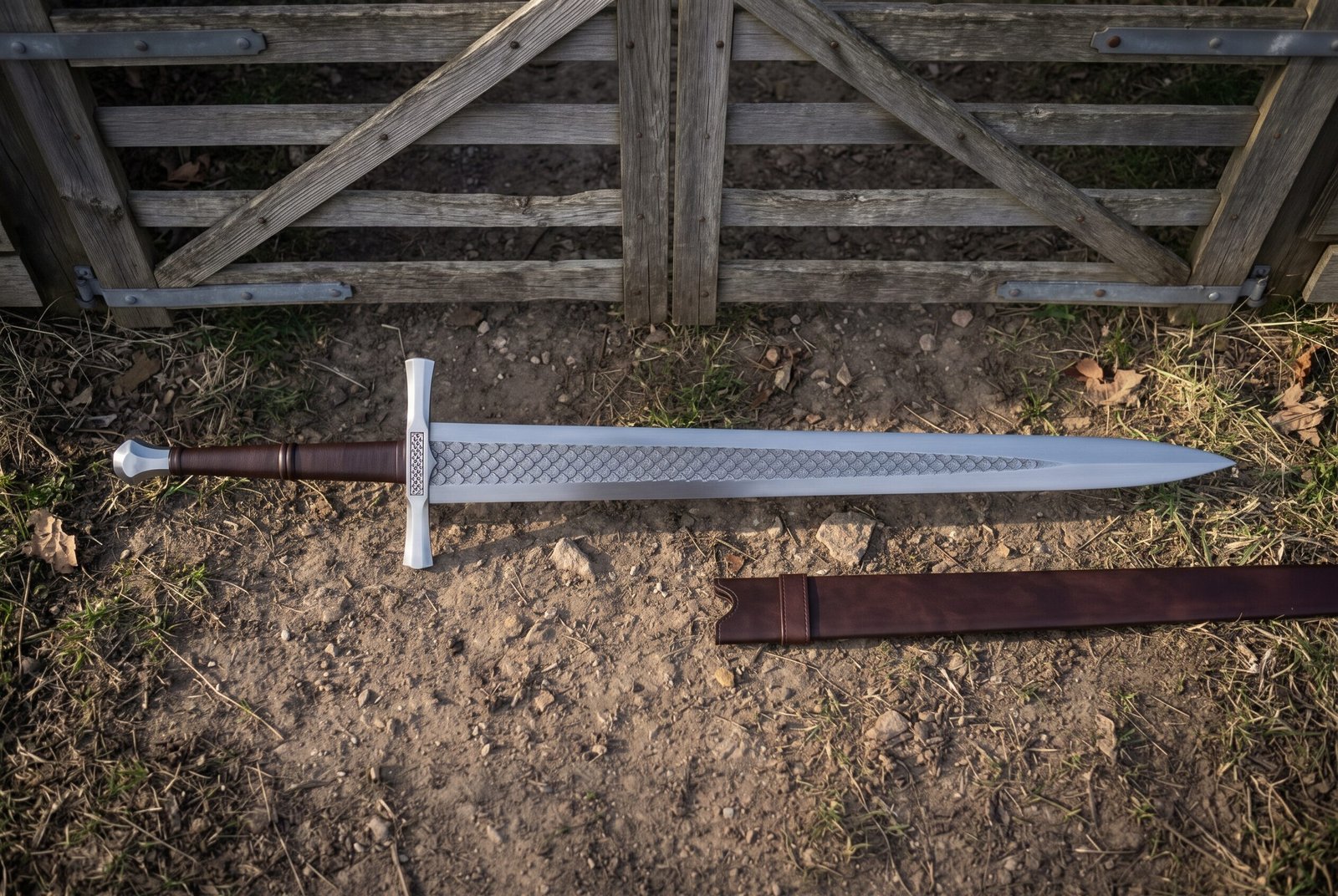
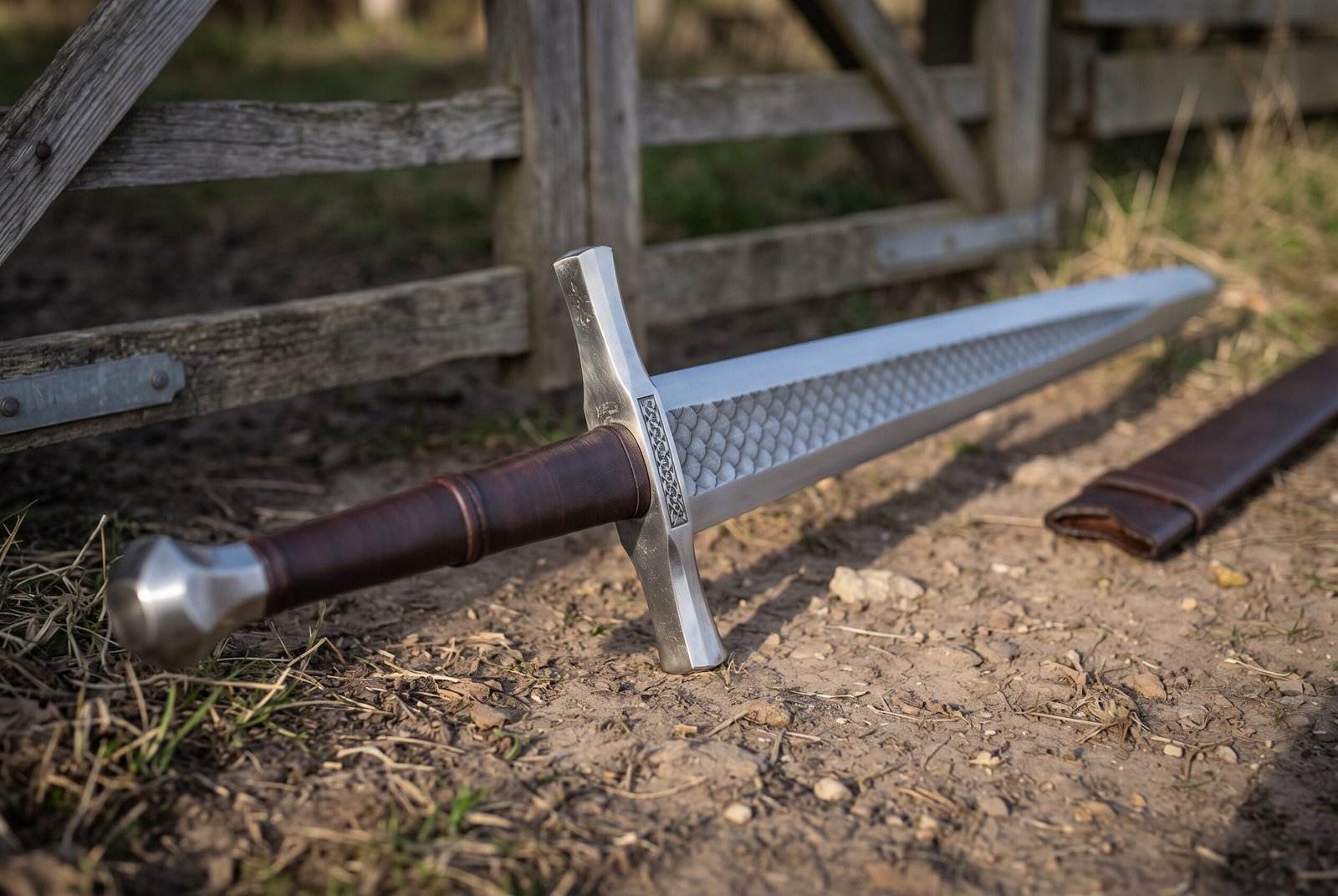
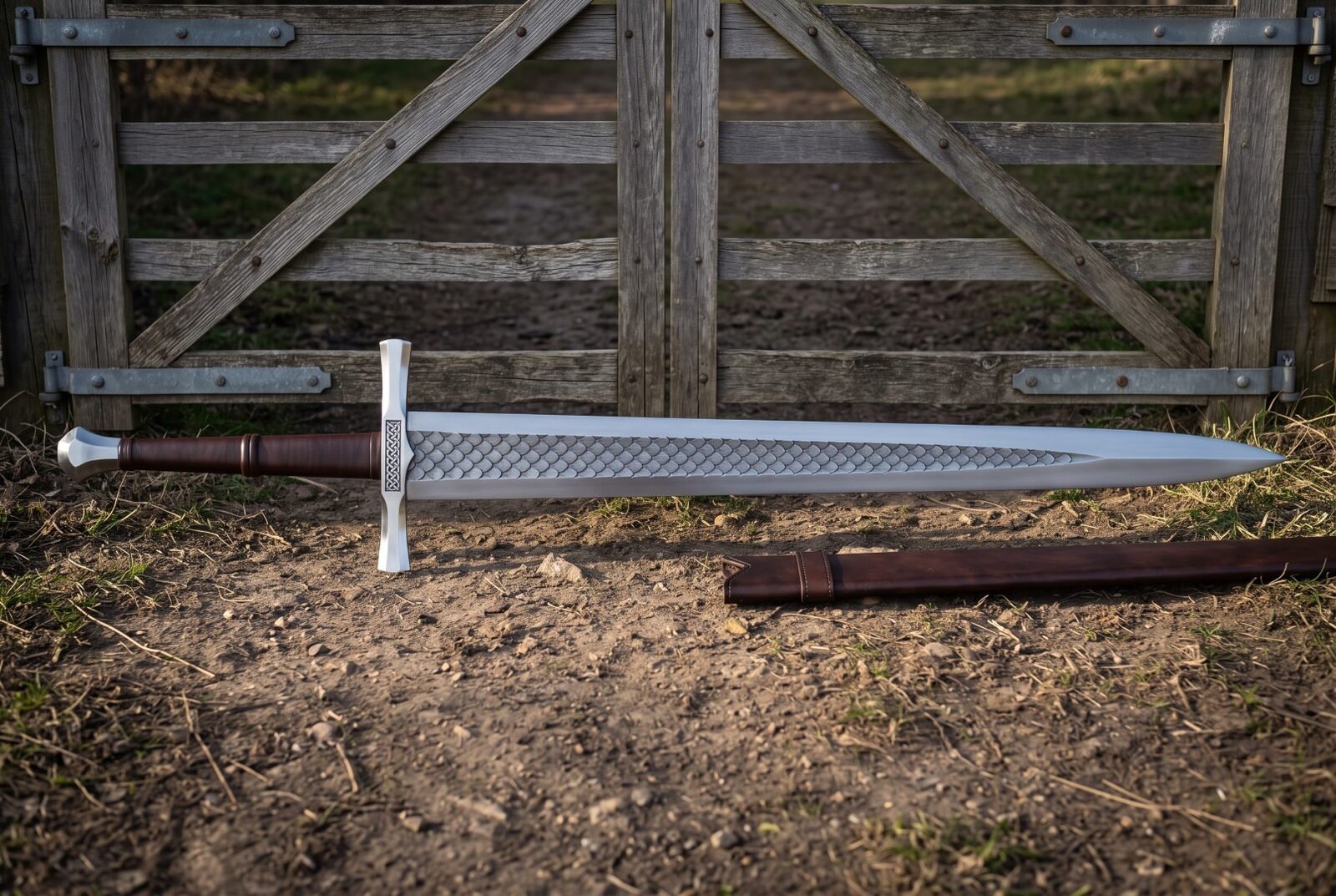
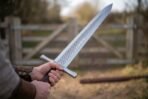
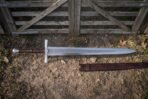
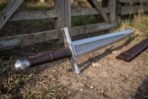
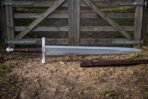
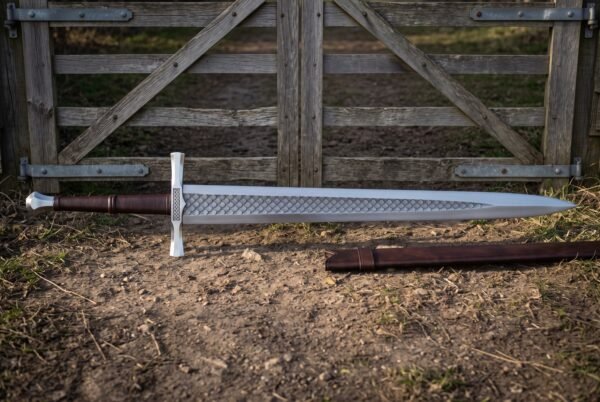
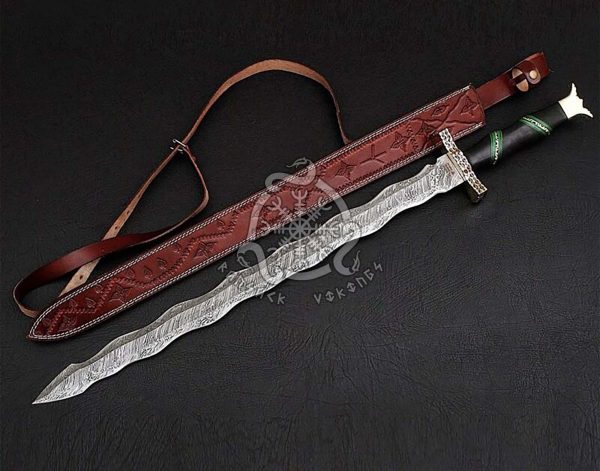
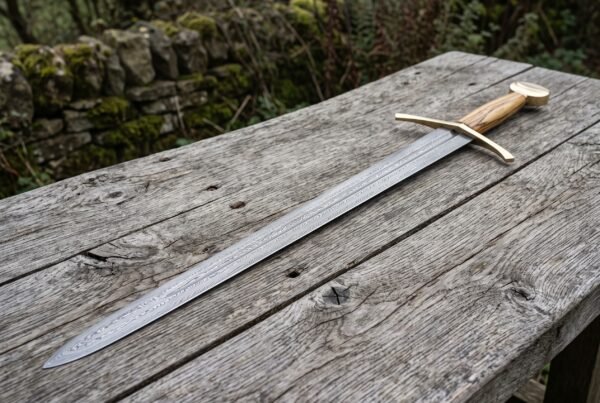
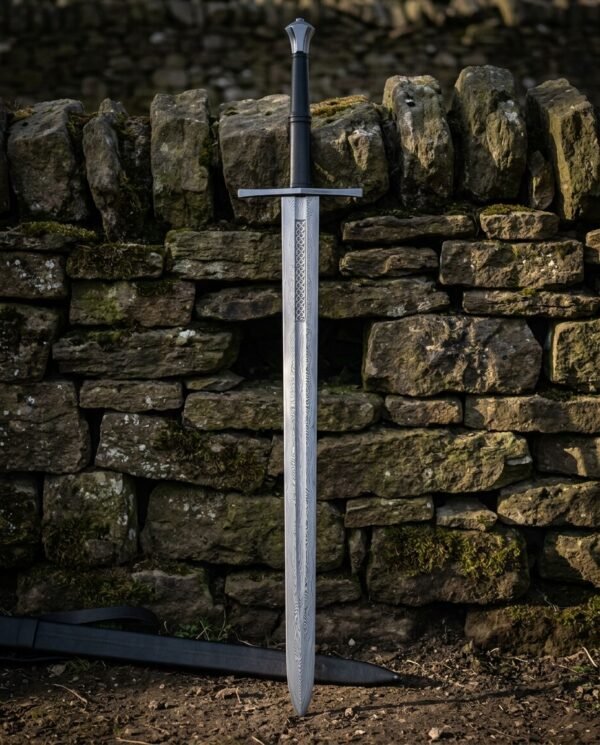
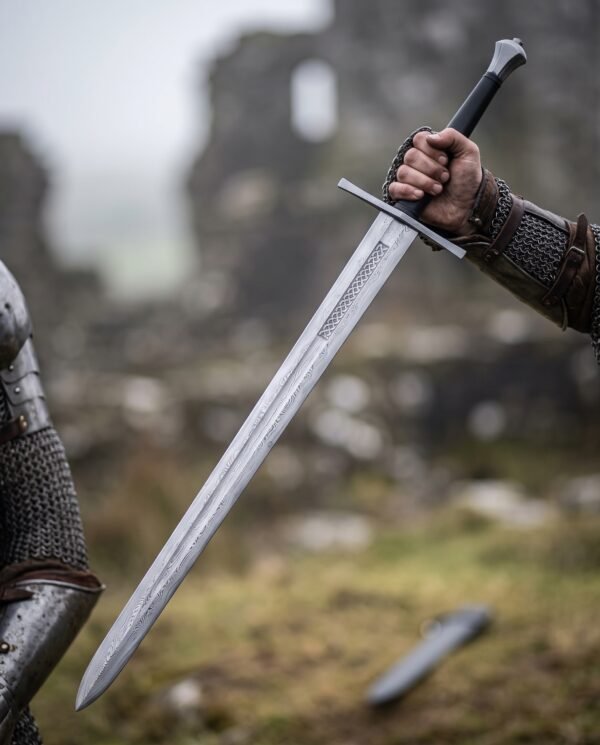
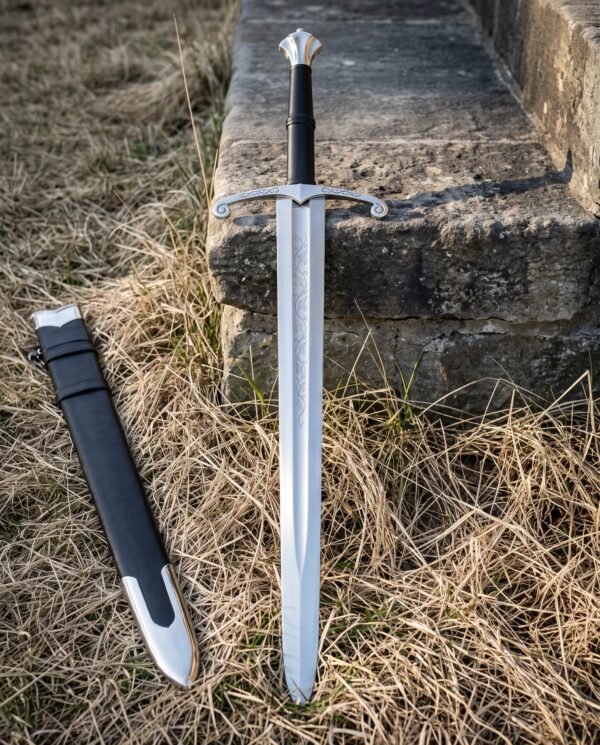
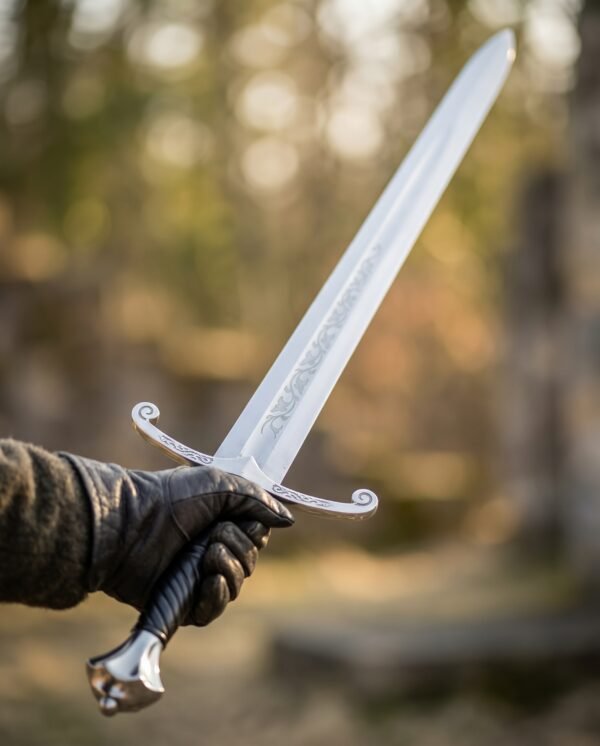
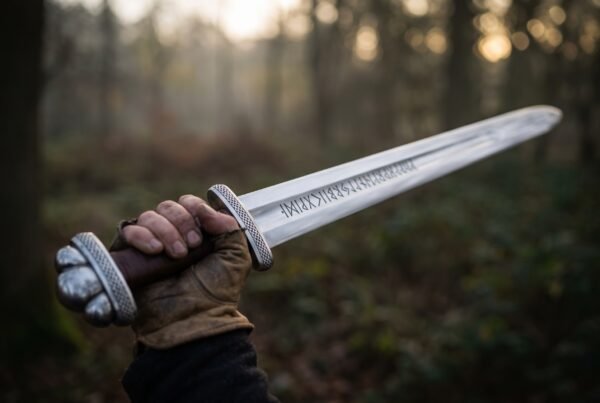
The Weavecrest is a war sword. The blade is broad, double edged and long, with a shallow fuller running down from the guard and a diamond lattice etched into it along most of its length. The crossguard is a straight steel bar with flared terminals, the grip is wrapped in brown leather and sized for a hand and a half, and the pommel is a faceted steel wedge peened over the tang. A brown leather scabbard is made to the blade.
War sword is not a marketing phrase. It is a translation of a real medieval category. Fourteenth century French inventories list an espee de guerre, English wills mention a grete swerde, and German sources have Kriegsschwert, and all of them mean the same thing, which is a sword bigger than the one a man wore around town. Knights of the period commonly owned both. The arming sword hung at the belt and went everywhere. The war sword lived on the saddle or with the baggage and came out when there was going to be a battle. It was longer, heavier and gripped for two hands, and it was the direct ancestor of what modern collectors call a longsword. Each one is forged, ground, heat treated, etched and fitted by hand in the Czech Republic, and ships with the scabbard shown and our lifetime warranty against defects in forging, grind, heat treat and fittings.
Long blades carry more legend than the rest, and the legend and what collectors buy separates the story from what people actually own. 1095 is the plain carbon steel we work in, and the steel glossary explains what the number means and why it takes an edge. For a grip that takes one hand or two, look at the bastard swords.
Specifications
| Item type | War sword, double edged, hand and a half grip |
|---|
| Material | 1095 high carbon steel, hardened to 54 to 58 HRC |
|---|
| Overall length | About 38 inches |
|---|
| Blade length | About 30 inches |
|---|
| Blade type | Broad double edged blade with a shallow fuller |
|---|
| Etching | Diamond lattice etched along most of the fuller, starting below the guard |
|---|
| Handle | Brown leather wrap over a shaped core with a raised ring, hand and a half grip |
|---|
| Guard | Straight steel crossguard with flared terminals and a small knotwork panel at the centre |
|---|
| Pommel | Faceted steel pommel peened over the tang |
|---|
| Finish | Satin polished steel throughout |
|---|
| Scabbard | Brown leather, fitted to the blade |
|---|
| Included | Sword and scabbard |
|---|
| SKU | RK-1966 |
|---|
What made a sword a war sword
The distinction was practical rather than legal. A sword worn all day has to be light enough to forget about and short enough not to trip you on stairs. A sword you only carry when you know a fight is coming has no such limits, so it can be longer in the blade, heavier in the section and gripped for two hands. That is the entire difference and it explains the shape of almost every large medieval sword.
Two things follow. The first is that a war sword is not simply a scaled up arming sword. Add length without adding grip and the balance runs away from you. That is why the grip on this one is long, and why the pommel is a substantial block of steel rather than a token cap. The second is that the flared terminals on the crossguard are not decoration. Widening the ends of the quillons makes it harder for an opposing blade to slide off the end of the guard and reach your hand, and it does that without adding length that would catch on a saddle or a doorway.
The transition from war sword to what we now call the longsword happened gradually across the fourteenth century as more men trained with the larger sword and started carrying it as a matter of course. By the time the fencing manuals were being written it was simply the sword.
Steel, the lattice and the leather
The blade is 1095 high carbon steel at 54 to 58 HRC, ground with a shallow fuller running from the guard down toward the last third. On a broad blade a shallow fuller is the right answer. A deep one would take out more steel than a blade this wide can afford, and a lens section with no fuller at all would carry weight in the middle where it does no work.
The lattice in the fuller is a shallow decorative etch rather than a deep cut field. It is bitten only far enough into the surface to hold a matte tone against the satin around it, which is how blade decoration was usually done historically. Deep etching looks dramatic but it creates texture that traps moisture, and on a panel that sits right where a hand rests when the sword is carried that is a poor trade. Shallow keeps the pattern crisp and keeps the blade easy to look after.
The grip is vegetable tanned leather over a shaped core and the scabbard is the same hide, wet moulded around the blade and dried to shape so it grips the sword by friction. Brown vegetable tanned hide darkens with handling and with the oils in your skin, so the grip on a sword that gets used ends up noticeably deeper in colour than the scabbard. That is normal and it is what old sword grips look like.
Engraving, runes and your own design
Use the rune converter on this page to turn a name, a date or a short phrase into Elder Futhark and we will cut it into the steel or the leather. If you would rather have a Viking pattern than a rune line, choose your own design in the engraving option above the add to cart button and tell us where it goes. Where a piece already carries an engraved design, your chosen engraving replaces it rather than sitting alongside it. On the Weavecrest that means the lattice panel in the fuller, which is the natural home for a rune line since the fuller already frames it. The scabbard leather takes a stamped line well if you want to keep the lattice. See the engraving page.
Handling and balance
This is a two hand sword that a strong person can drive one handed at need. Put the front hand under the guard and the back hand at the pommel and the sword pivots between them, which is where all the control comes from. The balance point sits around four inches ahead of the guard, far enough out to carry weight into a cut and close enough that the point comes back on line without a fight.
A broad blade of this length is a cutter first. It will thrust, but a narrow diamond section sword will thrust better and a sword this wide will cut better than that one does. Every blade is a compromise and this one leans toward the cut.
It is a sharp forged sword. It is not for sparring and it is not legal for contact reenactment. Do not use it against another person or against another blade. Soft target cutting practice is what it is for.
Care
Wipe the blade after every handling and keep a light film of mineral, camellia or gun oil on it. A large satin polished carbon steel blade shows rust freckling within days if fingerprints are left on it, and the lattice panel is the spot people miss because it looks matte and the eye slides over it. Work a little oil into the etched panel with a cloth. Full guidance is in our steel care notes.
Feed the grip and the scabbard once or twice a year with a leather balm. Do not store the sword sheathed for long stretches, since a fitted scabbard holds the blade close and holds any damp with it. If the scabbard gets wet, dry it slowly at room temperature and never by a heater or a fire, because heat shrinks and cracks vegetable tanned hide and it does not come back.
If it is going on a wall, hanging swords and axes safely covers mounts, fixings and what not to do.
Made in the Czech Republic
This piece is made by hand in the Czech Republic, in a workshop that still works the old way. The steel is forged, ground, heat treated and finished by smiths who learned the trade from the people before them, and the wood, horn and leather are cut and fitted by hand rather than pressed out on a line. That is also why no two pieces come out exactly the same.
Ransack Viking is a United States company. We import these pieces ourselves, check every one when it lands and ship from our warehouse in Chicago, Illinois. Engraving is done here in the United States after the piece arrives, so your runes or your own design go on before it leaves for you.
A note on handmade variation
This sword is hand made and not machine made or bulk produced, so what arrives will not be a pixel for pixel copy of the photograph. The etch is a chemical process, so the lattice will read a shade lighter or darker on yours and its exact length in the fuller will vary. Leather is a natural material and brown vegetable tanned hide takes colour differently between hides, so the grip and the scabbard will differ in tone from the photograph and slightly from each other. The width of the fuller, the flare of the quillon terminals and the facets on the pommel all vary. The length, the steel, the heat treat and the build stay constant. The character does not.
Frequently asked questions
What is the difference between a war sword and a longsword
Historically almost none by the end of the period. War sword is the older medieval term for the larger two hand sword a knight kept for the battlefield, and longsword is the name collectors and fencers use for the same class of sword today.
Is the lattice pattern engraved or etched
Acid etched into the surface of the fuller, deliberately shallow. It is part of the steel rather than a coating, and it will not wear off.
Can I use it one handed
Yes at need, and it is designed to allow it. Two hands is the intended grip and it is far easier to control that way.
Does it come sharp
Yes, on both edges, with a working edge. It is not a blunt trainer and it cannot be used for contact fencing.
Will the brown leather darken over time
Yes, particularly the grip, which takes oils from your hands. Most owners consider that an improvement. The scabbard darkens more slowly since it is handled less.
How long before it ships
One to two weeks of processing plus transit, free inside the United States. Engraved orders take slightly longer.
What is in the box
- Weavecrest war sword in 1095 high carbon steel with a lattice etched fuller
- Brown leather scabbard wet moulded to the blade
- Protective oil film on the blade for transit
- Care card and lifetime warranty against defects in forging, grind, heat treat and fittings
- Forged and finished in the Czech Republic
Explore the range
More in longswords, arming swords and swords, or read the guides on medieval sword types, fullers and scabbards.
Close to this one
In the same category sits the Indigohilt longsword, 40 inches overall. A near match for this one is the Valkhewn longsword, 43 inches overall. Closest to this in the range is the Runemark longsword, forged from 1095.
Fitting out further, the Rosehilt arming sword belongs with it. Nothing here exactly right, build one to your own spec on the custom Viking sword page.
If sparring is on your mind, the Drakvend longsword trainer is made for that job, and our tournament gear guide is a useful next stop.

Not what I paid for. Arrived with visible damage and a dull edge that needed real work. Doubt I’ll be ordering from here again.
Knew this sword was special the second I opened the box. Leather sheath is thick and well stitched. Not the cheap stuff you usually get. Fit and finish is museum quality. You can tell real craftsmen made this by hand. Will definitely order again for another gift. I keep coming back to Ransack Viking because it’s always this good.
Perfect gift. Perfect quality. No complaints. The wood handle feels amazing and the balance is perfect. Ransack Viking’s attention to detail is honestly unmatched. 1095 Steel blade holds a razor edge right out of the box. So worth it.
Knew this sword was special the second I opened the box. Weight and balance make it feel like a real functional piece not some cheap replica. Nice touch that it ships from within the US even though it’s crafted in the Czech Republic. Love it.
Showed up right on time and looked even better than the photos. 1095 Steel blade holds a razor edge right out of the box. 10/10 would buy again.