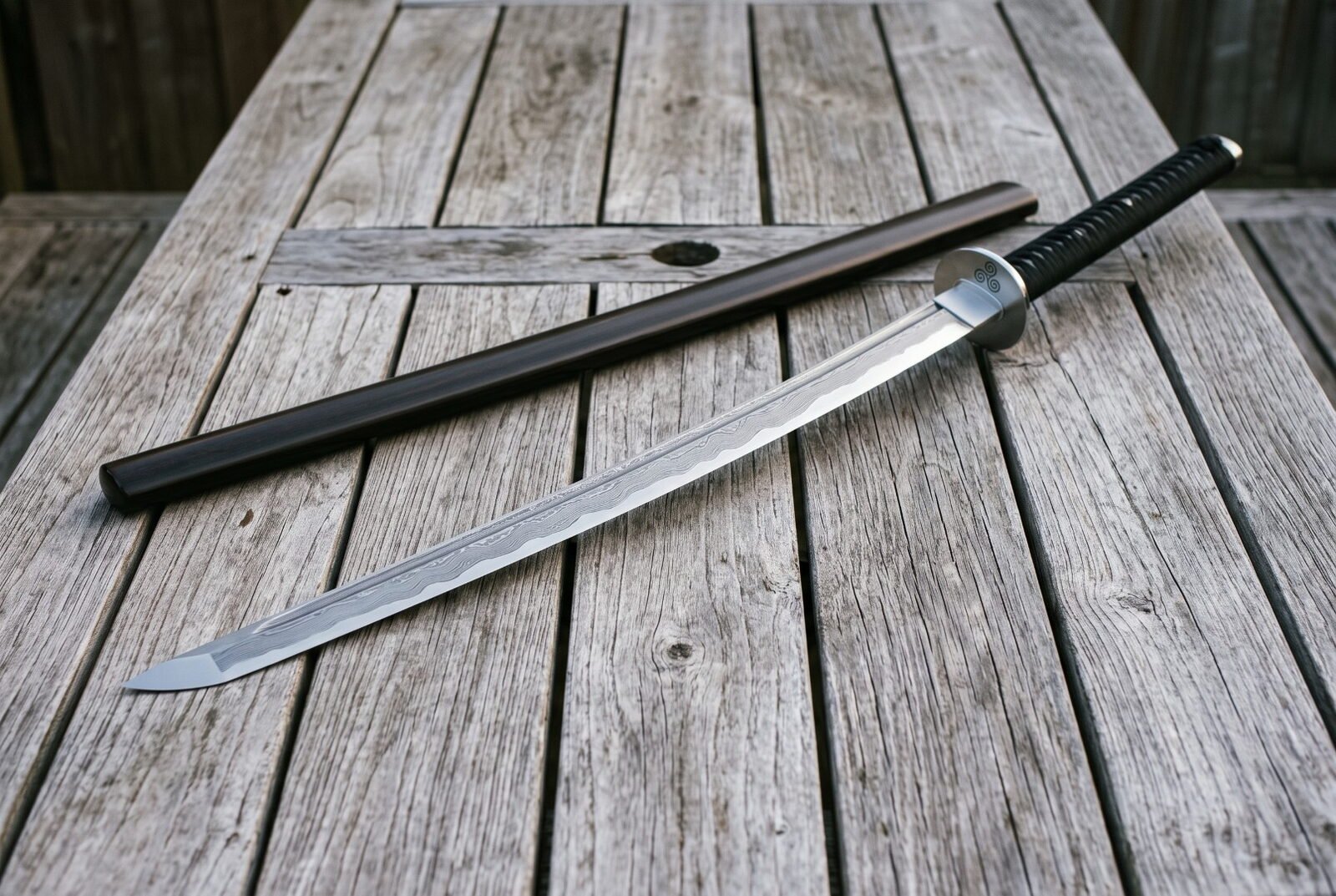
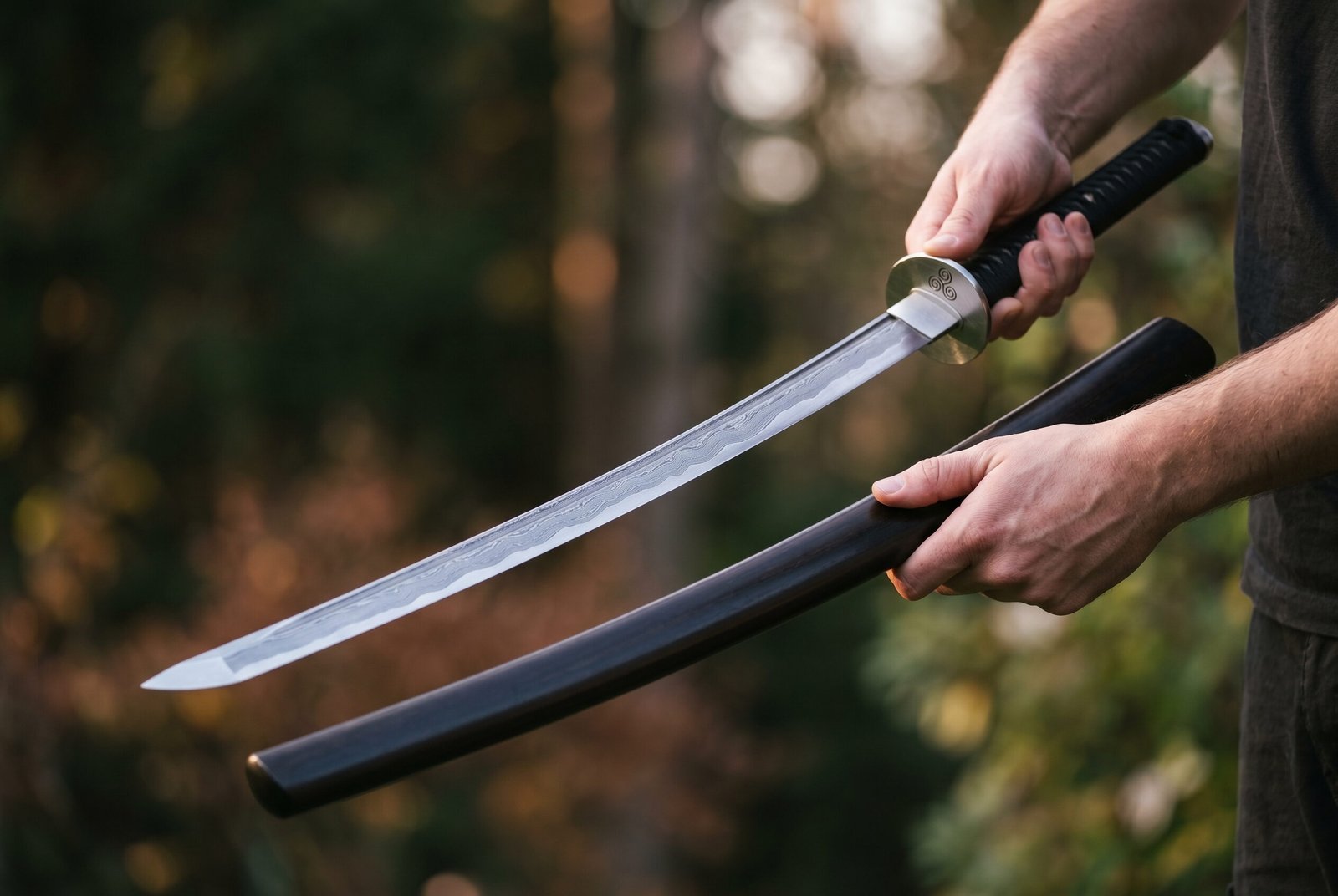
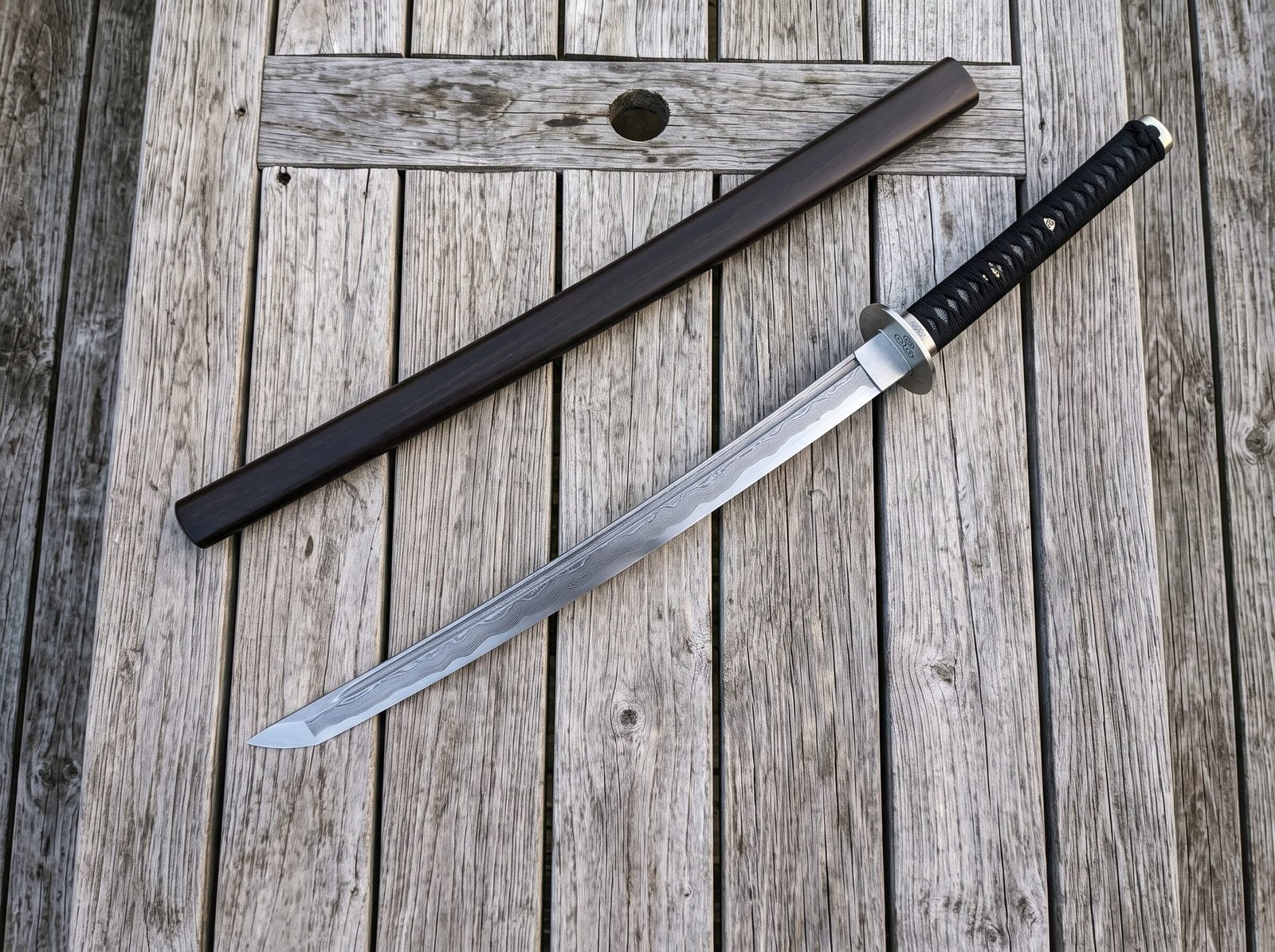
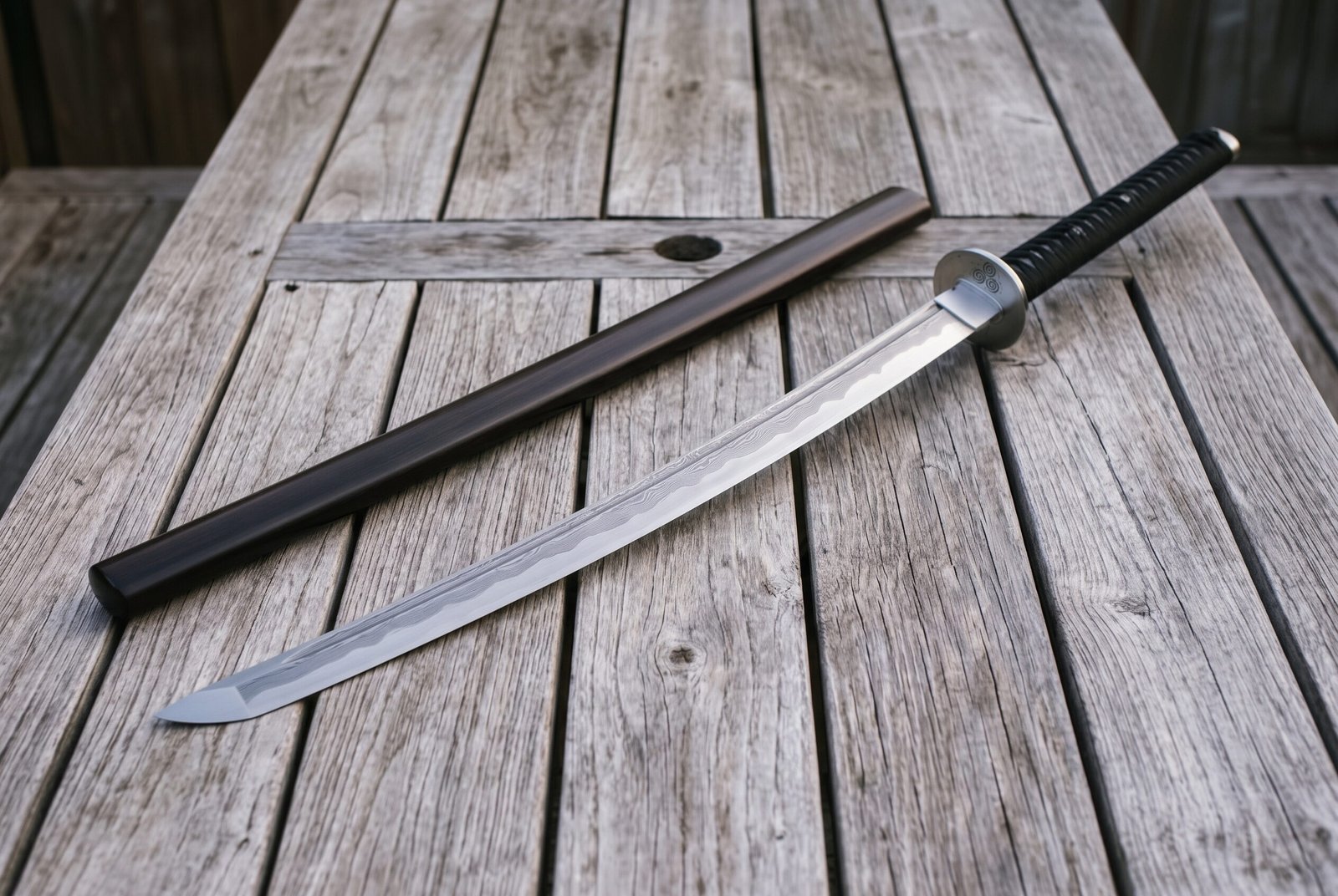
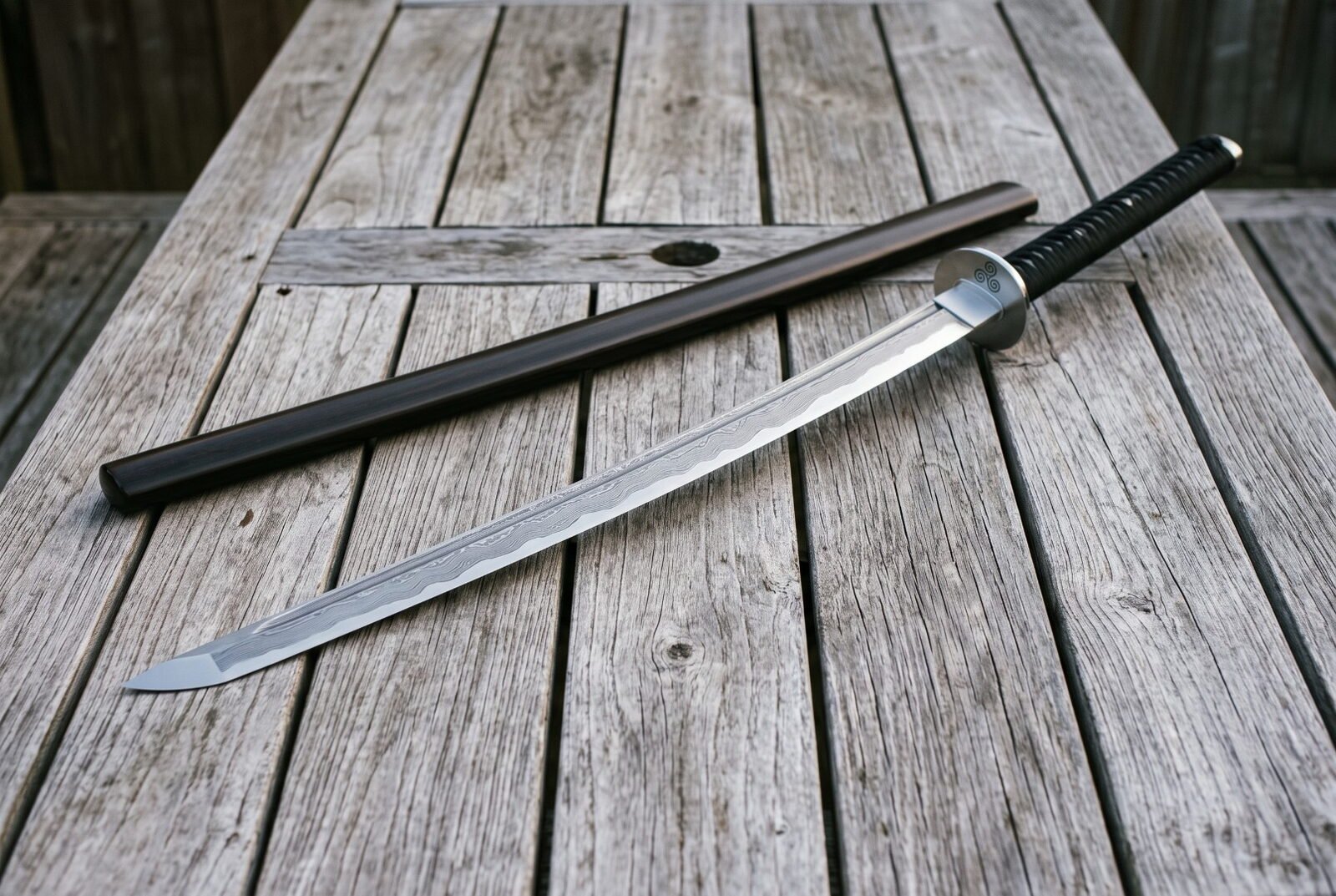
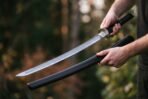
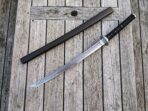
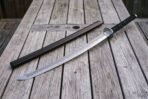
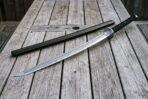
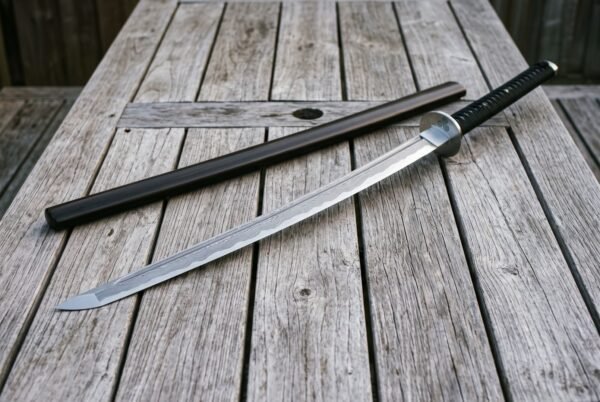
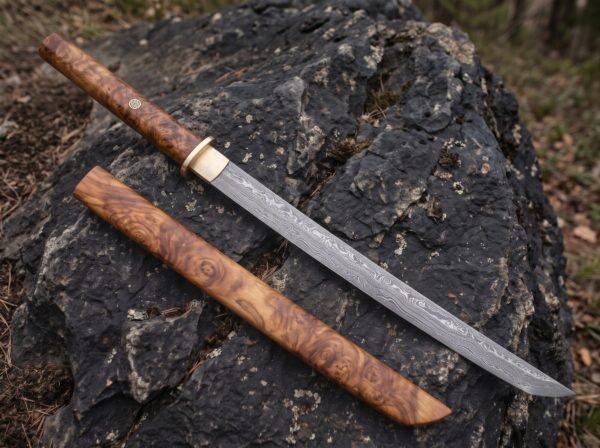
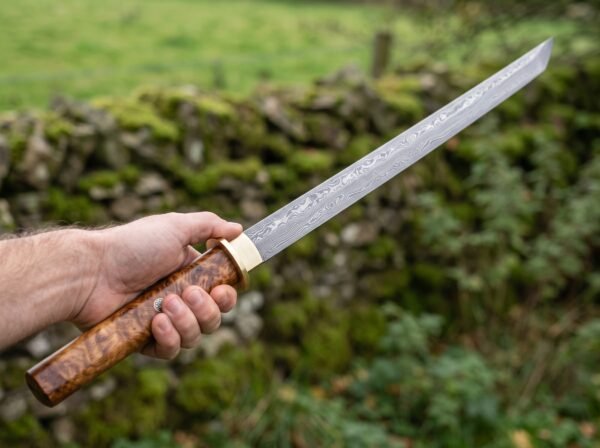
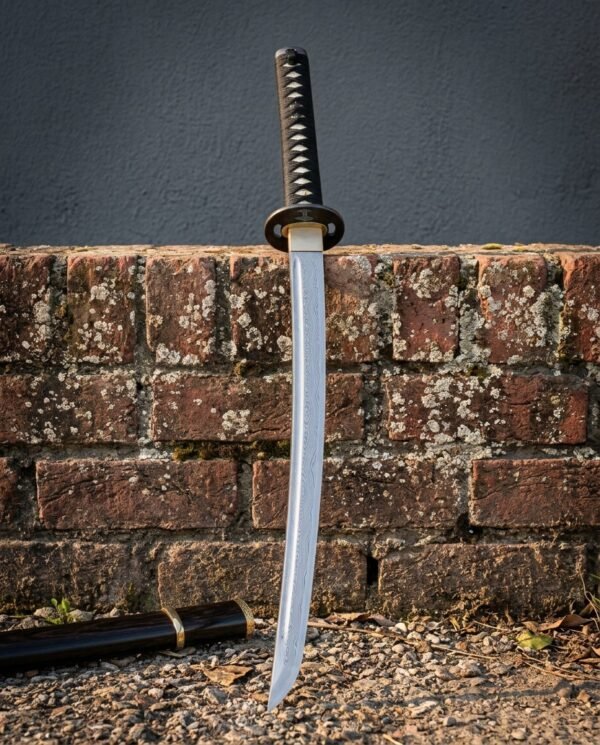
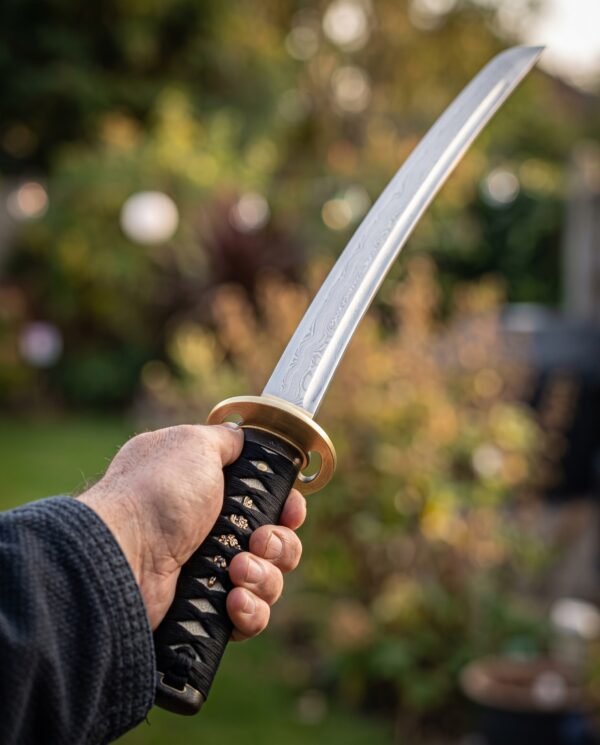
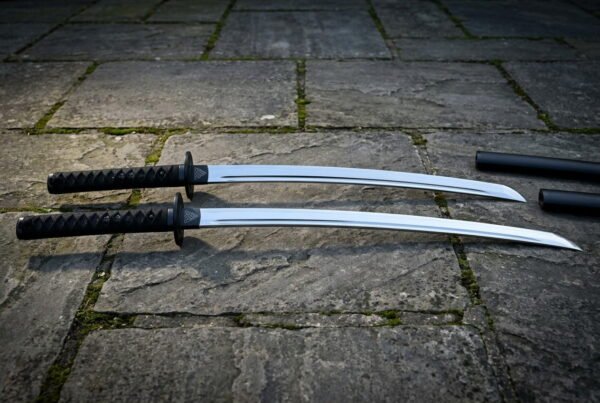
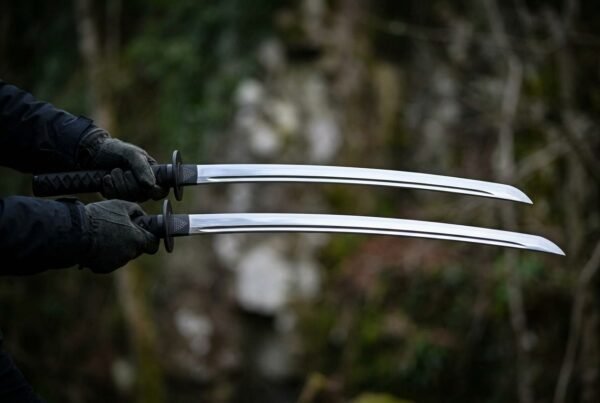
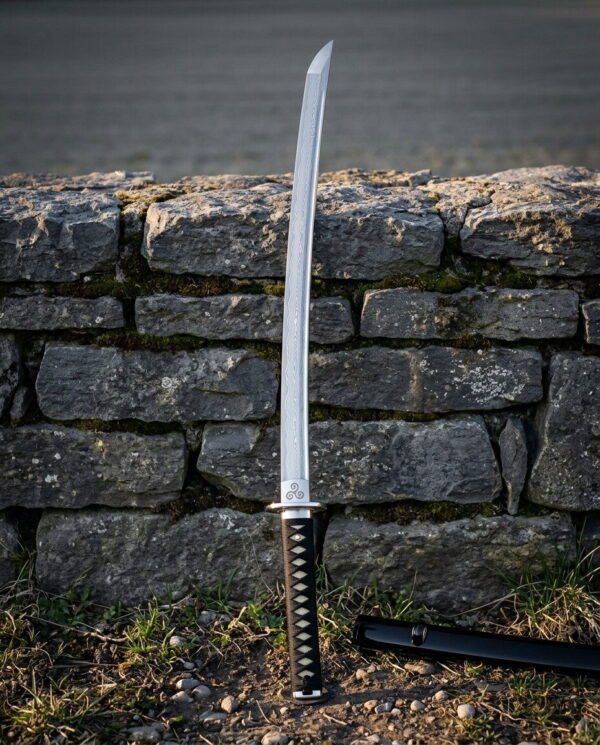
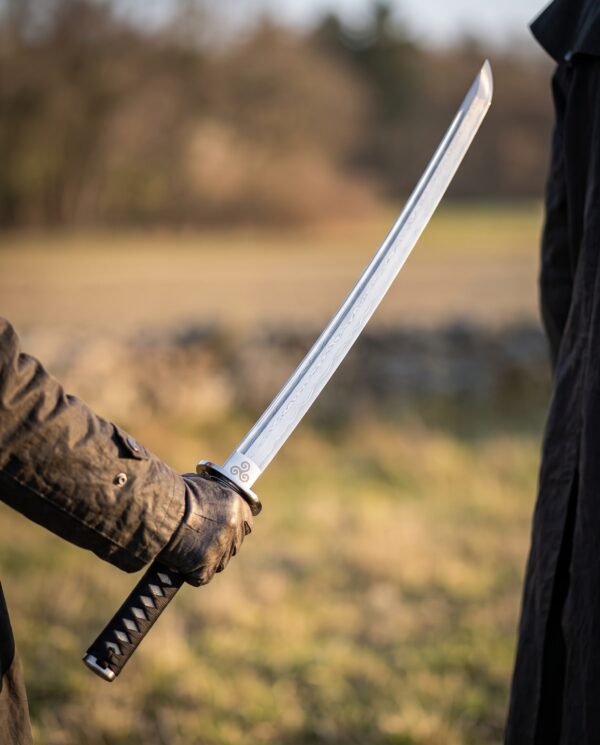
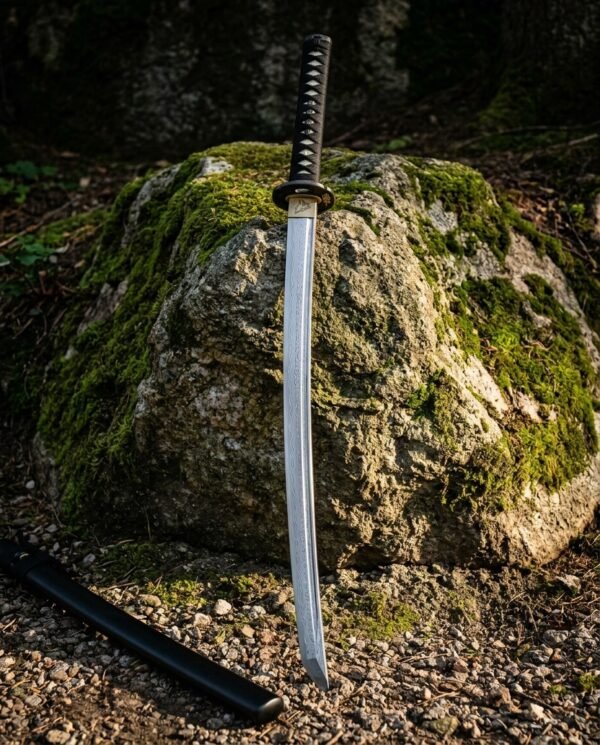
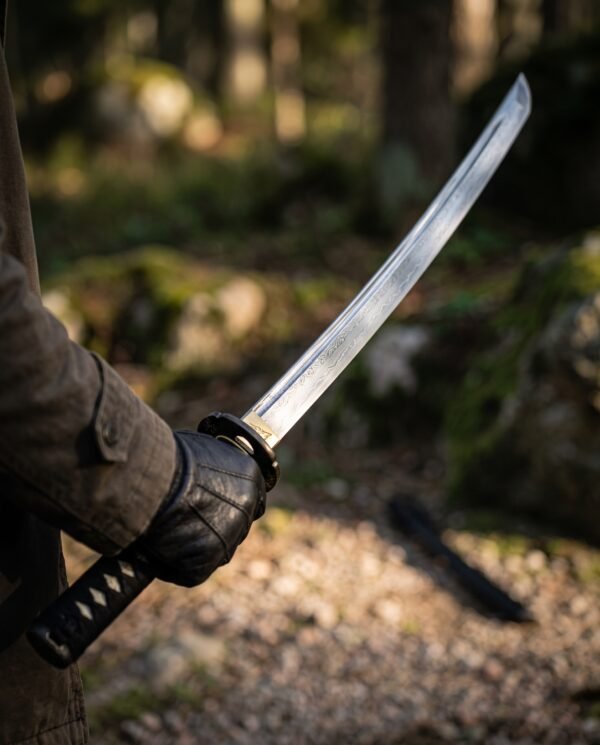
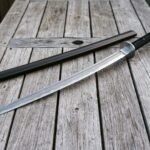
The Mistfold is a hand forged katana with a folded Damascus blade, a black cord wrapped tsuka and a plain hardwood saya finished in a deep near black stain. The blade runs a long shallow curve to a clipped point, and the pattern in the steel follows the line of the hardened edge so that the layering reads as a soft undulating band running the length of the flat above the edge. The tsuba is a round polished steel disc cut with a triple spiral, a motif that turns up on both Japanese and northern European work and sits comfortably on either.
The curve of a Japanese blade is not filed or ground in. It appears during the quench. The smith paints a thick clay slurry along the spine and a thin one along the edge, heats the blade to critical temperature and drops it into water. The thin clay lets the edge cool fast and turn to hard martensite. The thick clay holds heat in the spine so it cools slowly and stays tougher. Martensite takes up more room than the steel it came from, so the edge tries to grow while the spine does not, and the blade bends itself backwards into the shape you can see here. Every curved Japanese blade ever made got its profile from that argument between two cooling rates. Mistfold is forged, ground, heat treated, polished and fitted by hand in the Czech Republic, and it ships with the matching wooden saya, a cleaning cloth and a bottle of blade oil.
If you are deciding where to start, the three Japanese lengths compares the lengths. Damascus here means 1095 and 15N20 forge welded and etched, and what Damascus steel actually is covers how the layers get there. The tanto knives carry the same furniture at knife length.
Specifications
| Material | 1095 and 15N20 pattern welded Damascus, hardened to 58 to 60 HRC |
|---|
| Overall length | Approximately 40 inches sheathed |
|---|
| Blade length | Approximately 27 inches, single edged with a shallow curve |
|---|
| Point | Angular clipped point |
|---|
| Finish | Hand polished and etched to raise a wavy Damascus pattern along the edge |
|---|
| Handle | Approximately 11 inch tsuka, black cord wrapped over a light textured underlay |
|---|
| Guard | Round polished steel tsuba cut with a triple spiral |
|---|
| Collar and cap | Polished steel habaki and matching steel pommel cap |
|---|
| Scabbard | Hardwood saya, dark stained satin finish, friction fit |
|---|
| Weight | Approximately 2 lb 10 oz bare, 3 lb 4 oz sheathed |
|---|
| Included | Katana, wooden saya, cleaning cloth, blade oil |
|---|
| SKU | RK-1971 |
|---|
How a katana is held in its saya
There is no clip, spring or strap holding this sword in its scabbard, and there never was on a real one. The job is done by the habaki, the small wedge shaped collar of steel that sits at the base of the blade just in front of the guard. The habaki is very slightly tapered and fractionally wider than the wooden throat of the saya. When you push the blade home the habaki wedges into that throat and locks on friction alone. Everything forward of the habaki floats clear of the wood, which is the whole point. A polished edge that rubs on a scabbard wall for a few hundred draws will come out dulled and scratched, so the saya is hollowed a touch oversize and only the habaki ever makes contact.
Two practical things follow from that. The first is that the fit will loosen very slightly over the first few weeks as the wood settles, then stay put. If yours ever feels loose enough to drop free, a strip of paper folded once and pressed into the throat will take up the slack. The second is that you should never force the blade in past resistance. Let it seat with light pressure and stop where it stops.
The steel
The blade is pattern welded from alternating layers of 1095 and 15N20. The 1095 is a plain high carbon steel that goes very dark when it is etched. The 15N20 carries about two percent nickel, which resists the etchant and stays bright. Fold, draw out and fold again and you build up hundreds of alternating layers, then the grind cuts through them at an angle and exposes the pattern you see on the flats. Nothing is printed or applied. The figure is the internal structure of the bar showing through at the surface, which is why it runs off the edge of the blade rather than stopping at it.
The finished bar is normalised, hardened and tempered to 58 to 60 HRC. That is hard enough to take and hold a keen edge on a long cutting blade and still tough enough to survive the flex a katana sees in use. The pattern is raised with a light acid etch and then hand polished back so the bright nickel layers catch the light. The etch is in the steel, not on it, and it will not wear off.
Engraving, runes and your own design
Use the rune converter on this page to turn a name, a date or a short phrase into Elder Futhark and we will cut it into the steel or the wood. If you would rather have a Viking pattern than a rune line, choose your own design in the engraving option above the add to cart button and tell us where it goes. Where a piece already carries an engraved design, your chosen engraving replaces it rather than sitting alongside it. On this katana the usual places are the flat of the blade above the guard, the face of the tsuba, or the wood of the saya near the throat. If you are not sure what will look right, tell us the words and where you want them and we will lay it out before we cut. There is more detail on the engraving page.
Handling and balance
The balance point sits roughly four inches ahead of the guard. That is a deliberately forward bias and it is what gives a katana its authority in a cut. A blade balanced right at the hand feels quick but lands with nothing behind it. Push the mass out along the blade and the sword wants to travel through the target rather than stop on it. The trade is that recovery from a committed cut takes more effort, which is exactly why traditional two handed technique uses the left hand at the butt of the handle as the lever and the right hand near the guard as the guide, rather than driving with the right arm alone.
The tsuka is long enough for a genuine two hand grip with a gap of a finger width or so between the hands. Take hold lightly, with the last three fingers doing the work and the index finger and thumb relaxed. A hard clenched grip transmits shock straight into your wrists and kills the wrist snap at the end of the cut. This sword is sharp and it is a full length cutting blade, so treat it as one. It is not for sparring and it should never be used against another sword or against hard targets.
Care
Wipe the blade down after every handling. Skin oil is mildly acidic and a fingerprint left on carbon steel overnight will etch a permanent ghost of itself into the polish. Use the cloth to take off marks, then a few drops of oil on a soft rag drawn from the guard to the point along the flat, never across the edge. Store the sword horizontal or edge up, not point down, so oil does not collect in the throat of the saya and swell the wood.
If a spot of rust does appear, take it off early with a little oil and the corner of a fine synthetic pad, working along the length of the blade so any marks follow the polish lines. Do not use steel wool and do not use household abrasive cleaner. The wooden saya wants nothing more than a dry wipe. Keep it away from radiators and out of direct sun, since dry heat will shrink the wood and tighten the fit. Full detail is on our steel care page.
Damascus wants oil more than plain steel does, because the etch that shows the pattern also opens the surface, and caring for a Damascus pattern covers what to use.
Made in the Czech Republic
Every piece we sell is made by hand in the Czech Republic. The smiths there work the way the trade has been worked for a long time, heating and hammering the steel, taking the bevels down by eye, and fitting the handle and the leather one at a time. There is no automated line anywhere in it, so small differences from one piece to the next are normal and expected.
Ransack Viking is a United States company based in Chicago, Illinois. We bring the pieces in ourselves, inspect them on arrival and ship them from our own warehouse. If you add engraving, that is carried out here in the United States before your order goes out.
A note on handmade variation
This sword is hand made, not machine made or bulk produced, so what arrives will not be a pixel for pixel copy of the photograph. The Damascus pattern is created fresh in every billet and no two billets fold the same way, so the swirl and spacing of the layers on your blade will be its own. Hammer texture, the exact depth of the etch, the tone of the polish and the grain and colour of the wooden saya all vary because each piece is worked by hand from natural materials. The dimensions, the material and the build are the same every time. The character is not.
Frequently asked questions
Is it sharp out of the box
Yes. It ships with a hand finished cutting edge and it will shave paper. If you would prefer it blunt for display or because there are children in the house, say so in the order notes and we will send it unsharpened at no extra cost.
Is the Damascus pattern real or etched on
It is real. The blade is forge welded from alternating layers of 1095 and 15N20 and the figure is the internal layering showing at the ground surface. You can see it run off the edge and around the curve, which a printed pattern cannot do.
Can I cut with it
It is a functional sharpened blade and it is built to cut soft targets such as rolled mats and water bottles. It is not a sparring sword. Do not use it against another blade, against bone, or against anything hard, and do not use it as a chopping tool.
Will the saya scratch the blade
No. The inside of the scabbard is cut oversize so only the collar at the base of the blade touches wood. Keep the inside clean and free of grit and the polish will stay as it arrived.
Can I have runes cut into it
Yes. Use the rune converter on this page for Elder Futhark, or pick your own design in the engraving option. The blade flat, the guard and the scabbard are all workable surfaces.
How long before it ships
One to two weeks of processing. Shipping within the US is free and you will get a tracking number when it leaves Chicago.
What is in the box
- Mistfold Damascus katana, sharpened unless you ask otherwise
- Matching dark stained hardwood saya
- Lint free cleaning cloth
- Bottle of blade oil
- Care card and lifetime warranty note
- Forged and finished in the Czech Republic
Explore the range
See more in katana and Japanese swords, Damascus swords, wakizashi and swords, or read the guides for how we fold, quench and finish a blade.
Others in the same line
Next along the rack is the Spiralcrest Japanese sword, 40 inches overall. For a straight comparison, see the Stormfold Japanese sword, pattern welded Damascus. Worth putting side by side with this is the Ravenwake Japanese sword, pattern welded Damascus.
If you are putting a set together, the Gildcage Damascus sword sits alongside it. You can have this made your way instead on the design your own page.

This sword beat every expectation I had. The wood handle feels amazing and the balance is perfect. Shipping was fast and everything arrived well packaged.
So happy I finally pulled the trigger on this one. Weight and balance make it feel like a real functional piece not some cheap replica. Already planning my next purchase from this shop.
Got this as a birthday gift and the reaction was priceless. Even the small engravings are crisp and clean. This shop clearly takes pride in their work. You can tell it’s real Czech blacksmith work and shipping from the States made delivery painless.