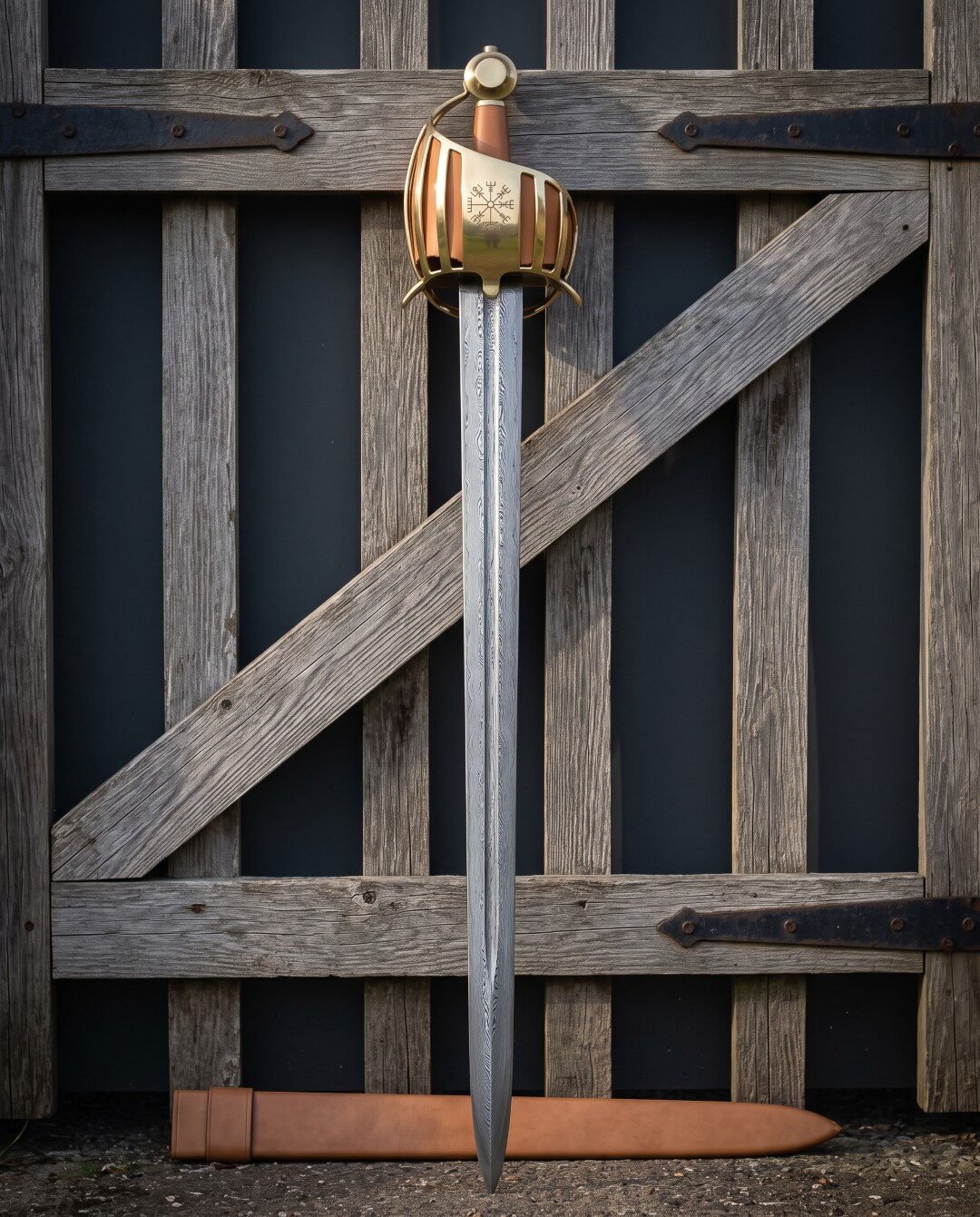
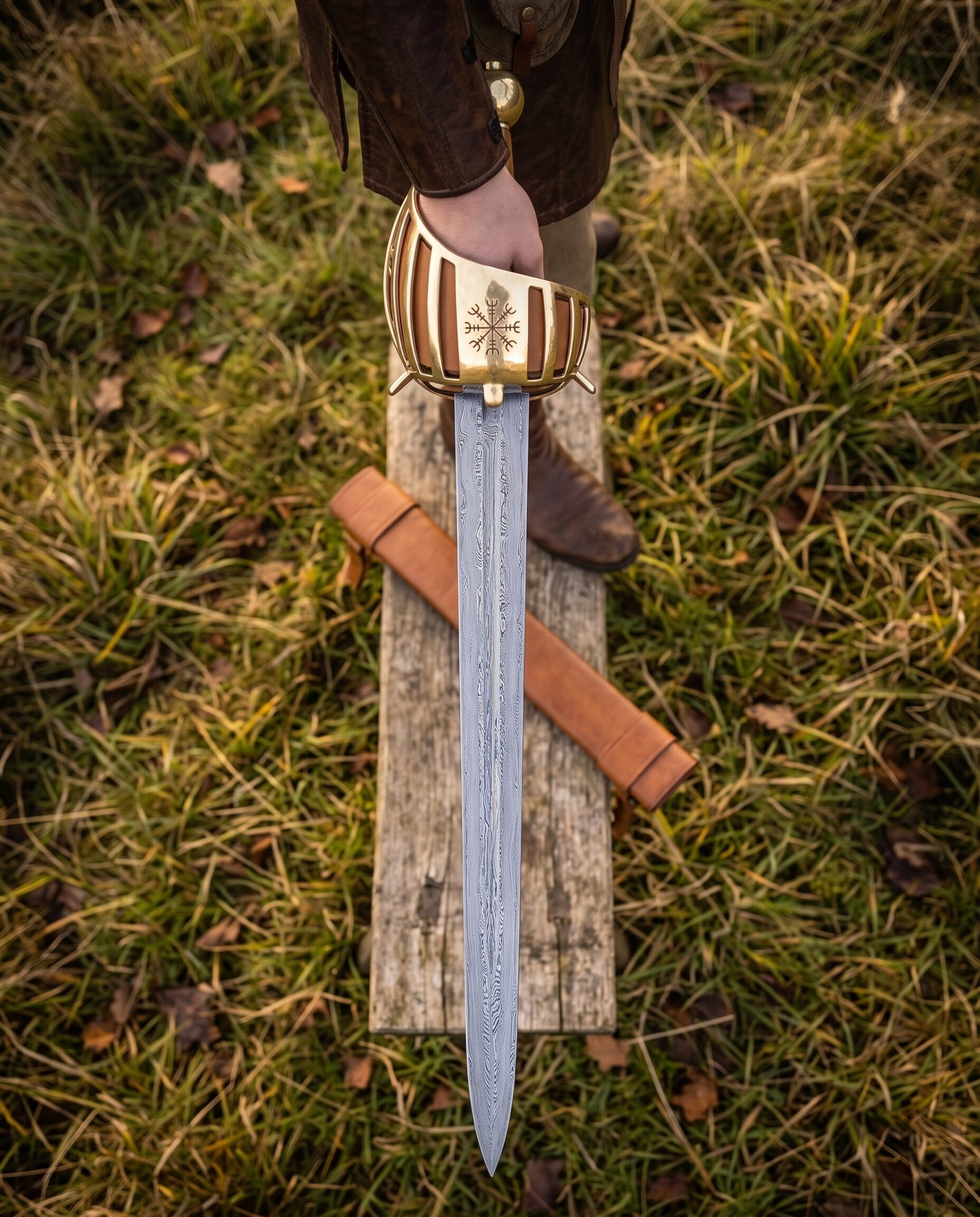
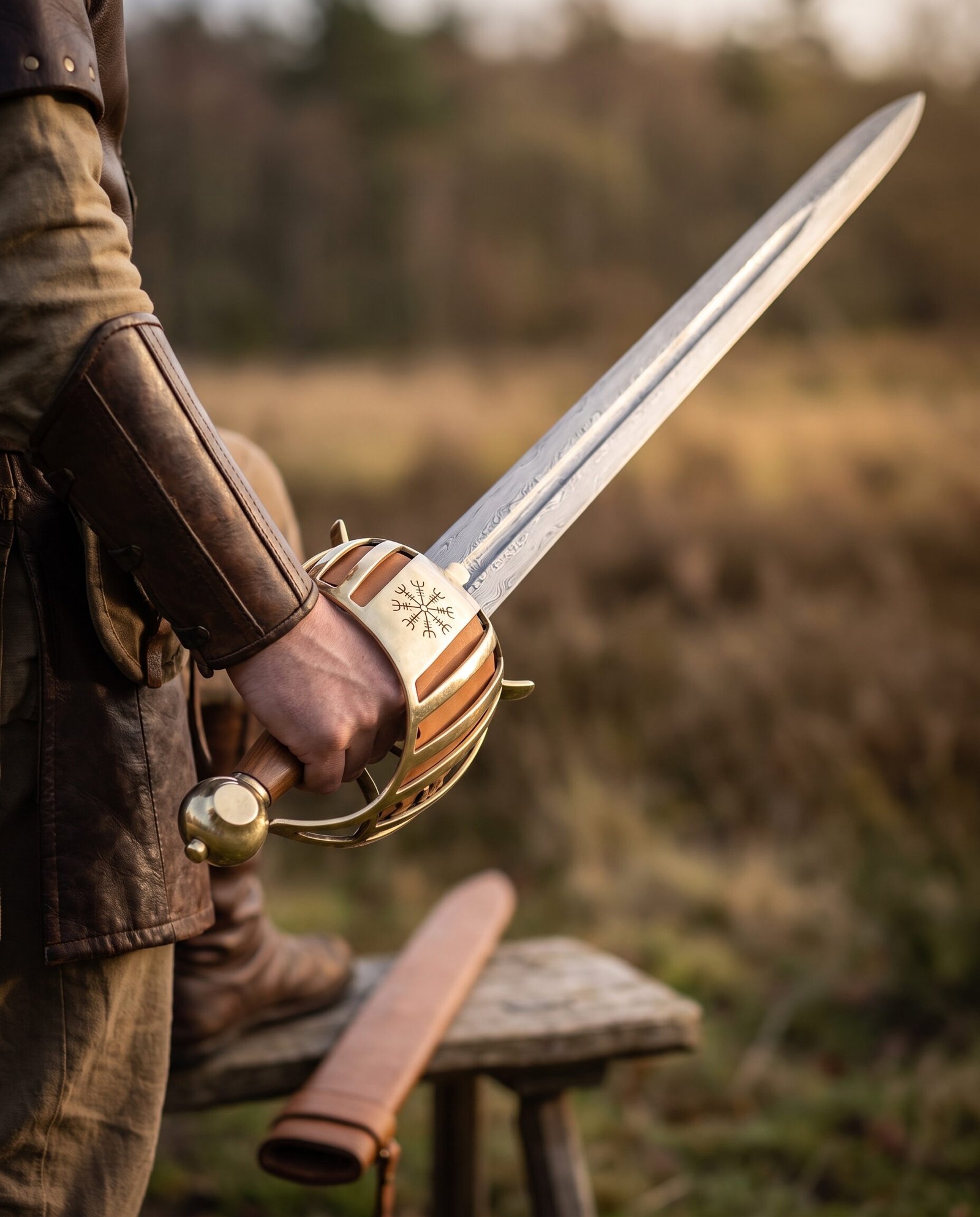
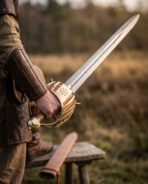
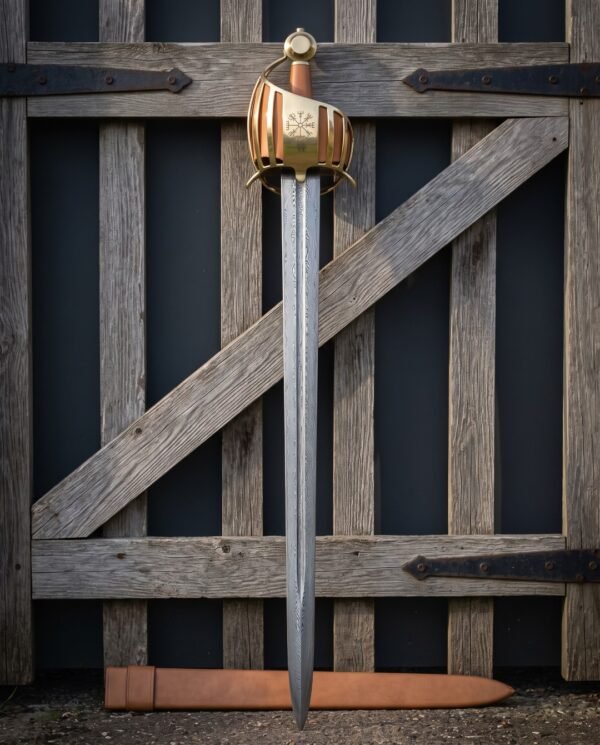
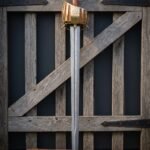
A short sword with a solid brass cage hilt, built as a half basket of curved brass bars springing from a wide plate and closing on a round brass pommel. Cut into that plate is a Vegvisir, the eight spoked runic stave, each arm ending in a different terminal. The blade is 1095 and 15N20 Damascus, broad at the shoulder and tapering to a sharp point, and the grip beneath the cage is tan leather.
The Vegvisir is worth being accurate about. It is not a Viking Age symbol. It appears in Icelandic grimoires, most famously the Huld manuscript compiled in 1860, several centuries after the Norse period ended, and its name means roughly signpost or wayfinder. The manuscript note that travels with it says that a person carrying this sign will not lose their way in storms or bad weather even when the way is unknown. That is a genuinely lovely thing to put on a hilt, and it is honest to call it Icelandic folk magic rather than pretend it came off a longship. Made by hand in the Czech Republic, imported and checked by Ransack Viking, shipped from our Chicago, Illinois warehouse with a tan leather scabbard.
A cage around the hand changes how a sword carries, and how to buy a first sword covers what to weigh up. That stave is the vegvisir, and the vegvisir explained is worth reading before anyone tells you it is Norse. For a Scottish blade with more mass behind it, look at the claymores.
Specifications
| Blade steel | 1095 and 15N20 Damascus |
|---|
| Hardness | 58 to 60 HRC |
|---|
| Blade profile | Broad double edged short sword blade tapering steadily to a sharp point |
|---|
| Hilt | Solid brass half basket of curved bars on a wide engraved plate, with small curled side quillons |
|---|
| Liner | Tan leather lining behind the basket bars |
|---|
| Engraving | Vegvisir, the eight spoked runic stave, cut into the brass plate |
|---|
| Grip | Tan leather over a wooden core |
|---|
| Pommel | Round brass pommel with a peened tang |
|---|
| Finish | Etched and polished Damascus, polished brass |
|---|
| Scabbard | Fitted tan leather scabbard |
|---|
| SKU | RK-2177 |
|---|
What the Vegvisir actually is
Eight staves radiate from a common centre. Each one is a different design, and none of them is a rune in the alphabetic sense, though the shapes borrow from runic forms. It belongs to a family of Icelandic signs called galdrastafir, magical staves, which were drawn to do specific jobs: find a thief, calm a sea, win a case at law, keep a traveller on the road.
The reason it is worth knowing the real story is that the popular version, that Vikings painted it on their ships, has no evidence behind it at all. What the Huld manuscript actually gives is a small drawing and a line of Icelandic saying its bearer will not lose the way in foul weather. Icelandic folk tradition of the eighteenth and nineteenth centuries is a real and interesting thing in its own right, and the stave belongs to it. On a hilt, held under the hand where a compass rose might sit on a chart, it reads exactly right.
Damascus and brass
The blade is layered 1095 and 15N20 folded into a billet and drawn out. The 15N20 carries nickel, which resists the etching acid, so after etching the nickel layers stand bright and the 1095 layers stand dark. The visible figure is a cross section through that stack, which is why it drifts and pools rather than running as straight stripes. Hardened to 58 to 60 HRC.
The basket is solid brass, cast and then filed, and the bars are shaped and fitted individually before the plate is engraved. Brass was a normal hilt material for real basket hilts because it can be worked into complex curved shapes without the welding a steel basket needs, and because it does not rust in the hollows where a cloth cannot reach. Its drawback is that it is soft. Brass will mark if it is knocked against something harder, and those marks are permanent.
Engraving, runes and your own design
Use the rune converter on this page to turn a name, a date or a short phrase into Elder Futhark and we will cut it into the steel, the brass or the leather. If you would rather have a Viking pattern than a rune line, choose your own design in the engraving option above the add to cart button and tell us where it goes. Where a piece already carries an engraved design, your chosen engraving replaces it rather than sitting alongside it. On this sword that matters more than usual, because the obvious panel is the brass plate the Vegvisir already occupies. If you want to keep the stave, we can cut your rune line along the blade instead. Engraving is done here in the United States after the piece arrives. See the engraving page.
Handling and balance
A cage hilt changes how a sword feels before you have moved it an inch. Your hand goes inside rather than behind, the brass sits over the back of the fingers, and the sword is suddenly attached to you in a way an open cross hilt never is. Short swords with enclosed hilts were carried by people who expected close quarters, where a hand is the first thing to get hit.
Because the basket is solid brass and sits right at the hand, the balance point is very close to the plate. The sword turns quickly and feels lighter than it is. Check the fit before you buy for someone with large hands, since a cage hilt has a fixed internal space and cannot be adjusted. This is a collector and display piece and we make no battle ready claim for it.
Care
Two materials, two routines. The Damascus wants a wipe and a light film of mineral oil or blade oil after handling, and it wants it more than plain steel does because the etched surface is very slightly textured and holds moisture. The brass wants nothing at all unless you like it bright, in which case a brass polish on a cloth restores it. Do not let brass polish reach the blade, since it is abrasive and will cut the etch contrast. Getting a cloth inside the cage is awkward, so use a cotton bud along the inner faces of the bars. Feed the grip and scabbard with a neutral leather cream twice a year. More detail sits in steel care.
Damascus wants oil more than plain steel does, because the etch that shows the pattern also opens the surface, and caring for a Damascus pattern covers what to use.
Made in the Czech Republic
Made by hand in the Czech Republic. The billet is forge welded and drawn, the blade ground and etched, the basket cast, filed and fitted, the Vegvisir cut, and the grip and scabbard stitched by the people who make it. None of it is drop shipped from an importer catalogue. Ransack Viking imports them into the United States, checks each hilt for tightness and each blade for straightness and etch quality, and holds stock in our Chicago, Illinois warehouse so orders ship from a shelf. Processing runs one to two weeks and sits at the longer end when an engraving is ordered, because the cut is done after the sword lands. Shipping in the United States is free, returns run seven days, and the lifetime warranty against defects in forging, grind, heat treat and fittings has no end date and needs no receipt.
A note on handmade variation
Hand made, not machine made or bulk produced, so what arrives will not be a pixel for pixel copy of the photograph. Two things vary most here. The Damascus figure is a slice through a folded billet, so no two blades carry the same pattern. And the brass bars are shaped and fitted by hand, so the sweep of the cage and the gaps between the bars differ slightly from one to the next, and a hand fitted basket is never a perfect mirror of itself. The Vegvisir is cut individually so its depth and line weight shift a little. The steel, the hardness, the geometry and the build are the same every time. The character is not.
Frequently asked questions
Is the Vegvisir a genuine Viking symbol
No, and we would rather say so. It comes from Icelandic grimoires of the nineteenth century, most famously the Huld manuscript of 1860, several hundred years after the Norse period. It is real folk tradition, just not Viking Age.
Is the blade sharp
It arrives with a finished edge and a sharp point. Treat it as a real blade, store it out of reach of children and do not test the edge with a thumb.
Will my hand fit inside the cage
Most adult hands do, but a cage hilt has a fixed internal space that cannot be opened up. If you have unusually large hands or you are buying for someone who does, message us before ordering.
Will the brass tarnish
Yes, slowly, to a deeper gold. That suits the piece and most owners leave it. Brass polish brings it back whenever you want, but keep the polish off the Damascus.
Can I get runes as well as the stave
Your engraving replaces an existing design rather than joining it, so if you want to keep the Vegvisir we will cut your runes along the blade instead of on the plate. Say which you would prefer when you order.
Is the scabbard included
Yes, a fitted tan leather scabbard comes with the sword, cut for this blade rather than a generic sleeve.
What is in the box
- One Damascus short sword with a solid brass Vegvisir engraved cage hilt
- One fitted tan leather scabbard
- Your Elder Futhark rune line or chosen Viking design, if ordered
- Lifetime warranty against defects in forging, grind, heat treat and fittings
- Hand made in the Czech Republic, shipped from our Chicago, Illinois warehouse
Explore the range
More in short swords, Damascus swords, swords and engraved and personalised pieces, plus the guides.
Others in the same line
If this one is not quite right, there is the Shellwarden shell hilt sword, 28 inches overall. Also in this group is the Cagebrand shell hilt sword, 38 inches overall. Sitting beside it in the catalogue is the Gildwolf shell hilt sword.
From the same corner of the shop, there is the Powerblade sword. You can have this made your way instead on the custom Viking sword page.
Anyone moving from display pieces to sparring can start with the Elmgarth Bolognese sidesword, and our rapier versus sidesword guide fills in the rest.


Reviews
There are no reviews yet