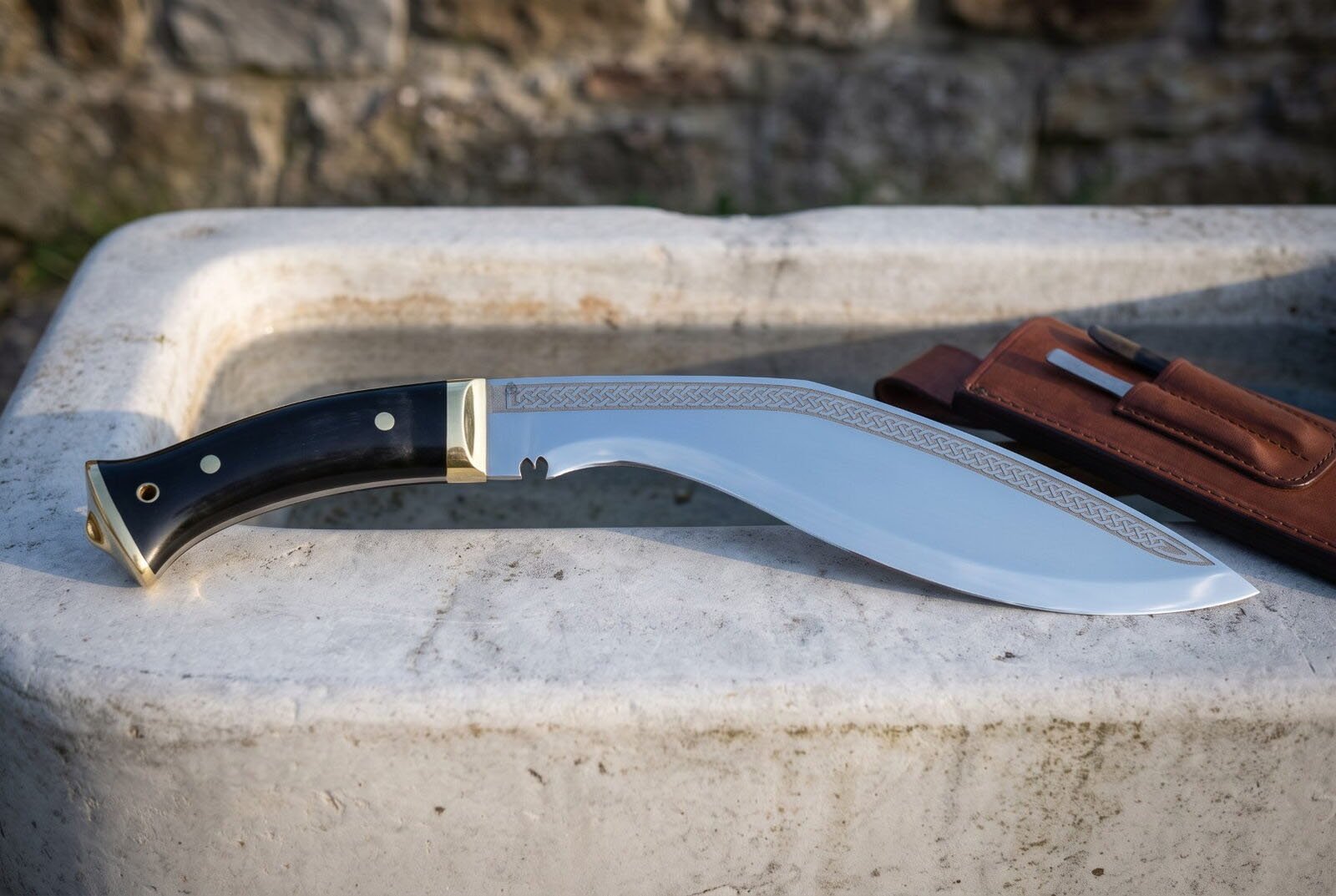
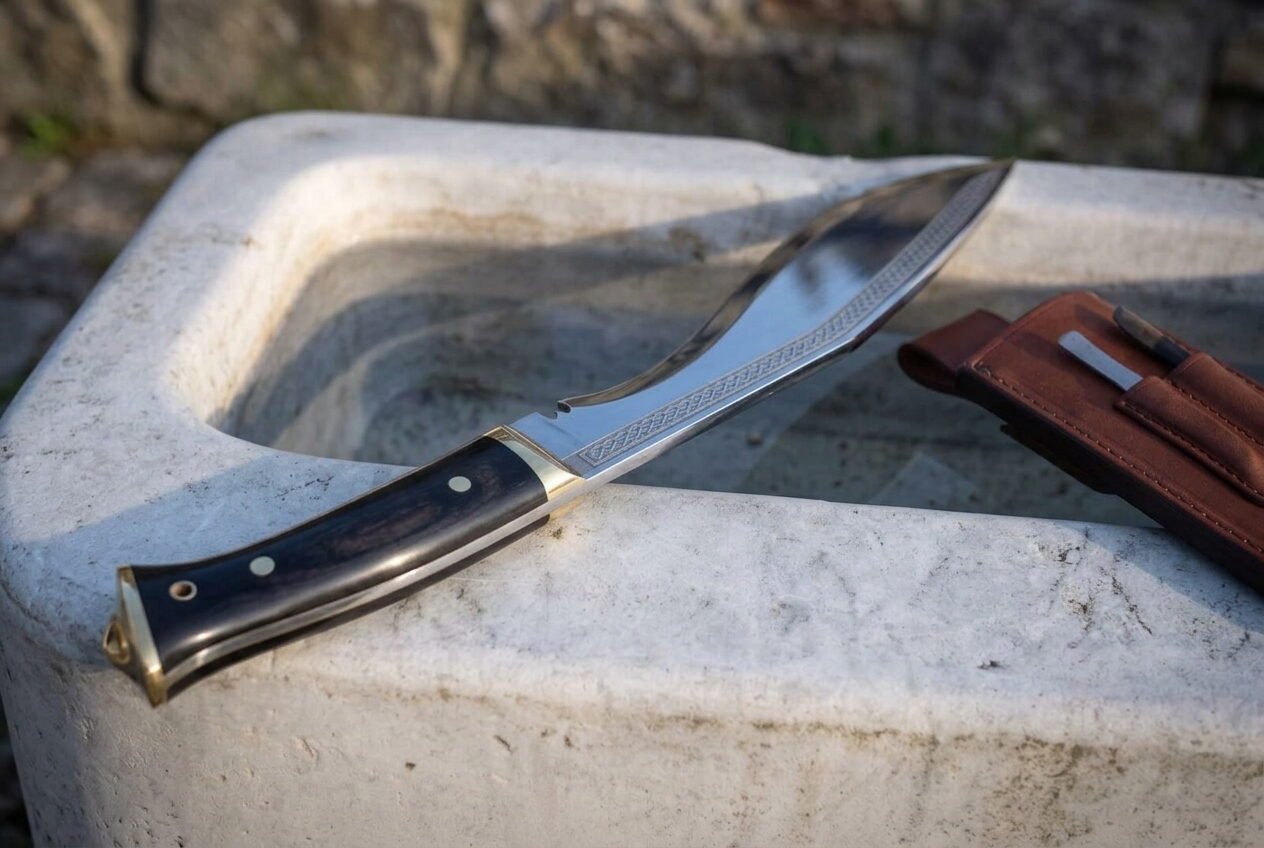
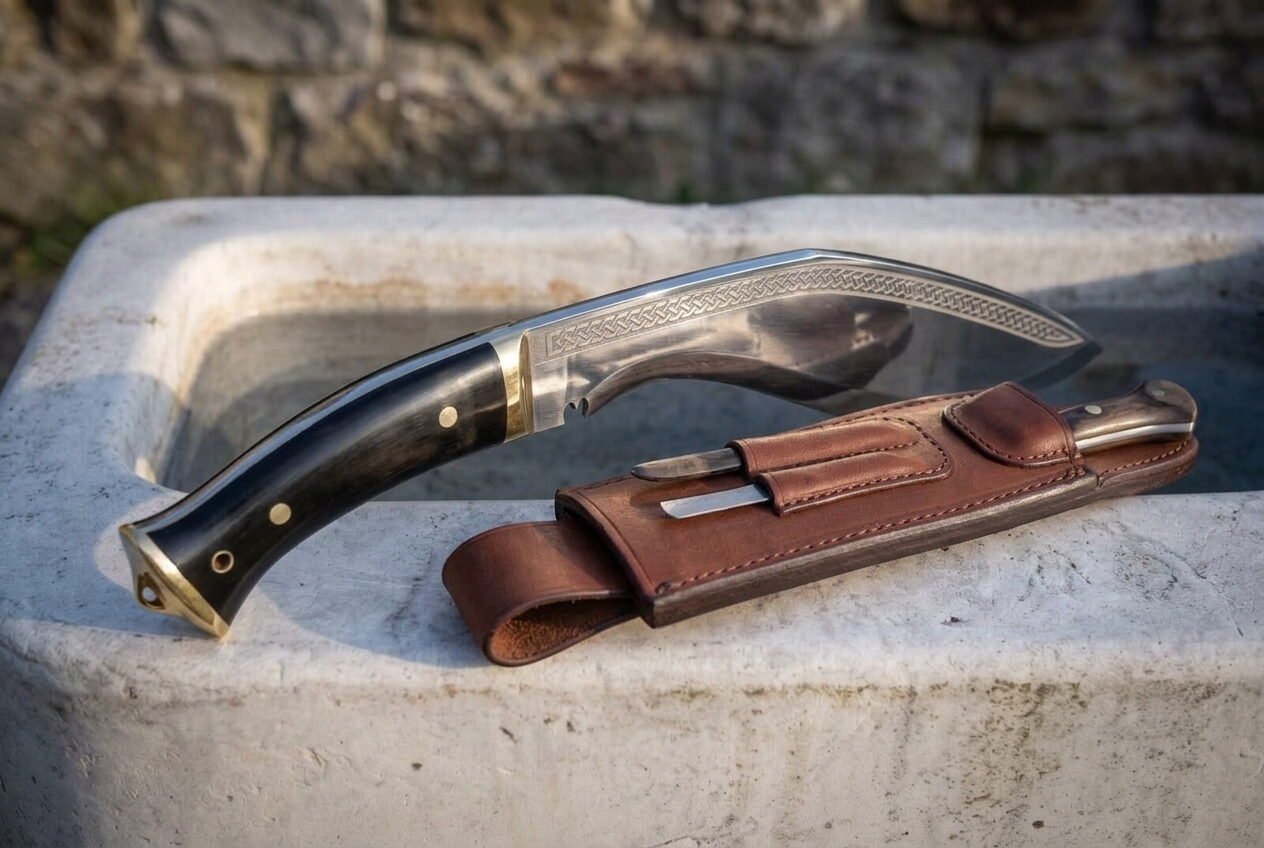
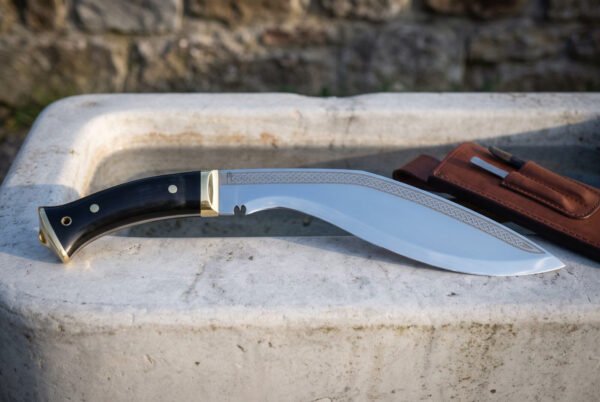
The Inkbraid is a polished 1095 kukri with black buffalo horn scales, brass fittings and a band of interlaced knotwork etched the whole length of the spine. It is the dressiest of our plain steel kukris and also, quietly, one of the most solidly built, because the tang runs the full width and length of the handle and is pinned twice through horn rather than hidden inside it. On a blade whose entire job is to be swung hard, that is the specification that matters most and the one that gets skipped most often.
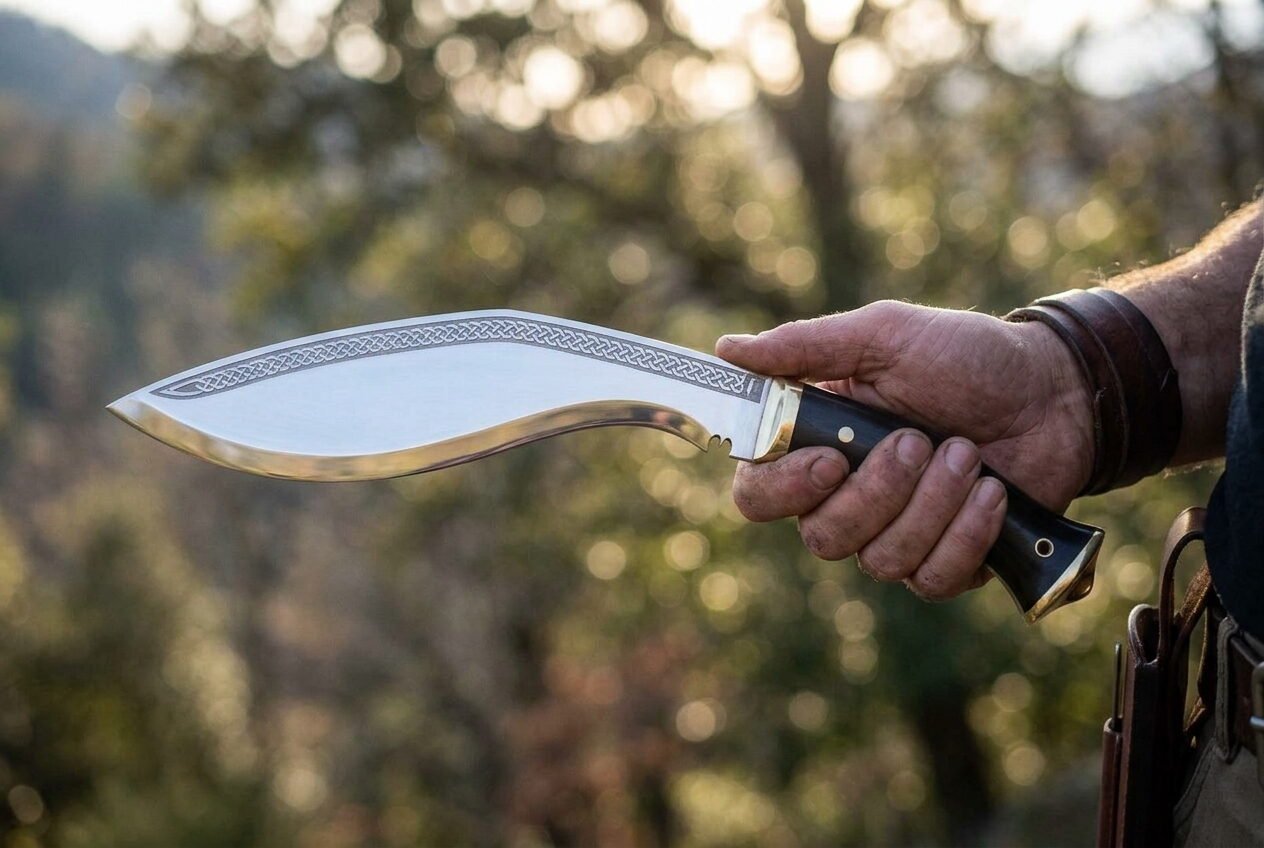
The blade carries the deep forward angle and heavy belly of a working kukri, polished bright, with a cho notch at the base of the edge. The etched band starts at the bolster and follows the spine all the way round the recurve to the point, which is a considerably harder thing to lay out than a single panel. Brass closes the handle at both ends. Every one is made by hand in the Czech Republic. Ransack Viking imports them, checks the etch, the edge and the sheath at our Chicago, Illinois warehouse, and ships from there. It arrives in a leather belt sheath with a front pouch holding two small companion knives.
A kukri cuts on the belly rather than the tip, which is the argument the kukri explained makes at length. Knotwork carried meaning as often as it was pure decoration, and our note on Norse symbols works through the recurring shapes. If you want a shorter belly for dressing game, the skinner knives cover that job.
Specifications
| Item type | Kukri, fixed blade |
|---|
| Material | 1095 high carbon steel, hardened to 54 to 58 HRC |
|---|
| Overall length | About 16 inches, hand made so it varies a little piece to piece |
|---|
| Blade length | About 11 inches measured along the spine |
|---|
| Blade style | Forward angled kukri recurve with a deep belly and a cho notch |
|---|
| Construction | Full tang |
|---|
| Handle | Black buffalo horn scales |
|---|
| Pins | Two brass pins and a brass lined lanyard hole |
|---|
| Bolster | Polished brass bolster |
|---|
| Butt cap | Brass butt cap |
|---|
| Engraving | Interlaced knotwork band etched along the full length of the spine |
|---|
| Finish | Polished blade |
|---|
| Edge | Sharpened and ready to use out of the box |
|---|
| Sheath | Brown leather belt sheath with a front pouch holding a karda utility knife and a chakmak burnisher |
|---|
| SKU | RK-2203 |
|---|
Full tang, and why it is not marketing language
There are three ways to attach a handle to a big knife. A rat tail tang is a thin rod welded or forged off the back of the blade and threaded through a handle, held by a nut at the end. A partial or push tang runs part way into the handle and stops. A full tang is the blade itself, continued back at the same width and depth as the handle, with the scales pinned to either side of it. On a paring knife any of the three is fine. On a sixteen inch chopper the difference is the difference between a tool and a hazard.
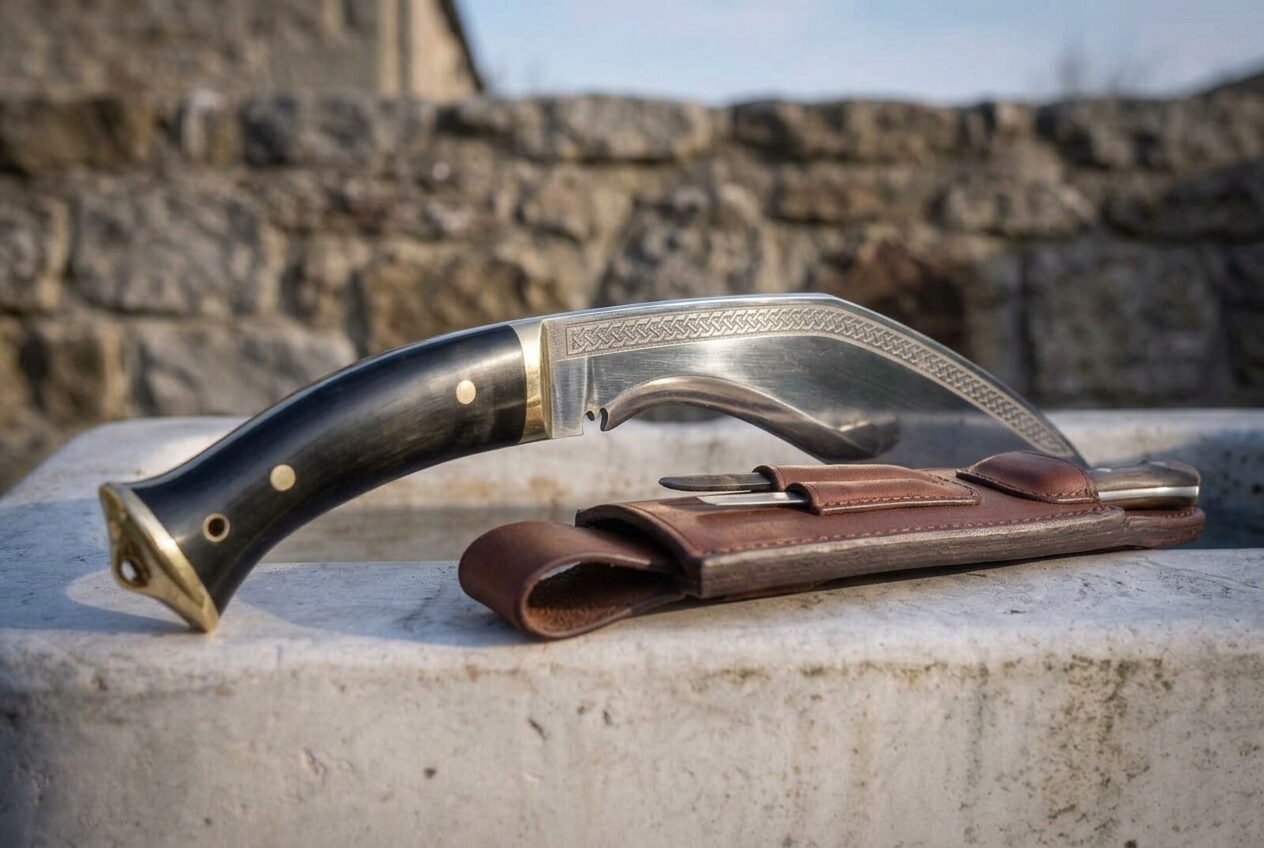
The reason is simple mechanics. When the blade stops suddenly against wood, the energy has to go somewhere, and it goes into whatever joins blade to handle. A rat tail concentrates all of that into a rod the thickness of a pencil and into the weld or shoulder at its base. A full tang spreads it across the entire cross section of the handle, and the pins are in shear rather than in tension. You can see the tang here as a dark line running between the horn scales all the way to the brass butt cap, which is exactly how you should check any knife you are thinking of buying. If the seller cannot show you that line, ask why.
Buffalo horn and 1095
Buffalo horn is keratin, the same material as fingernail and hoof, laid down in layers. It is cut from the solid tip section of the horn, flattened under heat and pressure, then stabilised, sawn into slabs and ground to shape. Under polish it comes up nearly black with a deep wet look, and because it is natural it often keeps pale streaks or a translucent edge where the light gets through. It is dense, it does not swell in the wet the way wood can, and it feels warm in the hand within seconds. Its one weakness is prolonged dry heat, which can shrink and crack it over years, so keep it off a sunny windowsill and away from a radiator.
The blade is 1095, about one percent carbon, hardened and drawn to 54 to 58 HRC. On a heavy chopper that temper is chosen so the edge rolls under abuse rather than chipping, because a rolled edge comes back in a minute on a steel and a chipped one does not. The etched knotwork is bitten into the surface with acid through a resist, which is why the line stays crisp around the curve of the recurve where an engraver’s graver would struggle.
Engraving, runes and your own design
Use the rune converter on this page to turn a name, a date or a short phrase into Elder Futhark and we will cut it into the steel or the leather. If you would rather have a Viking pattern than a rune line, choose your own design in the engraving option above the add to cart button and tell us where it goes. Where a piece already carries an engraved design, your chosen engraving replaces it rather than sitting alongside it. On this kukri that means a rune line would take the place of the knotwork band along the spine, so tell us clearly which you want. More detail sits on the engraving page.
Handling and balance
Horn is denser than most handle woods, so this one carries slightly more weight at the back than a wood scaled kukri of the same size and feels a touch more neutral in the hand. The balance still sits forward of the bolster, which is what gives a kukri its chopping authority. Grip it loosely at the swell, keep the wrist soft and let the belly of the blade fall where you are aiming. Forcing a kukri is the fastest way to tire out and the fastest way to miss.
The brass butt cap gives the little finger something to catch on a full swing, which matters on a polished handle. If you are working above waist height or over water, run a lanyard. For fine work, choke up so the thumb sits on the spine just behind the etch and use the front three inches.
Care
Dry the blade, oil the blade, and do not store it in the sheath for long periods. Tanned leather holds moisture and salts, and carbon steel left inside it will spot. Mineral or camellia oil on a cloth is all it needs. Horn should be wiped clean and given a very light rub of mineral oil once or twice a year to keep it from drying out, and it should never be soaked or put anywhere near a dishwasher. Feed the leather sheath with a neutral cream two or three times a year. Sharpen on a coarse stone at a shallow angle and finish fine, working the belly in sections. There is more on this in our knife care guide.
A curve like this does not sharpen the way a straight edge does, and sharpening a curved blade works through the stroke.
Made in the Czech Republic
Made by hand in the Czech Republic, imported by Ransack Viking, and never shipped straight out of an importer catalogue to a customer. Every kukri lands at our Chicago warehouse, gets unpacked, gets the tang line, the edge and the sheath fit looked at, and only then goes live as in stock. That is the honest reason processing runs one to two weeks. United States shipping is free, returns run for seven days, and the lifetime warranty against defects in forging, grind, heat treat and fittings has no end date and needs no receipt.
A note on handmade variation
This is hand made, not machine made or bulk produced, so what arrives will not be a pixel for pixel copy of the photograph. Buffalo horn is a natural material and every slab is different. Some are near solid black, some carry grey or amber streaking, some show a translucent glow at the edge in strong light, and none of that is a flaw. The etched band varies a little in depth and darkness. Hand grinding moves the sweep of the recurve by a fraction between blades. The dimensions, the steel and the build are the same every time. The character is not.
Frequently asked questions
Is this really full tang
Yes. The tang is the same steel as the blade, runs the full length and width of the handle, and is pinned twice. You can see it as a line between the horn scales all the way to the butt cap.
Is it sharp out of the box
Yes, with a working chopping bevel. It is keen but not razor thin at the edge, because a thin edge on a blade this heavy would fail the first time it met a knot.
My horn scales look different to the photo
That is expected. Horn is a natural material and no two slabs match. Streaking, marbling and a translucent edge are all normal and are not defects.
What are the small knives in the sheath
The karda is a small utility blade and the chakmak is an unsharpened burnisher for straightening the main edge. Both are traditional to the pattern and both are included.
Can I have runes instead of the knotwork
Yes. Choose the engraving option and give us your text. A chosen engraving replaces the existing knotwork band rather than sitting alongside it.
How long does shipping take
Processing takes one to two weeks while the piece is checked at our Chicago warehouse, then standard United States shipping on top. Engraving adds a few days.
What is in the box
- Inkbraid full tang kukri
- Leather belt sheath with a front pouch
- Karda utility knife
- Chakmak burnisher
- Care and warranty card
- Hand made in the Czech Republic, shipped from our Chicago, Illinois warehouse
Explore the range
See more in kukri knives, Viking knives, Norse arms and engraved and personalised pieces, or read the guides.
Others in the same line
Sitting beside it in the catalogue is the Trineknot kukri knife, 17 inches overall. Another in the same line is the Bonecurve kukri knife, 16 inches overall. Next along the rack is the Palefang kukri knife, 16 inches overall.
Fitting out further, the Hornfold folding pocket knife belongs with it. You can have this made your way instead on the custom hunting knife page.




Feels way more premium than the price suggests. Packaging was excellent and it arrived in perfect condition. Can’t recommend this enough.
This thing is a beast in the best way. Feels way more premium in person than the listing photos. This is going straight into my display case.
This piece is well made. Just a couple small things kept it from 5 stars. Good overall quality. Just a couple very minor details off. Second time ordering from Ransack Viking and still happy overall. Solid piece. Packaging could’ve been a bit sturdier. Would still tell others to give this a try.