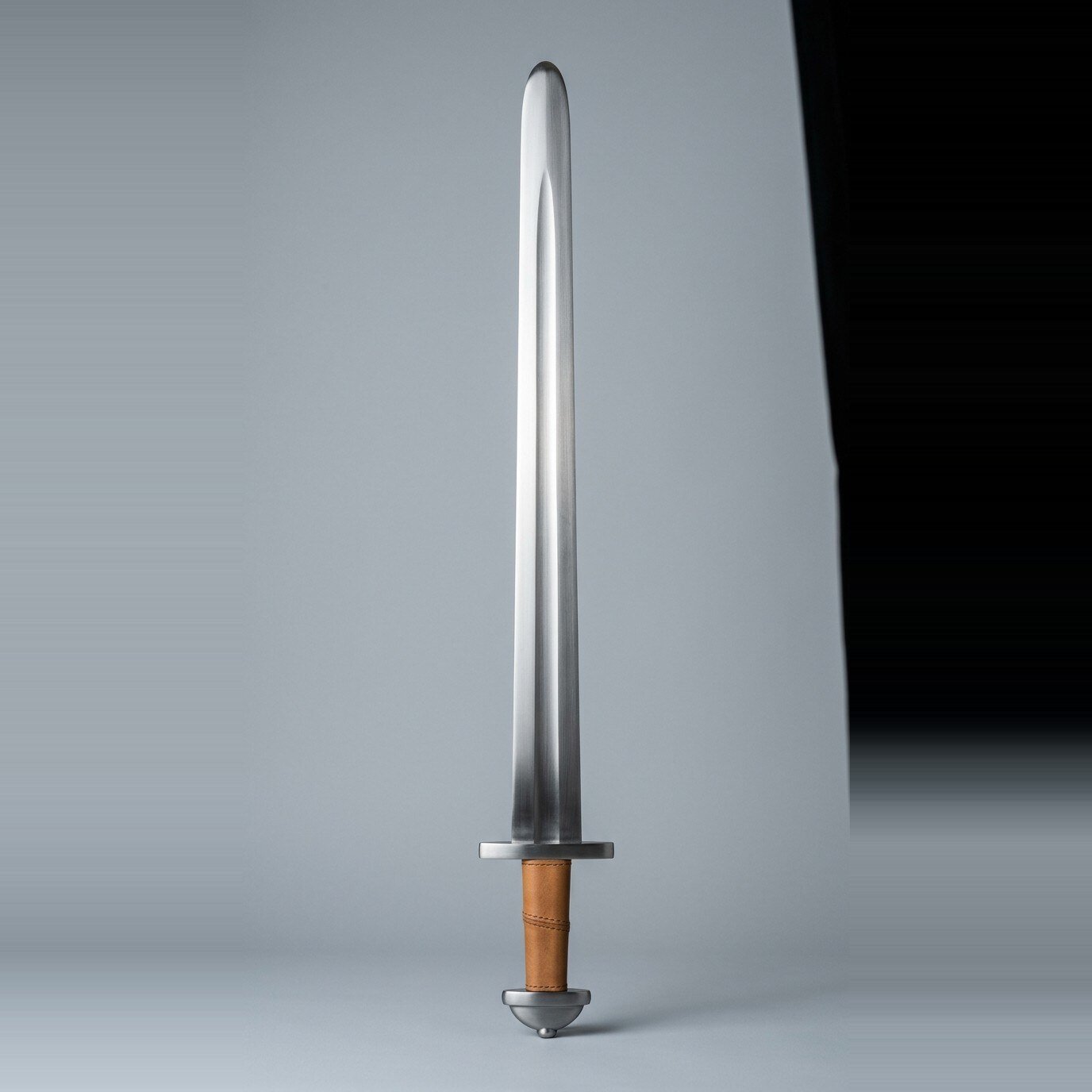
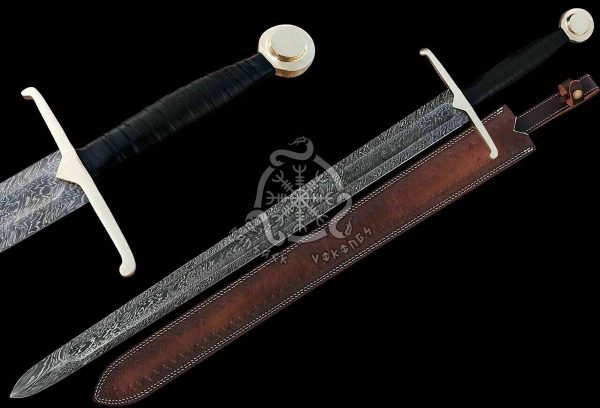
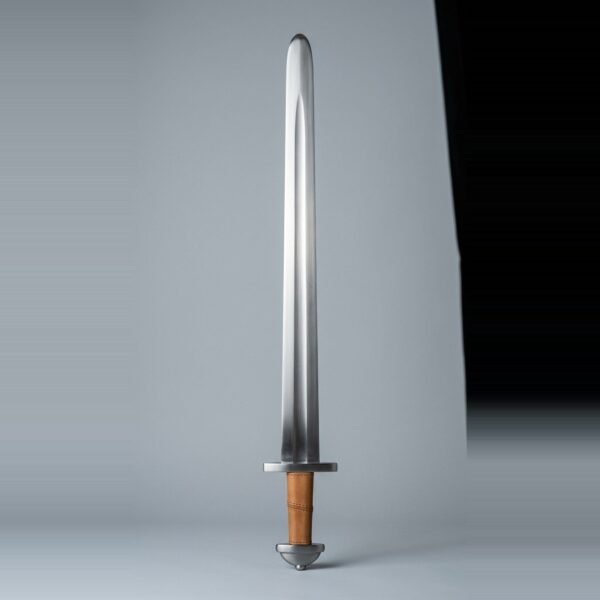
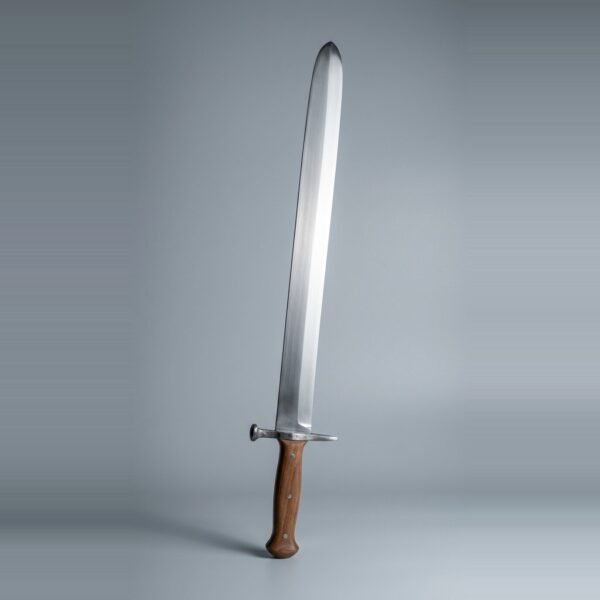
This is a single handed blunt cut to the migration era pattern, the broad short bladed sword that runs from the late Roman period through the Viking age. The edges sit close to parallel for most of the length and the point is a gentle rounding rather than a spike, because the original of this shape was a cutting sword carried beside a shield.
The fuller is broad and shallow and runs nearly the whole blade, which is the giveaway of the type. The lower guard is short and straight. The pommel is the two part arrangement the period is known for, an upper guard sitting on the shoulder of the tang with a separate cap riveted over the top, and the grip between them is tan leather over a wood core sized for one hand and no more.
New to steel, or coming to it from reenactment rather than from a fencing hall, read what HEMA actually is and blunt against sharp training swords before you buy. The rest of the single handed steel lives in HEMA arming swords. If this is the first steel you buy, read how to choose your first HEMA sword before you commit.
Specifications
| Material | 51CrV4 spring steel, hardened to 49 to 52 HRC |
|---|
| Overall length | About 36 inches, hand made so it varies a little piece to piece |
|---|
| Blade length | About 30 inches |
|---|
| Blade type | Broad double edged blunt with a shallow fuller down most of the length |
|---|
| Edge | Blunted, about 3 mm flat land, not sharpened |
|---|
| Tip | Rounded and flared, about 15 mm across |
|---|
| Guard | Short straight lower guard of plain bar stock |
|---|
| Pommel | Two part, upper guard and cap, riveted over the tang |
|---|
| Grip | Tan leather over wood, single handed |
|---|
| Flex | Medium tier, suited to shield and buckler drill |
|---|
| Included | Sword only. No scabbard. |
|---|
| SKU | RK-3009 |
|---|
The migration era form, the shield and what the sources do not say
Be straight about the history first. The migration era and Viking age predate every fencing manual we have. There is no Liechtenauer for this sword and no Bolognese master to quote. What we know comes from the finds, from wear on surviving blades, from the sagas and from what the shape itself will and will not do. Anyone selling you a documented system for a sixth century sword is selling you a reconstruction.
What the shape tells you is plain enough. Broad blade, shallow fuller, mass carried forward of the hand and a point that rounds off. It is built to cut, to be carried in one hand, and to work with a shield filling the other. Clubs use blunts like this for shield drill, for line work in reenactment fighting and as the crossover blade for fencers who want to feel a cutting sword after years on a feder.
It also stands in usefully for early sword and buckler practice. The sword of the I.33 manuscript is a later and slimmer thing, but a broad single hander teaches the same lesson about covering the hand, about winding the buckler forward with the sword and about keeping the point in the fight after the cut has landed. Fence it in gloves, mask and a gorget the same as anything else with an edge land.
A broad shallow fuller, forward mass and the spring steel choice
The steel is 51CrV4 hardened to 49 to 52 HRC. That is deliberately below the 54 to 58 HRC we run on the cutting swords. Spring steel at this hardness bends and returns instead of taking a set or snapping under a hard bind, which is exactly what you want from something that will be struck by another blade a few thousand times a year.
The broad shallow fuller does something different from the narrow groove on a later longsword. It removes weight along the whole blade rather than only through the middle, and because it is wide and shallow the blade keeps its width and its flat. The result is a blade that still has mass out toward the last third, which is where a cutting sword wants it, without the dead heaviness of an unfullered bar of the same width.
Flex sits in the medium tier. The market bands run light around 15 to 21 lb, medium around 25 to 29 lb, strong or tournament grade around 30 to 43 lb, and stiff for harnischfechten. A single handed blade this short feels stiffer in the hand than the same tier on a longsword simply because there is less blade to bend. We quote the tier and not a number, because we do not test every blade on a jig. The edge is blunted to a flat land over the 2 mm minimum club gear lists ask for and the point is rounded and flared to about 15 mm across so a thrust spreads rather than concentrates.
Engraving, runes and your own design
Use the rune converter on this page to turn a name, a date or a short phrase into Elder Futhark and we will cut it into the steel or the grip. On this one runes sit well on the broad flat beside the fuller, on the cap of the pommel or burned into the leather of the grip.
Text and runes are $19, a symbol is $39 and a family crest is $49, and the work is done in the United States after the piece has landed and passed inspection. If you would rather have your own design than a rune line, choose your own design in the engraving option above the add to cart button and tell us where it goes. Where a piece already carries an engraved design, your chosen engraving replaces it rather than sitting alongside it. More on the engraving page.
Handling and balance
This is a one handed sword and it behaves like one. The two part pommel puts a real lump of steel behind the fist, so the blade turns around the wrist rather than dragging it, and the short guard keeps the hand close to the balance point instead of pushing it forward.
Held with a shield it comes alive. The grip is sized so the hand fills it with no slack, which matters when you are recovering the sword after a cut has been taken on someone else’s board. We do not publish a weight or a point of balance for it. There is no scale in the photograph and every blade leaves the hammer a little different, so a printed figure would be a guess.
Care
Broad blades pick up more surface rust than narrow ones simply because there is more of them. Wipe it down after every session and put a thin film of oil on the flats before it goes back in the bag.
Shield work marks a blade. Expect dents along the edge land where it has met another edge or a shield rim, take any raised burr back flat with a fine file and do not chase it into a sharp edge. Watch the rivet on the pommel cap and stop using the sword if it loosens. Our full routine for oiling, rust and long storage is in the care guide.
Made in the Czech Republic
Made by hand in the Czech Republic and imported by Ransack Viking. Nothing here is drop shipped out of an importer catalogue straight to a customer. Every one is checked for hilt tightness, pommel seating and blade straightness at our North Babylon, New York warehouse, and ships from there. Shipping in the United States is free, returns run for seven days, and the lifetime warranty against defects in the forging, the grind, the heat treat and the fittings has no end date and needs no receipt.
A two part pommel has more joints than a wheel does, so the rivet and the seat of the upper guard are the first things the team looks at when the crate is opened, along with blade straightness.
A note on handmade variation
This is hand forged. It is not machine made, not cast and not bulk produced, so what arrives will not be a pixel for pixel copy of the photograph on this page. Fuller width wanders a little across a batch, the two part pommel is filed and fitted by hand so no two caps sit exactly alike, and vegetable tanned leather takes dye unevenly, so the tan can come out lighter or darker than the picture.
What does not vary is the standard. Every one leaves the workshop straight, tight and blunted the same way, and anything that fails the check at the warehouse never gets boxed.
Frequently asked questions
Whether this is a Viking sword or a HEMA trainer
Both descriptions fit the shape and neither fits perfectly. The form is migration era and Viking age, the build is a modern blunt trainer in spring steel at sparring hardness. Buy it to fence and drill with rather than as a reproduction of a particular find.
Whether it works for sword and buckler
Yes for drilling the principles, with a caveat. The I.33 sword is slimmer and longer in the grip than this, so a broad migration era blade will feel heavier in the bind. It teaches hand cover and buckler management perfectly well.
Whether a scabbard is included
No. This ships as the sword alone and we do not sell a scabbard for it. Keep it in a padded bag rather than a closed sheath, which traps moisture against the steel.
Whether the point is safe for thrusting
The point is rounded and flared to about 15 mm across, which spreads a thrust rather than concentrating it. Thrusting is still only as safe as the kit and the control of both fencers, so wear a rated jacket and a gorget.
Whether the blade can be sharpened
Do not sharpen it. 51CrV4 at 49 to 52 HRC is a sparring hardness, not a cutting hardness, and an edge on it would hold badly and make a safe trainer into something else.
How the sword should be stored between sessions
Dry, oiled and out of any closed leather sheath. A rack or a padded bag with the blade wiped down beats a car boot in every season.
What is in the box
- The Skarnvik migration era blunt arming sword, blunted along the full edge.
- A protective film of oil on the steel, which comes off with a rag.
- A printed card covering oiling, burrs and storage between sessions.
- The lifetime warranty against defects in the forging, the grind and the fittings.
Explore the range
More single handed steel sits in HEMA arming swords, the cut and thrust hilts in HEMA sideswords, two handed blades in HEMA longswords, and the whole training line under HEMA swords. The rest of our writing is in the guides.
If this one is not it
Close in size and role you have Draugmar arming sword, about 38 inches overall, Mirlaug arming sword, about 37 inches overall, Ashgrimm arming sword, about 37 inches overall and Elmgarth sidesword, about 41 inches overall to compare against this one.
The full HEMA arming sword category and the wider HEMA sword hub hold the rest of the line, and you can specify your own on the custom sword builder.








Reviews
There are no reviews yet