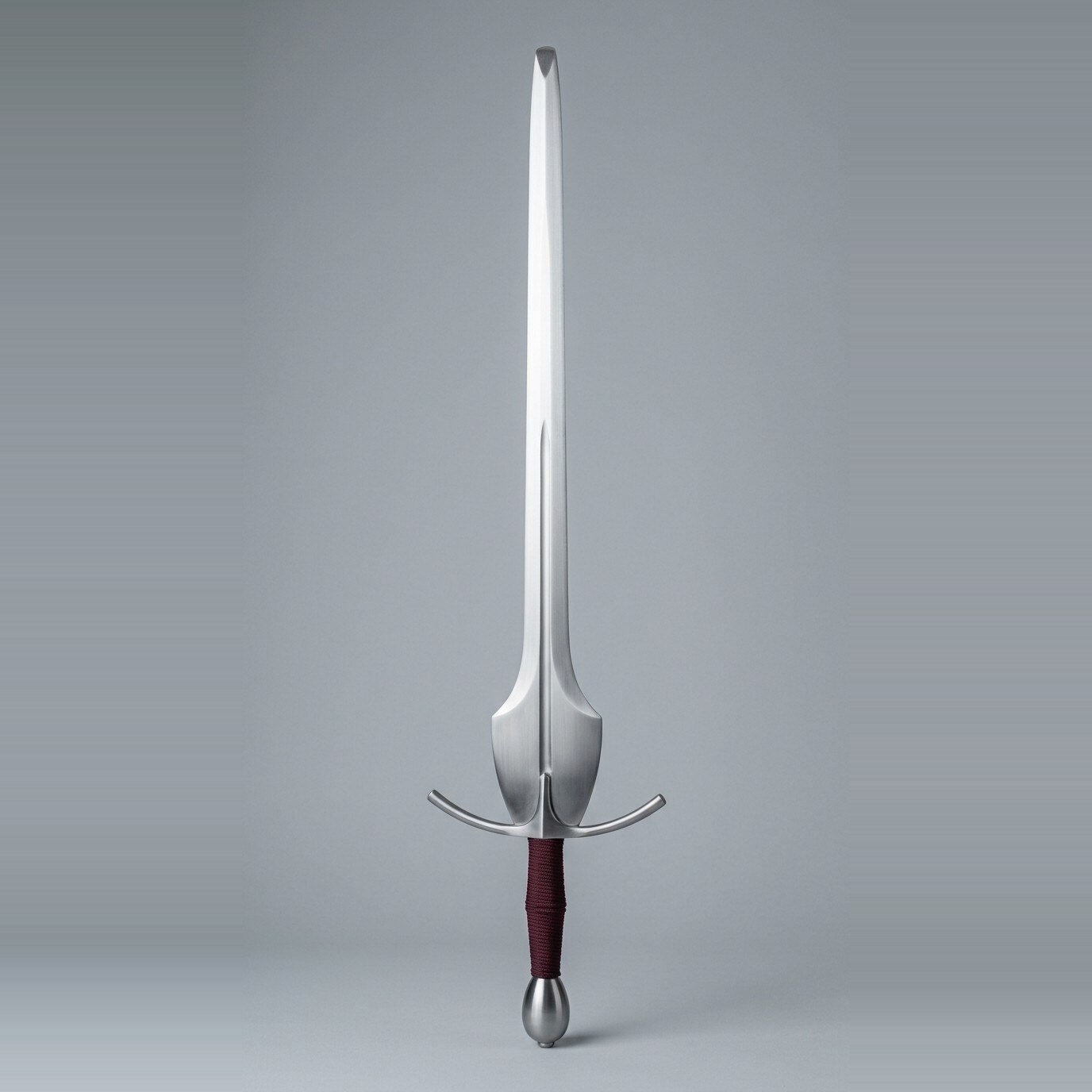
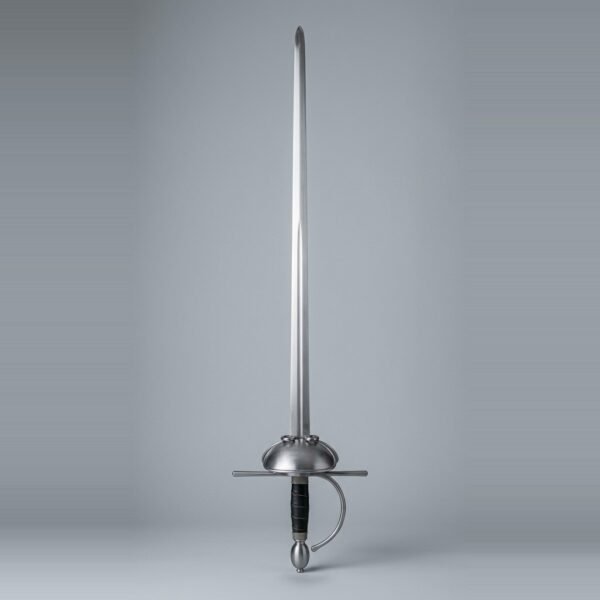
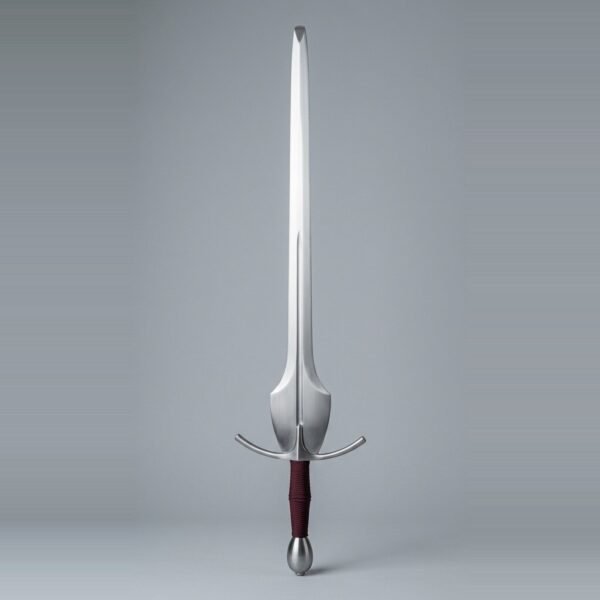
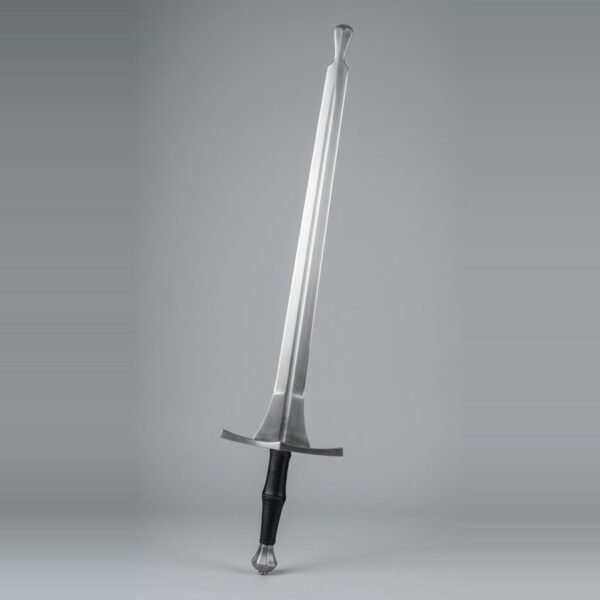
A feder is not a blunt longsword. It is a purpose built fencing tool, and this one has the full anatomy: a wide flat ricasso ahead of the cross, a shield shaped schilt standing clear on both flats to catch a blade that slides down, and a body that narrows sharply above the schilt so the blade can bend rather than transmit the shock straight into a hand.
Where most feders run flat and unfullered, this one carries a narrow fuller low in the blade, above the schilt and through the forte. It takes weight out of the part of the blade you never bend and leaves the handling a little quicker in the bind. The cross is curved rather than straight, the pommel is a pear peened over the tang, and the grip is burgundy cord over a wooden core. About 50 inches overall, hand made so it varies a little piece to piece.
If you are choosing between a feder and a blunt longsword, read what is a feder and then how to choose your first HEMA sword, because the answer usually comes down to what your club fences and what your local events allow. The rest of the line sits in feders.
Specifications
What we can state without guessing. Lengths are approximate because every one is forged and fitted by hand.
| Material | 51CrV4 spring steel, hardened to 49 to 52 HRC |
|---|
| Overall length | About 50 inches, hand made so it varies a little piece to piece |
|---|
| Blade length | About 39 inches |
|---|
| Blade type | Flat feder blade with a narrow fuller low in the blade |
|---|
| Edge | Blunted, about 3 mm flat land, not sharpened |
|---|
| Tip | Blunted and rounded off, no cutting point |
|---|
| Guard | Curved cross tapering to rounded ends |
|---|
| Schilt | Shield shaped, standing clear of the ricasso on both flats |
|---|
| Pommel | Pear shaped, peened over the tang |
|---|
| Grip | Burgundy cord over a wooden core, long enough for two hands |
|---|
| Flex | Medium, the tier most clubs put a first feder in |
|---|
| Included | The feder only. No scabbard and no tip protector |
|---|
| SKU | RK-3023 |
|---|
Why the feder exists and what it changed in longsword play
The feder was made for the fencing guilds, not for the battlefield. German fechtschule records and the Marxbruder and Federfechter accounts describe fencers turning up with a tool that looked like a longsword, weighed less in the forward half and was built to be thrust with. That is the sword the surviving feders in Dresden and Vienna are, and it is the sword this piece copies.
Two features carry the whole idea. The wide flat ricasso ahead of the cross lets the blade be gripped in the half sword and gives the schilt something to sit on. The schilt itself is the safety catch: when an opponent’s blade slides down yours in a bind, the schilt stops it before it reaches your fingers. Take the schilt away and you have a sword that punishes bad structure with broken hands.
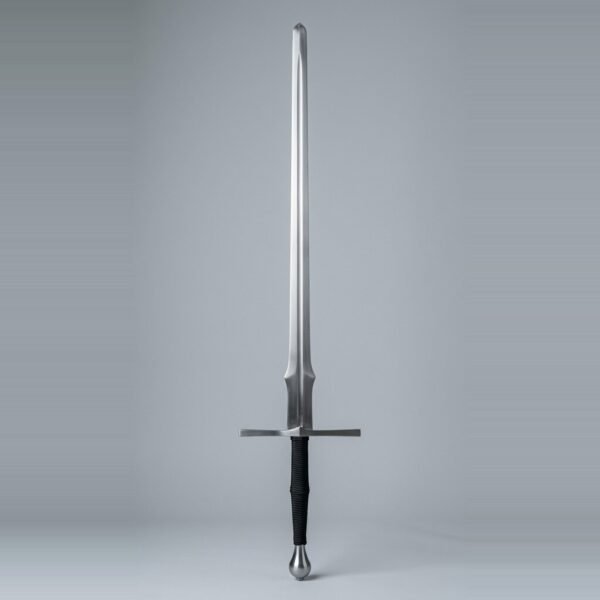
In practice a feder rewards a different game to a blunt longsword. The forward mass is lower, so winding at the bind is quicker and thrusts are far more controllable. Many longsword tournaments now ban blunt longswords outright and accept only purpose built feders or sword shaped feders, so if events are in your plans the feder is the safer buy. Check the ruleset before you enter, because no two organisers write it the same way.
Spring steel, the schilt and a fuller that lightens the lower blade
51CrV4 spring steel hardened to 49 to 52 HRC. We do not use 1095 on trainers. At 54 to 58 HRC a 1095 blade is harder and holds a cutting edge properly, but it is too hard for the bind: it takes a set or breaks instead of returning. Spring steel bends and comes back, which is the only behaviour worth having when two people are leaning on the same crossing.
The narrow fuller runs through the lower blade, above the schilt and out through the forte, and stops well before the flexing section. That placement matters. A fuller cut too high would weaken the part of the blade that has to bend evenly, so keeping it low removes mass where the blade is stiffest and leaves the upper blade to do its job. The result is a feder that feels a little livelier in the hand than an unfullered blade of the same length.
Flex is the medium tier, which the market usually brackets around the middle of the light to tournament range. That is where most clubs want a first feder: soft enough to thrust safely into a gambeson and jacket, stiff enough to hold a bind and to teach real structure. If you want the tiers explained properly, we wrote HEMA sword flex explained for that.
Engraving, runes and your own design
Use the rune converter on this page to turn a name, a date or a short phrase into Elder Futhark and we will cut it into the steel or the grip. If you would rather have your own design than a rune line, choose your own design in the engraving option above the add to cart button and tell us where it goes. Where a piece already carries an engraved design, your chosen engraving replaces it rather than sitting alongside it. More on the engraving page.
The pear pommel takes a short rune line around the waist, and the flat ricasso below the schilt is the largest clean surface on the sword for a name or a club mark. Tell us which you want and we will keep the layout clear of the schilt shoulders.
Handling and balance
Two hands on the hilt, the burgundy cord giving enough friction to hold a loose grip without slipping. The pear pommel puts real mass behind the hand, so the tip comes back quickly out of a cut and the sword changes line with very little effort. Anyone moving over from a blunt longsword will notice the tip feels lighter and the recovery shorter.
The ricasso is there to be used. Take the half sword grip with the forward hand on the flat and the schilt sits just ahead of your fingers where it belongs. We do not publish a weight or a point of balance for this piece, because every one is finished by hand and a printed figure would be a guess dressed up as a specification.
Care
Wipe the blade after every session and put a light film of mineral or camellia oil on it. The two places that rust first are the underside of the schilt and the angle where the cross meets the ricasso, because sweat runs down there and sits. Get a rag into both.
Cord grips absorb moisture. Let the sword dry in open air before it goes in a bag, and do not store it in a sealed sleeve after a hall session. Check the pommel peen every few months by twisting the grip gently; hand fitted hilts settle in the first season and a slightly loose pommel is repeened quickly. The full routine is in the knife care guide.
Made in the Czech Republic
Made by hand in the Czech Republic and imported by Ransack Viking. Nothing here is drop shipped out of an importer catalogue straight to a customer. Every one is checked for hilt tightness, pommel seating and blade straightness at our North Babylon, New York warehouse, and ships from there. Shipping in the United States is free, returns run for seven days, and the lifetime warranty against defects in the forging, the grind, the heat treat and the fittings has no end date and needs no receipt.
The feders in this line share a forge with the longswords and messers, so the cross and pommel finish matches across the range. Two pieces bought together will look like a pair rather than two separate orders.
A note on handmade variation
This is hand forged. It is not machine made, not cast and not bulk produced, so what arrives will not be a pixel for pixel copy of the photograph on this page.
On a feder that shows up in the exact curve of the cross, the depth of the fuller and the tone of the cord wrap. The schilt shape, the blade profile and the flex tier are consistent piece to piece. The small marks are not, and they are what tells you a person made it.
Frequently asked questions
Does this feder have a fuller
Yes. Most feders do not, and this one does. A narrow fuller runs through the lower blade above the schilt and stops before the flexing section, so it takes weight out of the stiff part without touching the part that bends.
Is it a blunt longsword
No. It is a feder, with a flat ricasso, a schilt and a blade built to bend. A blunt longsword is a sword shaped blade with the edges taken off and it behaves differently at the bind and in the thrust.
Can I enter a tournament with it
Read the ruleset you are entering. Many longsword events accept only purpose built feders and ban blunt longswords, which works in this sword’s favour, but tip requirements vary. The Berlin HEMA Cup asks for a spatulated or rolled tip of at least 1.5 cm. We never claim legality without naming the rules.
Why spring steel and not 1095
Because a trainer has to survive being leaned on. 51CrV4 at 49 to 52 HRC bends and returns. 1095 at 54 to 58 HRC is harder, cuts better and is what we use on the sharps, but it will take a set or break in a hard bind.
Is there a scabbard
No. Feders never had one historically and this one does not ship with one.
Can it be engraved
Yes. Elder Futhark runes or your own design, cut in the United States after the piece arrives. Text and runes are 19 dollars, a symbol 39 dollars, a family crest 49 dollars.
What is in the box
- One Brimhalt feder, about 50 inches overall
- A light coat of protective oil on the blade for transit
- Care and warranty details for the piece
- Ransack Viking packaging, inspected and shipped from North Babylon, New York
Explore the range
The rest of the two handed steel is in feders and HEMA longswords. For one hand, look at HEMA arming swords or the wider longswords shelf. Everything on steel, flex and first buys is in the guides hub.
Near neighbours in the shop
Its closest neighbours on the rack are Vindlaur feder, about 50 inches overall, Vandrekt feder, about 49 inches overall, Ravnstad feder, about 48 inches overall and Draugmoor longsword, about 49 inches overall.
The feder category and the HEMA sword hub hold the remainder, and you can order a one off on the custom sword builder.








Reviews
There are no reviews yet