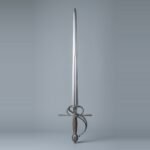
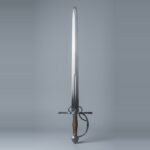
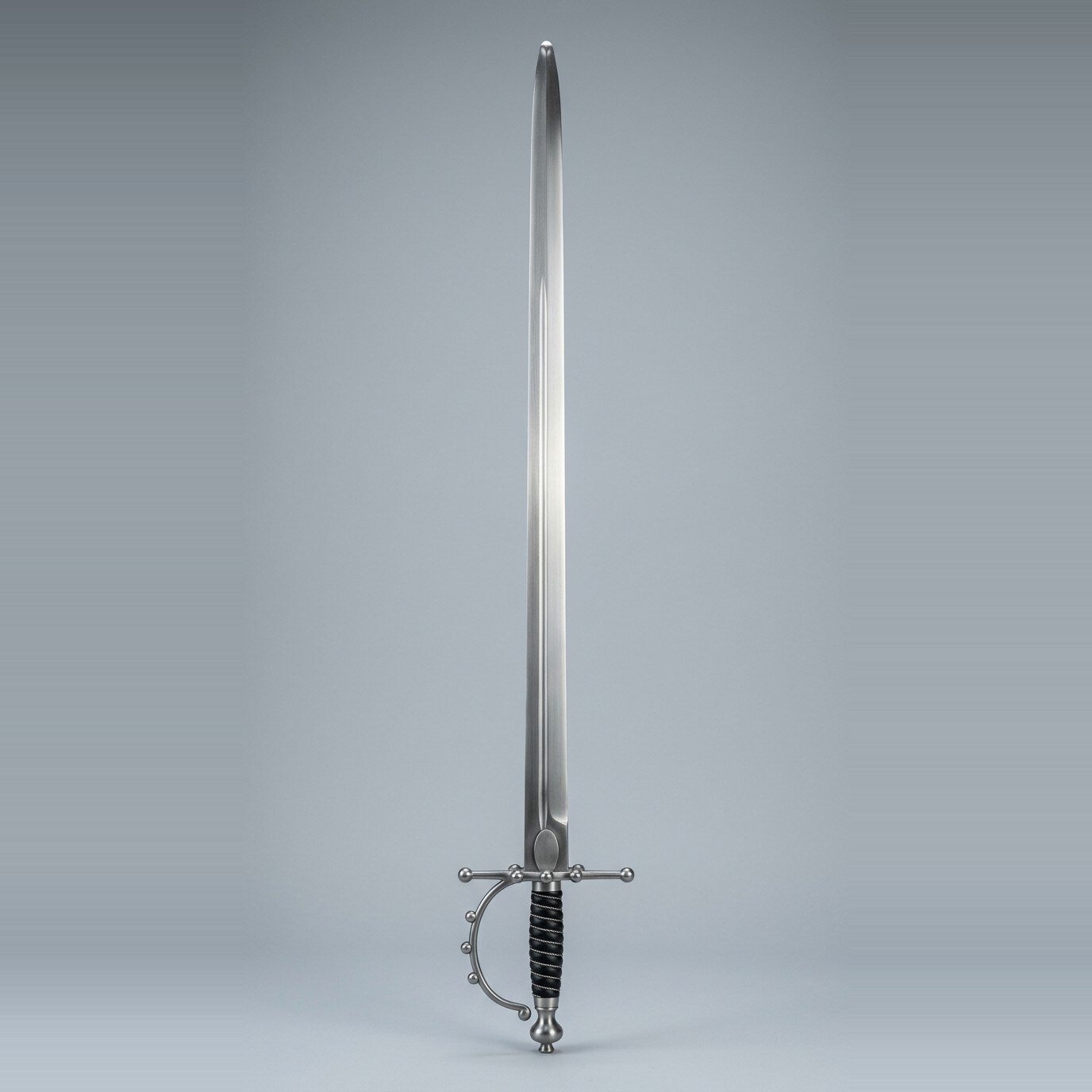
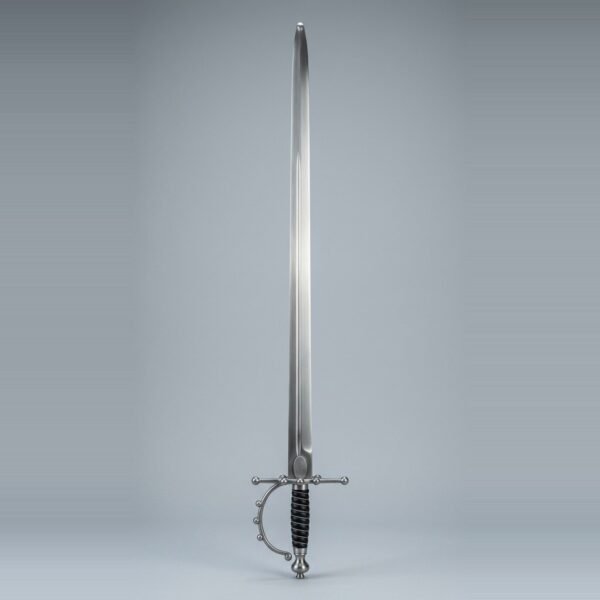
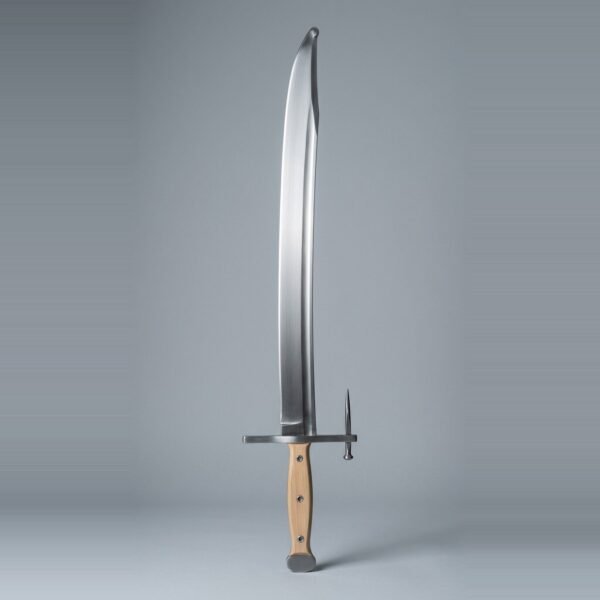
The Skaldrun is a spadroon, the light straight bladed cut and thrust sword an officer on foot wore at the end of the eighteenth century, built as a blunt trainer in 51CrV4 spring steel. The hilt is the five ball pattern that gives the type its face, small beads set along the guard and the knuckle bow, with an urn shaped pommel above a black grip bound with wire. The blade is straight, single edged, with a narrow groove running down the flat.
A spadroon is not a sabre and not a smallsword, and it is best understood as the compromise between them. It keeps the thrust of the smallsword and adds an edge, so the sword is fenced with the point in line and the cut arriving from the wrist. The British 1786 pattern infantry officer sword is the type specimen for this hilt, and what the manuals of the period drill on it is a small tight guard position, changes of line, and a cut delivered without ever losing the point.
Read the smallsword and spadroon guide and how to choose your first HEMA sword before you pick one, then compare across the smallswords and spadroons. A plain dish smallsword, a pierced shell and a five ball spadroon cover very different jobs even though the blades look similar at arm length.
Specifications
Every length is given as about, because this is ground and fitted by hand. We do not publish a weight or a point of balance, because we will not print a number we have not taken.
| Material | 51CrV4 spring steel, hardened to 49 to 52 HRC |
|---|
| Overall length | About 37 inches, hand made so it varies a little piece to piece |
|---|
| Blade length | About 31 inches |
|---|
| Blade type | Straight single edged blade with a narrow groove down the flat |
|---|
| Edge | Blunted flat land, not sharpened |
|---|
| Tip | Blunted and rounded off, measure it against your ruleset before an event |
|---|
| Guard | Five ball hilt, beads set along the guard and the knuckle bow |
|---|
| Pommel | Urn shaped, seated over the tang |
|---|
| Grip | Black grip bound with wire, single handed |
|---|
| Flex | Light to medium tier, the give sits forward of the middle |
|---|
| Included | The sword only. No scabbard |
|---|
| SKU | RK-3003 |
|---|
The five ball spadroon and the officer on foot
The spadroon belongs to a short window when the smallsword was going out of fashion and the sabre had not yet taken over the infantry. Officers wanted something that would still thrust like the court sword they had learned on but would also cut, because a smallsword answers badly to a man with a heavy blade. The result was a straight light single edged blade on a slim hilt, and the five ball guard is the decorative signature of the best known pattern of it.
On the floor it fences small. The point is carried in line, the hand is quiet, and the cut comes out of the wrist and forearm without the big circular preparation a sabre wants. Parries are close and answered immediately, because a blade this light does not win a contest of force and must win the line instead. Feints, changes under the blade and the thrust that follows a failed cut are the substance of the art, which is why players who like the rapier often take to it.
A straight single edged blade, the groove and the flex
This blade is 51CrV4 spring steel hardened to 49 to 52 HRC. Spring steel is chosen because it bends and returns instead of taking a set or snapping under a hard bind. Our sharps run 1095 at 54 to 58 HRC because a cutting edge needs the hardness, but that same hardness in a sparring blade is a liability, so trainers are drawn back until the steel gives and recovers.
The narrow groove down the flat is doing the same job a fuller does on a longsword at a much smaller scale. It lifts weight out of a blade that is already slim without letting it turn into a whippy strip, so the section stays stiff enough to hold a line in a parry. Being single edged, the back of the blade carries a spine, and that spine is what keeps a thrust honest. The flex sits forward of the middle and the forte stays firm.
One honest note on the point. The tip is blunted and rounded rather than flared. Tournament gear rules such as the Berlin HEMA Cup requirements ask for a spatulated or rolled tip of at least 1.5 cm across, so a rounded point will not satisfy them, and rounded tips are specifically not allowed on rapier and sabre there. Use this for drills, forms and club sparring under your own rules, and check the ruleset before entering an open event.
Engraving, runes and your own design
Use the rune converter on this page to turn a name, a date or a short phrase into Elder Futhark and we will cut it into the steel or the grip. A slim blade takes a short line best, so runes usually sit on the flat just above the hilt, and the urn pommel will hold a single small mark. Text and runes are $19, a symbol is $39 and a family crest is $49, all cut in the United States after the piece has landed and been inspected.
If you would rather have your own design than a rune line, choose your own design in the engraving option above the add to cart button and tell us where it goes. Where a piece already carries an engraved design, your chosen engraving replaces it rather than sitting alongside it. More on the engraving page.
Handling and balance
No weight and no point of balance from us. Nothing in the photographs carries a scale and these are ground by hand, so a number here would be invented. What the shape does is fair to describe. A straight light blade of this length keeps its mass back near the hand, which is why a spadroon feels quick on the point and unremarkable in the cut.
The wire binding matters more than it looks. Wire over a grip gives a hand something to key against, so you can hold it lightly and still control the edge, and light is how this sword wants to be held. The knuckle bow covers the fingers without enclosing them, so the hand stays free to angle the point. If you come to this from a sabre you will over commit at first, because the cut does not need the shoulder.
Care
Spring steel rusts. Wipe the blade after a session and put a thin film of oil on it before it goes away, and keep the oil off the wire and the grip. Salt from the hands is what starts the pitting, and it starts overnight in a closed bag rather than over months on a rack.
The five ball hilt has more places to check than a plain cross. Run a finger over the beads and the knuckle bow for anything that has shifted, and look at the join at the shoulder of the blade. Sight along the blade for a set that has not come back and take contact burrs off the blunt land with a fine file. Storage and the rest of the routine sit in the care guide.
Made in the Czech Republic
Made by hand in the Czech Republic and imported by Ransack Viking. Nothing here is drop shipped out of an importer catalogue straight to a customer. Every one is checked for hilt tightness, pommel seating and blade straightness at our North Babylon, New York warehouse, and ships from there. Shipping in the United States is free, returns run for seven days, and the lifetime warranty against defects in the forging, the grind, the heat treat and the fittings has no end date and needs no receipt.
We do not name the workshop and we do not print a town on the box. The same hands make the whole run, the blades reach us in batches rather than by the container, and anything that turns up with a loose hilt or a bend in it goes back. More on the country of origin page.
A note on handmade variation
This is hand forged. It is not machine made, not cast and not bulk produced, so what arrives will not be a pixel for pixel copy of the photograph on this page. Each bead is finished by hand, so their spacing and the exact turn of the urn pommel shift a little, and the wire binding is laid by eye rather than to a count.
Grain in the wood, the turn of a finial and the shade of the cord all move a little from piece to piece, and lengths are given as about because a hand made blade is ground to a shape rather than to a tolerance band. None of that is a defect. What is covered, for as long as you own it, is a failure in the forging, the grind, the heat treat or the fittings.
Frequently asked questions
Whether this spadroon is sharp
No. It is a blunt trainer with a flat land along the edge and a blunted rounded point. It is not ground for cutting and should not be taken to tatami or to a cutting stand.
How a spadroon differs from a smallsword
A spadroon has an edge and is fenced cut and thrust. A smallsword is a thrusting sword with a blade section that cannot cut, so the two share footwork and very little else.
Whether it is tournament legal
Read the ruleset for your event. Gear requirements like the Berlin HEMA Cup ask for spatulated or rolled tips of at least 1.5 cm, and this point is rounded rather than flared.
Who this suits
Anybody drilling late eighteenth and early nineteenth century cut and thrust material, rapier players who want an edge, and collectors who want the five ball hilt in a piece they can also fence with.
Whether a scabbard is included
No. Nothing in the HEMA range ships with a scabbard. You get the sword, oiled and wrapped.
Whether it can be engraved
Yes. Runes, a name, a date or your own design, cut in the United States after the piece arrives and is inspected. Text and runes are $19, a symbol is $39, a family crest is $49.
What is in the box
- The Skaldrun five ball spadroon trainer, one piece, full tang.
- A light film of protective oil on the blade for the journey.
- A printed care and storage card with the wipe down routine.
- Your lifetime warranty record against defects in the forging, grind and fittings.
Explore the range
Sit it beside the smallswords and spadroons, look at the HEMA sabres for a curved blade in the same century, try the rapiers if the point interests you more than the edge, or work down from the HEMA sword hub. Start at the guides if you are undecided.
Worth a look beside this
If the fit is not quite right, Orlunde spadroon, about 38 inches overall, Hrafnstede smallsword, about 39 inches overall, Lindmoor smallsword, about 39 inches overall and Ceravalt rapier, about 47 inches overall cover much the same ground.
Browse the smallsword and spadroon category or step up to the HEMA sword hub for the complete set, or start from scratch on the custom sword builder.








Reviews
There are no reviews yet