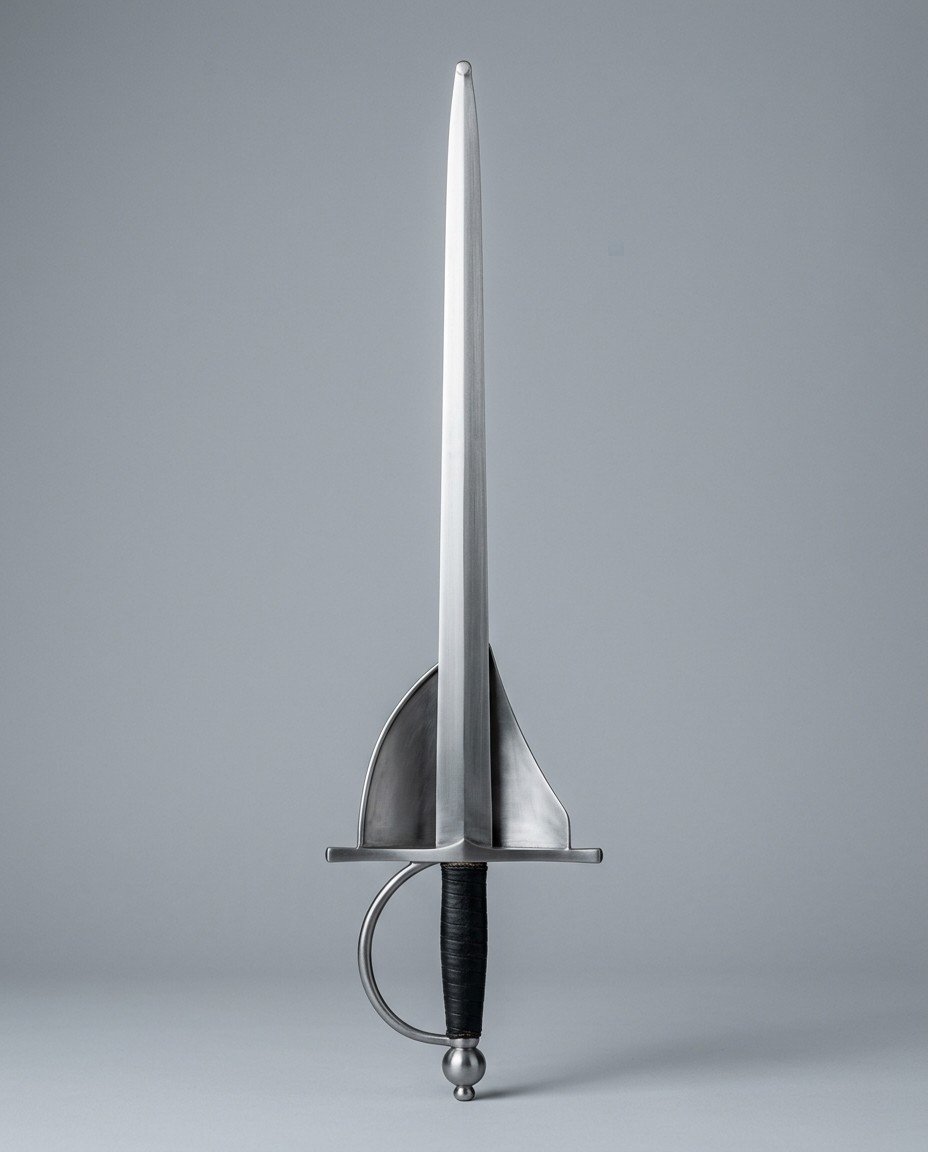
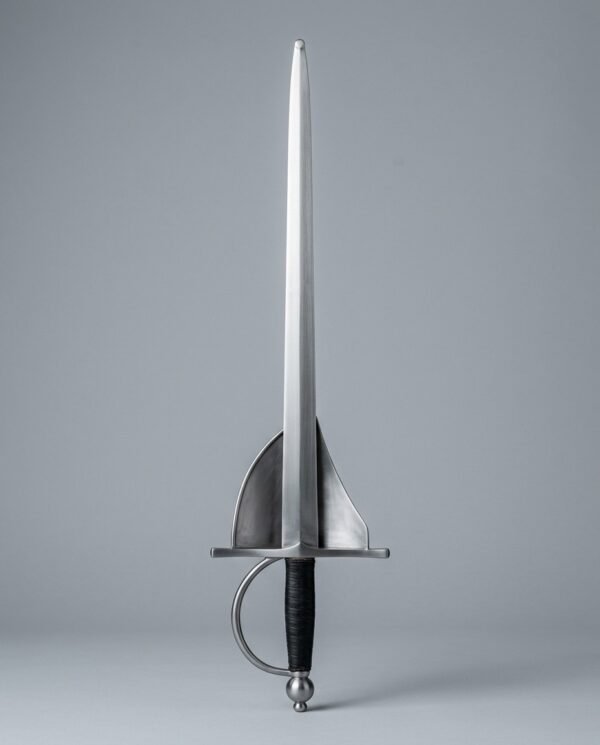
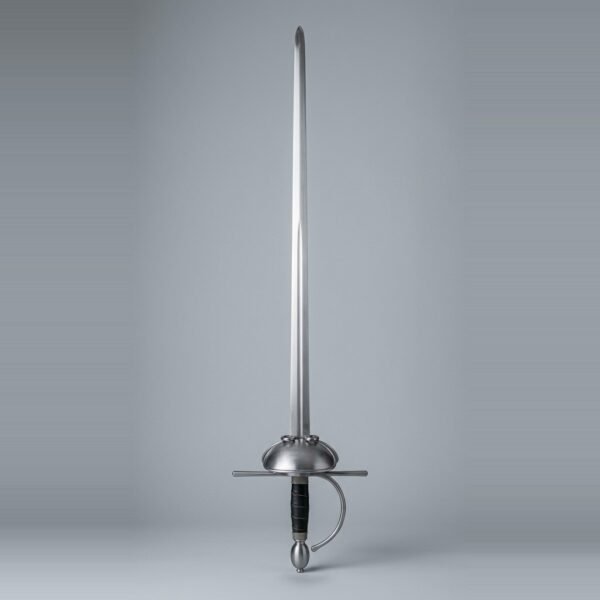
A rapier is a sword built around one idea. The point arrives first, it arrives from further away than the other fencer expects, and everything else on the sword exists to make that happen safely. The Ceravalt is a blunt trainer built on that logic, about 47 inches overall, with a narrow ridged blade and a pair of triangular shell plates standing over the quillon block to keep the hand out of trouble.
Shell plates are the practical answer to the same problem that swept bars solve, and they are a good deal easier to live with in a crowded hall because there is nothing for another blade to hook into. They cover the hand from above and below the quillon block, the quillons run straight out either side, and the ball pommel sits at the back of a leather wrapped grip where its mass does the most good. There is no fuller in this blade. Instead the section is raised into a central ridge, which is the stiffer solution and the right one for a sword that lives on the thrust.
Steel is 51CrV4 hardened to 49 to 52 HRC, the edges are left as a flat blunt land and the point is rolled and flared. If you are choosing between this and a shorter cut and thrust sword, rapier versus sidesword is the honest comparison, and how to choose your first HEMA sword covers the rest. The others are on the HEMA rapiers page.
Specifications
| Material | 51CrV4 spring steel, hardened to 49 to 52 HRC |
|---|
| Overall length | About 47 inches, hand made so it varies a little piece to piece |
|---|
| Blade length | About 39 inches |
|---|
| Blade type | Narrow thrusting blade with a raised central ridge and no fuller |
|---|
| Edge | Blunted, about 3 mm flat land, not sharpened |
|---|
| Tip | Rolled and flared, about 15 mm across |
|---|
| Guard | Paired triangular shell plates set over the quillon block, with straight quillons |
|---|
| Pommel | Ball form, turned and peened over the tang |
|---|
| Grip | Black leather over a shaped core |
|---|
| Flex | Medium, tuned to load on a thrust |
|---|
| Included | Rapier only, no scabbard |
|---|
| SKU | RK-3020 |
|---|
The rapier in the Italian and Spanish schools
Two traditions, two arguments, one sword. The Italian school runs from Camillo Agrippa in 1553 through Salvator Fabris in 1606 and Ridolfo Capoferro in 1610, and its language is measure, tempo and the line. You gain the opponent blade with your forte against his foible, you close the line in which he could hit you, and you go in a single tempo while he is committed to something else. Fabris will have you crouched low and controlling the blade from a long guard. Capoferro gives you the lunge as a decisive act out of a tight stance. Both of them assume a blade long enough and stiff enough to hold a line under pressure, which is what this one is.
The Spanish argument is different in temperament. La Verdadera Destreza, the true art, set out by Jeronimo Sanchez de Carranza in 1582 and developed by Luis Pacheco de Narvaez, works off the imaginary circle, moves in curved steps rather than straight lines, and keeps the arm extended so the point threatens continuously from outside the range at which a committed attack can reach you. It is geometry as fencing theory and it puts even more weight on a stable point. Either way you will be working atajo or the bind, feeling whether the other blade is strong or weak where it crosses yours, and answering by disengage, by cavazione or by closing the line harder. A rapier that wobbles cannot teach any of that.
Shell plates, the ridged blade and the point that leads
Losing the fuller and raising a central ridge instead is the single most important thing about this blade. A fuller lightens a cutting blade by taking metal out of the middle. A ridge does the opposite job, adding depth of section along the centre line so the blade resists bending sideways when it is loaded through the point. Since a rapier spends its working life pushing along its own length while another blade presses against its side, that is exactly the stiffness you want. The blade still tapers hard through the foible so the last third stays quick.
The shell plates cover the hand without the snagging risk of an open swept hilt, which matters more in sparring than it did in the street. Underneath, the steel is 51CrV4 at 49 to 52 HRC, which is softer than the 1095 at 54 to 58 HRC we use on cutting swords, and softer on purpose. A trainer has to bend under load and return to straight, not hold an edge. Now the tip, which is the part that gets people turned away at a gear check. The point here is rolled and flared to about 15 mm across. That clears the 1.5 cm minimum the Berlin HEMA Cup sets for spatulated or rolled tips, and it matters that the tip is flared rather than merely rounded off, because rounded tips are not accepted on rapier and sabre under those requirements. Always read your own event rules. More on all of it in HEMA tournament gear rules.
Engraving, runes and your own design
Use the rune converter on this page to turn a name, a date or a short phrase into Elder Futhark and we will cut it into the steel or the grip. Club names, a founding year, a line from the source you train out of, all of it works.
Engraving is done in the United States after the piece lands in North Babylon, so nothing is cut until you have told us what you want. Text and runes are $19, a symbol is $39 and a family crest is $49. If you would rather have your own design than a rune line, choose your own design in the engraving option above the add to cart button and tell us where it goes. Where a piece already carries an engraved design, your chosen engraving replaces it rather than sitting alongside it. More on the engraving page.
Handling and balance
We do not publish a weight or a point of balance for this rapier. The photograph carries no scale, we have not measured this individual sword, and a number invented for a product page is worse than no number at all. In the hand it is long and point led without being dead at the tip, which is the compromise a good rapier makes. The ball pommel carries enough mass to keep the hilt settled and let the arm hold an extended guard for longer than the blade length suggests. Leather over the core gives more feel than wire does, and the shells sit close enough to the hand that the sword does not feel front heavy at the guard. Expect your forearm to complain for the first few sessions. Everyone new to rapier finds that out.
Care
Rapier blades collect rust at the tip first, because that is the end that touches everything, so wipe the whole blade down after training and pay attention to the last few inches. A thin film of oil before it goes in the bag is enough. The inside of the shell plates traps sweat where it meets the quillon block, so dry under there rather than only wiping the outside. Leather grips want to dry naturally and hate being sealed into a damp case. Check the pommel peen every few weeks, since that peen is what keeps the shells, the quillon block and the grip in compression. Dress any burrs on the edge land with a fine file and keep the land flat. The routine is written out in the blade care guide.
Made in the Czech Republic
Made by hand in the Czech Republic and imported by Ransack Viking. Nothing here is drop shipped out of an importer catalogue straight to a customer. Every one is checked for hilt tightness, pommel seating and blade straightness at our North Babylon, New York warehouse, and ships from there. Shipping in the United States is free, returns run for seven days, and the lifetime warranty against defects in the forging, the grind, the heat treat and the fittings has no end date and needs no receipt.
A note on handmade variation
This is hand forged. It is not machine made, not cast and not bulk produced, so what arrives will not be a pixel for pixel copy of the photograph on this page. Shell plates are raised and fitted by hand, so their exact curve and the way they meet the quillon block differ a little from sword to sword, and leather takes colour unevenly. The steel, the hardness range, the blunt edge land and the rolled tip do not vary, and those are the parts that decide whether it is safe to fence with.
Frequently asked questions
Whether this rapier is sharp
No. The edges are left as a flat blunt land and the point is rolled and flared to about 15 mm. It is a sparring and drill sword. We do make a sharp cup hilt rapier for cutting and it is listed separately with its own description.
Whether the tip meets gear check requirements
The tip is rolled and flared to about 15 mm across, which clears the 1.5 cm minimum set out in the Berlin HEMA Cup requirements, and it is flared rather than simply rounded, since rounded tips are not accepted on rapier under those rules. Your own event may differ, so read its rules.
What flex tier this blade sits in
Medium. A rapier blade has to load on a thrust so the energy goes into the blade rather than into your partner, and that is what this tier does. We give a tier rather than a number in pounds because this blade has not been measured on a rig.
Whether it works for Spanish as well as Italian material
Yes. The length and the stiffness suit both, and nothing about the hilt favours one school. Destreza fencers tend to want a slightly longer blade and this sits comfortably in the usable range.
Whether a scabbard is included
No. It ships as a rapier only and no scabbard is offered for it.
Who this rapier is for
Fencers starting Italian or Spanish rapier who want a trainer that behaves like a real sword, clubs equipping a rapier class, and longsword fencers who want to learn what the thrust actually does.
What is in the box
- The Ceravalt shell guard rapier trainer, blunt, blade about 39 inches
- A warranty card covering the forging, the grind, the heat treat and the fittings, with no end date
- Care notes for the spring steel blade and the leather wrapped grip
- Your engraving already cut into the piece, if you chose one at checkout
Explore the range
Worth seeing the rest. The HEMA rapiers cover cup, shell and swept hilts, the HEMA sideswords are the shorter cut and thrust option, the smallswords and spadroons are what came next, and the HEMA swords hub lists the lot. Reading is collected at the guides hub.
Other pieces in this group
In this part of the line you will also find Corvalde rapier, about 48 inches overall, Velstrand cup hilt rapier, about 47 inches overall, Fenrholt rapier, about 47 inches overall, Skelvard sidesword, about 40 inches overall and Hrafnstede smallsword, about 39 inches overall.
Everything else sits in the HEMA rapier category and in the HEMA sword hub, and the custom sword builder builds to your own numbers.








Reviews
There are no reviews yet