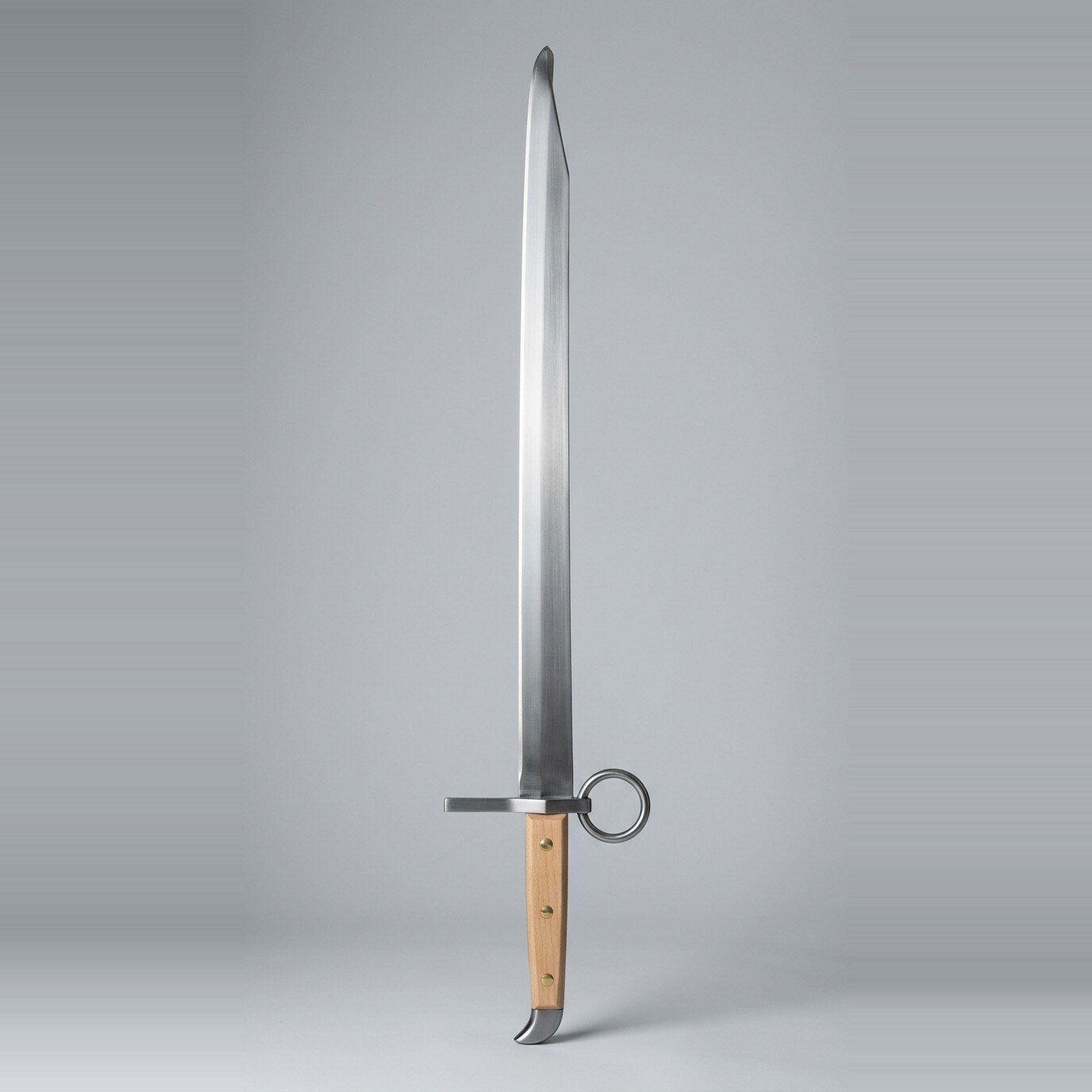
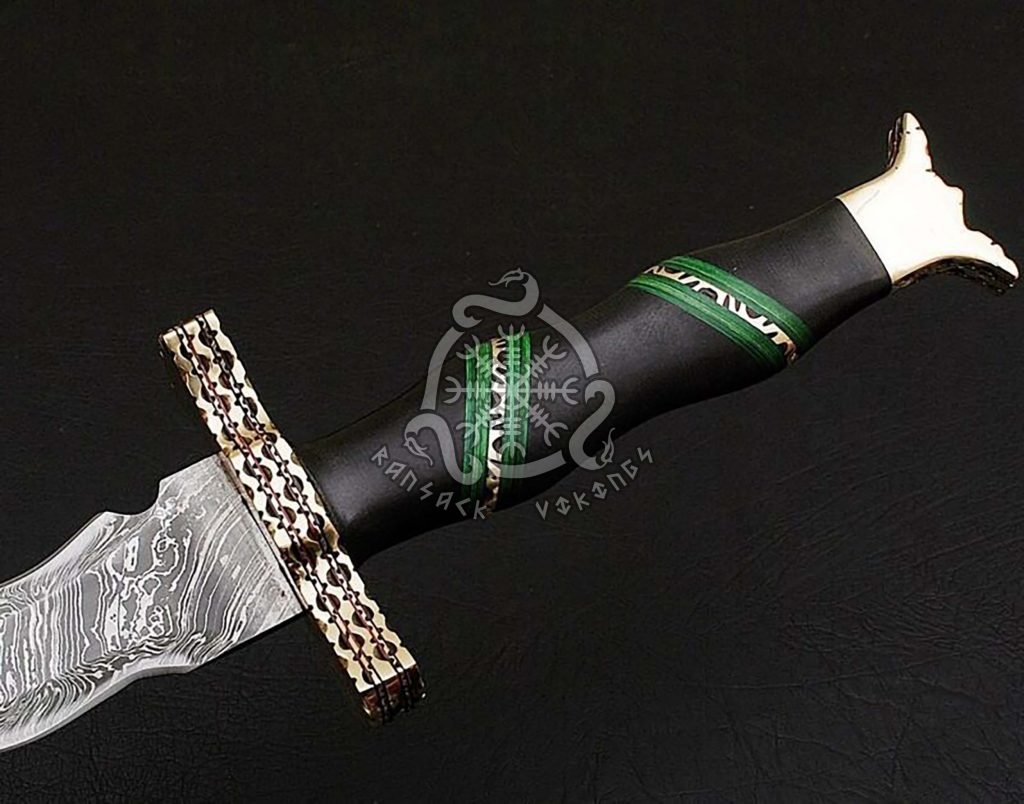
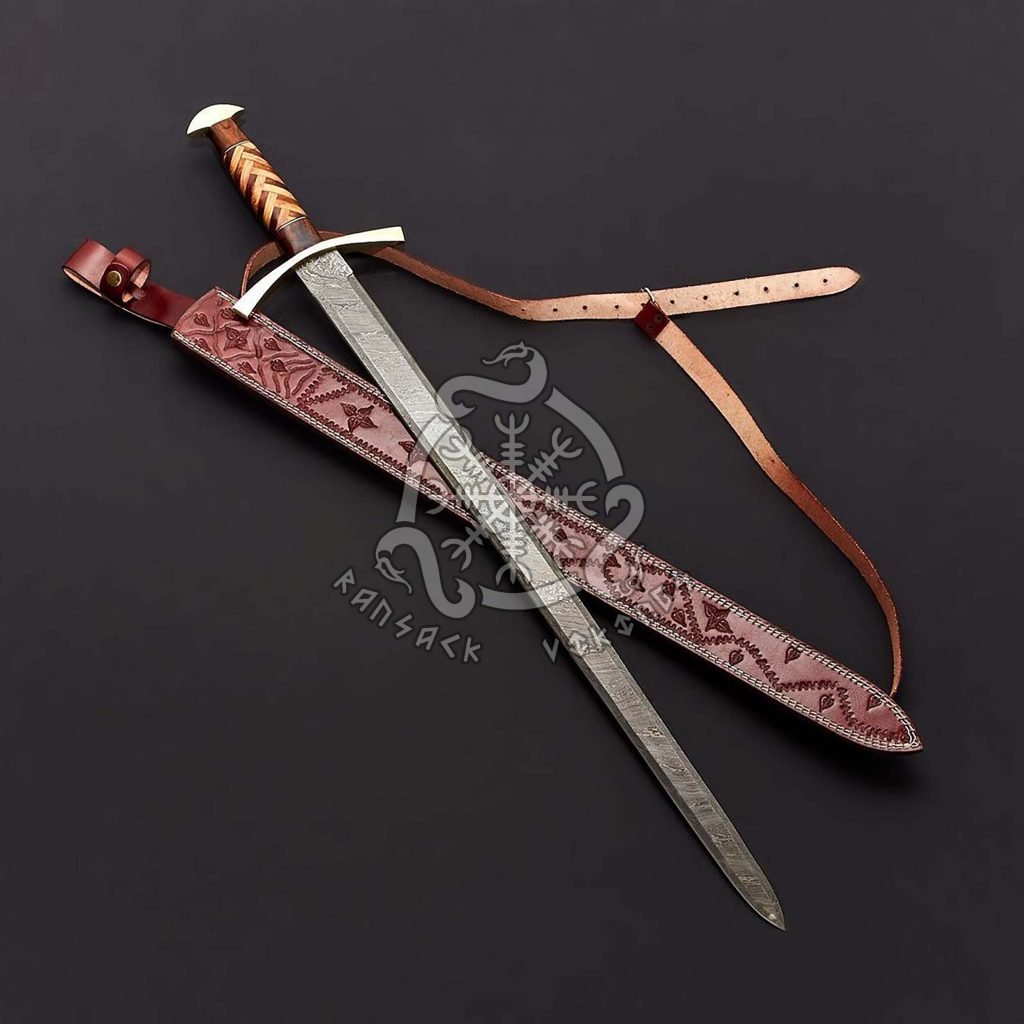
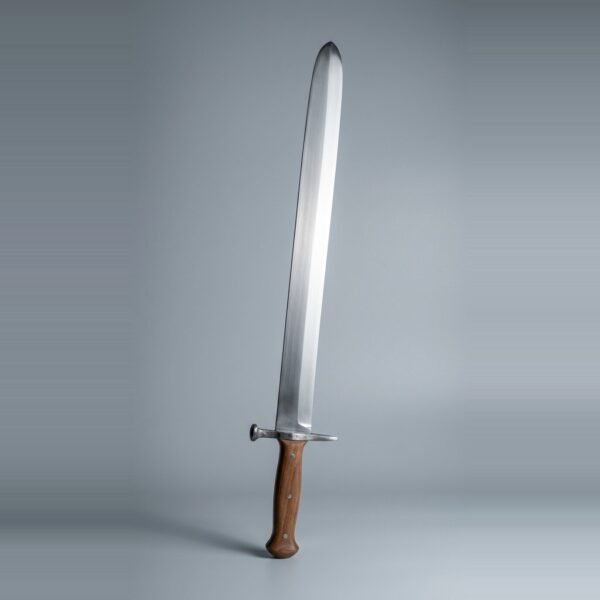
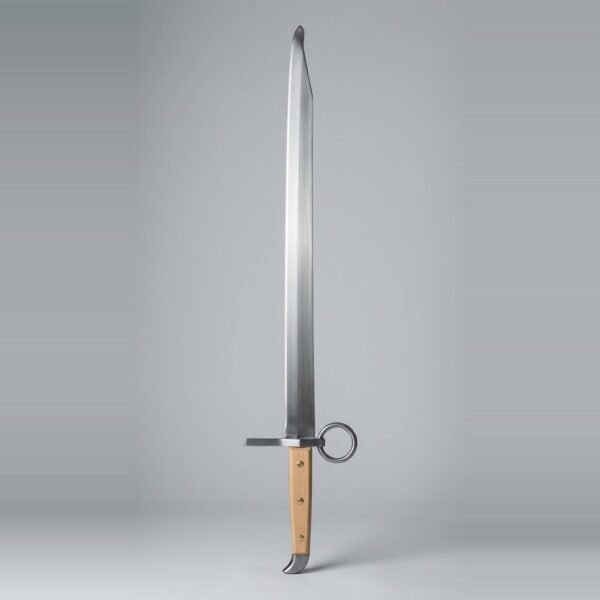
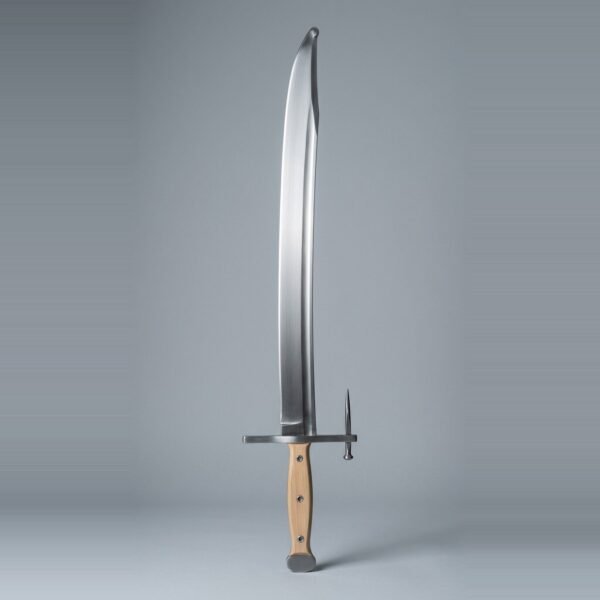
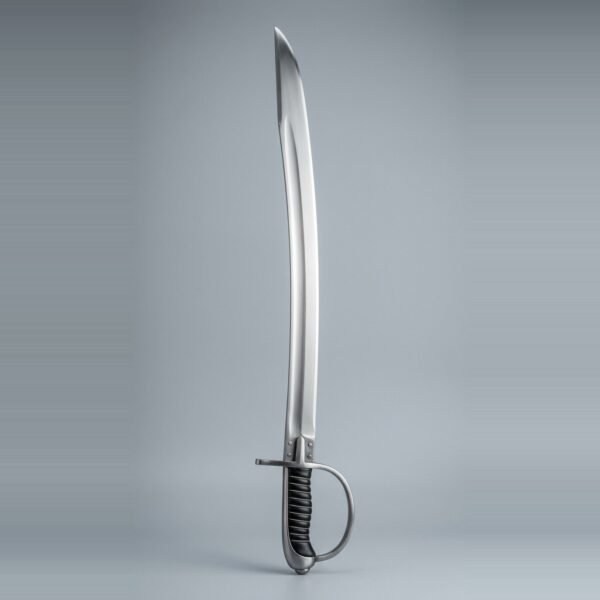
The Brenvald is a langes messer, the long knife of the German speaking lands, built as a blunt trainer in 51CrV4 spring steel. It is single edged with a clipped point, hung on a slab tang with pale wood scales held by three brass rivets, and the butt cap sweeps over into a beak. Out of the flat of the tang stands the nagel, here a ring form, the bar that covers the back of the hand and makes a messer a fencing sword rather than a large knife.
The messer has its own tradition and its own book. Johannes Lecküchner finished his Kunst des Messerfechtens in 1482, the single largest fencing treatise from the medieval German world, and it is all about this blade. Joachim Meyer wrote on it again almost a century later. What both teach is a single edged art built on the same bones as the longsword, with its own names for the strokes and its own answers in the bind, and a strong preference for taking the other hand or arm once you are close.
Read the messer guide and what HEMA actually is before you choose one, then compare across the HEMA messers. Nagel forms and point shapes vary a great deal in that group, and which one you want depends on whether you are drilling Lecküchner plays or Meyer ones.
Specifications
Every length is given as about, because this is ground and fitted by hand. We do not publish a weight or a point of balance, because we will not print a number we have not taken.
| Material | 51CrV4 spring steel, hardened to 49 to 52 HRC |
|---|
| Overall length | About 37 inches, hand made so it varies a little piece to piece |
|---|
| Blade length | About 28 inches |
|---|
| Blade type | Single edged with a clipped point, false edge along the clip |
|---|
| Edge | Blunted flat land, not sharpened |
|---|
| Tip | Blunted at the clipped point, measure it against your ruleset before an event |
|---|
| Nagel | Ring form, standing out of the flat of the tang over the back of the hand |
|---|
| Butt cap | Steel, swept over into a beak |
|---|
| Grip | Pale wood scales riveted to a slab tang with three brass rivets |
|---|
| Flex | Medium tier, stiff through the forte with give in the last third |
|---|
| Included | The messer only. No scabbard |
|---|
| SKU | RK-3006 |
|---|
Lecküchner, the nagel and the langes messer
The nagel is the piece that people new to messer look straight past, and it is the most important fitting on the sword. A messer has no cross, so nothing stops a descending blade from running down onto the hand. The nagel stands out of the flat of the tang to close that gap, and once you understand that, a whole family of plays makes sense. You can catch on it, wind under it, and much of the close work in the sources depends on the hand being covered.
What you drill with it is recognisably the same art as the longsword and pointedly not the same sword. There are master strokes with their own names, there is work in the bind where you feel whether the pressure is hard or soft, and there is a much greater emphasis on grabbing the arm, the wrist or the messer itself once the distance closes. Lecküchner devotes long sections to it. The clipped point matters here too, because it keeps a thrust available on a blade that is mostly about the edge.
Slab tang, riveted scales and the spring in the blade
This is 51CrV4 spring steel hardened to 49 to 52 HRC. Spring steel is chosen because it bends and returns instead of taking a set or snapping under a hard bind. Our sharp messers run 1095 high carbon at 54 to 58 HRC for cutting, and that hardness would be a mistake here, because a trainer is struck far more often than it strikes and needs to give rather than hold an edge.
The construction is the other thing to understand. A messer is not a sword with a hidden tang inside a grip. The tang is a flat slab of the same steel as the blade, the scales sit either side of it, and the rivets pass through everything. That is stronger than it looks and honest, because you can see the whole structure. Brass rivets are traditional and they are soft enough to peen without cracking the wood around them.
Flex on a messer sits in the last third and the forte is stiff, which suits an art that spends a lot of time pressed blade against blade at close measure. The blunted land runs along the true edge, the clip at the point carries a blunted false edge, and the point itself is blunted rather than flared. If your club or event has a tip rule, such as the spatulated or rolled tip of at least 1.5 cm the Berlin HEMA Cup asks for, measure this one first.
Engraving, runes and your own design
Use the rune converter on this page to turn a name, a date or a short phrase into Elder Futhark and we will cut it into the steel or the grip. The wide flat above the nagel takes a rune line cleanly, and the pale wood scales will hold a name or a date cut into the timber if you would rather keep the steel plain. Text and runes are $19, a symbol is $39 and a family crest is $49, all cut in the United States after the piece has landed and been inspected.
If you would rather have your own design than a rune line, choose your own design in the engraving option above the add to cart button and tell us where it goes. Where a piece already carries an engraved design, your chosen engraving replaces it rather than sitting alongside it. More on the engraving page.
Handling and balance
No weight and no point of balance from us. The photographs carry no scale, these are ground by hand, and a printed number would be a guess. What is fair to say is that a single edged blade with a spine carries its mass differently from a double edged one, and a messer of this length tends to feel eager at the point and steady at the hand.
The beak on the butt cap is a working feature. It gives the little finger and the heel of the hand something to lock against, so the messer does not creep forward in a hard cut and you can pull the blade back into a bind without regripping. Wood scales are warmer and drier in the hand than cord, which is part of why the form lasted. Keep the grip relaxed and let the nagel do the covering it was made for.
Care
Spring steel rusts and wood does not like being wet. Wipe the blade down at the end of a session and put a thin film of oil on the steel, keeping it off the scales. If the scales feel dry, a little furniture wax is enough.
Check the three rivets every few sessions. A messer takes a lot of load right at the scales and a rivet that has begun to work loose will show as a faint movement in the wood before anything rattles. Look along the blade for a set that has not come back and take contact burrs off the blunt land with a fine file. The full routine is in the care guide.
Made in the Czech Republic
Made by hand in the Czech Republic and imported by Ransack Viking. Nothing here is drop shipped out of an importer catalogue straight to a customer. Every one is checked for hilt tightness, pommel seating and blade straightness at our North Babylon, New York warehouse, and ships from there. Shipping in the United States is free, returns run for seven days, and the lifetime warranty against defects in the forging, the grind, the heat treat and the fittings has no end date and needs no receipt.
We do not name the workshop and we do not print a town on the box. The same hands make the whole run, the blades reach us in batches rather than by the container, and anything that turns up with a loose hilt or a bend in it goes back. More on the country of origin page.
A note on handmade variation
This is hand forged. It is not machine made, not cast and not bulk produced, so what arrives will not be a pixel for pixel copy of the photograph on this page. Wood is never twice the same, so the grain and the colour of the scales differ from piece to piece, and the ring of the nagel is bent and fitted by hand rather than cast.
Grain in the wood, the turn of a finial and the shade of the cord all move a little from piece to piece, and lengths are given as about because a hand made blade is ground to a shape rather than to a tolerance band. None of that is a defect. What is covered, for as long as you own it, is a failure in the forging, the grind, the heat treat or the fittings.
Frequently asked questions
Whether this messer is sharp
No. It is a blunt trainer with a flat land along the true edge, a blunted false edge on the clip and a blunted point. Our sharp messers are listed separately and are built in 1095 high carbon.
What the nagel actually does
It covers the back of the hand on a sword that has no cross, and it is a working part of the technique. Plays in the sources catch, wind and bind against it rather than treating it as a guard alone.
Whether a messer is just a big knife
No. It is a fencing sword with its own treatise tradition, its own named strokes and its own close work. The construction is knife like and the art is not.
Whether it can be used in tournaments
Read the ruleset for your event. Messer events differ on nagel size, point shape and tip requirements, and this point is blunted rather than spatulated or flared.
Whether a scabbard is included
No. Nothing in the HEMA range ships with a scabbard. You get the messer, oiled and wrapped.
Whether it can be engraved
Yes. Runes, a name, a date or your own design, cut in the United States after the piece arrives and is inspected. Text and runes are $19, a symbol is $39, a family crest is $49.
What is in the box
- The Brenvald langes messer trainer, one piece, slab tang, blunt.
- A light film of protective oil on the blade for the journey.
- A printed care and storage card with the wipe down routine.
- Your lifetime warranty record against defects in the forging, grind and fittings.
Explore the range
Work through the HEMA messers, look at the HEMA sabres and the dussacks beside them for the curved single edged material, go up to the longswords for two hand work, or browse the HEMA sword hub. Start at the guides if you are undecided.
Also in this part of the catalogue
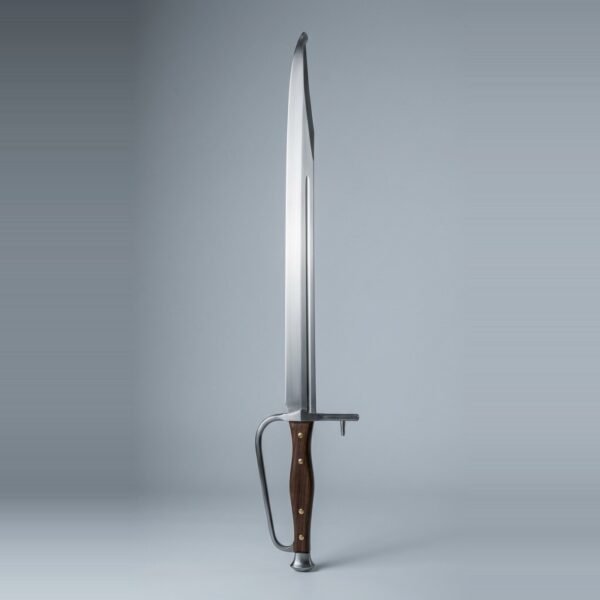
Sitting alongside it in the catalogue are Brunhak langes messer, about 37 inches overall, Torvhaug sharp langes messer, about 37 inches overall, Jarnfeld sharp langes messer, about 38 inches overall, Kaldrast hanger sabre, about 36 inches overall and Mirlaug arming sword, about 37 inches overall.
See the HEMA messer category and the HEMA sword hub for the full spread, and the custom sword builder if none of them is right.








Reviews
There are no reviews yet