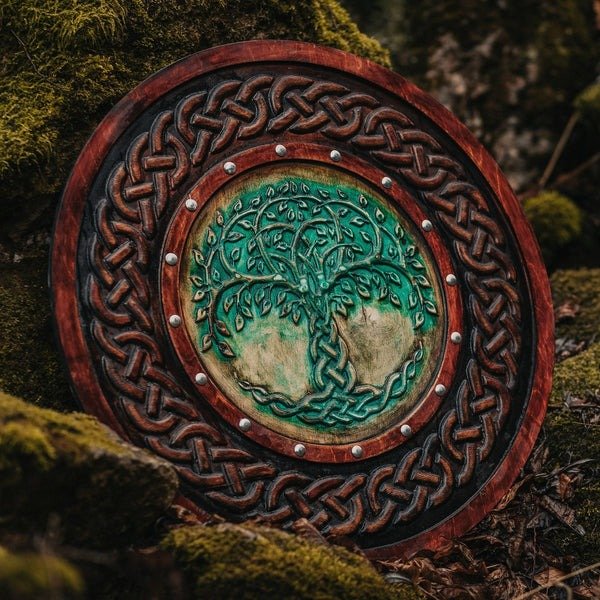
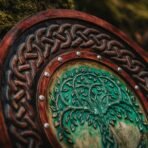
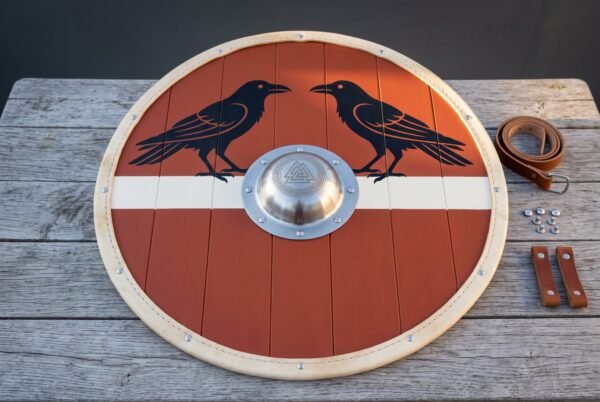
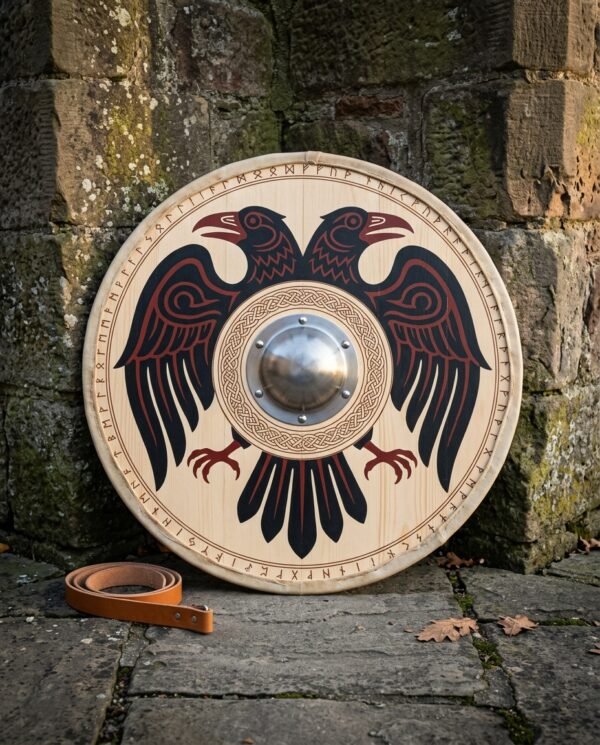
The Yggdrasil is a 24 inch round Viking shield with a plywood body and a carved Norse tree of life across the face, made for wall display in a home bar, a study, a games room or a hall. It is a decorative piece and we are going to be straight about that throughout, because a shield you hang on a wall and a shield you stand behind are two different objects and there is no honest way to pretend otherwise. What the tree meant to the people who carved it is set out in Yggdrasil and the nine worlds.
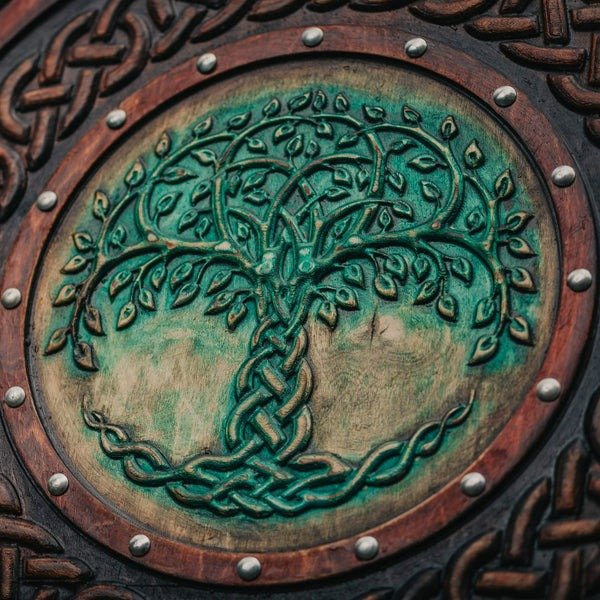
The tree on the face is Yggdrasil, and it is the structural centre of the entire Norse cosmos. The sources describe an immense ash with three roots running to three different worlds, each ending at a well. One reaches Asgard and the well of Urd, where the Norns sit and water the tree with white clay to stop it rotting. One reaches Jotunheim and Mimir well, the water Odin bought a drink of with his eye. One reaches Niflheim and Hvergelmir, where the serpent Nidhogg gnaws at the root from below. An eagle sits at the top, four stags browse the branches, and a squirrel called Ratatoskr runs the full height of the trunk carrying insults between the eagle and the serpent, which is one of the more human details in the whole mythology. The name itself probably means the horse of Ygg, Ygg being Odin, a grim kenning for the gallows he hung from to win the runes.
Every Yggdrasil shield is cut, carved, finished and packed in a Czech Republic workshop. Shipping inside the United States is free, processing takes one to two weeks, and returns are accepted within seven days.
Specifications
| Body | Plywood |
|---|
| Diameter | 24 inches |
|---|
| Face | Carved Norse tree of life, hand finished |
|---|
| Intended use | Wall display, photography and costume |
|---|
| Engraving | Available on request |
|---|
| SKU | RK-636 |
|---|
What a real Viking shield was made of
We know a good deal about Norse shields, and almost all of it comes from two finds. The Gokstad ship burial in Norway, dated to around 890, was excavated in 1880 with sixty four shields still hanging along the sides of the ship. They were round, roughly 94 centimetres across, which is a little over 37 inches, and they were built from thin butted planks about seven millimetres thick. Painted alternately black and yellow. In 2008 a shield was recovered at Trelleborg in Denmark, again round, again planked, about 85 centimetres across and made of fir.
Two things about that construction surprise people. The first is how thin those boards are. Seven millimetres of softwood is not armour in any modern sense, and it was never meant to be. A Viking shield was a consumable. It was expected to catch a blade, split, bind the blade in the split, and be replaced. The second is the centre. There is a round hole cut through the middle of the boards, a single horizontal handgrip across the back of it, and a domed iron boss riveted over the front covering your knuckles. That is the whole grip system, and it is why Norse shields are held in the centre at arm length rather than strapped to the forearm like a later medieval shield.
The rim is the part most reproductions get wrong. Edges were bound, with rawhide or leather stitched around the circumference, because an unbound plank edge splits from the first impact. Iron clamps appear on some finds. The Icelandic law code Gragas even legislated shield construction for duelling, which tells you the specification was a matter people argued about.
Material, construction and honest proportions
This shield has a plywood body rather than butted softwood planks. Plywood is the right answer for a display piece and here is why. Cross laminated veneers do not split along a grain line the way a solid plank does, they are dimensionally stable across seasons in a heated house, and they hold a carved relief cleanly without the carving opening up as the wood moves. A planked shield made the historical way needs a rawhide binding and periodic attention. A plywood one hangs on a wall for twenty years and does nothing.
At 24 inches across it is also deliberately smaller than the archaeology. The Gokstad shields are around 37 inches and the Trelleborg one is around 33. A shield at that scale dominates a domestic wall and is genuinely awkward to hang. Twenty four inches reads unmistakably as a Viking shield, sits well above a bar or a fireplace, and does not need two people and a stud finder. If you are buying for strict reenactment rather than display, that size difference is the thing to be aware of before you order.
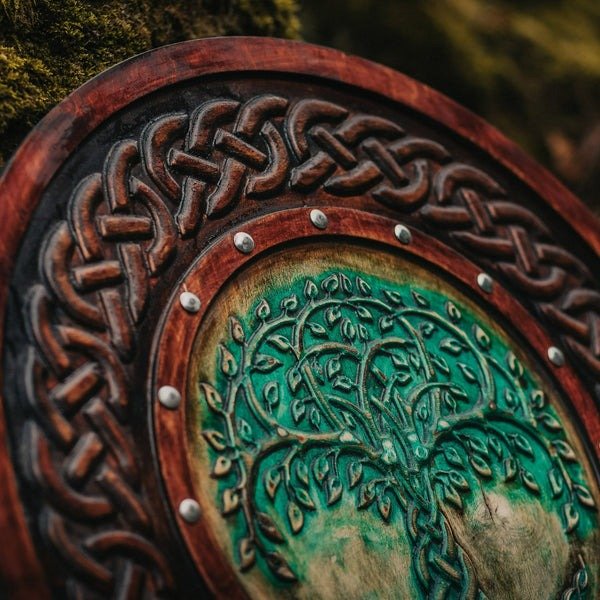
The face is carved and then finished by hand, which means the depth of the cut and the way the finish sits in the recesses varies slightly from one shield to the next.
Why wood and not steel
People occasionally ask why a shield is not made of metal, and the Norse answer is better than the modern one. A steel plate the size of a shield is enormously heavy, it rings and transmits shock straight into your arm, and it deflects a blade rather than catching it. Wood does something cleverer. It is light enough to move quickly, it absorbs and deadens an impact instead of passing it on, and when a blade does bite it grips the edge and holds it, which takes the blade out of the fight for a moment. Every shield tradition that had access to iron still made the body out of wood and put the iron only where it was needed, at the boss and the rim. If you want the metallurgy behind the rest of our range, it is in Damascus versus stainless.
Engraving, runes and your own design
Use the rune converter on this page to turn a name, a date or a short phrase into Elder Futhark and we will cut it into the steel or the handle. If you would rather have a Viking pattern than a rune line, choose your own design in the engraving option above the add to cart button and tell us whether it goes on the blade or the handle. Where a piece already carries an engraved design, your chosen engraving replaces it rather than sitting alongside it. That matters particularly here, because this shield already carries the carved tree across the face. A chosen design is cut in place of it rather than crowded around it, while a short rune line can usually sit on the rim without disturbing the tree. Tell us which you want at checkout, or see the engraving page.
Care and upkeep
Wood on a wall is a low maintenance object but not a zero maintenance one. Dust the carved face with a soft dry brush rather than a cloth, because a cloth catches on the relief and lifts fibres out of the deeper cuts. Keep it out of direct sunlight, which fades finishes and darkens exposed timber unevenly over a couple of years, and away from a working fireplace or a radiator, where repeated drying cycles will eventually open a check in any wood.
Do not use a household spray polish or anything containing silicone. If the finish looks tired after some years, a very light wipe of furniture wax with a soft cloth brings the depth back. Never wash it. There is no steel on this piece to oil and no edge on it to sharpen, but the care notes for the bladed part of the range are in steel care and sharpening with a whetstone if you own those as well.
Made in the Czech Republic
This is a handmade piece from the Czech Republic, made in a workshop that still forges, grinds and finishes by hand instead of stamping parts out. The smiths there have kept the older way of working, and the wood, horn and leather are shaped and fitted by hand as well. Two pieces of the same design will never be identical, and that is part of what you are buying.
Ransack Viking is a United States company. We handle the import ourselves, look over every piece when it lands and ship from our warehouse in Memphis, Tennessee. Engraving is done in the United States after the piece arrives, so your design goes on before we send it out.
A note on handmade variation
This shield is made by hand. It is not machine made and it is not bulk produced, so what arrives will not be a pixel for pixel copy of the photograph. The depth of the carving, the way the finish pools in the recesses, the tone of the timber and the precise line of the branches all vary, because each face is worked by hand. The diameter, the construction and the design are the same every time. The character is not, and small differences from the photograph are the evidence that a person cut it.
Frequently asked questions
Can I use this in reenactment fighting?
No. It is built for wall display, photography and costume. It is not combat rated equipment and should never be used to take a strike.
How do I hang it?
Most people use two heavy duty picture hooks or a plate hanger sized to the rim, fixed into a stud or a proper wall anchor. Message us before ordering if you need to know exactly what fixing points are on the back of the current batch.
Why is it 24 inches when real Viking shields were bigger?
Because it is made for a wall rather than a shield wall. The Gokstad shields are around 37 inches across, which is enormous in a living room. Twenty four inches keeps the proportions readable and stays practical to hang.
Is the tree carved or printed on?
Carved. The relief is cut into the face and then finished by hand, which is why the depth varies a little between shields.
What actually is Yggdrasil?
The world tree of Norse cosmology, described as an ash, with three roots reaching three worlds and three wells. An eagle sits at the top, the serpent Nidhogg gnaws the root, and the squirrel Ratatoskr carries insults between them.
Will it warp in a humid room?
Plywood is far more stable than solid planking, which is a large part of why it is used here. Keep it out of direct sun and away from a heat source and it will stay flat.
What is in the box
- One Yggdrasil carved Viking shield, 24 inch diameter
- Protective packaging
- Forged and finished in the Czech Republic
Explore the range
Related collections: Viking Shields, Viking Helmet, Viking Axes and Viking Beer Mugs. The Norse background reading sits in the guides.









Reviews
There are no reviews yet