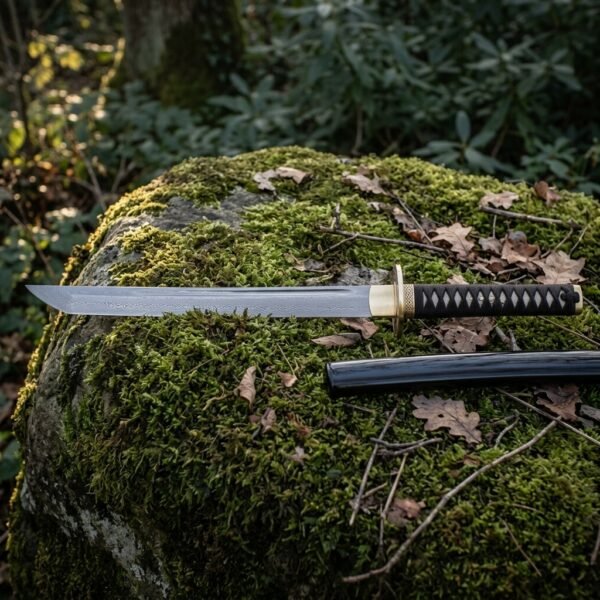
The Japanese swords here cover the katana, the wakizashi that partners it, the tanto, the straight bladed ninjato and matched daisho sets. Every piece is hand forged and single edged, mounted the traditional way with a cord wrapped tsuka over a textured underlay, a tsuba at the guard and a fitted wooden saya. Several arrive with blade oil, a cleaning cloth and a care card.
Two steels run through the group. Plain 1095 high carbon is hardened to 54 to 58 HRC, and one piece here is edge hardened to 58 HRC over a softer spine. Damascus katana are 1095 and 15N20 forge welded, folded and acid etched at 58 to 60 HRC, which is where the layered pattern in the steel comes from. Katana run about 36 to 40 inches in the saya with 26 to 28 inches of blade measured from the habaki, at roughly 2 lb 6 oz to 2 lb 10 oz bare. Wakizashi run 26 to 30 inches sheathed with 18 to 20 inch blades.
Settle on the length first, then on whether you want a plain polished blade or the Damascus pattern.
Free US shipping
On most pieces. Heavier and oversized ones carry a flat charge.
Hand Forged
Heated, hammered and ground by hand.
Engraving available
Names, dates or Norse runes on most pieces.
Ships from New York
Inspected and dispatched from our New York warehouse. No import duty, no customs delay on US orders.
Katana & Japanese Swords
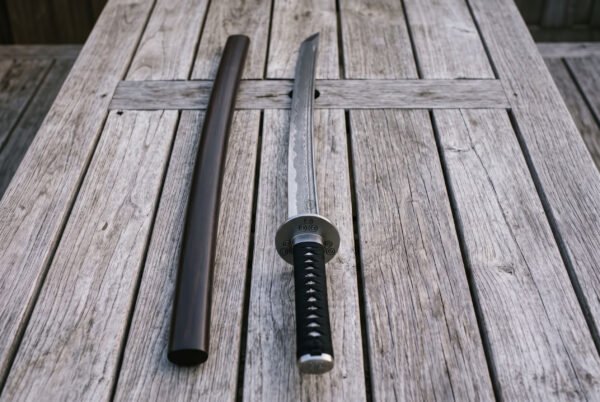
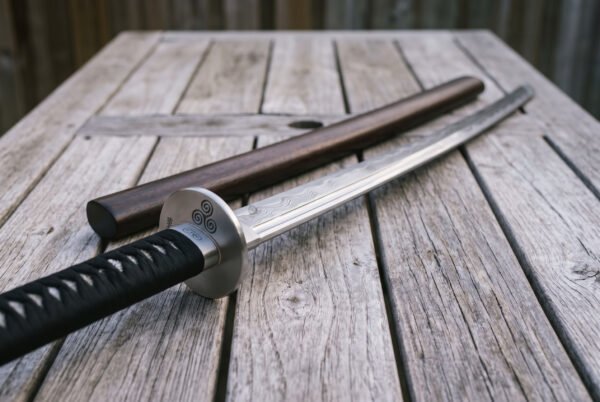
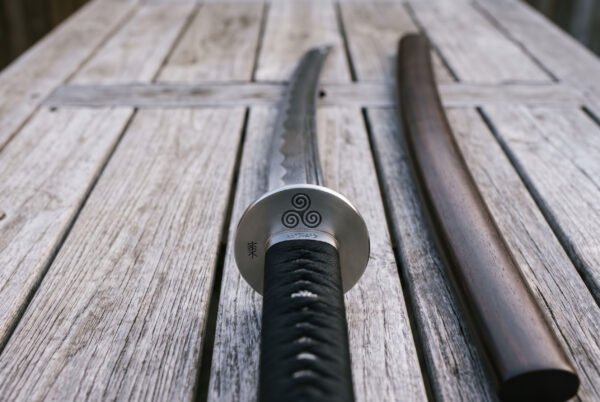
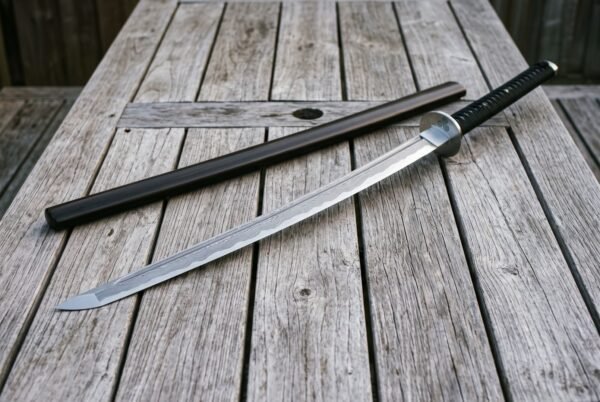
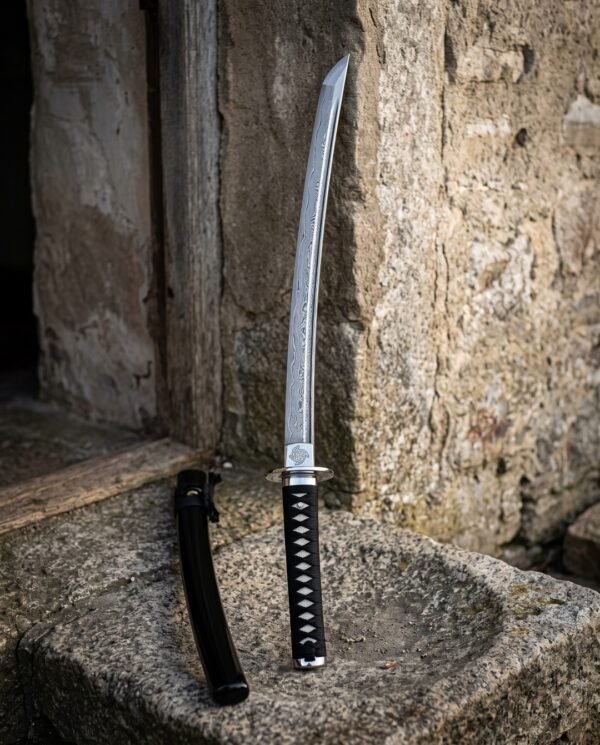
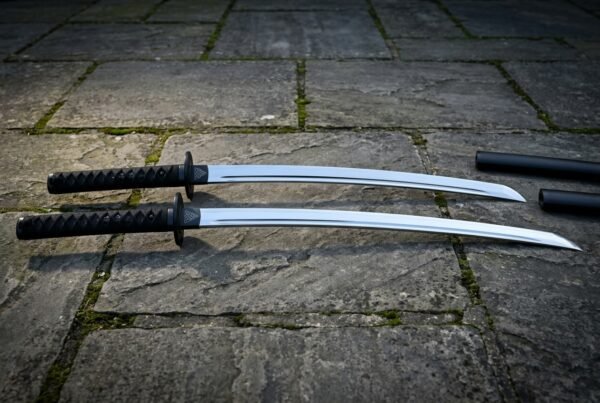
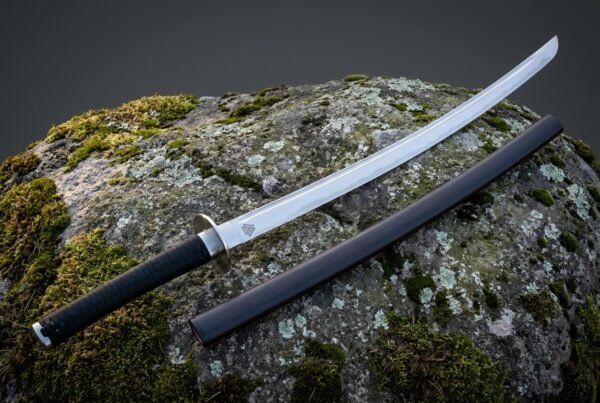
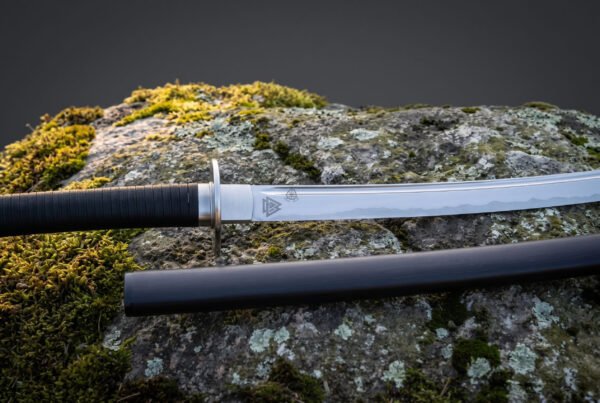
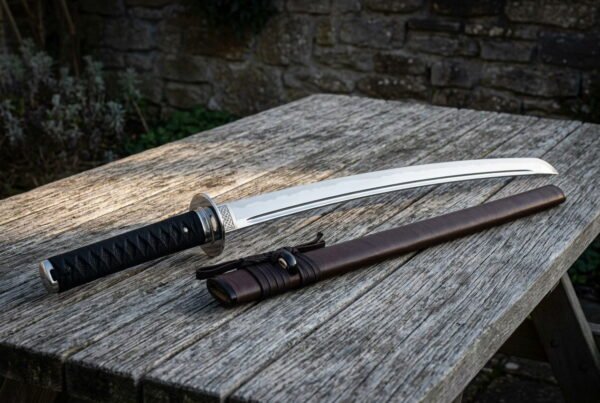
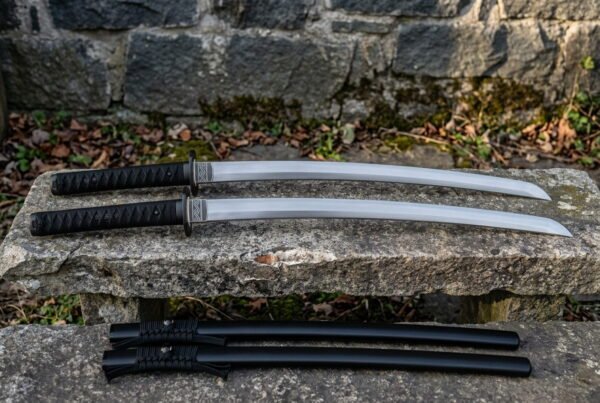
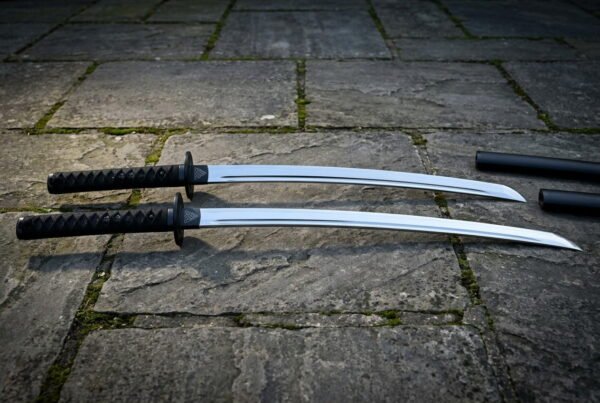
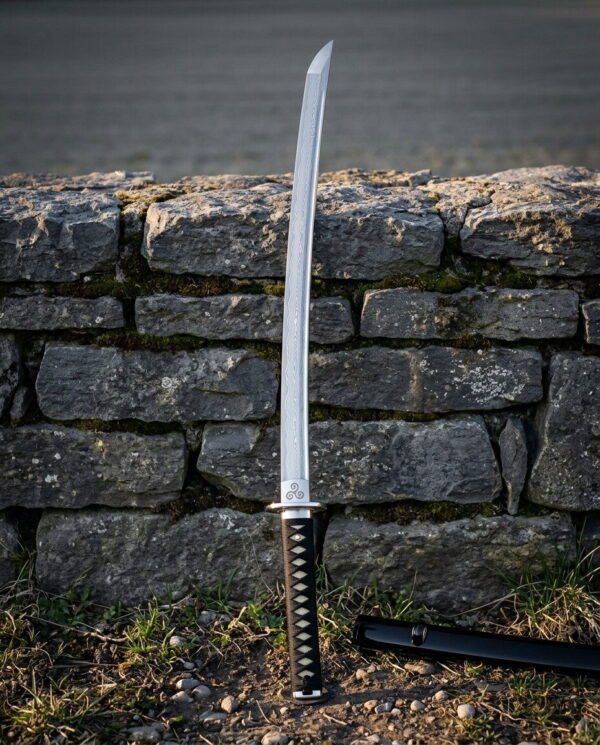
What makes a Japanese sword a Japanese sword
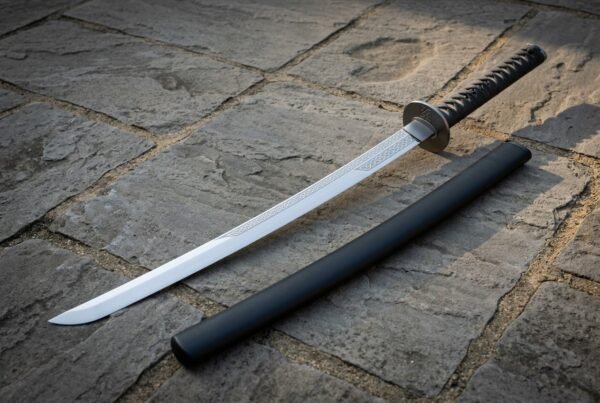
The defining feature is not the curve. It is that the blade is single edged with a ridge line running down each face, the shinogi, which divides the flat of the blade from the bevel that carries the edge. That ridge gives a cross section which is thick and stiff along the spine and thin where it cuts, so the blade holds a very fine edge without being fragile through its body. Almost every Japanese blade form, from the tanto up to the tachi, is built on that same section.
The curve, the sori, comes second and follows from how the sword is used. A curved edge meeting the target at an angle slices as it lands instead of chopping, and it draws itself through the cut as the arms extend. A curve also lets a long blade come out of a scabbard worn edge up in one motion, which a straight blade of the same length cannot do.
The third element is the mounting. A Japanese sword is a set of separate parts held together by a bamboo peg through the tang: the habaki collar that locks the blade into the scabbard, the tsuba guard, the spacers either side of it, the tsuka handle with its cord wrap over a textured underlay, and the saya. That is why the sword can be dismantled with a small hammer and a punch, and why a Japanese blade is measured from the habaki rather than from the guard.
The pieces on this page follow that architecture. They are hand forged interpretations built to the same geometry and mounted in the same way, not reproductions of a named historical smith's work, and none of them is presented as one.
The blades on this page
Five forms cover the whole category. The difference between them is mostly length, and in Japan length was the legal definition rather than a matter of taste.
Katana
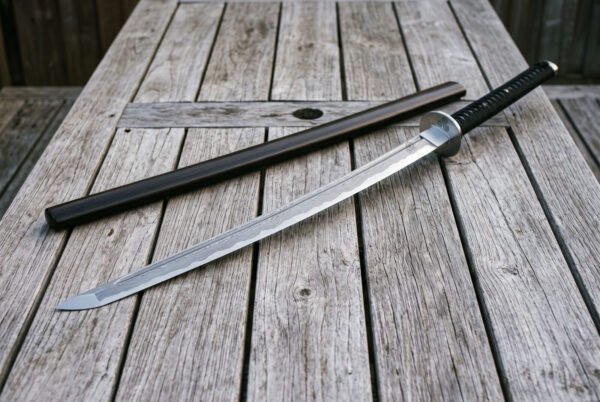
The long blade of the pair, worn edge up through the sash. Katana here run about 36 to 40 inches in the saya with 26 to 28 inches of blade measured from the habaki, and the listings that state a weight give 2 lb 6 oz to 2 lb 10 oz bare, or 3 lb 4 oz to 3 lb 6 oz with the scabbard. Tsuka length is around 10 to 11 inches, which is a genuine two handed grip rather than a hand and a half. Some carry a bo hi, the long groove down the flat, which lightens the blade and gives the audible note people associate with a swing.
Wakizashi
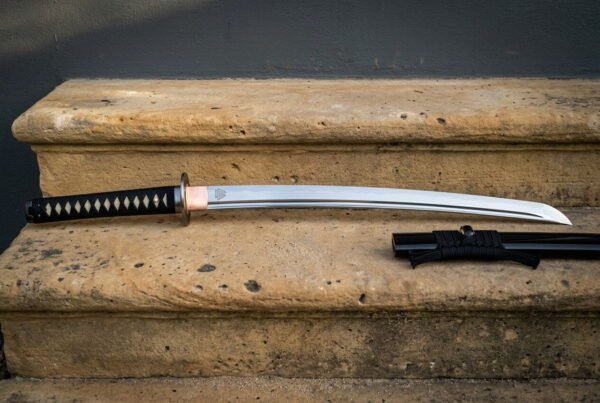
The companion blade, between about 12 and 24 inches of edge by the historical definition. The pieces here run 26 to 30 inches in the saya with 18 to 20 inch blades, at about 1 lb 12 oz to 1 lb 15 oz without the scabbard. A wakizashi was the sword worn indoors and the one a person kept when the long blade was left at the door, which is why so many surviving examples are more decorated than the katana they partnered.
Tanto
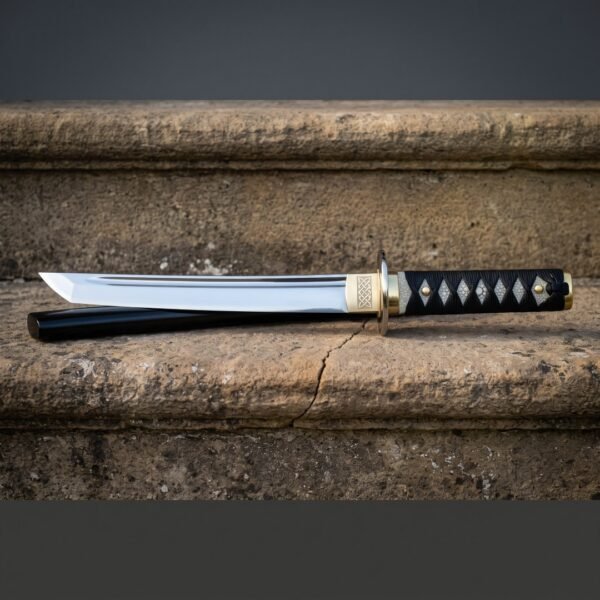
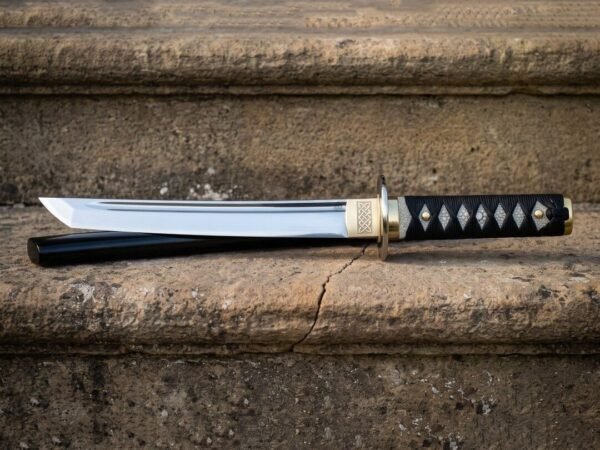
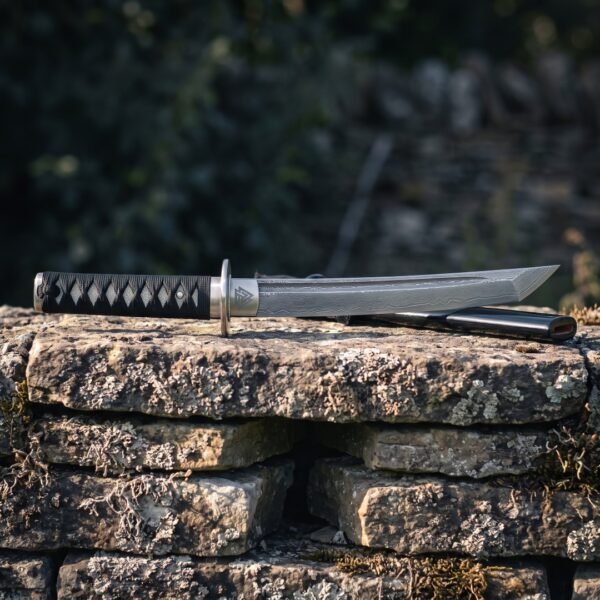
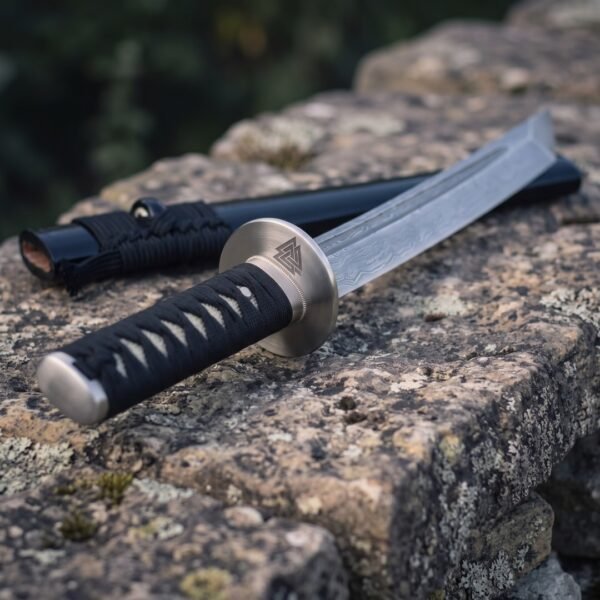
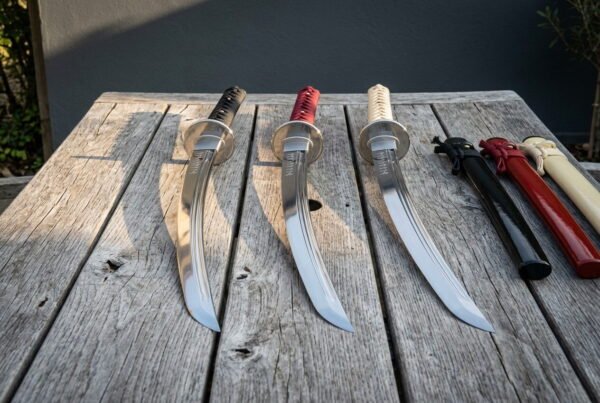
The short blade, under about 12 inches of edge, with the same shinogi section and a reinforced point. Tanto here are mounted in full Japanese fittings, with cord wrapped handles over pale rayskin and fitted black scabbards, in both polished steel and Damascus with an etched blade panel. A tanto is the easiest piece in this group to display on a shelf rather than a wall.
Ninjato
The straight bladed sword of popular culture rather than of the archaeological record. There is no surviving evidence for a distinct straight ninja sword, and honest sellers say so. What these are is a clean straight blade in Japanese fittings, about 35 inches overall with a 24 inch blade, usually with a square tsuba and a plain black cord wrap. Buy one because the look appeals, which is a perfectly good reason.
Daisho and matched sets
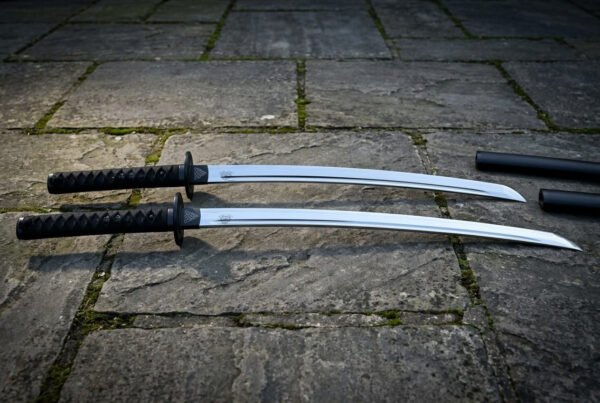
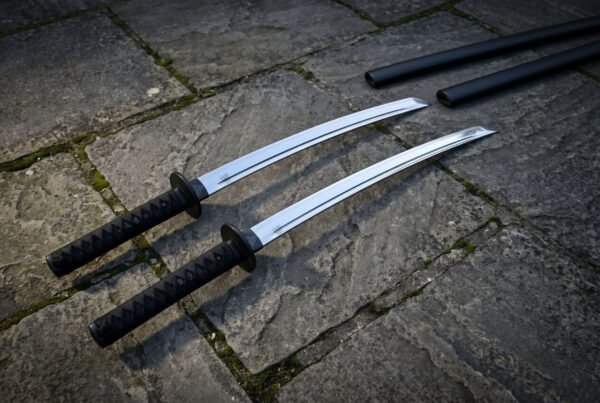
Daisho means large and small, and refers to a katana and wakizashi mounted as a pair with matching fittings. Sets here come as two swords with two scabbards, sometimes as three, and the blades are near matched rather than identical because each is forged and ground by hand. A twin set on a two tier stand is the most complete looking display in the whole sword range.
Hand forged Damascus and plain high carbon
Two steels are presented as a house standard across this site. Plain 1095 high carbon is hardened to 54 to 58 HRC. Damascus of 1095 and 15N20 is forge welded in alternating layers, drawn out, folded and acid etched, and hardened to 58 to 60 HRC. One wakizashi here states something different in its own specification table, 1095 edge hardened to 58 HRC over a softer spine, and that table is the accurate answer for that piece.
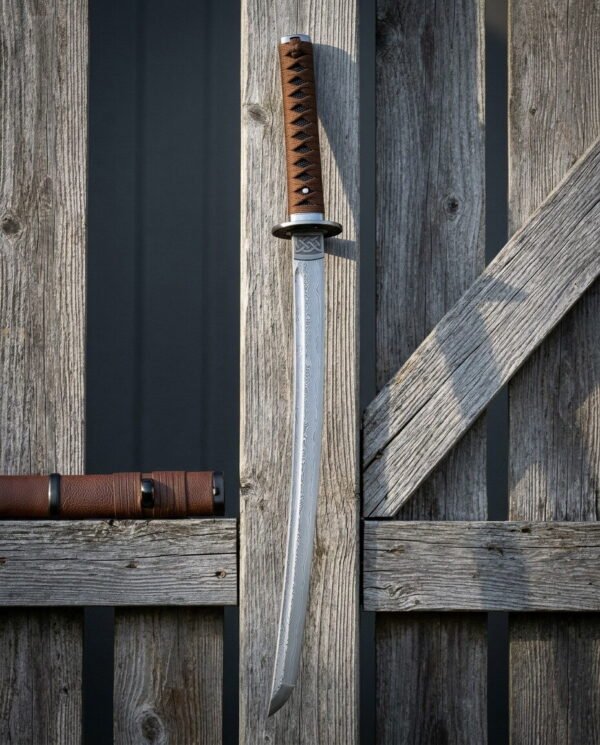
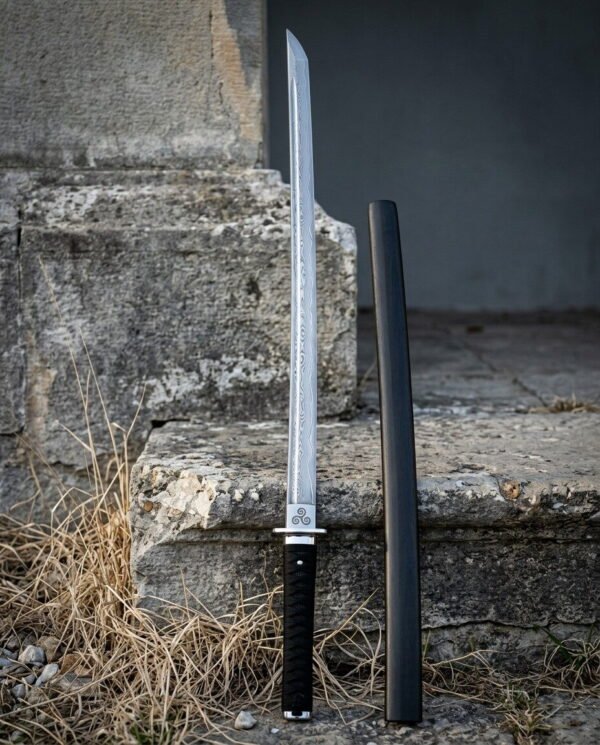
A Damascus katana gets its pattern from nickel. 15N20 carries roughly two percent of it and 1095 carries none worth mentioning, so when the finished blade is etched the 15N20 layers stay bright and the 1095 layers go dark. The pattern you see is the cut edge of every fold, opened up by the grinder and brought out by the acid. It is not a hamon and it is not the same thing as a traditional folded tamahagane blade, which is a different material made by a different process.
For a hand forged katana in plain 1095, the trade is the familiar one. Lower hardness means more toughness through a long blade and a faster return on a stone, at the cost of some edge retention. Damascus at 58 to 60 HRC keeps its edge longer and gives you the figure in the steel, which on a sword that will live on a stand is usually the point. Neither steel is stainless. Both will rust if left wet.
Lengths, weights and fittings across the range
Every figure below is taken from the specification panel of a product on this page. Nothing is estimated, and a blank is shown as not listed rather than filled in.
| Piece | Overall length | Blade length | Steel and hardness | Weight | Fittings |
|---|---|---|---|---|---|
| Mistfold Damascus katana | About 40 in sheathed | About 27 in | Damascus at 58 to 60 HRC | 2 lb 10 oz bare, 3 lb 4 oz sheathed | 11 in tsuka, wooden saya, cloth and oil |
| Jadewake Damascus katana | About 40 in in the saya | About 28 in from the habaki | Damascus at 58 to 60 HRC | 2 lb 10 oz bare, 3 lb 6 oz with saya | 11 in tsuka, green cord, hardwood saya |
| Emberfold Damascus katana | About 40 in in the saya | About 27 in from the habaki | Damascus at 58 to 60 HRC | Not listed | Lacquered black saya |
| Jadecord katana | About 40 in in the saya | About 28 in with a shinogi ridge | 1095 high carbon | About 2 lb 6 oz without the saya | 11 in tsuka, green ito, oil and care card |
| Valkcurve katana | 40 in in the saya | 28 in from the habaki | 1095 high carbon | About 2 lb 6 oz without the saya | Charcoal lacquered saya |
| Inkwake katana | About 36 in | About 26 in | 1095 high carbon | Not listed | 10 in tsuka, black cord over white rayskin |
| Inkfold Damascus wakizashi | 28 in in the saya | 19 in along the curve | Damascus at 58 to 60 HRC | About 1 lb 12 oz bare | Fitted saya |
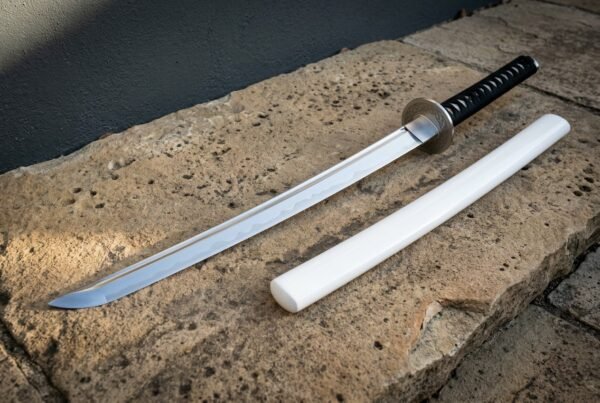
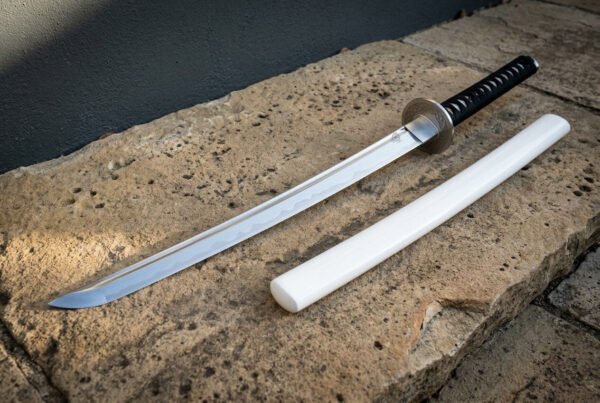
| Snowfold wakizashi | 30 in in the saya | 20 in from the habaki | 1095 high carbon | About 1 lb 15 oz without the saya | Gloss white saya |
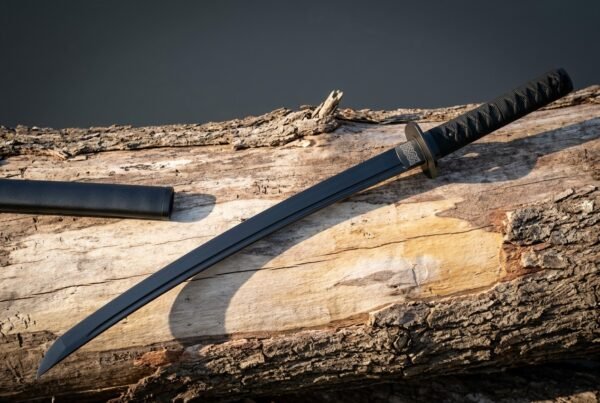
| Moonwake wakizashi | About 26 in in the saya | About 18 in from the habaki | 1095 edge hardened to 58 HRC, softer spine | Not listed | Lacquered black saya |
| Blackreed ninjato | About 35 in | About 24 in | 1095 high carbon | Not listed | Black cord wrapped tsuka, fitted saya |
Read those overall figures carefully. A Japanese sword is almost always quoted in its scabbard, and the blade is measured from the habaki collar rather than from the guard, so a katana listed at 40 inches overall has a 27 or 28 inch blade rather than something close to 40. Compared against a western sword quoted guard to point, the same number means a very different piece.
The mounting and what arrives with the sword
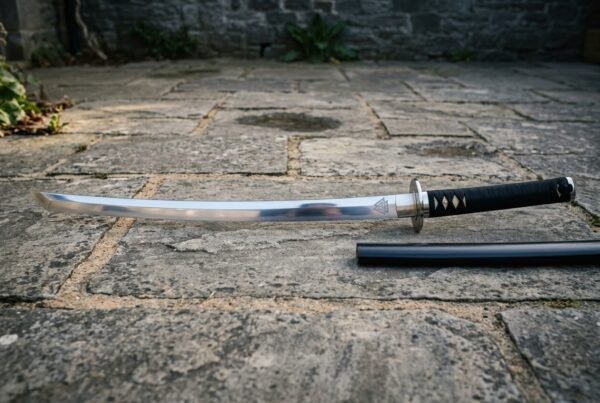
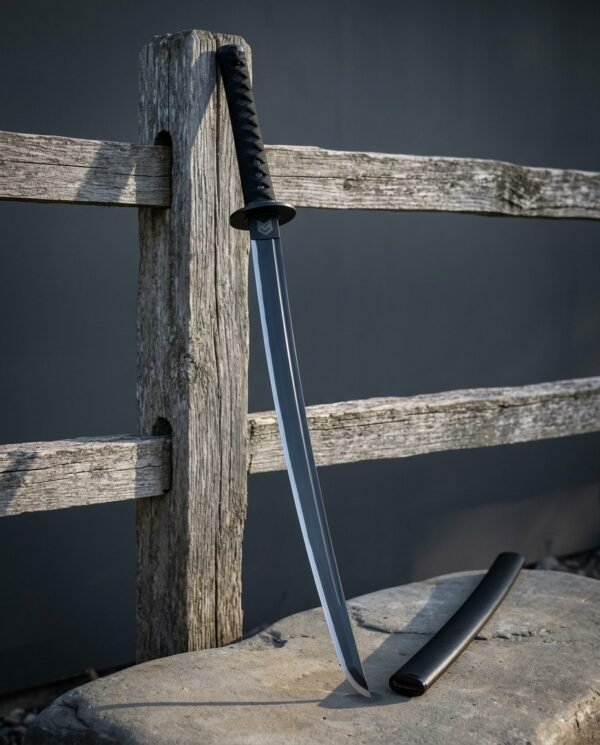
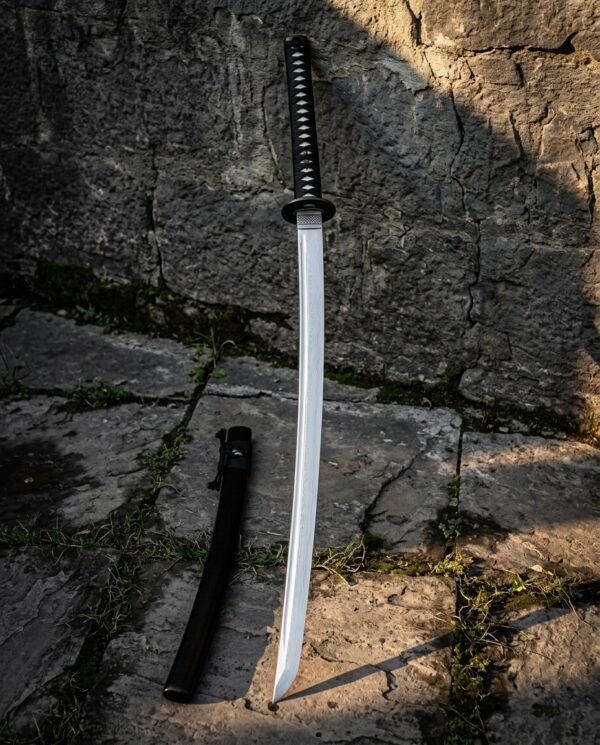
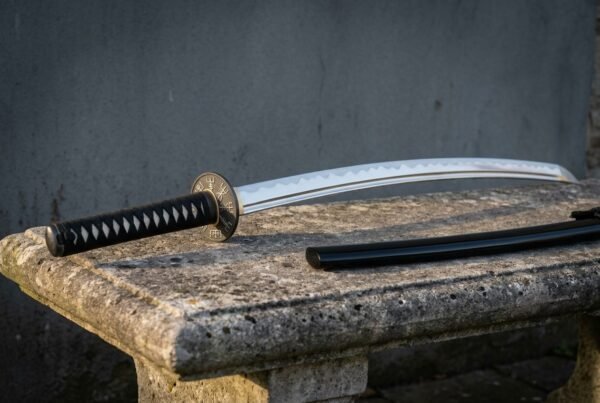
The tsuka is a shaped hardwood core covered with a textured underlay and bound in flat cord in the alternating diamond pattern, so the wrap crosses itself and leaves the underlay showing through in a row of openings. That texture is what stops the hand turning on a wet grip. Cord colours here include black, deep red, ivory and green, and the kashira at the butt is shaped rather than a plain cap on most pieces.
The tsuba is the guard, a plate pierced for the tang, and several here are engraved with knotwork or a Valknut, which is a Norse motif on a Japanese form and is done deliberately rather than by accident. The saya is a fitted wooden scabbard, lacquered black, white, charcoal or leather covered, and on some pieces a tied sageo cord is fitted for wearing it through a belt.
What arrives varies by listing and each product page states it. Some pieces ship with the sword and saya alone. Others include blade oil, a cleaning cloth, a care card, a tied sageo or a cotton storage sleeve. Sets arrive with a scabbard for each blade. No stand is included unless the listing says so, and a stand is worth buying, because a katana laid on a shelf will roll.
Care, oiling, display and where these are made
A carbon steel blade in a close fitting wooden scabbard is the classic rust trap, which is why the traditional cleaning routine exists at all. Wipe the blade down with a soft cloth, put the thinnest possible film of oil on it, and slide it home. Camellia oil is traditional and mineral oil works as well. Too much oil is worse than too little, because the excess pools inside the saya and sits against the steel.
Never touch the flat of a polished blade with bare fingers if you can avoid it. Salt from a hand etches a visible print into a polished surface within days in a humid room, and once it is in, it needs abrasive to come out. Hold the sword by the tsuka, and if you must steady the blade, do it with a cloth.
Display it horizontally on a stand with the edge up and the curve rising, which is how the sword sits and how the saya was designed to hang. Keep it out of direct sun, which fades cord wrap and lacquer, and away from a radiator, which dries a wooden saya until it shrinks onto the blade.
Every sword on this page is made by hand in the Czech Republic. Finished pieces are imported into the United States, inspected by Ransack Viking in North Babylon, New York, and shipped from there, with engraving added after arrival. Two blades of the same name will differ a little in polish, cord tension and the tone of the lacquer, because two people made them on two different days.
Browse related sword categories
- Wakizashi, the companion blade to the katana
- Damascus swords in forge welded 1095 and 15N20
- Short swords, from gladius to sawback to wakizashi
- Longswords and hand and a half swords for two hands
- Arming swords, the single handed medieval sword
- The full sword range across every period and shape
- Tanto knives with reinforced chisel points
- Sword stands and display racks
Guides worth reading first
- What a katana is, and how the shinogi section works
- Katana, wakizashi and tanto compared by length and use
- What a wakizashi is and why it was worn indoors
- What a tanto is and what the point geometry buys you
- How to clean, oil and store a Damascus blade
Frequently asked questions
What is a Damascus katana?
It is a katana whose blade is pattern welded from 1095 and 15N20 in alternating layers, forge welded, folded, drawn out and acid etched so the nickel bearing layers stay bright and the rest goes dark. The pieces here are hardened to 58 to 60 HRC. It is not the same thing as a traditional folded tamahagane blade, which is a different material made a different way.
How long is a katana?
The katana on this page run about 36 to 40 inches in the saya with 26 to 28 inches of blade measured from the habaki collar, and a tsuka of roughly 10 to 11 inches. Because a Japanese sword is quoted sheathed and measured from the habaki, a 40 inch listing does not mean a 40 inch blade.
What is the difference between a katana and a wakizashi?
Length, and that is genuinely the whole answer. Both share the same single edged shinogi section, the same mounting and the same curve. A wakizashi has roughly 12 to 24 inches of edge, a katana more than that. Worn together as a matched pair they are called a daisho.
Is the ninjato historically accurate?
No, and it is worth saying so plainly. There is no surviving archaeological evidence for a distinct straight bladed ninja sword. The ninjato is a twentieth century invention from film and fiction. The pieces here are honest interpretations of that look, mounted in Japanese fittings.
Are these Japanese swords sharp?
It varies and the product page says which. Some listings state that the blade is ground and sharpened by hand and arrives keen, and some sets state that both blades are sharpened. Where no edge line appears, treat the sword as a display grind. Any blade of this length is dangerous whether it is sharpened or not.
How do I oil and store a katana?
Wipe the blade with a soft cloth, apply the thinnest possible film of camellia or mineral oil, and return it to the saya. Too much oil pools inside the scabbard and works against you. Keep fingerprints off the polished flat, because salt etches a print in within days.
Can a Japanese sword be dismantled?
Yes. The handle is held on by a bamboo peg through the tang, and tapping the peg out lets the tsuka, spacers and tsuba come off. That is how these swords are meant to be maintained, and it is one of the few blade forms on this site that comes apart at all.
Where are these swords made?
They are made by hand in the Czech Republic, then imported, inspected and shipped by Ransack Viking from North Babylon, New York, with engraving added in the United States after arrival.