A coif is a mail hood, and for several hundred years it was the most common piece of head protection in Europe, worn far more widely than any helmet. It covers the skull, the neck and the throat, and it spreads out over the shoulders into a mantle that takes the weight off the head and puts it where the body can carry it. In the tenth and eleventh centuries a coif was often integral to the hauberk, cut as one piece with the body. By the twelfth century separate coifs like this one were common, which meant a fighter could pull the hood back off his head between engagements instead of cooking in it.
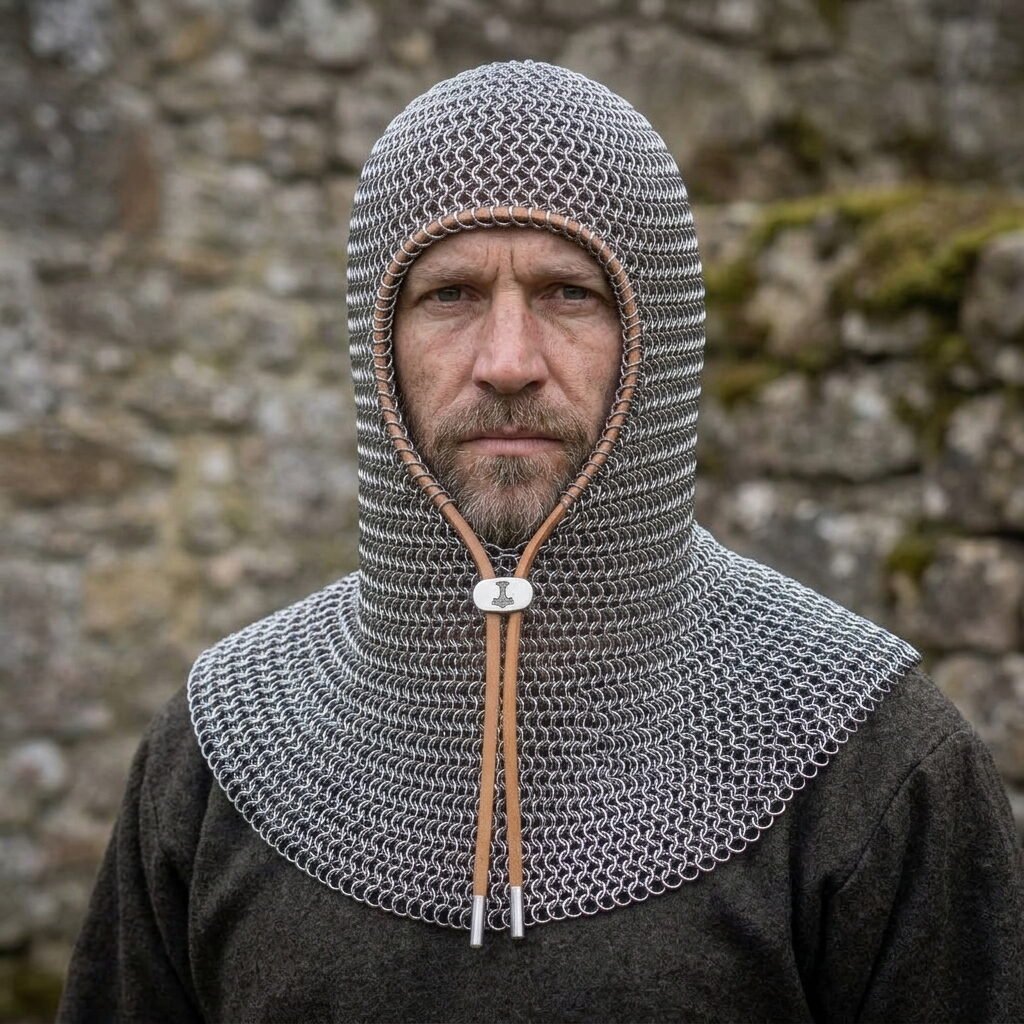
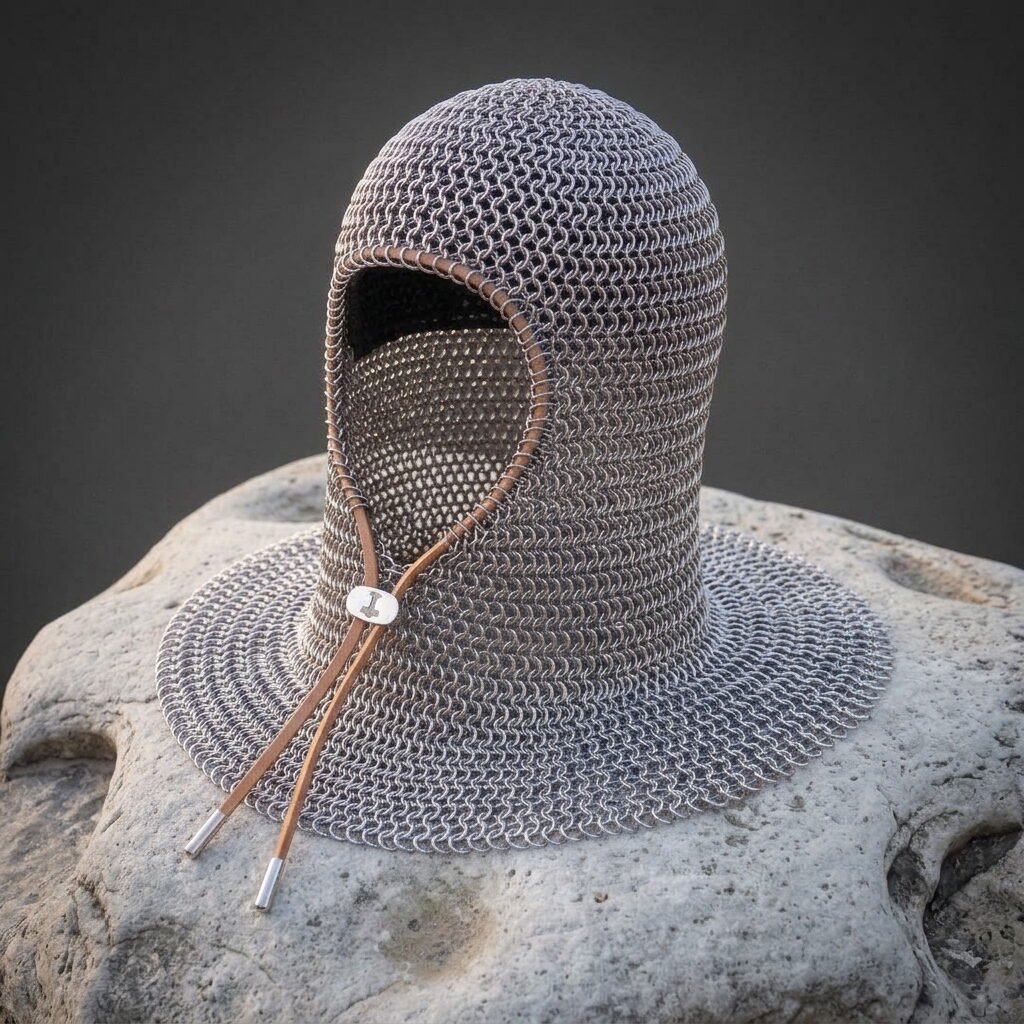
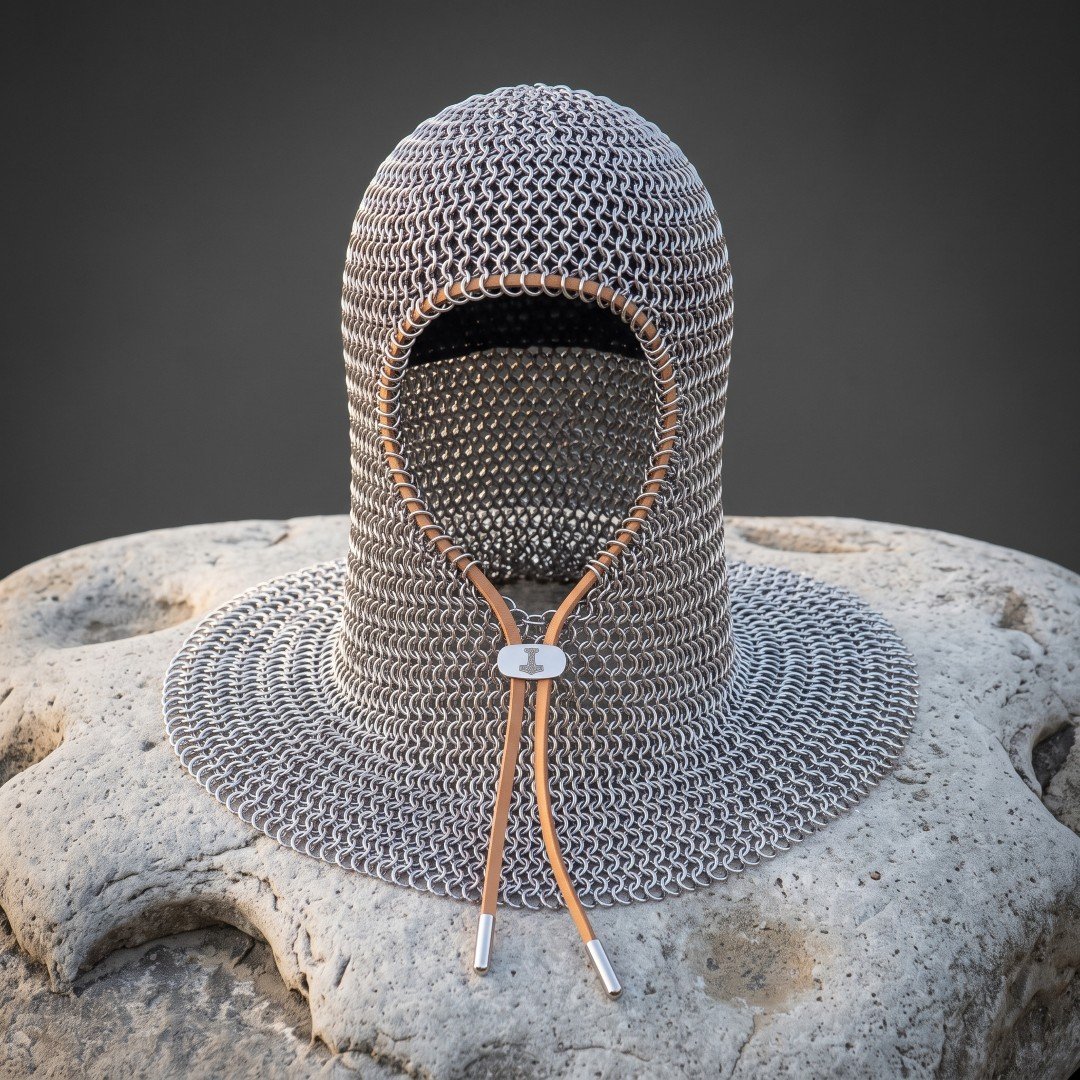
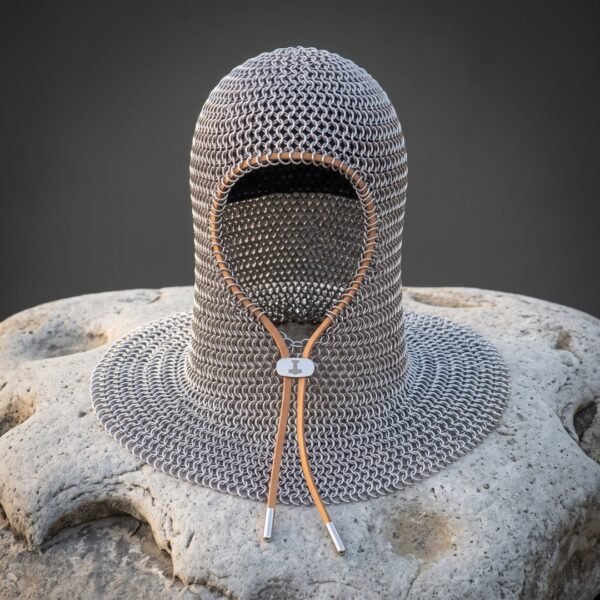
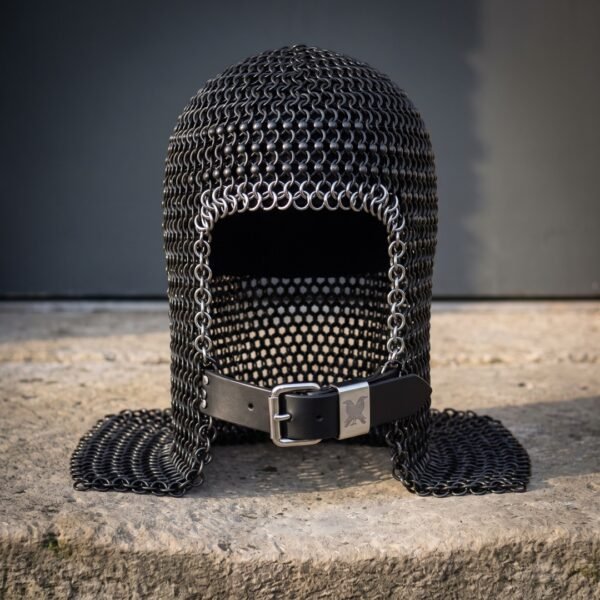
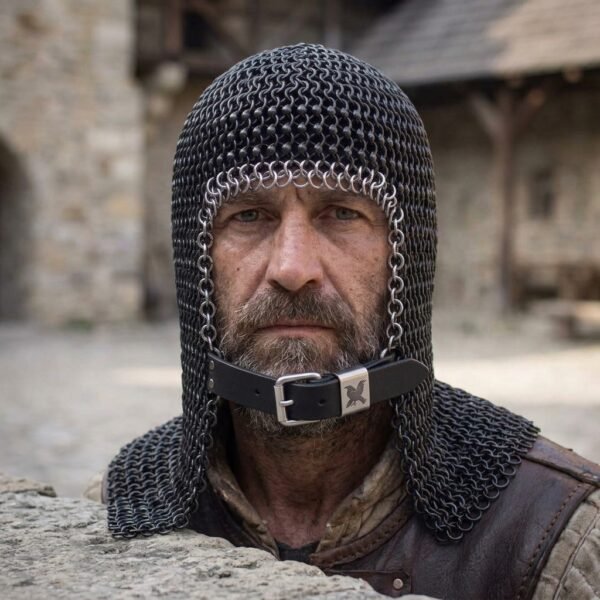
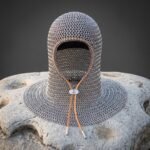
This coif is woven and finished in the Czech Republic. It is a full hood with a wide shoulder mantle, the face opening is edged in russet vegetable tanned leather so the rings never sit against your cheekbones, and a leather drawstring with a slider and metal tips lets you close the throat as tight or as loose as you want. It ships oiled and ready to wear. What was worn over mail and what went under it is set out in our piece on Viking armour.
Specifications
| Material | Mild steel mail, round section wire |
|---|
| Ring construction | Butted rings, closed by hand, European four in one weave |
|---|
| Ring size | Approximately 8 mm inside diameter in 16 gauge wire |
|---|
| Form | Full hood with a wide flared shoulder mantle and open face |
|---|
| Face edging | Tan vegetable tanned leather cord laced round the face opening |
|---|
| Closure | The same cord runs down as a drawstring through an oval steel slider engraved with a Mjolnir, with metal tipped ends |
|---|
| Fit | One adult size, worn over a padded arming cap |
|---|
| Weight | Approximately 5 lb |
|---|
| Finish | Bright polished mail, oiled |
|---|
| Intended use | Display, living history, light reenactment |
|---|
| SKU | RK-1473 |
|---|
What the mantle is for, and why the face is bound in leather
The wide skirt of mail spreading over the shoulders is not there to look impressive. Mail is heavy and it hangs from whatever it is attached to. A hood with no mantle hangs entirely from the crown of your head and gives you a headache in twenty minutes. Extend the weave down over the collarbones and the load transfers to the shoulders, exactly the way a modern pack transfers weight to the hips. It also closes the gap between the bottom of a helmet and the top of a hauberk, which is one of the classic places a thrust finds its way in.
The leather binding round the face is the detail people notice second and appreciate first. Raw mail at an opening presents a row of ring edges directly to your skin, and after an hour of turning your head those edges have found your cheekbones and your jaw. Lacing a leather cord round the opening through the outermost course removes that entirely, gives the opening a defined shape so it does not sag, and provides an anchor for the drawstring.
On construction, be clear about what you are getting. These rings are butted, meaning the ends are brought together and closed rather than overlapped and riveted. Riveted mail is stronger by a wide margin and is what genuine medieval mail almost always was. Butted mail looks right, drapes right and sounds right, and it is entirely appropriate for display, photography, costume and light living history. It is not safe for full contact combat, and a thrust will separate butted rings. Do not fight in it.
The steel and the leather
Mail is described by wire gauge and ring diameter, never by blade steel grades. This coif is mild steel wire at 16 gauge wound to roughly 8 mm inside diameter. That combination is the historical sweet spot. Bigger rings in thinner wire produce a coif that is light but looks coarse and open. Smaller rings in the same wire produce a beautiful dense weave that weighs considerably more and takes far longer to build. Mild steel is used rather than a hardened alloy because ductility is a virtue here: a stressed ring deforms and can be worked back closed instead of snapping.
The binding and drawstring are vegetable tanned cowhide. Vegetable tannage darkens with handling, takes a dressing without turning greasy, and ages into the colour you can see on any well used piece of historical leather.
Engraving, runes and your own design
Use the rune converter on this page to turn a name, a date or a short phrase into Elder Futhark and we will cut it into the steel or the leather. If you would rather have a Viking pattern than a rune line, choose your own design in the engraving option above the add to cart button and tell us where it goes. Where a piece already carries an engraved design, your chosen engraving replaces it rather than sitting alongside it. On a coif the practical surfaces are the leather face binding and the drawstring slider. Details are on the engraving page.
Fit and sizing
This is built to one adult size, cut deliberately roomy in the crown because a coif is meant to be worn over a padded arming cap. Wearing mail directly against your hair is uncomfortable and it pulls. Measure around your head above the ears and add the thickness of the cap you intend to wear underneath. The drawstring at the throat takes up a useful amount of slack, so a slightly loose fit is far better than a tight one.
If you intend to wear a helmet over the coif, order the helmet a size up. A coif adds a genuine half inch or more all round to your head, and a helmet that fits your bare head will not go on over mail. Tell us what helmet you are pairing it with and we will advise honestly.
Care
Mail is thousands of small steel surfaces and every one of them wants to rust. Wipe the coif down after wearing, particularly around the face and neck where sweat collects, and keep a film of light machine oil or paste wax on the rings. The old method for cleaning a rusted coif is still the best one: put it in a bag or drum with dry sand, tumble it until the bloom is gone, shake it out and oil it. Store it loose or hung on a form, never sealed in plastic and never folded tight and damp, because rings will print rust onto each other. Feed the leather binding once or twice a year. Our notes on steel care cover oils and rust removal in more detail. The sand tumble and the rest of the routine are set out in caring for chainmail and steel armour.
Made in the Czech Republic
This piece is made by hand in the Czech Republic, in a workshop that still works the old way. The steel is forged, ground, heat treated and finished by smiths who learned the trade from the people before them, and the wood, horn and leather are cut and fitted by hand rather than pressed out on a line. That is also why no two pieces come out exactly the same.
Ransack Viking is a United States company. We import these pieces ourselves, check every one when it lands and ship from our warehouse in Chicago, Illinois. Engraving is done here in the United States after the piece arrives, so your runes or your own design go on before it leaves for you.
A note on handmade variation
This coif is hand made, not machine made or bulk produced, so what arrives will not be a pixel for pixel copy of the photograph. Ring closures, the drape of the mantle, the tone of the leather binding and the exact shape of the face opening all vary a little, because each one is worked by hand from natural materials. The dimensions, the material and the build are the same every time. The character is not.
Frequently asked questions
Is the mail riveted or butted?
Butted. Rings are closed end to end by hand rather than riveted through. That is right for display, costume and light living history and wrong for full contact fighting.
Can I wear a helmet over it?
Yes, but the helmet has to be sized for it. A coif adds half an inch or more all round, so a helmet that fits your bare head will not fit over mail.
Do I need a padded cap underneath?
Yes, and the coif is cut roomy on the assumption that you will wear one. Mail directly on the scalp pinches and pulls hair.
How heavy is it?
Around five pounds, most of which sits on your shoulders rather than your head thanks to the mantle. It is noticeable but not tiring for an event day.
Will the leather binding wear out?
It is a leather cord laced through the outer course rather than glued, so it wears the way a belt wears. Feed it occasionally and it will outlast the wearer.
How long does it take to ship?
Processing is one to two weeks because every ring is closed by hand. Shipping inside the United States is free and returns are accepted within seven days.
What is in the box
- One hand woven chainmail coif with shoulder mantle
- Leather cord laced round the face opening through the outer course
- Leather drawstring with Mjolnir engraved steel slider and metal tips, fitted
- Light protective oil coat applied before packing
- Care and storage card
- Forged and finished in the Czech Republic
Explore the range
See more in chainmail armor, viking armor, viking helmets and medieval helmets, or read the guides.
Other pieces in this group
Another in the same line is the Ringward chainmail armor. Next along the rack is the Nightweave chainmail armor. For a straight comparison, see the Ringmantle chainmail armor.
The Roanward gambeson covers the other half of the same kit. Nothing here exactly right, build one to your own spec on the design your own page.




Been eyeing this armor piece for months and it did not disappoint. This is my third order from Ransack Viking and they never disappoint.
Absolutely blown away by this armor piece. Fit is excellent and the steel gauge feels genuinely protective. Shipping was fast and everything arrived well packaged.
Wanted to like this more than I actually do. Some of the rivets were a little uneven. Fit was off from the sizing chart listed. On the fence about ordering here again. Ransack Viking usually does better than this in my experience.
I collect stuff like this and this armor piece is on another level. Rivets and trim are all solid. Nothing feels flimsy. Worth every penny.
Solid armor piece. Glad I ordered it. Fits well though I had to adjust the straps a bit. Would still tell others to give this a try.