Blog
Best Damascus Hunting Knives in 2026: A Field-Tested Buyer’s Guide

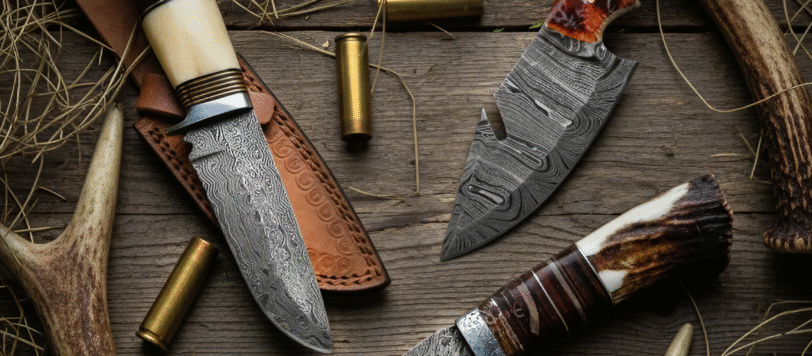
The best Damascus hunting knife is a fixed-blade, full-tang knife with a drop-point profile, a high-carbon Damascus blade around 4 to 5 inches, and a handle that stays grippy when wet. That build handles field dressing, skinning, and camp work while giving you the layered pattern Damascus is bought for. Most arguments about hunting knives are about the last ten percent, and the shape above covers the other ninety. In this guide we cover the blade shapes that matter for hunters, how to judge quality pattern-welded steel, honest downsides, and how to keep a Damascus edge working season after season. Every knife in our Damascus hunting knife collection is hand-forged, ships from Chicago, IL, and many models include free engraving.
Why Hunters Choose Damascus Steel
Modern Damascus is made by forge-welding two or more steels into a billet, then folding and manipulating the layers to create the flowing pattern you see on the finished blade. Done well, the result is a blade with a hard, keen edge supported by tougher surrounding layers, a combination that suits the slicing and detail work of processing game. The pattern is decorative and also unrepeatable: no two blades come out the same, which is why Damascus hunting knives are so often bought as gifts and heirlooms.
The honest trade-off is maintenance. Most Damascus is built from high-carbon steels that can rust if neglected. If you want a blade you can leave wet in a truck bed, read our Damascus steel vs stainless steel comparison before you decide. For some hunters stainless is genuinely the better call, and there is no prize for choosing the harder blade to look after.
Hunting Blade Shapes Explained
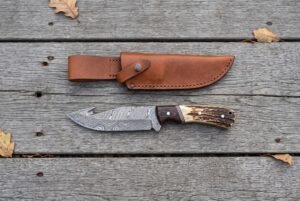 Wengehunter Hand Forged Damascus Gut Hook Hunting Knife with Stag Horn and Wenge Wood Handle | Deer Field Dressing Gift | RK-610
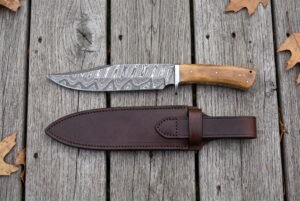 Sandbone Hand Forged Damascus Bowie Knife with Dyed Camel Bone Handle & Leather Sheath | Hunting and Camping Bowie Gift | RK-488
Drop Point
The spine slopes gently down to the tip, putting the point low and in line with your grip. Strong tip, lots of belly, hard to accidentally puncture organs while field dressing. The best first hunting knife shape, full stop.
Drop points make up most of what we file under big game hunting knives.
Clip Point
A finer, sharper tip for detail work and piercing. Slightly more fragile at the point, but excellent for caping and precise cuts around joints.
Skinner
A deep, sweeping belly built to pull long strokes between hide and meat without nicking either. If you process several deer a season, a dedicated Damascus skinner knife earns its place in the pack.
Gut Hook
A sharpened hook on the spine that unzips the abdominal cavity without piercing the intestines. Convenient in the moment, and a nuisance every time you sharpen it afterwards.
Tracker Style
A multi-zone blade combining chopping belly and fine edge in one tool. Heavier, but versatile for hunters who also camp rough. See our Damascus tracker knives for examples.
The same blades double as camp knives, and the ones we would take into the woods are under bushcraft knives.
Damascus Hunting Knife Styles Compared
| Style | Typical Blade Length | Best For | Watch Out For |
|---|---|---|---|
| Drop point | 3.5 to 5 in | All-around field dressing | Nothing, the safe pick |
| Clip point | 3.5 to 5 in | Caping, detail cuts | Delicate tip |
| Skinner | 3 to 4.5 in | Skinning large game | Less useful for piercing |
| Gut hook | 3.5 to 4.5 in | Opening the cavity fast | Hook needs special sharpening |
| Tracker | 5 to 7 in | Hunt-plus-camp versatility | Weight on the belt |
How to Judge a Quality Damascus Hunting Knife
Full Tang Construction
The steel should run the full length and width of the handle, sandwiched between two scales. A full tang cannot snap at the handle joint the way a partial “rat-tail” tang can when you lever through a pelvic bone. On a quality knife you can see the steel layer between the handle scales.
Real Pattern, Not Etched Fake
Cheap knives sometimes laser-etch or acid-print a Damascus-looking pattern onto plain steel. On genuine pattern-welded Damascus, the pattern continues over the spine and into the edge bevel, and it will not polish off. Buy from sellers who describe their forging process and show photos of the actual knife.
Handle Material and Shape
Blood and fat are slippery. Look for stabilized wood, bone, horn, or Micarta with a palm swell and a guard or finger notch that keeps your hand off the edge. Avoid glossy, sealed handles with no texture if you plan real field use.
Edge Geometry
A hunting knife should be ground thin enough to slice, not split wood. A flat or high convex grind with a modest edge angle gives the clean separation you want between hide and meat. Extremely thick “tactical” grinds fight you the whole way through an animal.
Sheath Quality
A fitted leather sheath with a solid retention strap protects the edge and your leg. Remember that leather holds moisture, dry the knife before it goes back in, and store the knife out of the sheath in the off-season.
Who Should NOT Buy a Damascus Hunting Knife?
If you routinely hunt in heavy rain or salt-air coastal environments and will not wipe and oil a blade, high-carbon Damascus will spot and rust. Choose stainless instead. If you want a knife to baton firewood and pry stuck cartridges, buy a thick utility blade and save the Damascus for game. And if your budget only stretches to a suspiciously cheap “Damascus” knife with no details about steel or forging, you are likely paying for an etched pattern, not the real thing.
Field Care for a Damascus Blade
Care takes minutes. After processing game, wash off blood promptly, because it is mildly corrosive, then dry the blade completely and wipe on a thin coat of mineral oil before it goes back in the pack. At home, strop the edge to keep it keen, and touch up on a fine stone when stropping stops working. Avoid dishwashers, long soaks, and abrasive scrubbing that can dull the etched pattern. Stored dry and oiled, a hand-forged Damascus blade will outlast its owner. For more care guides and buying advice, browse the Ransack Viking blog.
If the knife is going to a hunter who also collects, look at the Norse patterns before you decide. A broken back seax is built the same way as a modern drop point hunter, full tang, high carbon steel, leather sheath, and it preps camp food and light game work perfectly well once you get used to the low tip. Our Viking knives collection covers those shapes.
Damascus Hunting Knife FAQ
Is Damascus steel good for hunting knives?
Yes. Quality pattern-welded Damascus made from high-carbon steels takes a very keen edge and holds it well through skinning and field dressing, and the layered construction adds toughness. Its main weakness is corrosion: it must be cleaned, dried, and lightly oiled after use, which is an easy habit to keep and an equally easy one to skip.
What blade length is best for a deer hunting knife?
A blade between 3.5 and 5 inches handles nearly everything on whitetail-sized game. Shorter blades give more control inside the cavity; longer blades speed up skinning strokes. Blades over 6 inches look impressive in a photograph and turn clumsy for the precise cuts that make up most of field dressing.
How can I tell if Damascus steel is real?
Real pattern-welded Damascus shows its layers in three dimensions: the pattern wraps over the spine, appears in the sharpened bevel, and remains after polishing because it runs through the steel. Etched imitations sit only on the flat surface, look identical from knife to knife, and fade where the blade is sharpened or worn.
Will a Damascus hunting knife rust?
Most Damascus is forged from high-carbon steels, so yes, it can rust or develop gray patina if left wet or put away dirty. Prevention is simple: rinse off blood, dry the blade fully, and apply a light coat of mineral oil before storage. Never store the knife long-term inside a leather sheath, which traps moisture. The sheath is for carrying the knife, not for keeping it.
What is the best all-around blade shape for field dressing?
The drop point. Its lowered tip is less likely to puncture organs when opening the cavity, the strong point survives work around bone, and the generous belly skins efficiently. Clip points and skinners are better at their specialties, but the drop point does everything well, which is why most experienced hunters recommend it first.
Can I get a Damascus hunting knife engraved?
Yes. Handles and blade flats can be engraved with names, initials, or dates, and we include free engraving on many of our hunting knives. An engraved Damascus knife is a popular retirement, groomsman, and first-deer gift, and the personalization does not affect the blade’s performance.
For deer work specifically, see our skinning knife picks, and for whether you need a separate skinner at all read one knife or two in the field. The steel is explained in our Damascus steel explainer.
If nothing on the shelf is quite right, build a custom hunting knife and choose the blade profile, the steel, the length and the sheath.
On the shelf
If you are shopping rather than reading, the Yumastag hunting knife and the Ramcrown hunting knife are the nearest match. Also worth opening, the Campmaster camp knife and the Rosetracker tracker knife.
Shop the range
Wengehunter Hand Forged Damascus Gut Hook Hunting Knife with Stag Horn and Wenge Wood Handle | Deer Field Dressing Gift | RK-610Sandbone Hand Forged Damascus Bowie Knife with Dyed Camel Bone Handle & Leather Sheath | Hunting and Camping Bowie Gift | RK-488