
Blog
Best Viking Swords for Collectors: What to Look For

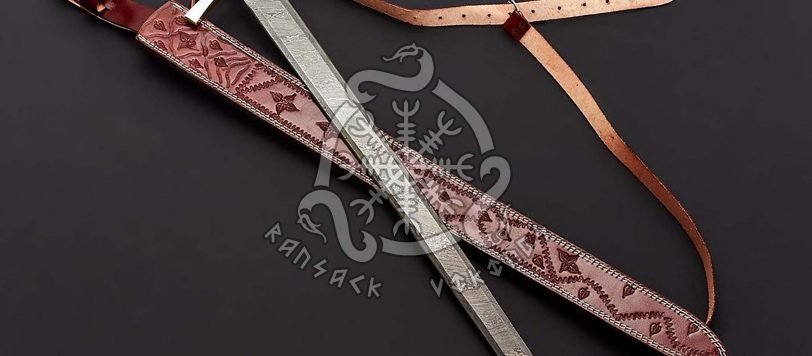
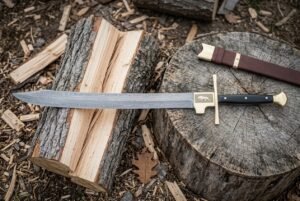
The best Viking sword for a collector is a hand-forged reproduction of the classic Norse pattern: a straight, double-edged blade around 28 to 32 inches with a wide fuller, a short crossguard, a lobed or curved pommel, and a grip sized for one hand. A great deal of what is sold under the name is a stainless casting with a sword’s silhouette and none of its engineering. Whether you want a wall centerpiece, a reenactment blade, or the start of a serious collection, the same fundamentals separate a sword worth owning from a wall-hanger: honest steel, sound tang construction, and historically grounded proportions. This guide explains the Viking sword’s anatomy, the types on the market, and exactly what to inspect before buying. Our hand-forged sword collection ships from Chicago, IL, and many pieces can be personalized with engraving.
What Defines a Viking Sword
Norse swords of the 8th to 11th centuries were prized possessions, often named, often inherited. The pattern is consistent: a double-edged blade near 30 inches, a deep central fuller that lightens the blade without weakening it, a compact guard (Vikings relied on shields, not sword guards, for defense), and a heavy pommel that balances the blade close to the hand. The result is a fast, agile cutter, not the heavy crushing blade movies suggest. Historical examples typically weighed only 2 to 3.5 pounds.
The most famous originals are the Ulfberht blades, forged from unusually clean crucible steel and inscribed with the maker’s name, medieval proof that steel quality has always been the heart of a good sword.
Blade Geometry in Plain Words
Geometry is the shape of the blade in three dimensions. It matters more than every figure in the listing put together, which is presumably why listings so rarely mention it.
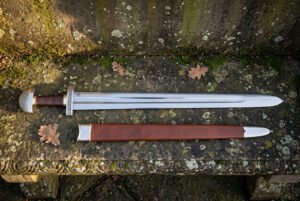
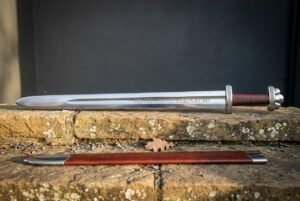
Profile taper is how much the blade narrows from guard to tip when you look at it flat. Early Viking blades had almost parallel edges and a rounded, spatulate tip, because they were built to cut, not thrust. Later ones narrow more toward the point. Neither is wrong, but a reproduction with a needle point on a wide early-style blade is a modern invention.
Distal taper is how much the blade thins from guard to tip when you look at it edge on. This is the one cheap reproductions skip. A blade the same thickness all the way down is heavy at the tip, slow in the hand, and feels like a bar. A properly forged blade gets visibly thinner toward the point, which is where most of the historical lightness comes from.
Cross-section is the shape you would see if you cut the blade in half. Viking blades are usually lenticular, meaning a flattened oval, with the fuller hollowed out of the middle of each face. The edges are ground to a fine but not razor-thin bevel. A sword with a thick, obtuse edge and no fuller is a wall piece no matter what the listing says.
The Fuller: What It Is Actually For
The fuller is the long shallow groove that runs down the center of each face of the blade. You will still hear it called a blood groove. It has nothing to do with blood. It is a weight-saving feature, the same idea as an I-beam: removing steel from the center of the blade where it contributes least to stiffness cuts weight without making the blade bend more. On a Viking sword the fuller is wide, often a third or more of the blade width, and runs most of the length before fading out near the tip. A well-cut fuller is even in depth and width from one side to the other. An uneven or very shallow fuller is a sign it was ground in quickly for looks rather than forged in for weight.
Types of Viking Swords for Collectors
Display and Collection Swords
Hand-forged blades with authentic proportions, finished for presentation. The priority is material honesty and looks; they are sharp or semi-sharp but not meant for contact.
Battle-Ready and Reenactment Swords
Properly tempered high-carbon blades with blunted edges and full tangs, built to take controlled contact in reenactment. “Battle-ready” is a phrase with no agreed definition and a great deal of marketing mileage. It should mean properly hardened and tempered steel and a peened or firmly secured pommel, and a seller should be able to say so plainly.
Damascus Viking Swords
Modern pattern-welded blades that echo the original serpent-pattern cores of high-status Norse swords. The layered pattern makes each blade unique, which is why it is the collector favorite for display and gifting. The Viking sword collection holds both plain 1095 and Damascus versions of the pattern.
Functional Cutters
Sharpened, tempered reproductions for backyard cutting practice (tatami, bottles). These need the most careful vetting of tang, temper, and assembly.
Viking Sword Types Compared
| Type | Edge | Best For | Key Check |
|---|---|---|---|
| Display / collection | Sharp or semi-sharp | Wall and cabinet display | Materials, finish, proportions |
| Battle-ready | Blunted | Reenactment, stage combat | Temper, full tang, pommel fit |
| Damascus | Sharp | Collections, gifts | Real pattern-welded steel |
| Functional cutter | Sharp | Cutting practice | Temper and assembly quality |
Hilt Types Without the Jargon
The hilt is everything that is not blade: the guard, the grip and the pommel. Collectors classify Viking hilts by pommel and guard shape, often with type letters attached. You do not need the letters. Here is what the shapes mean in the hand and on the wall.
The guard on a Viking sword is short, often barely wider than the blade, and either straight or slightly curved toward the blade. Its job was to stop the hand sliding onto the edge, not to catch an opponent’s blade. A wide cruciform guard belongs to a later medieval sword; on a “Viking” reproduction it is a mistake.
The grip is short, usually under four inches, made of wood and often wrapped in leather or cord. It is meant to be held with the pommel bearing against the heel of the hand, which is why a modern buyer with large hands can find it tight. That is correct, not a flaw.
The pommel is the heavy counterweight at the end, and it is where most of the visual variety lives. Lobed pommels look like a row of three or five rounded bumps and are the shape most people picture. Brazil-nut pommels are a single smooth curved lump. Disc pommels are flat and round. Tea-cosy and cocked-hat shapes are somewhere in between. All are period styles. What matters is that the pommel is solid, properly fitted, and heavy enough to bring the balance point back toward the hand.
Display or Handling: Decide Before You Buy
Every other decision follows from this one. If the sword is going on a wall and will come down a few times a year to be admired, you can prioritize finish, pattern and proportions, and a sharp edge is fine because nobody is swinging it. If it will be handled at reenactments, practiced with, or used for cutting, the checks below on tang and temper become the whole purchase. A collector who wants both usually ends up with two swords, one for the wall and one for the hand, because a sharp ornate display piece is a poor thing to practice with and a plain blunt reenactment sword looks dull above a fireplace.
If the sword is going on display, plan the mount at the same time. A sword laid on a shelf or leaned in a corner scratches, and a blade hung from its grip by wire stresses the fittings. The sword stands and displays collection has wall mounts and stands built for the weight and length of a full-size blade.
What to Inspect Before Buying
Steel and Temper
High-carbon steel, properly heat treated, is non-negotiable for anything beyond pure decoration. Decorative stainless swords over about 12 inches are brittle and belong on walls only; stainless is not a steel we use for anything. The blades on this site are plain 1095 at 54 to 58 HRC or Damascus made from 1095 and 15N20 at 58 to 60 HRC. Pattern-welded Damascus adds the layered look; if you are weighing it against plain carbon steel, our Damascus steel vs stainless steel guide covers the practical differences.
Tang Construction
The tang is the sword’s spine of trust. A full-width or substantial hidden tang, running through the grip to a peened or solidly fixed pommel, is what separates a sword from a stick of sharpened scrap. Rat-tail welded tangs on swords advertised as battle-ready are the most common failure point on cheap imports, and they let go at the hilt, which is where your hand happens to be. Ask, and buy from sellers who answer plainly.
Weight and Balance
A faithful one-handed Viking sword weighs roughly 2 to 3.5 pounds with a balance point a few inches ahead of the guard. If a listing boasts about the sheer heft of the thing, it is selling furniture. Light and lively is the historically correct answer.
Fittings and Grip
Look for tight guard and pommel fit with no rattle, and a grip of wood wrapped in leather or cord sized for one hand (Viking grips are short, that is correct, not a flaw). Lobed, brazil-nut, and disc pommels are all period styles.
The Scabbard
Wood-core, leather-wrapped scabbards are the traditional match. As with knives, do not store a carbon steel blade sealed in leather long term. Display it dry and oiled instead.
What to Ask a Seller
A good seller will answer all of these without hesitation. A bad one will change the subject.
What steel is the blade, by name, and what hardness is it heat treated to? A seller who says “high-carbon” and stops there may not know. What is the tang: full, hidden, or a welded rod? How is the pommel fixed: peened, threaded, or glued? Where was the blade forged, and by whom? Is the pattern on a Damascus blade forged in or etched onto the surface? What is the actual weight and balance point of the sword in the photo, not the catalog figure? Is the blade sharp, semi-sharp or blunt as shipped? Will you take it back if it arrives with a rattle in the hilt?
You will learn more from how the answers are given than from any product description.
Where These Swords Come From
Ransack Viking is a US company in Chicago, Illinois. The swords are not made in Chicago. Every blade is handmade in the Czech Republic by smiths working the old way, then imported to Chicago, inspected, and shipped from there. Engraving is done in the US after inspection. We say it plainly because it is one of the questions above, and we would rather answer it before you ask.
Who Should NOT Buy a Viking Sword?
Skip the sword if what you really want is a usable tool. A sword does no practical job that a Viking axe or big knife does not do better. Skip sharpened functional swords entirely if children can access your display. And if your budget is minimal, buy a smaller honest piece, a quality seax or dagger, rather than a cheap sword-shaped object; a small real thing always beats a large fake one in a collection.
Displaying and Caring for a Collection Sword
Mount the sword on padded wall hooks or a stand out of direct sunlight, in a dry room. Wipe the blade with a soft cloth and a thin coat of mineral oil every few months, more often if handled, since fingerprints etch carbon steel. Never store it long-term in the scabbard, and check fittings yearly. A hand-forged sword cared for this way will outlive its buyer by generations. For more collector guides, visit the Ransack Viking guides.
If this is the first sword you have bought, our guide to buying a sword without regretting it covers the checks worth making. The other decision to settle early is whether you want a display piece or a battle ready one.
Questions people ask
How much does a good Viking sword weigh?
Historically accurate one-handed Viking swords weigh about 2 to 3.5 pounds, with the pommel bringing the balance point close to the hand. Anything much heavier is either a decorative piece or a badly designed one. The originals were fast, maneuverable blades rather than slow crushing tools, and a good reproduction should feel that way in the hand. If it handles like a shovel, it is not a reproduction of anything.
What length is a typical Viking sword?
Blades ran roughly 28 to 32 inches, with overall lengths around 35 to 40 inches. The single-hand grip is short by modern standards, usually under 4 inches of usable space, because the sword was used with a shield, one-handed, and the compact grip locks the pommel against the hand for control.
Are Viking swords legal to own?
Owning a sword at home is generally treated like owning any other collectible. Carrying one in public is a different matter, restricted in many places, with rules varying between states and cities. Transport yours cased and direct to its destination, and check the local rules before any public event or reenactment. We cannot advise on the law where you live, and anyone selling you a sword who claims they can is guessing.
What is an Ulfberht sword?
Ulfberht swords are a group of Viking-age blades inscribed +VLFBERH+T, forged between roughly 800 and 1000 AD from crucible steel far cleaner than typical European metal of the era. They were elite blades in their day, and the name has become shorthand for the highest tier of Viking sword craftsmanship. Many modern makers offer Ulfberht-inspired reproductions.
How can I tell a display sword from a battle-ready sword?
Ask three questions: what steel is the blade and how was it heat treated, what is the tang (full or substantial hidden tang means functional, a thin welded rod means display), and is the edge tempered for contact. Honest sellers state all three. A sword failing any of them should hang on a wall and never be swung.
What is the groove down the middle of the blade for?
That is the fuller, and it is not a blood groove. It removes steel from the center of the blade where it adds least to stiffness, so the sword gets lighter and faster without becoming more flexible. Viking fullers are wide and run most of the blade length. A clean, even fuller is one sign of a carefully made blade. A shallow scratch of one is a sign of the opposite.
Can a Viking sword be engraved?
Yes. Blade flats, fullers, guards, and pommels all take engraving, and runic inscriptions are a popular period-appropriate choice; the Norse themselves inscribed and named their swords. Engraving on our swords is done in the US after the blade arrives, and it turns a collection piece into a named heirloom the way the originals were.
If nothing on the shelf is quite right, build a custom sword and choose the type, the blade length, the crossguard, the pommel and the scabbard.
Where to see these
If you are shopping rather than reading, the Runeflame Viking sword and the Skaldbone Viking sword are the nearest match. Also worth opening, the Valkbraid Viking sword and the Staveholm Viking sword.
If it ever leaves the wall
Some collectors eventually want to know what the thing does in use, which is how people turn up at a HEMA club with a lovely sword they are not allowed to spar with. Choosing your first HEMA sword sorts out what a club will actually accept, and the HEMA arming sword range starts with blunt pieces such as the Mirlaug blunt arming sword.

One thought on “Best Viking Swords for Collectors: What to Look For”
Comments are closed.