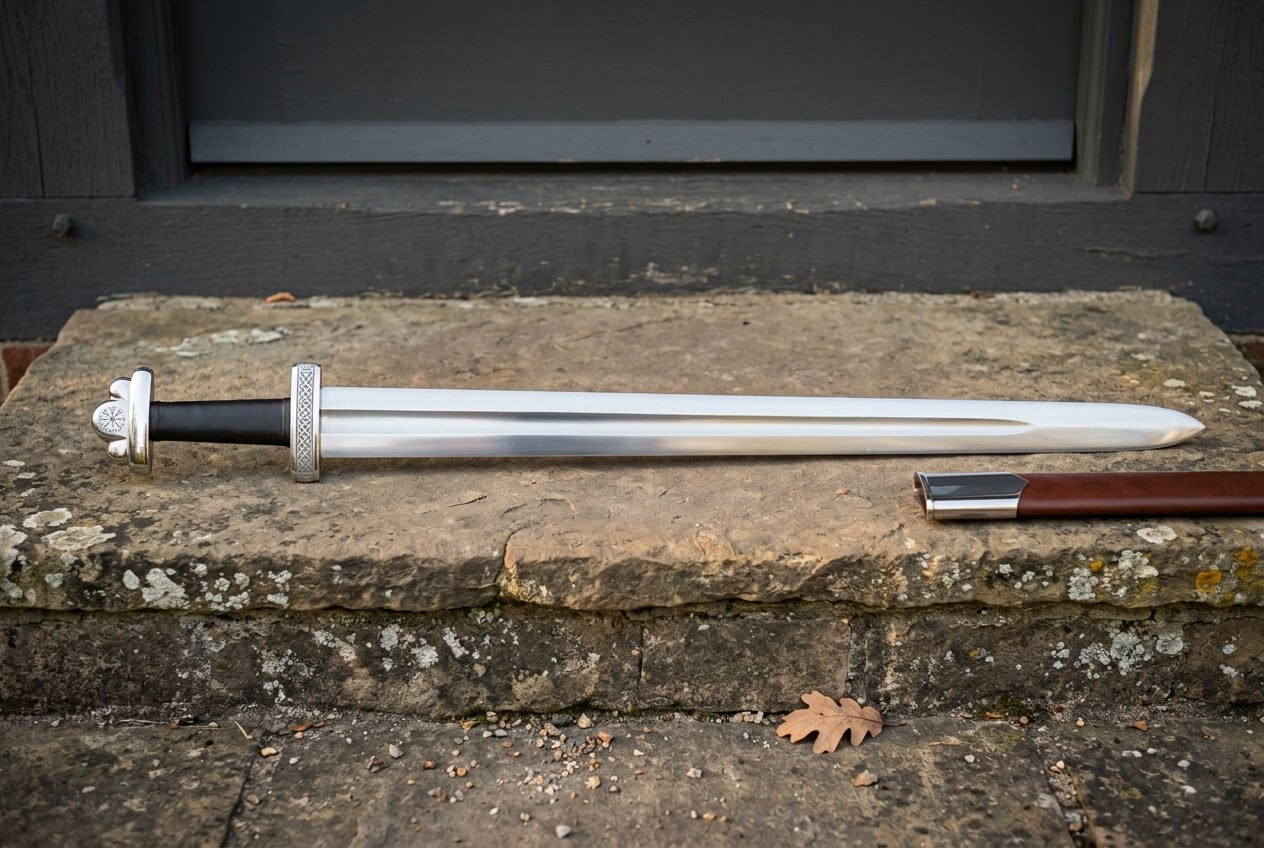
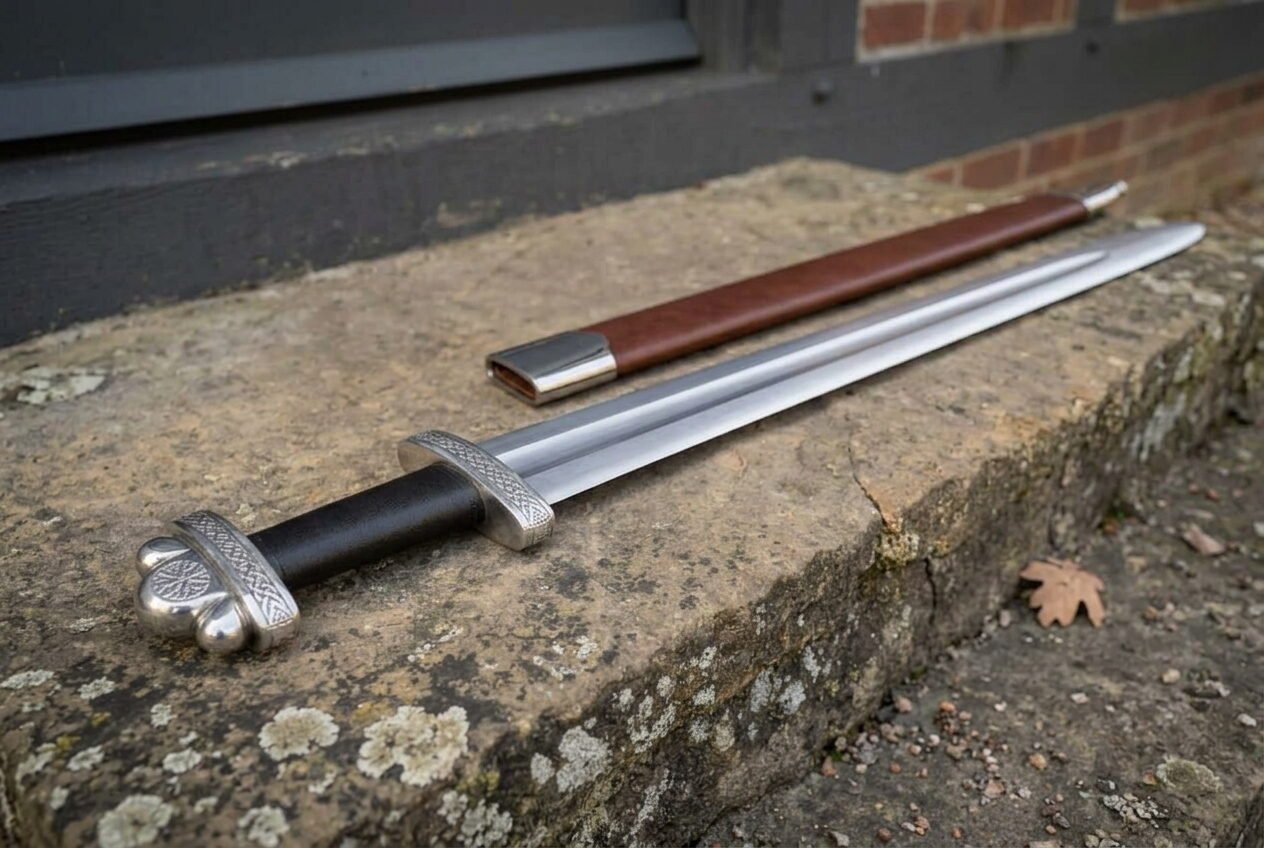
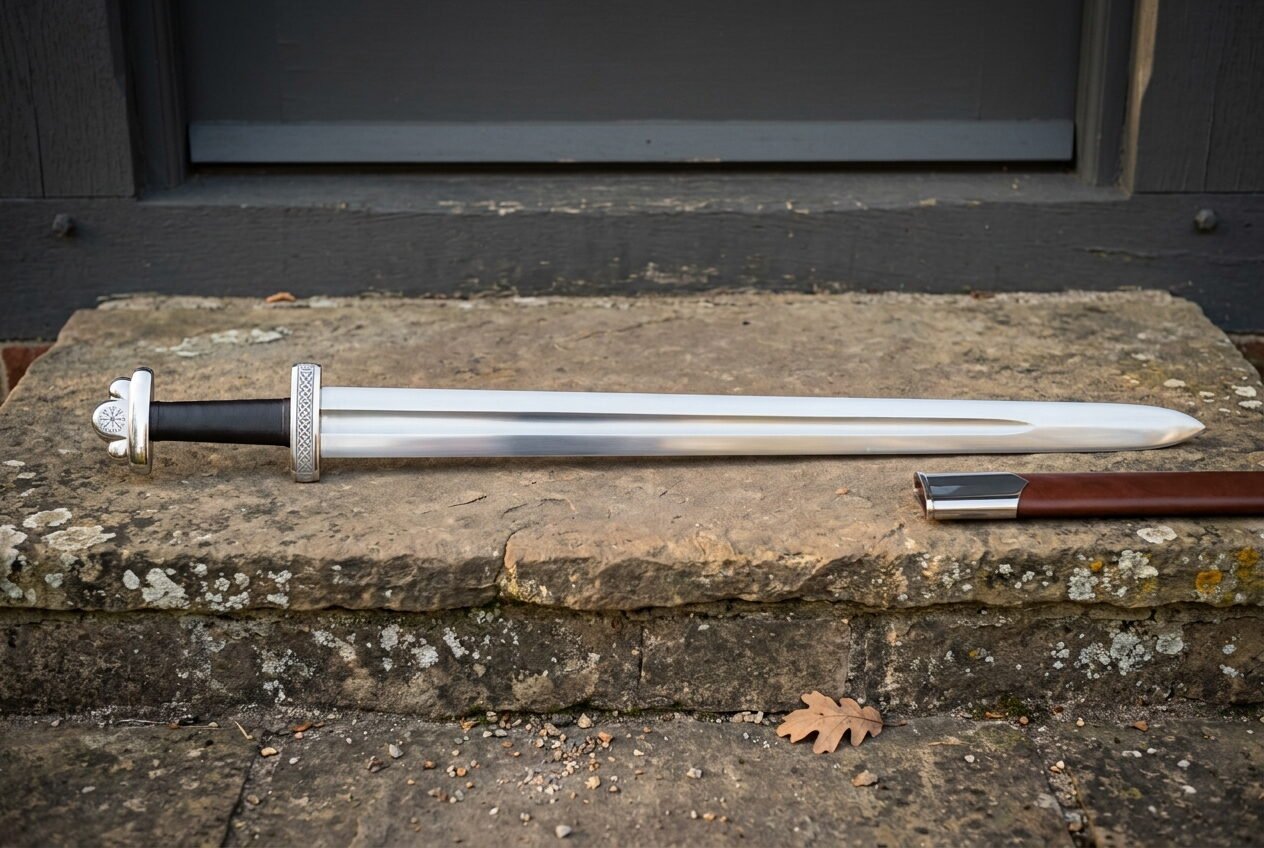
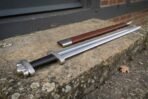
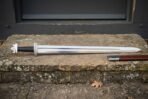
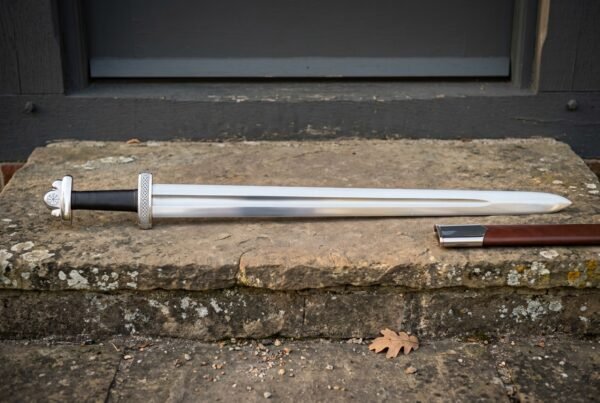
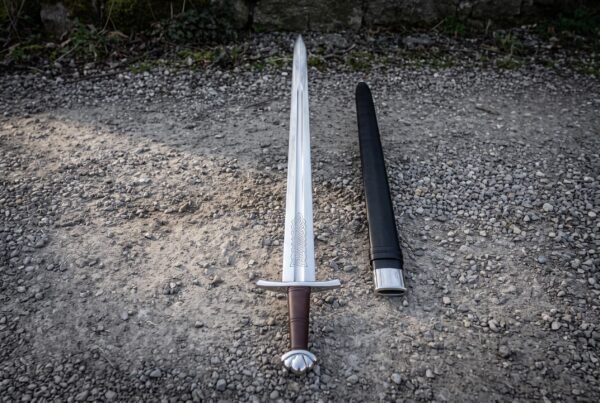
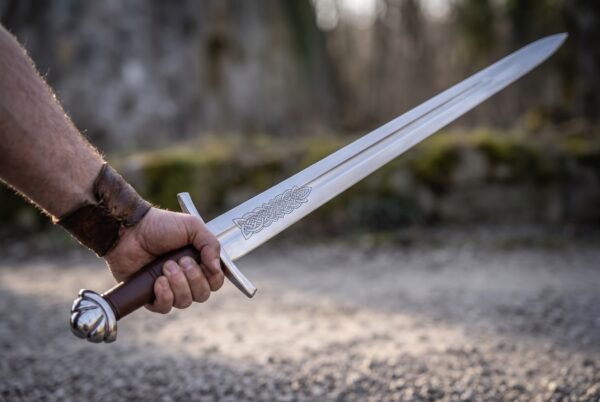
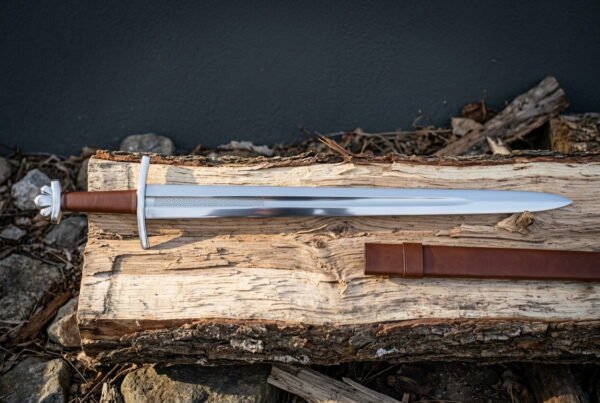
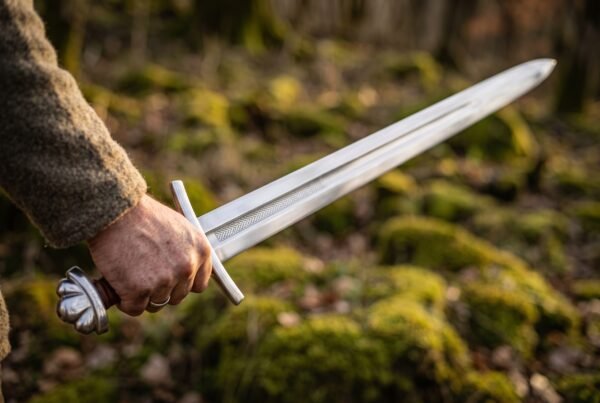
The Rhinewarden is a Carolingian sword, the Frankish pattern that armed both the Empire and, awkwardly for the Empire, most of the Vikings who raided it. It carries a broad fullered blade of high carbon steel, a short knotwork engraved guard, and a three lobed pommel over a black leather wrapped grip, running 36 inches overall with a 30 inch blade. The awkwardness is documented. Charlemagne and his successors repeatedly legislated against the sale of swords and mail to the Northmen and to other peoples beyond the frontier, with capitularies issued in 779, 803 and again at the assembly of Diedenhofen in 805 threatening confiscation and worse for merchants caught trading arms across the border. Those laws exist because the trade was real and profitable, and the archaeology proves it never stopped. Frankish blades turn up again and again in Norwegian and Danish graves, and the great sword producing workshops of the middle Rhine supplied a market that included the raiders who were sailing up the same river. A very large share of what we now call Viking swords were Frankish exports, legal or otherwise, with Norse hilts fitted at the other end. For the things worth checking before you buy, read the collector notes.
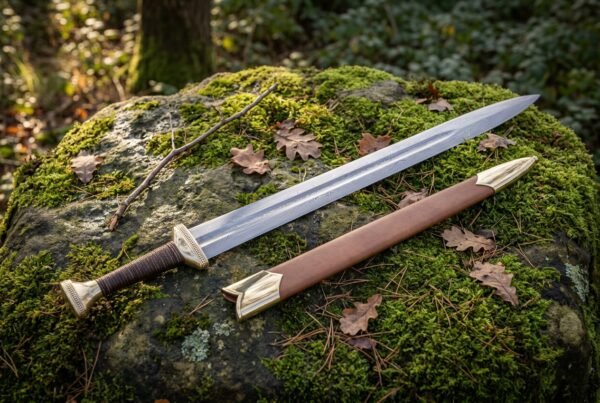
This one is forged and finished by hand in the Czech Republic. The blade is drawn under the hammer, the wide fuller is ground in by hand, and the sword is hardened and tempered here before the guard and pommel are fitted and the tang peened over. It ships with a fitted brown leather scabbard over a wooden core with steel throat and chape, a belt hanger, blade oil and a care card. Shipping inside the United States is free, and the engraving option above the add to cart button is open on every piece we make.
Specifications
| Steel | 1095 high carbon steel, hand forged, oil quenched and tempered |
|---|
| Hardness | 54 to 58 HRC |
|---|
| Overall length | 36 inches |
|---|
| Blade length | 30 inches |
|---|
| Blade | Double edged, broad and polished, tapering to a rounded spear point |
|---|
| Fuller | Wide shallow central fuller, hand ground, running most of the blade |
|---|
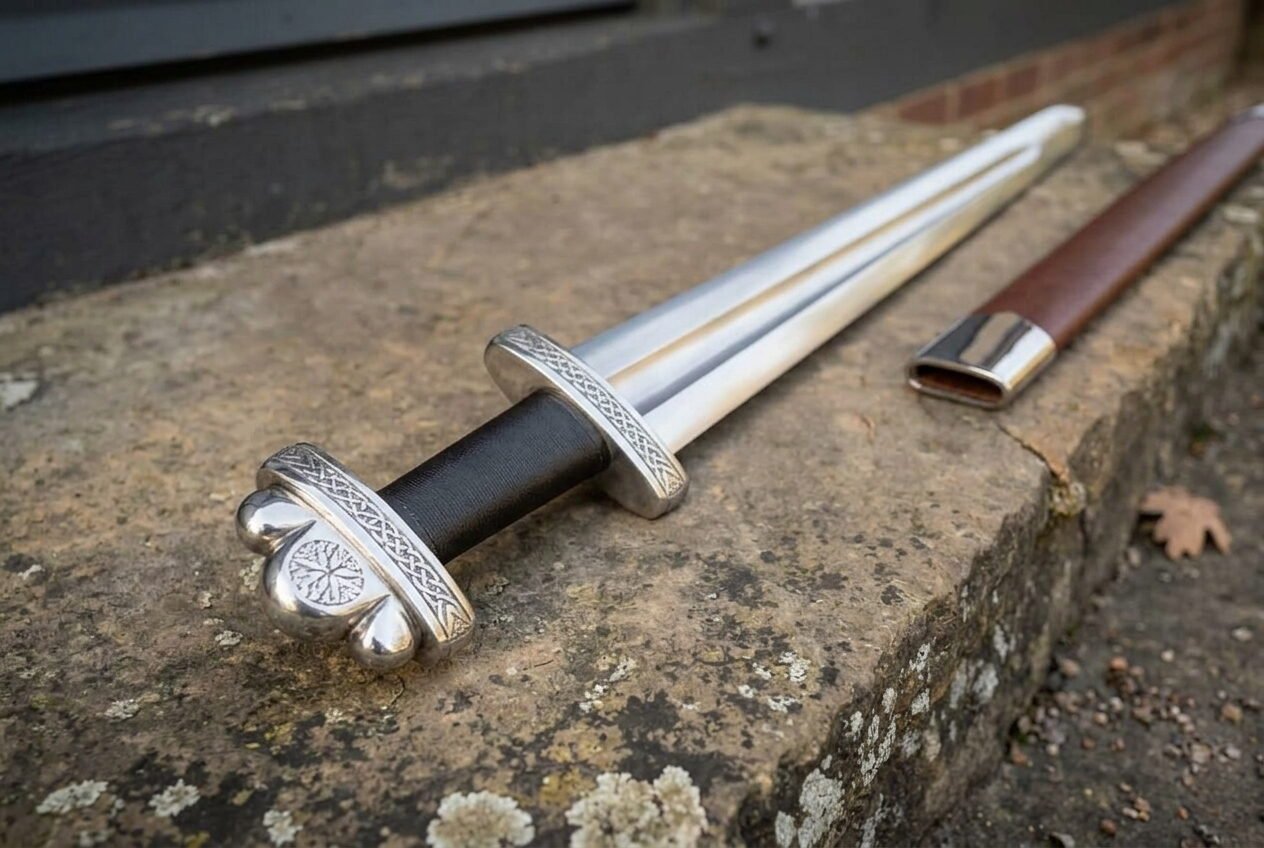
| Guard | Short, thick polished steel guard cut with a knotwork band |
|---|
| Pommel | Three lobed polished steel pommel on a knotwork engraved base, with an engraved Norse emblem on the centre lobe, peened tang |
|---|
| Grip | Hardwood core wrapped in black leather |
|---|
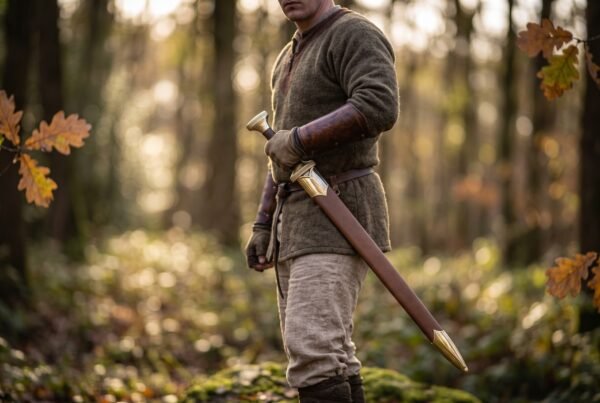
| Scabbard | Brown leather over a wooden core with steel throat and chape, belt hanger |
|---|
| Weight | Approximately 2 lb 11 oz |
|---|
| SKU | RK-1234 |
|---|
What the guard is for
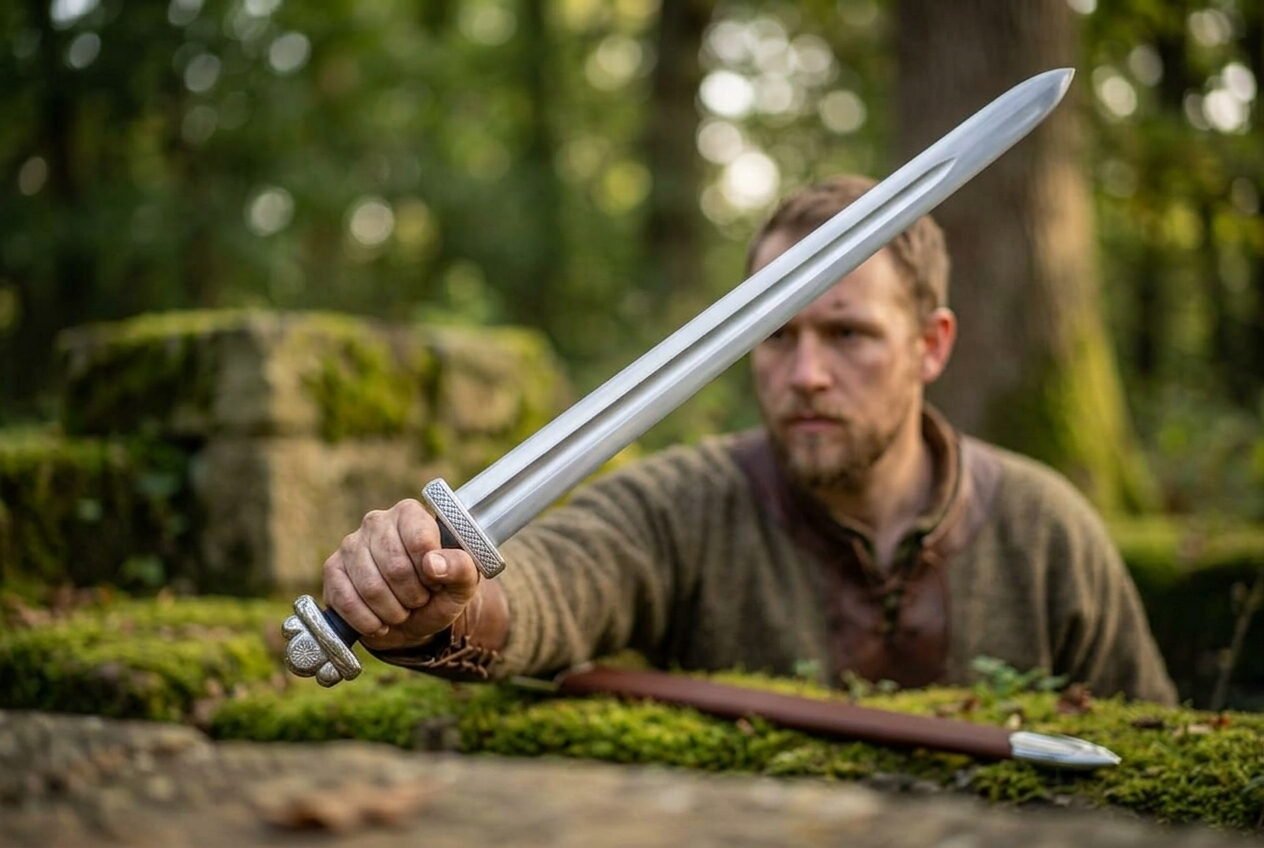
The guard on this hilt is short and thick, polished steel cut with a knotwork band, the form found on many swords of the Viking age. It is a plain piece of engineering and it does three separate jobs.
First, it stops the hand sliding forward onto the edge under a hard thrust, which matters more than it sounds when the grip is wet. Second, it is a lever. A guard that projects past the width of the blade gives you something to catch, deflect and turn an opposing blade with, and it lets you bind and control from the hilt rather than from the middle of the blade. Third, it is structural. The guard is slotted tight to the tang shoulders and is the piece that stops the whole handle assembly moving under a cut, which is why on a well built sword you should not be able to rock the guard at all.
Above the hand sits a lobed pommel over a knotwork engraved base, peened onto the tang. Norse and Frankish smiths built these in a range of shapes, from tea cosy caps to lobed crowns to brazil nuts, and the Norwegian archaeologist Jan Petersen classified them into twenty six types in 1919, a system still used today. Whatever the shape, the function is the same: mass behind the hand to counterbalance the blade. Remove the pommel from a sword like this and the blade becomes a club almost immediately.
Why high carbon steel and not stainless
1095 is a plain high carbon steel with a simple chemistry, and simple is what a long blade wants. It hardens through, holds an edge, and at 54 to 58 HRC it will flex under load and return rather than break. Stainless steel earns its rust resistance from a large chromium content, and in a section this long that chromium produces coarse carbides and brittle behaviour, which is why long stainless blades belong on a wall rather than in a hand. Carbon steel asks for a wipe and a film of oil in return for behaving properly, and it will develop a patina over the years, which most owners come to prefer to a factory shine. The full comparison, including what each does under bending load, is on our Damascus versus stainless page.
The grip and the fittings
The grip core is shaped hardwood, waisted so the hand knows the edge alignment without checking, and the leather wrap is wet fitted so it dries tight to the core, and the seam is stitched along the back edge where it sits away from the palm. Guard and pommel are polished steel, filed and fitted by hand, and the tang is peened over the pommel button so the whole assembly is mechanically locked. Nothing structural relies on glue.
Since the core is wood, treat it as wood. Do not soak it, do not leave it in a hot vehicle or against a radiator, and if it gets damp wipe it and let it dry at room temperature. Our note on wooden handle care covers the same material and the same failure modes, and the leather itself wants a light conditioner once or twice a year to stop it drying out at the stitch line.
Engraving, runes and your own design
Use the rune converter on this page to turn a name, a date or a short phrase into Elder Futhark and we will cut it into the steel or the handle. If you would rather have a Viking pattern than a rune line, choose your own design in the engraving option above the add to cart button and tell us whether it goes on the blade or the handle. Where a piece already carries an engraved design, your chosen engraving replaces it rather than sitting alongside it. On a Carolingian blade the wide fuller is the historically correct place for lettering, since that is exactly where the Frankish workshops laid their own inlaid maker names, and the guard takes a short line or a set of initials well. The engraving page shows the placements and the character counts we can hold.
Care and sharpening
The routine is short. Wipe the blade after handling and keep a film of oil on it, because fingerprints are mildly acidic and will etch a polished surface within days in a humid room. Do not store the sword in the scabbard for months on end, since leather holds moisture and tanning salts and both will pit steel over time. Hang the sword and keep the scabbard next to it. Our steel care guide covers storage, patina and how to lift a rust spot before it turns into a pit.
When the edge dulls, sharpen it as you would any high carbon blade, just over more length. Work in overlapping sections down a coarse stone and then a fine one at a consistent angle, then strop. A long combination stone or a guided rod system both suit a blade this size. The angle control method in our guide to sharpening with a whetstone is the same one we use on the bench.
Made in the Czech Republic
The work behind this piece happens in a Czech Republic workshop that has kept to the old methods. Steel is forged and heat treated by hand, the grind is taken down by eye rather than by machine, and the handle, fittings and sheath are cut and finished one at a time. Because of that, every piece carries small marks of the hand that made it.
Ransack Viking is a United States company. We import direct, check each piece when it reaches us, and ship from our Chicago, Illinois warehouse. Engraving is added here in the United States after arrival, so the piece you receive is finished to your order.
A note on handmade variation
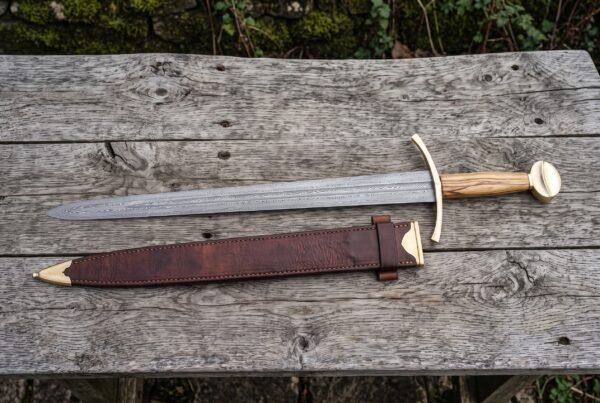
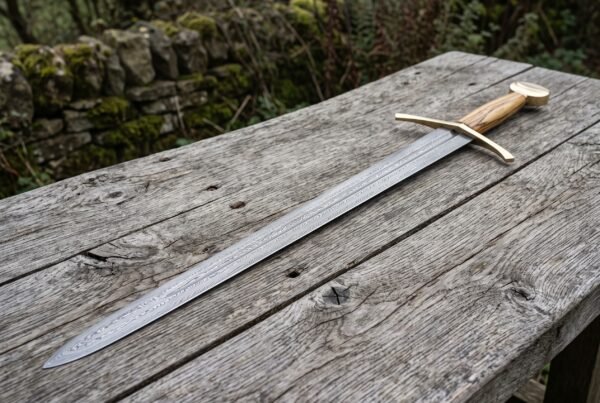
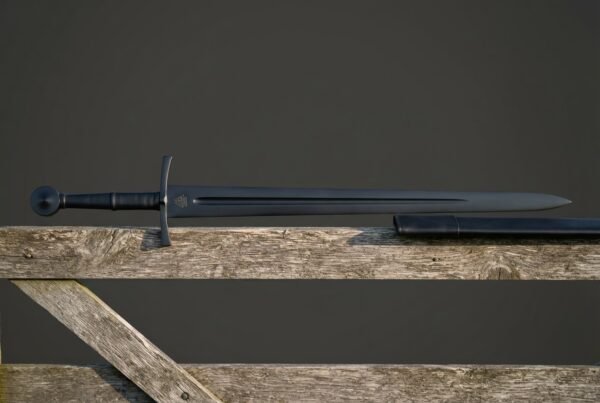
This sword is hand forged. It is not machine made and it is not bulk produced, so what arrives will not be a pixel for pixel copy of the photograph on this page. The grain of the wood under the grip, the exact tone the brown leather takes, the way light moves along the hand ground fuller, the file finish on the crossguard and the precise line of the point are all worked by hand from natural materials and vary from piece to piece. What does not vary is the specification. The steel, the heat treatment, the stated dimensions, the construction and the finish standard are the same every time. The character is what changes, and that is the difference between something forged and something stamped out.
Frequently asked questions
What is the difference between a Carolingian sword and a Viking sword?
Mostly geography and hilt, not blade. Carolingian describes the Frankish swords of roughly the 8th to 10th centuries with a long straight crossguard and a curved upper pommel. Viking sword describes the same family as it appears in Norse hands, often with a Frankish blade and a locally made hilt. A great many swords in Viking graves are Carolingian in origin, so the two terms overlap heavily rather than describing rival designs.
Is it sharp when it arrives?
Yes. It comes with a hand cut and honed working edge, ground for durability rather than shaving. If you want it blunt for display or for a household with children around, say so in the order notes and we will finish it with a rounded edge at no extra charge.
Can I cut with it?
Yes, on soft targets. Through hardened 1095 at 54 to 58 HRC with a peened full tang will handle water bottles, tatami mats and green pool noodles. Do not use it against another blade, against steel or stone, against seasoned hardwood, and do not throw it.
Can I have my own runes or a design engraved?
Yes. Use the rune converter on this page for Elder Futhark, then select the engraving option above the add to cart button and tell us whether the work goes on the blade or the handle. The wide fuller is the historically correct location and gives the most room.
Will mine look identical to the photograph?
It will match in shape, size and specification, but not in character. Leather tone, wood grain, polish and hand file work differ between pieces because each sword is built individually rather than pressed out of a machine.
How long does shipping take?
Shipping inside the United States is free. In stock swords leave within two business days with tracking. Forged to order, allow two to three weeks of bench time, plus a few days more if you have added engraving.
What is in the box
- One Rhinewarden Carolingian sword, 36 inches overall with a 30 inch 1095 high carbon steel blade
- Fitted brown leather scabbard over a wooden core with steel throat and chape
- Leather belt hanger with buckle
- Blade oil and a lint free cloth for first storage
- Care and sharpening card
- Forged and finished in the Czech Republic
Explore the range
See the rest of the Viking swords, the arming swords that grew out of this pattern, the wider swords collection and the Norse arms we carry alongside them. Background on steel and edges is in the guides.
If this one is not it
Another in the same line is the Knotreave Viking sword, 36 inches overall. Next along the rack is the Bluehilt Viking sword, forged from 1095. For a straight comparison, see the Splitcrown Viking sword, forged from 1095.
The Brasswind Japanese sword covers the other half of the same kit. Pick the steel, the length and the fittings yourself on the custom Viking sword page.


Got this as a gift and now I want one for myself too. Leather sheath is thick and well stitched. Not the cheap stuff you usually get. Beyond happy with how this turned out.
Got this as a birthday gift and the reaction was priceless. Even the small engravings are crisp and clean. Great buy overall.
This sword beat every expectation I had. Weight and balance make it feel like a real functional piece not some cheap replica. Great buy overall.
Got this as a gift and now I want one for myself too. The wood handle feels amazing and the balance is perfect. Already telling my friends to check this out.
Happy with this one for the most part. Wood handle looks great though it’s a little smaller than I imagined. Still very happy with it and would recommend.