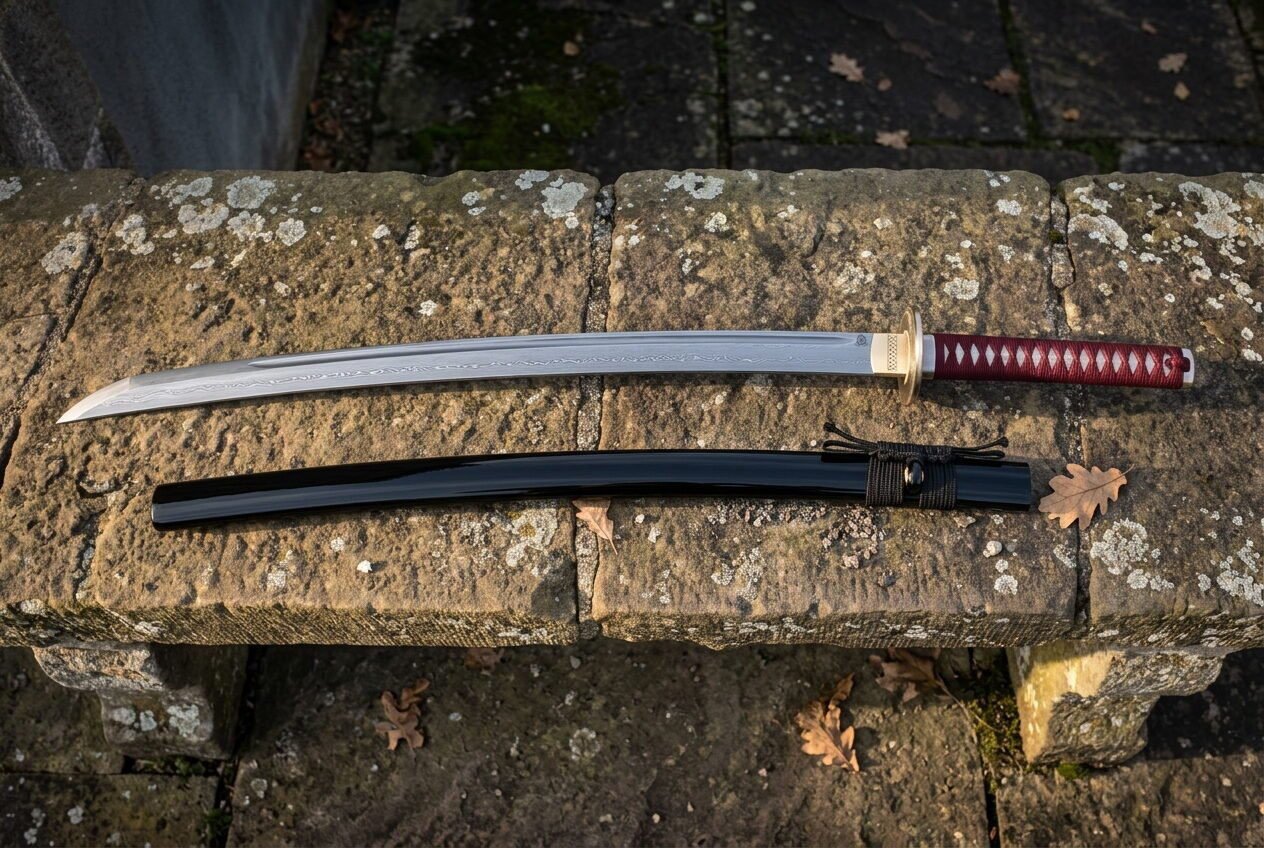
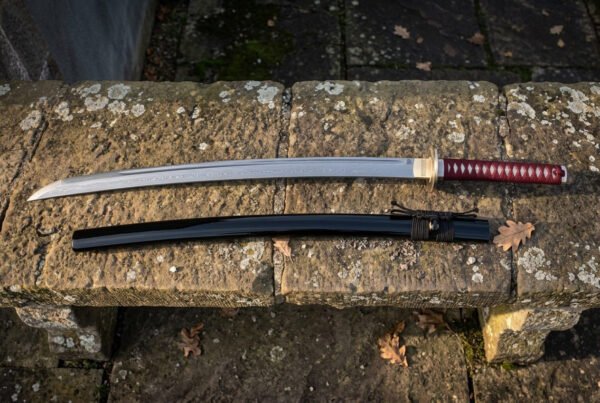
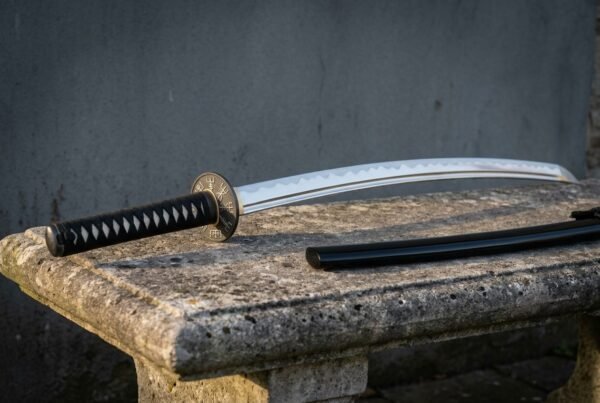
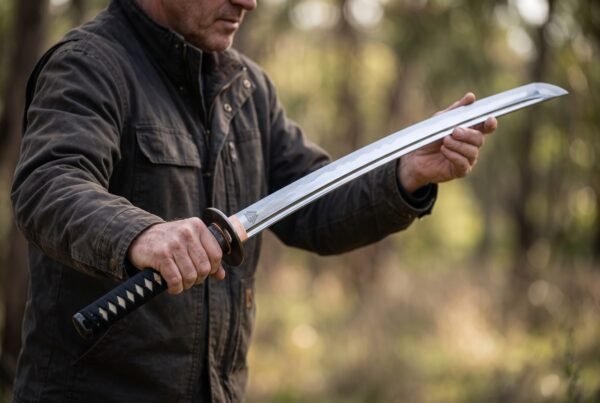
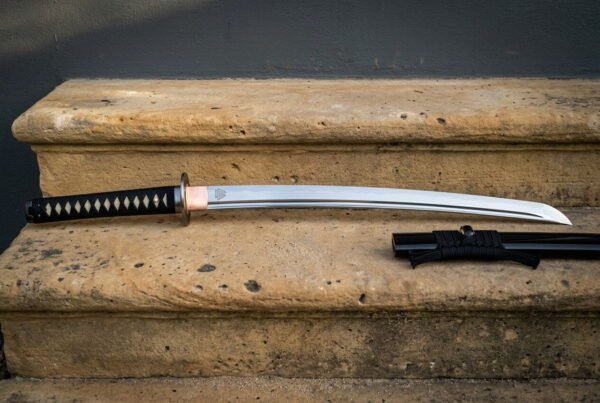
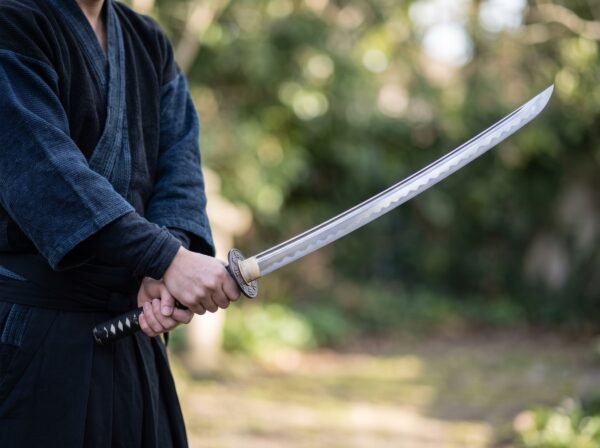
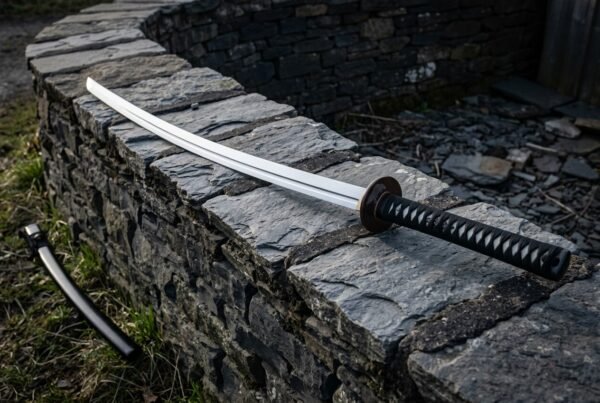
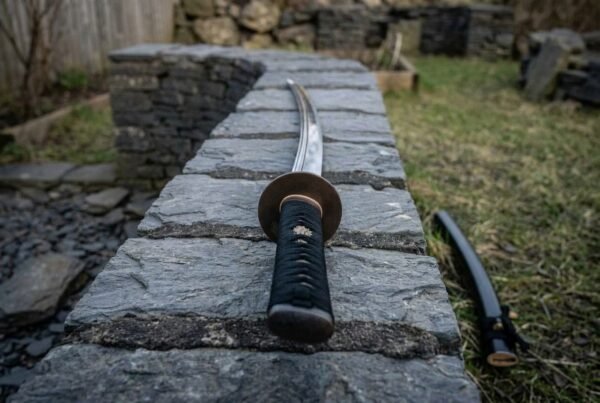
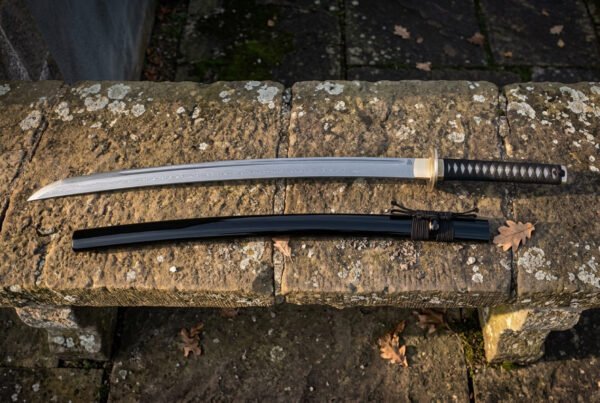
A katana is defined less by its curve than by the way that curve is made. The blade is coated in clay before quenching, thick along the spine and thin along the edge, so that when it goes into the water the edge cools fast and hardens while the spine cools slowly and stays tough. The hardening edge tries to expand, the softer spine refuses to follow, and the blade pulls itself into its curve inside the quench tank. Emberdusk is forged on that principle from 1095 high carbon steel and hardened to 54 to 58 HRC, with a 28 inch blade that carries its sori evenly from the habaki to a long kissaki. How the curve is actually created is explained in the katana explained.
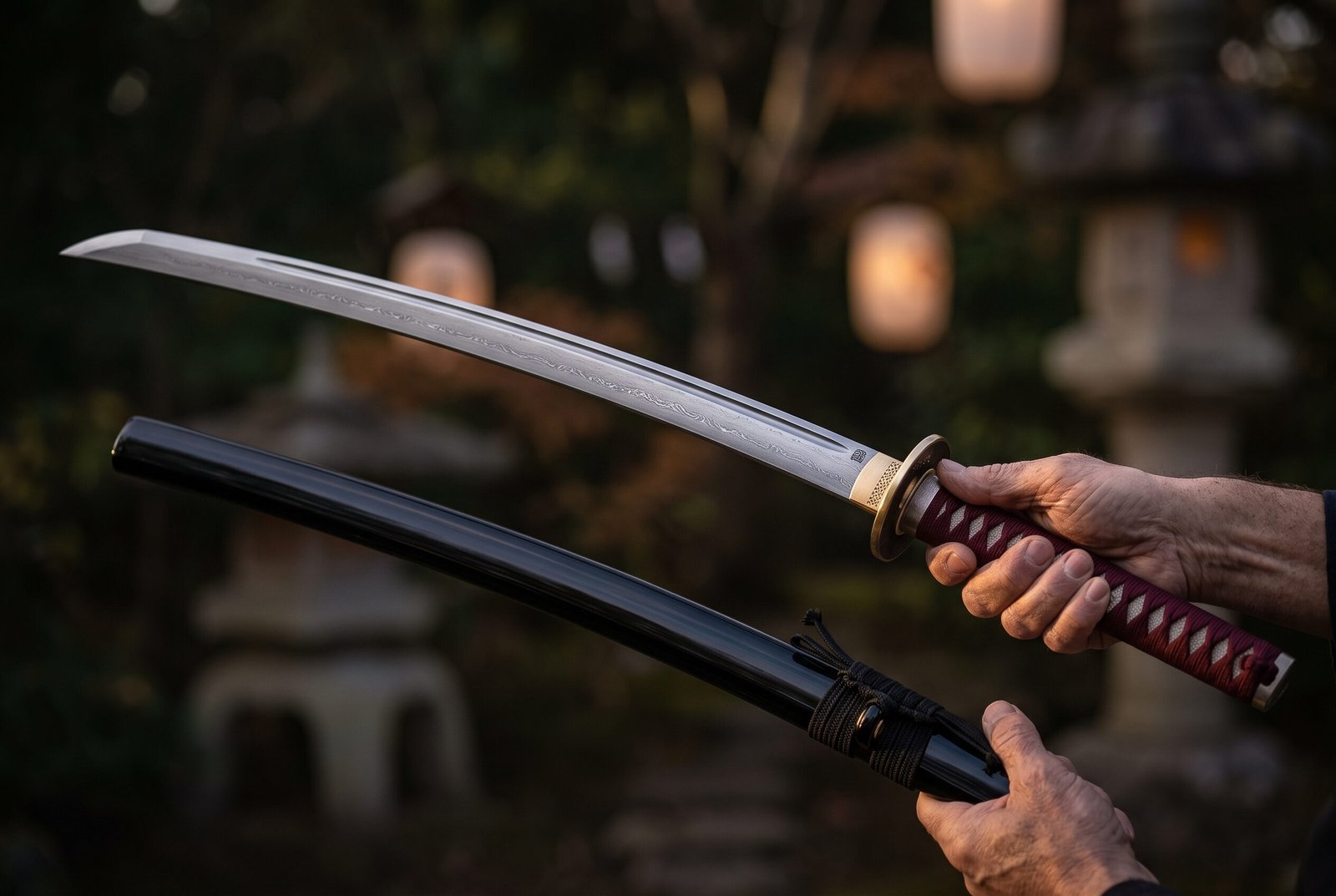
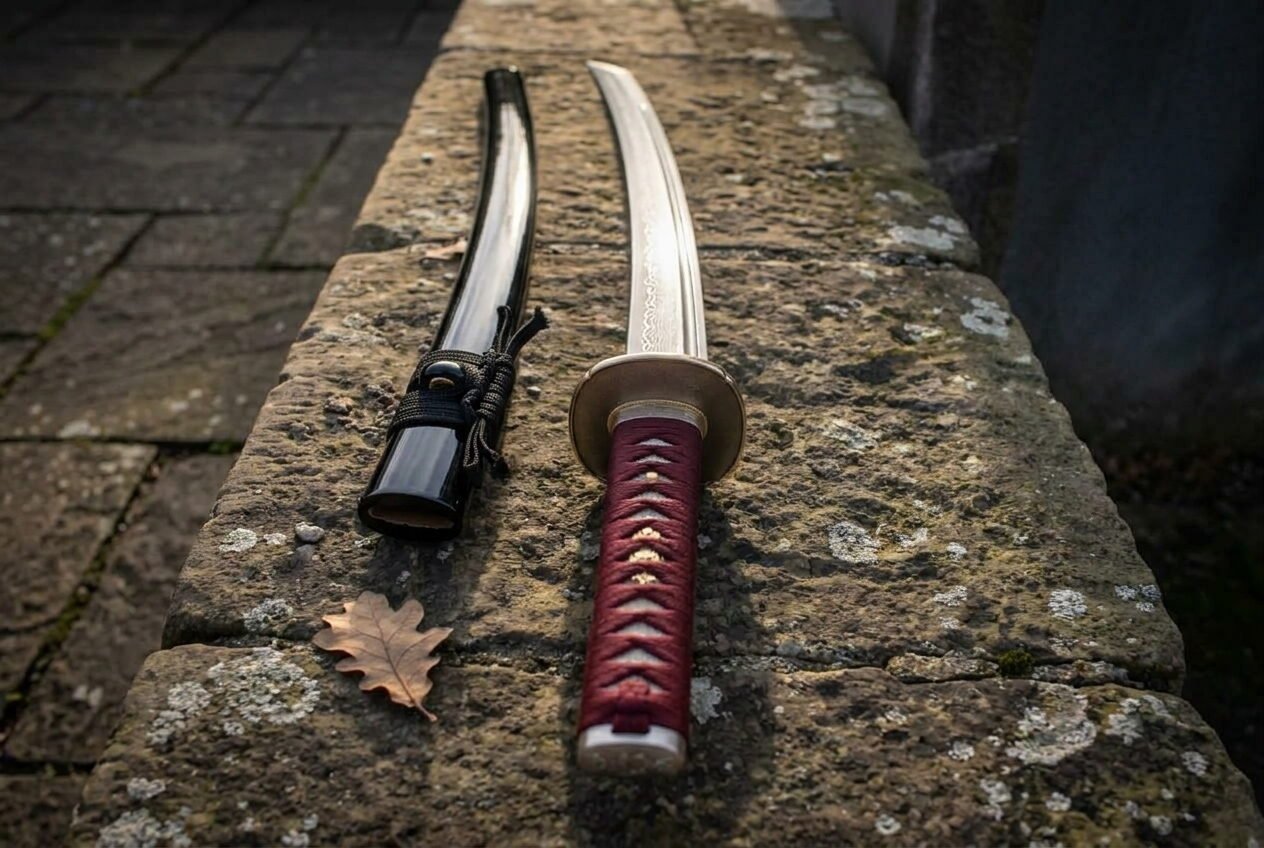
Every part of this sword is forged, ground, heat treated and mounted by hand in the Czech Republic. It ships with the black lacquered wooden saya shown in the photographs, a cord sageo, and a light protective coat of oil on the blade. Shipping inside the United States is free.
Specifications
| Steel | 1095 high carbon steel |
|---|
| Hardness | 54 to 58 HRC |
|---|
| Overall length | 40.5 inches |
|---|
| Blade length | 28 inches |
|---|
| Blade profile | Shinogi zukuri with a narrow groove along the upper flat, a visible temper line and a long kissaki, hand polished |
|---|
| Handle | Hardwood tsuka core wrapped in deep crimson cord over white same |
|---|
| Guard | Round polished brass tsuba with brass seppa |
|---|
| Habaki | Brass |
|---|
| Fuchi and kashira | Polished silver tone metal collar and pommel cap |
|---|
| Scabbard | Black lacquered wooden saya with black cord sageo |
|---|
| Weight | Approximately 2.6 pounds bare, 3.4 pounds in the saya |
|---|
| SKU | RK-1270 |
|---|
What the curve actually does
The sori of a katana is not decoration and it is not there to make the sword look fast. A curved edge meeting a target does not strike all at once. It lands at a point and then rolls along the target as the arms carry the sword through, which turns a chop into a draw cut. That is why a curved blade of the same weight and the same sharpness cuts deeper than a straight one for the same effort. The curve also moves the point of percussion, the spot along the blade where a hit sends the least shock back into the hands, out towards the forward third where the sword is meant to meet its target.
The other consequence is geometry at the tip. The long kissaki on this blade means the cutting edge continues almost to the point rather than dropping away into a short rounded nose, so the last few inches remain useful. On a hand forged sword the boundary between the hardened edge and the softer spine follows the clay line, and because that line is laid on by hand it wanders. It is never the same twice and it should not be.
Why 1095 high carbon steel and not stainless
1095 is a simple steel. It is iron with just under one percent carbon and very little else, and that plainness is the point. There is no chromium in it competing for the carbon, so nearly all of the carbon is available to form the hard structures that hold an edge. It takes a fine polish, it responds cleanly to a differential heat treatment, and it can be sharpened back to full keenness on an ordinary whetstone without special abrasives.
Stainless steel resists rust because chromium locks up in the surface and forms an oxide skin. The trade is that the same chromium ties up carbon in coarse carbides, which blunts the fine edge you can take a blade to, and in a sword length section stainless is prone to failing suddenly rather than bending. A sword is a long lever, and long levers should bend before they break. The cost of 1095 is that it will rust if you leave it wet, which is what the oil is for. If you want the longer version of that argument, read our steel and hardness notes.
The tsuka and how it is wrapped
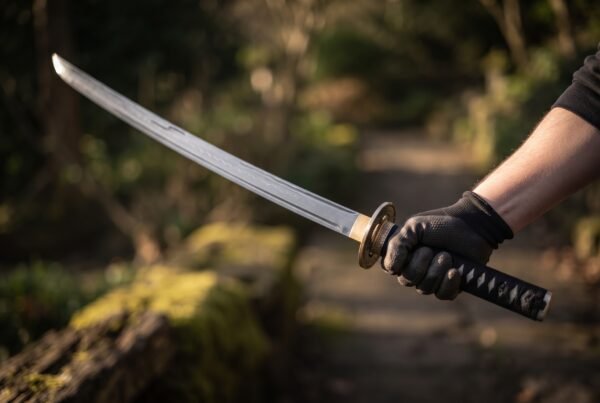
The handle is a two piece hardwood core shaped to the tang, closed around it and covered in white same, the pebbled rayskin that gives the cord something to bite into. Over that goes the deep crimson tsukaito, wrapped in alternating diamonds so that each turn locks the one before it. The wrap is not there for looks. It creates a series of ridges and hollows that let the hand find the same position without looking, and it leaves the cord bearing on the rayskin rather than on the wood, so the grip stays firm as the cord settles with use.
The core is wood and the saya is wood, and both want the same treatment. Keep them out of long damp and out of direct sun, and wipe rather than soak them. Our notes on handle and sheath care apply to a tsuka and a saya as much as to a knife scale.
Engraving, runes and your own design
Use the rune converter on this page to turn a name, a date or a short phrase into Elder Futhark and we will cut it into the steel or the handle. If you would rather have a Viking pattern than a rune line, choose your own design in the engraving option above the add to cart button and tell us whether it goes on the blade or the handle. Where a piece already carries an engraved design, your chosen engraving replaces it rather than sitting alongside it. There is more detail about placement and depth on the engraving page.
Care and sharpening
Wipe the blade down after handling. Skin leaves salt and moisture behind and 1095 will take a print on the polish within a day in a humid room. A thin film of light mineral oil on a cloth is enough. Do not store the sword in the saya for months at a time in a damp climate, because a wooden scabbard holds humidity against the steel. Stand it or lay it out of the saya if the room is damp.
The edge takes a normal whetstone. Work a coarse stone only when the edge is genuinely damaged, and keep to a fine stone and a strop for maintenance, holding the same angle the edge was ground at and following the curve so you do not flatten it. Our guides on steel care and sharpening with a whetstone cover both jobs step by step.
Made in the Czech Republic
The work behind this piece happens in a Czech Republic workshop that has kept to the old methods. Steel is forged and heat treated by hand, the grind is taken down by eye rather than by machine, and the handle, fittings and sheath are cut and finished one at a time. Because of that, every piece carries small marks of the hand that made it.
Ransack Viking is a United States company. We import direct, check each piece when it reaches us, and ship from our Chicago, Illinois warehouse. Engraving is added here in the United States after arrival, so the piece you receive is finished to your order.
A note on handmade variation
This katana is hand forged. It is not machine made and it is not bulk produced, so what arrives will not be a pixel for pixel copy of the photograph. The temper line will run its own path, the polish will catch the light in its own way, the grain and tone of the wood in the tsuka and the saya will be their own, and the exact profile of the curve will vary by a small margin from one blade to the next because it is set in the quench and not in a die. The dimensions, the steel and the build are the same every time. The character is not, and that is the nature of work done by hand from natural materials.
Frequently asked questions
Does it arrive sharp?
Yes. It is sharpened and ready to cut on arrival. If you are buying it for display and would rather it came blunted for a household with children or for a venue that requires it, say so in the order notes and we will supply it unsharpened at no extra cost.
Can I cut with it or is it a display sword?
It is a working blade in a full length tang, and it will handle tatami mats, water bottles and light bamboo. It is not a test cutting sword for hard targets. Do not cut into wood, metal, sand filled targets or anything you have not identified, and do not use it for sparring against another blade. Steel on steel takes chips out of a hardened edge.
Can I have runes engraved on it?
Yes. Use the rune converter on this page for an Elder Futhark line, or pick your own design from the engraving option above the add to cart button. Tell us whether you want it on the blade or on the tsuka.
Will mine look exactly like the photographs?
Close, but not identical. Same length, same steel, same fittings and same crimson wrap. The temper line, the polish and the figure of the wood are individual to each sword.
What is the difference between this and a wakizashi?
Length, and what that length is for. A katana at 40 inches overall is a two handed sword meant for open ground. A wakizashi runs around 28 inches overall and is a one handed companion blade for indoors and close quarters. Historically they were worn as a pair, the daisho, and a wakizashi is the easier of the two to keep and display in a normal room.
How long does shipping take?
Free within the United States. Most orders leave the shop within one to two weeks, a little longer with engraving, and then run two to five days in transit depending on where you are.
What is in the box
- Emberdusk hand forged 1095 high carbon steel katana
- Black lacquered wooden saya with cord sageo
- Light protective oil coat on the blade
- Care and sharpening card
- Elder Futhark rune engraving where selected
- Forged and finished in the Czech Republic
Explore the range
See the rest of the katana and Japanese swords, the shorter wakizashi, the full sword range, or read the guides for care, sharpening and engraving.
If this one is not it
For a straight comparison, see the Valkcurve Japanese sword, 40 inches overall. Worth putting side by side with this is the Tidefold Japanese sword, 40 inches overall. In the same category sits the Moonedge Japanese sword, forged from 1095.
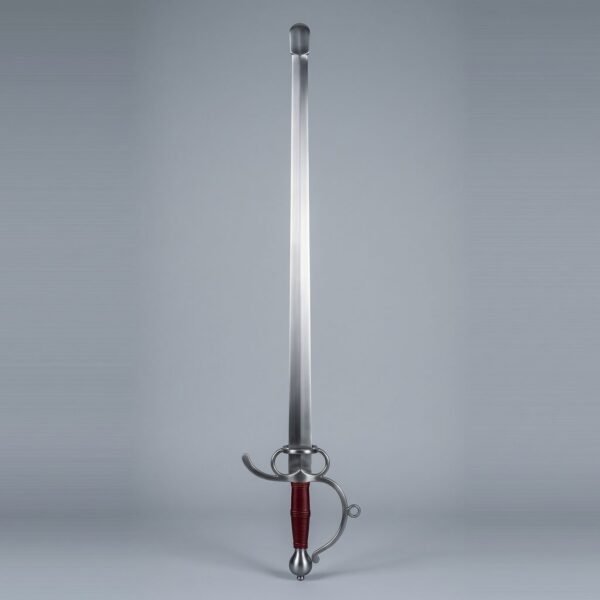
From the same corner of the shop, there is the Rosehilt arming sword. Pick the steel, the length and the fittings yourself on the design your own page.

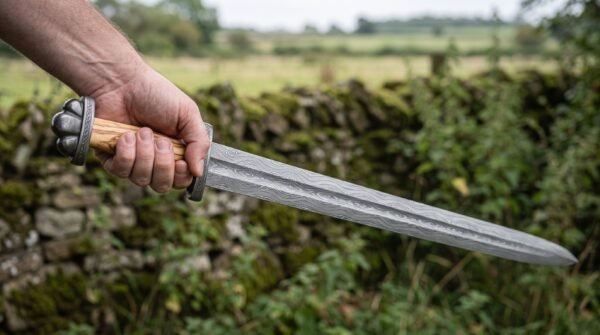
Photos don’t do this sword justice at all. Edge retention has been great even after regular use. Even the small engravings are crisp and clean. Great buy overall.
Did not expect this level of quality for the price. Leather sheath is thick and well stitched. Not the cheap stuff you usually get. This shop clearly takes pride in their work.
My whole family was impressed when I unboxed it. Leather sheath is thick and well stitched. Not the cheap stuff you usually get. It’s handmade in the Czech Republic but ships from a US warehouse so it arrived quicker than I expected. Came in a nice gift box which made it feel even more special. Weight and balance make it feel like a real functional piece not some cheap replica. This shop clearly takes pride in their work.