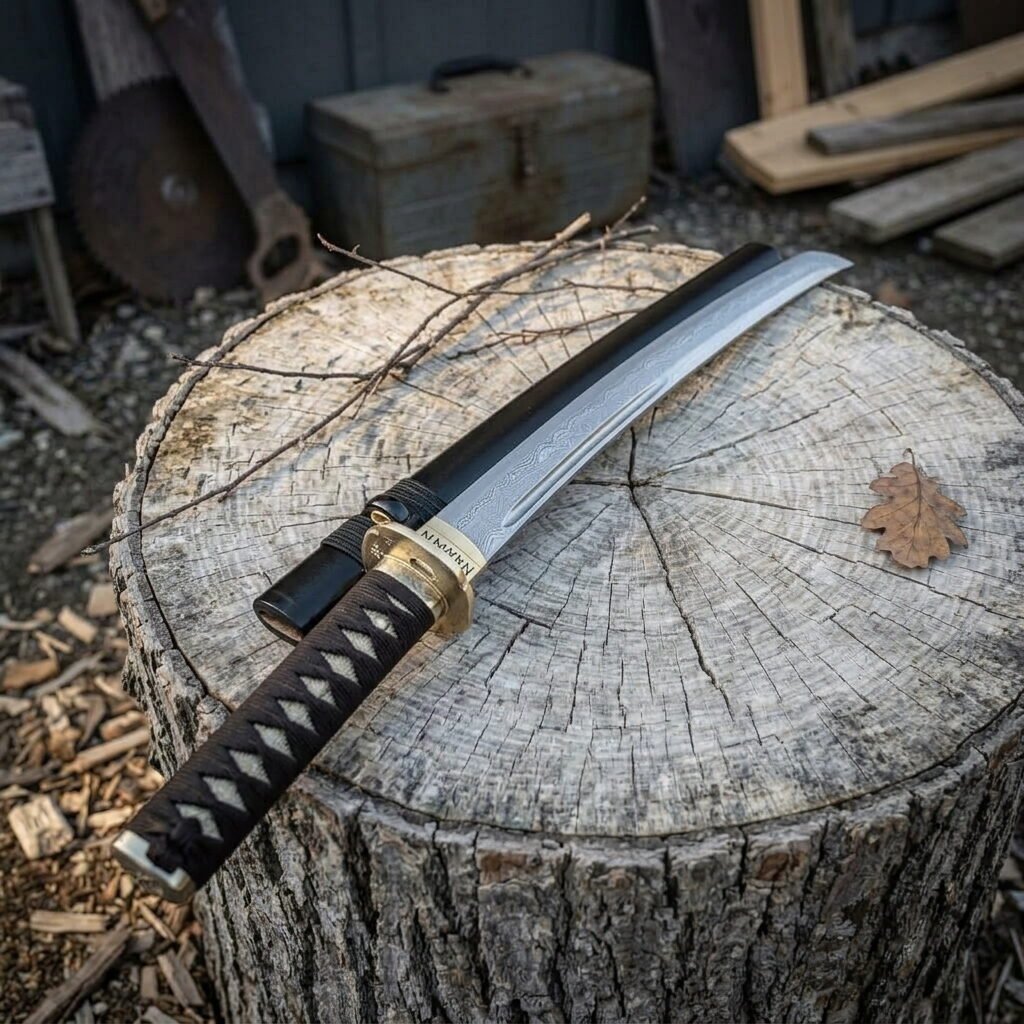
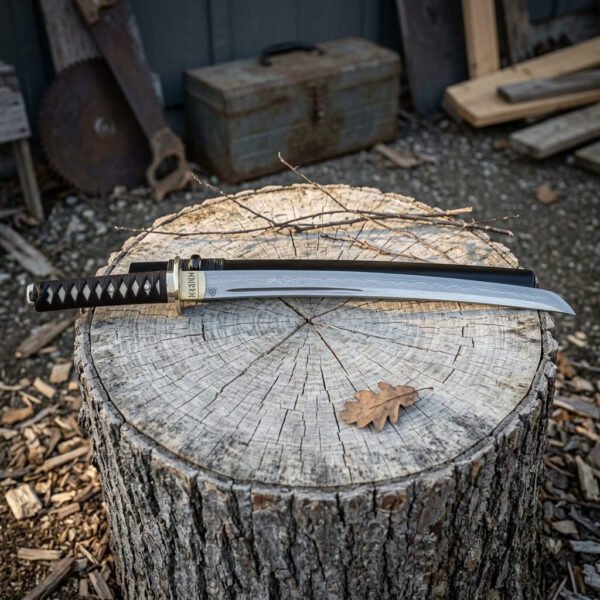
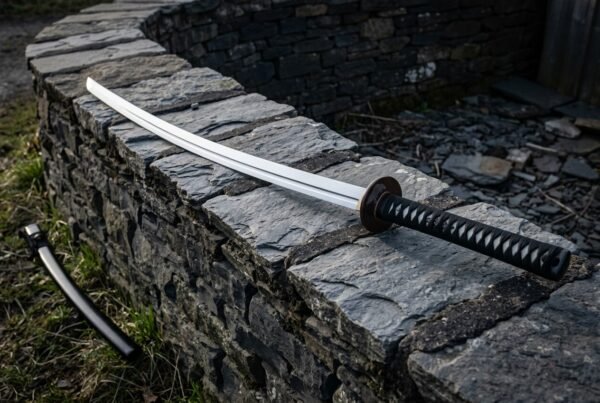
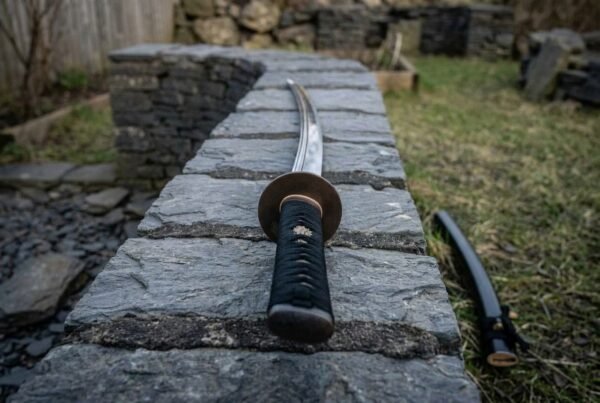
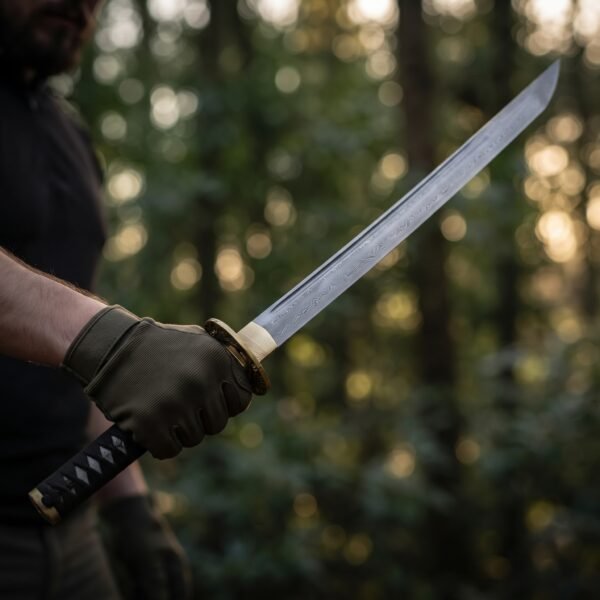
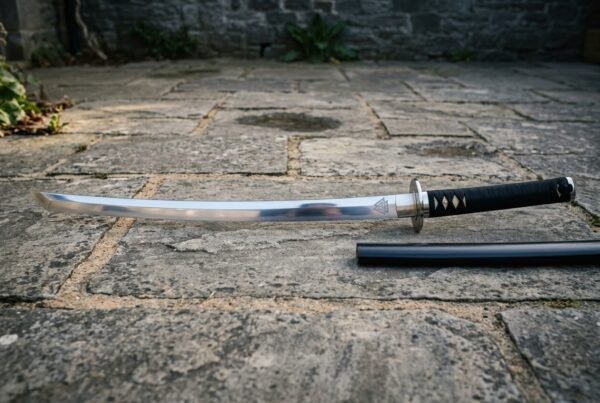
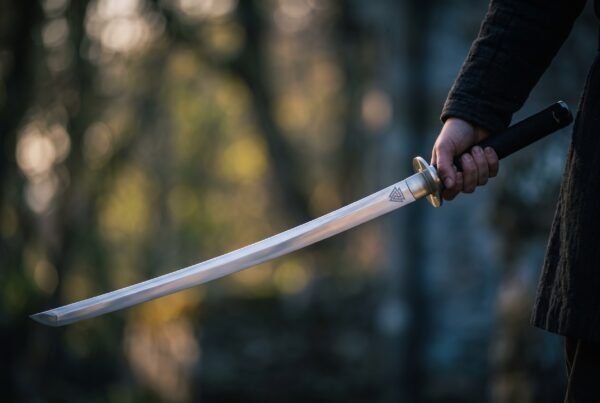
The brass disc between the blade and the handle of a samurai sword is the most misunderstood fitting on the whole sword. A tsuba is not a shield and it was never meant to catch an incoming blade the way a European cross guard does. It exists to stop the hand sliding forward onto the edge when a thrust stops hard, to give the leading hand something to register against so the grip lands in the same place every time, and to add a small weight right at the pivot that settles the balance without slowing the blade. Everything beyond that is craft and decoration, which is why surviving tsuba are collected as objects in their own right. Brasswind carries a solid brass tsuba with matching seppa and habaki, on a 27 inch blade of 1095 and 15N20 Damascus steel hardened to 58 to 60 HRC. A curve needs a different stroke on the stone, and sharpening a curved blade shows it.
Forged, ground, heat treated and mounted by hand in the Czech Republic. It ships with a black lacquered wooden saya, a cord sageo and a protective coat of oil on the blade. Shipping inside the United States is free.
Specifications
| Steel | Damascus, 1095 and 15N20 forge welded |
|---|
| Hardness | 58 to 60 HRC |
|---|
| Overall length | 39.5 inches |
|---|
| Blade length | 27 inches |
|---|
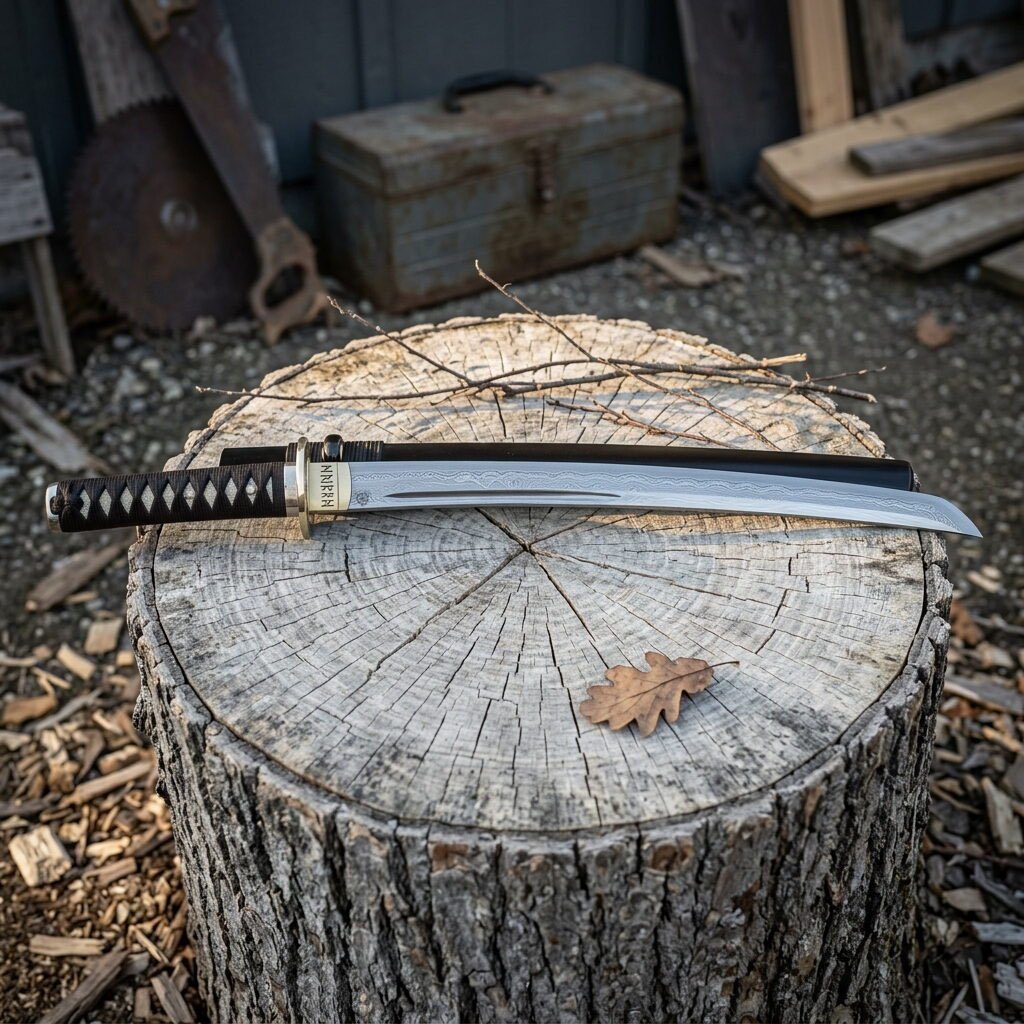
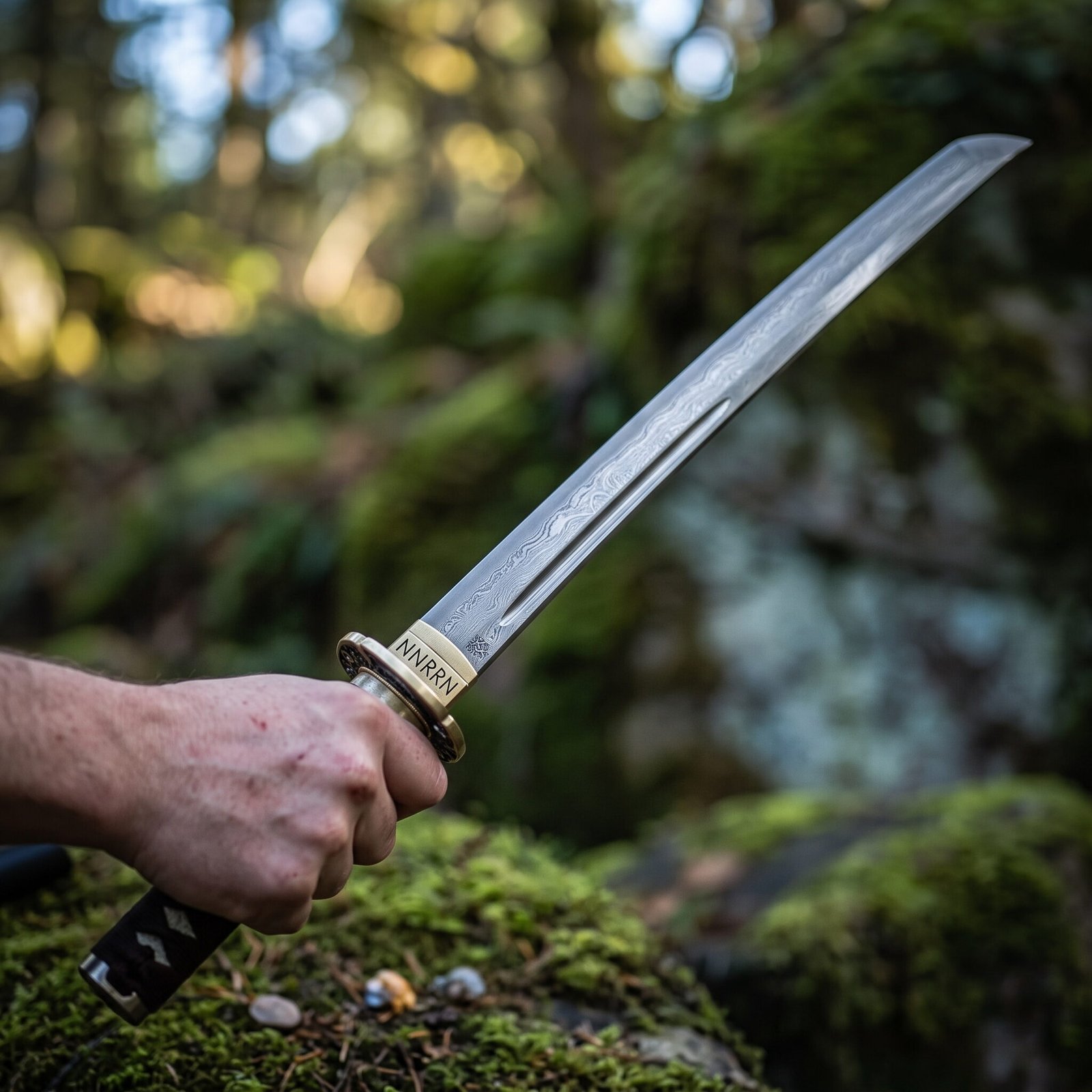
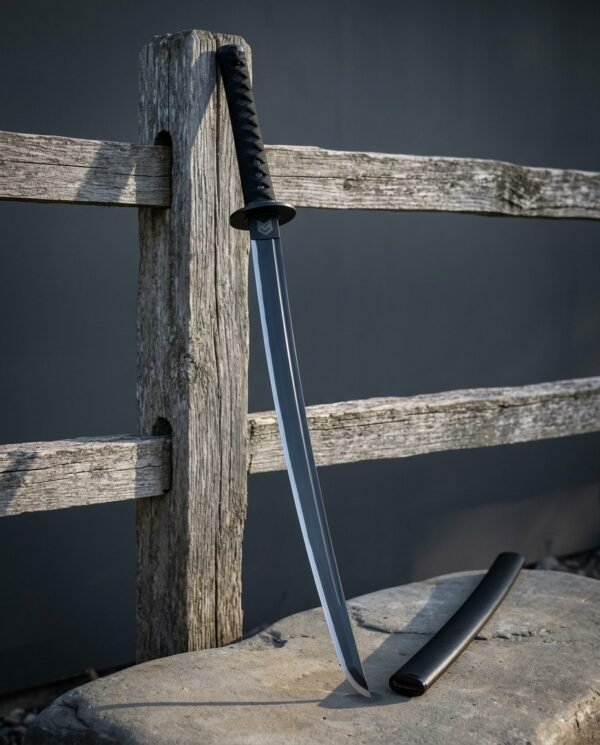
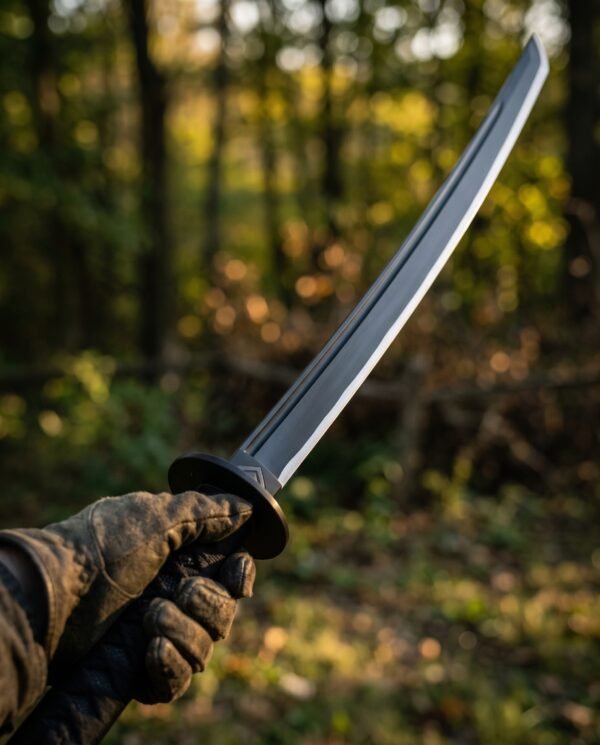
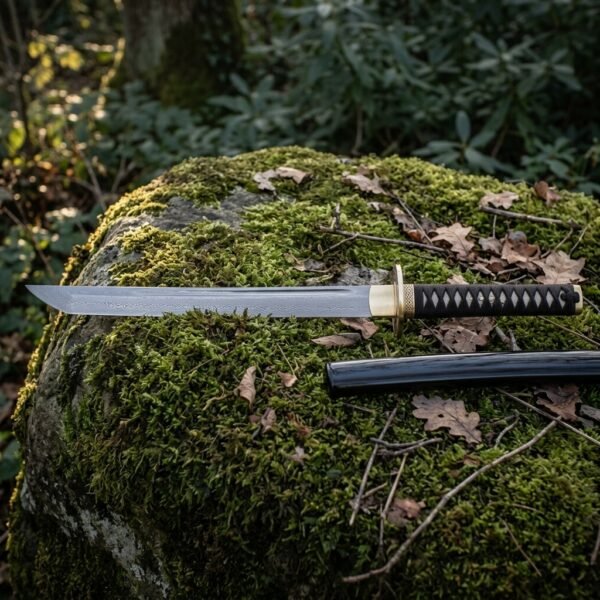
| Blade profile | Shinogi zukuri with a bo hi fuller and a compact kissaki, etched to show the Damascus pattern |
|---|
| Handle | Hardwood tsuka wrapped in black cord in a diamond pattern over white same |
|---|
| Guard | Solid brass tsuba with brass seppa |
|---|
| Habaki | Brass habaki engraved with a rune line |
|---|
| Kashira | Metal end cap on the tsuka |
|---|
| Scabbard | Black lacquered wooden saya with cord sageo |
|---|
| Weight | Approximately 2.5 pounds bare, 3.3 pounds in the saya |
|---|
| SKU | RK-1273 |
|---|
The shinogi and why a katana is not flat
Run a finger up the flat of this blade and you will feel a ridge running parallel to the edge, closer to the spine than to the cutting edge. That is the shinogi, and the whole cross section of the sword is built around it. Below the ridge the steel tapers steeply to the edge in a single clean bevel. Above it the steel falls away much more gently to the spine. It is a deliberate compromise between two things that pull against each other.
A thin blade cuts well and breaks. A thick blade survives and drags. Putting the ridge high keeps the section behind the edge thin enough to part material cleanly, while leaving a thick spine to carry the bending load and to sit as a mass of softer, tougher steel behind the hardened edge. The ridge also does something useful in the target. Once the edge has opened a cut, the shinogi is the widest point the blade has to push through, and because it sits at a shallow angle it wedges the cut open and then releases, which is why a properly ground katana does not bind halfway through a tatami mat. Getting that ridge to run dead straight and at a constant height along 27 inches is the hardest part of grinding one of these by hand.
Why Damascus steel and not stainless
The blade is pattern welded from 1095 and 15N20, two carbon steels forge welded into one bar and then etched, which is what brings up the flowing grain you can see along the flat. Neither steel carries the chromium of a stainless, so the edge can be taken truly sharp and brought back sharp on a plain whetstone. It also heat treats predictably, which matters when a blade this long has to come out of the quench straight.
Stainless is the opposite trade. Chromium buys corrosion resistance and costs edge fineness and, at sword length, toughness. A long blade should take a bend and give warning rather than snapping. The price of carbon steel Damascus is honest rust if you leave it wet, and the oil answers that. The comparison is set out properly in our steel and hardness notes.
Handle, wrap and brass fittings
The tsuka is a hardwood core fitted in two halves to the full length tang, covered in white same and wrapped in black cord in alternating diamonds. The brass seppa either side of the tsuba take up the last of the slack so nothing rattles, and the brass habaki wedges into the mouth of the saya so the scabbard grips the collar rather than the polished blade.
Brass darkens with handling. It will go from bright yellow to a warmer, deeper tone over a year or two, and most owners leave it. If you prefer it bright, a metal polish on a cloth and a careful hand around the wrap will bring it back. The wood in the handle core and the saya wants the treatment described in handle and sheath care, which is to say kept dry, out of the sun and wiped rather than washed.
Engraving, runes and your own design
Use the rune converter on this page to turn a name, a date or a short phrase into Elder Futhark and we will cut it into the steel or the handle. If you would rather have a Viking pattern than a rune line, choose your own design in the engraving option above the add to cart button and tell us whether it goes on the blade or the handle. Where a piece already carries an engraved design, your chosen engraving replaces it rather than sitting alongside it. Placement and depth are explained on the engraving page.
Care and sharpening
Wipe the blade down after handling, including around the habaki where moisture collects between brass and steel. Light mineral oil on a cloth is enough. Keep the sword out of the saya if the room is genuinely damp, because a wooden scabbard holds humidity against the polish.
The edge sharpens on ordinary water stones at the angle it was ground at, worked along the curve rather than across it, finished fine and stropped. Save the coarse stone for actual damage. Step by step in steel care and sharpening with a whetstone.
Made in the Czech Republic
Every piece we sell is made by hand in the Czech Republic. The smiths there work the way the trade has been worked for a long time, heating and hammering the steel, taking the bevels down by eye, and fitting the handle and the leather one at a time. There is no automated line anywhere in it, so small differences from one piece to the next are normal and expected.
Ransack Viking is a United States company based in Chicago, Illinois. We bring the pieces in ourselves, inspect them on arrival and ship them from our own warehouse. If you add engraving, that is carried out here in the United States before your order goes out.
A note on handmade variation
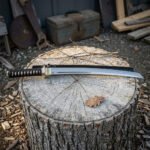
Brasswind is hand forged. It is not machine made and it is not bulk produced, so what arrives will not be a pixel for pixel copy of the photograph. The Damascus pattern is unique to each blade, the shinogi line is cut by hand and eye, the brass will have its own tone, and the grain of the wood in the tsuka core and saya is unique to that tree. The curve varies slightly from sword to sword because it comes out of the quench rather than a die. Dimensions, steel and build are the same every time. The character is not.
Frequently asked questions
Is the tsuba solid brass or plated?
Solid brass, along with the seppa and the habaki. It will darken with handling into a warmer tone, which most owners prefer, and it polishes back if you do not.
Does it come sharpened?
Yes, sharp and ready to use. Ask in the order notes if you want it supplied blunt for display or for a venue with rules about edged display pieces, and there is no extra charge.
Can I cut with it?
Soft targets only. Tatami, water bottles and light bamboo are fine. Hard wood, metal, sand filled targets and blade to blade contact are not, and no hardened sword edge survives a hit against another sword without damage.
Can I have runes engraved on it?
Yes. Elder Futhark through the rune converter on this page, or your own Viking pattern chosen in the engraving option above the add to cart button, on the blade or the handle as you prefer.
Will mine look exactly like the photograph?
Same steel, same length, same brass fittings and black wrap. The Damascus pattern, the brass tone and the wood figure differ from one to the next because the work is done by hand.
How long does shipping take?
Free within the United States. One to two weeks in the shop, a few days more with engraving, then two to five days in transit depending on where you are.
What is in the box
- Brasswind hand forged Damascus steel katana
- Black lacquered wooden saya with cord sageo
- Spare bamboo mekugi peg
- Protective oil coat on the blade
- Care and sharpening card
- Elder Futhark rune engraving where selected
- Forged and finished in the Czech Republic
Explore the range
Browse the rest of the katana and Japanese swords, the shorter wakizashi, every sword we carry, or read the guides.
Near neighbours in the shop
Worth putting side by side with this is the Mistfold Japanese sword, 40 inches overall. In the same category sits the Jadewake Japanese sword, 40 inches overall. A near match for this one is the Emberfold Japanese sword, 40 inches overall.
For a different piece from the same family, look at the Stonewake Viking sword. You can have this made your way instead on the design your own page.

Got this as a gift and now I want one for myself too. Came in a nice gift box which made it feel even more special. Will definitely order again for another gift.