The Polish szabla is one of the few European swords that was genuinely better than what it replaced, and everyone who fought against it said so at the time. Polish and Hungarian cavalry adopted the curved sabre from Ottoman and Turkic patterns in the sixteenth century and then did something the originals had not: they closed the hilt. A knuckle bow and, on many surviving examples, a thumb ring gave the rider a grip he could lock, which meant he could deliver a drawing cut at a gallop without the sword being torn out of his hand. Western observers spent the next two hundred years copying the result, and the light cavalry sabre of every European army descends from it. The curved sword family is wider than most people think, and what a scimitar is sorts it out.
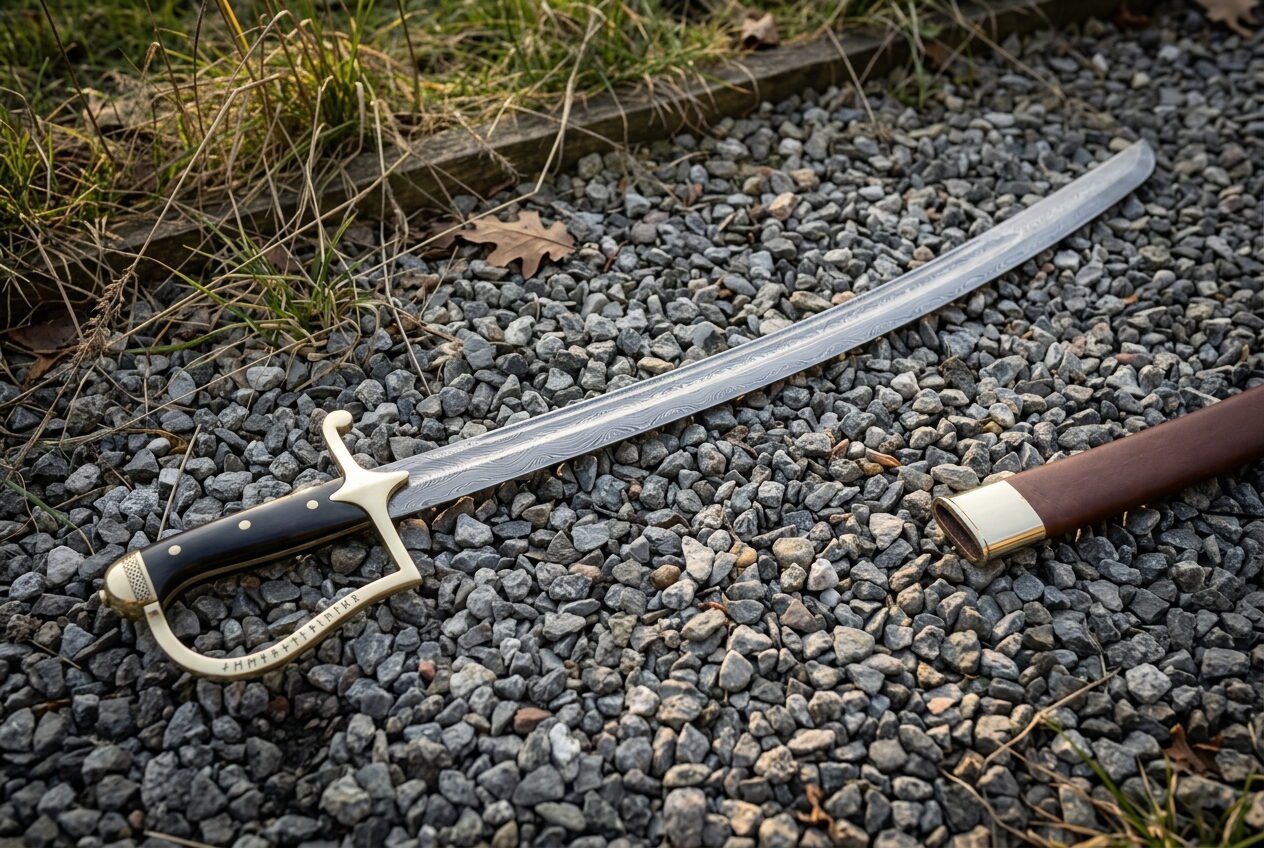
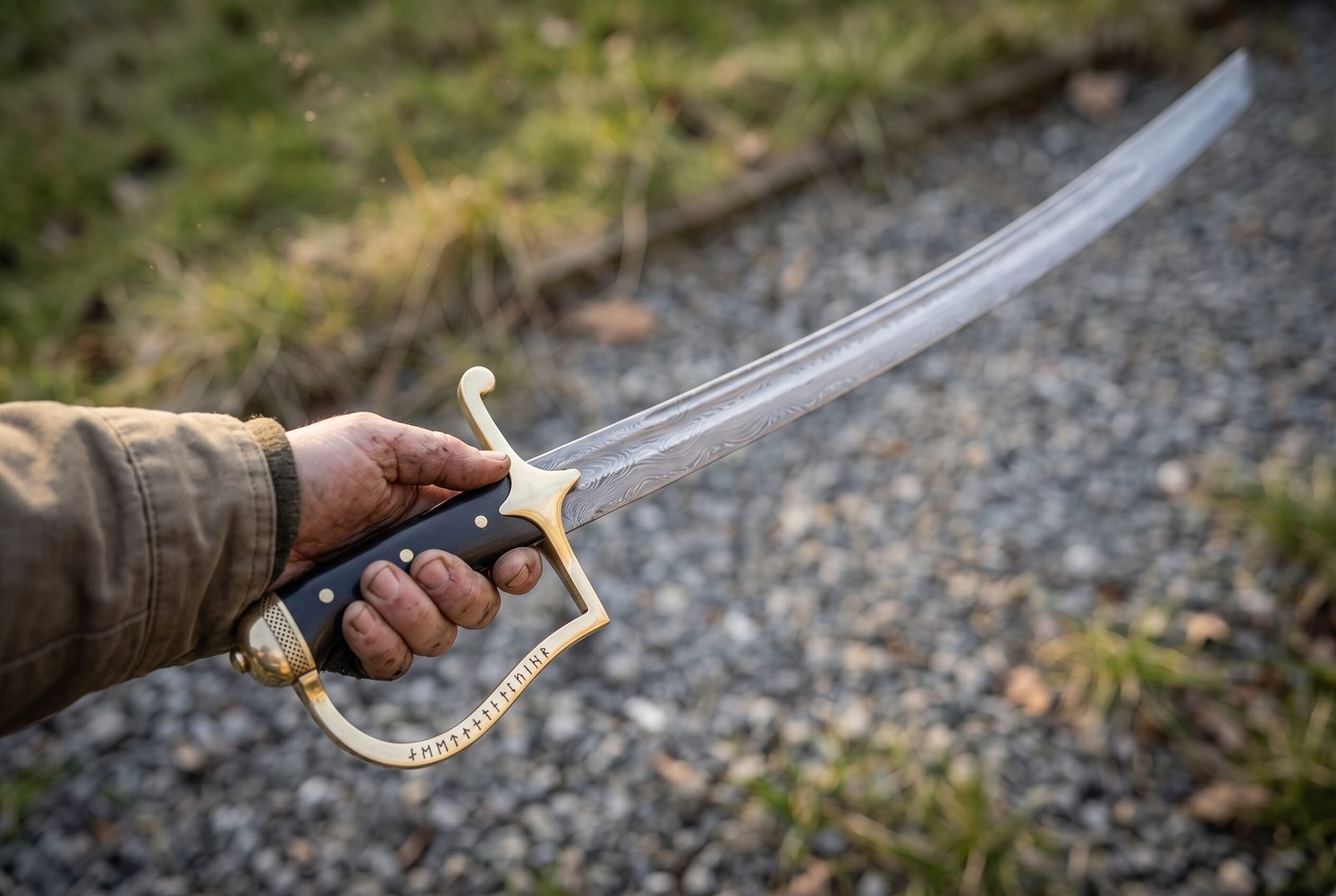
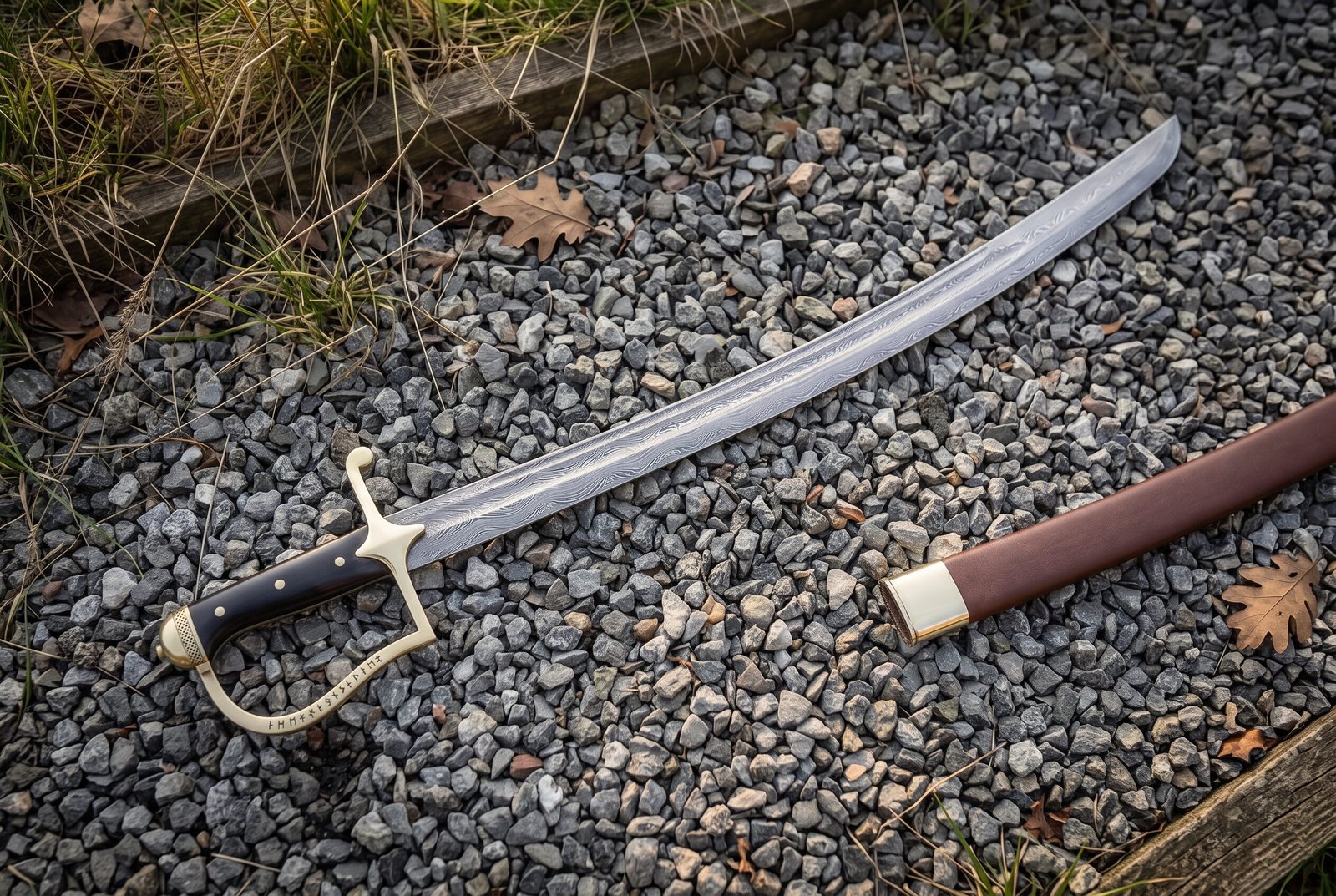
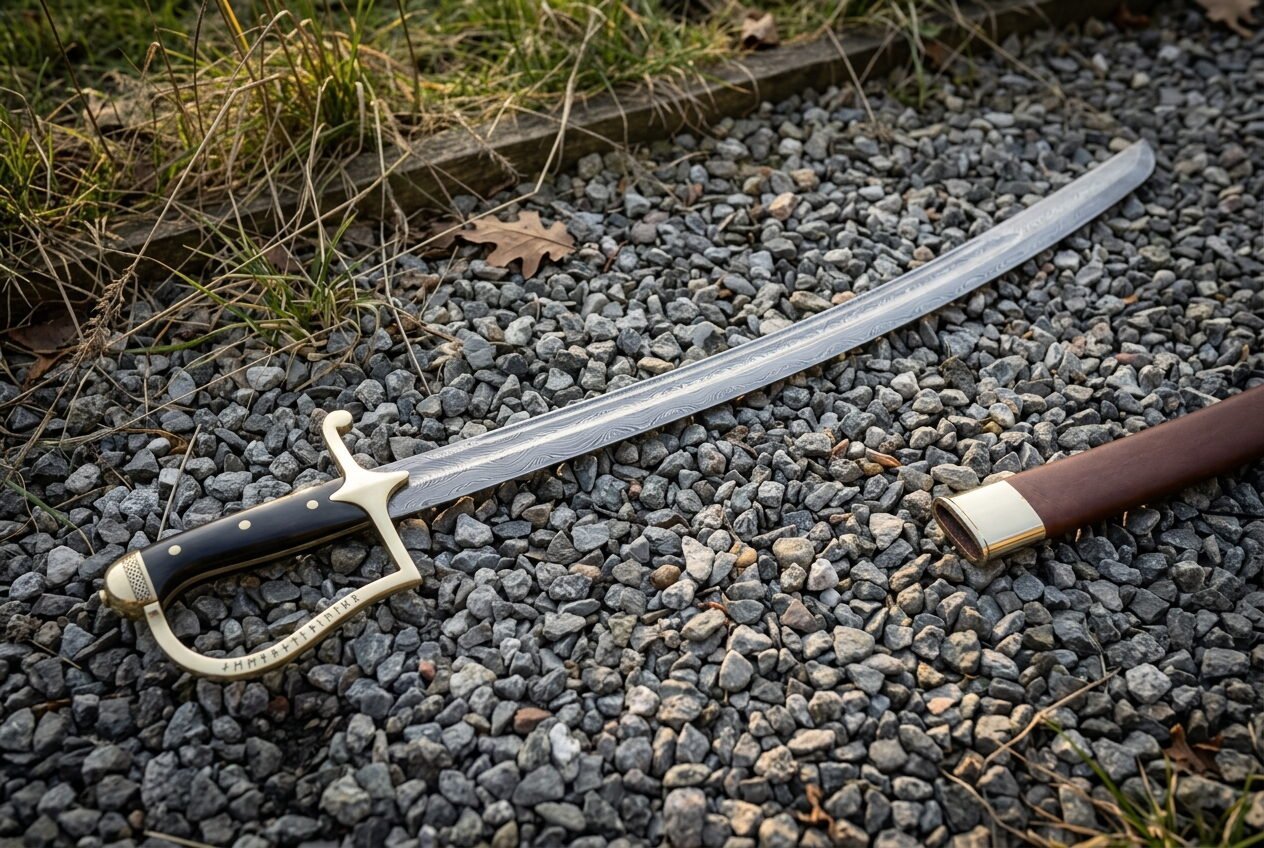
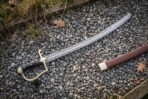
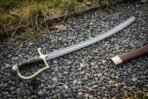
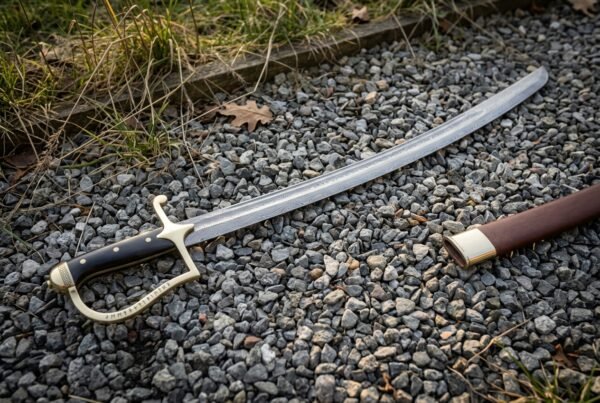
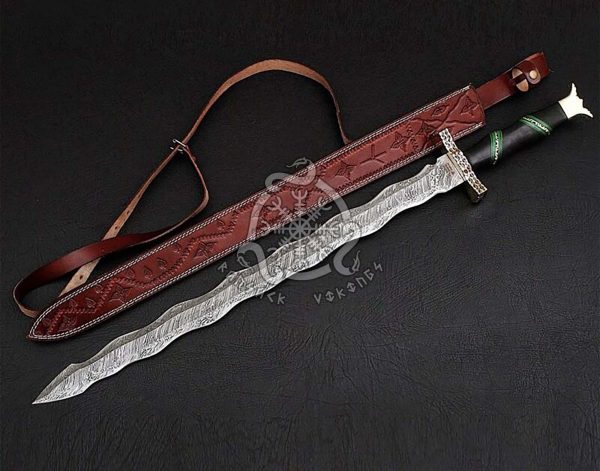
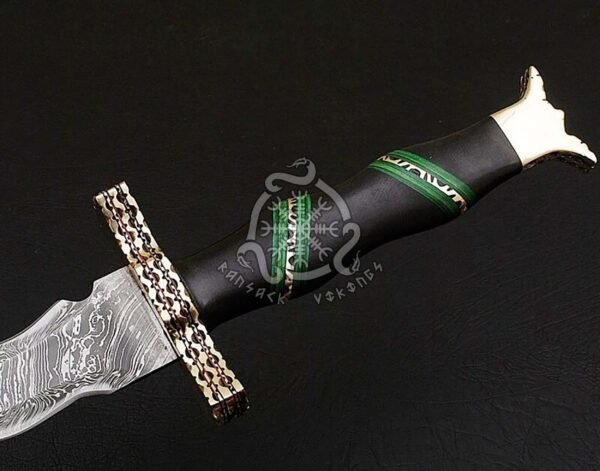
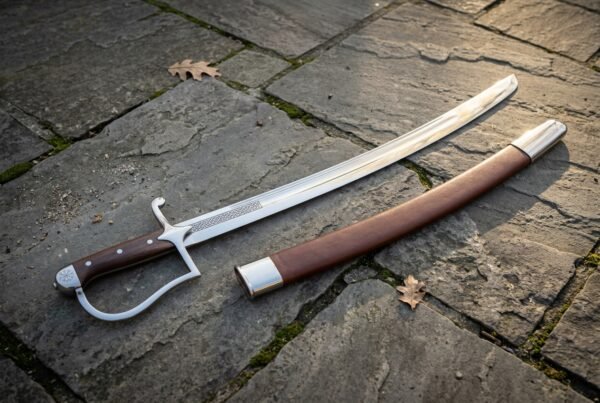
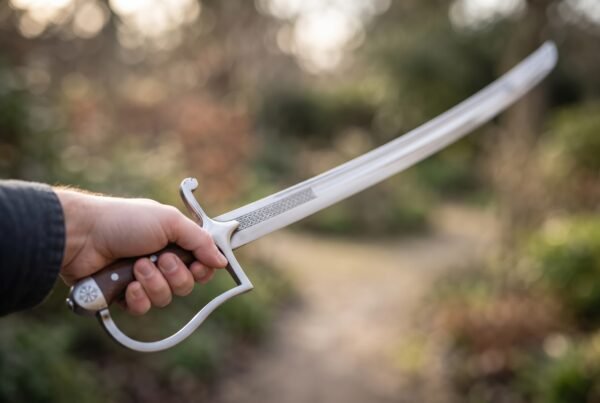
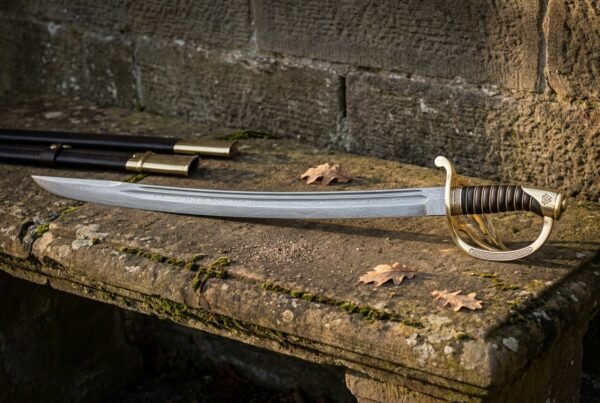
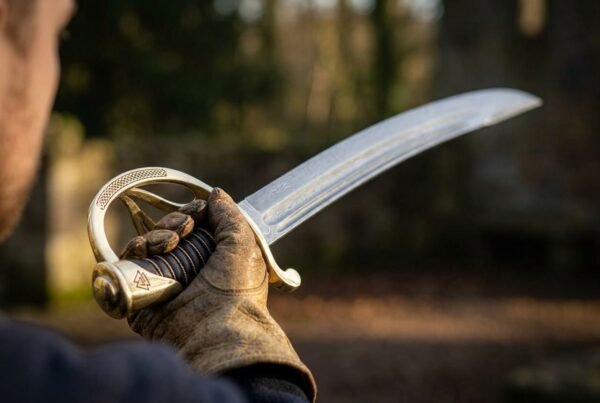
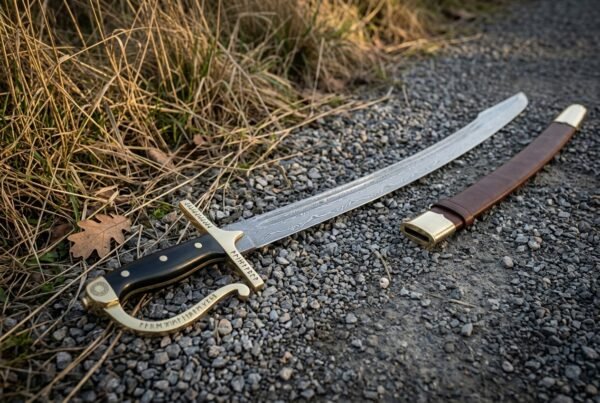
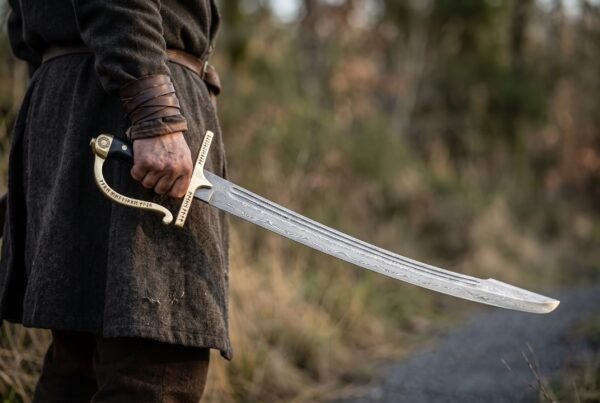
This Hornreach szabla is forged by hand in the Czech Republic. The blade is welded from 1095 and 15N20, drawn long and slender, curved at the anvil and etched to raise the layers. The hilt is open brass with a forward hooked upper quillon and a knuckle bow running back to a filed brass cap, and the grip is black horn in slabs pinned with brass. It ships with a brown leather scabbard fitted in brass, and shipping inside the United States is free.
Specifications
| Steel | 1095 and 15N20 forge welded Damascus, hand etched |
|---|
| Hardness | 58 to 60 HRC |
|---|
| Overall length | 37 inches |
|---|
| Blade length | 31 inches |
|---|
| Blade profile | Slender single edged blade with a long even curve and no false edge |
|---|
| Guard | Open brass cross guard with a forward hooked upper quillon |
|---|
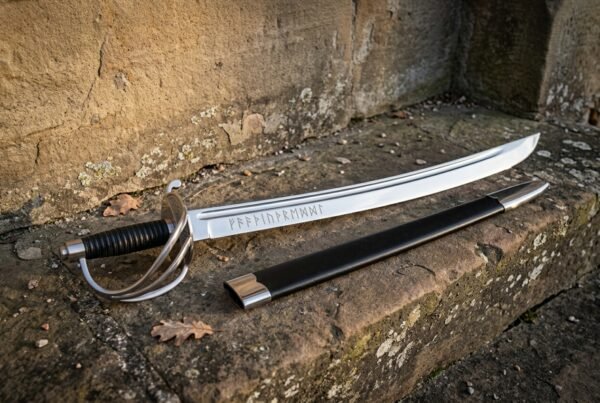
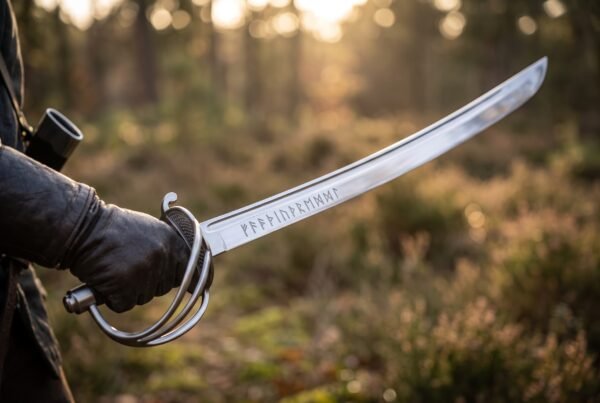
| Knuckle bow | Full brass knuckle bow running back to the pommel, engraved with an Elder Futhark rune line |
|---|
| Grip | Black horn slab scales, full tang, pinned with three brass rivets |
|---|
| Bolsters | None, the horn runs from the guard to the pommel cap |
|---|
| Pommel | Brass cap with a knurled band |
|---|
| Scabbard | Brown leather scabbard with a brass throat and chape |
|---|
| Edge | Shipped with a working edge, sharpened on request at no charge |
|---|
| SKU | RK-1312 |
|---|
What makes a szabla a szabla
Three things, and the curve is only one of them. The first is the open hilt: a cross guard with quillons rather than a plate or a basket, joined by a bow that runs from the forward quillon back to the pommel. That leaves the hand visible and light while still catching a descending blade. The second is the grip angle. A szabla grip is not in line with the blade. It cants down and back, so when the hand is relaxed the point drops naturally into a cutting line instead of having to be forced there. Pick this one up and you will feel the sword want to fall into the cut on its own.
The third is the length and thinness of the blade. Compare it to a cutlass or a cavalry sabre and it looks almost delicate. That is the reach: a szabla was made to be used from a horse against a man on the ground or on another horse, where the extra six inches decide the exchange, and the weight has to stay low enough that the arm can hold the sword out at the end of a long day. The distal taper on this blade is real, not cosmetic. It is noticeably thinner two thirds of the way to the point than it is at the ricasso, which is what keeps a 31 inch blade from feeling like a crowbar.
Later Polish patterns often added a closed thumb ring under the guard, and the karabela subtype swapped the whole hilt for an open eagle head grip with no bow at all. This one sits in the earlier, more usable middle of that family.
Why Damascus and not stainless
The blade is forge welded from 1095, a plain high carbon steel that etches dark, and 15N20, a nickel bearing steel that stays bright under acid. Alternating layers of the two are brought to welding heat and hammered into a single bar, then drawn, cut, folded and welded again until the layer count is where the smith wants it. That process cannot be done with stainless steel in any practical forge, because the chromium that makes stainless stainless forms an oxide film at welding temperature and the layers will not bond through it. The mechanical argument matters more anyway: at 31 inches, a blade with enough chromium to be rustproof is brittle, and a brittle sword is not a sword. Carbon steel gives 58 to 60 HRC at the edge and a spine that flexes and returns. The cost is that you have to oil it. The full argument is on our page on Damascus versus stainless.
The black horn grip
The scales are horn, cut as slabs and pinned through the tang with three brass rivets, running from the guard to the brass pommel cap. Horn was the standard grip material on eastern European sabres for good practical reasons. It is dense enough not to compress under the rivets, it does not split along a grain the way wood can when a pin is driven through it, and it warms to the hand quickly rather than staying cold. It is also a natural material, which means every slab has its own depth of colour. Held to the light this one shows brown and amber in the black.
Horn wants very little. Keep it out of prolonged direct sun and away from radiators, because heat dries it and dried horn can craze. A wipe with a dry cloth is normally enough, and a drop of neutral oil worked in once a year keeps the surface deep. The brass guard and bow tarnish slowly and come back with a little metal polish. More in our handle care notes.
Engraving, runes and your own design
Use the rune converter on this page to turn a name, a date or a short phrase into Elder Futhark and we will cut it into the steel or the handle. If you would rather have a Viking pattern than a rune line, choose your own design in the engraving option above the add to cart button and tell us whether it goes on the blade or the handle. Where a piece already carries an engraved design, your chosen engraving replaces it rather than sitting alongside it. On a Damascus blade we cut shallow, so the engraving reads against the pattern rather than fighting it. See the engraving page for what works and what does not.
Care and sharpening
Etched Damascus is a shallow relief, only a few thousandths of an inch deep, so it will polish away if you attack it with abrasives. Use a soft cloth, never a scouring pad, and keep a thin film of oil on the steel. Wipe fingerprints off promptly, because skin acid continues etching the surface and leaves marks that show badly against the layers. Store the szabla out of its scabbard for long periods, since leather traps moisture against steel. Our full routine is on the steel care page.
Sharpening a long curve means moving the sword, not the hands. Set your angle, then draw the blade across the stone so the point of contact travels steadily from ricasso to tip. It takes longer than a straight blade and it is not more difficult. We cover the whole method in our guide to sharpening with a whetstone.
Made in the Czech Republic
This is a handmade piece from the Czech Republic, made in a workshop that still forges, grinds and finishes by hand instead of stamping parts out. The smiths there have kept the older way of working, and the wood, horn and leather are shaped and fitted by hand as well. Two pieces of the same design will never be identical, and that is part of what you are buying.
Ransack Viking is a United States company. We handle the import ourselves, look over every piece when it lands and ship from our warehouse in Chicago, Illinois. Engraving is done in the United States after the piece arrives, so your design goes on before we send it out.
A note on handmade variation
This szabla is hand forged. It is not machine made and it is not bulk produced, so what arrives will not be a pixel for pixel copy of the photograph on this page. The Damascus figure is unique to the billet it came from and cannot be repeated. The horn will carry its own colour, the brass will have taken the file its own way, and the curve will show the hand of the smith who set it. Dimensions, steel and build are the same every time. The character is not.
Frequently asked questions
Is this real forge welded Damascus?
Yes. Alternating layers of 1095 and 15N20 welded in the fire, so the pattern runs through the full thickness of the steel. It is not a surface etch or a print, and it will not sharpen off.
Does it arrive sharp?
It has a working edge out of the box. Ask in the order notes for a full sharpening and we will take it up before shipping at no extra cost.
Can I actually cut with it?
Yes. Full tang, peened pommel, properly hardened and tempered steel. It handles tatami, bottles and light target cutting well, and the curve rewards a drawing cut rather than a chop. It is not a sparring sword and must never be used against another blade or a person.
Can I have runes engraved on it?
Yes, on the blade or on the brass. Use the rune converter on this page for Elder Futhark or choose your own Viking design in the engraving option above the add to cart button.
What is the difference between a szabla and a cavalry sabre?
The szabla is the ancestor. It is longer, thinner, more deeply curved, and its grip cants away from the blade so the point falls into the cut. A nineteenth century cavalry sabre is shorter, stiffer, straighter in the last third so it can still thrust, and usually hilted with a closed three bar guard. The szabla cuts better; the sabre is the compromise.
How long does shipping take?
Free inside the United States. Stock pieces leave in two to four business days. Engraved Damascus pieces take three to four weeks.
What is in the box
- One Hornreach hand forged Damascus Polish szabla in 1095 and 15N20, 37 inches overall
- Brown leather scabbard with a brass throat and chape
- Care card covering oiling, etched surfaces, horn and storage
- Certificate of hand forging with the SKU recorded
- Forged and finished in the Czech Republic
Explore the range
See the rest of the sabres, the full damascus swords collection, the heavier cutlasses, and the wider swords range. Background on pattern welding and blade care is in the guides.
Worth a look beside this
Worth putting side by side with this is the Wheelbraid arming sword, 36 inches overall. In the same category sits the Knotmere arming sword, pattern welded Damascus. A near match for this one is the Gildhawk sabre, pattern welded Damascus.
For a different piece from the same family, look at the Talonsweep Damascus sword. Or start from a blank sheet on the design your own page.
Training at a HEMA club? Look at the Kjeldhar sabre trainer for drills and free play, and check our HEMA sabre guide as well.

Overall a good buying experience. Solid piece. Packaging could’ve been a bit sturdier. Would still tell others to give this a try.
Knew this piece was special the second I opened the box. The craftsmanship really shows in the small details. This will be a family heirloom for sure.
Does the job but I wasn’t blown away. It’s fine for the price. Nothing that stood out. Wouldn’t say no to it but wouldn’t rave about it either.