The cutlass exists because of ceilings. Fighting below deck on a wooden ship means fighting in a space about five feet high, crowded with rigging, barrels and other people, where a long sword cannot be raised and a thrust cannot be extended. The answer was a short, broad, heavy bladed sword that works in a horizontal arc, cuts through rope and canvas without complaint, and can be swung one handed while the other hand holds a line. It was also, not incidentally, the tool used to hack rope, open crates and butcher meat, which is why so many surviving cutlasses show wear that has nothing to do with combat at all.
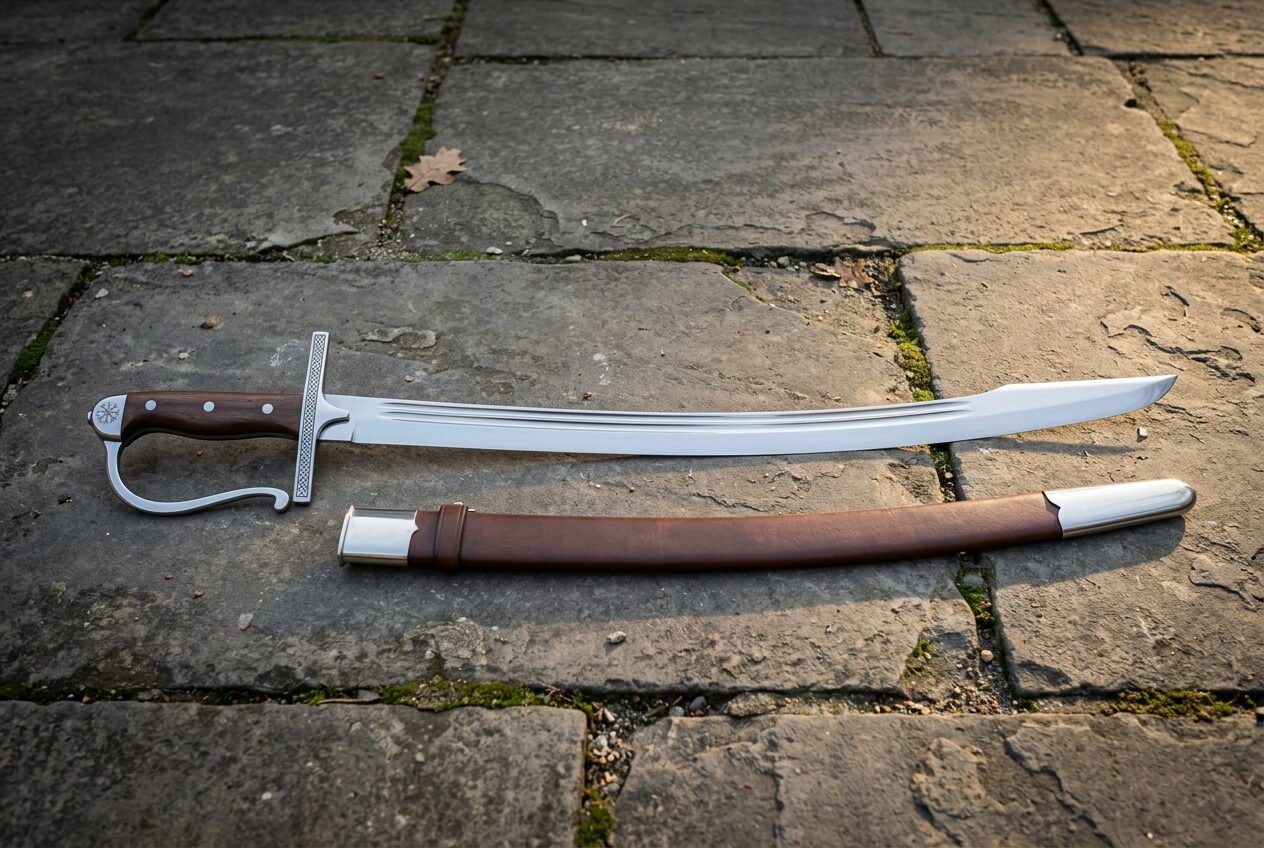
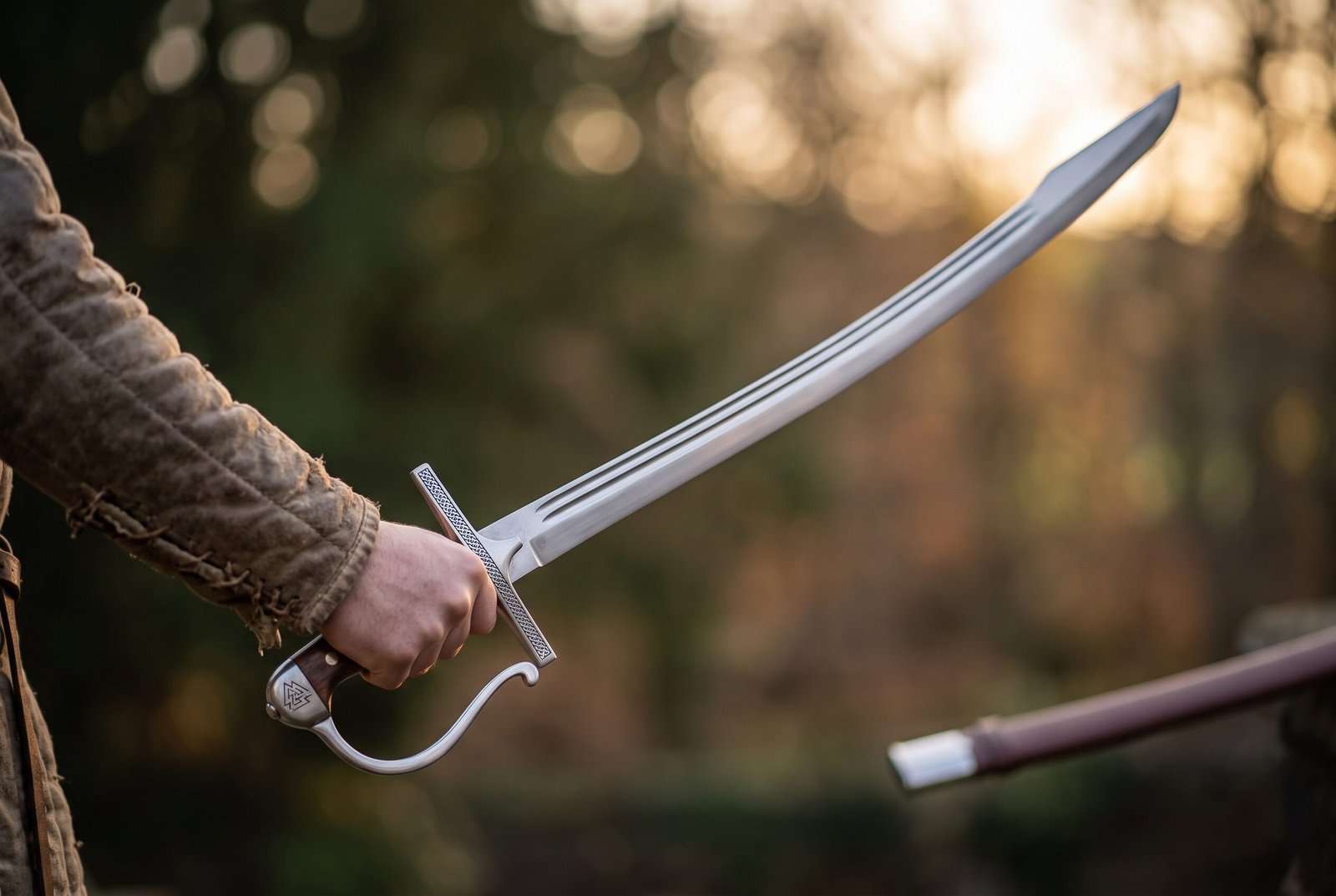
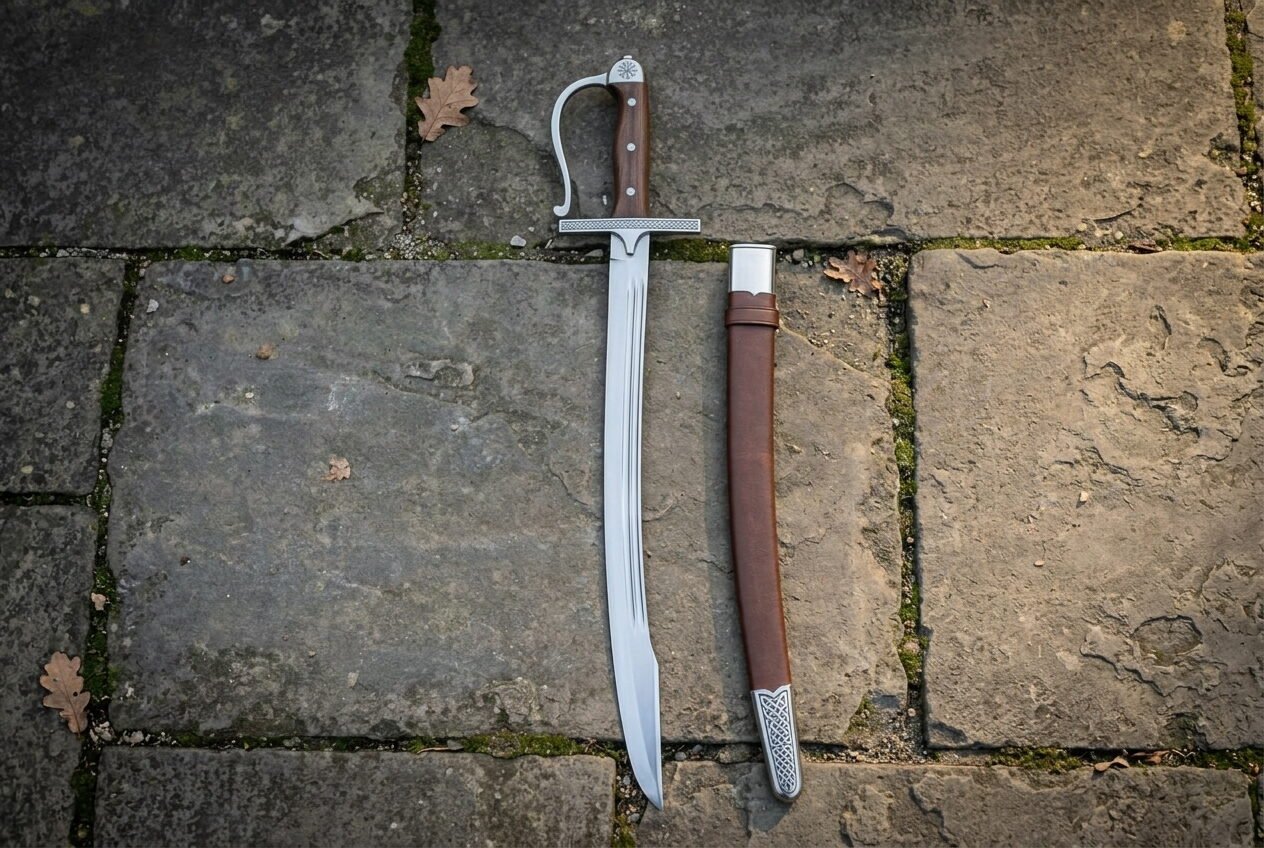
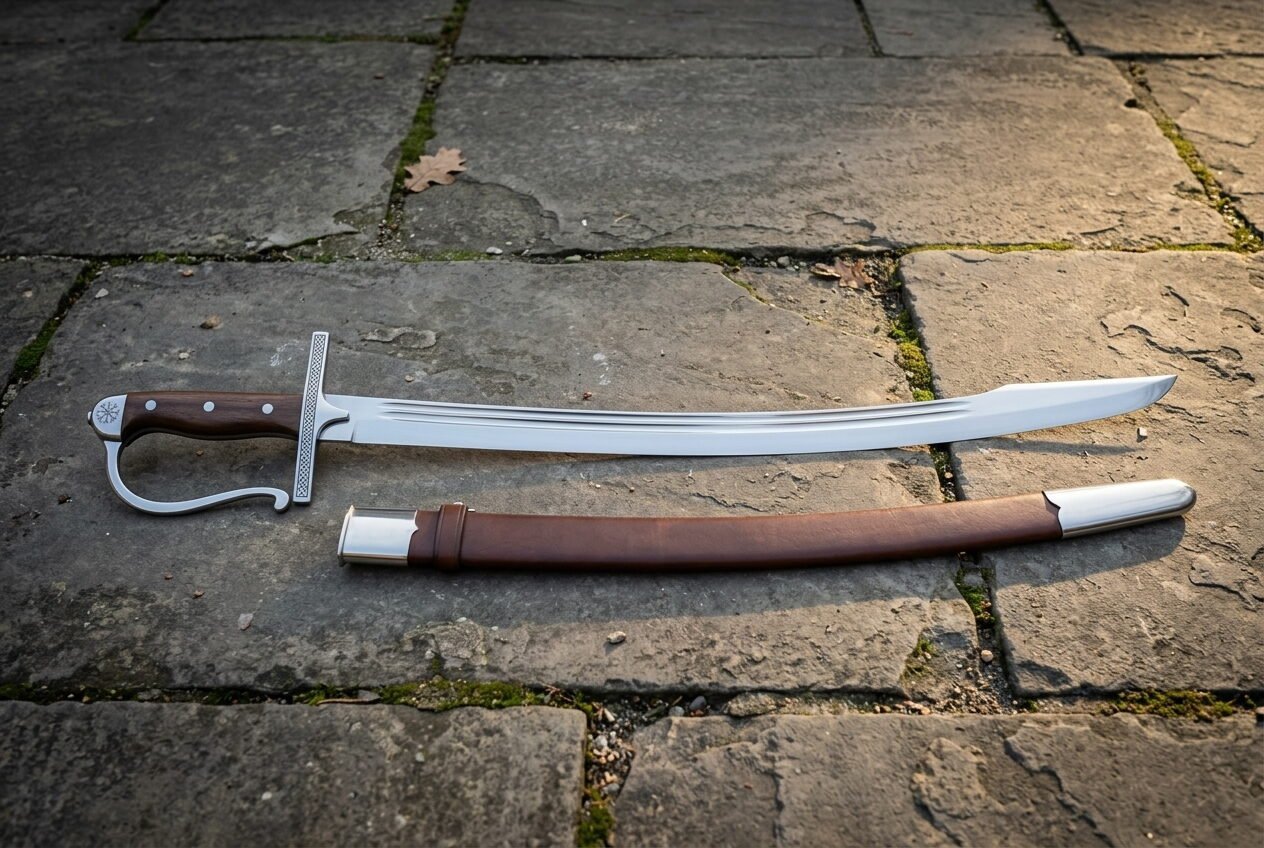
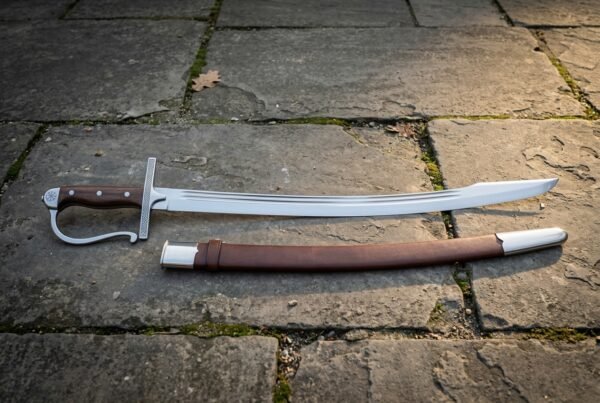
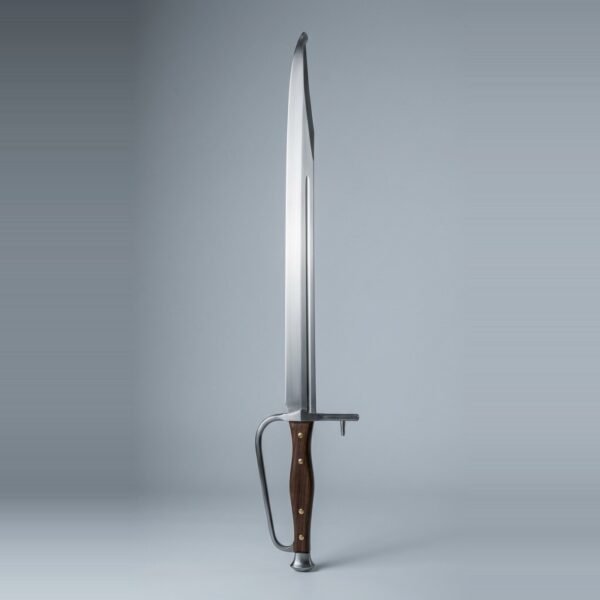
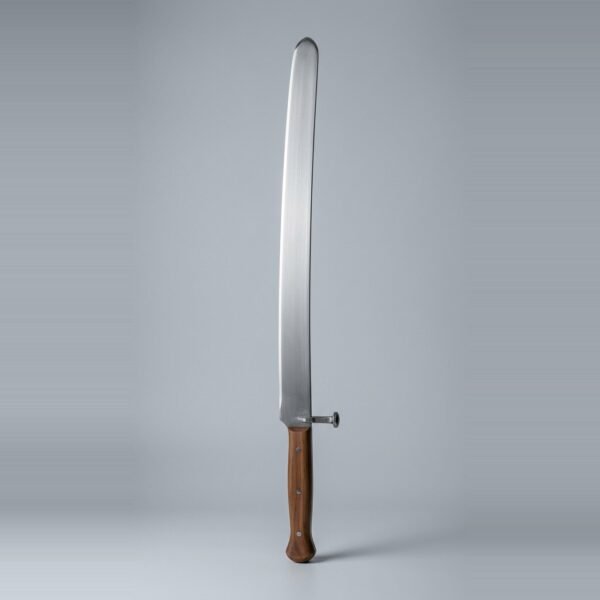
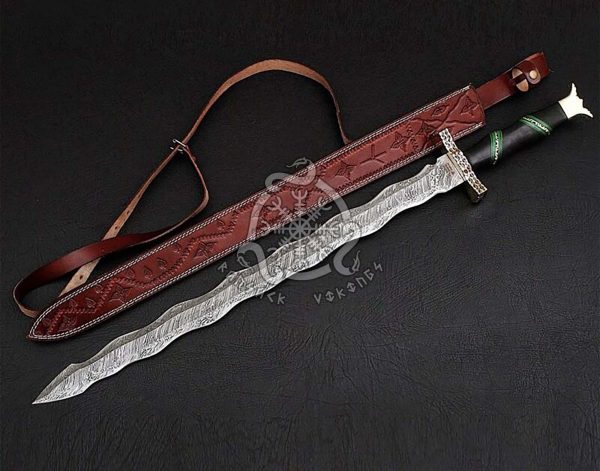
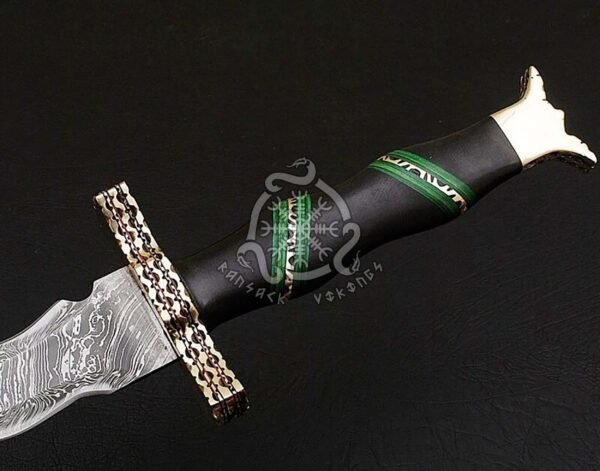
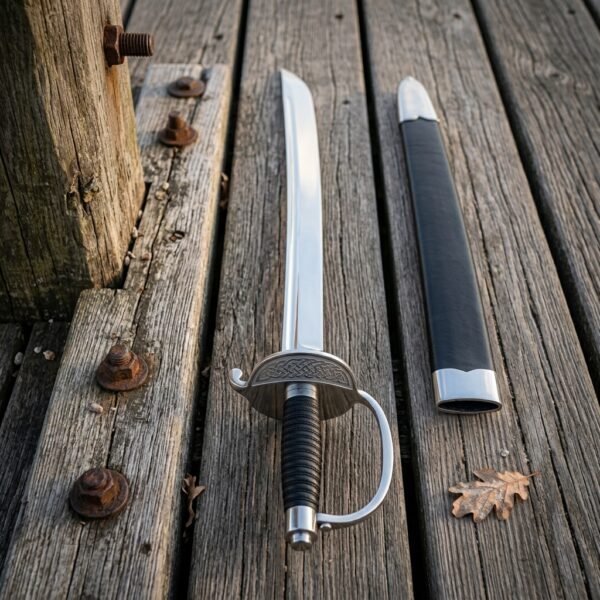
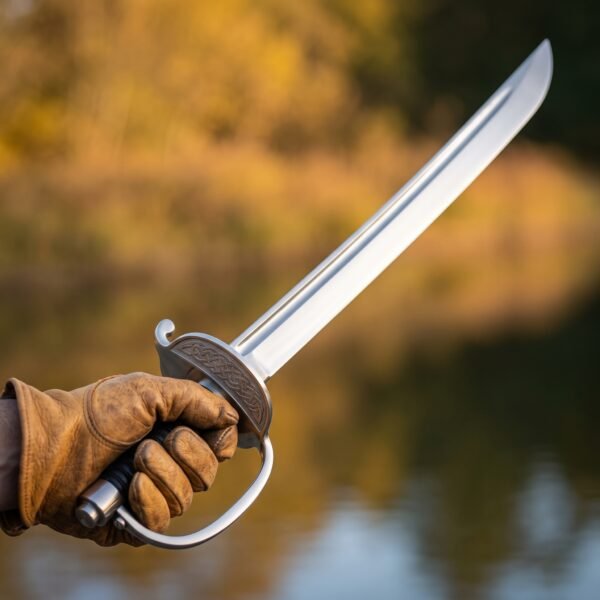
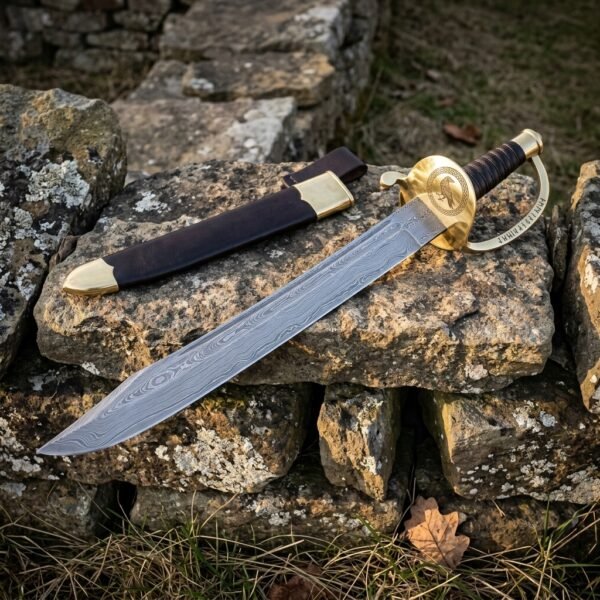
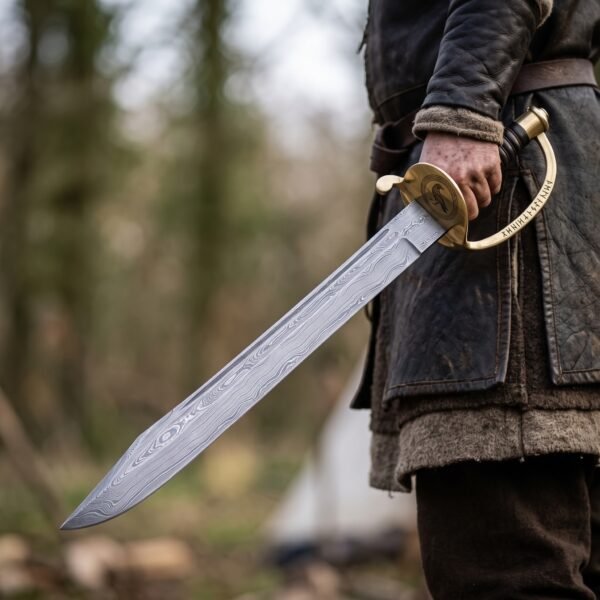
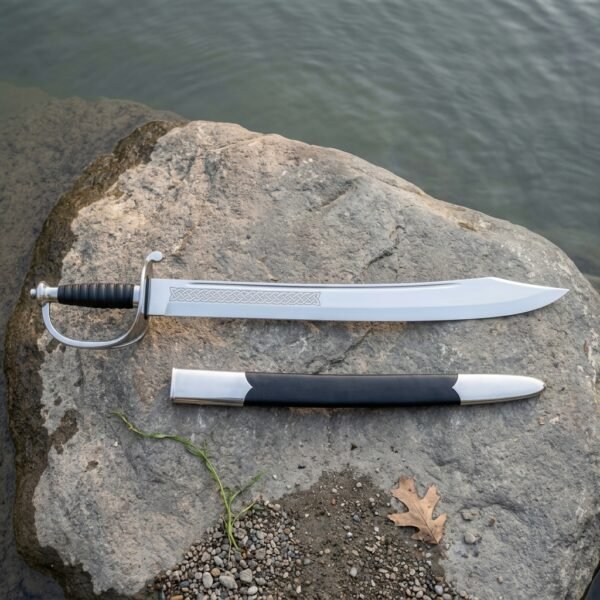
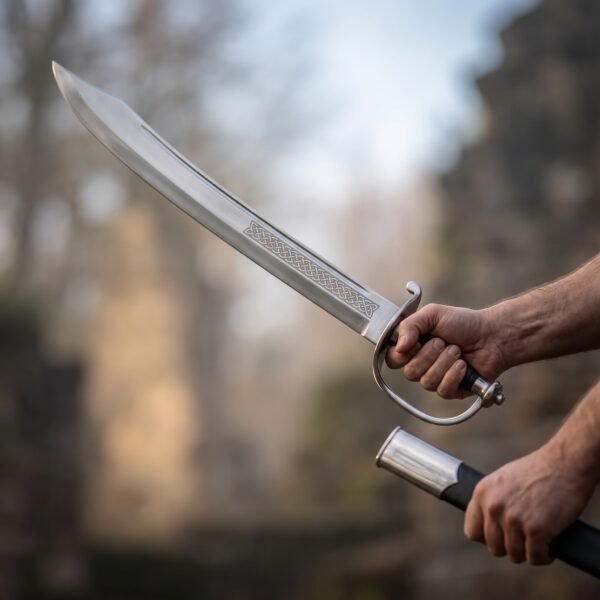
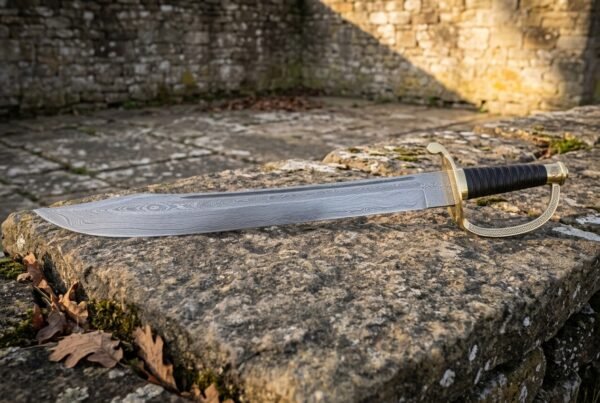
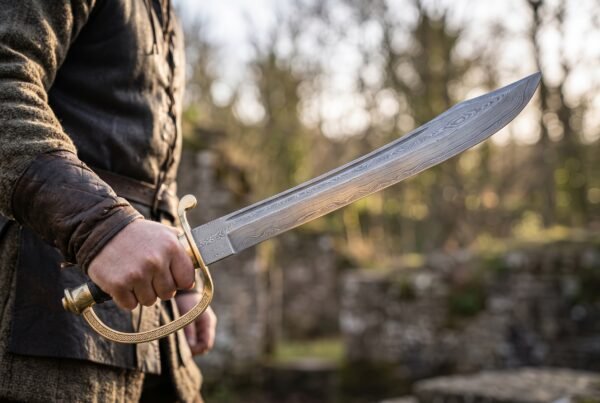
This Tidewrack cutlass is forged by hand in the Czech Republic. The blade is 1095 high carbon steel with a clipped point and three narrow fullers running out from the ricasso, hardened, tempered and polished bright. The hilt is steel with a swept knuckle bow and a straight textured cross guard, the grip is walnut in slabs pinned with steel rivets, and it ships with a brown leather scabbard mounted in steel. Shipping inside the United States is free.
Specifications
| Steel | 1095 high carbon steel, hand forged and polished bright |
|---|
| Hardness | 54 to 58 HRC |
|---|
| Overall length | 31 inches |
|---|
| Blade length | 25 inches |
|---|
| Blade profile | Broad curved single edged blade with a clipped point and three narrow fullers at the forte |
|---|
| Guard | Straight steel cross guard with a knotwork engraved face and a short langet onto the blade |
|---|
| Knuckle bow | Swept steel bow with a hooked finial |
|---|
| Pommel cap | Steel cap engraved with an eight point star |
|---|
| Handle | Walnut slab scales pinned with three steel rivets through a full width tang |
|---|
| Scabbard | Brown leather with a plain steel throat and a knotwork engraved steel chape |
|---|
| Edge | Shipped with a working edge, sharpened on request at no charge |
|---|
| SKU | RK-1315 |
|---|
What the fullers on this blade actually do
The three narrow grooves running out from the guard are fullers, and they are not blood grooves. That name is folklore and it survives because it sounds better than the truth. A fuller is a structural feature and its purpose is simple: it removes metal from the middle of the blade, where the metal contributes least to stiffness, and leaves it at the edges, where it contributes most. The result is a cross section that behaves like an I beam. You get most of the rigidity of a thicker blade at noticeably less weight.
On a cutlass this matters more than on almost any other sword, because a cutlass has to be heavy at the point to cut well and light in the hand to be swung in a confined space for a long time. Fullering the forte, the third of the blade nearest the guard, takes weight out of exactly the region where you do not want it and leaves the mass forward where the cut lands. Pick this cutlass up and it feels alive rather than dead, which is the whole point.
The fullers are forged in with a rounded tool while the steel is hot, not milled out afterwards. That distinction is visible if you look closely at where they run out toward the tip: a forged fuller has a slightly irregular fade because the metal was moved, where a machined groove ends abruptly. It is one of the honest tells of a hand made blade.
The clipped point is the other defining feature. Angling the last few inches of the spine down toward the edge brings the point back into line with the centre of the blade, so a cutlass that is built for the cut can still be driven forward into a thrust without the tip riding up. It also concentrates the tip so it will punch through heavy canvas and leather.
Why 1095 high carbon steel and not stainless
1095 is about one percent carbon with a little manganese and almost nothing else, which is precisely why it is the right steel here. It moves predictably under the hammer, which matters when you are forging fullers rather than cutting them, it quenches cleanly, and at 54 to 58 HRC it holds a working edge over a spine that still flexes and returns instead of snapping. Stainless steel gets corrosion resistance from a heavy chromium addition, and at the thickness and length a sword requires, that chromium makes the blade brittle. A brittle 25 inch blade is a hazard, not a working blade. The honest cost of carbon steel is that it must be kept oiled, and on a sword whose whole history is salt water that is worth saying plainly. The longer comparison is on our page covering Damascus versus stainless.
The walnut grip
The scales are walnut, cut as slabs and riveted through the full width tang with three steel pins. Walnut has been the standard grip and stock timber for working tools and firearms for three centuries because it hits an unusual balance: dense enough to hold a rivet without crushing, light enough not to drag the balance backward, stable enough not to move much with humidity, and tough enough to take a knock without splitting along the grain. It also darkens slowly with handling, so a grip that gets used develops a colour that a new one does not have.
Because the scales are pinned rather than moulded, the grip is repairable. If a scale is ever damaged the rivets come out and a fresh pair goes on. Keep the wood out of long soaking and out of direct heat, wipe it dry, and work a little oil into it once or twice a year. Our routine is set out on the page covering wooden handle care.
Engraving, runes and your own design
Use the rune converter on this page to turn a name, a date or a short phrase into Elder Futhark and we will cut it into the steel or the handle. If you would rather have a Viking pattern than a rune line, choose your own design in the engraving option above the add to cart button and tell us whether it goes on the blade or the handle. Where a piece already carries an engraved design, your chosen engraving replaces it rather than sitting alongside it. On this cutlass the eight point star on the pommel cap is the existing engraved element, so tell us if that is the surface you want used. Everything we can and cannot cut is listed on the engraving page.
Care and sharpening
Carbon steel rusts, and a broad polished flat shows every mark. Wipe the blade down after handling, because skin acid is what starts most spotting, and keep a thin film of oil on it. Pay particular attention to the fullers, since oil collects in the grooves and dust collects in the oil; a cotton bud along each fuller once in a while keeps them clean. Store the cutlass out of its scabbard if it is going to sit for months, because leather holds damp against steel. Full instructions are on our steel care page.
The broad shallow curve of a cutlass is easy to sharpen. Set the angle, then draw the blade along the stone so the contact point travels from ricasso to point without the wrist rolling. Go carefully around the clipped point, where the geometry changes and it is easy to round the tip off. Our guide to sharpening with a whetstone covers the whole method.
Made in the Czech Republic
The work behind this piece happens in a Czech Republic workshop that has kept to the old methods. Steel is forged and heat treated by hand, the grind is taken down by eye rather than by machine, and the handle, fittings and sheath are cut and finished one at a time. Because of that, every piece carries small marks of the hand that made it.
Ransack Viking is a United States company. We import direct, check each piece when it reaches us, and ship from our Chicago, Illinois warehouse. Engraving is added here in the United States after arrival, so the piece you receive is finished to your order.
A note on handmade variation
This cutlass is hand forged. It is not machine made and it is not bulk produced, so what arrives will not be a pixel for pixel copy of the photograph on this page. Walnut is a natural material and no two sets of scales share the same grain or the same tone, the fullers will run out slightly differently because they were moved rather than cut, and the polish will hold the light its own way. Dimensions, steel, hardness and build are the same every time. The character is not.
Frequently asked questions
Are the grooves blood grooves?
No. They are fullers, and they are structural. Removing metal from the centre of the blade while leaving it at the edges gives you an I beam section, so the blade keeps its stiffness at lower weight. The blood groove story has no basis in how swords are made or used.
Does it arrive sharp?
It has a working edge out of the box, keen enough to cut paper but not shaved down to a razor. Ask in the order notes and we will take it to a full cutting edge before it ships, at no extra cost.
Can it be used for cutting practice?
Yes. Full width tang, riveted walnut scales and properly heat treated steel. It is excellent on tatami, bottles and rope. It is not a sparring sword and should never be used against another blade or against a person.
Can I have runes engraved on it?
Yes. Use the rune converter on this page for Elder Futhark, or choose your own Viking design in the engraving option, and tell us whether it goes on the blade or the handle.
What is the difference between this and a naval cutlass?
Mostly the hilt. Issued naval cutlasses of the eighteenth and nineteenth centuries used a full stirrup or sheet steel bowl guard because the navy could afford to make thousands of them. This pattern is the private and merchant version: a simple cross and knuckle bow over a riveted wood grip, cheaper to make, lighter to carry and easier to repair at sea.
How long does shipping take?
Free inside the United States. Finished stock leaves us in two to four business days. Engraved pieces take two to three weeks before they ship.
What is in the box
- One Tidewrack hand forged 1095 high carbon steel cutlass, 31 inches overall
- Brown leather scabbard with a steel throat and chape
- Care card covering oiling, fullers, walnut care and storage
- Certificate of hand forging with the SKU recorded
- Forged and finished in the Czech Republic
Explore the range
Browse the rest of the cutlasses, the longer sabres, the wider swords collection, and everything under Norse arms. Background on fullers, steel and edge care is in the guides.
Compare it with these
In the same category sits the Saltbrand cutlass, 30 inches overall. A near match for this one is the Sunwarden cutlass, 30 inches overall. Closest to this in the range is the Ravenhold cutlass, pattern welded Damascus.
Fitting out further, the Hornreach sabre belongs with it. Pick the steel, the length and the fittings yourself on the design your own page.
If sparring is on your mind, the Skaldrun spadroon trainer is made for that job, and our smallswords and spadroons is a useful next stop.


This thing is a beast in the best way. If you’re on the fence just get it. You won’t regret it.