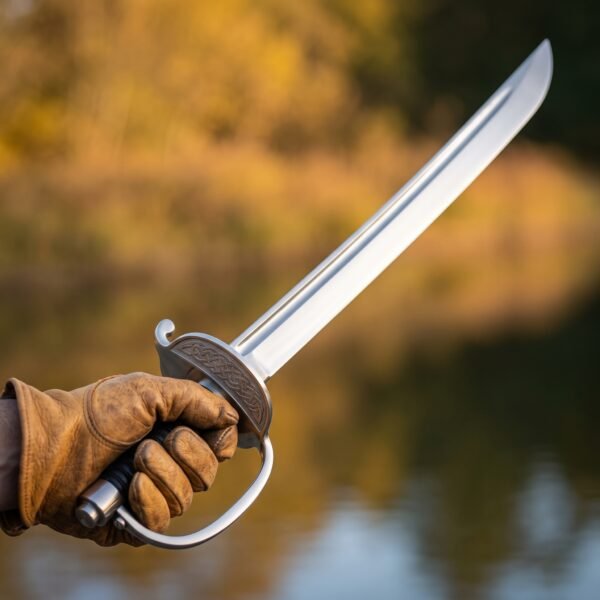
The plate that sits between the guard and the grip on this cutlass is a shell, and it is the feature that separates a serious fighting cutlass from a light hanger. Open bar guards protect the hand from a blade coming straight in, which is most of what happens in an open field. On a crowded deck the hand is threatened from below, from the side, and from a blade that skids off the flat of your own, and no arrangement of bars covers all three. A solid shell does. Every navy that fought at close quarters ended up with some form of plate over the hand, and the ones that started with bars added the plate later.
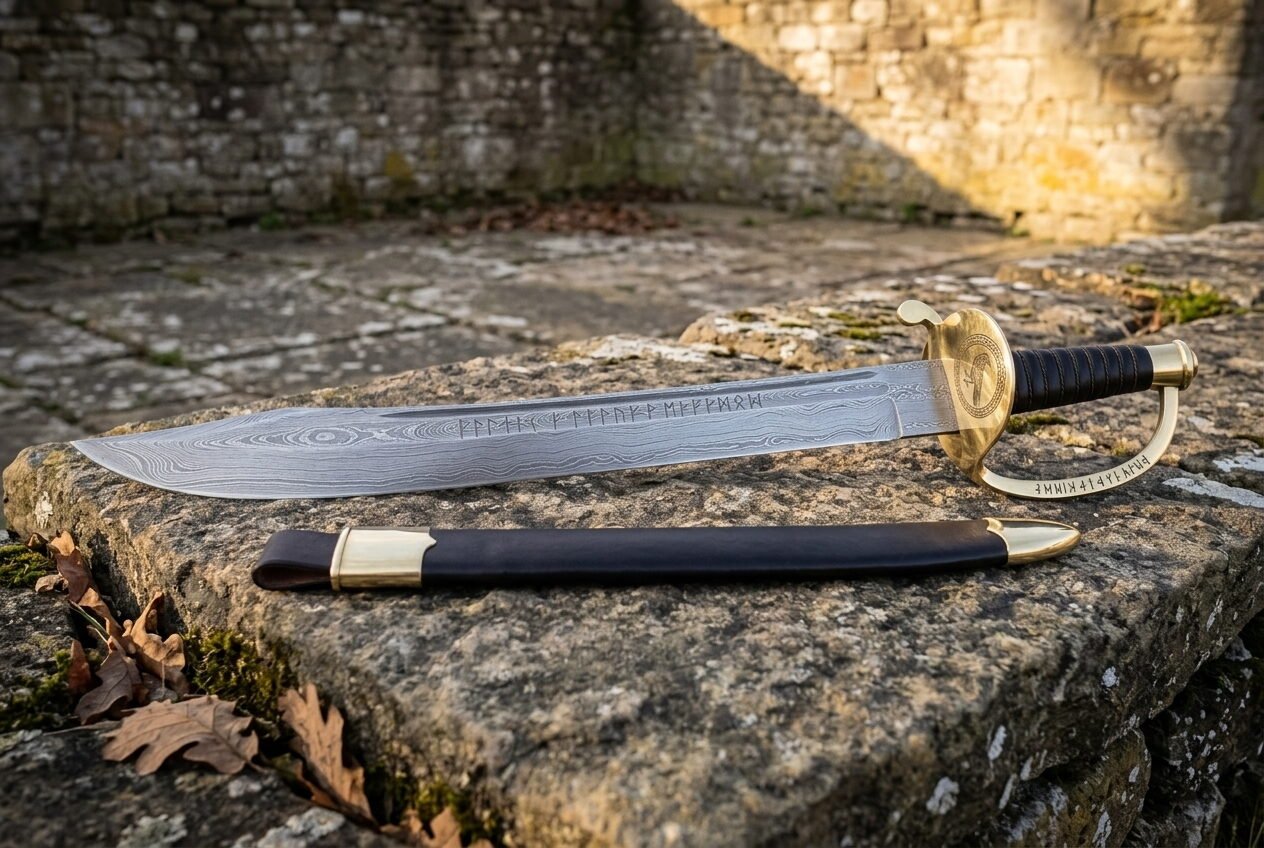
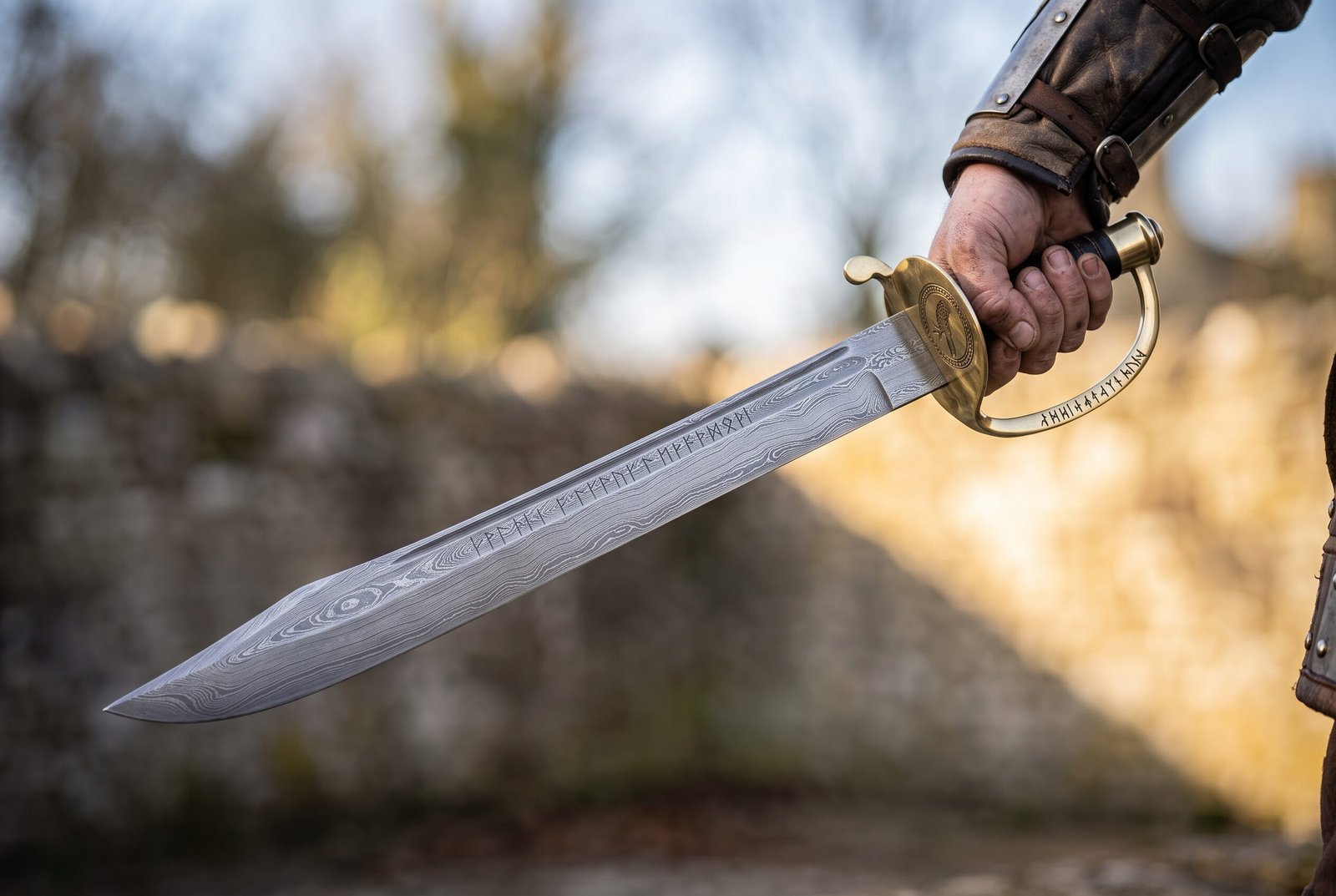
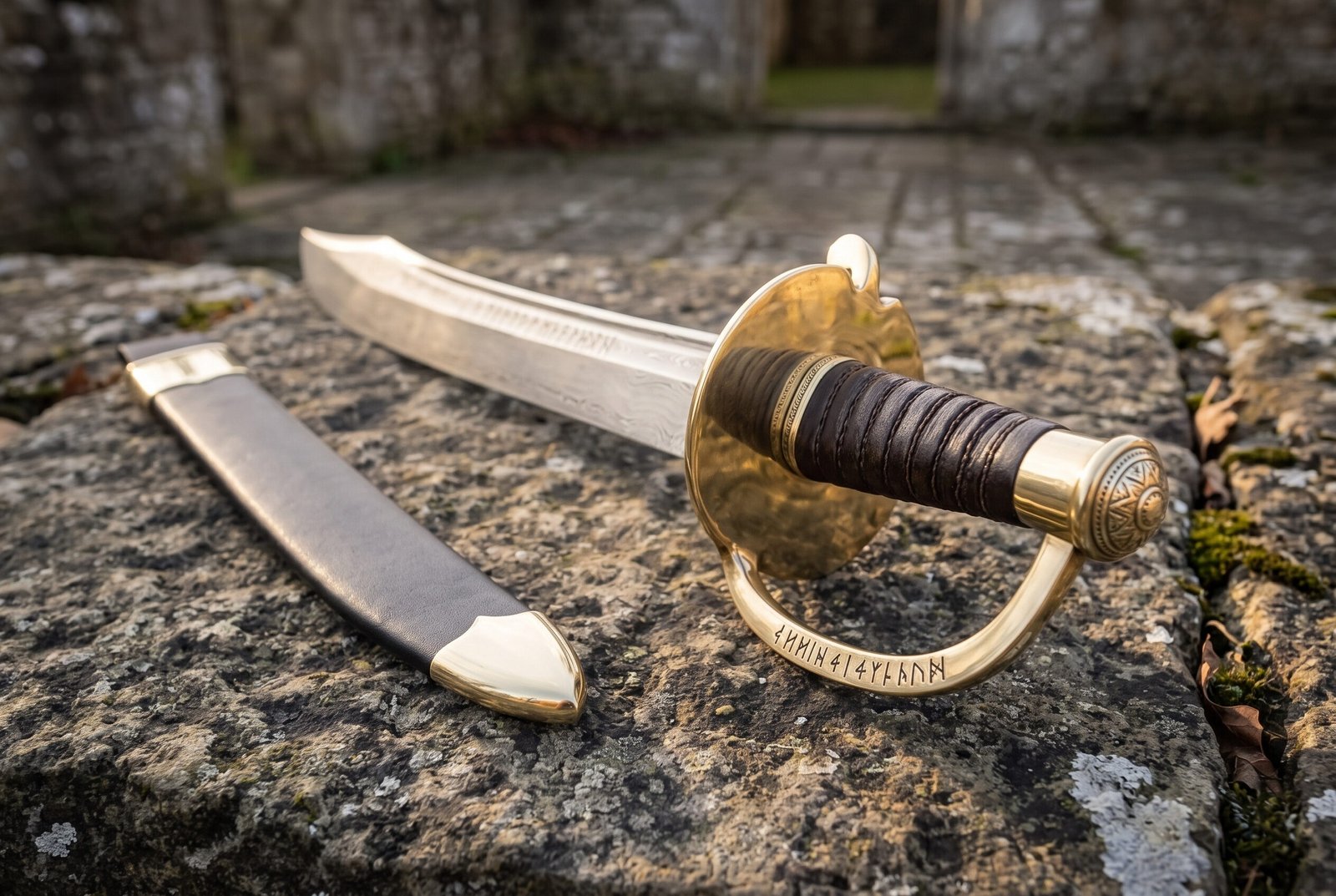
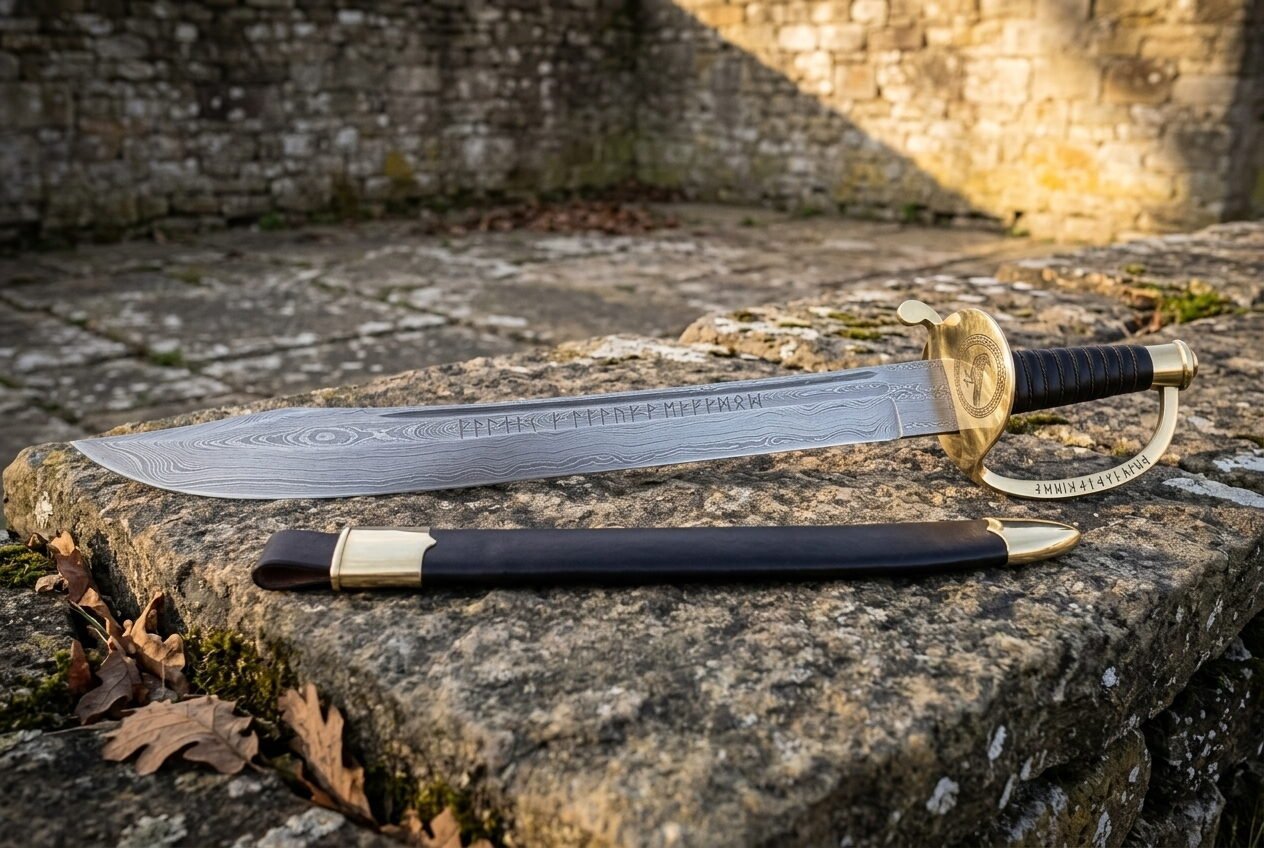
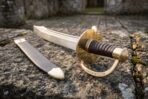
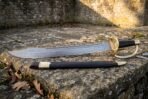
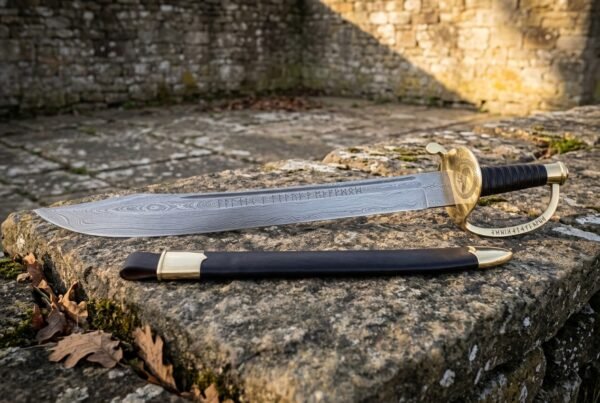
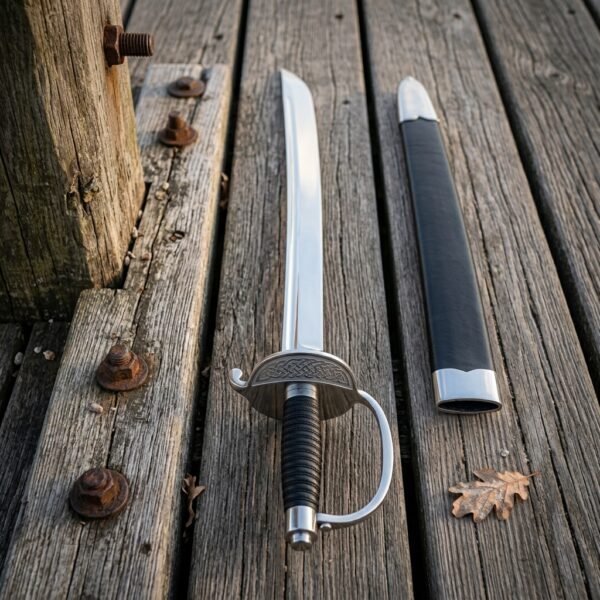
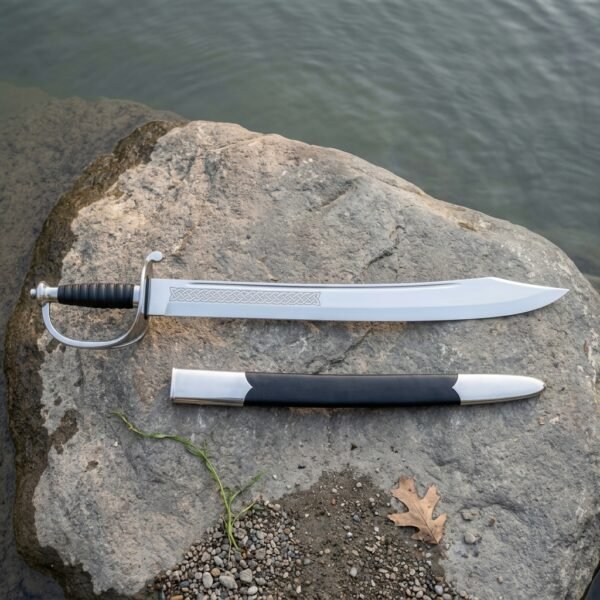
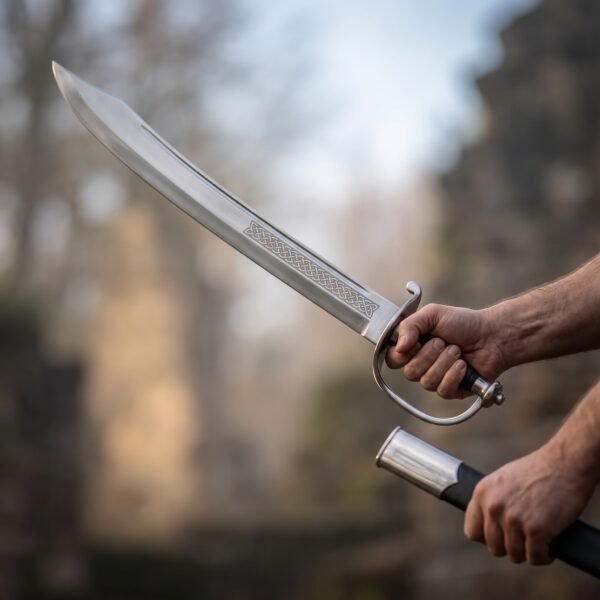
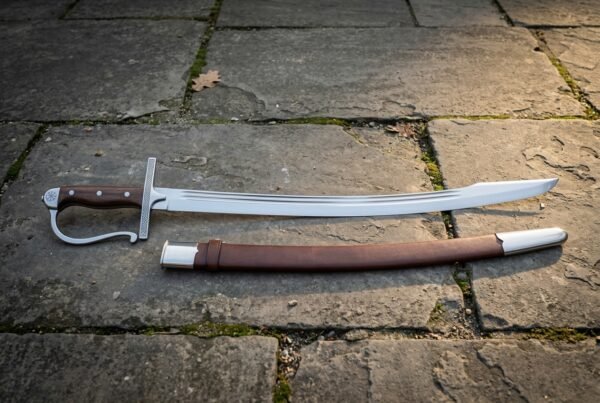
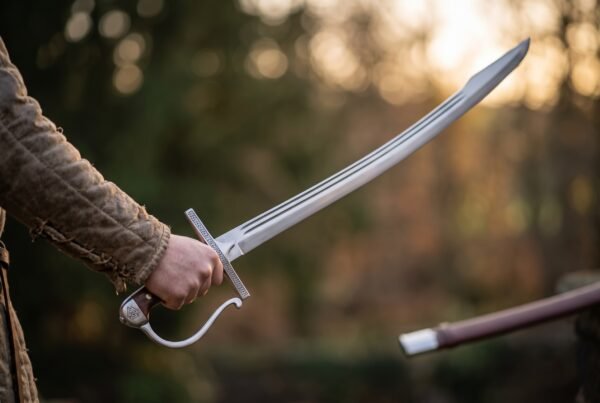
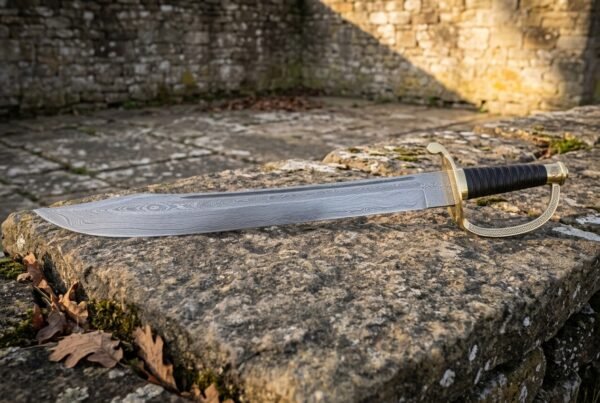
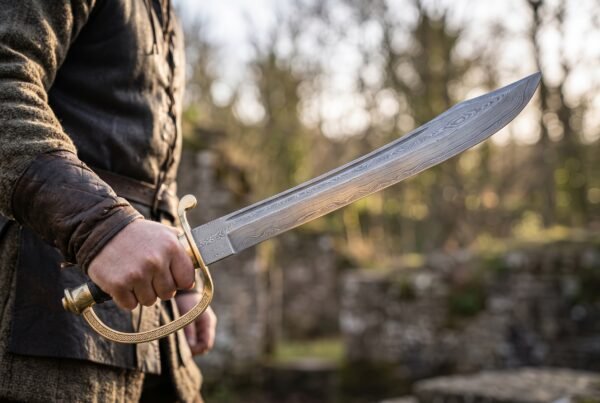
This Sunwarden cutlass is hand forged in the Czech Republic. The blade is welded from 1095 and 15N20, drawn broad, hardened, tempered and etched, with a line of Elder Futhark cut along the flat. The hilt is filed brass with a shell guard carrying an engraved sun wheel, a knuckle bow cut with runes, and a ribbed dark brown leather grip. It ships with a black leather scabbard mounted in brass, and shipping inside the United States is free.
Specifications
| Item type | Single edged naval cutlass with shell hilt |
|---|
| Steel | 1095 and 15N20 forge welded Damascus, hand etched |
|---|
| Hardness | 58 to 60 HRC |
|---|
| Overall length | 30 inches |
|---|
| Blade length | 24 inches |
|---|
| Blade profile | Broad single edged blade with a deep belly, clipped point and an engraved Elder Futhark rune line along the spine |
|---|
| Guard | Raised brass shell guard with an engraved sun wheel medallion and an upturned hooked quillon |
|---|
| Knuckle bow | Brass D shaped bow with an Elder Futhark rune line |
|---|
| Handle | Ribbed dark brown leather grip with cord binding over a shaped core |
|---|
| Ferrule and pommel | Brass ferrule with a knotwork band at the guard, brass pommel cap with an engraved sun design |
|---|
| Scabbard | Black leather scabbard with a brass throat and chape |
|---|
| Edge | Shipped with a working edge, sharpened on request at no charge |
|---|
| SKU | RK-1318 |
|---|
What the shell guard is for
A shell is a curved plate seated between the quillon block and the grip, standing proud of the blade on the outside of the hand. It works in three ways at once, and only one of them is obvious.
The obvious one is coverage. It puts a solid piece of metal in the path of anything travelling toward the knuckles from outside or below, including a blade that has skidded off your own flat and is running down toward the fingers. The second is deflection. Because the plate is curved rather than flat, a blade landing on it slides outward and away instead of stopping dead, so the shock reaching the wrist is much lower than the blow that caused it. The third is stiffness. The shell braces the whole hilt against the blade, which stops the guard flexing under a hard parry and keeps the tang from working loose over time.
Brass is the traditional material for shells and for good reason. It can be raised into a dished shape cold, it does not corrode in salt air, and when it takes a hard hit it dents rather than cracking, so a dented shell is still a working shell. The trade off is weight, which is why cutlass shells are small compared with the great cup hilts of duelling swords. You want just enough plate to cover the hand and no more, because everything you add behind the guard slows the sword down.
The sun wheel engraved into this shell is our own work rather than a naval device. So is the rune line along the blade and the Elder Futhark cut into the knuckle bow.
Why Damascus and not stainless
This blade is 1095 and 15N20 welded together in the fire. 1095 is a plain high carbon steel that hardens hard and etches dark; 15N20 carries about two percent nickel and stays bright under acid. Alternating layers are brought to welding heat and hammered into a single bar, then drawn, folded and welded again until the layer count is where the smith wants it. The pattern that appears when the finished blade is etched is a record of that work, and because the blade is forged from the billet rather than cut out of it, the figure stretches and compresses to follow the shape of the sword.
Stainless cannot be pattern welded in a normal forge. The chromium that makes it stainless forms an oxide film at welding heat and the layers will not bond through it. That is the technical objection. The practical one is that a blade with enough chromium to resist rust is brittle at the section a sword needs, and a brittle sword is a hazard. Carbon steel gives 58 to 60 HRC at the edge with a spine that flexes and returns, and the price is that you have to keep it oiled. The full comparison is on our page covering Damascus versus stainless.
The ribbed leather grip
The grip is leather laid over a shaped core and bound into raised ribs, with a brass ferrule at each end. Ribs give the fingers something firm to register against, so the hand finds the same hold every time without looking, and they stop the palm sliding forward under a heavy cut, which matters on a blade with this much mass in the belly. Leather also swells slightly when it is damp, which is the opposite of what a smooth metal or wood grip does, so a wet hand grips better rather than worse.
The brass pommel is peened over the tang, meaning the hilt is held together by metal moved into metal and not by adhesive. Wipe the leather dry if it gets wet and let it dry away from direct heat. A little neutral leather conditioner once or twice a year keeps it supple. Do not saturate it, because leather that has been soaked stretches and the ribs go soft under the hand.
Engraving, runes and your own design
Use the rune converter on this page to turn a name, a date or a short phrase into Elder Futhark and we will cut it into the steel or the handle. If you would rather have a Viking pattern than a rune line, choose your own design in the engraving option above the add to cart button and tell us whether it goes on the blade or the handle. Where a piece already carries an engraved design, your chosen engraving replaces it rather than sitting alongside it. This cutlass carries three engraved elements already, the rune line on the blade, the runes on the knuckle bow and the sun wheel on the shell, so tell us which one you want used. Details are on the engraving page.
Care and sharpening
An etched Damascus surface is a shallow relief, a few thousandths of an inch deep, and abrasive polishing will take it off. Clean with a soft cloth, never a scouring pad, and keep a thin film of oil on the steel. Wipe fingerprints away promptly, because skin acid keeps etching and leaves marks that show badly against the layers. Store the cutlass out of its scabbard for long periods, since leather traps moisture against steel. The full routine is on our steel care page.
For the edge, remember that a bellied blade is sharpened by moving the sword, not the hands. Set your angle and draw the blade across the stone so the contact point travels around the curve at a steady rate. Our guide to sharpening with a whetstone takes it step by step.
Made in the Czech Republic
The work behind this piece happens in a Czech Republic workshop that has kept to the old methods. Steel is forged and heat treated by hand, the grind is taken down by eye rather than by machine, and the handle, fittings and sheath are cut and finished one at a time. Because of that, every piece carries small marks of the hand that made it.
Ransack Viking is a United States company. We import direct, check each piece when it reaches us, and ship from our Chicago, Illinois warehouse. Engraving is added here in the United States after arrival, so the piece you receive is finished to your order.
A note on handmade variation
This cutlass is hand forged. It is not machine made and it is not bulk produced, so what arrives will not be a pixel for pixel copy of the photograph on this page. The Damascus figure belongs to the billet it came from and cannot be repeated. The shell will have been raised and filed by hand and no two sit exactly alike, the engraving is cut rather than stamped so the line has its own weight, and the leather will take the dye a shade lighter or darker. Dimensions, steel, hardness and build are the same every time. The character is not.
Frequently asked questions
Is the Damascus genuine?
Yes. The blade is forge welded from alternating layers of 1095 and 15N20 and the pattern runs through the full thickness of the steel. Sharpening or regrinding simply exposes a different section of the same pattern.
Does it arrive sharp?
It comes with a working edge, enough to cut paper. Ask in the order notes and we will take it to a full cutting edge before it ships at no extra cost.
Is the shell guard structural or decorative?
Structural. It covers the outside of the hand, deflects a blade sliding down your own flat, and braces the hilt against the blade so the guard does not flex under a parry. The engraving on it is decorative; the plate is not.
Can I have runes engraved on it?
Yes. Use the rune converter on this page for Elder Futhark or choose your own Viking design, and say whether it goes on the blade, the bow or the shell. Your engraving replaces the existing work on that surface rather than sitting beside it.
What is the difference between this and the plain steel naval cutlass?
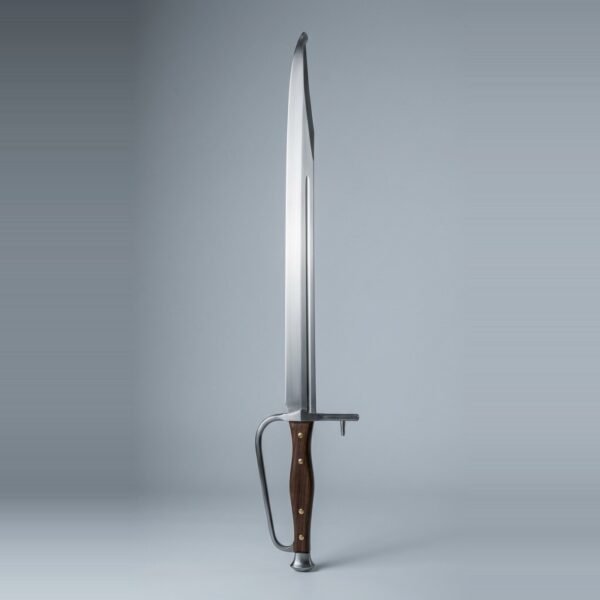
Steel, hilt and hardness. The plain cutlass is 1095 at 54 to 58 HRC with a steel stirrup guard. This one is forge welded 1095 and 15N20 at 58 to 60 HRC with a raised and engraved brass shell hilt, so it holds an edge longer, carries the layered pattern, and takes several times the shop hours to build. Those hours are most of the price difference.
How long does shipping take?
Free inside the United States. Finished stock leaves us in two to four business days. Engraved Damascus pieces take three to four weeks before they ship.
What is in the box
- One Sunwarden hand forged Damascus naval cutlass in 1095 and 15N20, 30 inches overall
- Black leather scabbard with a brass throat and chape
- Care card covering oiling, etched surfaces, brass and storage
- Certificate of hand forging with the SKU recorded
- Forged and finished in the Czech Republic
Explore the range
See the rest of the cutlasses, the full damascus swords collection, the longer sabres, and the wider swords range. Background on pattern welding, hilts and care lives in the guides.
If this one is not it
For a straight comparison, see the Valknight cutlass, 29 inches overall. Worth putting side by side with this is the Saltbrand cutlass, 30 inches overall. In the same category sits the Brinehook cutlass, 30 inches overall.
From the same corner of the shop, there is the Barrowlight Viking sword. Pick the steel, the length and the fittings yourself on the design your own page.
If you would rather train with a sword than hang one up, the Kaldrast hanger sabre trainer suits club work, and our HEMA sabre range covers the choices.

No regrets on this purchase at all. The craftsmanship really shows in the small details. Exactly as described and clearly made with care. Can’t recommend this enough.
Got this as a birthday gift and the reaction was priceless. The craftsmanship really shows in the small details. If you’re on the fence just get it. You won’t regret it.
Incredible craftsmanship on this one. Shipping was fast and everything arrived well packaged.
Nice piece for the price. Good overall quality. Just a couple very minor details off. Would still tell others to give this a try.
Five stars isn’t even enough honestly. The craftsmanship really shows in the small details. Already telling my friends to check this out.