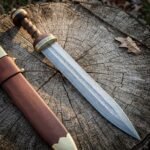
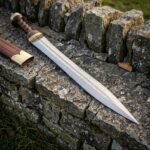
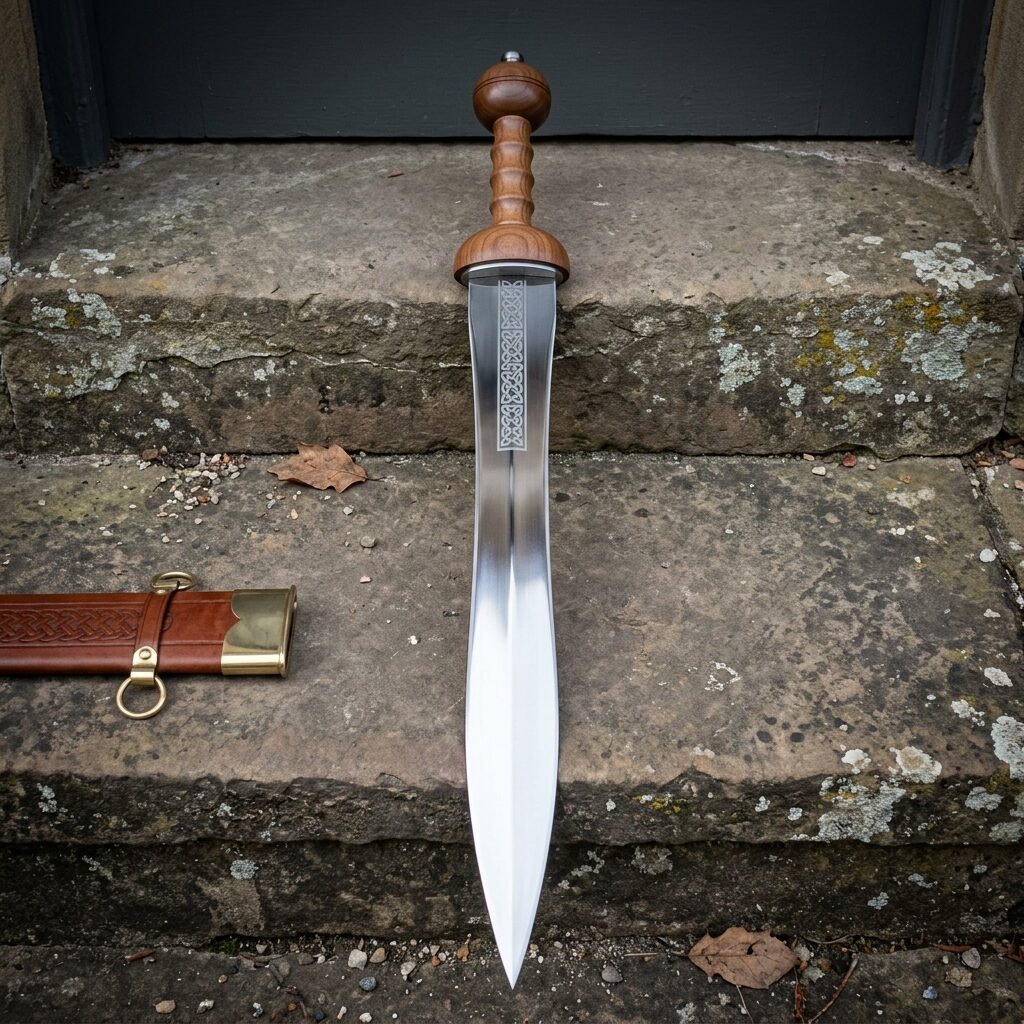
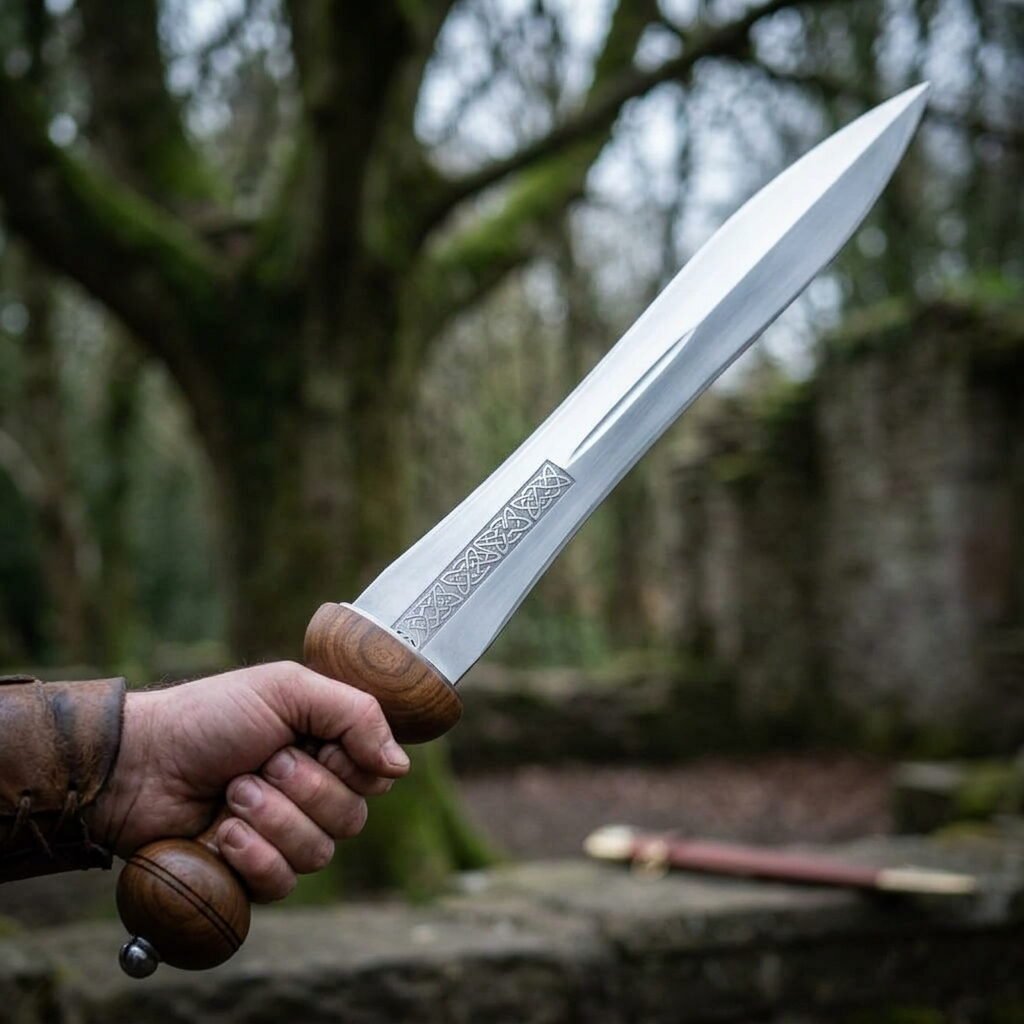
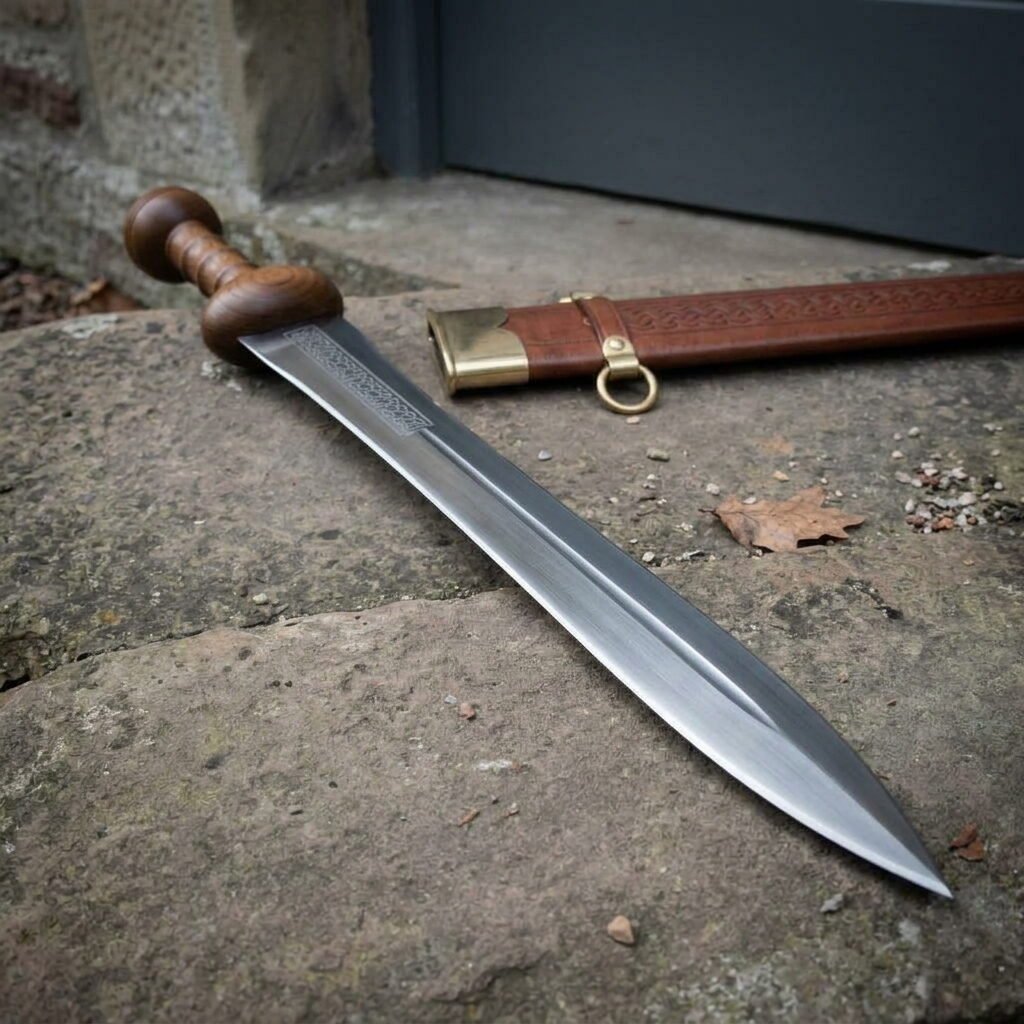
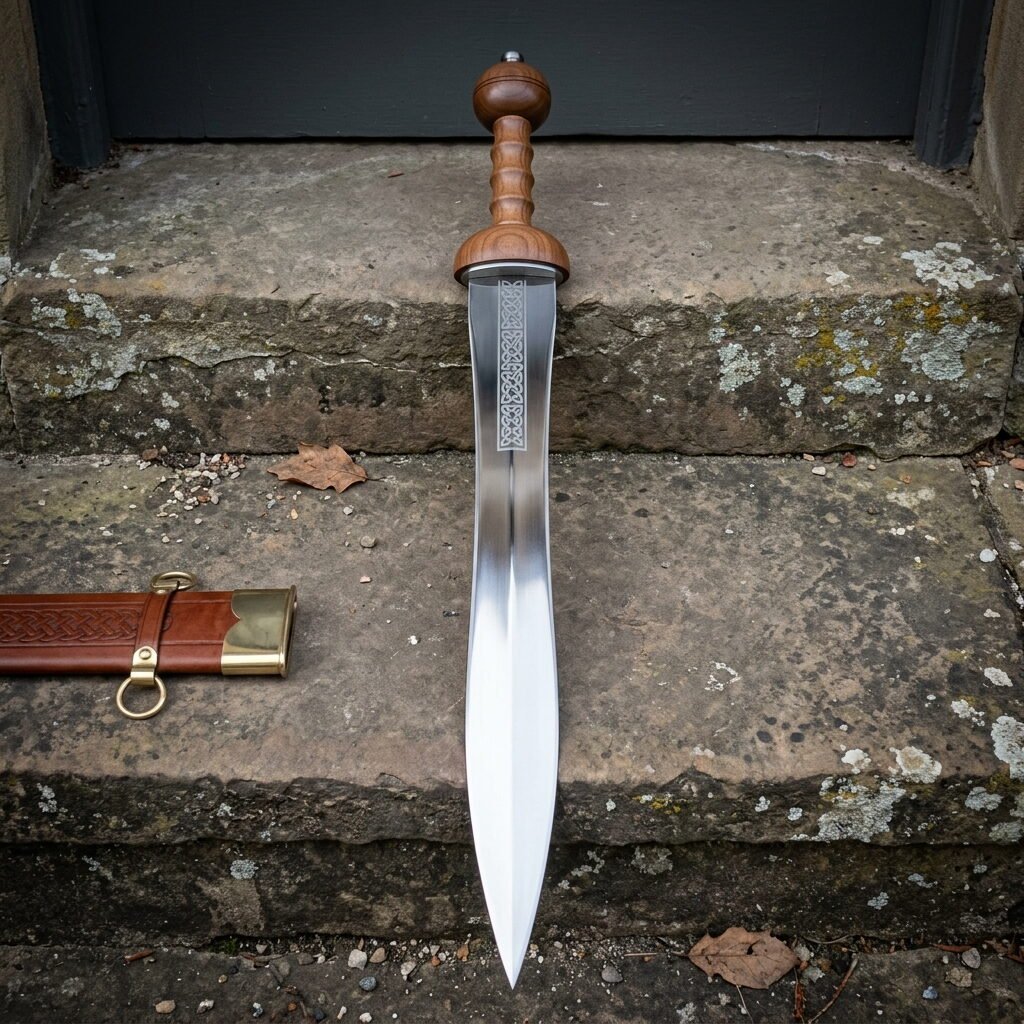
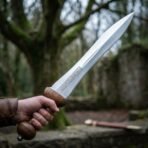
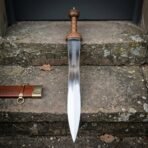
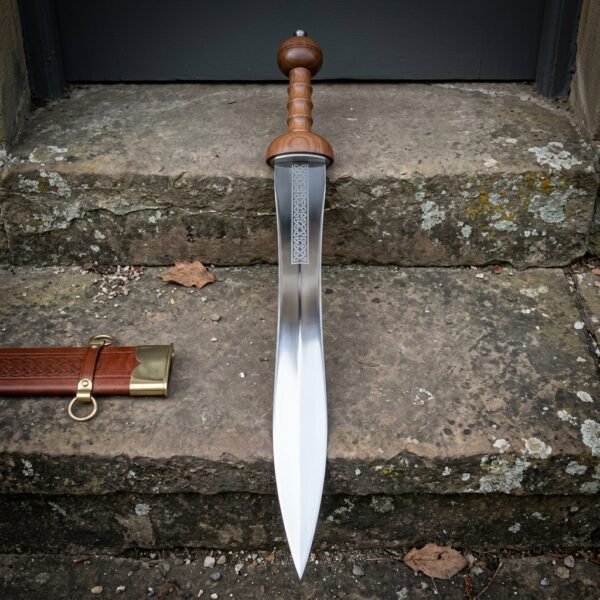
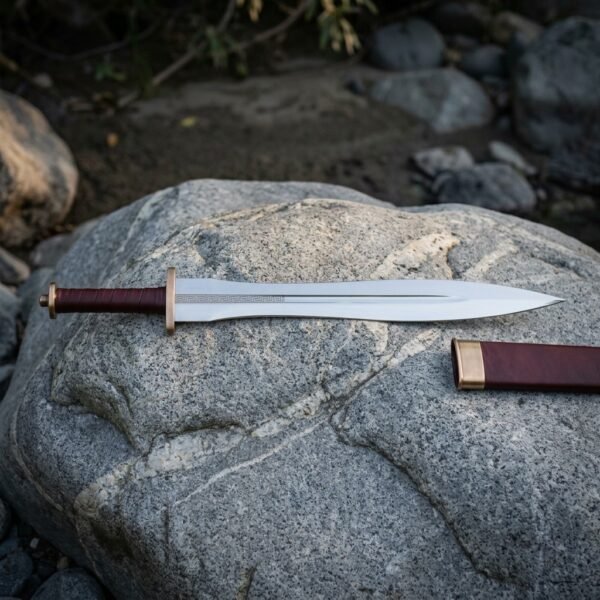
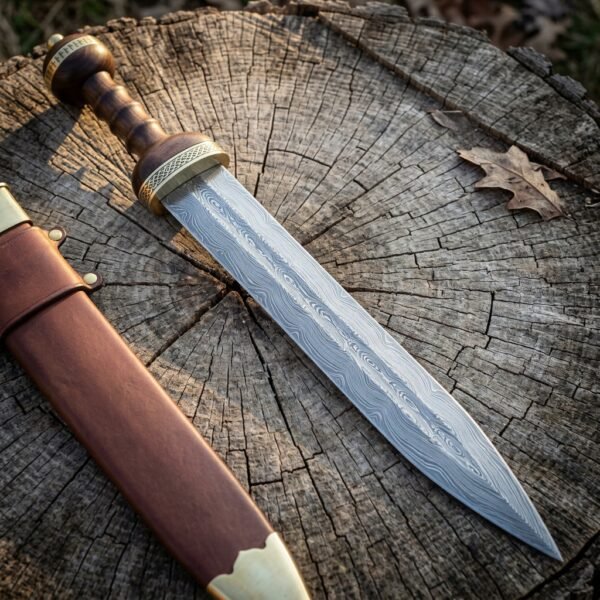
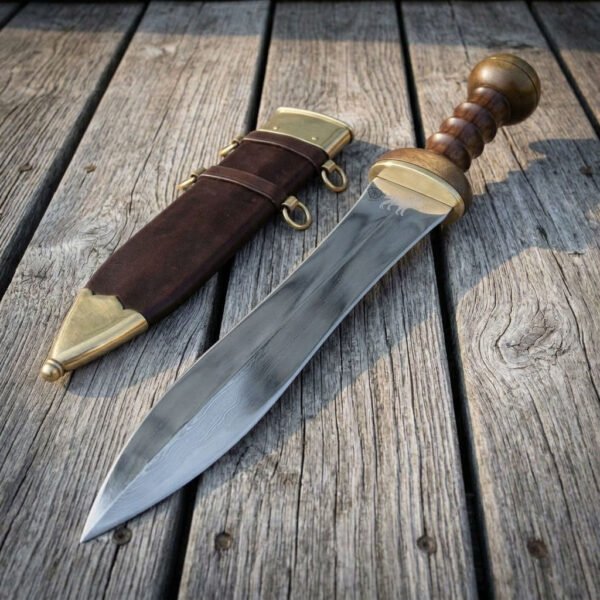
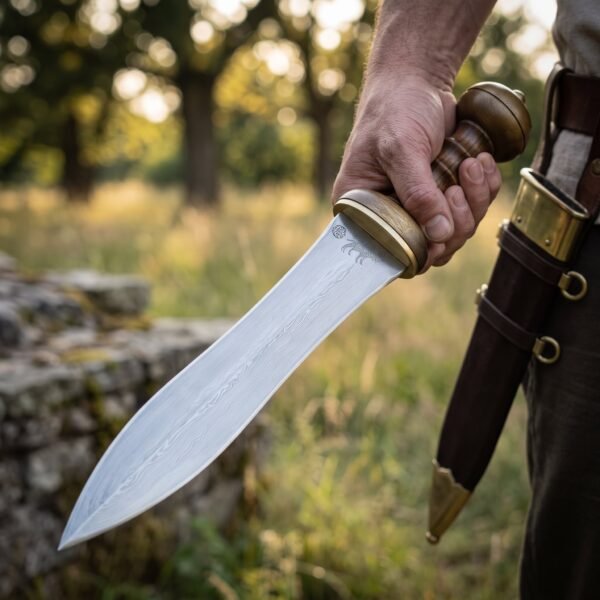
This is a hand forged Roman gladius on the Mainz pattern, the earlier and more sculptural of the two great legionary blade shapes. A Mainz blade does not run straight. It leaves the guard wide, pulls in to a narrow waist about a third of the way down, swells out again and then draws into a long slender point that can be a quarter of the whole blade. The pattern is named for a group of swords dredged from the Rhine at Mainz, where a legionary fortress sat from the reign of Augustus onward, and it was the standard shape from roughly the late first century BC into the middle of the first century AD. That waist is not decoration. It takes mass out of the middle of the blade where it does the least work and leaves it at the shoulder and behind the point, which is why a Mainz gladius feels alive in the hand despite being a heavy short sword. The long point was built to find the gap in mail and the seam in a shield edge.
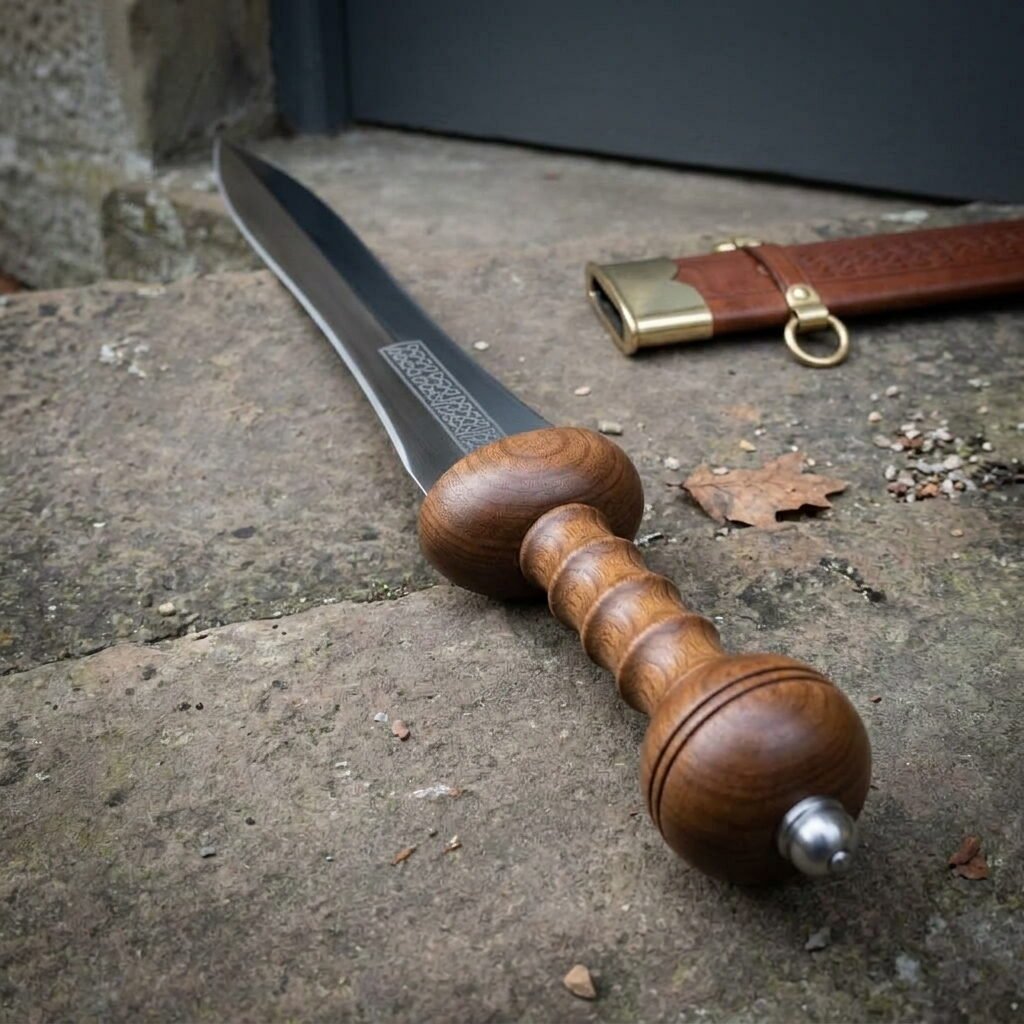
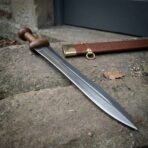
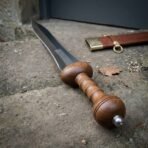
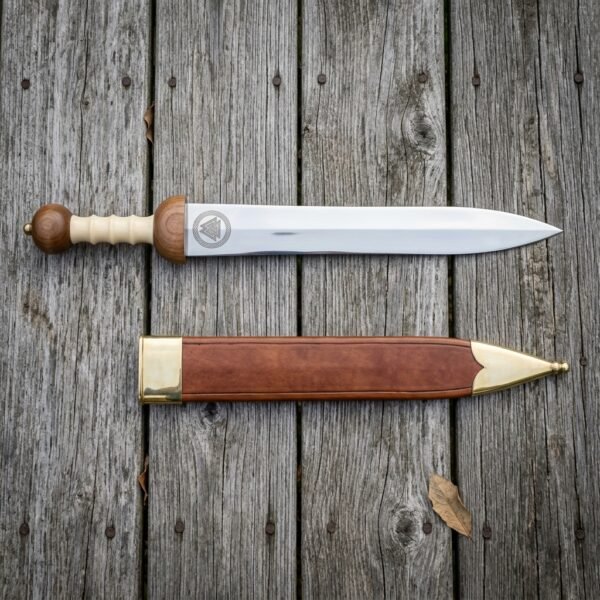
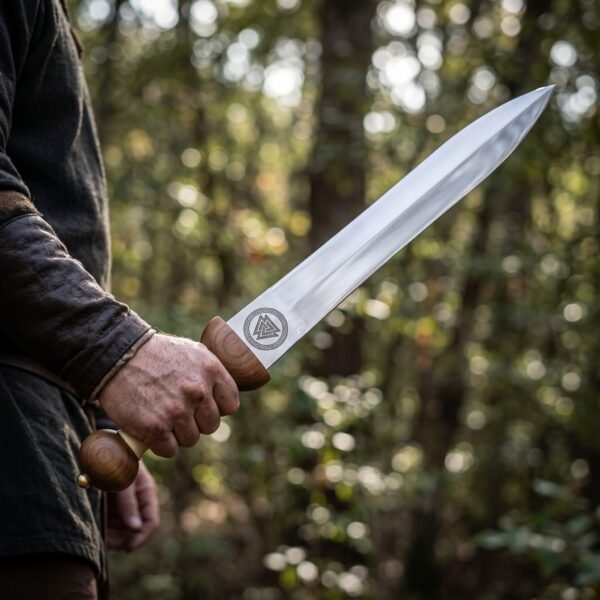
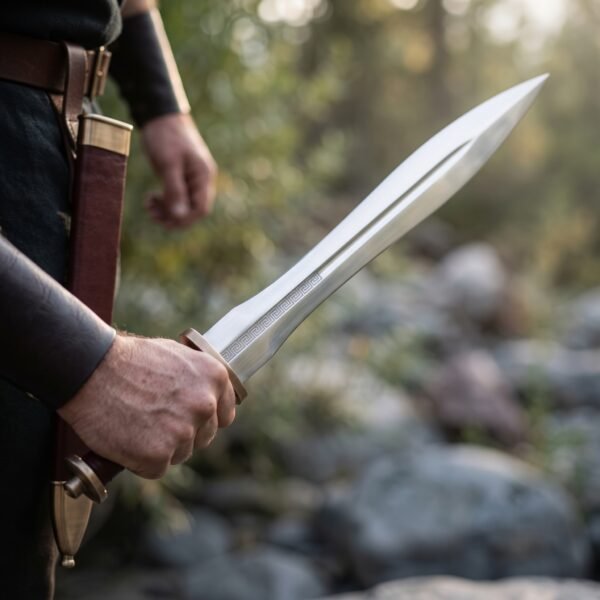
This one is forged, ground, hardened and fitted by hand in the Czech Republic. The blade is 1095 high carbon steel taken to a mirror polish with a knotwork panel etched into the forte. The hilt is turned cherry wood, ribbed at the grip, with a globular pommel pinned over a peened tang. It ships in a tooled brown leather scabbard with a heavy brass throat and a brass suspension ring. Shipping inside the United States is free.
Specifications
| Steel | 1095 high carbon steel, hand forged and mirror polished |
|---|
| Hardness | 54 to 58 HRC |
|---|
| Overall length | 28 inches |
|---|
| Blade length | 21 inches |
|---|
| Hilt length | 7 inches |
|---|
| Blade profile | Waisted Mainz leaf with a long triangular point |
|---|
| Blade detail | Etched knotwork panel at the forte and a narrow central fuller |
|---|
| Guard | Turned wooden half round guard block |
|---|
| Grip | Ribbed turned cherry wood grip |
|---|
| Pommel | Globular wooden pommel with a steel tang nut |
|---|
| Tang | Full length, peened at the pommel |
|---|
| Scabbard | Tooled brown leather with a knotwork border, brass throat and brass suspension ring |
|---|
| SKU | RK-1332 |
|---|
What the Mainz waist actually does
Pick the sword up and the first thing you notice is that it turns faster than its weight suggests. That comes from the distribution rather than the total mass. Metal is removed from the centre of percussion outward, so the blade carries a thick stiff shoulder for parrying, a lighter middle, and then a reinforced diamond section behind a point that can be pushed through a mail ring without folding. The point of balance sits about three inches ahead of the guard.
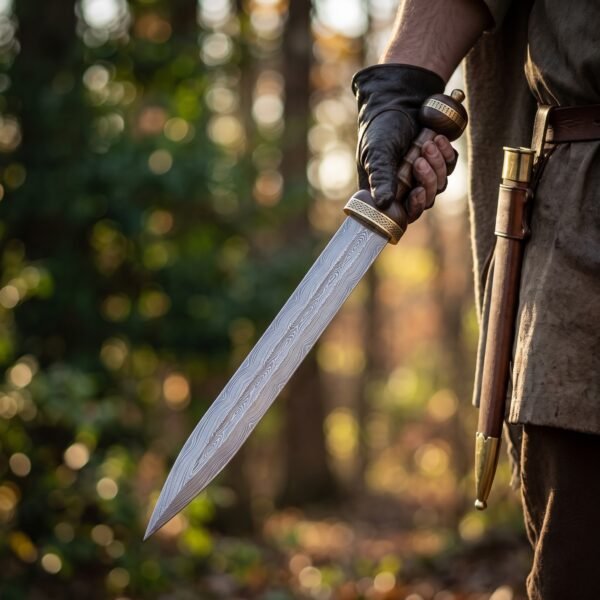
The shape also tells you how the sword was carried and drawn. A legionary wore the gladius high on the right hip on a belt or a baldric, hung from rings on the scabbard like the one on this piece, so the sword could come out with the right hand while the left kept the shield in place. A long blade cannot be drawn from that position. A twenty one inch blade can, and it clears the scabbard mouth in a short upward pull that puts the point immediately in line. Roman drill trained the short thrust from behind the shield, over and over, and the Mainz blade is that drill made in steel. Later the army moved to the plainer parallel edged Pompeii pattern, which was quicker to make and simpler to repair, but the Mainz is the shape most people picture when they hear the word gladius.
Why 1095 high carbon steel and not stainless
1095 is a simple steel, about nine tenths of one percent carbon and very little else, and that simplicity is exactly what makes it right for a sword. It forges predictably, it quenches to a clean martensite and it can be tempered back to the range a long blade wants. We run this one at 54 to 58 HRC, softer than a pocket knife on purpose, because a sword has to flex under a bad cut and return straight rather than break. Stainless steels buy their rust resistance with a large chromium content, and at sword lengths that trade costs toughness in the shoulder and tang where a failure is dangerous. Carbon steel will patina and will rust if you leave it wet, and that is the price of a blade that behaves. The detail is set out in Damascus versus stainless.
The cherry wood hilt
Roman hilts were assembled from a guard block, a grip and a pommel threaded onto the tang, and Roman finds include turned wood, bone and ivory in all three positions. This hilt is cherry, which turns beautifully, holds a crisp rib and darkens with handling into a deep reddish brown that plain woods never reach. The ribs are finger swells. On a thrusting sword they stop the hand creeping forward against the guard block under load, and they give you a positive index of edge alignment without looking down.
Wood on a sword hilt needs almost nothing, but it does need consistency. Wipe it dry after handling, oil it lightly once or twice a year and keep it away from radiators, direct sun and the inside of a hot car, because it is swelling and shrinking that loosens a peened tang. Our guide to wooden handle care covers it in a couple of minutes of reading.
Engraving, runes and your own design
Use the rune converter on this page to turn a name, a date or a short phrase into Elder Futhark and we will cut it into the steel or the handle. If you would rather have a Viking pattern than a rune line, choose your own design in the engraving option above the add to cart button and tell us whether it goes on the blade or the handle. Where a piece already carries an engraved design, your chosen engraving replaces it rather than sitting alongside it. On this sword that means your rune line or pattern takes the place of the knotwork panel at the forte. Details and examples are on the engraving page.
Care and sharpening
Wipe the blade dry after every handling and put a film of light machine oil or paste wax on it before it goes on the wall. Skin oil is acidic and a mirror polish will show a fingerprint etch within a week in a humid room. Do not keep the sword sheathed for long periods, because vegetable tanned leather holds moisture and tanning salts against steel and will bloom rust on a polished blade. Our page on steel care applies to plain carbon blades as well. To bring the edge back, work a coarse then fine stone at a shallow angle from the shoulder toward the point, following sharpening with a whetstone, then re oil.
Made in the Czech Republic
This is a handmade piece from the Czech Republic, made in a workshop that still forges, grinds and finishes by hand instead of stamping parts out. The smiths there have kept the older way of working, and the wood, horn and leather are shaped and fitted by hand as well. Two pieces of the same design will never be identical, and that is part of what you are buying.
Ransack Viking is a United States company. We handle the import ourselves, look over every piece when it lands and ship from our warehouse in Chicago, Illinois. Engraving is done in the United States after the piece arrives, so your design goes on before we send it out.
A note on handmade variation
This gladius is hand forged. It is not machine made and it is not bulk produced, so what arrives will not be a pixel for pixel copy of the photograph. The figure and colour of the cherry, the depth the polish takes, the exact sweep of the waist and the tone the brass has settled to all vary because each one is worked by hand from natural materials. The dimensions, the steel and the build are the same every time. The character is not, and that variation is the mark of a forged sword rather than a defect in one.
Frequently asked questions
Is it sharp out of the box?
Yes, it arrives with a working edge. If you want it blunt for reenactment or stage work, say so in the order notes and we will leave a rounded quarter inch edge at no extra cost.
Can I use it for cutting practice?
Yes, against soft targets such as bottles, mats and pool noodles. Do not cut into steel, hardwood or bone, do not spar with it and never throw it. The long Mainz point is the part most at risk if you drive it into something hard.
How is this different from the Pompeii pattern?
The Pompeii blade is straight and parallel edged with a short stiff triangular tip, easier to make and to repair. The Mainz blade is waisted with a long slender point, better at finding a gap in armour, more work to grind and more delicate at the tip. Mainz is the earlier shape, Pompeii the one the army settled on later.
Can I have runes cut into it?
Yes. Use the rune converter above the add to cart button and pick the blade or the hilt. On this sword the knotwork panel at the forte is the natural place, and your engraving replaces it.
Does the scabbard ring take a belt?
It does. The brass ring is set for a suspension strap or a narrow baldric of up to about one inch. We do not include a belt with this sword, but the ring is sized for standard reenactment fittings.
How long does shipping take?
Free inside the United States. Seven to ten working days in the shop, then two to five in transit. Allow an extra week if you order engraving.
What is in the box
- One hand forged 1095 high carbon steel Mainz pattern gladius, 28 inches overall
- Tooled brown leather scabbard with brass throat and brass suspension ring
- Light protective oil coat on the blade for transit
- Care and sharpening card
- Forged and finished in the Czech Republic
Explore the range
See the rest of the gladius range, the wider short swords, our single handed arming swords and everything under swords. Background reading lives in the guides.
Worth a look beside this
A near match for this one is the Ironlegion gladius. Closest to this in the range is the Legionward gladius, 27 inches overall. If this one is not quite right, there is the Bronzetide gladius, 27 inches overall.
The Grimwake falchion covers the other half of the same kit. Or start from a blank sheet on the custom Viking sword page.

Reviews
There are no reviews yet