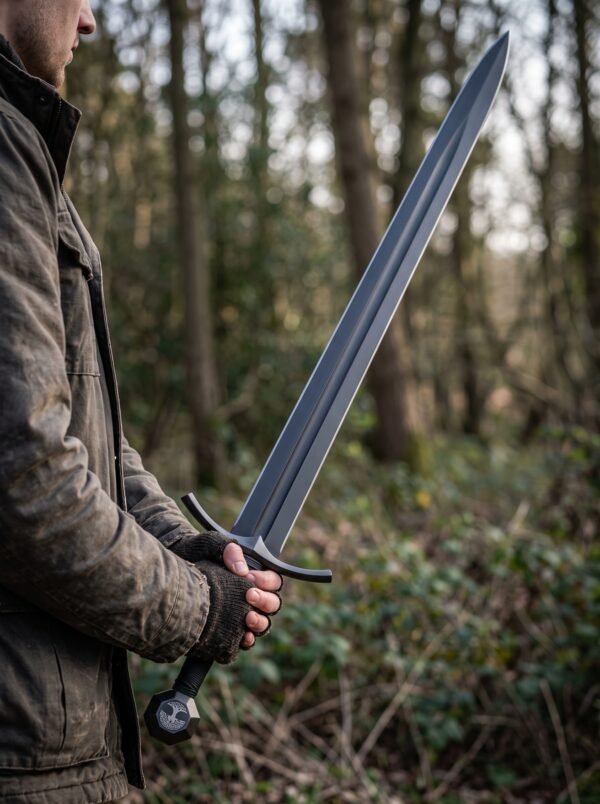
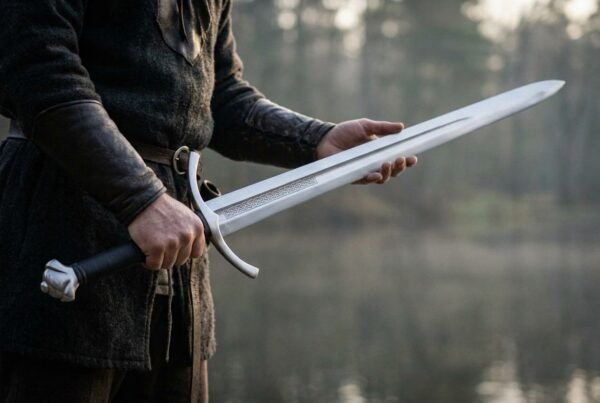
This is a single handed knightly sword built squarely on the Oakeshott type XII, the broad flat evenly tapering blade with a wide fuller running about two thirds of its length that dominates European swordmaking from roughly 1180 to 1350. The typology is worth understanding because it is the language everyone uses. Ewart Oakeshott published it in 1960, and rather than sorting swords by country or by century he sorted them by blade geometry, on the sensible grounds that the blade is the sword and the hilt is the fashion. The system runs from type X, a wide Viking derived cutting blade with a broad shallow fuller, through to type XXII. Type XII sits at the hinge point of the whole sequence, the moment where a pure cutting blade starts to acquire a real point without giving up its cutting width. Almost everything that follows is a response to armour getting better.
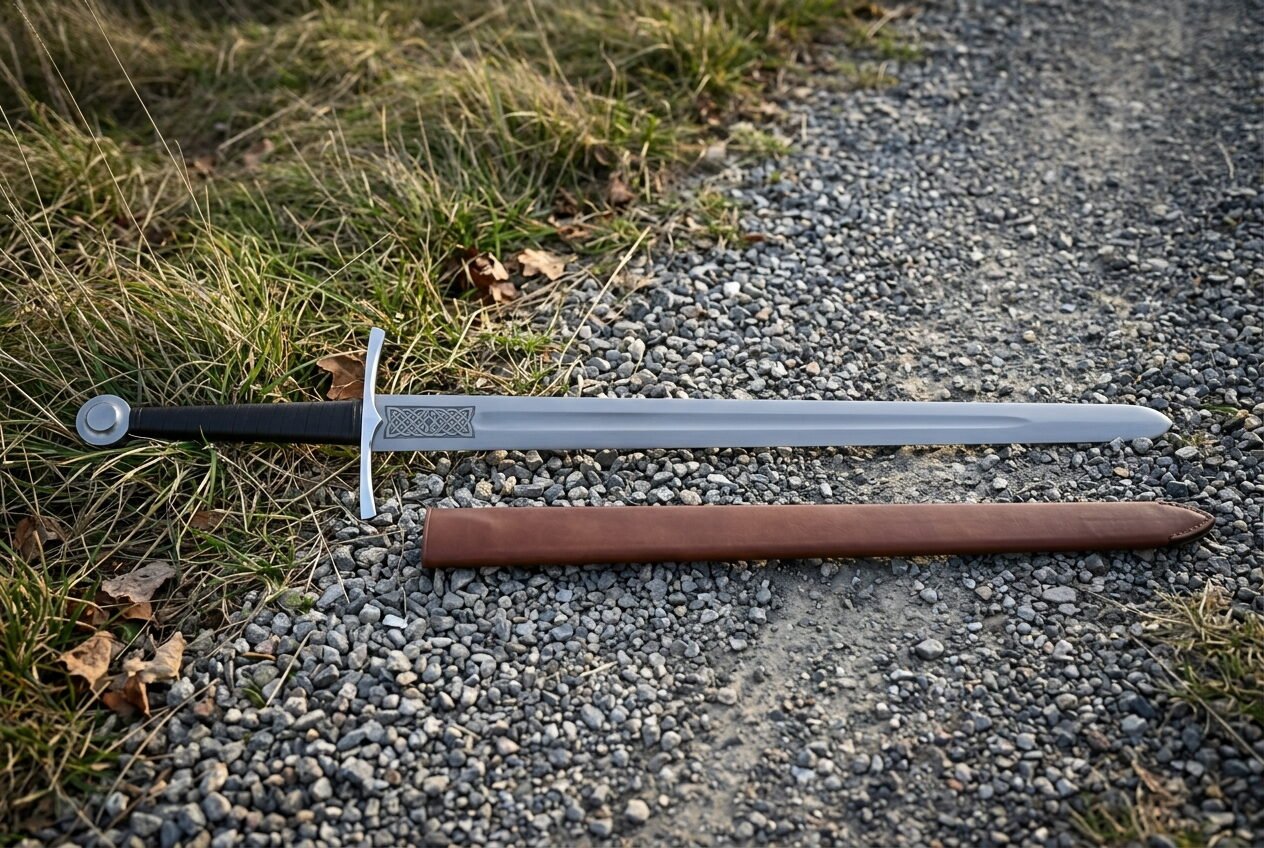
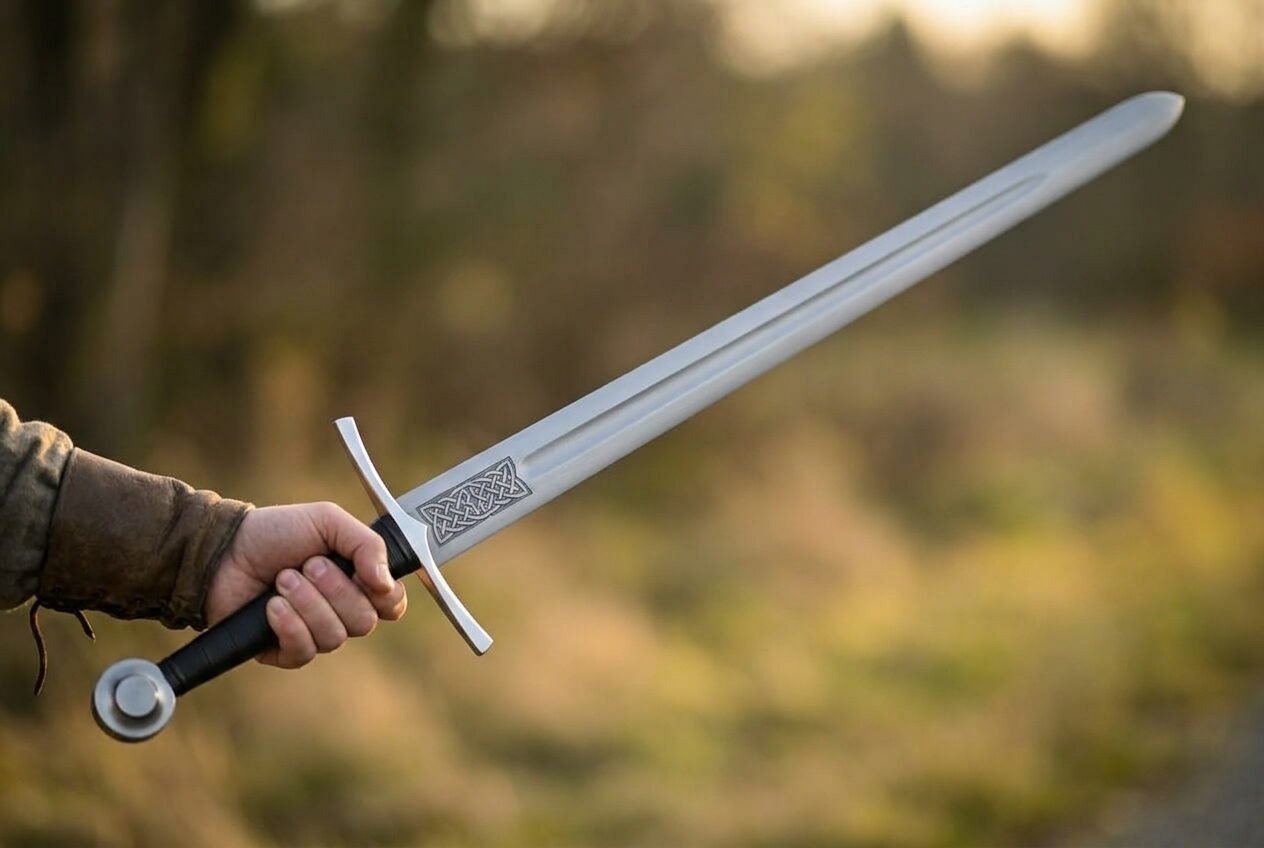
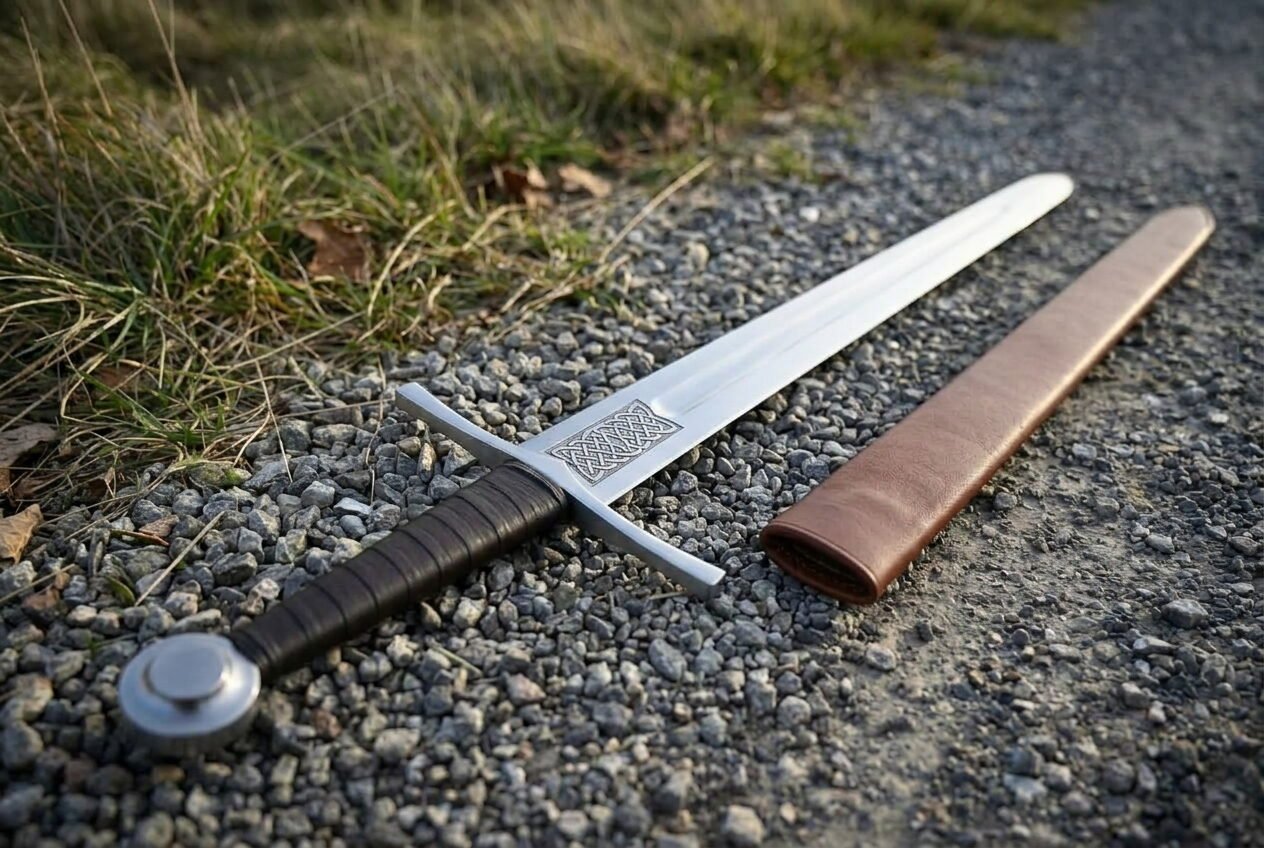
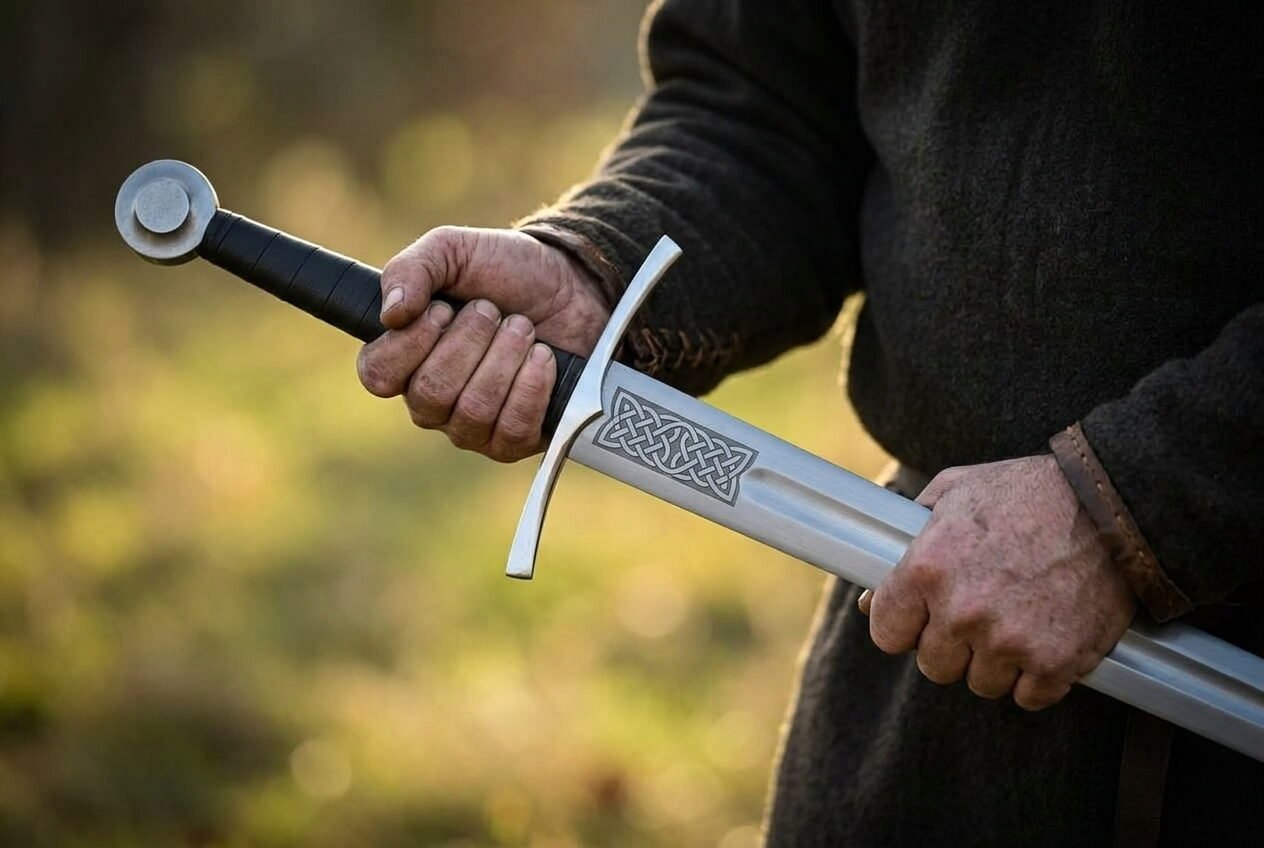
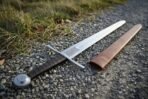
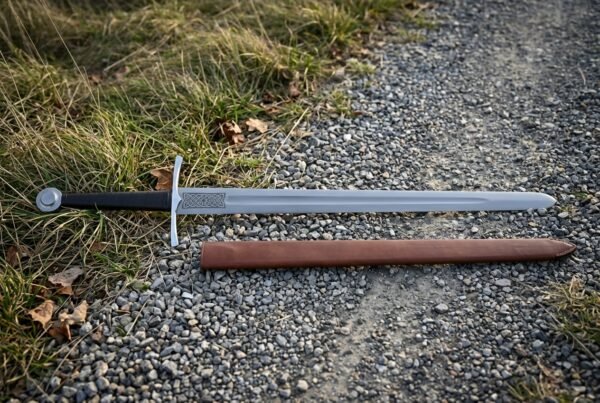
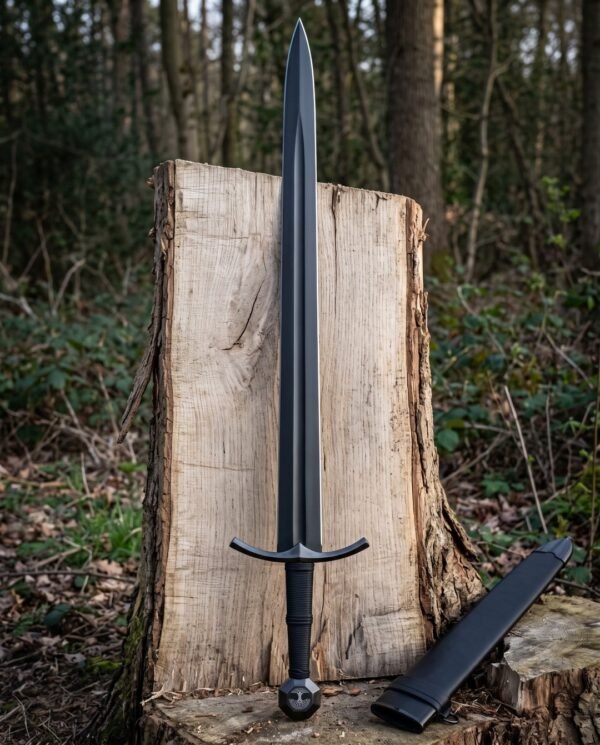
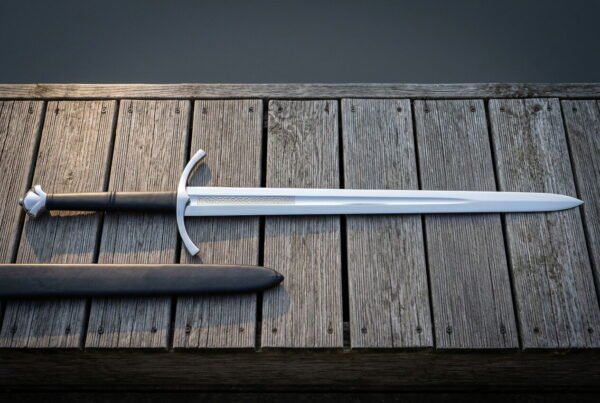
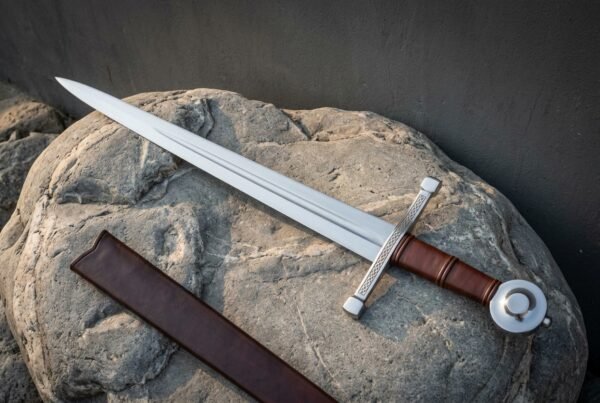
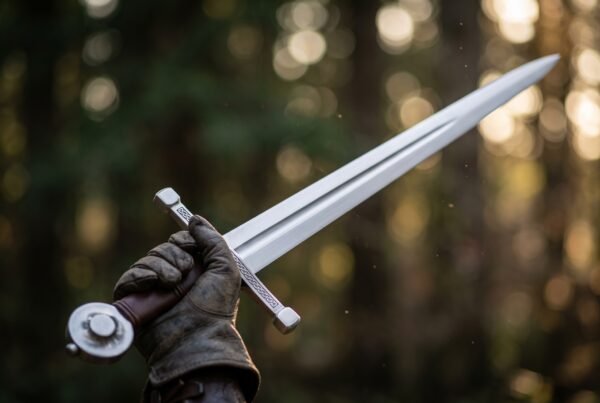
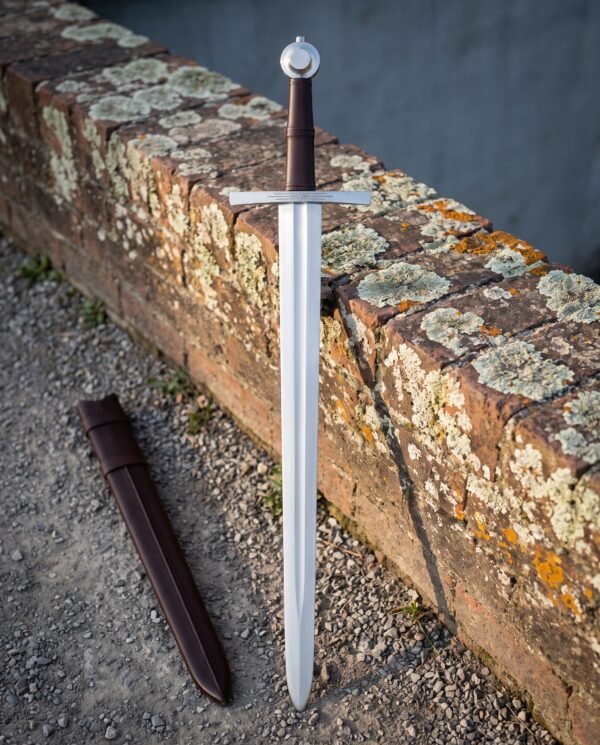
This one is forged, ground, hardened, etched and fitted by hand in the Czech Republic. The blade is 1095 high carbon steel taken to a mirror polish, with a wide central fuller and a band of etched knotwork at the forte. The hilt is a black leather grip between a gently arched steel cross and a turned steel wheel pommel. It ships in a plain brown leather scabbard. Shipping inside the United States is free.
Specifications
| Steel | 1095 high carbon steel, hand forged and mirror polished |
|---|
| Hardness | 54 to 58 HRC |
|---|
| Type | Single handed arming sword, Oakeshott type XII |
|---|
| Overall length | 36 inches |
|---|
| Blade length | 30 inches |
|---|
| Blade profile | Broad evenly tapering blade with a wide central fuller and an etched knotwork panel at the forte |
|---|
| Grip | Black leather wrapped grip over a wooden core |
|---|
| Guard | Steel cross, gently arched toward the blade |
|---|
| Pommel | Steel wheel pommel with a raised centre boss |
|---|
| Tang | Full length, peened over the pommel |
|---|
| Scabbard | Plain brown leather, no metal fittings |
|---|
| SKU | RK-1339 |
|---|
How to read the Oakeshott typology on this blade
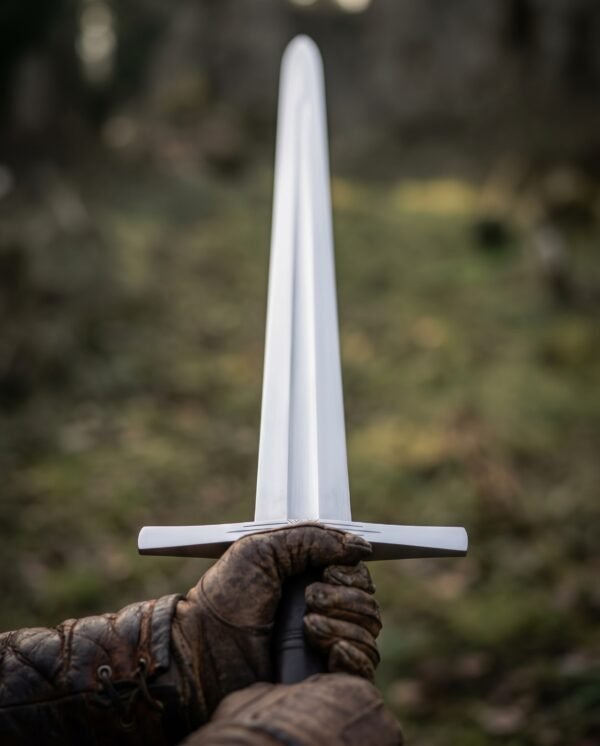
Three things identify a type XII, and you can check all three on this sword. First, the width at the shoulder is broad, close to two inches, and the taper from there to the point is smooth and continuous rather than stepped or waisted. Second, the fuller is wide and shallow and stops roughly two thirds of the way down, leaving the last third as a stiffer flattened diamond section that supports the point. Third, the blade is long enough to be a serious cutting blade but short enough to be used in one hand alongside a shield, typically twenty eight to thirty two inches.
Compare that with its neighbours and the logic becomes obvious. A type X, the older Viking derived form, has a fuller running almost to the tip and a rounded or spatulate point, because it was made for cutting against mail and nothing else. A type XV, two centuries later, has no fuller at all, a stiff diamond section from end to end and edges that taper hard to an acute point, because by then it was facing plate. The type XII is the compromise between those two worlds, and that balance is why it stayed in service so long and why it is the shape most people think of when they picture a knight’s sword.
Why 1095 high carbon steel and not stainless
1095 carries about nine tenths of one percent carbon and almost nothing else, and that simplicity is the point. It moves cleanly under the hammer, quenches predictably and tempers into the range a long blade wants. This one runs at 54 to 58 HRC, deliberately softer than a pocket knife, because a sword has to bend when a cut lands out of alignment and return straight rather than snapping. Stainless steels buy their corrosion resistance with a heavy chromium content, and at thirty inches that chromium costs the toughness you need most in the shoulder and the tang. Carbon steel patinas, and it will rust if you leave it wet, and that is the honest exchange for a blade that behaves. Read Damascus versus stainless for the full picture.
The grip and the wheel pommel
The grip is black leather over a shaped wooden core, which is how medieval grips were built and remains the best construction for a sword that will be handled. The core is split, fitted around the tang, glued closed and shaped to a slight oval so that the flats of the grip tell your hand where the edge is without you having to look. The leather over it takes the sweat and the wear and can be replaced decades from now without touching the sword.
The wheel pommel is turned steel, peened over the end of the tang so that the whole hilt sits under compression. Its function is counterweight. On a thirty inch blade this broad, a light pommel would leave the sword nose heavy and slow to recover between cuts, and a heavy one would kill the cut altogether. The mass here brings the balance point to roughly four inches ahead of the cross, which is about right for a type XII. Because there is wood inside the grip, keep it dry, keep it out of hot cars and away from radiators, and treat it as set out in our note on wooden handle care.
Engraving, runes and your own design
Use the rune converter on this page to turn a name, a date or a short phrase into Elder Futhark and we will cut it into the steel or the handle. If you would rather have a Viking pattern than a rune line, choose your own design in the engraving option above the add to cart button and tell us whether it goes on the blade or the handle. Where a piece already carries an engraved design, your chosen engraving replaces it rather than sitting alongside it. On this sword that means your rune line or chosen pattern takes the place of the knotwork band at the forte. The wide fuller is also a good home for a longer inscription if you want one. See the engraving page.
Care and sharpening
Dry the blade after handling and wipe it with light machine oil or a hard paste wax before it goes away. Skin oil is acidic and a mirror polish will show a fingerprint etch within days in a humid room. Do not store the sword in the scabbard for long periods, because vegetable tanned leather holds moisture and tanning salts against steel and rust starts where you cannot see it. Hang the sword or lay it on a rack and use the scabbard for carrying. Our page on steel care covers plain carbon steel as well as pattern welded. When the edge dulls, work a coarse then a fine stone at a shallow angle from the cross toward the point as set out in sharpening with a whetstone, then re oil.
Made in the Czech Republic
This is a handmade piece from the Czech Republic, made in a workshop that still forges, grinds and finishes by hand instead of stamping parts out. The smiths there have kept the older way of working, and the wood, horn and leather are shaped and fitted by hand as well. Two pieces of the same design will never be identical, and that is part of what you are buying.
Ransack Viking is a United States company. We handle the import ourselves, look over every piece when it lands and ship from our warehouse in Chicago, Illinois. Engraving is done in the United States after the piece arrives, so your design goes on before we send it out.
A note on handmade variation
This sword is hand forged. It is not machine made and it is not bulk produced, so what arrives will not be a pixel for pixel copy of the photograph. The exact width and run of the fuller, the crispness of the etched knotwork, the tone of the leather and the way the polish reads under different light all vary because each one is worked by hand from natural materials. The dimensions, the steel and the build are the same every time. The character is not, and that is what you are buying when you buy something forged rather than manufactured.
Frequently asked questions
What does type XII actually mean?
It is a classification from Ewart Oakeshott, who sorted medieval blades by geometry rather than by date or country. A type XII is broad at the shoulder, tapers evenly, and carries a fuller that runs about two thirds of the length. It is the classic single handed knightly blade of the twelfth to fourteenth centuries.
Is it sharp when it arrives?
Yes, with a working edge. Ask in the order notes for a blunt display or reenactment edge and we will leave a rounded quarter inch instead, at no extra cost.
Can I use it for test cutting?
Yes, against soft targets. Bottles, mats and pool noodles are all fine and a broad type XII is very good at them. Do not cut into steel, hardwood or bone, do not spar with it and never throw it.
Does it come with a belt?
Not this one. It ships with a plain brown leather scabbard. If you want a full rig with a matching belt, look at our arming swords supplied with a scabbard and belt together.
Will mine look like the photograph?
The shape, size and fittings will match. The exact tone of the leather and the way the polished surface catches light will not, because both come from natural materials worked by hand.
How long does shipping take?
Free inside the United States. Seven to ten working days in the shop, then two to five days in transit, plus about a week if you order engraving.
What is in the box
- One hand forged 1095 high carbon steel Oakeshott type XII arming sword, 36 inches overall
- Brown leather scabbard
- Light protective oil coat on the blade for transit
- Care and sharpening card
- Forged and finished in the Czech Republic
Explore the range
Browse the rest of the arming swords, the two handed longswords, our scabbards and sheaths and everything under swords. Background reading is in the guides.
Worth a look beside this
Next along the rack is the Wheelgird arming sword, 37 inches overall. For a straight comparison, see the Emberdisc arming sword, 36 inches overall. Worth putting side by side with this is the Discthane arming sword, 38 inches overall.
If you are putting a set together, the Stonewake Viking sword sits alongside it. Or start from a blank sheet on the custom Viking sword page.
The Skarnvik arming sword is our blunt option for club training, and our blunt versus sharp guide is there if you want to compare.

Feels way more premium than the price suggests. Weight and balance make it feel like a real functional piece not some cheap replica. Edge retention has been great even after regular use. If you’re on the fence just get it. You won’t regret it.
Middle of the road experience with this one. Might work for casual use or display.
Five stars isn’t even enough honestly. Fit and finish is museum quality. You can tell real craftsmen made this by hand. Shipping was fast and everything arrived well packaged.
Overall a good buying experience. Blade quality is solid. Arrived a bit less sharp than expected but a few passes on a strop fixed it. Wood handle looks great though it’s a little smaller than I imagined. Glad I made this purchase.
Can’t stop showing this off to everyone who comes over. Can’t recommend this enough.