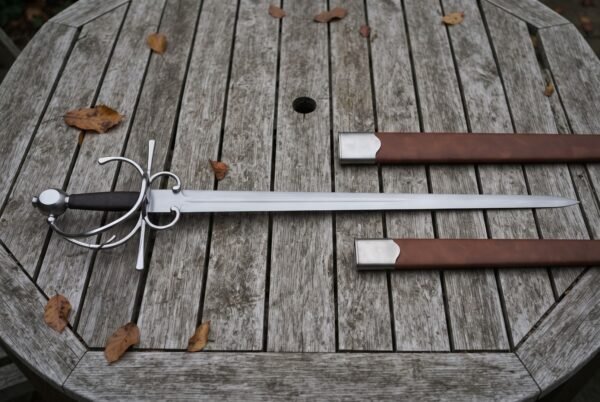
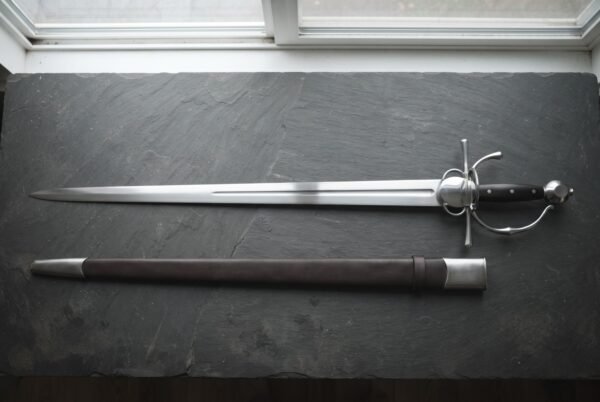
The Oakflank is a hand forged side sword, the working civilian sword of the sixteenth century and the direct ancestor of the rapier. It is worth being clear about what a side sword is, because the term causes confusion. It is not a short rapier and it is not a late medieval arming sword with a fancier guard. It is its own thing: a broad double edged blade that still cuts properly, hung on the kind of complex hilt that only makes sense once men stopped wearing gauntlets. Fencing manuals of the period treat it as the default sword, the one you would be taught first, and the one you would actually be carrying when trouble found you.
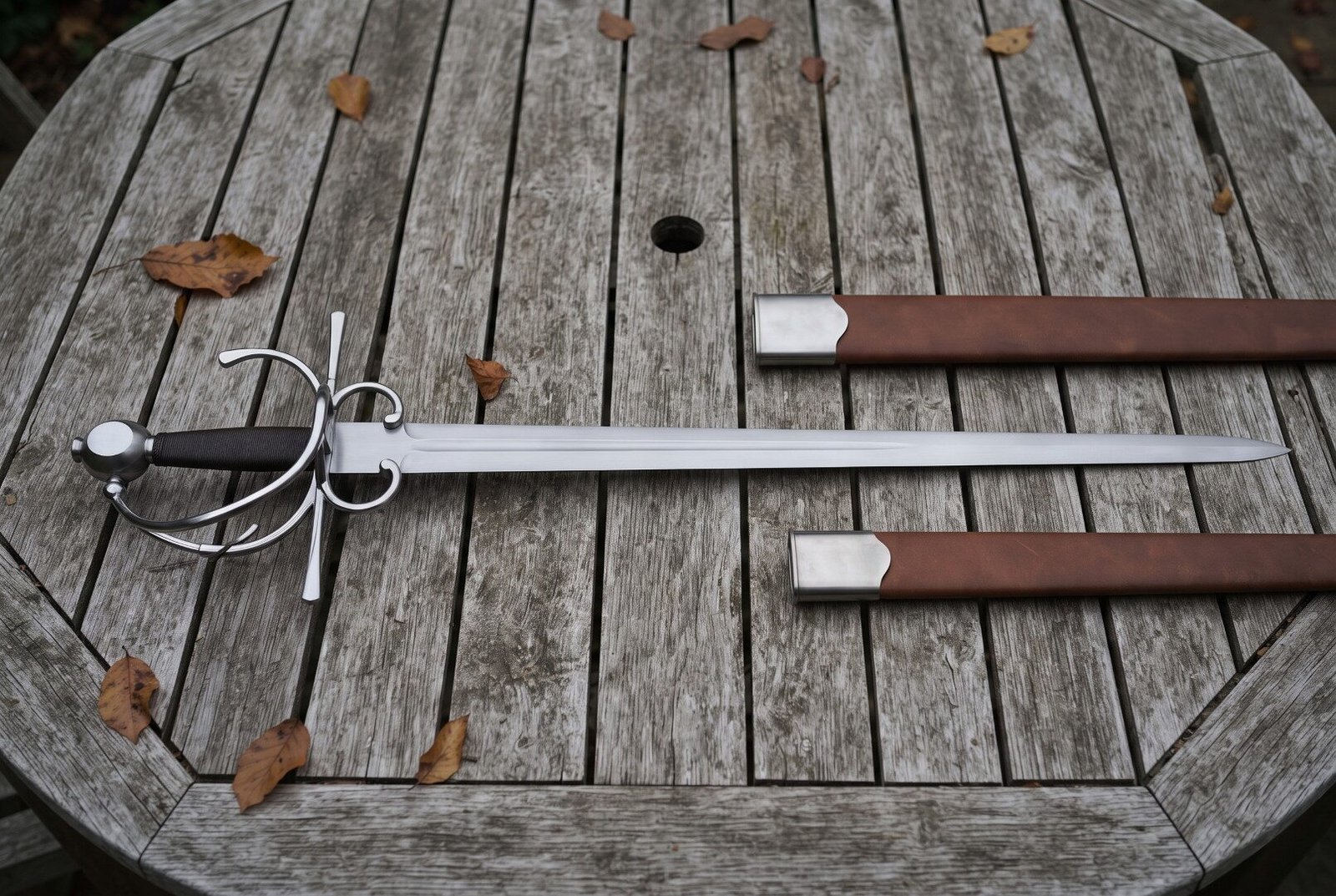
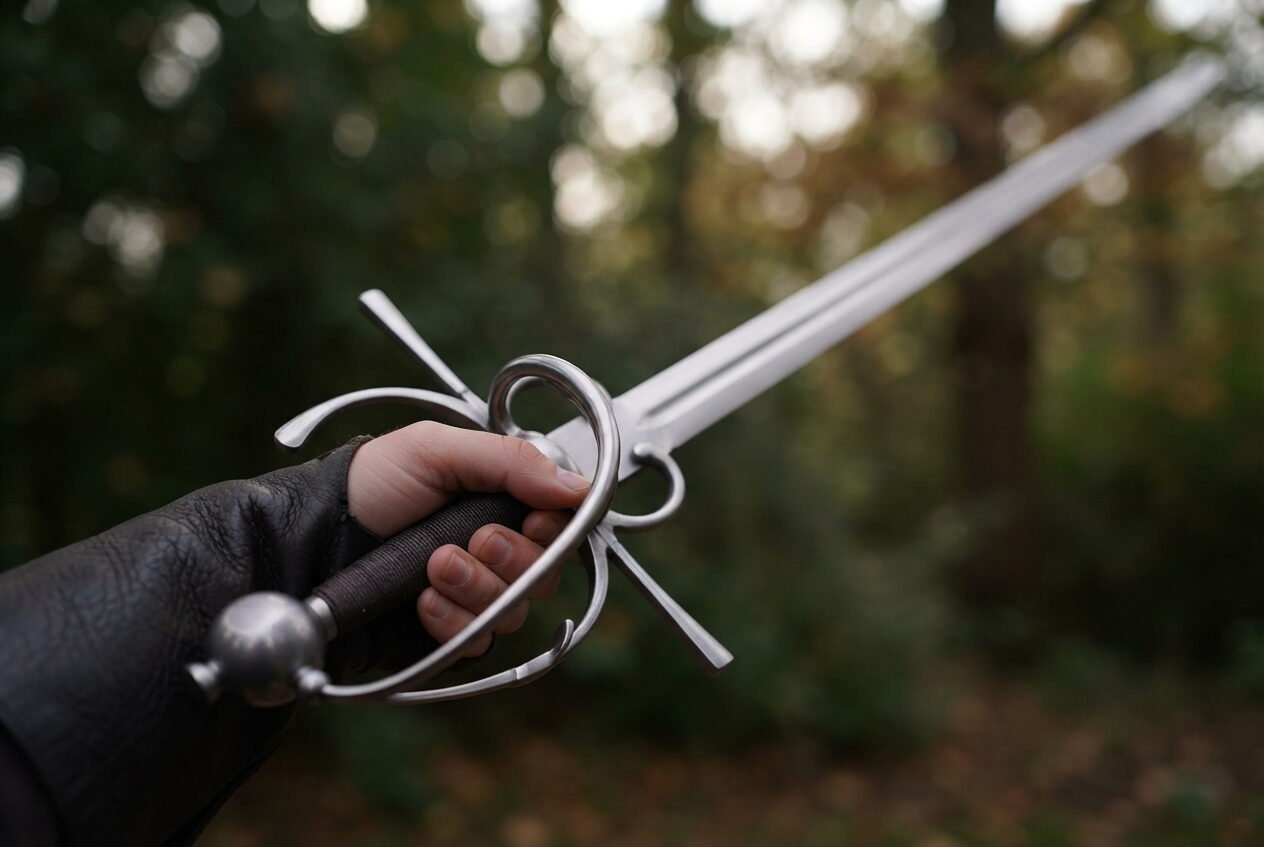
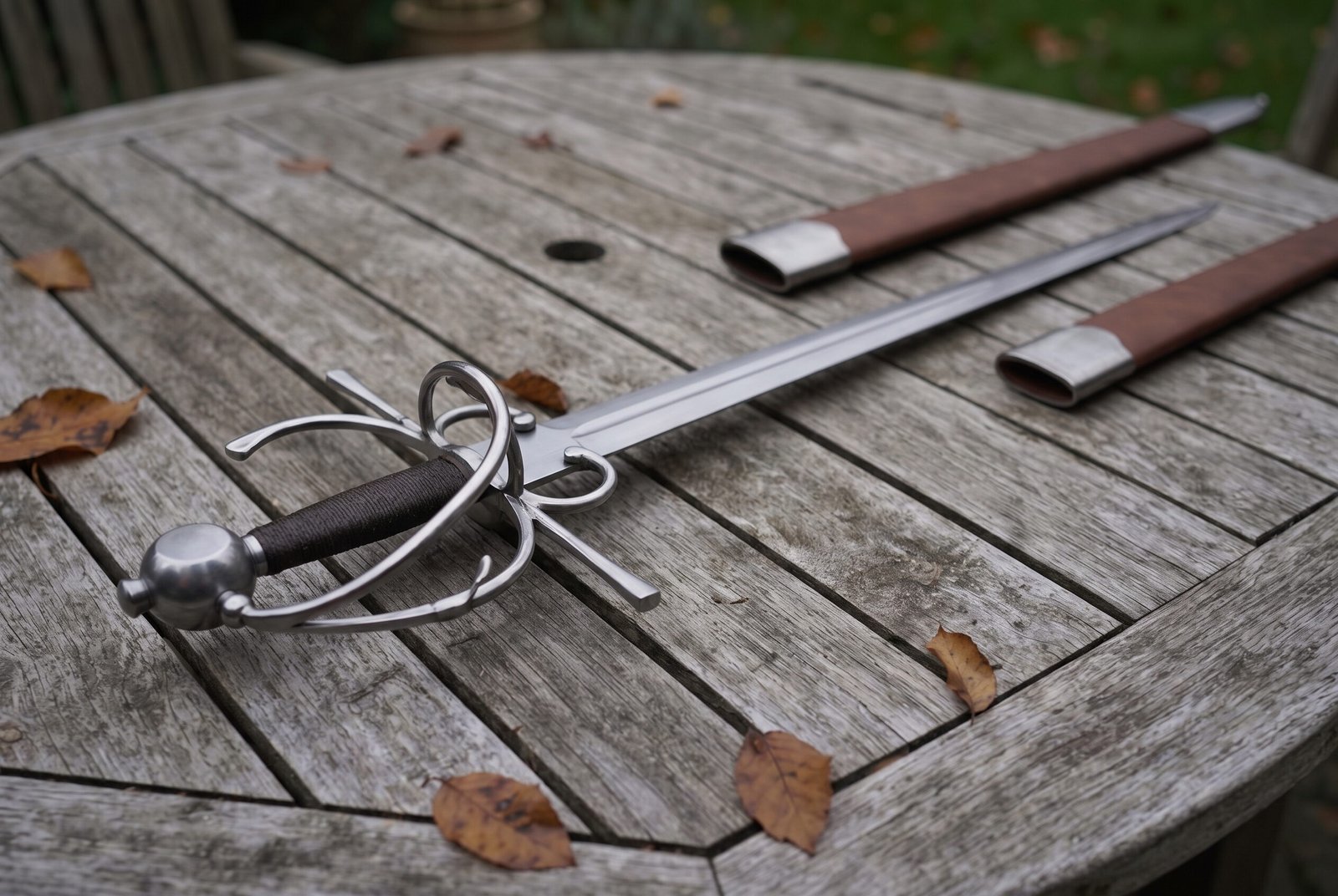
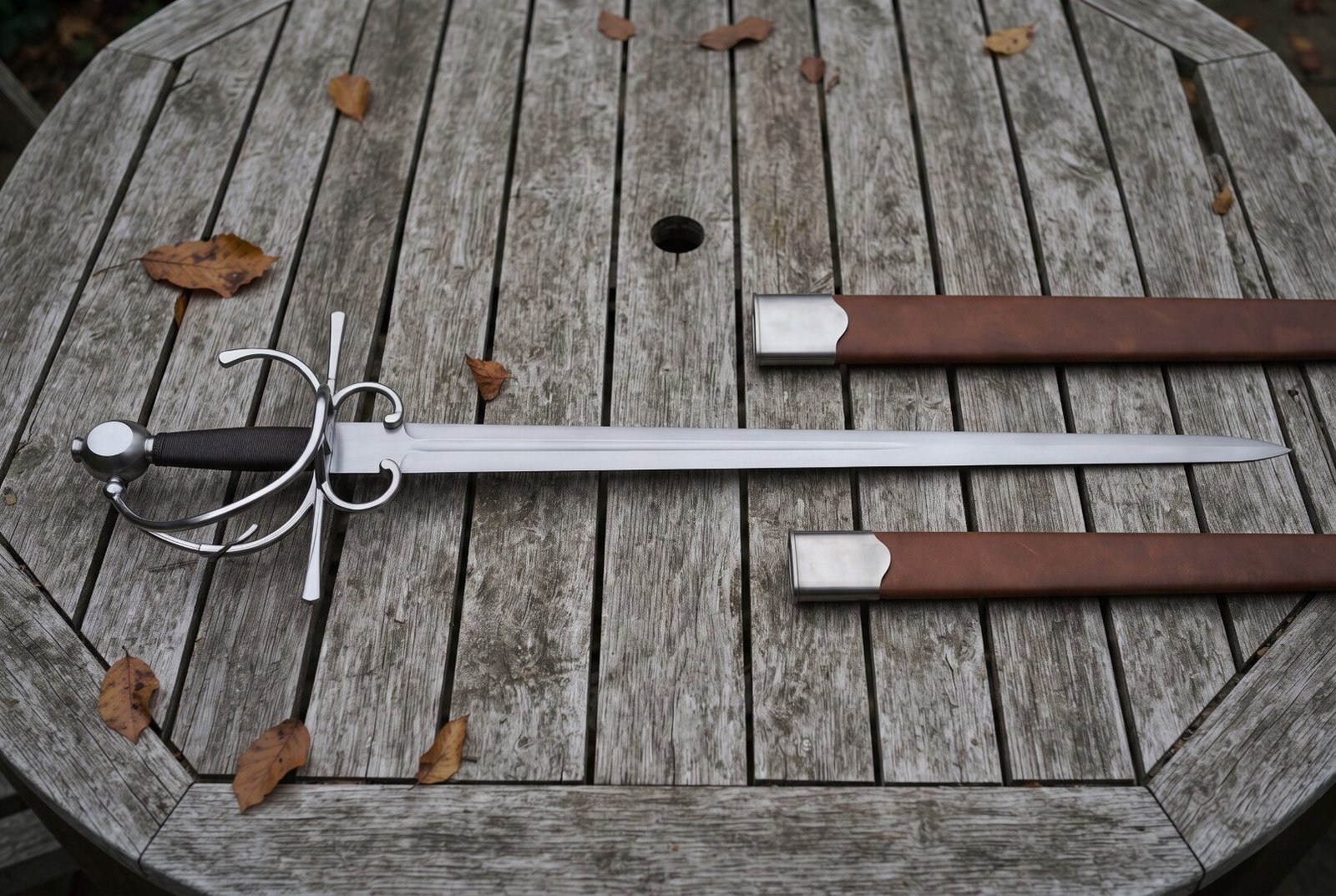
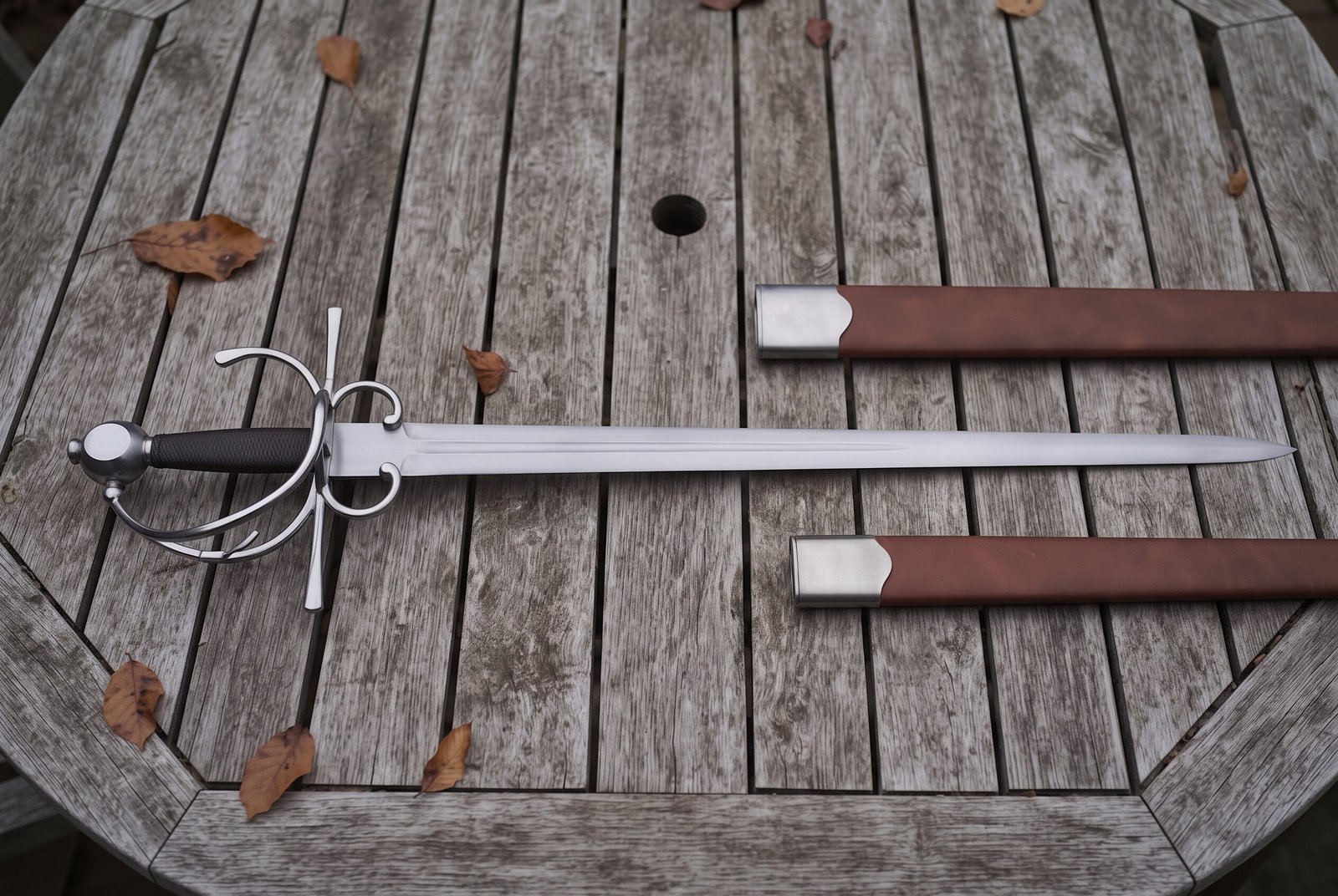
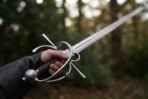
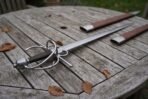
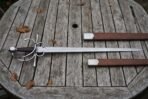
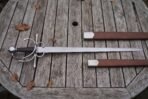
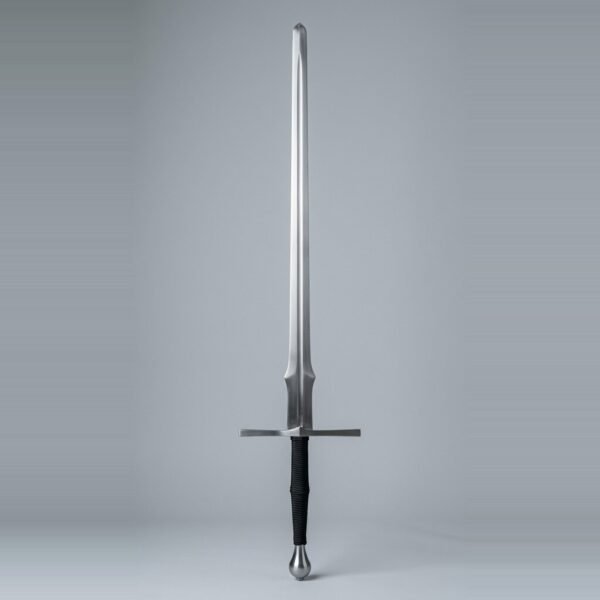
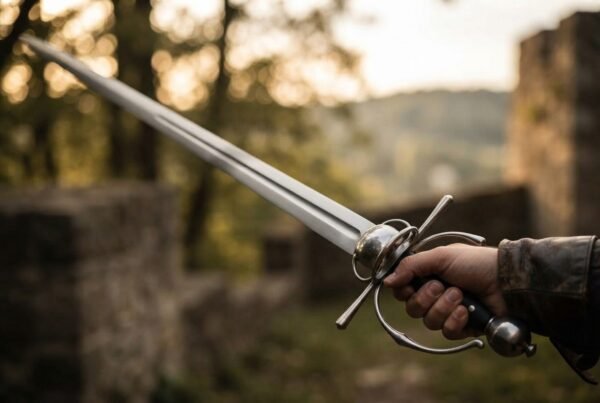
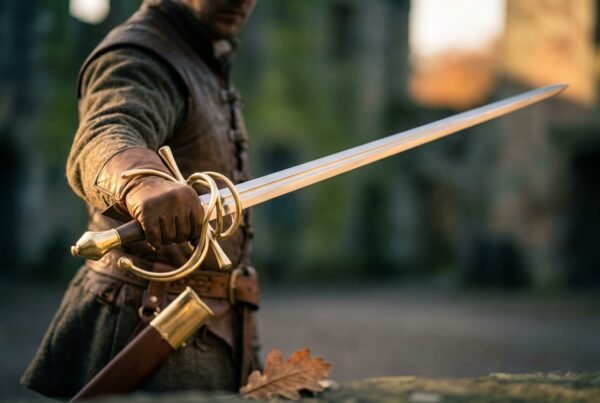
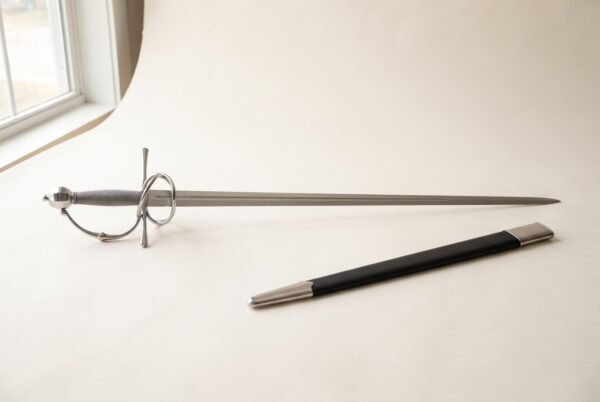
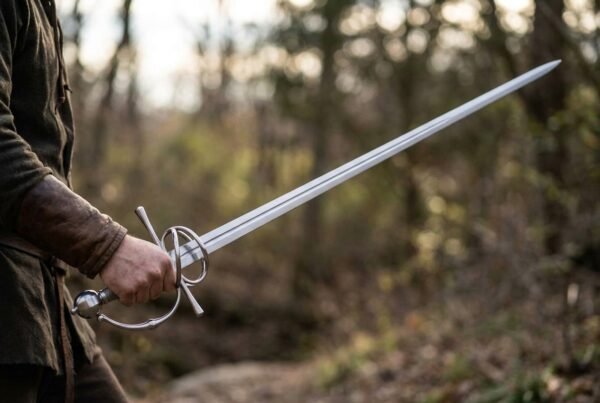
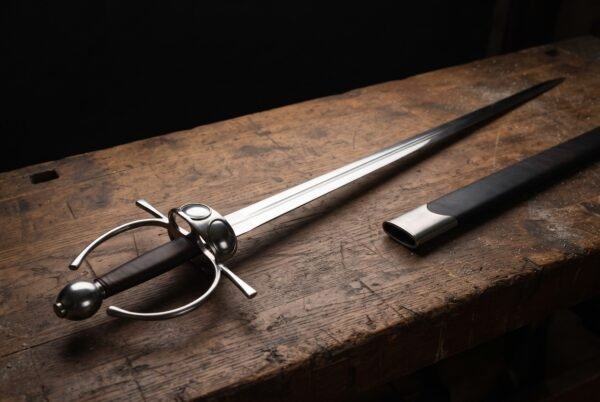
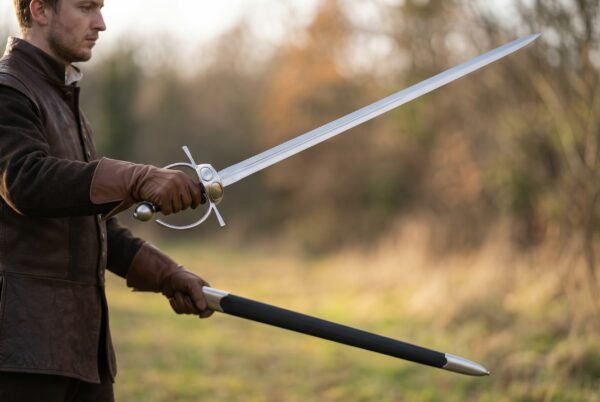
This one is forged and finished in the Czech Republic. The blade is 1095 high carbon steel, hardened and tempered, ground with a long narrow fuller running most of its length and brought to a mirror polish. The hilt is polished steel, swept into curved counter guards and side rings around the outside of the hand, with a knuckle bow and a straight quillon with flared ends. The grip is dark brown leather over a shaped wood core, closed by a round steel pommel with a flat face. It ships with the fitted brown leather scabbard shown, mounted with a polished steel throat.
Specifications
| Steel | 1095 high carbon steel |
|---|
| Hardness | 54 to 58 HRC |
|---|
| Overall length | 39 inches |
|---|
| Blade length | 32 inches |
|---|
| Blade profile | Broad double edge with a single fuller running most of the length, mirror polished |
|---|
| Guard | Polished steel swept hilt with knuckle bow, scrolled side rings, counter guards and straight quillons with flared ends |
|---|
| Grip | Dark brown leather over a wood core |
|---|
| Pommel | Round polished steel pommel with a flat face and tang button |
|---|
| Scabbard | Brown leather with polished steel throat |
|---|
| SKU | RK-1410 |
|---|
What the fuller does, and why this blade is this wide
The groove running down the centre of the blade is a fuller, and it is the single most misunderstood feature on any sword. It is not a blood groove. Blood does not create suction on a blade and there is no historical source that says it does. A fuller is a stiffness to weight device, and the engineering is the same as the reason a steel beam is an I shape rather than a solid bar.
When a blade bends, almost all the stress is carried in the outer surfaces, at the edges and along the spine. The material at the middle of the section does very little except add weight. Cut a groove down that middle and you remove the idle material while leaving the working material where it is. The blade loses a noticeable fraction of its weight and almost none of its rigidity. On a sword you swing, that weight comes off exactly where you least want it, out along the length, so the whole thing accelerates faster and stops sooner.
The width of the blade is the other half of the equation. A cut is not delivered by sharpness alone, it is delivered by mass moving along an edge, and a broad blade carries more mass out at the point of percussion where the cut lands. Narrow the blade the way a true rapier does and you lose the cut. Keep it broad and fuller it, as this blade is, and you get a sword that will still take a cut properly while remaining light enough to fence with. That compromise is the whole reason the side sword existed for as long as it did.
Why 1095 high carbon steel and not stainless
Stainless resists rust because of its chromium content, and that same chromium is why it makes a poor sword. It locks carbon into coarse carbides scattered through the steel, and each of those is a small flaw where a crack can start in a blade that flexes and takes lateral load. The usual workaround is to leave a stainless sword soft so it bends instead of breaking, which is why so many of them arrive with a slight curve and keep it forever.
1095 is iron with just under one percent carbon and very little else. It hardens deeply and evenly, tempers to a figure you can predict, and at 54 to 58 HRC gives a long blade both a durable edge and real spring. It rusts if neglected, and that is the honest cost. Wipe it and oil it. The comparison is set out in Damascus versus stainless.
The leather grip and the wooden core
Under the brown leather is a shaped wooden core, slightly waisted so the hand settles in the same place every time. Wood remains the correct material here because it is light, it takes a shape steel cannot economically be given, and it does not chill the palm. Leather over wood also has a small amount of give, which absorbs the shock of a cut rather than transmitting all of it into the wrist.
Because there is wood under the wrap, treat it as a wooden handle. Do not store the sword in a damp basement or a garage that swings through the seasons, and keep it out of direct sun and away from radiators. Both extremes shrink a core and loosen the leather over it. A little leather conditioner once or twice a year keeps the wrap supple. More detail is in wooden handle care.
Engraving, runes and your own design
Use the rune converter on this page to turn a name, a date or a short phrase into Elder Futhark and we will cut it into the steel or the handle. If you would rather have a Viking pattern than a rune line, choose your own design in the engraving option above the add to cart button and tell us whether it goes on the blade or the handle. Where a piece already carries an engraved design, your chosen engraving replaces it rather than sitting alongside it. The Oakflank is deliberately plain, so the obvious panels are the flat of the blade beside the fuller and the flat face of the pommel. See the engraving page for lettering and pattern options.
Care and sharpening
Wipe the blade after handling. Fingerprints are mildly acidic and will etch a mirror polish within days if they are left there, and the inside of a fuller is exactly where people forget to wipe. Keep a thin film of mineral or camellia oil on the steel and take the sword out of the scabbard if it is going to be stored for months, since leather holds moisture against a blade. The routine is on the steel care page.
The edges arrive sharp and usable. To bring them back, use a whetstone and follow the bevel already on the blade rather than imposing a steeper one. Work both sides evenly with long passes and finish on a strop. Never use a bench grinder on a hardened blade, because the heat destroys the temper long before the steel changes colour. See sharpening with a whetstone.
Made in the Czech Republic
This piece is made by hand in the Czech Republic, in a workshop that still works the old way. The steel is forged, ground, heat treated and finished by smiths who learned the trade from the people before them, and the wood, horn and leather are cut and fitted by hand rather than pressed out on a line. That is also why no two pieces come out exactly the same.
Ransack Viking is a United States company. We import these pieces ourselves, check every one when it lands and ship from our warehouse in Chicago, Illinois. Engraving is done here in the United States after the piece arrives, so your runes or your own design go on before it leaves for you.
A note on handmade variation
This piece is hand forged, not machine made or bulk produced, so what arrives will not be a pixel for pixel copy of the photograph. The sweep of each bar in the guard, the exact width and finish of the fuller, the tone of the brown leather on both grip and scabbard, and the way the polish catches light will all vary, because each is worked by hand from natural materials. The dimensions, the steel and the build are the same every time. The character is not.
Frequently asked questions
Is the side sword sharp when it arrives
Yes, with a working edge that will cut. It is not honed to a razor finish because a razor edge on a sword chips as soon as it meets something hard.
Can I cut with it or is it display only
The blade is properly hardened and tempered, so light target cutting on bottles or a rolled mat is within what it is built for. It is not made for edge on edge sparring with another steel sword.
Can I have runes engraved on the blade
Yes. Use the rune converter on this page for Elder Futhark or choose your own design in the engraving option, and tell us whether it goes on the blade or the handle.
Will mine look exactly like the photograph
Close in size and shape, individual in character. Leather tone and the precise curves of the hilt vary from one to the next because they are finished by hand.
Is a side sword the same thing as an espada ropera
Broadly yes. Espada ropera is the Spanish term, meaning the sword worn with clothes rather than armour, and side sword is the English convention for the same family. Both describe a broad bladed civilian sword on a complex hilt.
How long does shipping take
Free shipping within the United States. Stock pieces leave within a few days. It takes two to four weeks in the shop, plus a little more for engraved work.
What is in the box
- Oakflank hand forged 1095 high carbon steel side sword
- Fitted brown leather scabbard with polished steel throat
- Care card covering oiling, polish upkeep and leather care
- Elder Futhark rune engraving or your own Viking design if selected at checkout
- Forged and finished in the Czech Republic
Explore the range
Browse the short swords, the rapiers, the arming swords and the full sword range, or read the guides.
Close to this one
For a straight comparison, see the Petalward rapier, 41 inches overall. Worth putting side by side with this is the Duskbroad rapier, 38 inches overall. In the same category sits the Quickthorn rapier, 46 inches overall.
From the same corner of the shop, there is the Thornwatch longsword. Nothing here exactly right, build one to your own spec on the design your own page.
If this style appeals, the Velstrand cup hilt rapier is a sharp from our HEMA line rather than a sparring tool, and our blunt versus sharp guide is worth reading first.

Incredible craftsmanship on this one. Edge retention has been great even after regular use. Shipping was fast and everything arrived well packaged.
Knew this sword was special the second I opened the box. Even the small engravings are crisp and clean. Edge retention has been great even after regular use. Couldn’t be happier with this. Nice touch that it ships from within the US even though it’s crafted in the Czech Republic.
This thing is a beast in the best way. Weight and balance make it feel like a real functional piece not some cheap replica. Will definitely order again for another gift.