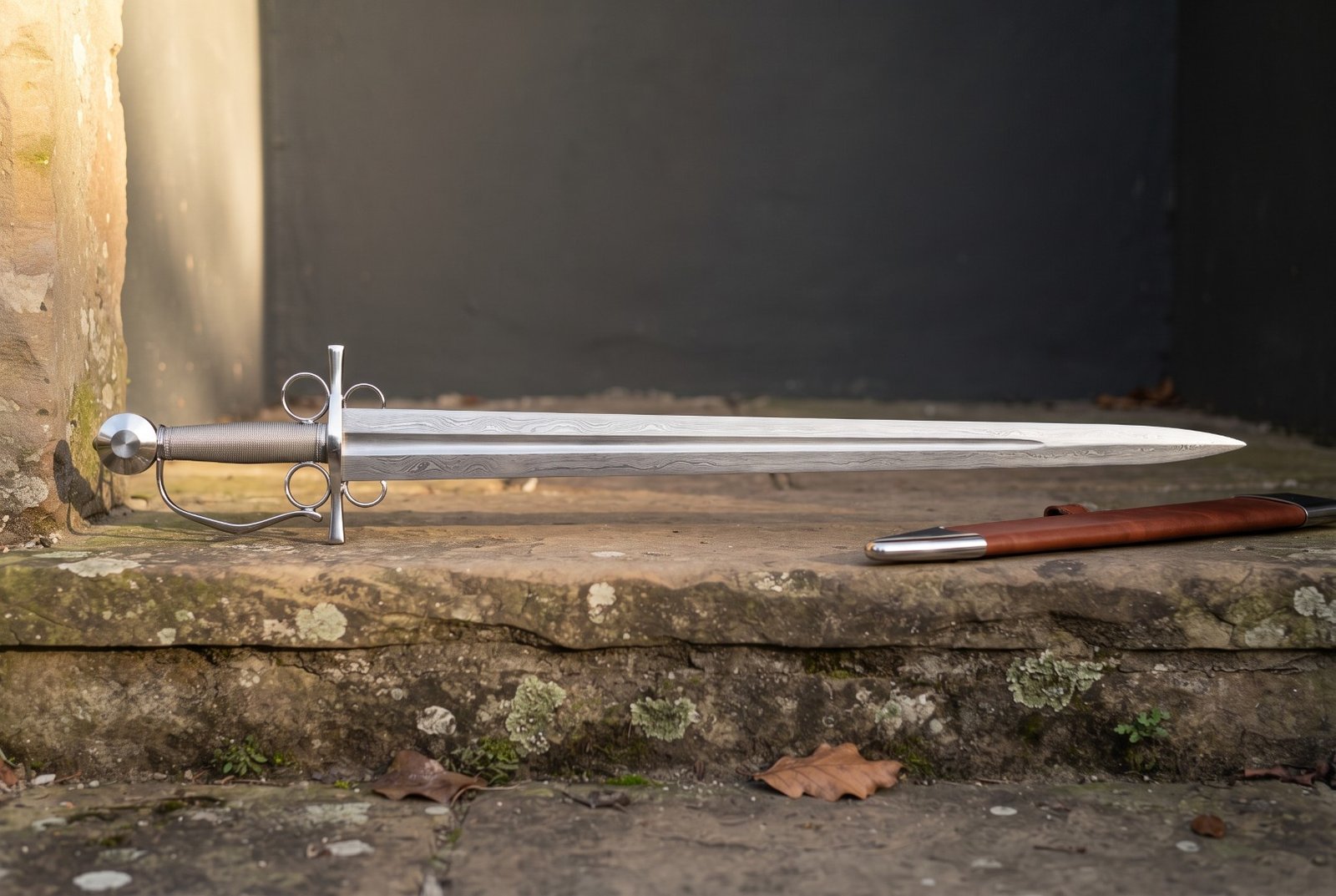
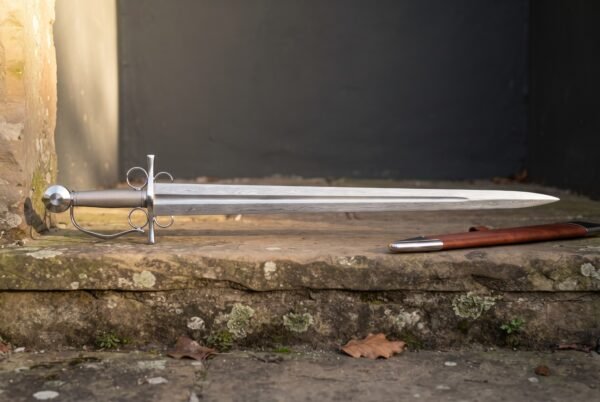
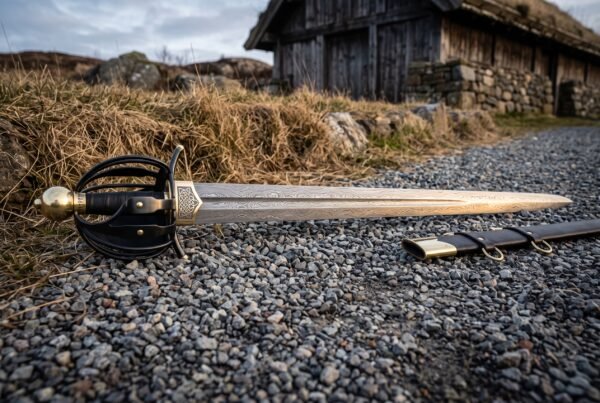
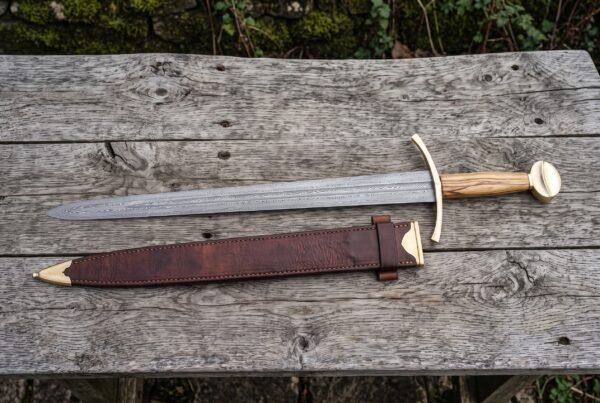
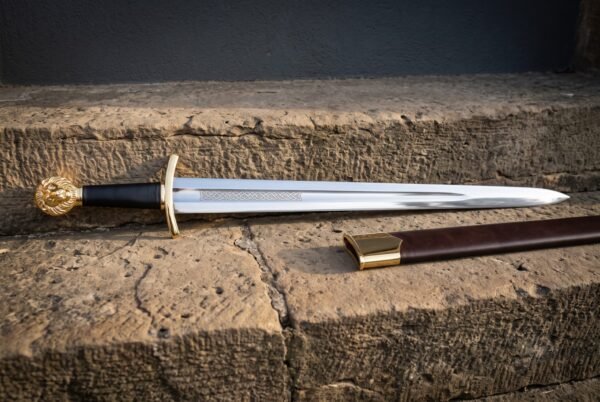
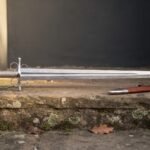
The Tidegrain is a hand forged Damascus side sword with a straight tapering blade and a polished four ring hilt. It sits at the cutting end of the renaissance sword family, the sort of blade a soldier of the period would have chosen over a fashionable rapier because it would still take an arm off. Fencing manuals of the sixteenth century are surprisingly blunt about this distinction. The masters who taught the long thrusting sword were teaching a duelling sword for men in doublets. The men who expected to end up in a boarding action, a siege or a street brawl carried something broader, shorter and heavier at the tip, and the manuals for those readers spend their pages on cuts rather than on the geometry of the lunge.
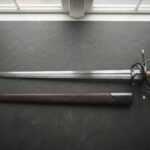
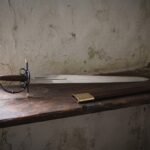
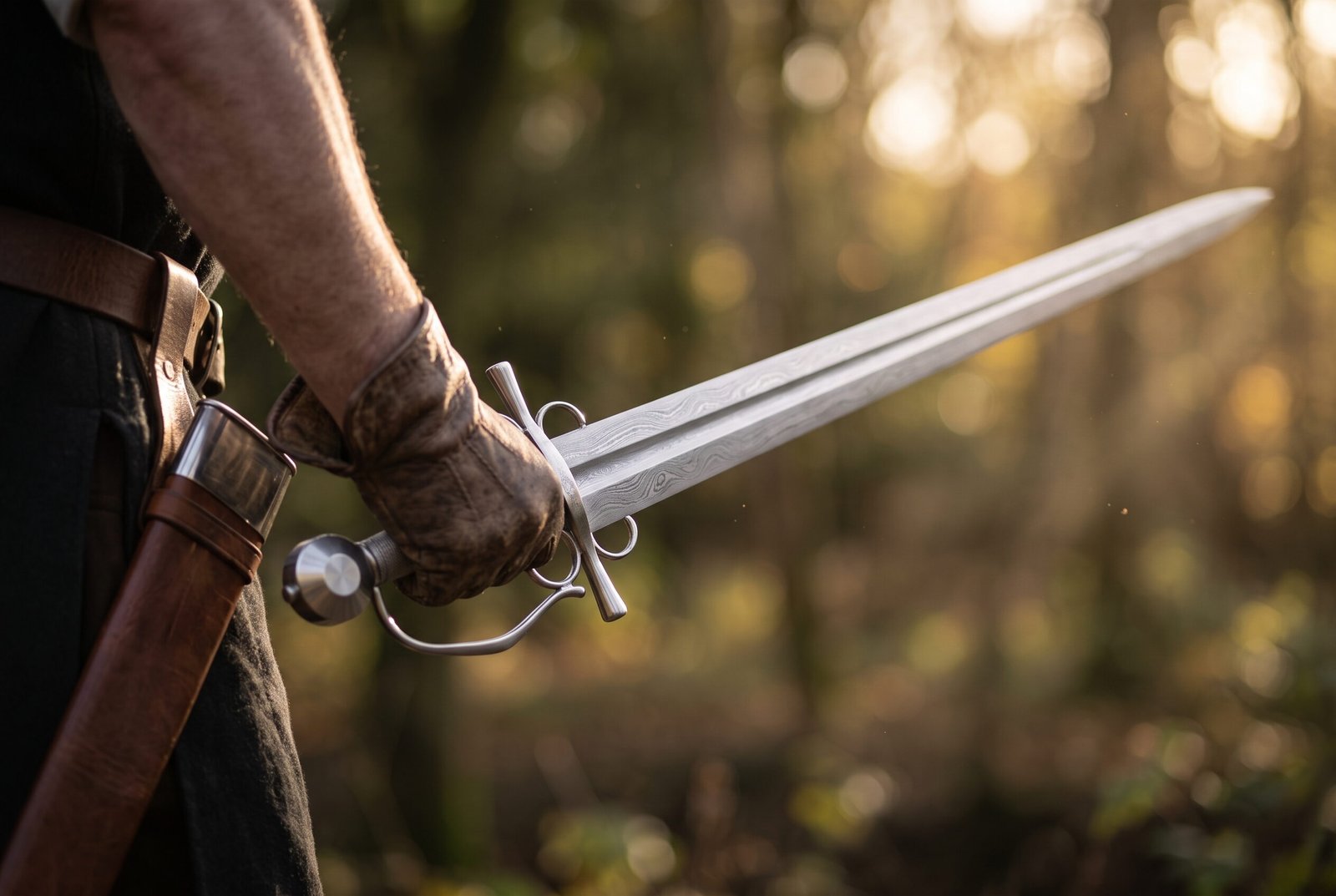
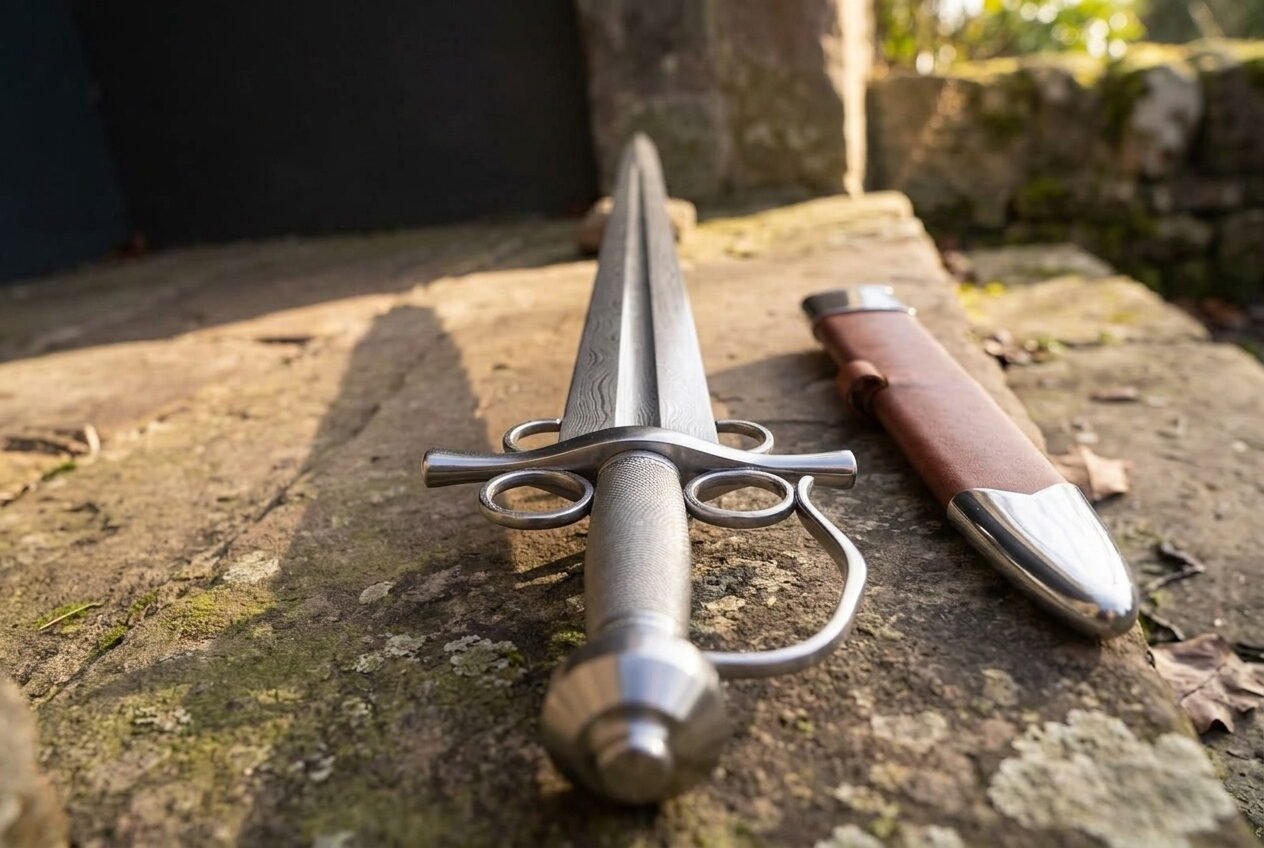
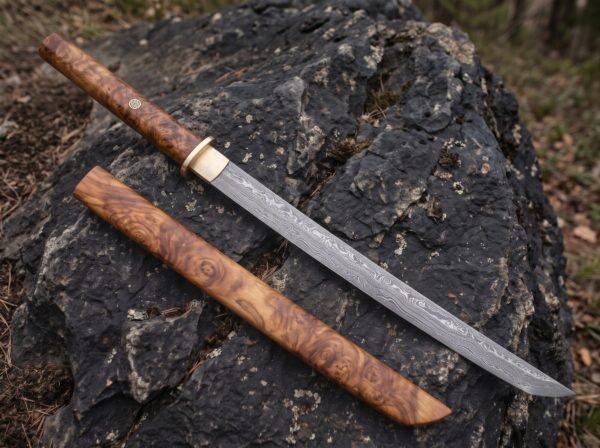
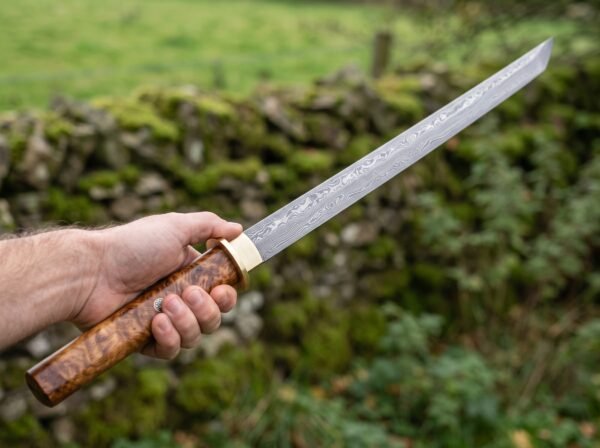
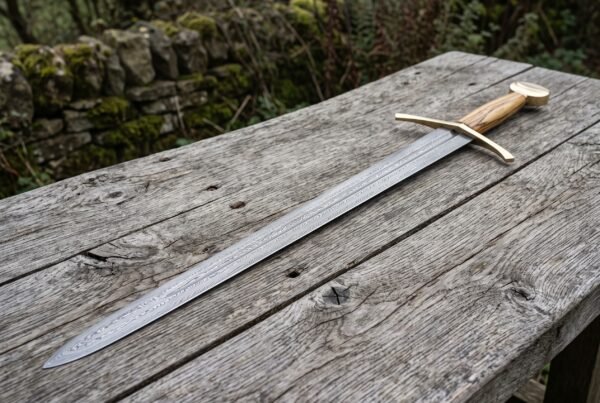
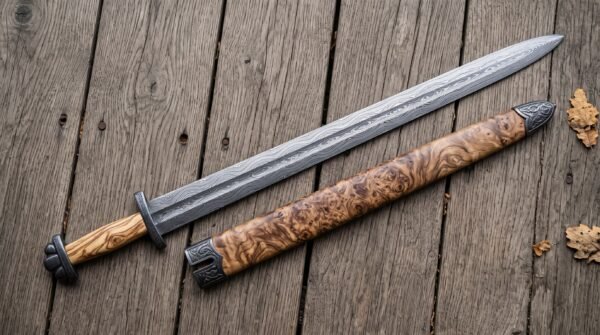
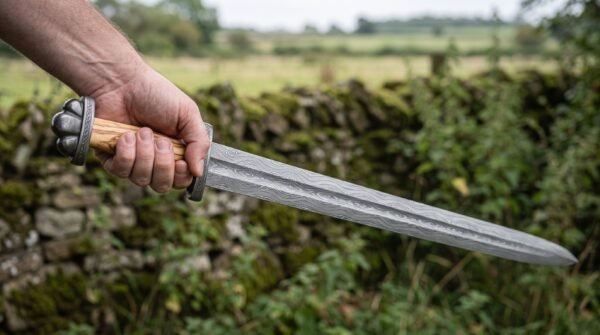
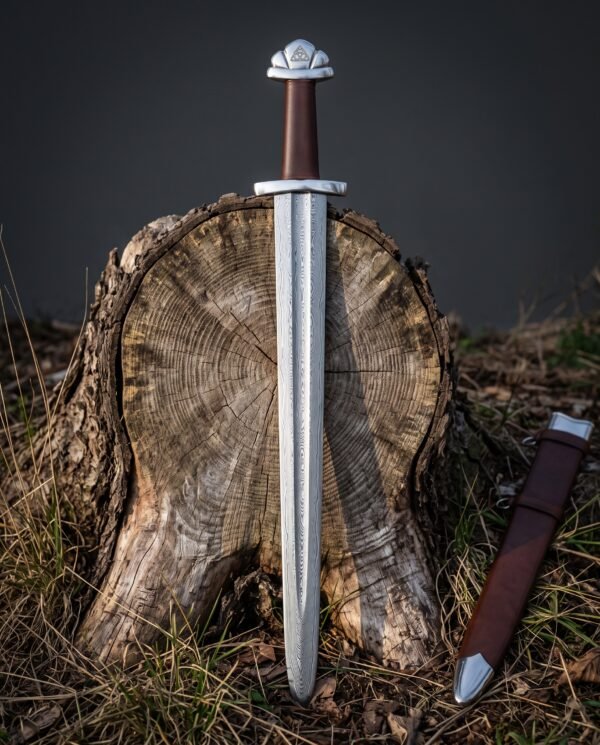
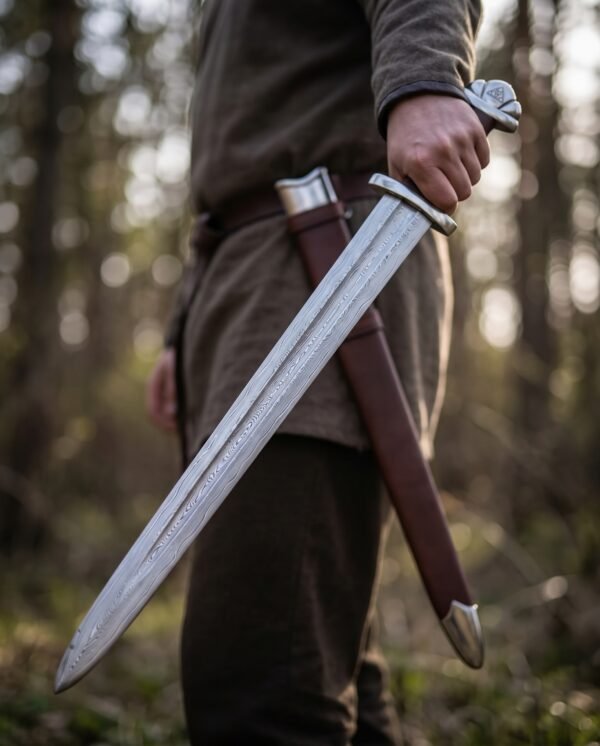
This one is forged and finished in the Czech Republic. The blade is Damascus, 1095 and 15N20 forge welded in hundreds of layers, forged straight and tapering to the point, ground with a long fuller and etched to bring up a dense wood grain figure. The hilt is polished steel, with two rings above and two below the quillon block, a straight quillon and a knuckle bow. The grip is bound in twisted wire under a disc pommel. It ships with the fitted russet leather scabbard shown, mounted with a polished steel chape.
Specifications
| Steel | Damascus, 1095 and 15N20 forge welded |
|---|
| Hardness | 58 to 60 HRC |
|---|
| Overall length | 38.5 inches |
|---|
| Blade length | 31.5 inches |
|---|
| Blade profile | Straight double edged blade tapering to an acute point, long central fuller, etched Damascus figure |
|---|
| Guard | Polished steel four ring hilt, two rings above and two below the quillon block, straight quillons and a knuckle bow |
|---|
| Grip | Twisted steel wire wrap |
|---|
| Pommel | Polished steel disc pommel with a centre button |
|---|
| Scabbard | Russet leather with polished steel throat and chape |
|---|
| SKU | RK-1417 |
|---|
What 58 to 60 HRC actually means
Every blade we sell carries a hardness figure and almost nobody explains what it is. HRC stands for Rockwell C, a standardised test in which a diamond cone is pressed into the steel under a known load and the depth of the dent is measured. Deeper dent, softer steel, lower number. It is a single number that tells you a great deal about how a blade will behave.
The trade sits between two failure modes. Harder steel holds a finer edge for longer because the edge resists deforming, but past a certain point it stops bending and starts chipping. Softer steel absorbs shock and bends rather than breaking, but the edge rolls over and blunts quickly. Kitchen knives typically live around 58 to 62 because they meet soft food and hard boards and nothing else. Axes sit down near 50 to 54 because they take violent impacts. Swords historically ran in the middle, often surprisingly soft by modern standards, because a broken sword is a disaster and a blunt one is merely an inconvenience.
Our plain 1095 blades are tempered to 54 to 58 HRC, which is a deliberately conservative sword range with plenty of toughness. This Damascus blade runs slightly harder at 58 to 60. It can do that because the laminate structure gives the blade a degree of crack resistance that a monosteel of the same hardness would not have. Hundreds of interfaces between layers make it harder for a crack to travel in a straight line, in the same way plywood resists splitting where a solid board does not. The result is a blade that keeps a keener edge without giving up the toughness that matters in a sword.
Why Damascus and not stainless
The laminate is 1095 and 15N20 stacked, welded at forging heat, drawn out, folded and welded again until the layers number in the hundreds. Both are simple high carbon steels that harden to a similar figure, so the blade behaves as one piece of steel. The visible difference comes from nickel: 15N20 carries about two percent of it and nickel resists the acid that finishes the blade, so those layers stay bright while the 1095 darkens.
Stainless offers rust resistance and takes away almost everything else. Chromium locks carbon into coarse carbides that make a long blade brittle if hardened and useless if left soft. Damascus at 58 to 60 HRC holds an edge longer and returns true from a flex. It will rust if left wet, which is the honest trade. See Damascus versus stainless.
The wire grip and the four ring guard
The grip is bound in twisted steel wire rather than leather. On a sword like this that is a practical choice as well as a period correct one, because a broad blade delivering real cuts twists in the hand if the grip is smooth, and a ridged surface holds edge alignment through a cut without a crushing grip. Wire also survives storage indefinitely where leather stretches and softens. Work a little oil along the winding with a cloth from time to time, since the grooves between turns will hold moisture.
Four rings rather than two is worth noticing. The upper pair shields the forefinger hooked over the quillon block. The lower pair covers the underside of the hand, which is exposed when the wrist rolls to deliver a cut from below. A rapier hilt can get away with less because a rapier fencer rarely turns his hand that way. A cutting sword needs the extra pair, and the fact that this hilt has them tells you what it was designed to do.
Engraving, runes and your own design
Use the rune converter on this page to turn a name, a date or a short phrase into Elder Futhark and we will cut it into the steel or the handle. If you would rather have a Viking pattern than a rune line, choose your own design in the engraving option above the add to cart button and tell us whether it goes on the blade or the handle. Where a piece already carries an engraved design, your chosen engraving replaces it rather than sitting alongside it. On this sword the wide flat beside the fuller is the natural panel, and an engraving there cuts through the etch to read as bright steel against the dark grain. See the engraving page.
Care and sharpening
The etched surface of Damascus is very slightly textured, and texture holds moisture where a mirror polish sheds it. Wipe the blade after handling, work a thin film of mineral or camellia oil into the surface, and pay attention to the fuller and to the inside of the rings, both of which are easy to miss. Do not store the sword sheathed for long periods, because leather holds moisture against steel. A dulled pattern can be re etched rather than polished away. The routine is on the steel care page.
The edge arrives sharp. To refresh it, use a whetstone and follow the existing bevel with long light passes on both sides, then strop. At 58 to 60 HRC this steel takes a little more work on the stone than a softer blade and rewards it by staying sharp longer. See sharpening with a whetstone.
Made in the Czech Republic
This is a handmade piece from the Czech Republic, made in a workshop that still forges, grinds and finishes by hand instead of stamping parts out. The smiths there have kept the older way of working, and the wood, horn and leather are shaped and fitted by hand as well. Two pieces of the same design will never be identical, and that is part of what you are buying.
Ransack Viking is a United States company. We handle the import ourselves, look over every piece when it lands and ship from our warehouse in Chicago, Illinois. Engraving is done in the United States after the piece arrives, so your design goes on before we send it out.
A note on handmade variation
This piece is hand forged, not machine made or bulk produced, so what arrives will not be a pixel for pixel copy of the photograph. No two Damascus billets pattern alike, and the tapering forging pushes the layers around in ways that are never quite repeatable, so the swirl and density of the grain on yours will be its own. The rings are bent by hand, the wire pitch varies, and the russet leather takes dye differently across hides. The dimensions, the steel and the build are the same every time. The character is not.
Frequently asked questions
Is this Damascus real pattern welded steel
Yes. It is 1095 and 15N20 forge welded in hundreds of layers and etched to reveal the structure. It is not a printed or laser marked pattern, and it goes right through the blade.
Is it sharp and can I cut with it
It arrives sharp. It is a broad hardened cutting blade and light target cutting on bottles or a rolled mat is well within what it was built for. It is not intended for edge on edge sparring with another steel sword.
Why is this harder than your plain steel swords
The laminate structure resists crack propagation, so we can temper it a little harder without losing toughness. It holds an edge longer as a result.
Can I have runes engraved on the blade
Yes. Use the rune converter for Elder Futhark or select your own design. On Damascus the engraving cuts through the etch and reads bright against the pattern.
What is the difference between a side sword and an arming sword
The hilt, mostly. An arming sword has a simple cross guard because the hand was inside a gauntlet. A side sword carries rings and bars because it was worn in ordinary clothes with a bare hand. The blades can be quite similar.
How long does shipping take
Free shipping within the United States. In stock pieces ship in a few days. Damascus takes four to six weeks in the shop, and engraved work a little longer.
What is in the box
- Tidegrain hand forged Damascus side sword in 1095 and 15N20
- Fitted russet leather scabbard with polished steel chape
- Care card covering oiling, etch care and storage
- Elder Futhark rune engraving or your own Viking design if selected at checkout
- Forged and finished in the Czech Republic
Explore the range
See the Damascus swords, the short swords, the rapiers and the full sword range, or read the guides.
Also in this part of the catalogue
Next along the rack is the Ashbraid short sword, 38 inches overall. For a straight comparison, see the Sawreave short sword, pattern welded Damascus. Worth putting side by side with this is the Tidebrand short sword, 28 inches overall.
If you are putting a set together, the Woodspine sword sits alongside it. Or start from a blank sheet on the custom Viking sword page.

Showed up right on time and looked even better than the photos. Damascus blade holds a razor edge right out of the box. Even the small engravings are crisp and clean. So worth it.