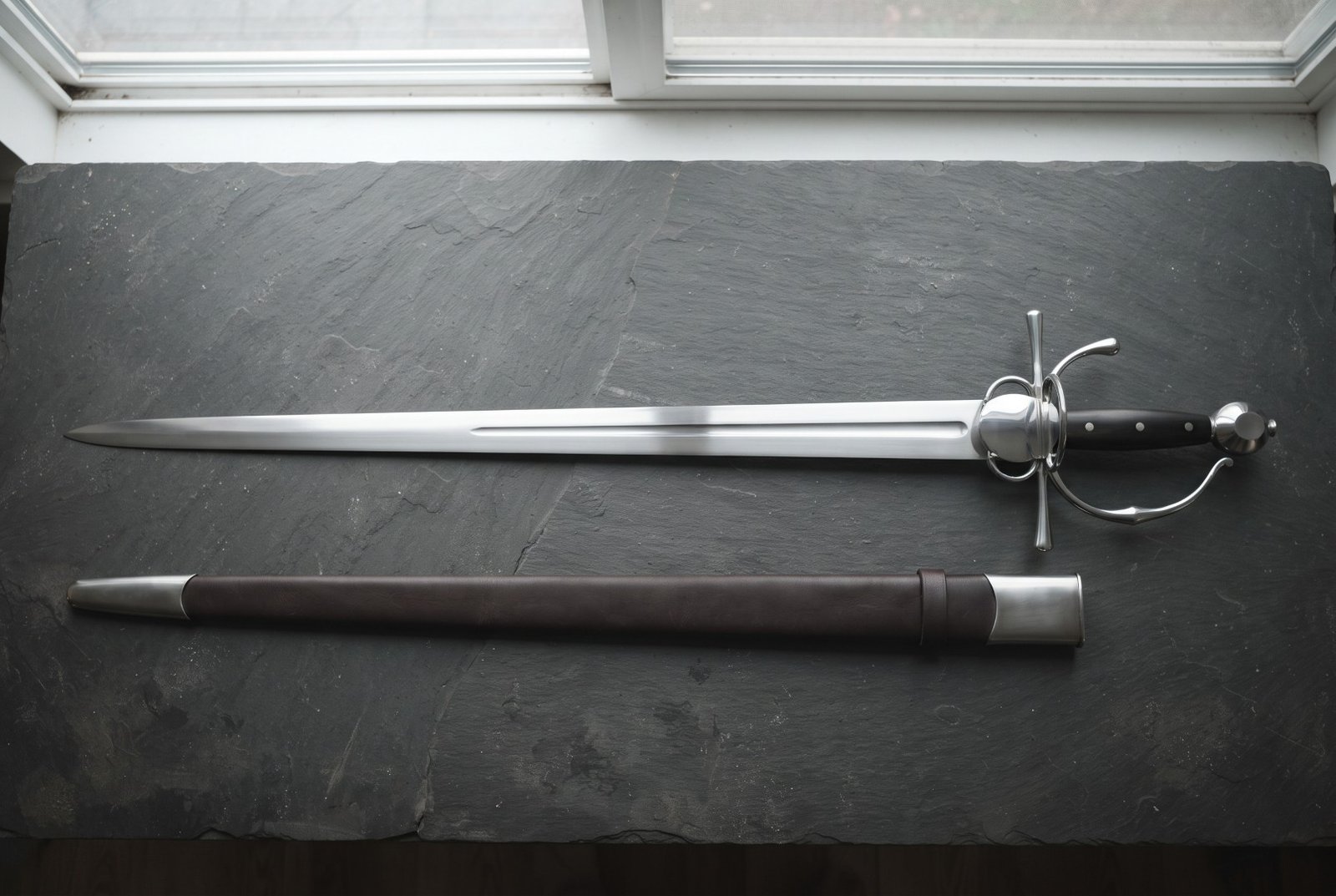
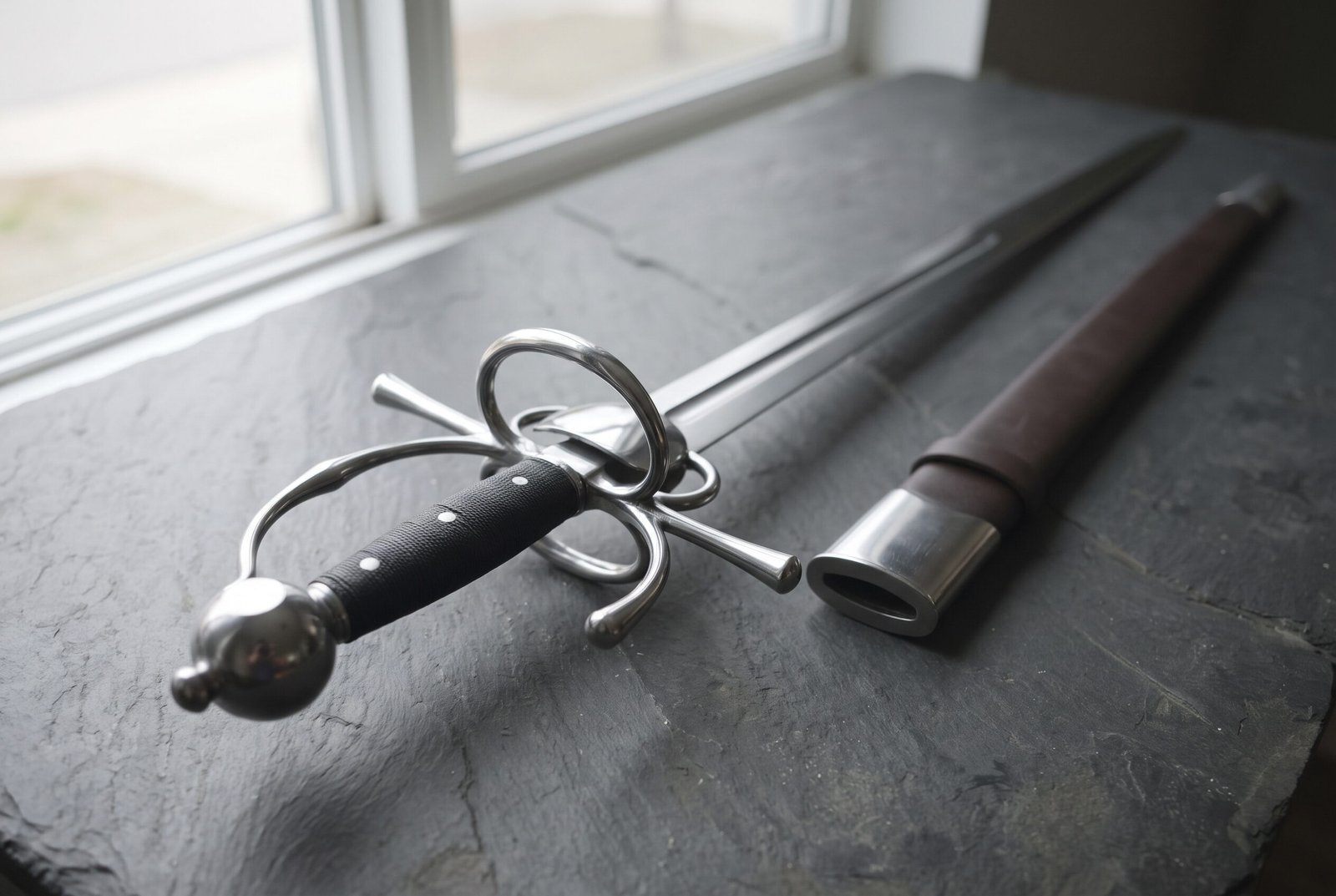
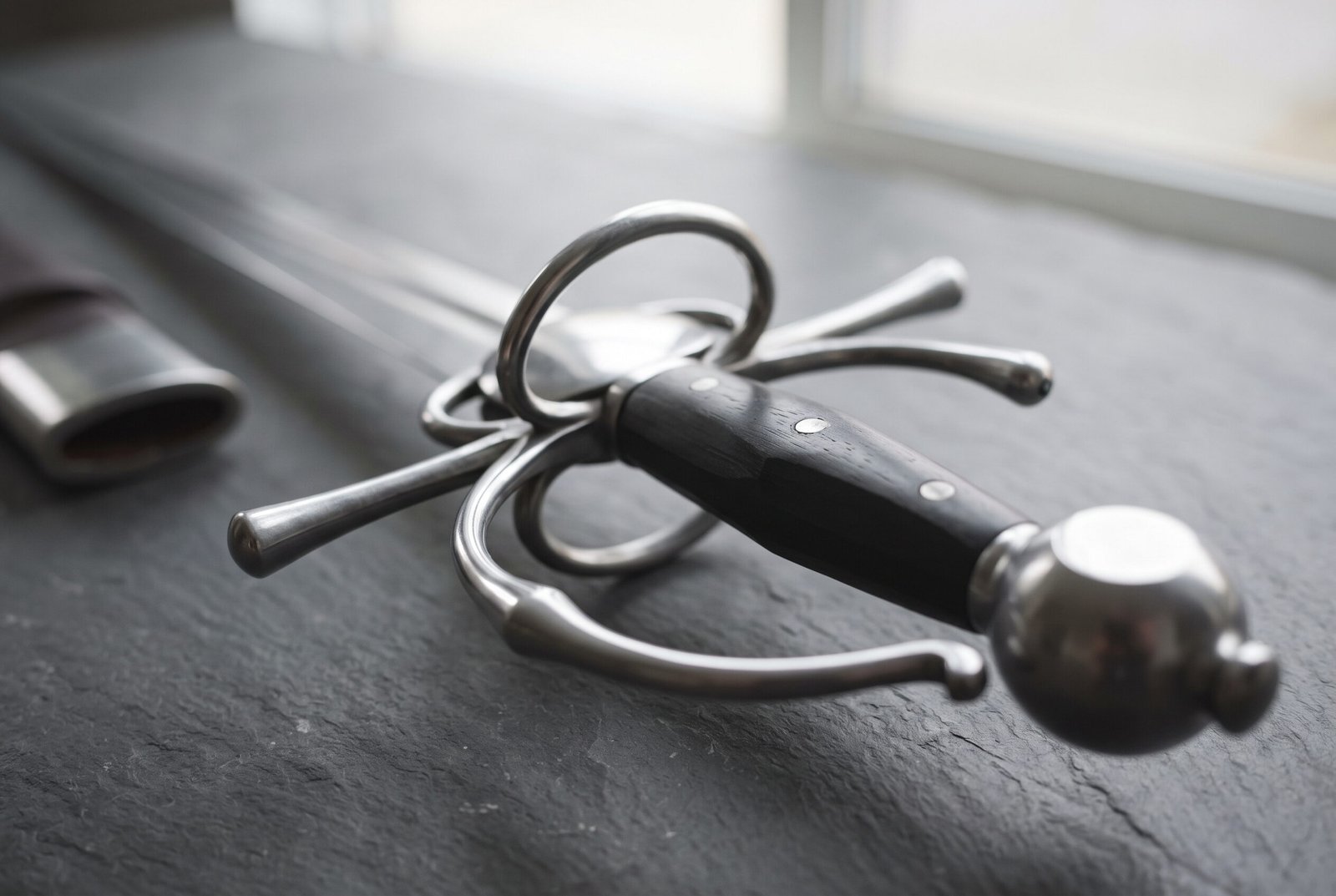
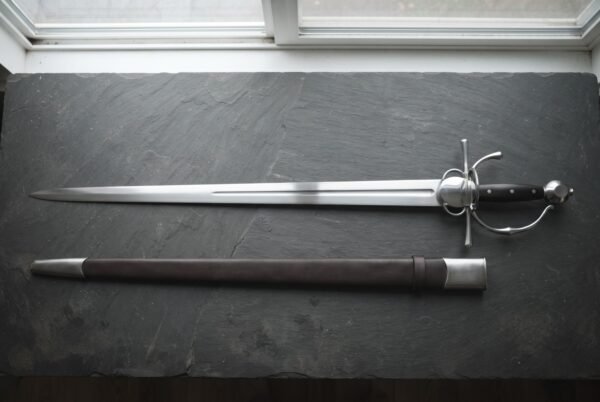
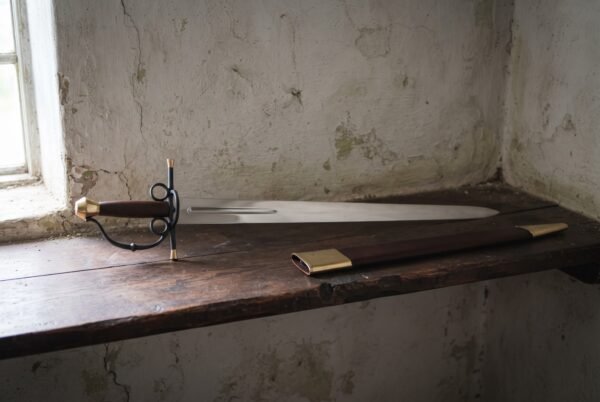
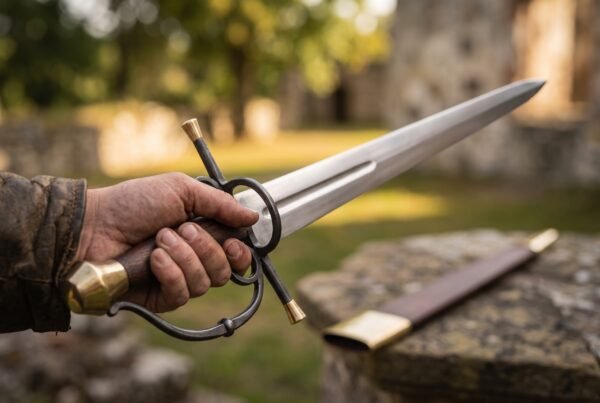
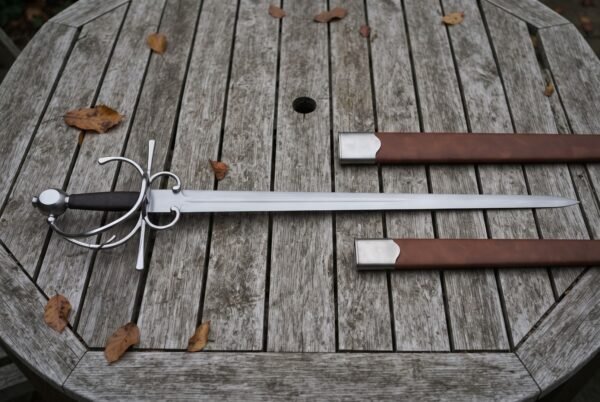
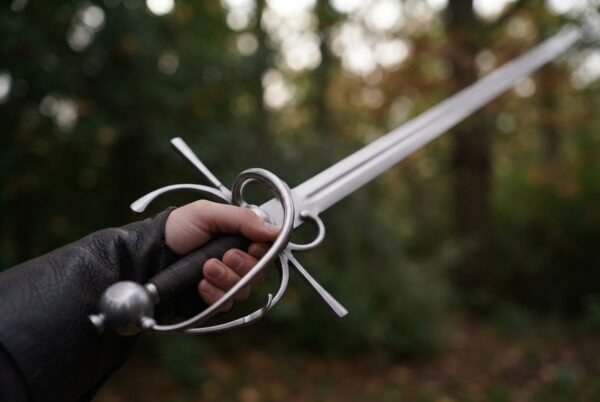
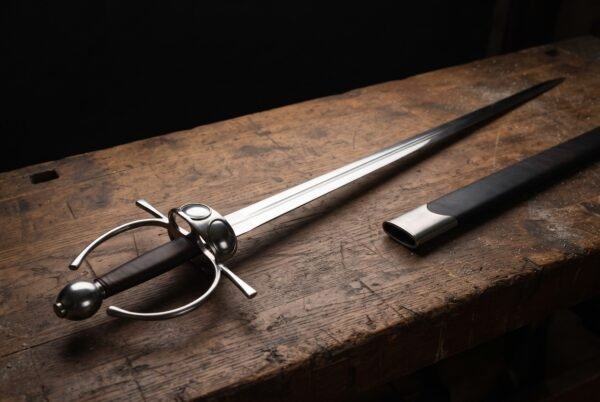
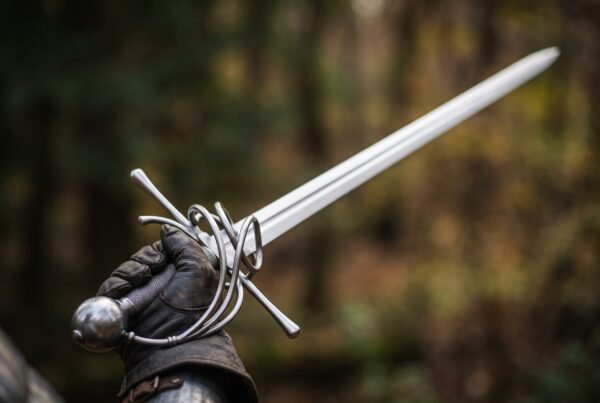
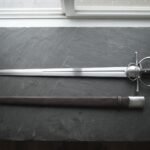
The Ebonguard is a hand forged renaissance side sword with a broad fullered blade, a ring and shell guard and a pinned ebony slab grip. The slab grip is the detail worth pausing on. Almost every sword you will see has a grip built as a hollow shell around the tang, wrapped in leather or wire. This one is built the way a knife is built, with two slabs of ebony pinned through the tang and shaped to the hand. It is a construction that appears on plenty of surviving sixteenth century side swords and it has real advantages, but it is rare enough on modern reproductions that most people have never handled one.
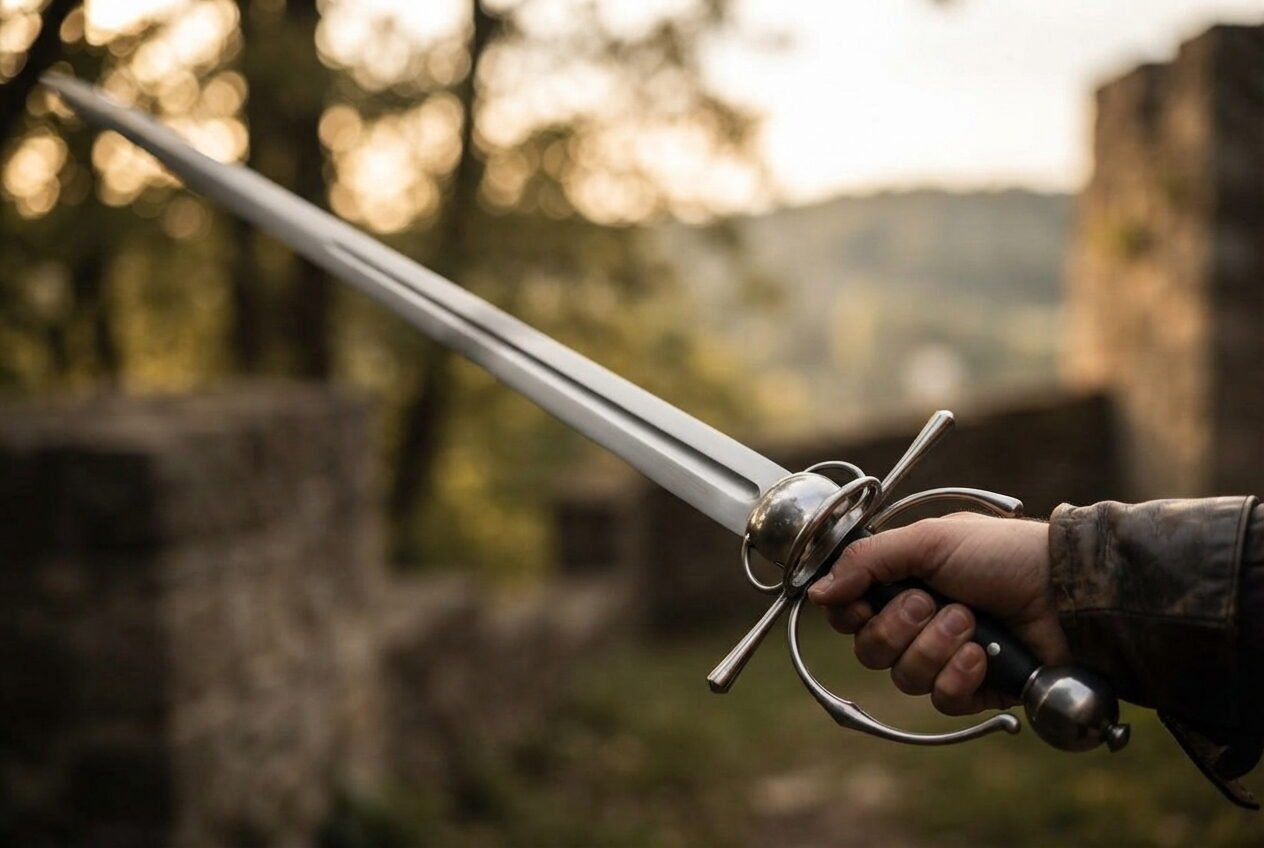
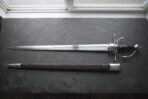
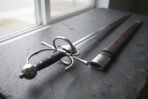
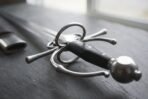
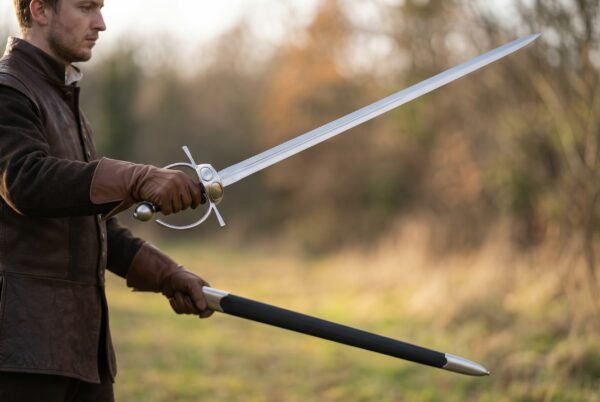
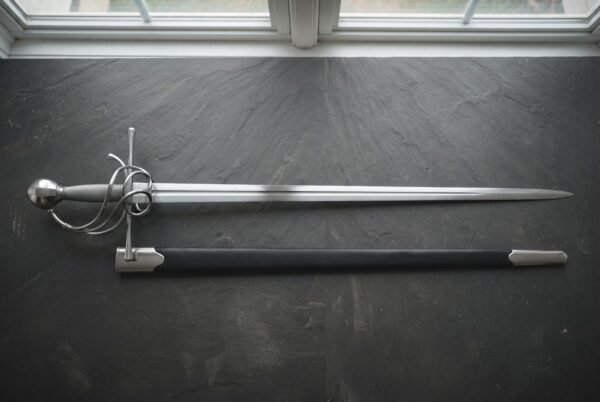
This sword is forged and finished in the Czech Republic. The blade is 1095 high carbon steel, hardened and tempered, ground broad with a long central fuller and taken to a mirror polish. The hilt is polished steel with a knuckle bow, straight quillons with flared ends, a recurved side branch, side rings and a domed steel shell over the blade root. The grip is dark ebony in two slabs, pinned through the tang, under a round steel ball pommel. It ships with the fitted brown leather scabbard shown, mounted with a polished steel throat and chape.
Specifications
| Steel | 1095 high carbon steel |
|---|
| Hardness | 54 to 58 HRC |
|---|
| Overall length | 40 inches |
|---|
| Blade length | 33 inches |
|---|
| Blade profile | Broad double edge with long central fuller, mirror polished |
|---|
| Guard | Polished steel hilt with straight flared quillons, an open knuckle bow, a recurved side branch, side rings and a domed central shell |
|---|
| Grip | Black ebony slabs pinned through the tang |
|---|
| Pins | Three steel pins |
|---|
| Pommel | Polished steel ball pommel with peened button |
|---|
| Scabbard | Brown leather with polished steel throat and chape and a leather belt band |
|---|
| SKU | RK-1420 |
|---|
How a sword is actually held together
The part of a sword nobody sees is the part that decides whether it survives. Behind the guard, the blade continues as a tang, a narrower tongue of the same piece of steel running the full length of the grip. A sword is not a blade glued into a handle. Blade and tang are one bar, forged together, and everything else is threaded onto that bar and locked in place.
There are two ways to lock it. The historical method is peening. The tang is left slightly long, passed through the pommel, and the protruding end is hammered cold until it spreads into a rivet head that cannot pull back through. A peened sword cannot loosen, cannot be unscrewed and cannot be taken apart without destroying the peen. The modern alternative is a threaded tang with a pommel that screws on, which is easier to service and easier to make, and it is also why so many production swords develop a rattle after a year: the nut works loose under vibration and there is nothing else holding the assembly in compression.
The slab grip on this sword adds a third element. Where a wrapped grip relies entirely on the pommel clamping everything together, slabs are pinned directly through the tang, so the grip is mechanically fixed to the steel independently of the pommel. That is why slab construction feels so solid. There is no possibility of the grip rotating on the tang, which is the first thing that goes wrong on a wrapped grip that has dried out. The trade is that a slab grip cannot be re wrapped when it wears, and ebony is less forgiving of a hard knock than leather over wood. It is a construction that rewards care.
Why 1095 high carbon steel and not stainless
Stainless steel keeps its shine because of a large chromium content, and that chromium is exactly what makes it unsuitable for a sword blade. It combines with carbon to form coarse hard carbides scattered through the metal, and in a blade that flexes each of those is somewhere a crack can start. The manufacturing answer is to leave stainless swords soft, so they bend instead of breaking, which is why so many arrive slightly curved and stay that way.
1095 is a plain high carbon steel, iron with just under one percent carbon. It hardens deeply, tempers predictably, and at 54 to 58 HRC gives a long broad blade both a working edge and real spring. It rusts if left wet or fingerprinted, and a wipe with an oiled cloth solves that. The full comparison is on Damascus versus stainless.
Ebony, and how to look after it
Ebony is one of the densest timbers in commercial use, heavy enough that it will sink in water, with a grain so fine that a finished surface feels closer to horn than to wood. That density is why it was chosen for grips. It takes a crisp edge where a softer wood would round off, it does not compress under the pins over decades, and it holds a deep near black colour without dye.
It is also the most movement prone timber you are likely to own. Dense woods lose and gain moisture slowly but they build up real internal stress while doing it, and ebony is notorious for developing fine surface checks if it is taken from a damp environment into a dry one quickly, or left in direct sun. Keep the sword somewhere with stable humidity, never in an attic, a garage or a car. A very light wipe with a hard wax or a wood oil once a year, buffed off rather than left standing, is all it needs. The full routine is in wooden handle care.
Engraving, runes and your own design
Use the rune converter on this page to turn a name, a date or a short phrase into Elder Futhark and we will cut it into the steel or the handle. If you would rather have a Viking pattern than a rune line, choose your own design in the engraving option above the add to cart button and tell us whether it goes on the blade or the handle. Where a piece already carries an engraved design, your chosen engraving replaces it rather than sitting alongside it. On the Ebonguard the shell plate on the guard is the best steel panel, and ebony itself takes a cut beautifully, holding fine detail in a way few timbers can, so a rune line along a grip slab is worth considering. See the engraving page.
Care and sharpening
Wipe the blade after handling and keep a thin film of mineral or camellia oil on the steel. Mirror polish records fingerprints permanently if they sit for a week or two, and the broad flats on this blade show them clearly. Keep oil off the ebony, since it does not need it and an oily grip attracts dust. Do not store the sword sheathed for months at a time, because leather holds moisture against steel. The routine is on the steel care page.
The edges arrive sharp and functional. To bring them back, use a whetstone, follow the bevel already ground onto the blade, and work both sides evenly with long passes before finishing on a strop. Keep the stone off the fuller, which is a finished ground surface rather than an edge. See sharpening with a whetstone.
Made in the Czech Republic
The work behind this piece happens in a Czech Republic workshop that has kept to the old methods. Steel is forged and heat treated by hand, the grind is taken down by eye rather than by machine, and the handle, fittings and sheath are cut and finished one at a time. Because of that, every piece carries small marks of the hand that made it.
Ransack Viking is a United States company. We import direct, check each piece when it reaches us, and ship from our Chicago, Illinois warehouse. Engraving is added here in the United States after arrival, so the piece you receive is finished to your order.
A note on handmade variation
This piece is hand forged. It is not machine made or bulk produced, so what arrives will not be a pixel for pixel copy of the photograph. Ebony varies more than most people expect, from an even black through to streaked greys and browns, and no two sets of slabs match. The dome of the shell is worked by hand, the ring is bent by eye, and the brown leather takes dye its own way. The dimensions, the steel and the build are the same every time. The character is not.
Frequently asked questions
Is the ebony grip solid wood or a veneer
Solid. Two slabs of ebony, shaped and pinned through the tang. It is not a black stained softwood or a veneer over a core.
Will the grip come loose over time
It should not. The slabs are pinned directly through the tang rather than relying on the pommel to clamp them, which is the more secure of the two constructions.
Is the sword sharp when it arrives
Yes, with a working edge on both sides. It is not honed to a razor, which would chip on the first hard contact.
Can I cut with it or is it for display
It is a functional hardened blade and light target cutting is within its design. It is not built for edge on edge sparring against another steel sword.
What is the difference between a side sword and a smallsword
Around a century and a great deal of blade. A side sword is broad, cuts as well as it thrusts and carries a ring hilt. A smallsword is an eighteenth century court sword, very light, with a small shell guard and a triangular hollow ground blade that has no cutting edge at all.
How long does shipping take
Free shipping in the United States. Stock pieces leave within a few days. It takes three to five weeks in the shop because of the slab fitting, plus a few days for engraving.
What is in the box
- Ebonguard hand forged 1095 high carbon steel renaissance side sword
- Fitted brown leather scabbard with polished steel throat and chape
- Care card covering oiling, polish upkeep and ebony care
- Elder Futhark rune engraving or your own Viking design if selected at checkout
- Forged and finished in the Czech Republic
Explore the range
Browse the short swords, the rapiers, the arming swords and the full sword range, or read the guides.
If this one is not it
For a straight comparison, see the Shieldring rapier, 5 inches overall. Worth putting side by side with this is the Duskbroad rapier, 38 inches overall. In the same category sits the Quickthorn rapier, 46 inches overall.
From the same corner of the shop, there is the Willowtide Chinese sword. Pick the steel, the length and the fittings yourself on the design your own page.
If you would rather train with a sword than hang one up, the Ceravalt rapier trainer suits club work, and our HEMA rapier range covers the choices.



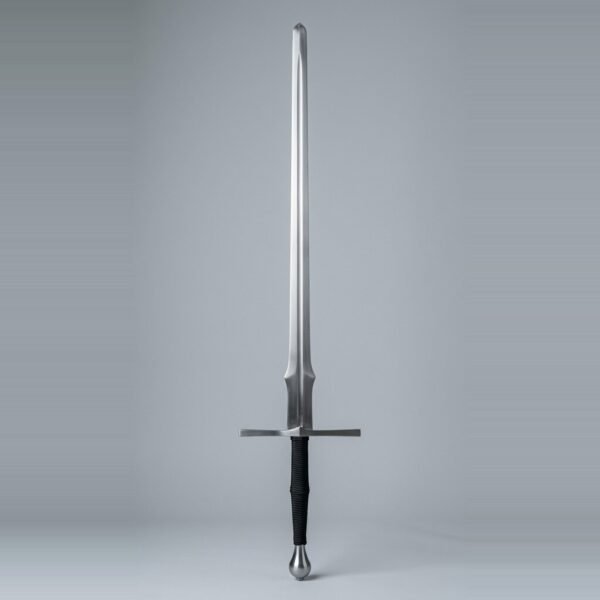
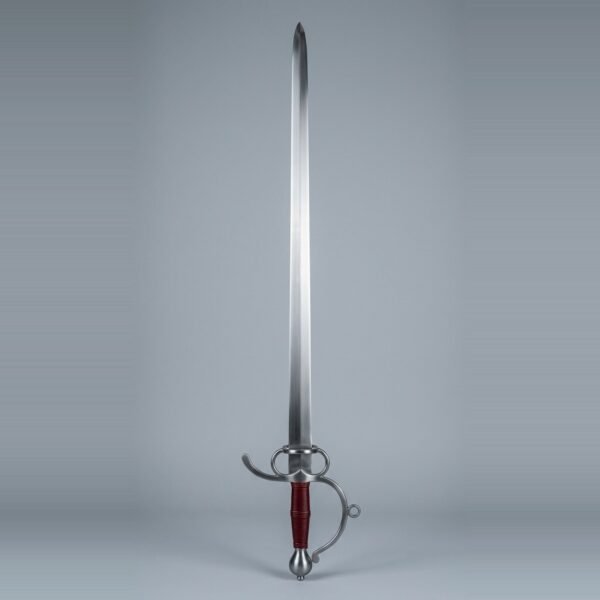
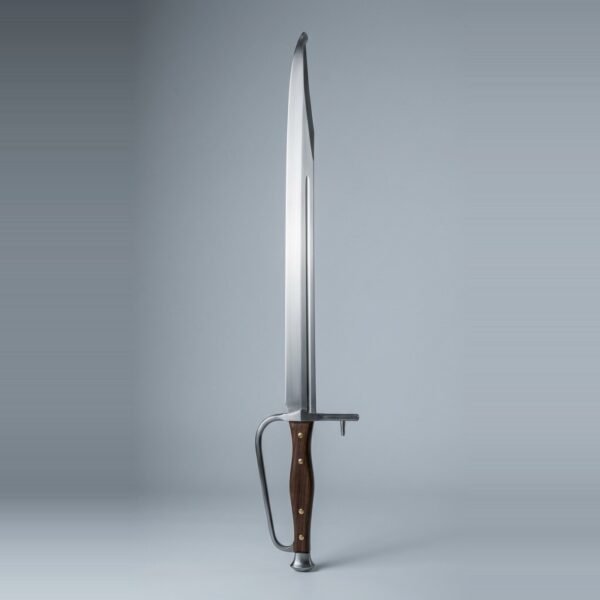
Best sword I’ve ever owned. Came in a nice gift box which made it feel even more special. High Carbon Steel blade holds a razor edge right out of the box. Fit and finish is museum quality. You can tell real craftsmen made this by hand. This is going straight into my display case.
Overall a good buying experience. Blade quality is solid. Arrived a bit less sharp than expected but a few passes on a strop fixed it. Would buy from this shop again.
Incredible craftsmanship on this one. Leather sheath is thick and well stitched. Not the cheap stuff you usually get. Shipping was fast and everything arrived well packaged.
Knew this sword was special the second I opened the box. Leather sheath is thick and well stitched. Not the cheap stuff you usually get. Already planning my next purchase from this shop. You can tell it’s real Czech blacksmith work and shipping from the States made delivery painless.
Got this as a gift and now I want one for myself too. Fit and finish is museum quality. You can tell real craftsmen made this by hand. Beyond happy with how this turned out.
Perfect gift. Perfect quality. No complaints. Fit and finish is museum quality. You can tell real craftsmen made this by hand. Weight and balance make it feel like a real functional piece not some cheap replica. High Carbon Steel blade holds a razor edge right out of the box. This shop clearly takes pride in their work.
Did not expect this level of quality for the price. Even the small engravings are crisp and clean. Will definitely order again for another gift.
Got this as a gift and now I want one for myself too. Leather sheath is thick and well stitched. Not the cheap stuff you usually get. The wood handle feels amazing and the balance is perfect. Came in a nice gift box which made it feel even more special. Beyond happy with how this turned out.
Can’t stop showing this off to everyone who comes over. Fit and finish is museum quality. You can tell real craftsmen made this by hand. Leather sheath is thick and well stitched. Not the cheap stuff you usually get. This will be a family heirloom for sure.
Was nervous ordering something like this online but so glad I did. Love it. Made overseas in the Czech Republic yet shipped from a US location so no long customs wait.