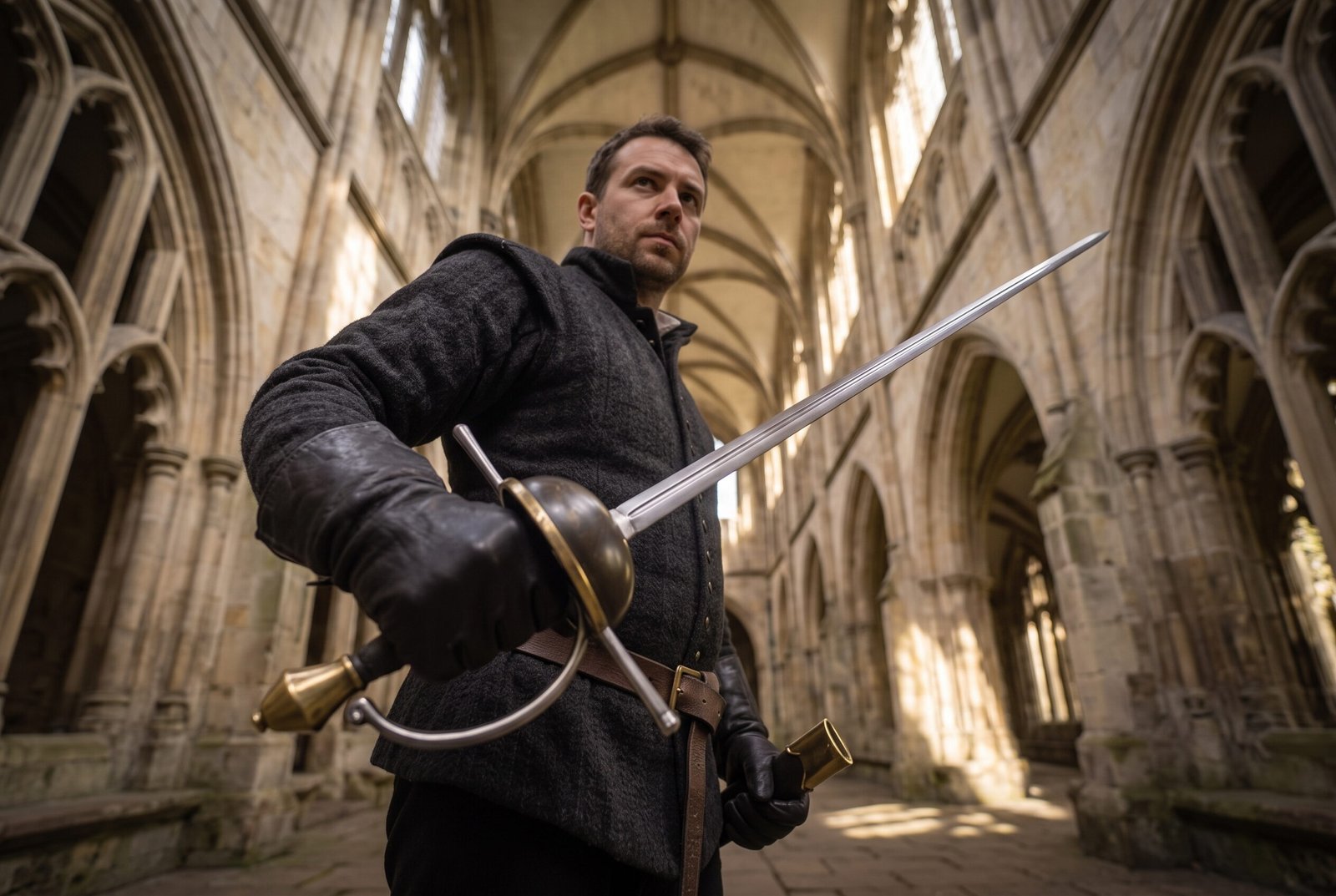
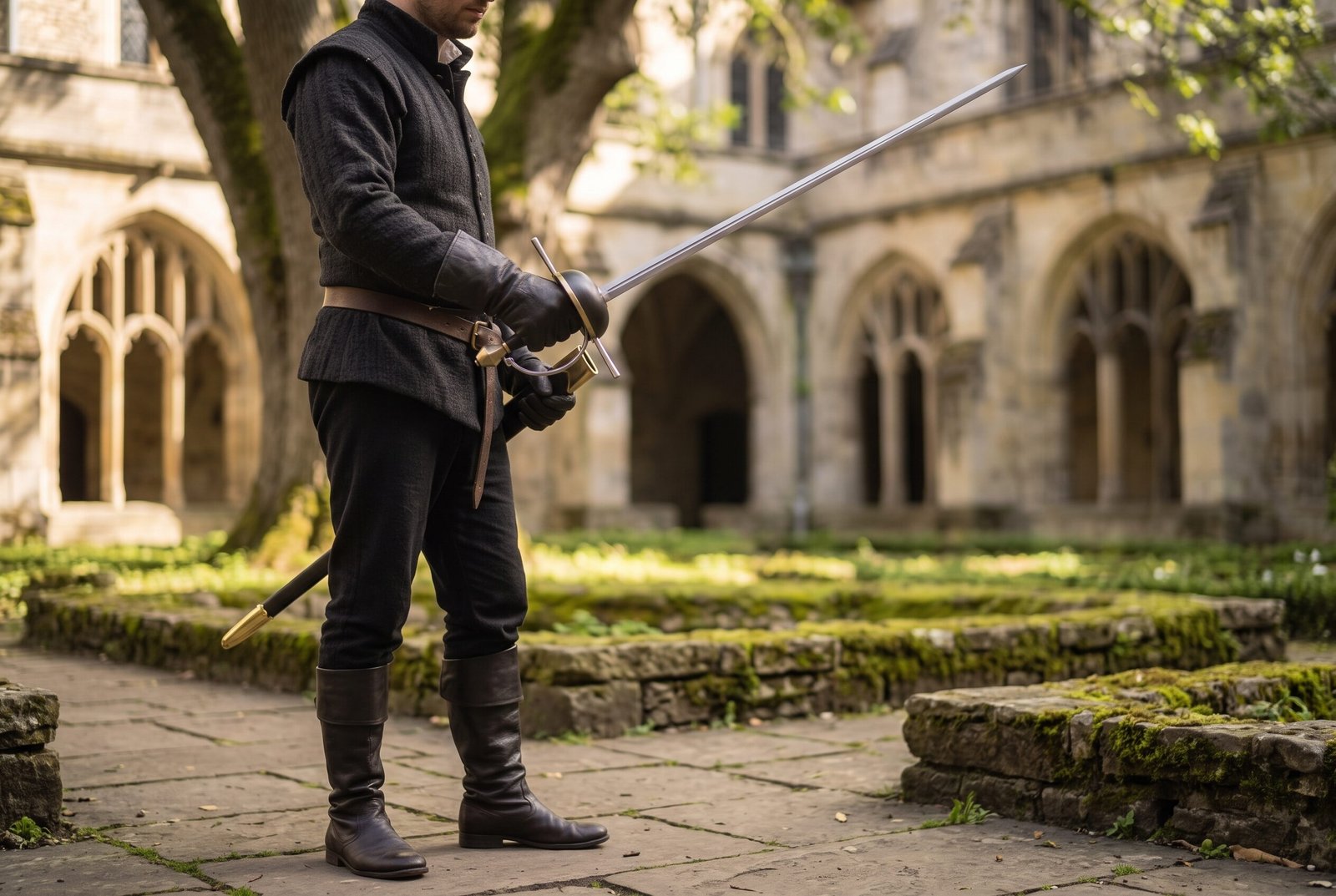
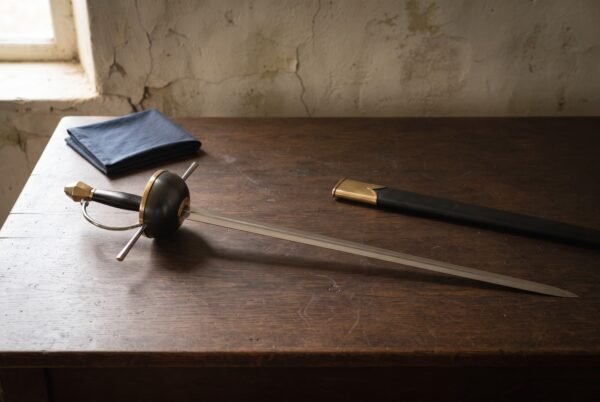
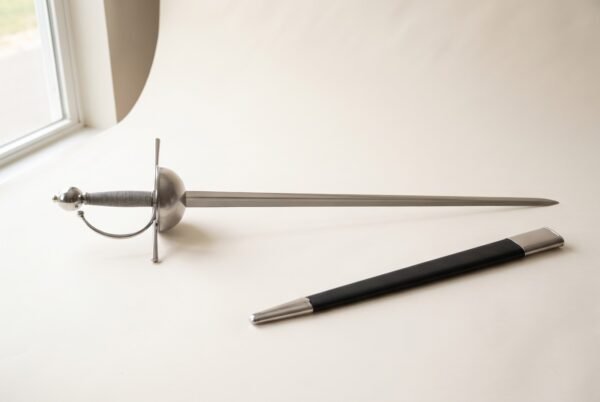
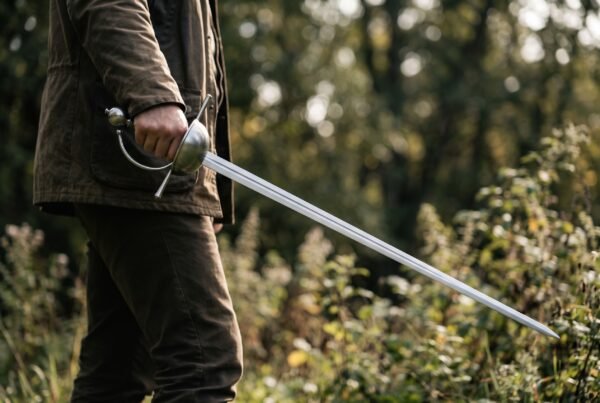
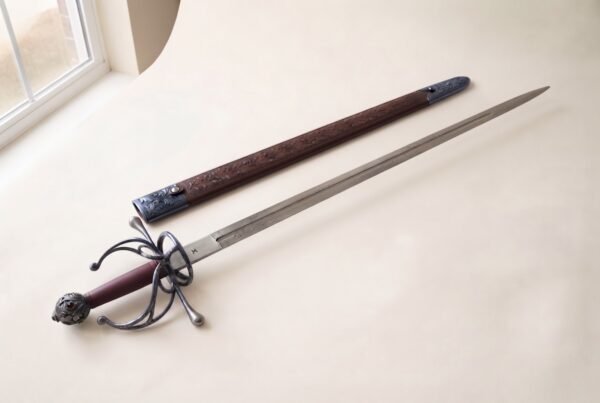
The Bellcourt is a hand forged musketeer sword, a deep cup hilted rapier of the kind carried by the household companies of seventeenth century France and Spain. The musketeers of the French royal guard are remembered for a novel written two centuries after they existed, but the sword is real enough. A guardsman carried a matchlock or flintlock musket that was slow to load and useless once fired, and a long cup hilted rapier for everything that happened afterwards. The sword was the reliable one. The gun was the opening statement.
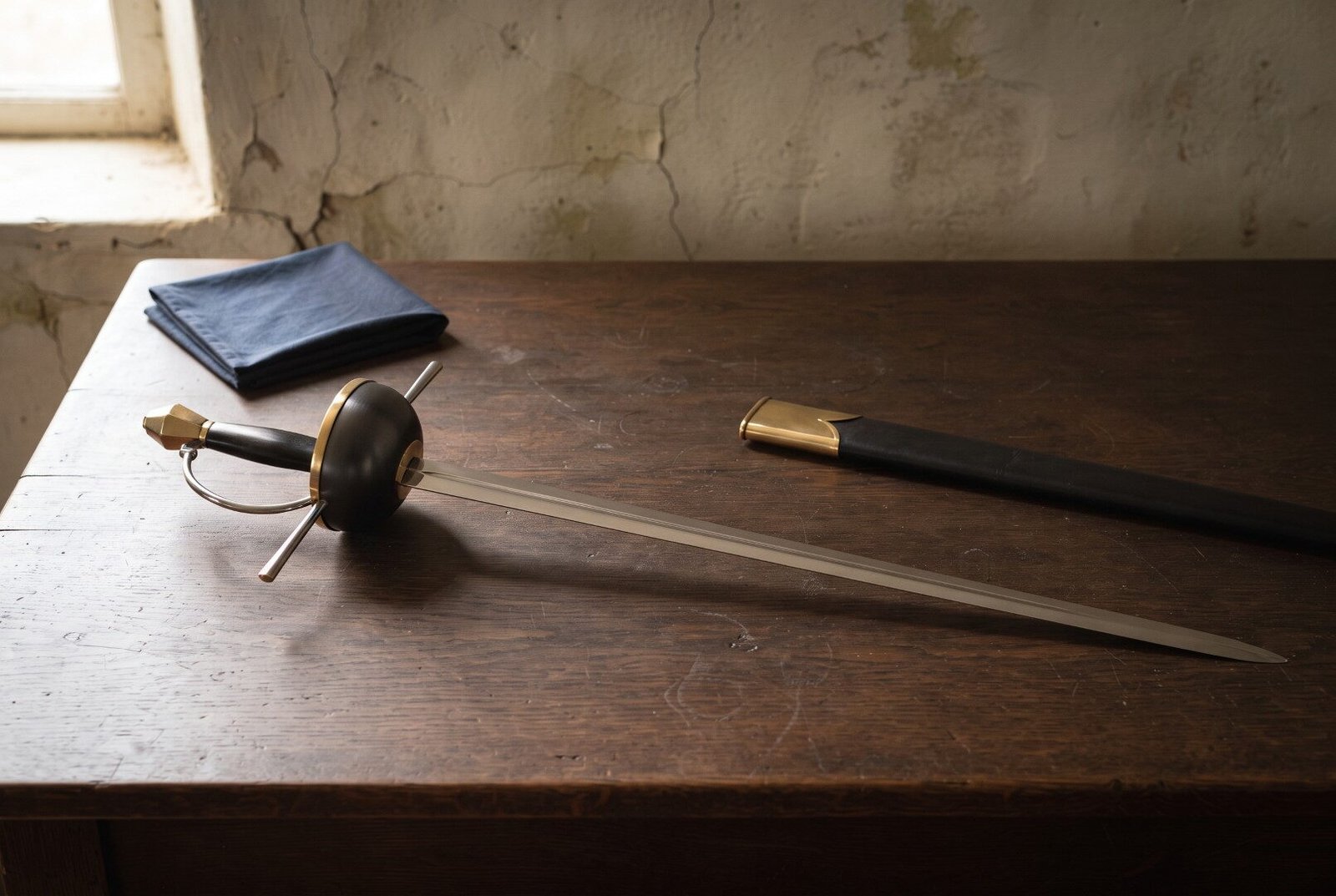
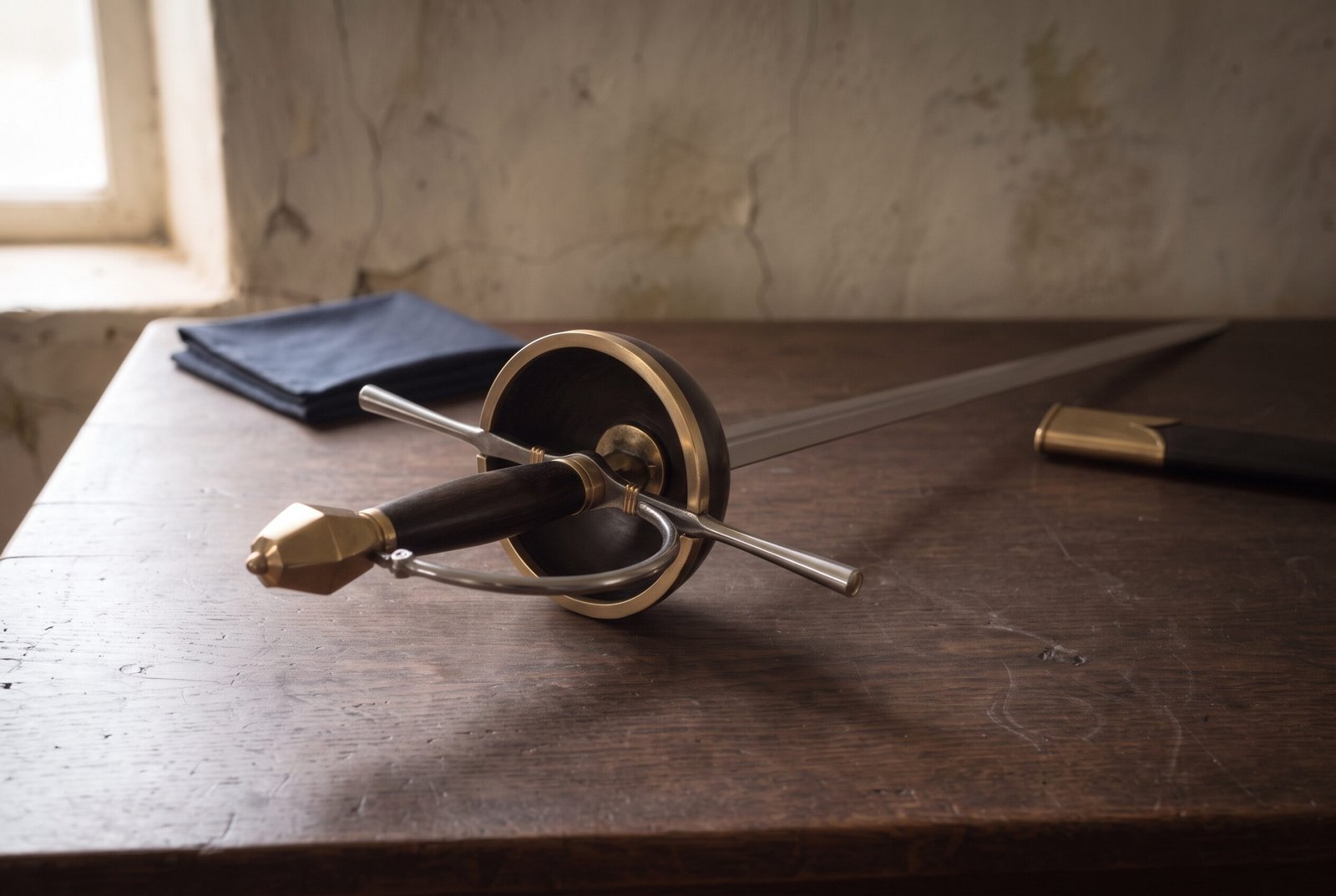
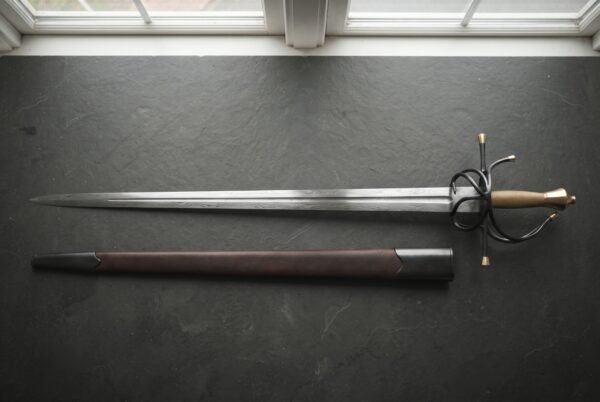
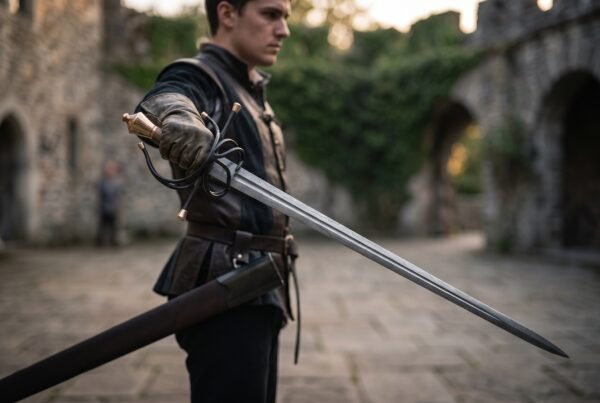
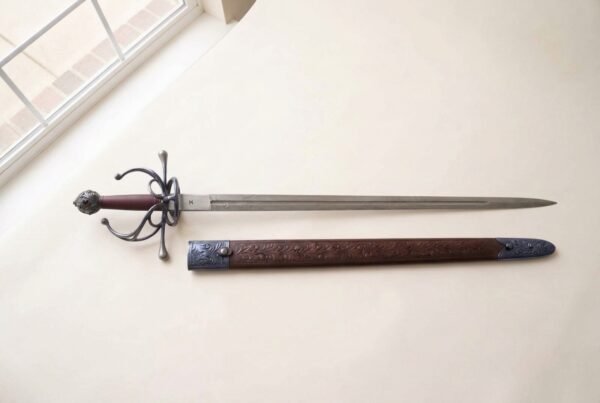
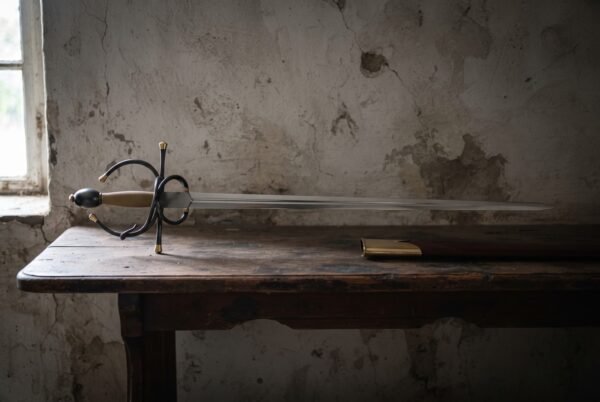
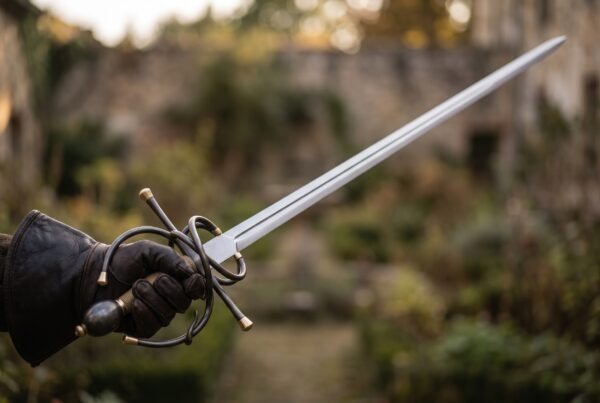
This one is forged and finished in the Czech Republic. The blade is 1095 high carbon steel, hardened, tempered, ground to a long slender diamond section that carries its stiffness far down towards the point. The hilt is a deep blackened steel cup with a polished brass rim and a brass rosette set at its centre, straight steel quillons and a steel knuckle bow. The grip is dark and smooth under a faceted brass pommel. It ships with the fitted black leather scabbard shown, mounted with a heavy brass throat.
Specifications
| Steel | 1095 high carbon steel |
|---|
| Hardness | 54 to 58 HRC |
|---|
| Overall length | 46.5 inches |
|---|
| Blade length | 39 inches |
|---|
| Blade profile | Slender diamond section thrusting blade |
|---|
| Guard | Deep blackened steel cup with polished brass rim and brass rosette at the centre |
|---|
| Quillons | Straight plain steel quillons |
|---|
| Knuckle bow | Steel knuckle bow |
|---|
| Grip | Dark smooth grip |
|---|
| Pommel | Faceted brass pommel |
|---|
| Scabbard | Black leather with heavy brass throat |
|---|
| SKU | RK-1421 |
|---|
The cup hilt and the rim that stops a point
The single deep bowl replaced the cage of bars because a cage, however cleverly bent, always leaves gaps, and by the middle of the seventeenth century the fencing being taught had become almost purely a matter of the point. A cup closes every gap at once. It is heavier than a swept hilt and it blocks more of your view of the opponent, and Spanish and Italian fencers accepted both costs because a solid bowl cannot be threaded.
The rim is the part worth knowing about. On the best Spanish cups the edge of the bowl is not simply a cut edge. It is rolled or built up into a raised lip, and Spanish sources call it the rompepuntas, literally the point breaker. When an opposing blade slides across the outside of the cup looking for a way past, a flat rim lets it run straight off and onward into your forearm. A raised rim catches it. The point either stops dead against the lip or is deflected out and away from the arm entirely.
It is a very small piece of metal doing a very specific job, and it is one of the clearest examples in the history of arms of a feature that looks decorative and is not. On this hilt the rim is executed in polished brass against a blackened cup, so it reads as a bright line around the bowl, which is both period correct in spirit and useful for seeing the shape of the guard across a room.
The rosette at the centre of the cup covers the point where the blade passes through, taking the load of the guard against the shoulders of the blade and spreading it across the bowl rather than concentrating it on one thin spot of sheet steel.
Why 1095 high carbon steel and not stainless
Thirty nine inches of slender blade is the hardest thing to ask of a sword steel. It has to bow deeply under a thrust and return absolutely straight, hold a fine point, and take a lateral knock without a crack starting anywhere along its length. Stainless is not the material for it. Its chromium content, which is what makes it resist rust, produces coarse carbides through the metal that behave as crack initiators in a thin section. Stainless blades of this length are either left soft and take a permanent set, or hardened and liable to break.
1095 is simple iron and carbon with very little else. It hardens right through, tempers to a figure you can rely on, and at 54 to 58 HRC combines the point retention and the elasticity a long rapier blade lives on. It rusts if neglected, which is the honest trade for that performance. The full comparison is at Damascus versus stainless.
The grip and the brass fittings
Inside the cup, the grip is short and slim by modern expectations. That is correct for a cup hilt. Because the bowl protects the whole hand, there is no need for the long grip and heavy pommel that an open hilted sword requires, and a shorter grip pulls the hand closer to the guard where the pivot points sit. It feels odd for a moment and then it feels right.
The pommel is faceted brass. Brass is denser than steel, so a pommel of a given size counterweights more effectively without needing to be enlarged, which matters on a sword where the cup already adds mass out in front of the hand. Leave the brass alone and it will darken into a warm patina that most collectors prefer. If you would rather keep it bright, use the mildest polish you can find and use very little of it, and keep it away from the blackened steel of the cup.
Engraving, runes and your own design
Use the rune converter on this page to turn a name, a date or a short phrase into Elder Futhark and we will cut it into the steel or the handle. If you would rather have a Viking pattern than a rune line, choose your own design in the engraving option above the add to cart button and tell us whether it goes on the blade or the handle. Where a piece already carries an engraved design, your chosen engraving replaces it rather than sitting alongside it. A cup hilt offers the largest single engraving surface of any sword in the range, and a design cut into blackened steel reads as bright metal against a dark ground, which is the most striking combination available on this range. See the engraving page.
Care and sharpening
Wipe the blade after handling and keep a thin film of mineral or camellia oil on it. Do not use abrasive polish anywhere on the blackened cup, since it will cut through the finish in seconds and leave bright scars that cannot be blended back. A dry cloth is all the cup needs. Pay attention to the inside of the bowl, which collects dust and is awkward to reach once the sword is mounted on a wall. Do not store the sword sheathed for months. The routine is on the steel care page.
The edges on a rapier are secondary to the point and arrive sharp enough to be treated with respect. To refresh them use a whetstone and follow the existing bevel with light passes, and be careful at the tip where pressing too hard will round a fine point in a few strokes. See sharpening with a whetstone.
Made in the Czech Republic
This is a handmade piece from the Czech Republic, made in a workshop that still forges, grinds and finishes by hand instead of stamping parts out. The smiths there have kept the older way of working, and the wood, horn and leather are shaped and fitted by hand as well. Two pieces of the same design will never be identical, and that is part of what you are buying.
Ransack Viking is a United States company. We handle the import ourselves, look over every piece when it lands and ship from our warehouse in Chicago, Illinois. Engraving is done in the United States after the piece arrives, so your design goes on before we send it out.
A note on handmade variation
This piece is hand forged, not machine made or bulk produced, so what arrives will not be a pixel for pixel copy of the photograph. A raised cup is never twice the same depth or exactly the same curve, the blackening mottles differently on every one, the brass takes polish and patina its own way and the leather varies across hides. The dimensions, the steel and the build are the same every time. The character is not, and that is the difference between something forged and something pressed out on a die.
Frequently asked questions
What is the raised rim around the cup for
It catches an opponent point sliding across the guard and stops it running on into the forearm. Spanish sources call it the rompepuntas, the point breaker. It is functional rather than ornamental.
Is the sword sharp
The edges arrive with a working sharpness and the point is a genuine point. A rapier is a thrusting sword first, so the tip is the part to handle carefully.
Can I fence with it
No. This is a sharp sword rather than a blunt trainer. Historical fencing needs purpose made blunts with rolled tips and full protective equipment.
Is the cup steel or brass
The cup is steel, raised and blackened. The rim around its edge and the rosette at its centre are brass, polished bright against the dark bowl.
What is the difference between a musketeer sword and a smallsword
Size and era. This is a full seventeenth century rapier, long and cup hilted, meant to be worn and used in earnest. A smallsword is the eighteenth century successor, far shorter and lighter, with a small shell guard and a triangular blade with no cutting edge.
How long does shipping take
Free shipping in the United States. In stock pieces leave within a few days. It takes three to five weeks in the shop because of the cup raising, and engraved work a little longer.
What is in the box
- Bellcourt hand forged 1095 high carbon steel musketeer sword
- Fitted black leather scabbard with heavy brass throat
- Care card covering oiling, blackened cup and brass upkeep
- Elder Futhark rune engraving or your own Viking design if selected at checkout
- Forged and finished in the Czech Republic
Explore the range
See the rapiers, the cutlasses, the short swords and the full sword range, or read the guides.
Worth a look beside this
Sitting beside it in the catalogue is the Swiftcoil rapier, 45 inches overall. Another in the same line is the Cupwarden rapier, 47 inches overall. Next along the rack is the Nightgild rapier, 47 inches overall.
Fitting out further, the Slatehaven Chinese sword belongs with it. Or start from a blank sheet on the design your own page.
Our HEMA line includes the Corvalde rapier for drills and sparring, and our rapier versus sidesword guide is the place to look next.




This one was a letdown compared to the listing. Arrived with visible damage and a dull edge that needed real work. Build quality felt cheaper than the pictures suggested. Considering asking for a return.
So happy I finally pulled the trigger on this one. High Carbon Steel blade holds a razor edge right out of the box. Shipping was fast and everything arrived well packaged.
Been eyeing this sword for months and it did not disappoint. Even the small engravings are crisp and clean. Already planning my next purchase from this shop.
Been eyeing this sword for months and it did not disappoint. High Carbon Steel blade holds a razor edge right out of the box. Fit and finish is museum quality. You can tell real craftsmen made this by hand. Love it.
My husband was speechless when he opened this. Even the small engravings are crisp and clean. This shop clearly takes pride in their work. It’s handmade in the Czech Republic but ships from a US warehouse so it arrived quicker than I expected.