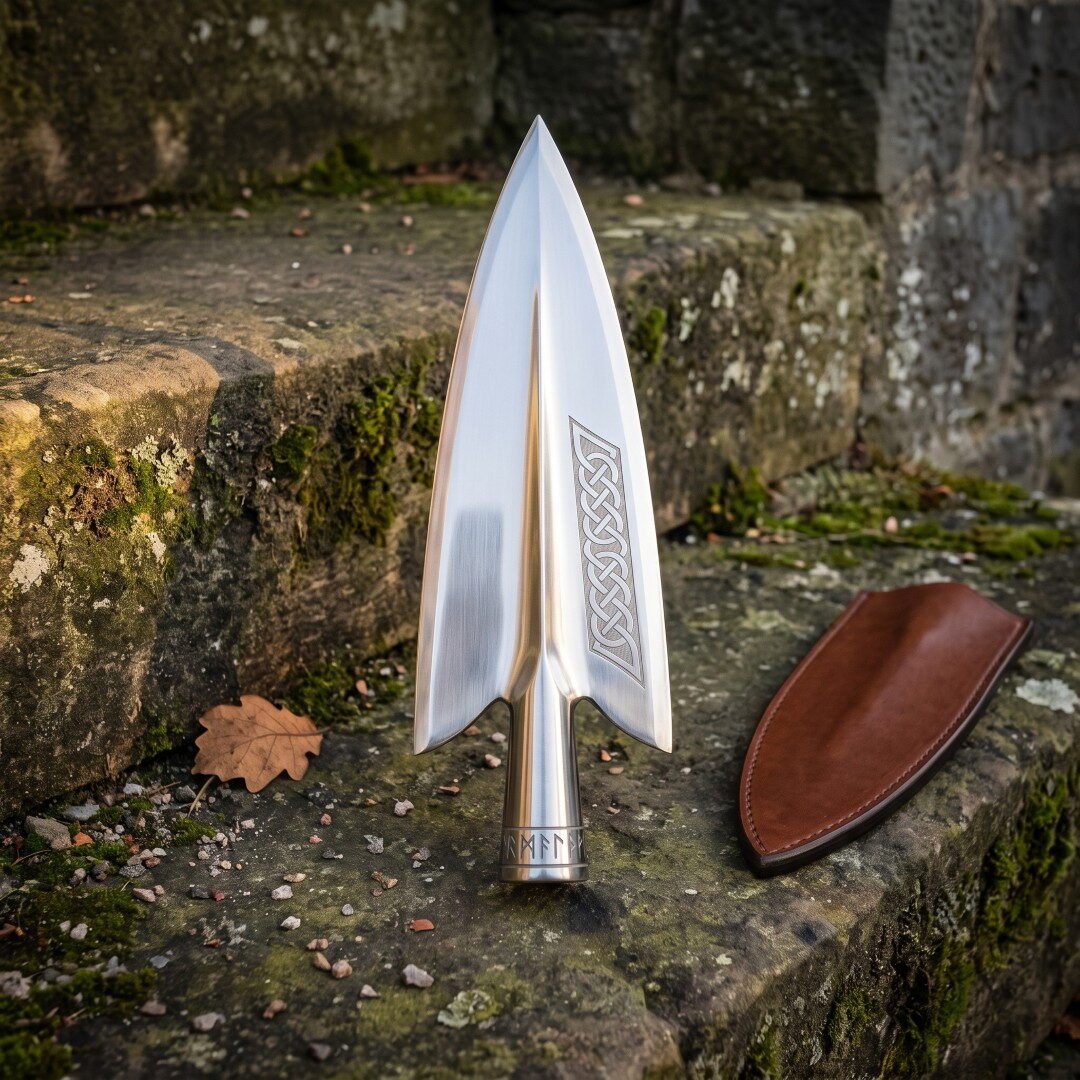
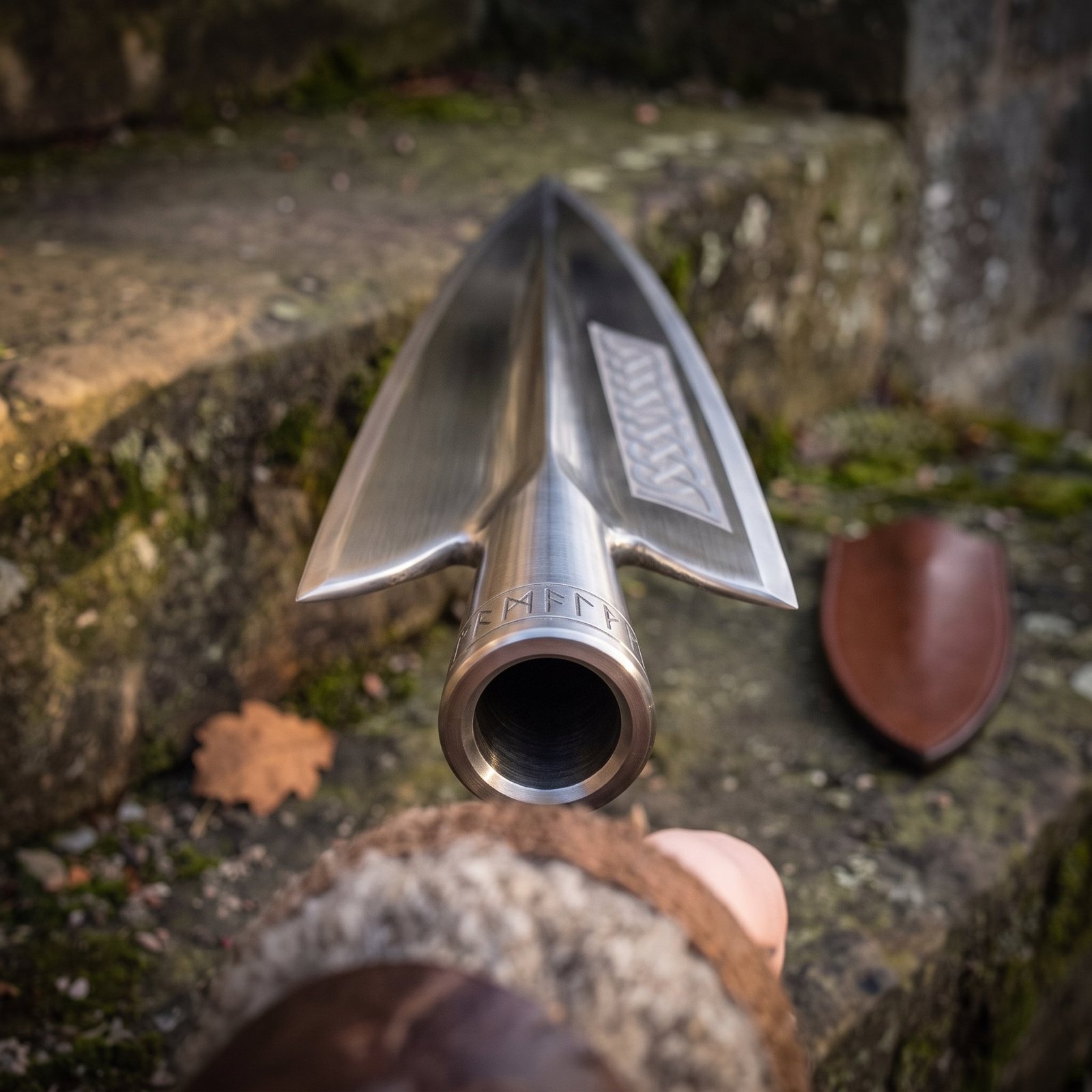
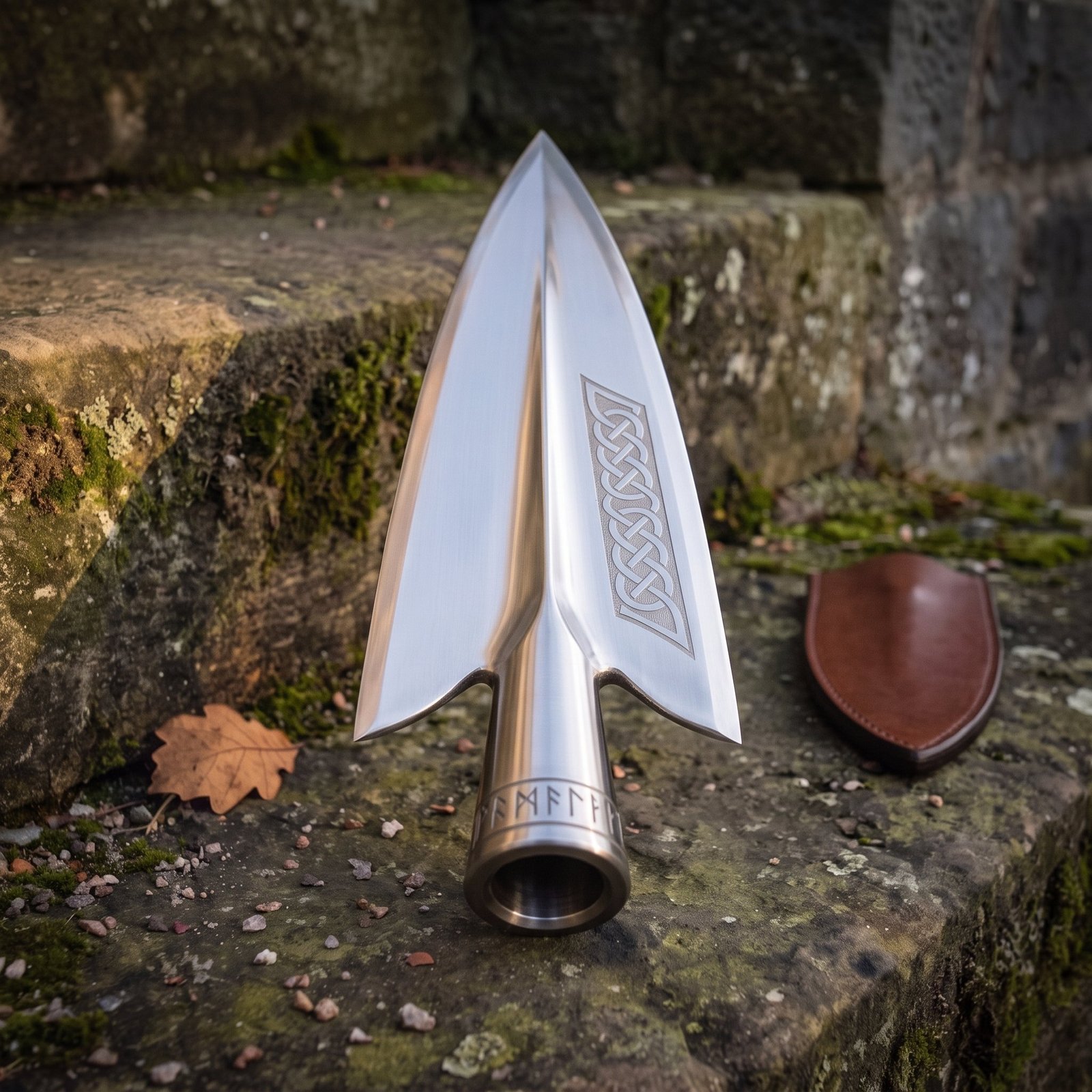
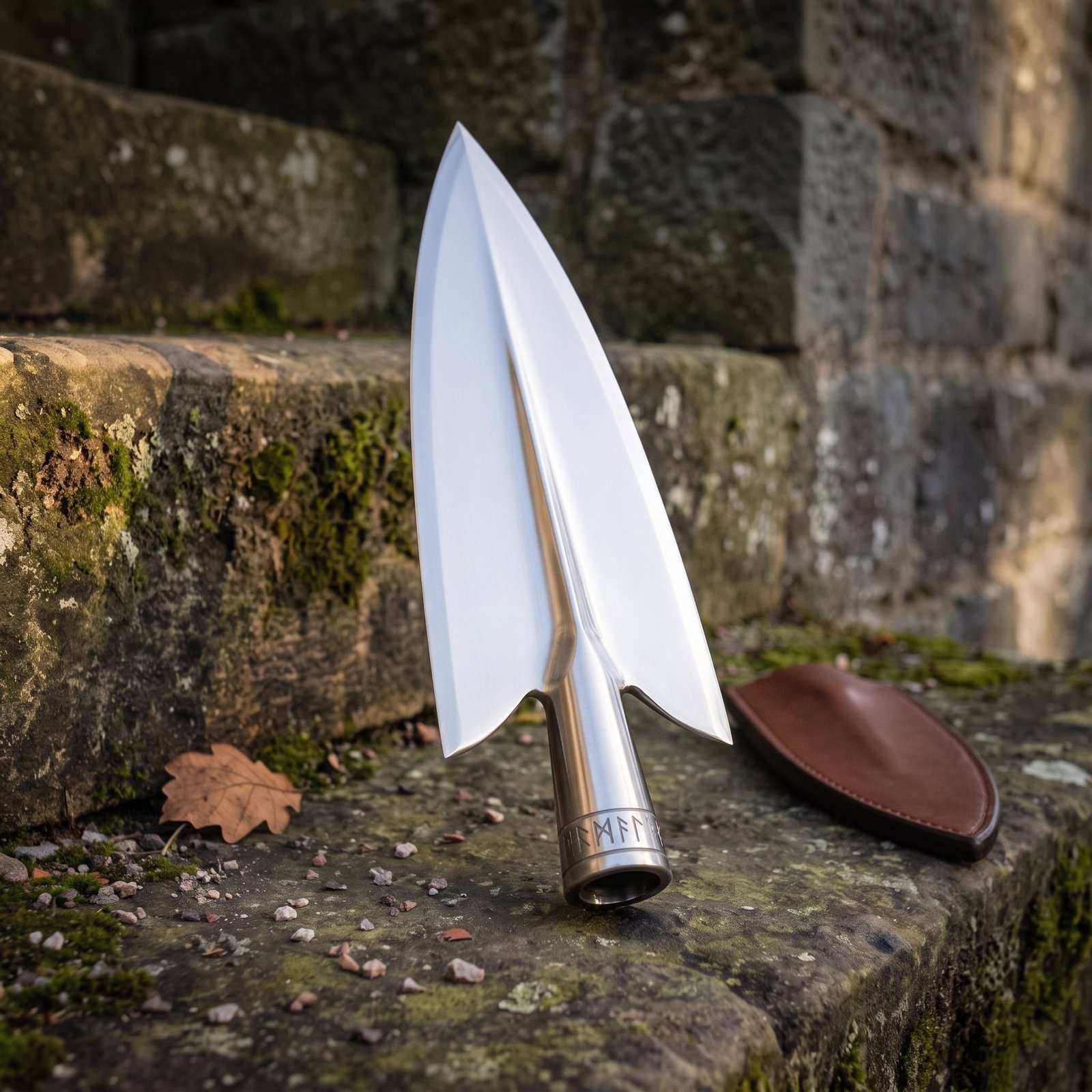
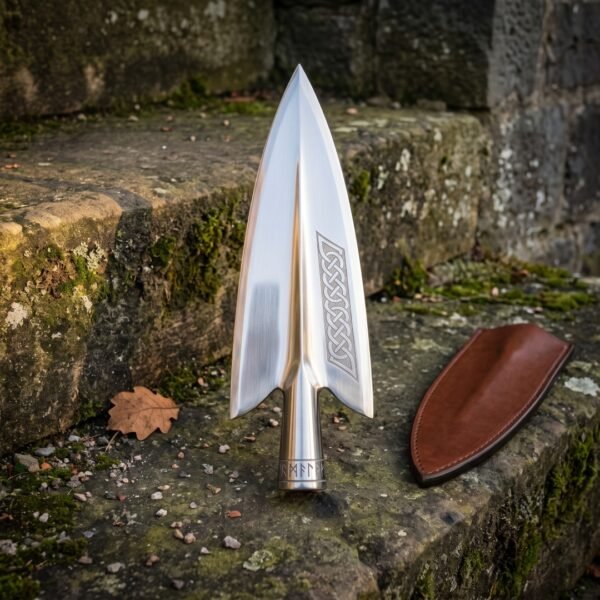
Silverleaf is a winged spearhead in 1095 high carbon steel, taken to a mirror polish, with a broad leaf blade, a raised centre ridge, a pair of swept lugs at the shoulder and a panel of engraved knotwork running alongside the ridge. The socket carries a short band of Elder Futhark at its mouth. It is supplied as a head with a stitched leather cover and no shaft, so you can haft it to whatever length and timber suits you.
Spears armed the Viking age in a way that swords never did. A sword took a great deal of iron and a great deal of a smith time, and it was the possession of a wealthy man. A spear needed a fraction of the metal, a shaft that any farm could cut, and it gave better reach than anything else on the field. Odin carried Gungnir rather than a sword for a reason. When the graves are counted, spearheads outnumber swords many times over. Every Silverleaf is forged, ground, hardened and finished by hand in the Czech Republic. Free shipping inside the United States, one to two weeks processing, seven day returns, and a genuine lifetime warranty against defects in the forging, the grind, the heat treat and the fittings, with no end date and no receipt needed. The spear was the arm most Norsemen actually carried, and our piece on the Viking spear covers the types.
Specifications
| Item type | Socketed Viking spearhead, head only |
|---|
| Blade steel | 1095 high carbon steel |
|---|
| Hardness | 54 to 58 HRC |
|---|
| Finish | Mirror polished across the blade, ridge and socket |
|---|
| Blade form | Broad leaf with a raised central ridge running to the point |
|---|
| Shoulders | Swept back pointed shoulders at the base of the blade |
|---|
| Socket | Round polished steel socket with a short Elder Futhark band near the mouth |
|---|
| Engraving | Knotwork panel cut into one face of the blade beside the ridge |
|---|
| Sheath | Brown stitched leather blade cover |
|---|
| Supplied | Head and cover only, no shaft, socket ready for hafting |
|---|
| SKU | RK-1463 |
|---|
Why a spearhead is socketed rather than tanged
Almost every European spearhead from the Iron Age onward is socketed, meaning the head ends in a hollow cone that slides over the outside of the shaft. Arrowheads and some early javelins were tanged, with a spike driven into the end of the shaft, and the difference tells you a great deal about how each was expected to fail.
A tang splits wood. Drive a spike into the end grain of a shaft, put a hundred and eighty pounds of body weight behind it and the shaft wants to open along its length like a wedge in a log. A socket does the exact opposite. It grips the shaft from outside, compresses it inward on impact, and reinforces the weakest inch of the whole spear precisely where the load is highest. It also means the shaft can be cut down and re fitted as many times as you like without the head ever needing rework, which mattered enormously when your spear broke in a field two days from anywhere.
The socket on Silverleaf is forged and closed in the traditional way rather than turned from bar, so it has the slight seam and the taper that a spear socket should have. The rune band sits at the mouth where a period smith would have put a decorative collar.
1095 high carbon steel and a mirror finish
The head is 1095, a simple high carbon steel that has been the backbone of good hand forged blades for a century. It has enough carbon to harden properly and nothing much else in it, which means it responds cleanly to heat treatment and sharpens easily on a stone. Hardened and tempered to 54 to 58 HRC, it is deliberately a little softer than a knife blade would be, because a spearhead has to survive being driven into hard things at an angle and toughness matters more than the last few points of edge retention.
The mirror polish is the other decision. A mirror surface is harder to keep than a satin one, because it shows every fingerprint and every water spot, but it is also the most rust resistant finish you can put on carbon steel. Rust needs somewhere to start, and a polished surface gives it nothing to key into. Keep it wiped and oiled and it will stay bright for decades. Leave a thumbprint on it in a humid room and you will find the print etched into the surface within a week.
Engraving, runes and your own design
Use the rune converter on this page to turn a name, a date or a short phrase into Elder Futhark and we will cut it into the steel or the leather. If you would rather have a Viking pattern than a rune line, choose your own design in the engraving option above the add to cart button and tell us where it goes. Where a piece already carries an engraved design, your chosen engraving replaces it rather than sitting alongside it. On Silverleaf the socket already carries a rune band and the blade carries a knotwork panel, so your chosen line or design takes the place of one of them. Full detail is on the engraving page.
Hafting and display
Ash is the classic shaft timber and it remains the right answer. It is springy, it does not shatter, and it grows straight. Shave the top of the shaft to a snug taper, seat the head dry to check the fit before you commit, then pin or rivet through the socket. Do not glue it, because a pinned head can be pulled and re seated after a broken shaft and a glued one cannot.
If it is going on a wall rather than a shaft, mount it so light rakes across the blade rather than hitting it flat on. A mirror polish is at its best when it is picking up a reflection, and a flat frontal light makes it look grey. Keep the leather cover on the edge if it is within reach of children, and keep the head out of a damp garage.
Care
1095 is not stainless and a mirror surface shows every mark, so wipe the blade after handling and keep a light film of oil or a paste wax on it. Fingerprints are acidic and will etch themselves in if they are left. Do not store the head inside the leather cover for long periods, because leather holds moisture against steel and will start rust under the flap. Sharpen on a stone rather than a powered wheel so you do not draw the temper out of the edge. Feed the leather with a neutral conditioner two or three times a year. Full oiling and rust removal guidance is on our steel care page. If you are kitting out for the field, our notes for reenactors cover what actually gets used.
Made in the Czech Republic
This is a handmade piece from the Czech Republic, made in a workshop that still forges, grinds and finishes by hand instead of stamping parts out. The smiths there have kept the older way of working, and the wood, horn and leather are shaped and fitted by hand as well. Two pieces of the same design will never be identical, and that is part of what you are buying.
Ransack Viking is a United States company. We handle the import ourselves, look over every piece when it lands and ship from our warehouse in Chicago, Illinois. Engraving is done in the United States after the piece arrives, so your design goes on before we send it out.
A note on handmade variation
This spearhead is hand made and not machine made or bulk produced, so what arrives will not be a pixel for pixel copy of the photograph. The sweep of the lugs, the height of the ridge, the exact run of the engraved knotwork and the tone of the leather all vary because each one is worked by hand from natural materials. The dimensions, the material and the build are the same every time. The character is not.
Frequently asked questions
Does a shaft come with it?
No. This is a head with a leather cover. Shafts are a personal fit and awkward to ship, so the socket is supplied ready for you to haft it yourself.
Is it damascus?
No, and we will not call it that. It is 1095 high carbon steel taken to a mirror polish. There is no pattern welding in this head, and the surface is not etched to imitate one.
Is it sharp?
Yes. It is heat treated to 54 to 58 HRC and ground to a working edge. Treat it as sharp from the moment the cover comes off.
Why is it softer than a knife blade?
Because a spearhead takes impact at awkward angles and toughness matters more than the last few points of hardness. A very hard spear point chips. A slightly softer one bends and can be straightened.
How do I keep a mirror polish looking right?
Wipe it after every handling and keep a thin film of oil or wax on it. The polish itself resists rust well, but fingerprints left on it will etch in.
How long does it take to ship?
One to two weeks, because each head is forged, ground, hardened and polished to order. Engraved orders take a little longer. Shipping inside the United States is free.
What is in the box
- One winged Viking spearhead in mirror polished 1095 steel
- Stitched leather blade cover
- Engraved knotwork panel and a rune band at the socket mouth
- Your own Elder Futhark line or Viking design in their place where selected
- Hafting, sharpening and oiling notes
- Forged and finished in the Czech Republic
Explore the range
See more in Norse arms, battle axes and engraved and personalized pieces, or read the guides for how carbon steel is heat treated.
Also in this part of the catalogue
A near match for this one is the Wyrmtooth Norse arms, pattern welded Damascus. Closest to this in the range is the Ashreaver Viking spear, forged from 1095. If this one is not quite right, there is the Ashpoint Viking spear, forged from 1095.
The Brasscurl Norse arms covers the other half of the same kit. Or start from a blank sheet on the custom Norse arms page.

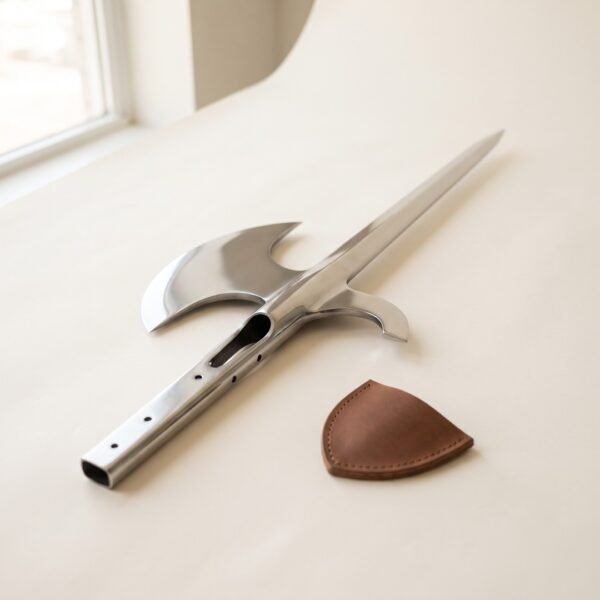
Five stars isn’t even enough honestly. Haft feels sturdy and well balanced for the size of the head. Came in solid packaging and arrived in perfect condition. Will definitely order again for another gift.
My husband was speechless when he opened this. Steel head is heavy in a good way. You can tell it’s not hollow. Beyond happy with how this turned out.
This thing is a beast in the best way. Great for reenactment or just display. Either way it looks amazing. Came in solid packaging and arrived in perfect condition. Already planning my next purchase from this shop.
Very disappointed with this polearm.
Got this as a birthday gift and the reaction was priceless. Came in solid packaging and arrived in perfect condition. Will definitely order again for another gift.
Got this as a birthday gift and the reaction was priceless. Love that this is Czech craftsmanship and shipping from the US meant it showed up in just a few days.
Incredible craftsmanship on this one. Came in solid packaging and arrived in perfect condition. Finish on the metal is even and clearly hand forged. Haft feels sturdy and well balanced for the size of the head. If you’re on the fence just get it. You won’t regret it.
Incredible craftsmanship on this one. Haft feels sturdy and well balanced for the size of the head. If you’re on the fence just get it. You won’t regret it.
Turned out better than I expected going in. Made in the Czech Republic but ships from the US. Delivery was quick even so. Haft is solid though a touch shorter than I pictured. Minor nitpicks aside, good quality piece.
Five stars isn’t even enough honestly. Great for reenactment or just display. Either way it looks amazing. 10/10 would buy again.