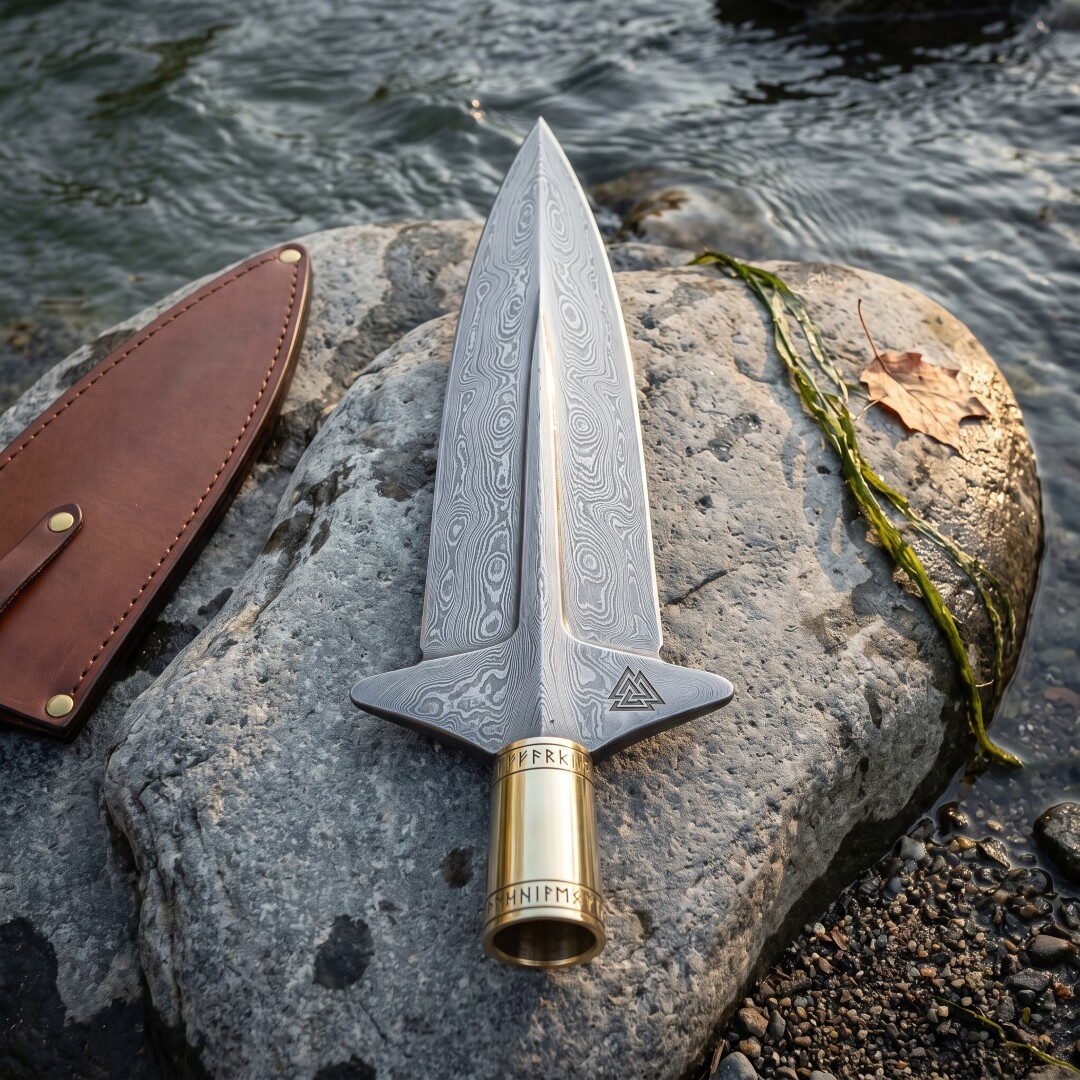
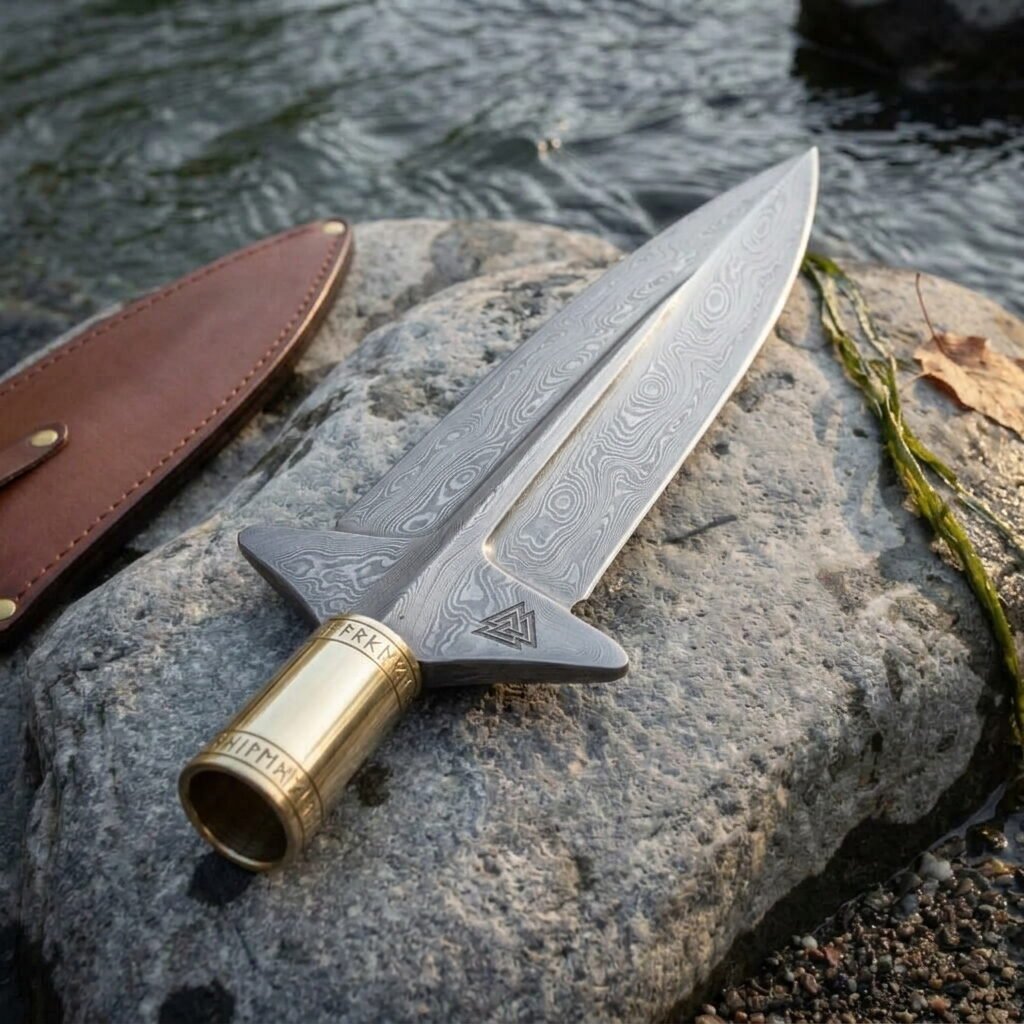
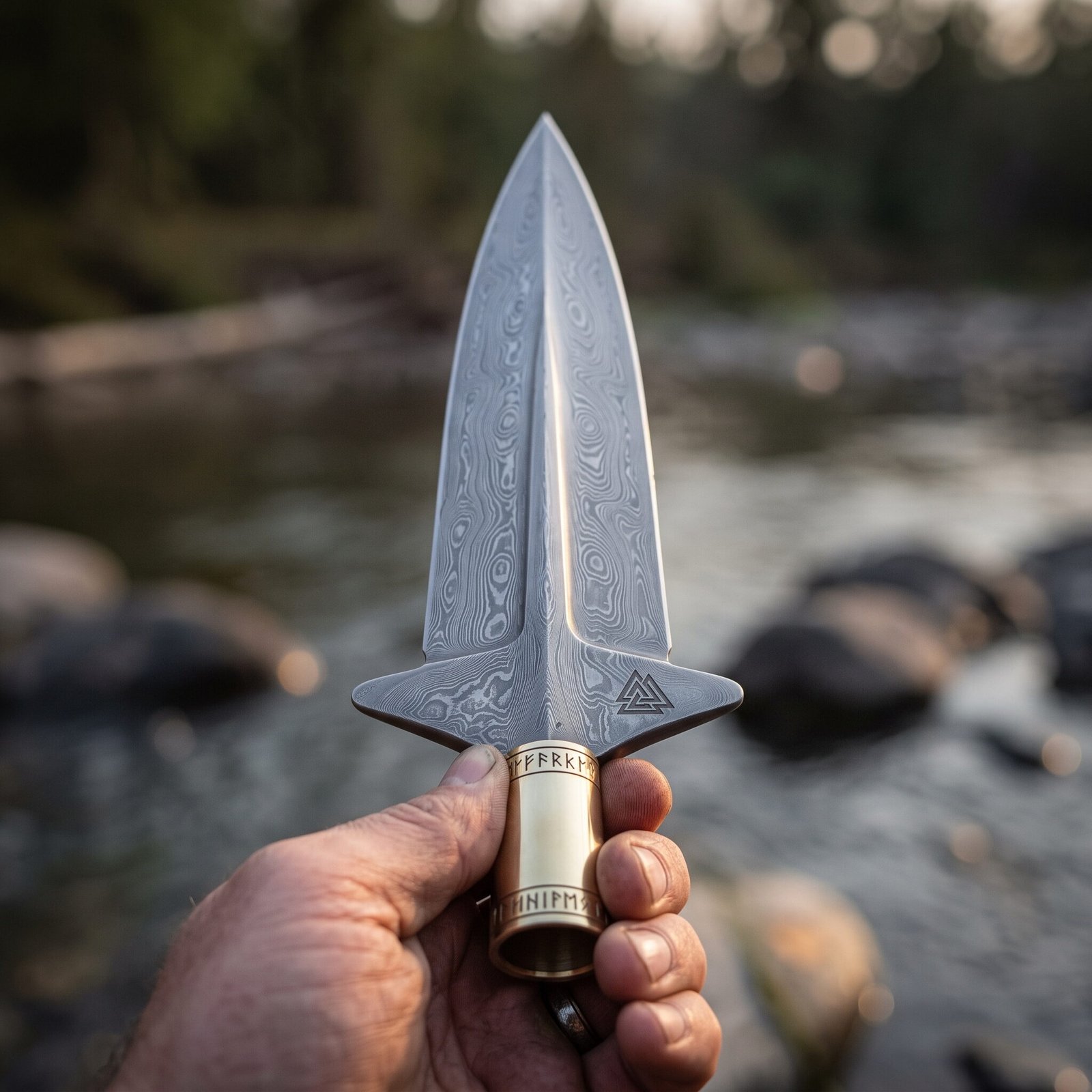
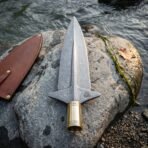
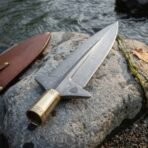
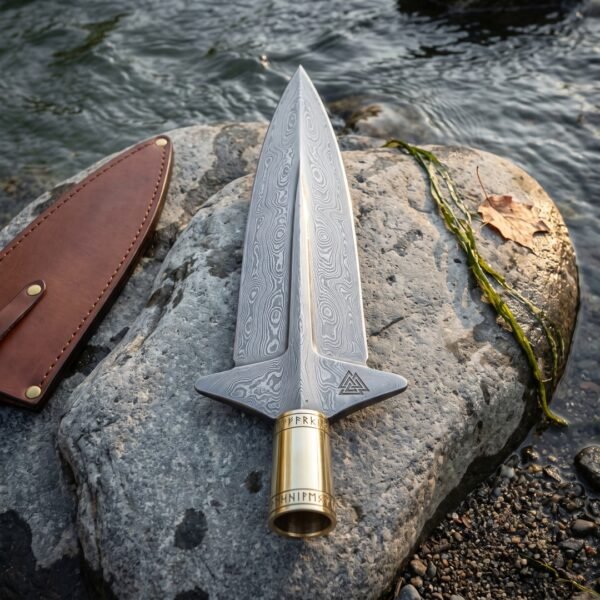
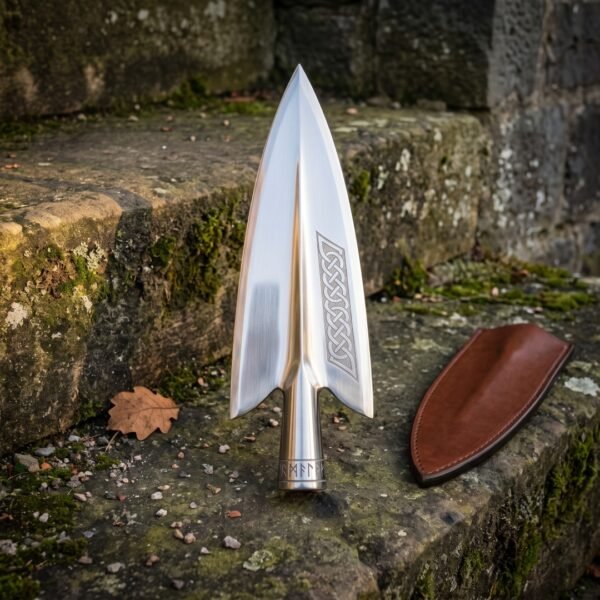
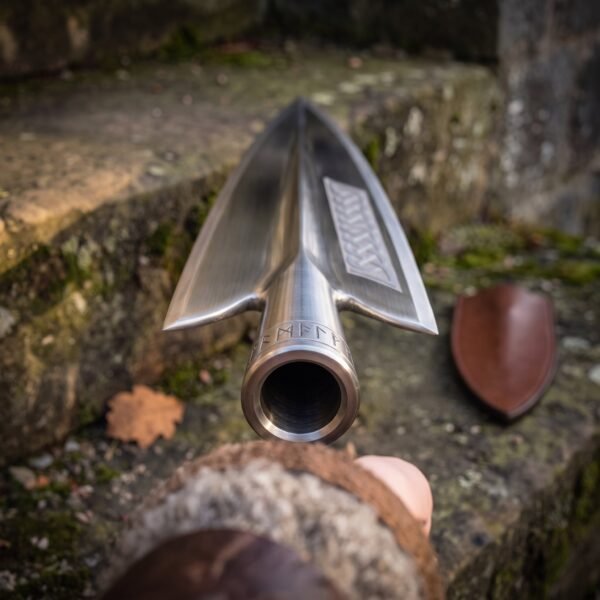
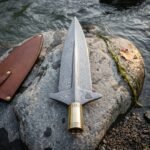
Wyrmtooth is a winged spearhead in forge welded damascus, with a long tapering blade carrying a raised central ridge, a pair of swept lugs at the base and a brass socket engraved with two bands of Elder Futhark. A valknut is cut into the blade just above the shoulder. It is supplied as a head with a stitched leather cover, without a shaft, because a spear shaft is a personal fit and shipping a seven foot pole across the country is a nuisance for everyone.
The wings are the interesting part and they are genuinely diagnostic of the type. Those two swept lugs at the base of the blade stop the head from going in too far. On a hunting spear that matters enormously, because a boar that runs up the shaft to reach the man holding it is a real and well documented way to die, and a crossbar solves it. In war they served as a catch for parrying and for hooking a shield rim aside. Every Wyrmtooth is welded, drawn, ground, hardened and fitted by hand in the Czech Republic. Free shipping inside the United States, one to two weeks processing, seven day returns, and a genuine lifetime warranty against defects in the forging, the grind, the heat treat and the fittings, with no end date and no receipt needed. The spear was the arm most Norsemen actually carried, and our piece on the Viking spear covers the types.
Specifications
| Blade steel | Forge welded damascus in 1095 and 15N20 |
|---|
| Hardness | 58 to 60 HRC |
|---|
| Blade form | Long tapering blade with straight edges and a raised central ridge running to the point |
|---|
| Lugs | Angular winged lugs forged at the base of the blade, swept back toward the socket |
|---|
| Socket | Solid brass, engraved with two bands of Elder Futhark, open for hafting |
|---|
| Engraving | Valknut cut into the blade above the shoulder |
|---|
| Sheath | Tan leather blade cover, stitched, with a strap and stud closure |
|---|
| Supplied | Head and cover only, no shaft, socket ready for hafting |
|---|
| Intended use | Collection, display and wall mounting, sharp and fully functional |
|---|
| SKU | RK-1461 |
|---|
The central ridge, and why a spear blade is shaped this way
Run a finger along the flat of this blade and you will find it is not flat at all. There is a raised spine down the middle that runs from the socket to within an inch of the point, and the blade tapers away from it to each edge. That ridge is the whole engineering argument of a spearhead.
A spear is used with the whole weight of a body behind a very small area, and the load on the blade is enormous relative to its thickness. A flat blade of the same width would either have to be thick everywhere, which makes it heavy and slow to enter, or thin everywhere, which lets it fold sideways the moment it meets bone or a shield edge. The ridge puts the material where the bending load is highest, along the centre line, and lets the metal thin out toward the edges where you want cutting geometry rather than mass. It is the same principle as an I beam, and Viking age smiths were building it into spearheads five hundred years before anyone wrote the mathematics down.
The result is a head that is stiff along its length, light in the hand, and thin enough at the edge to cut as well as pierce. A Norse spear was not only for thrusting and this profile is why.
Forge welded damascus, brass and leather
The pattern in the blade is real forge welding, not an etch printed onto the surface. Layers of 1095 and 15N20 are stacked, welded at forging heat, drawn out and folded until there are hundreds of them, then the finished head is etched so the acid bites the 1095 and leaves the nickel bearing 15N20 bright. That is why the pattern follows the taper of the blade and runs into the ridge and out to the lugs. A printed or stencilled pattern sits on the surface, stops at the bevel and wears away. This one is in the steel.
At 58 to 60 HRC the edge is a working hardness. Treat this as sharp, not an ornament, from the moment the cover comes off. The socket is solid brass, which is soft enough to take a crisp engraved rune and which patinas warmly against the etched steel. The cover is vegetable tanned leather, stitched and studded.
Engraving, runes and your own design
Use the rune converter on this page to turn a name, a date or a short phrase into Elder Futhark and we will cut it into the steel or the leather. If you would rather have a Viking pattern than a rune line, choose your own design in the engraving option above the add to cart button and tell us where it goes. Where a piece already carries an engraved design, your chosen engraving replaces it rather than sitting alongside it. On Wyrmtooth the brass socket already carries two rune bands, so your own line takes the place of one of them, and the valknut on the blade can be replaced by your design instead if you prefer. Full detail is on the engraving page.
Hafting and display
If you want to haft it, ash is the traditional and still the best timber for a spear shaft. Turn or shave the top of the shaft to a taper that enters the socket snugly, seat the head dry first to check the fit, then set it with a wooden pin or a rivet through the socket rather than relying on friction alone. Do not glue it. A pinned head can be pulled and re seated. A glued head cannot.
For display, the head shows best mounted on a plaque or laid on a stand where the pattern in the steel catches raking light rather than flat frontal light. Keep the leather cover on it wherever it is within reach of anyone who does not know it is sharp. Away from direct sunlight is better for the leather and for the brass.
Care
High carbon damascus rusts, and the etch that shows the pattern opens the surface slightly so it will spot more readily than plain polished steel. Wipe the blade after handling, because fingerprints are acidic and will etch themselves into a bright surface within days in a humid room. Keep a thin film of light oil or a paste wax on the steel. Never store the head inside the leather cover long term, because leather holds moisture against the blade. Sharpen on a stone rather than a powered wheel so the temper is not drawn. Feed the leather with a neutral conditioner two or three times a year. Full oiling and rust removal detail is on our steel care page. Etched steel wants its own routine, which is on the Damascus care page.
Made in the Czech Republic
Every piece we sell is made by hand in the Czech Republic. The smiths there work the way the trade has been worked for a long time, heating and hammering the steel, taking the bevels down by eye, and fitting the handle and the leather one at a time. There is no automated line anywhere in it, so small differences from one piece to the next are normal and expected.
Ransack Viking is a United States company based in Chicago, Illinois. We bring the pieces in ourselves, inspect them on arrival and ship them from our own warehouse. If you add engraving, that is carried out here in the United States before your order goes out.
A note on handmade variation
This spearhead is hand made and not machine made or bulk produced, so what arrives will not be a pixel for pixel copy of the photograph. The damascus pattern is unique to each head because it depends on how that billet moved under the hammer. The sweep of the lugs, the depth of the ridge, brass tone and leather colour vary too. The dimensions, the material and the build are the same every time. The character is not.
Frequently asked questions
Does it come with a shaft?
No. This is a head and a leather cover. Spear shafts are a personal fit and are awkward to ship, so we supply the socket ready for you to haft it yourself.
Is the pattern real damascus or an etched print?
Real forge welded damascus in 1095 and 15N20. The layers follow the taper of the blade and run out into the lugs, which a surface etch cannot do.
Is it sharp?
Yes. It is heat treated to 58 to 60 HRC and ground to a working edge. Treat it as sharp from the moment the cover comes off.
What are the wings for?
They stop the head driving in too far, which matters enormously when hunting boar, and they give you something to catch and turn a blade or a shield rim with.
How should I fit it to a shaft?
Taper an ash shaft to a snug dry fit in the socket, then pin or rivet through the socket. Do not glue it, because a pinned head can be pulled and re seated and a glued one cannot.
How long does it take to ship?
One to two weeks, because each billet is welded and each head is forged, ground and hardened to order. Engraved orders sit at the longer end. Shipping inside the United States is free.
What is in the box
- One winged damascus Viking spearhead with a brass socket
- Stitched leather blade cover with a stud closure
- Elder Futhark rune bands on the socket and a valknut on the blade
- Your own rune line or Viking design in their place where selected
- Hafting, sharpening and oiling notes
- Forged and finished in the Czech Republic
Explore the range
See more in Norse arms, Viking axes and engraved and personalized pieces, or read the guides for how pattern welded steel is made.
Near neighbours in the shop
Next along the rack is the Serpentcast Viking spear, 74 inches overall. For a straight comparison, see the Runeleaf Viking spear, 72 inches overall. Worth putting side by side with this is the Silverleaf Norse arms, forged from 1095.
If you are putting a set together, the Brasscurl Norse arms sits alongside it. You can have this made your way instead on the custom Norse arms page.

I collect stuff like this and this polearm is on another level. Came in solid packaging and arrived in perfect condition. You can tell it’s real Czech blacksmith work and shipping from the States made delivery painless. If you’re on the fence just get it. You won’t regret it.