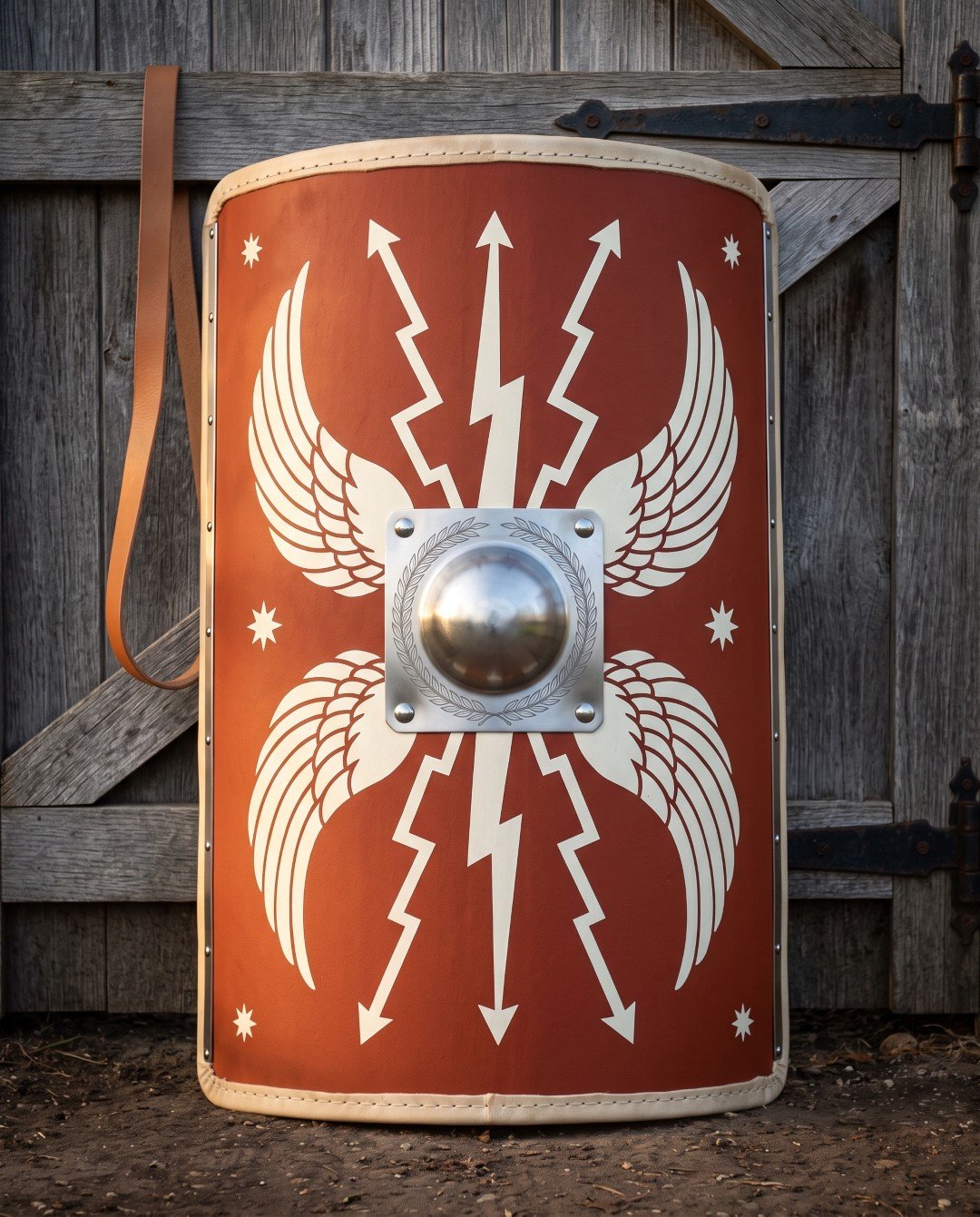
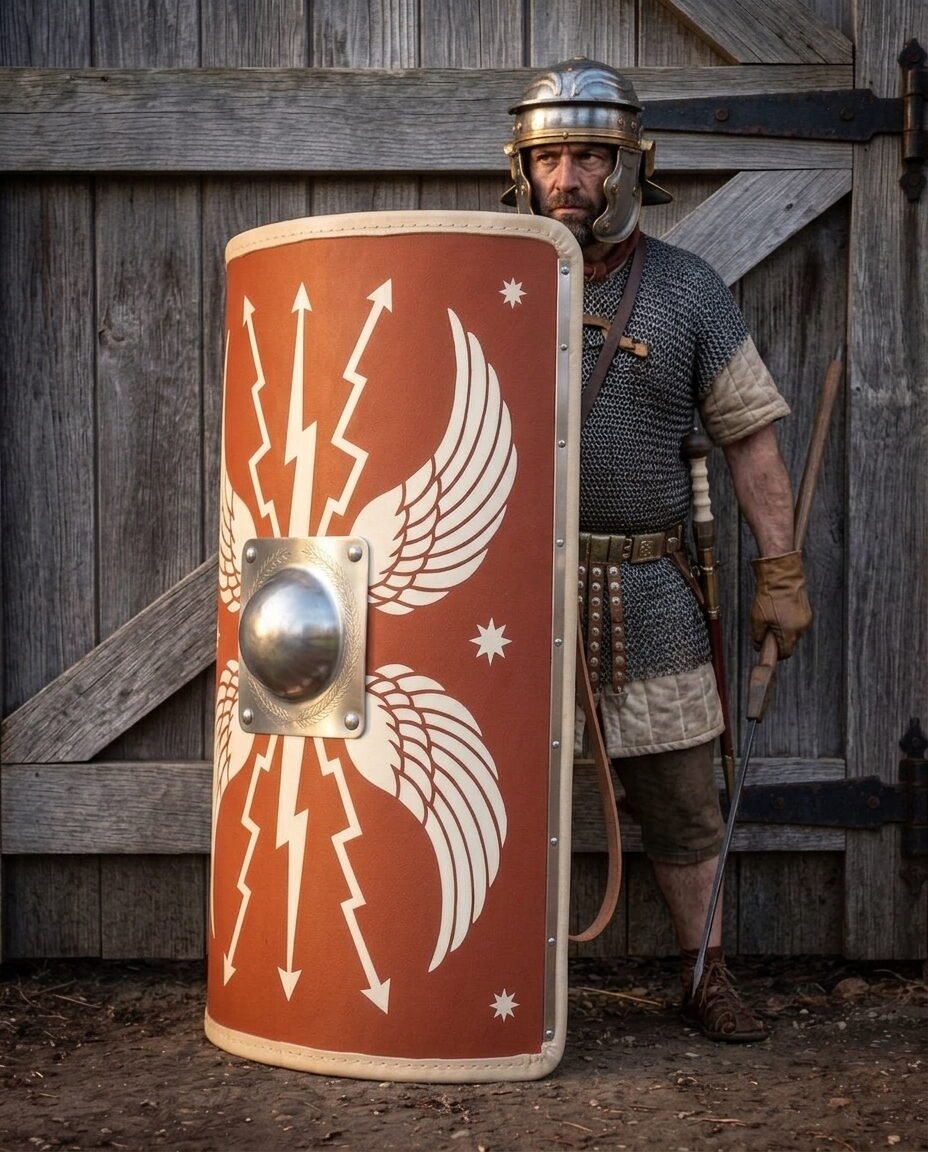
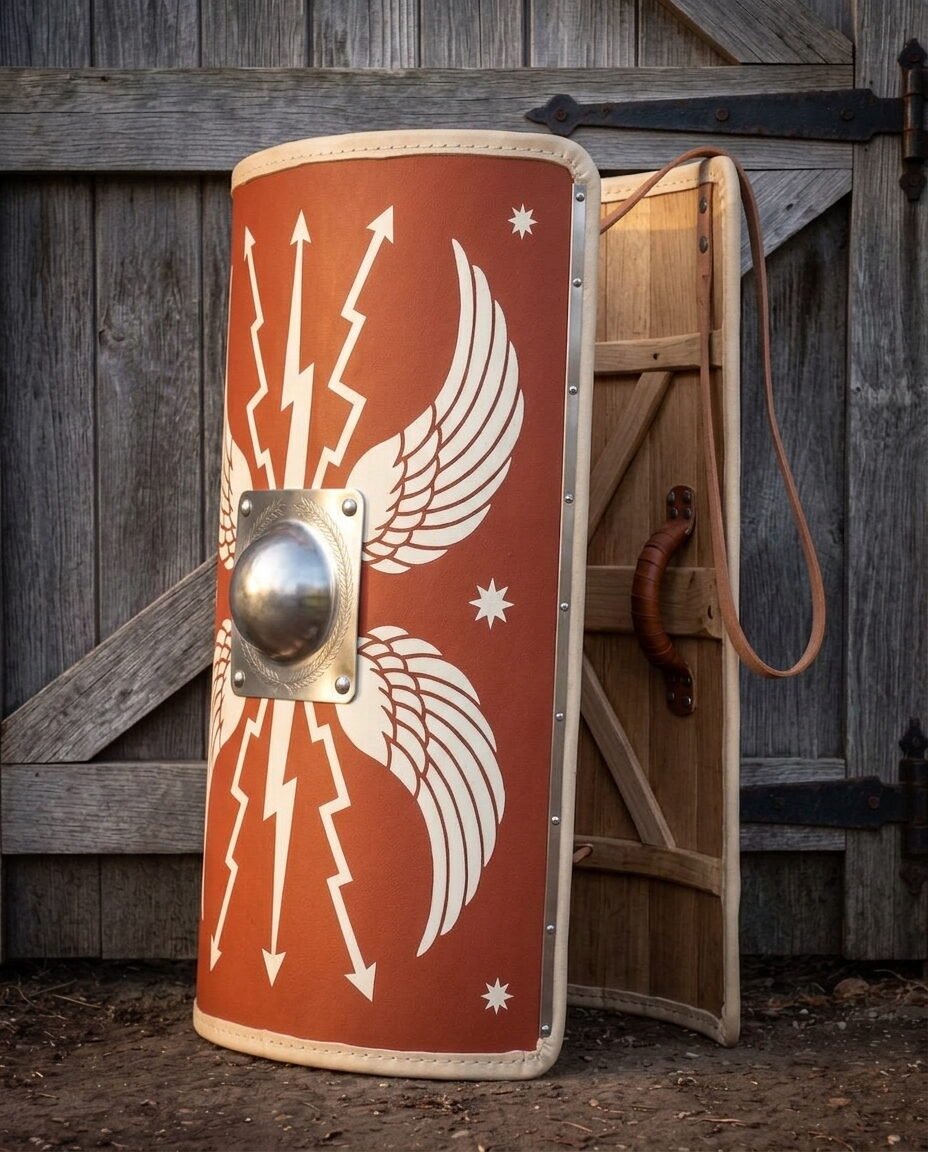
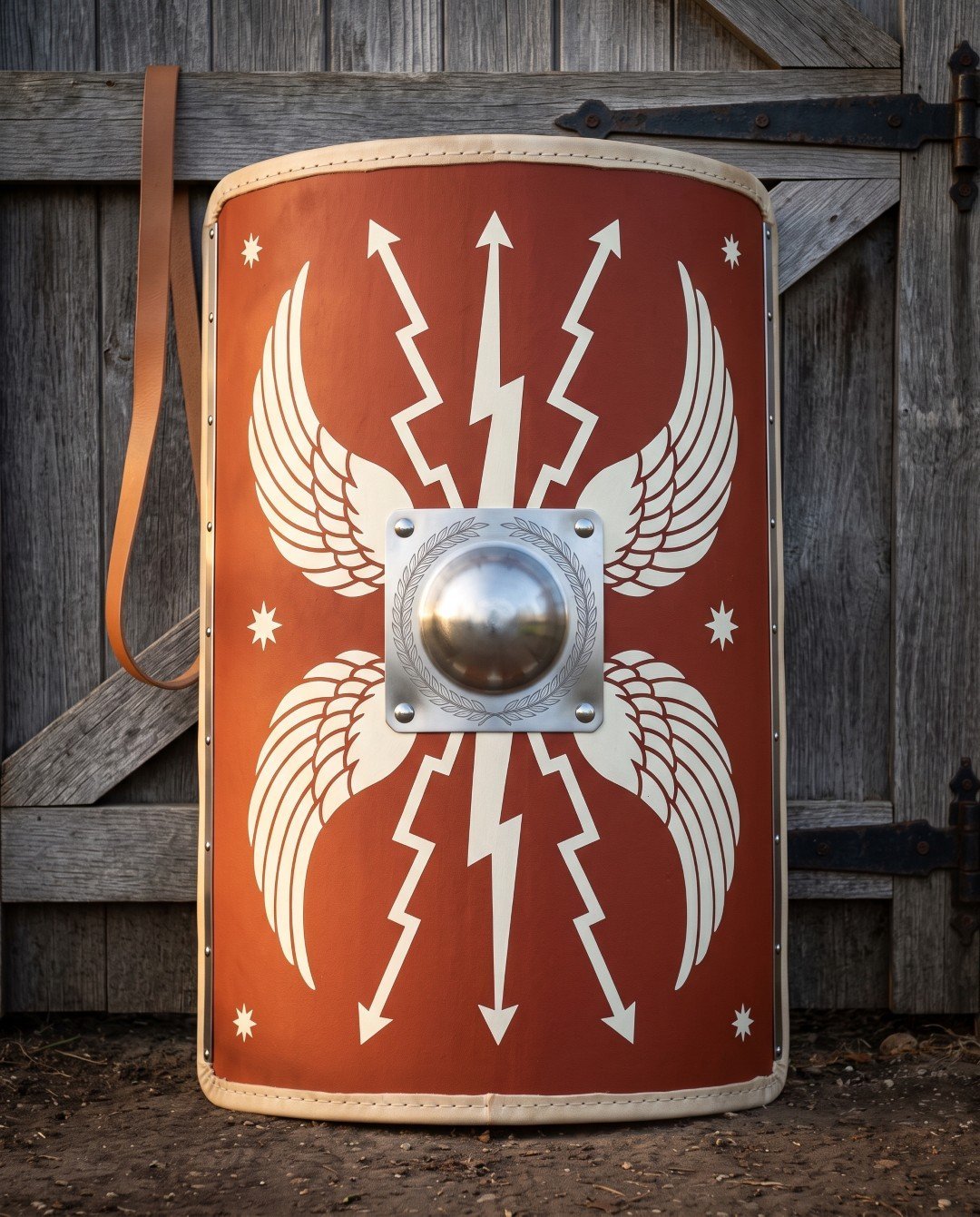
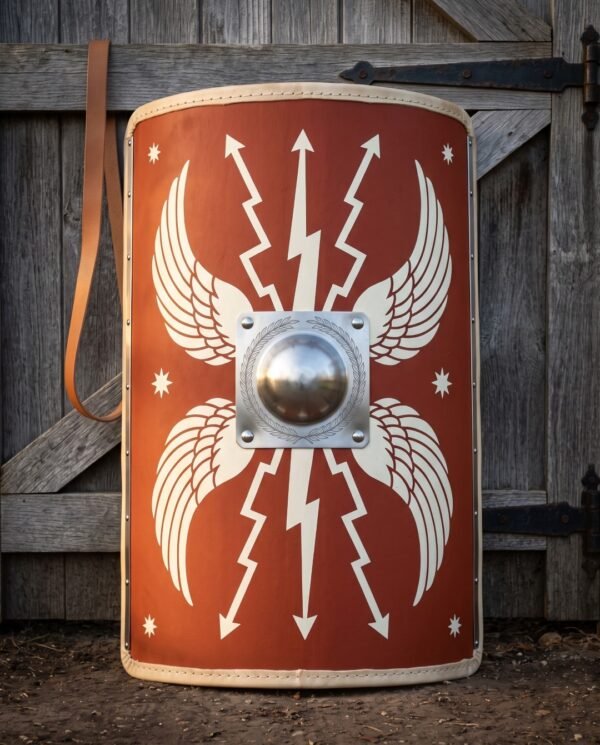
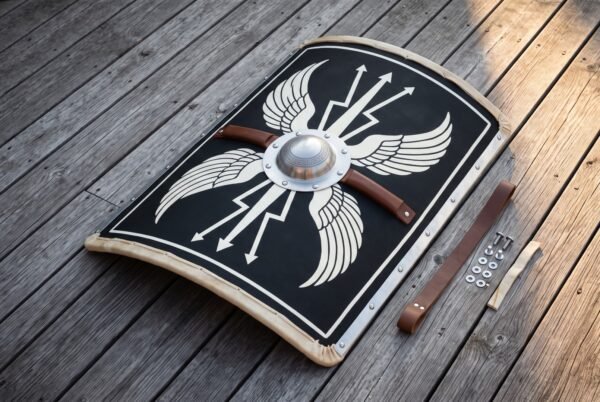
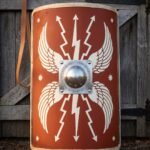
The Stormwing is a curved rectangular scutum built the way a legionary carried one, with a laminated body bent across the vertical axis, a hide edge binding, and a steel dome boss riveted through a square plate at the centre. The face is painted in the classic red field with mirrored wings, forked lightning bolts and eight pointed stars, a design taken from the shields of the first century imperial legions. The wings and bolts are the thunderbolt of Jupiter, which is why the same motif turns up on shield after shield in the Rhine and Danube frontier finds and on Trajan Column reliefs.
What surprises most people is that the curve is structural rather than decorative. A flat board of this size flexes and splits when it is struck across the grain. Roll it into a section of a cylinder and it becomes a stressed skin that resists a blow across its whole width, which is why a legionary could hold a shield this large one handed on a horizontal grip. Every Stormwing is cut, laminated, bent, faced, painted and fitted in a Czech Republic workshop, and it ships ready to hang or carry. The round shield of the north worked on the same principles, covered in our guide to Viking shields.
Specifications
| Body | Cross laminated hardwood ply, bent to a cylinder section, approximately 12 mm thick |
|---|
| Back | Bare wood, braced with horizontal battens and diagonal struts |
|---|
| Height | Approximately 48 inches |
|---|
| Width across the curve | Approximately 26 inches |
|---|
| Weight | Approximately 13 to 15 pounds |
|---|
| Face | Hand painted, red ground with cream winged thunderbolts and eight pointed stars |
|---|
| Edging | Cream rawhide binding around the full perimeter, riveted steel strip along the long edges |
|---|
| Boss | Polished steel dome on a square steel plate, four corner rivets, engraved laurel wreath border |
|---|
| Grip | Leather wrapped wooden handle on the back, bolted through with steel plates |
|---|
| Intended use | Display, film and light reenactment, not rated for full contact steel combat |
|---|
| SKU | RK-1491 |
|---|
Why the scutum is curved and what the boss actually does
A Roman shield does two jobs that a round shield does not. It covers a man from shin to shoulder while he stands shoulder to shoulder with the next man, and it lets him punch. The curve is what makes both possible. Wrapping the board around the body pulls the top and bottom edges forward so the shield shelters the flanks without getting any wider, and it keeps the whole panel in compression when something lands on it. Original scuta were built from three thin layers of wood glued with the grain crossed, exactly like modern plywood, and then faced in linen and hide. That is a laminate, and it was invented for this job two thousand years before anyone sold a sheet of ply.
The boss is the second half of the system. On the originals the board behind the dome was cut away and a horizontal bar crossed the hole, so the fist sat inside the dome and the whole shield could be driven forward to strike. On the Stormwing the dome is a solid boss and the shield is held by a leather wrapped wooden handle bolted to the braced back. The dome still takes the direct hits, and a blow that lands on it is carried by steel rather than timber.
The trade off is that a centre gripped shield is tiring to hold at arm length and it cannot be slung on the arm to free the hand. Legionaries solved that on the march with a leather cover and a carrying strap, which is why so many reliefs show the scutum hanging at the shoulder rather than being held.
Materials, paint and edging
The body is cross laminated hardwood ply, bent over a form and held until the glue cures so the curve is set in the panel rather than forced by the fittings. It is faced and then hand painted with the wings, bolts and stars laid out from the centre line. Paint is applied in flat blocks in the Roman manner rather than airbrushed, so the edges of the motifs have the very slight hand cut quality you can see in the photograph.
The perimeter is bound in stitched rawhide and leather. On an original this binding was the wear item. It took the sword cuts that skated off the face, and it kept the exposed end grain of the laminate from drinking water and delaminating. Ours does the same thing, and it is stitched rather than stapled so that it can be replaced without damaging the board.
The boss is raised from mild steel sheet, planished, and mounted on a square plate with an engraved wreath border and four rivets through the timber. Mild steel is the correct material here. It dents and deforms under impact instead of cracking, which is what you want from a piece of armour that is supposed to absorb energy. It is not hardened and it is not meant to be.
Engraving, runes and your own design
Use the rune converter on this page to turn a name, a date or a short phrase into Elder Futhark and we will cut it into the steel or the leather. If you would rather have a Viking pattern than a rune line, choose your own design in the engraving option above the add to cart button and tell us where it goes. Where a piece already carries an engraved design, your chosen engraving replaces it rather than sitting alongside it. On the Stormwing the natural places are the boss plate, where your line takes the place of the wreath border, or the leather edging near the top rim. A cohort number, a unit name or a date is the usual request. Full detail is on the engraving page.
Hanging and display
Because the scutum is curved it does not sit flat against a wall. Two heavy duty French cleats or a pair of coated hooks set to bear on the top rim will hold it with the belly of the curve standing off the plaster, which is how it looks best. Put the fixings into studs. Fifteen pounds hanging on drywall anchors will come down eventually. On a floor stand it should lean at a slight angle rather than stand vertical, so the weight rests on the bottom rim and not on the edge binding alone.
If you are carrying it for an event, sling it rather than gripping it for hours. A simple shoulder strap looped through the handle on the back takes the load off the wrist and is period correct for the march.
Care
Keep it out of direct sunlight for long periods, because red pigment fades faster than any other colour on a shield face. Dust the painted face with a dry cloth. Do not use household cleaners on it. Feed the rawhide and leather edging twice a year with a neutral leather cream so it stays flexible and does not shrink away from the rim. Wipe the steel boss with an oiled rag now and again, especially if you handle it often, because fingerprints etch mild steel over time. Our full notes on keeping bare steel from rusting are on the steel care page and they apply to a boss just as much as to a blade. If it is going on a wall rather than into a line, choosing a shield for display covers size and mounting.
Made in the Czech Republic
Every piece we sell is made by hand in the Czech Republic. The smiths there work the way the trade has been worked for a long time, heating and hammering the steel, taking the bevels down by eye, and fitting the handle and the leather one at a time. There is no automated line anywhere in it, so small differences from one piece to the next are normal and expected.
Ransack Viking is a United States company based in Chicago, Illinois. We bring the pieces in ourselves, inspect them on arrival and ship them from our own warehouse. If you add engraving, that is carried out here in the United States before your order goes out.
A note on handmade variation
This shield is hand made, not machine made or bulk produced, so what arrives will not be a pixel for pixel copy of the photograph. The exact sweep of the painted wings, the grain showing through the face, the tone of the rawhide edging and the planishing marks on the boss vary from one shield to the next, because each one is worked by hand from natural materials. The dimensions, the material and the build are the same every time. The character is not.
Frequently asked questions
Can I use this for full contact reenactment
No. It is built for display, for film and theatre work and for light drill and parade use. Full contact steel combat groups require shields built to their own society standard with heavier bodies and specific edge treatment, and this is not certified to any of those standards.
How heavy is it to hold
Around thirteen to fifteen pounds, which is close to the weight of an original. It is held by a single handle on the back, so it feels heavier than a strapped shield of the same weight. Most people can hold it comfortably for a few minutes at a time.
Is the boss real steel
Yes. It is mild steel, raised and planished, riveted through the body on a square plate. It is not plated plastic and it is not a resin casting.
Will the paint chip
Handled normally it will not. Knocked against a doorframe or struck with steel it will mark, and touch up is straightforward with acrylic. We would rather tell you that than pretend a painted wooden shield is indestructible.
Is the strap in the photograph included
No. The leather strap and the barn door in the photograph are photography setting. The shield ships with the body, the painted face, the edge binding, the boss and the handle.
How long does it take to arrive
Processing is one to two weeks because each shield is laminated, painted and fitted to order, then shipping is free within the United States. Because of the size it travels in an oversized carton.
What is in the box
- One Stormwing Roman legionary scutum, curved laminated body with a hand painted face
- Steel dome boss on an engraved square plate, riveted in place
- Leather wrapped wooden handle bolted to the back
- Stitched rawhide and leather edge binding around the full perimeter
- Lifetime warranty against defects in forging, grind, heat treat and fittings
- Made by hand in the Czech Republic
Explore the range
See more in kite shields and bucklers, round shields and shield bosses, or read the guides before you choose a size.
Others in the same line
Next along the rack is the Palewing buckler. For a straight comparison, see the Lionward buckler. Worth putting side by side with this is the Wavewarden buckler.
If you are putting a set together, the Legionwall Greek shield sits alongside it. You can have this made your way instead on the design your own page.


Good quality shield for the price. Good solid build. Finish could be a touch more even. Second time ordering from Ransack Viking and still happy overall. Minor nitpicks aside, good quality piece.
Nice piece for the price. Good solid build. Finish could be a touch more even. Fits well though I had to adjust the straps a bit. Good product. Just not quite perfect.
This thing is a beast in the best way. Highly recommend this one.
Expected better quality for the price. Ransack Viking usually does better than this in my experience. Probably won’t be ordering again.
Was nervous ordering something like this online but so glad I did. Padding and straps make it comfortable to wear for hours. Made overseas in the Czech Republic yet shipped from a US location so no long customs wait. If you’re on the fence just get it. You won’t regret it.