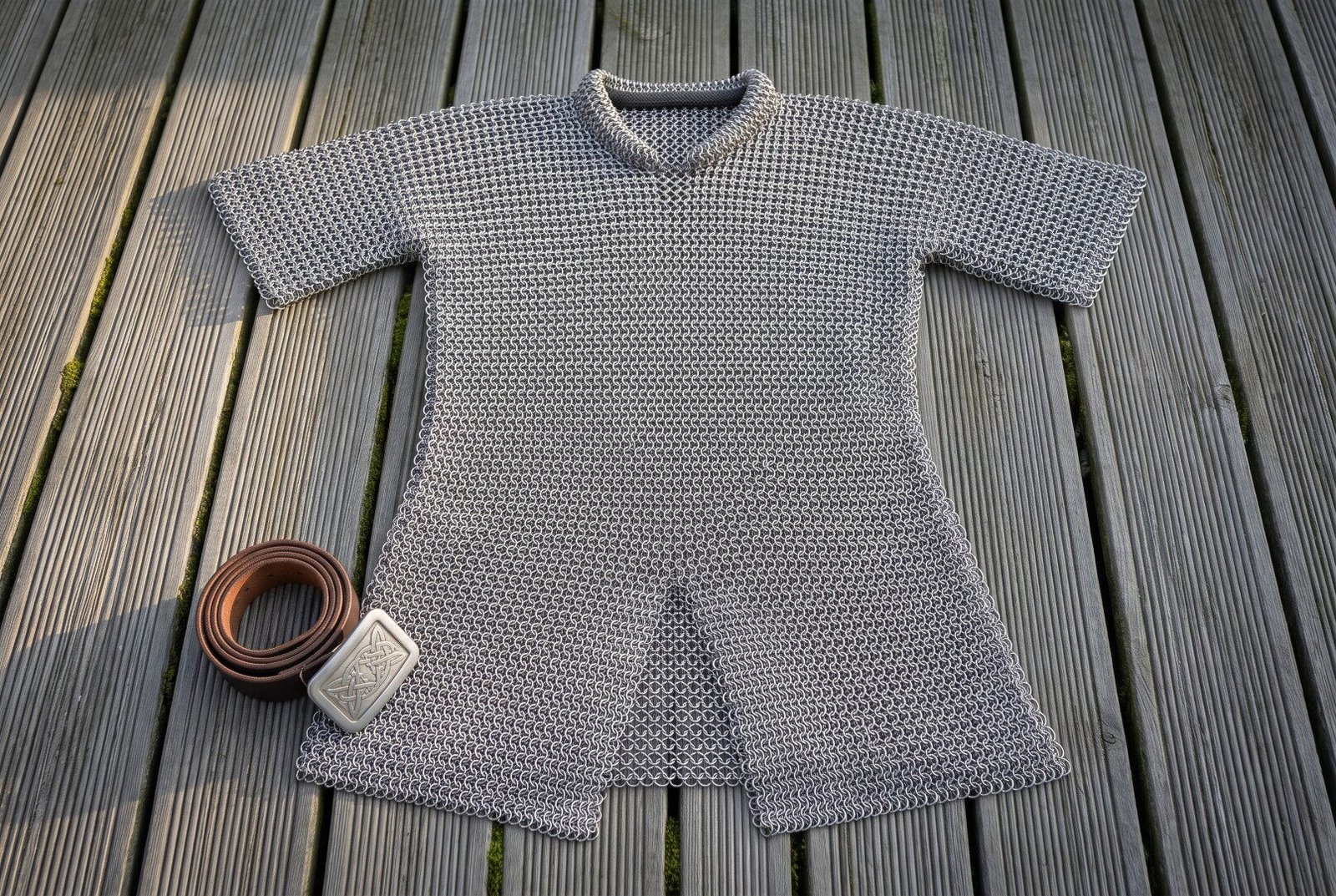
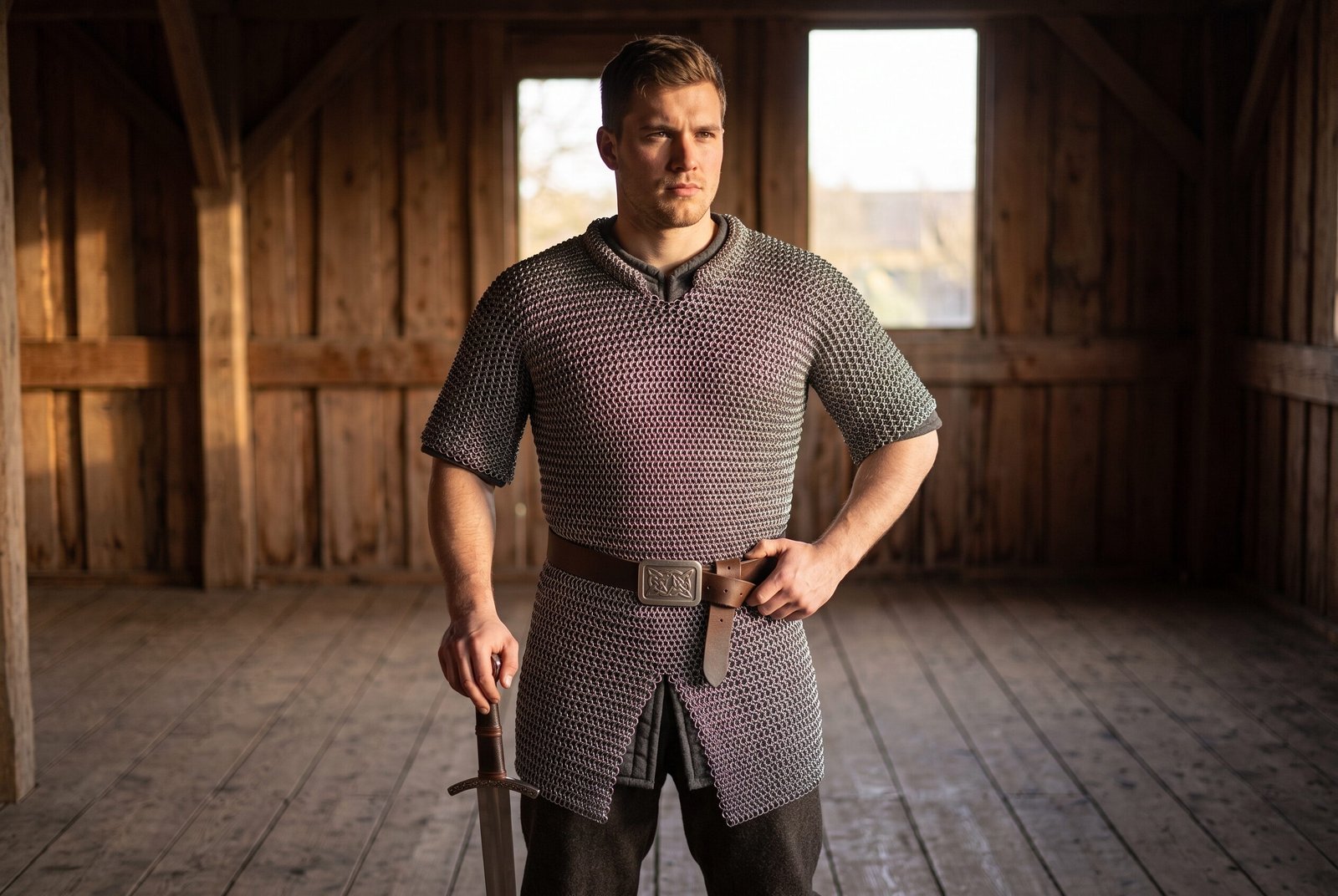
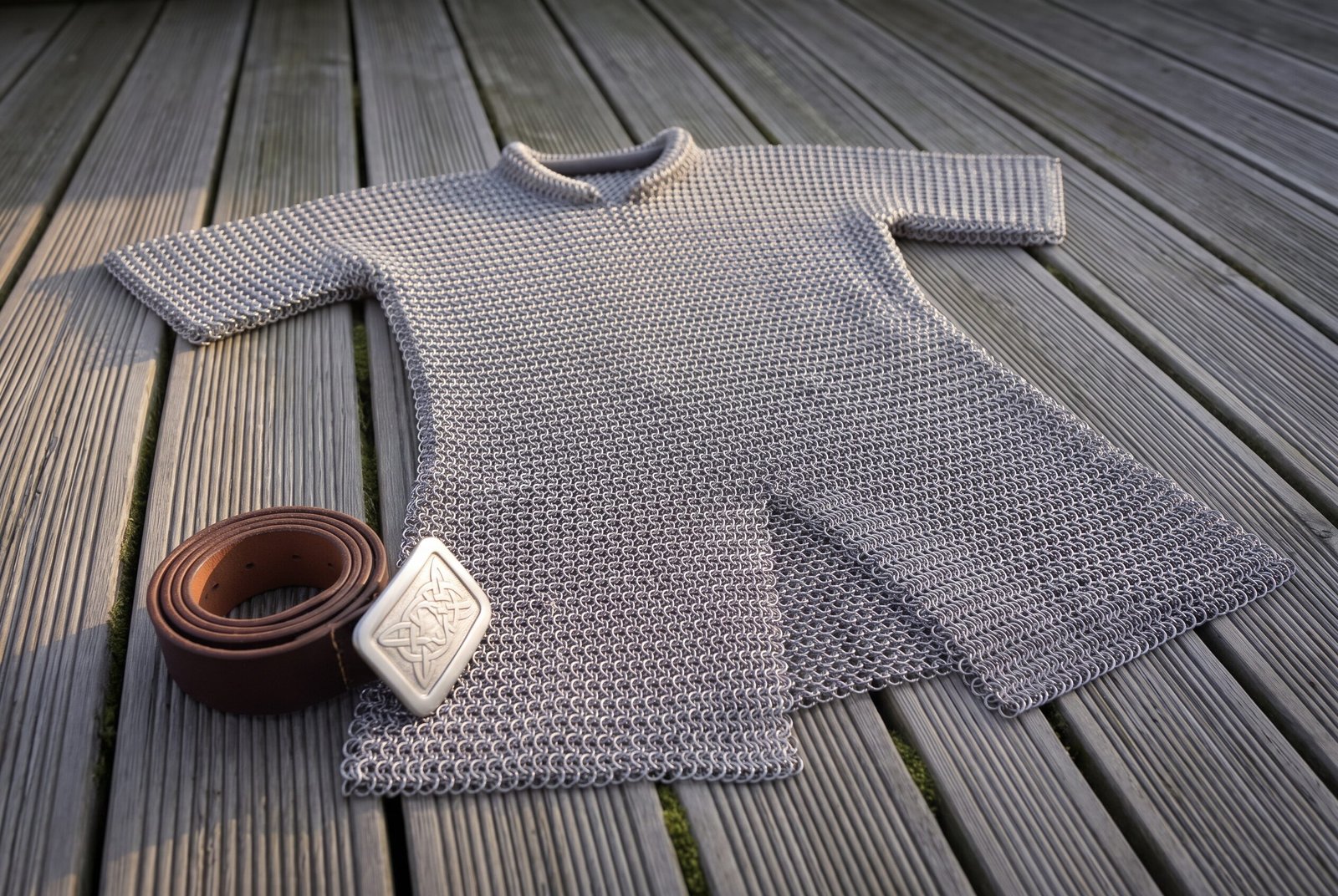
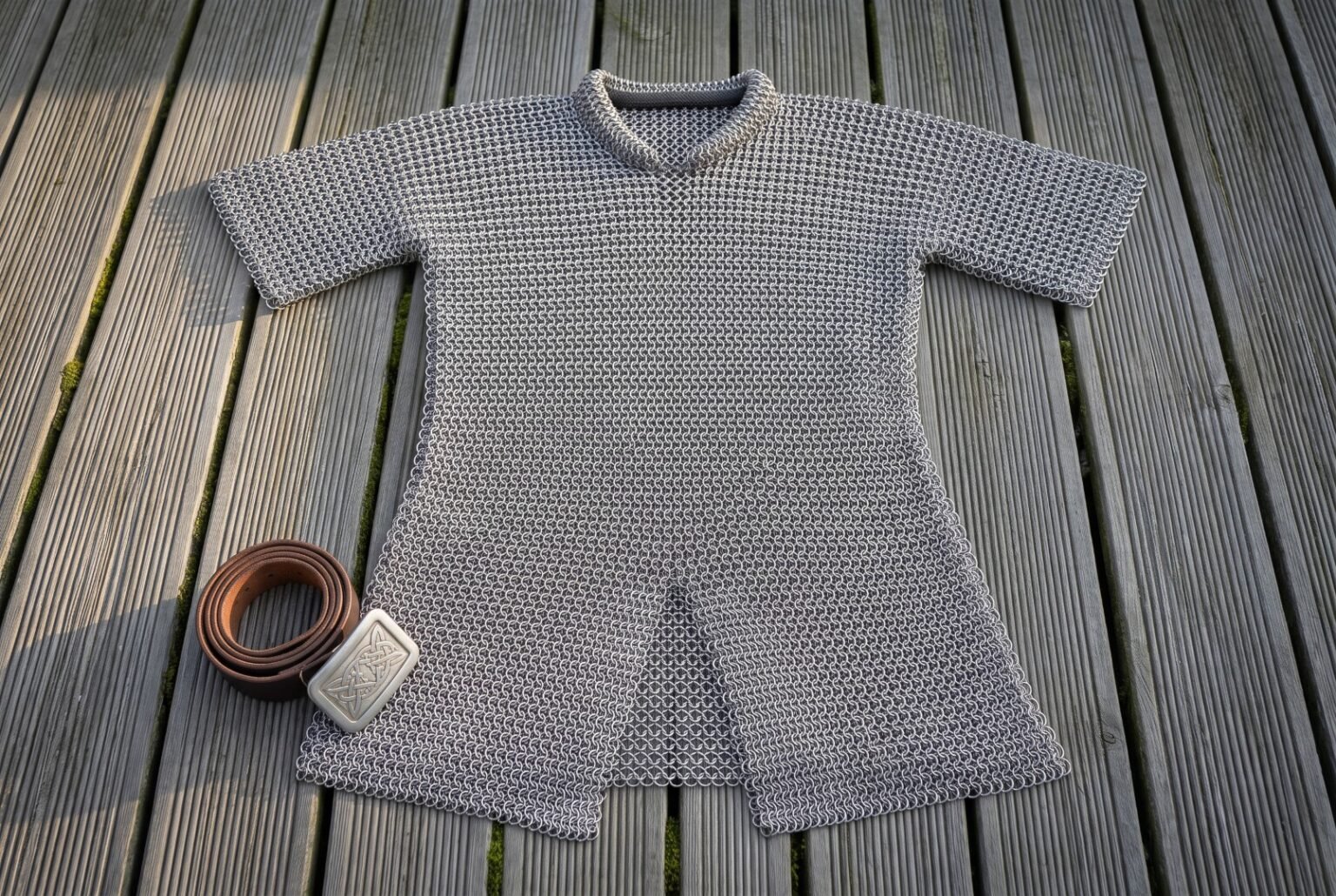
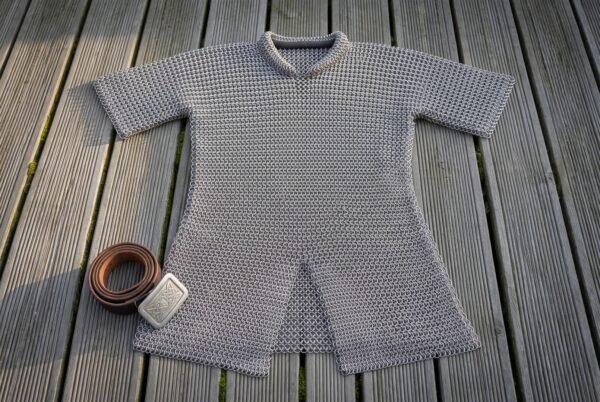
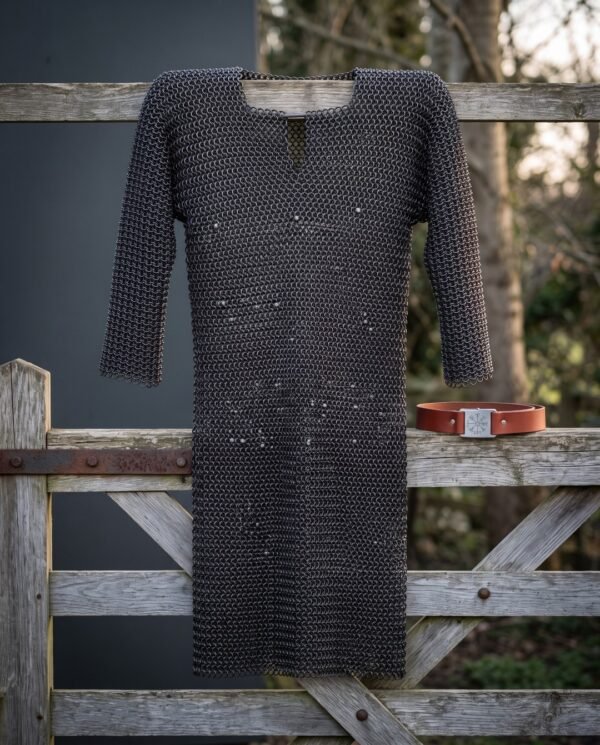
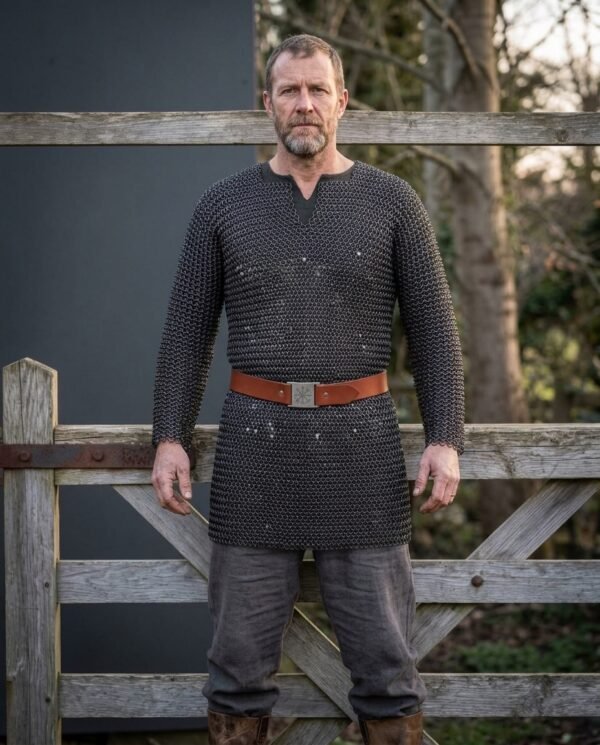
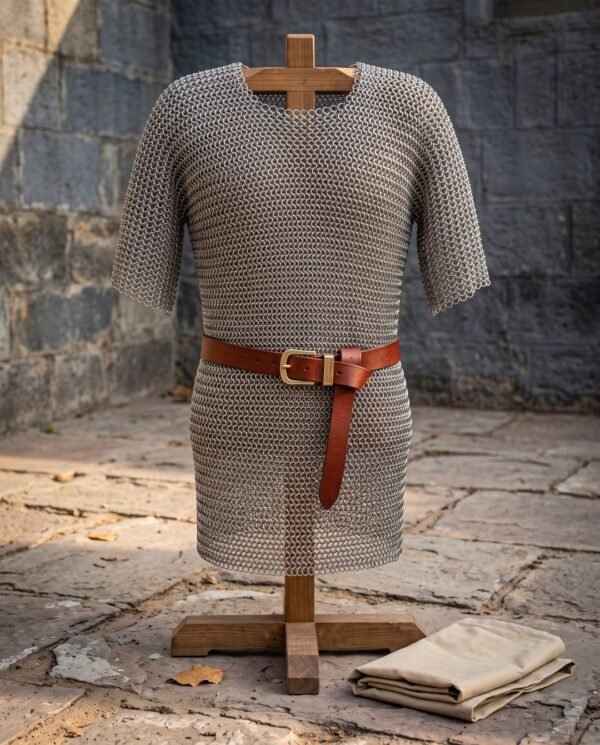
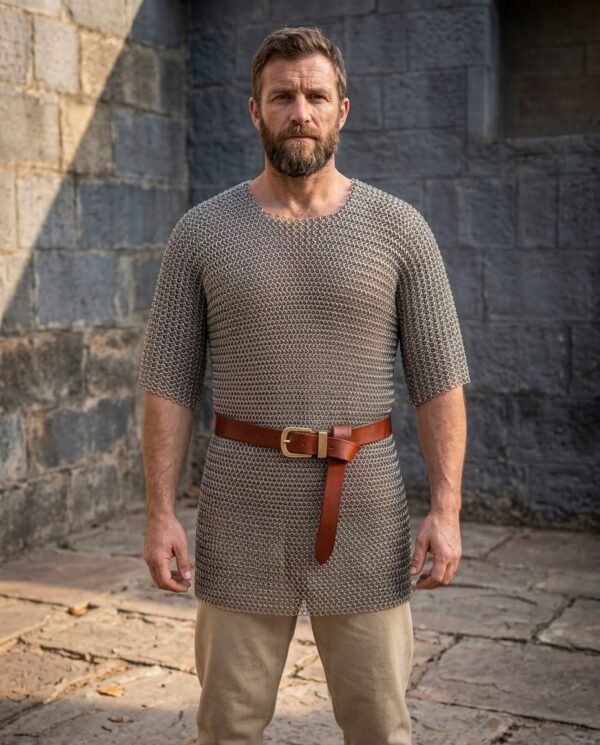
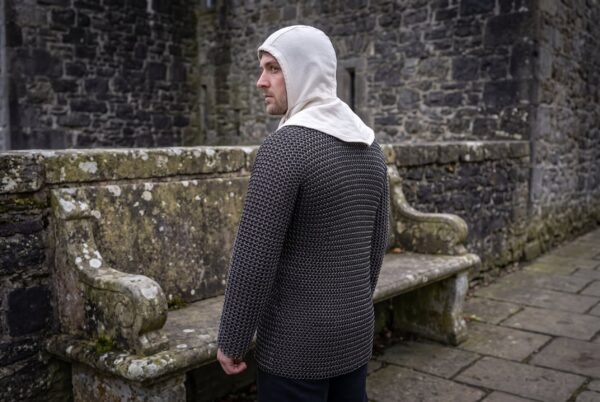
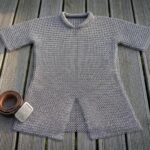
A full length mail shirt woven in the four in one pattern, cut with short sleeves to the elbow, a low standing collar and a skirt that reaches the middle of the thigh, split front and back so you can sit, run or ride in it. The rings are small, about 9 mm across the inside, which gives a dense fine mesh that drapes and moves like heavy cloth rather than the coarse open weave you see on cheap costume mail. This is a hauberk in the proper sense, a body defence rather than a vest.
A small correction that most sellers never make. The word chainmail is a Victorian invention. For the whole period this armour was actually worn, people simply called it mail, from the old French maille and behind that the Latin macula, a mesh or a spot. Chain mail was coined by nineteenth century antiquarians who wanted to distinguish it from other things they had decided to call plate mail and scale mail, none of which are period terms either. We use the modern word because that is what you searched for, and it is worth knowing the real one. Woven, closed and finished in a Czech Republic workshop. The brown leather belt with the engraved steel buckle seen in the photographs comes with it. What was worn over mail and what went under it is set out in our piece on Viking armour.
Specifications
| Item type | Butted chainmail hauberk, thigh length |
|---|
| Material | Mild steel wire rings, bright finished |
|---|
| Ring type | Butted round ring, closed edge to edge, not riveted and not welded |
|---|
| Ring size | Approximately 9 mm inside diameter in 16 gauge wire |
|---|
| Weave | Four in one, the standard European pattern |
|---|
| Cut | Short sleeves to the elbow, low standing collar with a small front opening, thigh length skirt |
|---|
| Skirt | Split front and back for sitting, walking and riding |
|---|
| Belt | Brown leather belt with an engraved knotwork steel buckle, included |
|---|
| Size or fit | Made to a stated chest measurement and body length |
|---|
| Weight | Approximately 18 to 24 pounds depending on the size built |
|---|
| Lining | None, mail is worn over a padded gambeson |
|---|
| SKU | RK-1519 |
|---|
Butted or riveted, and why it matters more than anything else here
This is butted mail, and you should understand exactly what that means before you buy it. Every ring in a mail shirt has to be closed. In butted mail the two ends of the ring are brought together and left touching. In riveted mail the ends are overlapped, flattened and pierced, and a tiny rivet is set through the overlap so the ring is mechanically locked shut. Riveted mail is the historically correct method and it is many times stronger, because a thrust that meets a butted ring can spring it open where a riveted ring holds.
So be clear about use. Butted mail is not safe for full contact reenactment combat and it must not be used where a spear point, an arrow or a hard thrust could land. It will open, and it will open at the worst moment. What butted mail is genuinely good for is everything else. It looks correct at any distance a photograph or an audience will ever see, it drapes and sounds exactly like mail because it is mail, it costs a fraction of riveted, and it is right for display, film and stage, LARP where thrusts are prohibited, museum mannequins, living history where you are not being hit and costume of every kind. If you need mail you can be hit in, buy riveted, and expect to pay several times this price.
The four in one weave itself is worth a word. Every ring passes through four others, two above and two below, so the mesh has no straight line through it and no gap larger than a ring. That pattern turns up on Celtic finds, on Roman lorica hamata, on Viking age shirts and on late medieval hauberks essentially unchanged. Very few pieces of technology stay correct for two thousand years.
The steel and the making
The rings are drawn mild steel wire at about 16 gauge, coiled, cut and closed. Mild steel rather than a hardened alloy is the right call for butted mail, because a spring hard butted ring is more likely to snap than to deform and a mild ring can be pinched closed again with pliers when one does open. Expect to close a handful of rings over the life of a shirt, which is normal maintenance for mail and not a defect.
A hauberk at this ring size runs to tens of thousands of rings. That is the real reason mail was expensive in period and is expensive now, and it is why the price of mail scales with how small the rings are rather than with how much steel is in it.
Engraving, runes and your own design
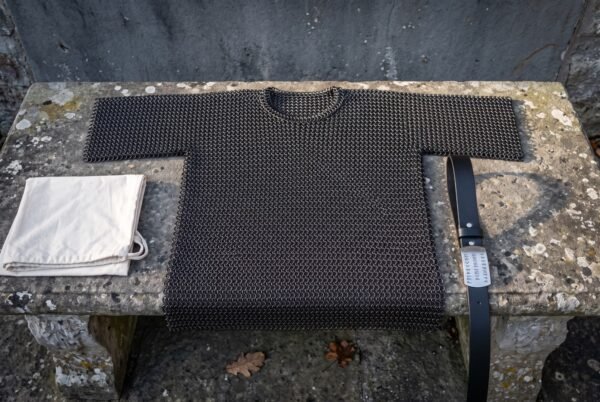
Use the rune converter on this page to turn a name, a date or a short phrase into Elder Futhark and we will cut it into the steel or the leather. If you would rather have a Viking pattern than a rune line, choose your own design in the engraving option above the add to cart button and tell us where it goes. Where a piece already carries an engraved design, your chosen engraving replaces it rather than sitting alongside it. Mail itself cannot be engraved, so for this piece we cut your line into a small steel or brass tag woven into the hem or into the collar edge, which is how owners marked a shirt in period as well. See the engraving page.
Fit and sizing
Mail is more forgiving than plate but the two measurements that matter are chest and body length. Give us your chest circumference measured over the gambeson you will wear underneath, and the length you want from the top of the shoulder to the hem. Mail hangs from the shoulders, so a shirt that is too long simply loads more weight onto them, and a shirt that reaches past mid thigh will slap your legs when you walk.
Wear a belt over it. That is not decoration, it is load management. A belt cinched at the waist transfers a good part of the shirt weight off your shoulders onto your hips, and it is the difference between a comfortable day and a sore neck by lunchtime. Never wear mail directly over a shirt or bare skin. A padded gambeson stops the mesh pinching, spreads the load and is half of the armour system.
Care
Mail rusts because it is thousands of small steel surfaces with air between them. The good news is that mail also cleans itself when it moves. Store it hanging on a broad hanger or rolled loosely, never crushed in a damp bag. After a wet or sweaty day, dry it thoroughly, then wipe it over with an oiled cloth or tumble it in a bag with oiled rags. If surface rust does take hold, the traditional fix still works, which is to put the shirt in a barrel or a stout sack with clean sand and roll it until the rings polish each other. Oil after every cleaning. The rust and oiling advice on steel care applies here too. The sand tumble and the rest of the routine are set out in caring for chainmail and steel armour.
Made in the Czech Republic
This is a handmade piece from the Czech Republic, made in a workshop that still forges, grinds and finishes by hand instead of stamping parts out. The smiths there have kept the older way of working, and the wood, horn and leather are shaped and fitted by hand as well. Two pieces of the same design will never be identical, and that is part of what you are buying.
Ransack Viking is a United States company. We handle the import ourselves, look over every piece when it lands and ship from our warehouse in Chicago, Illinois. Engraving is done in the United States after the piece arrives, so your design goes on before we send it out.
A note on handmade variation
This is hand made, not machine made or bulk produced, so what arrives will not be a pixel for pixel copy of the photograph. Ring count and hem line shift with your size, the drape is different on every body, and the brightness of the finish changes as the shirt is worn and cleaned. The dimensions, the material and the build are the same every time. The character is not.
Frequently asked questions
Is this riveted or butted mail
Butted. The ring ends are closed edge to edge rather than riveted through an overlap. That makes it far more affordable and it also makes it unsuitable for combat where anything can be thrust into it.
Can I fight in it
Not full contact, and not anywhere thrusts are allowed. It is right for display, film, stage, museum mounts, living history and LARP systems that ban thrusting. For contact fighting you need riveted mail and league approved kit.
What do I wear under it
A padded gambeson, always, and a belt over the top. The gambeson stops the mesh pinching and carries the load, and the belt moves weight from your shoulders to your hips.
How heavy is it
Between about eighteen and twenty four pounds depending on the size we build. That sounds a lot and it is manageable, because a belted hauberk spreads its weight over your whole torso rather than hanging from one point.
What happens if a ring opens
You close it with a pair of pliers, and that is normal for butted mail rather than a fault. Send it back if a seam or a whole area fails and we will repair it under warranty.
How long does it take to make
One to two weeks of processing because each shirt is woven to your measurements, then shipping is free inside the United States.
What is in the box
- One butted mild steel chainmail hauberk in four in one weave
- Brown leather belt with an engraved steel buckle
- Short sleeves, standing collar and a skirt split front and back
- Spare rings for repairs
- Care sheet for storing, drying and oiling mail
- Lifetime warranty against defects in weave and construction
- Made and finished in the Czech Republic
Explore the range
See more in chainmail armor, viking armor, brigandine and gambeson and plate armor, or read the guides on mail sizing and care.
Also in this part of the catalogue
A near match for this one is the Ringmantle chainmail armor. Closest to this in the range is the Grimhold chainmail armor. If this one is not quite right, there is the Nightweave chainmail armor.
The Vendelgaze Viking helmet covers the other half of the same kit. Or start from a blank sheet on the design your own page.



Incredible craftsmanship on this one. Love that this is Czech craftsmanship and shipping from the US meant it showed up in just a few days. Couldn’t be happier with this.