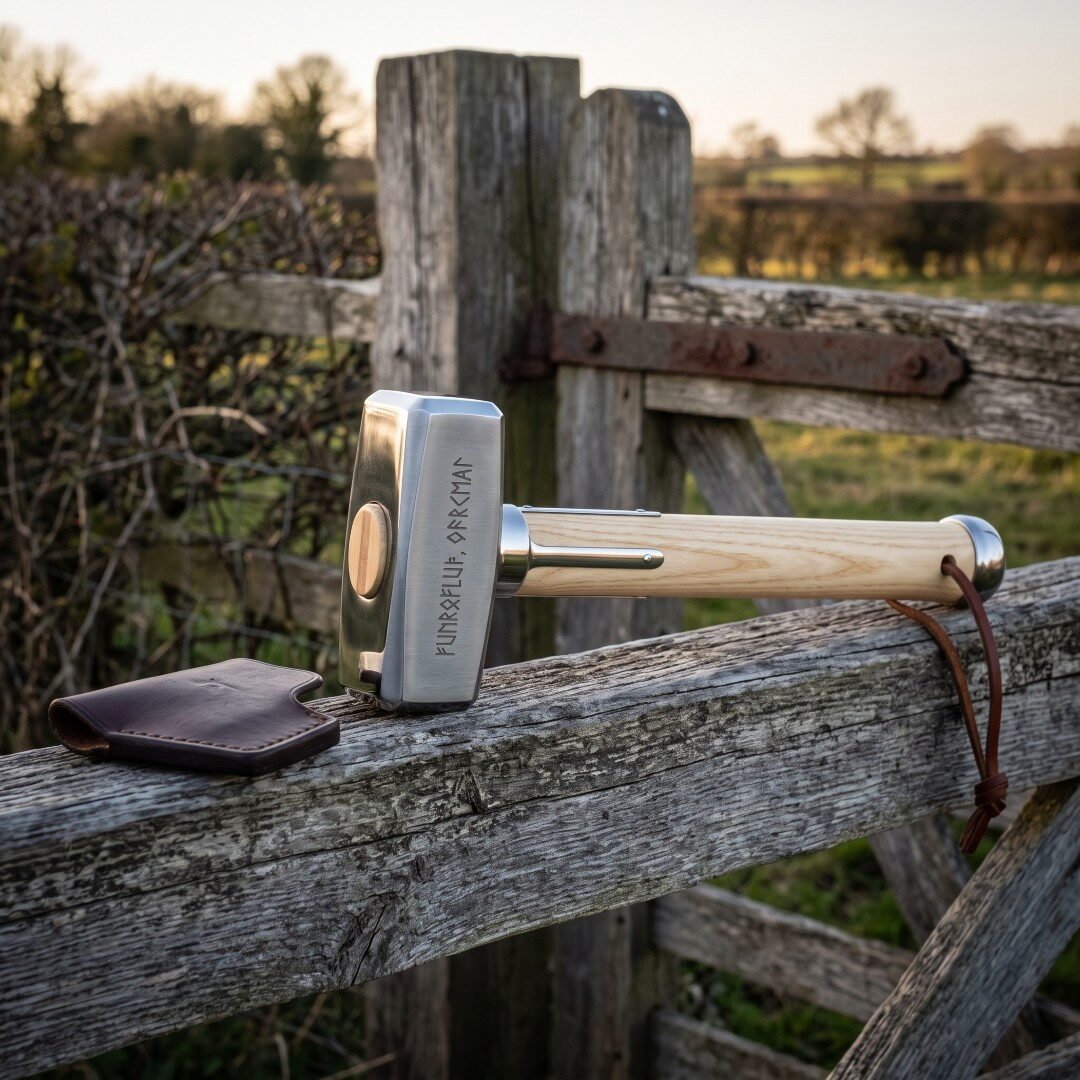
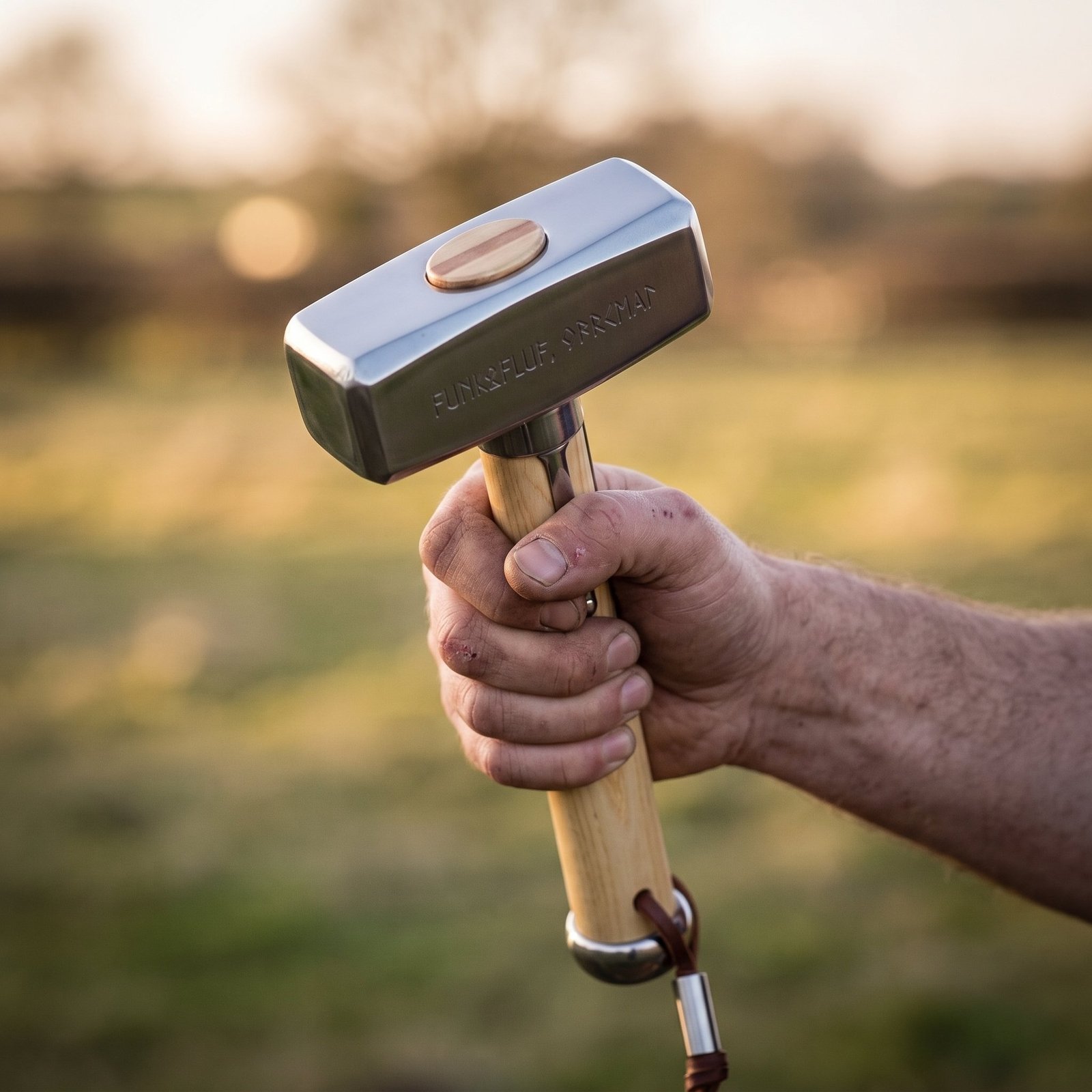
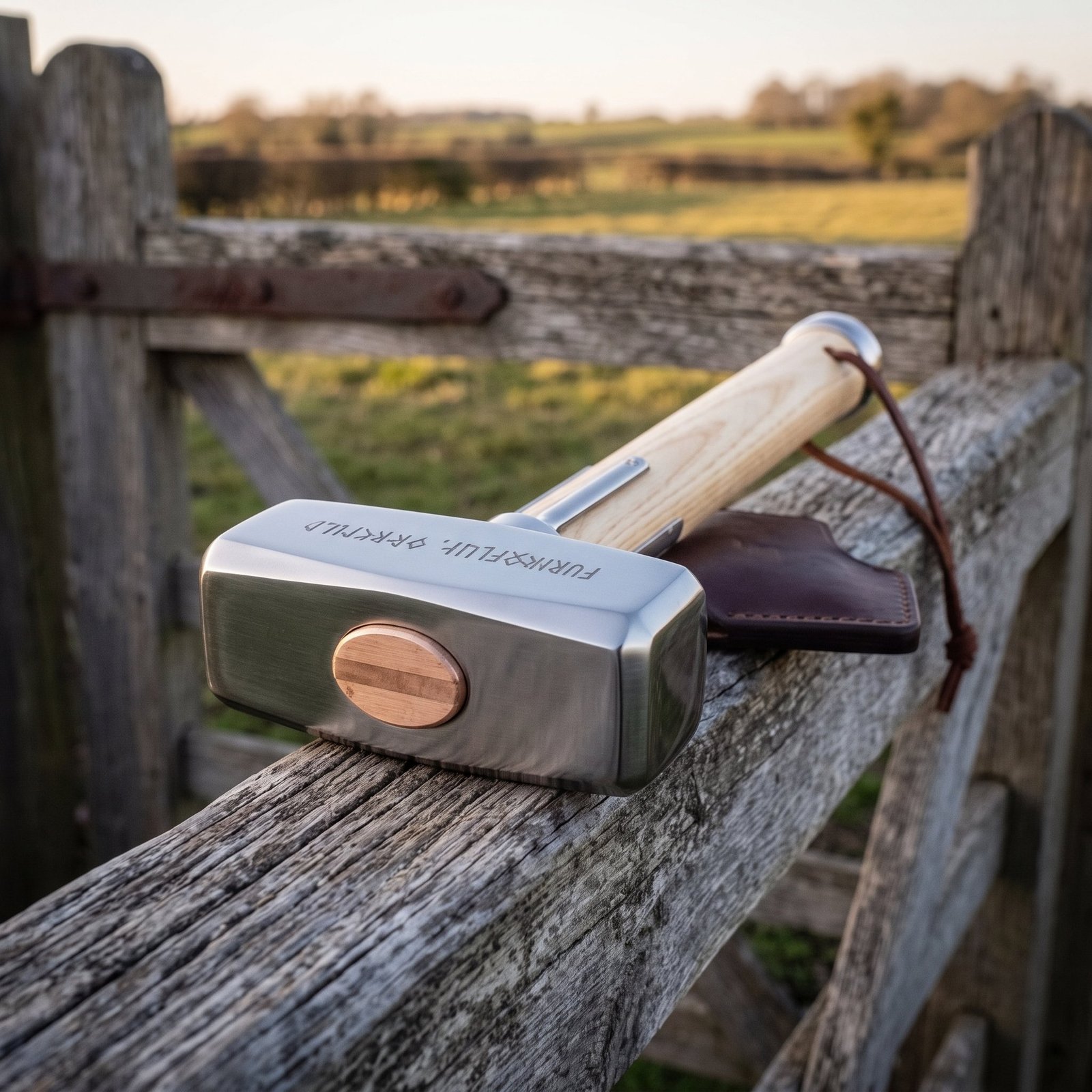
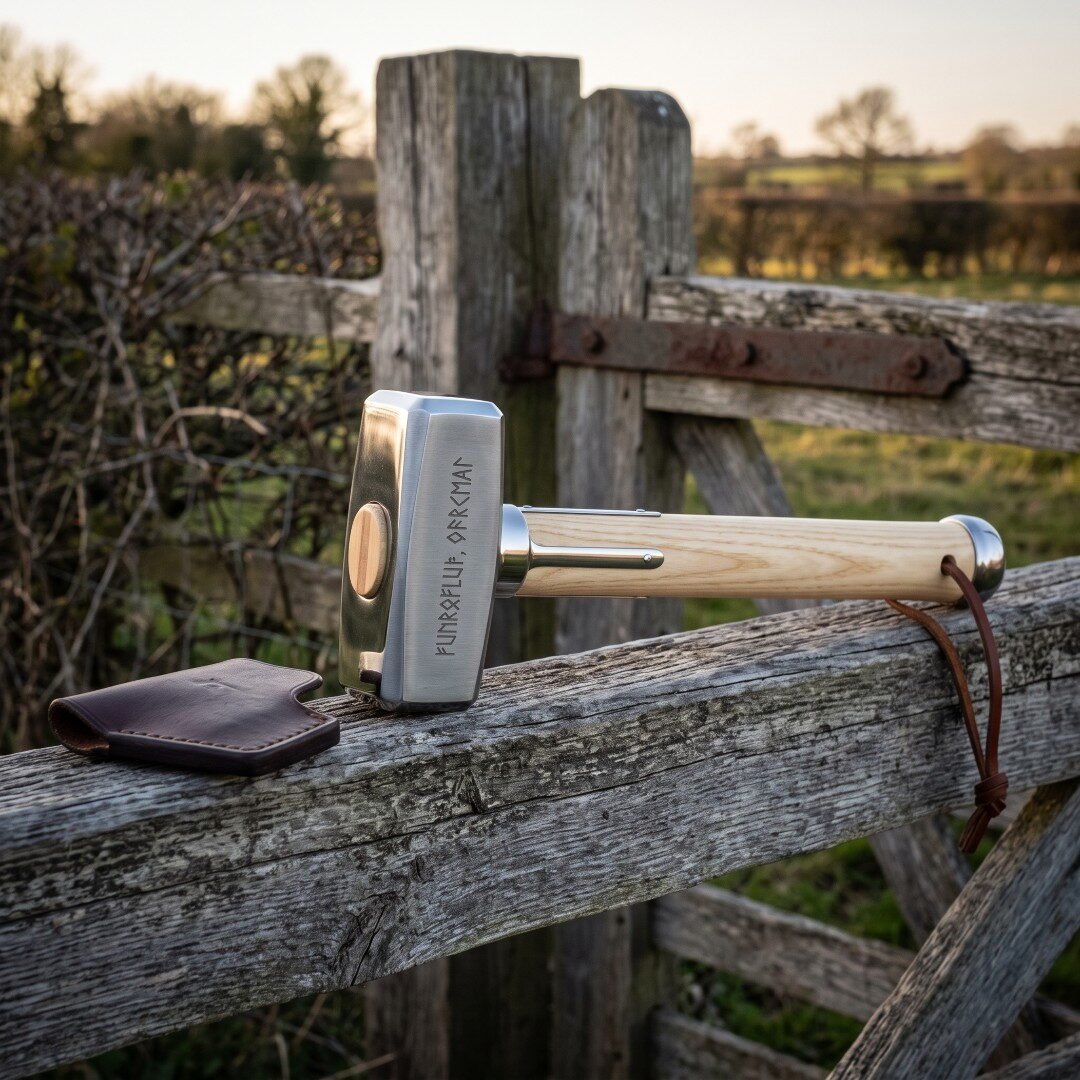
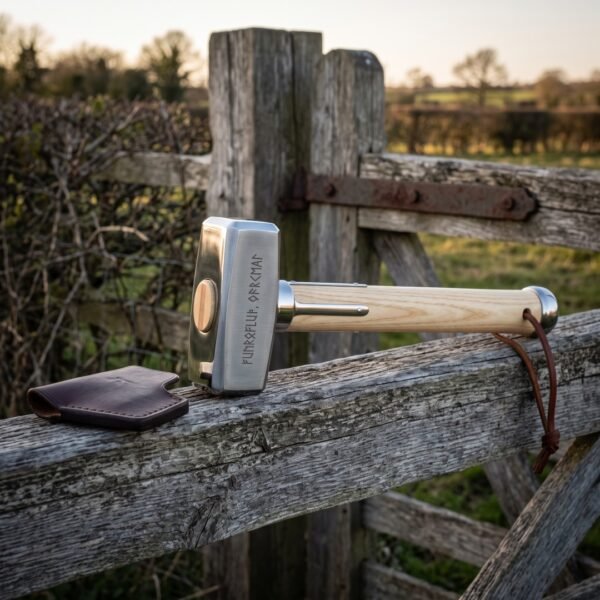
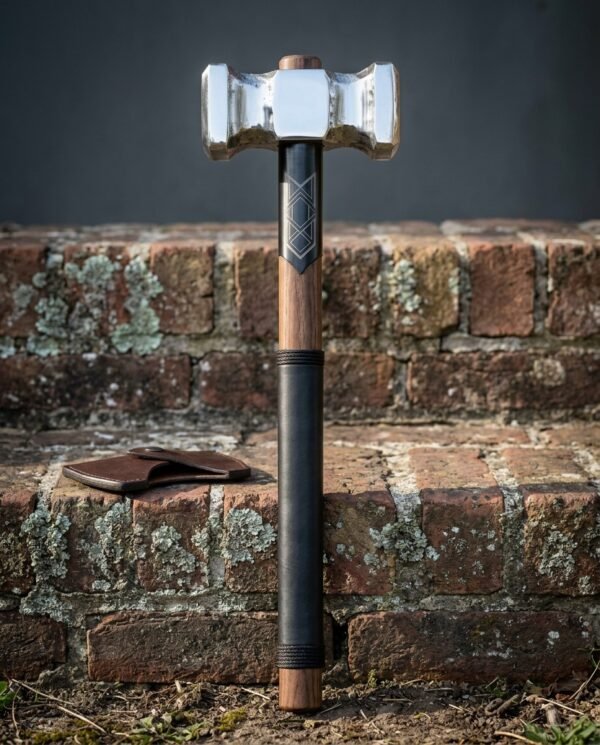
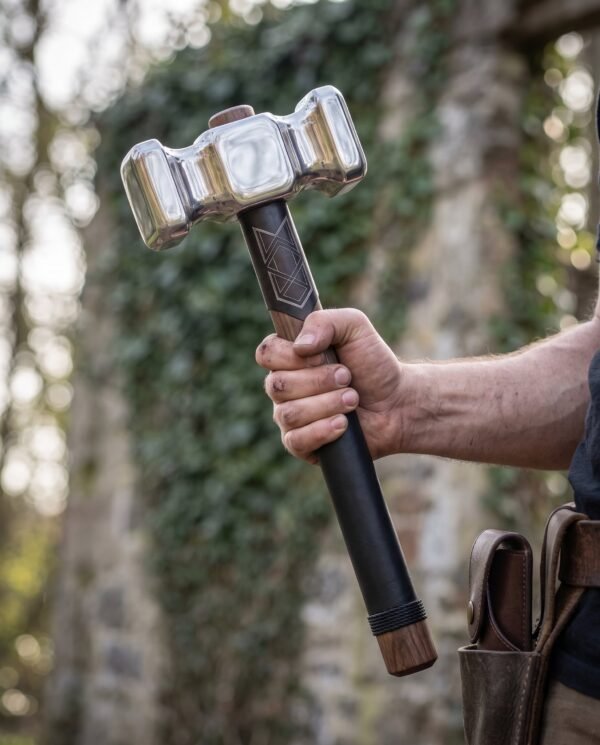
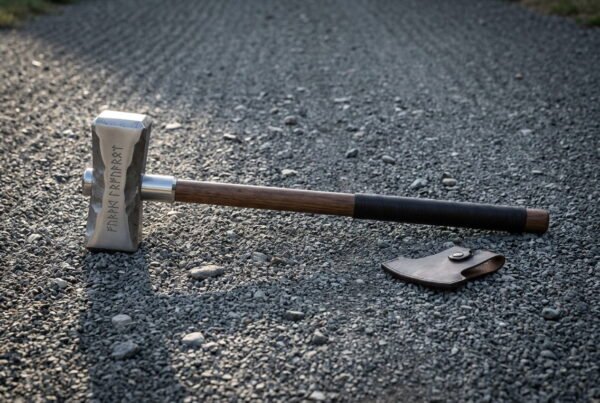
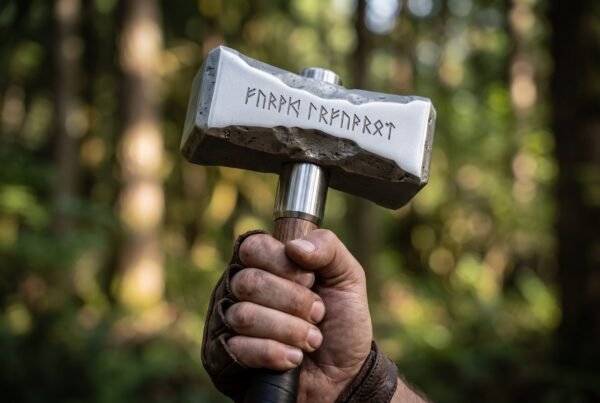
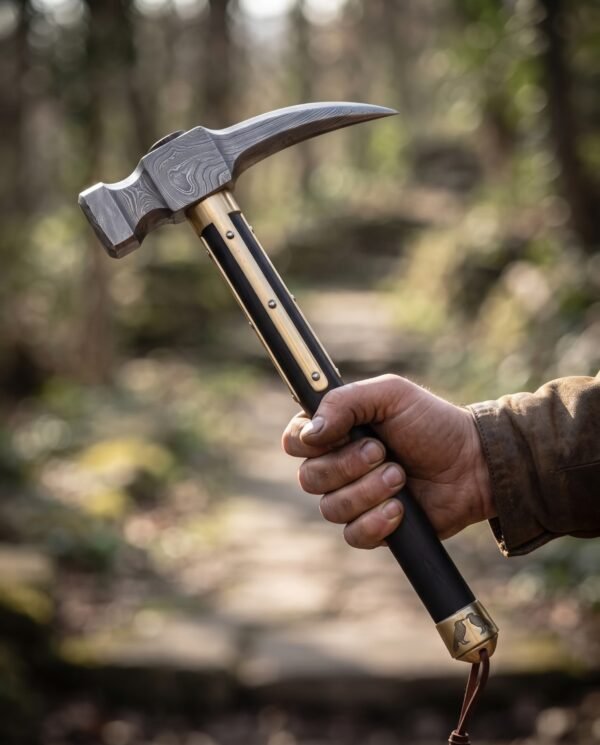
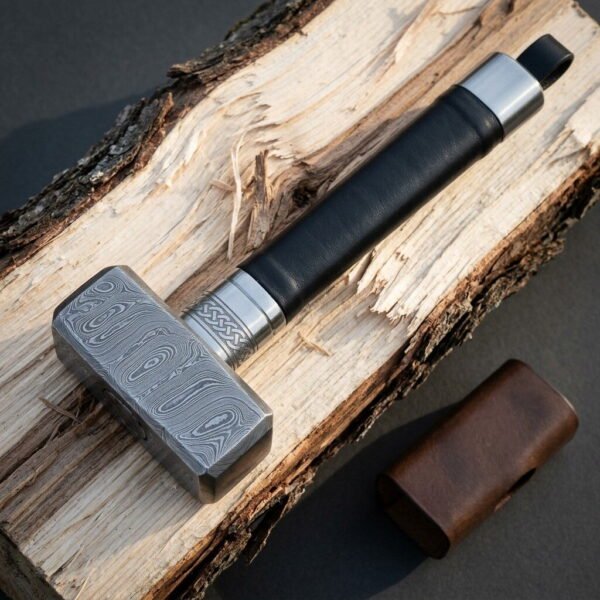
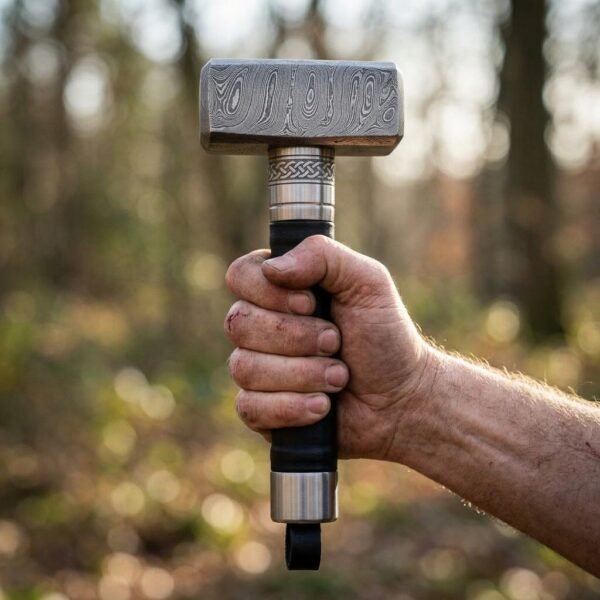
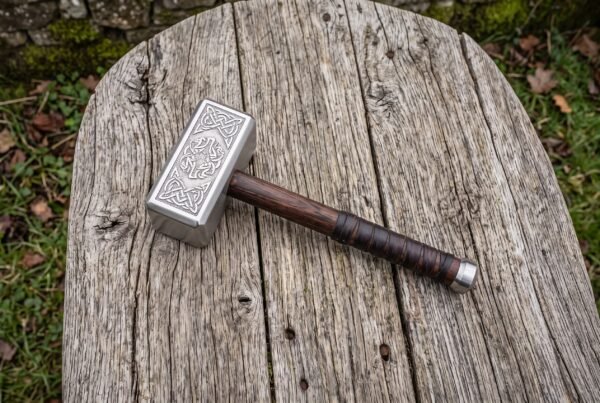
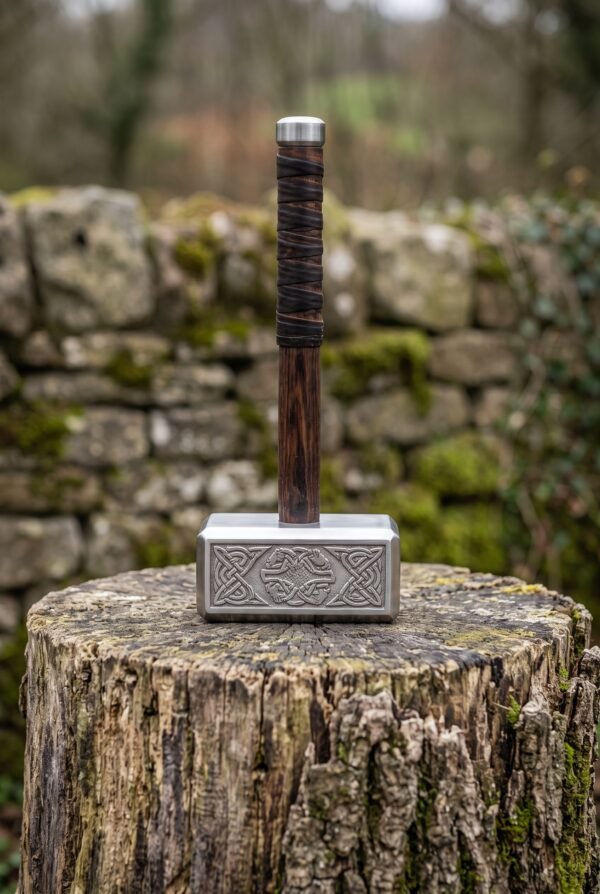
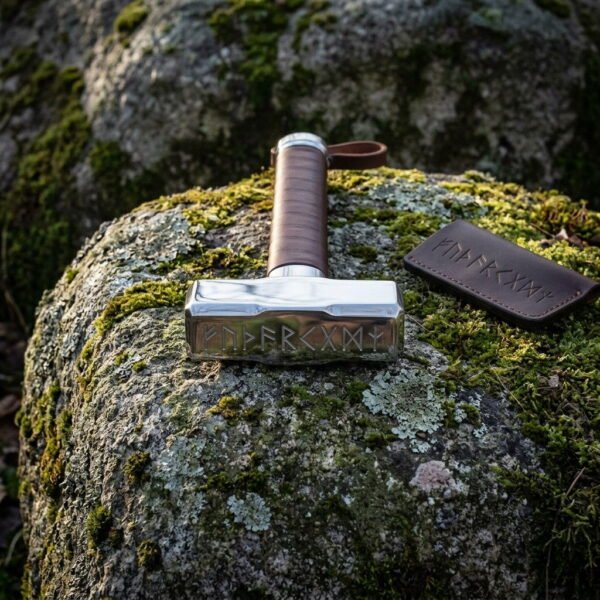
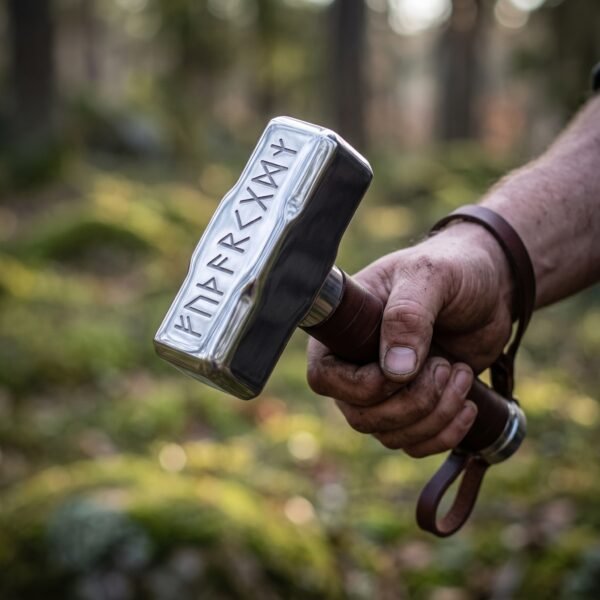
This is a hand forged war hammer with a squared polished steel head, a line of Elder Futhark runes cut into each of two faces of the head, a straight ash haft with a steel collar at the throat and a steel butt ferrule, and a leather lanyard through the end. A shaped leather cover is supplied so the head can be stood against a wall or carried without marking anything.
Something worth knowing about the runes on the side. Elder Futhark is the row we cut, and it takes its name the way the alphabet does, from its own first six letters, fehu, uruz, thurisaz, ansuz, raido and kaunan. It was in use roughly from the second century to the eighth. By the Viking age proper the Norse had actually moved to the Younger Futhark, a shorter row of only sixteen runes, which is why real Viking age inscriptions look sparser than most people expect. We cut Elder Futhark because its twenty four characters map far more completely onto a modern name, and we would rather tell you that than pretend otherwise. This hammer is forged, ground, engraved and hafted in a Czech Republic workshop. This one is kept with the Thor’s hammers, and the Mjolnir pendants sit right beside it.
Specifications
| Head material | 1095 high carbon steel, polished |
|---|
| Hardness | 54 to 58 HRC |
|---|
| Head form | Rectangular block head with chamfered edges, the wedged haft end showing through the eye |
|---|
| Engraving | Elder Futhark rune line cut into two faces of the head |
|---|
| Collar | Steel collar at the throat with a steel strap running down the haft |
|---|
| Haft | Straight pale ash, clear finished |
|---|
| Butt | Domed steel butt ferrule |
|---|
| Lanyard | Brown leather thong through the butt with a knotted stop |
|---|
| Finish | Polished steel head, clear finished pale ash |
|---|
| Included | Dark brown shaped leather head cover |
|---|
| Intended use | Display, collection and ceremonial gift piece |
|---|
| SKU | RK-1635 |
|---|
How a head is hung on a haft
The join between steel and wood is where a hafted tool lives or dies, and it is worth understanding what you are looking at. The head has an eye drifted through it, meaning a tapered punch was driven through hot steel to open a hole rather than a hole being drilled out, which leaves the grain of the metal flowing around the opening instead of cut across it. The ash haft is shaped to that eye, driven in from below so the taper wedges tighter under load, and then locked with a wedge driven down into the end grain from the top.
The steel collar under the head is doing two jobs. It reinforces the throat, which is the thinnest and most stressed part of any haft, and it protects the wood from the overstrike that eventually chews the neck off an unprotected handle. The butt ferrule stops the end of the haft splitting if the piece is ever stood down hard, and the lanyard is there so it can be hung on a peg. Handsome, and all of it structural.
The steel and the ash
The head is 1095 high carbon steel, forged, drifted, ground and then hardened and tempered to 54 to 58 HRC. That is a deliberately lower and tougher range than we use on a knife blade. A hammer head wants to bend rather than chip, and taking the temper back a little buys toughness at the cost of edge holding, which a hammer does not need.
The haft is ash, which is the traditional handle timber across northern Europe and still the best answer for the job. Ash is a ring porous hardwood, which means its growth rings alternate between open spring vessels and dense summer wood, and that layered structure lets it flex and absorb shock instead of transmitting all of it into the hand. It is also straight grained and splits predictably, so a haft can be riven along the grain rather than sawn across it, which is why a properly made ash handle does not shear the way a sawn one can.
Engraving, runes and your own design
Use the rune converter on this page to turn a name, a date or a short phrase into Elder Futhark and we will cut it into the steel, the leather or the wood. If you would rather have a Viking pattern than a rune line, choose your own design in the engraving option above the add to cart button and tell us where it goes. Where a piece already carries an engraved design, your chosen engraving replaces it rather than sitting alongside it. On this hammer that means your line goes where the stock rune lines sit on the head, and the opposite face is free for a second inscription or a date. See the engraving page.
Handling and balance
Everything heavy on this piece is at the far end, which is what a hammer is. Held at the butt it feels long and slow and it wants to swing itself. Slide the hand up until the fingers touch the steel collar and it turns quick and controlled, which is the grip most people settle on when they pick one up. The chamfers on the head are not only decoration. They take the sharp arris off the corners so the piece can be leaned against a shelf or handed across a table without gouging anything.
Please treat it as a display and ceremonial piece rather than a working tool. The head is hardened steel and the haft is a fitted wooden handle, and neither is designed to take repeated impact against another hard object. It is not for sparring and we make no battle ready claim for it.
Care
The head is high carbon steel and it will rust if it is left damp or handled and put away wet. Wipe it after handling and put a thin film of mineral oil or light gun oil on it, especially into the cut rune lines where moisture collects. Do not leave it inside the leather cover in a humid room for months, because leather holds water against steel. If a bloom of orange appears, a nylon pad with oil takes it off without dulling the polish. The ash haft wants a wipe with a dry cloth and a light coat of boiled linseed or hardwood oil once a year, which keeps it from drying and shrinking away from the collar. Full detail is on the steel care page.
Made in the Czech Republic
The work behind this piece happens in a Czech Republic workshop that has kept to the old methods. Steel is forged and heat treated by hand, the grind is taken down by eye rather than by machine, and the handle, fittings and sheath are cut and finished one at a time. Because of that, every piece carries small marks of the hand that made it.
Ransack Viking is a United States company. We import direct, check each piece when it reaches us, and ship from our Chicago, Illinois warehouse. Engraving is added here in the United States after arrival, so the piece you receive is finished to your order.
A note on handmade variation
This hammer is hand made, not machine made and not bulk produced, so what arrives will not be a pixel for pixel copy of the photograph. Ash is a natural timber and every haft carries its own grain lines, colour and figure, some pale and even and some with darker streaks through the heartwood. The forged head shows faint hammer texture under the polish, the chamfers are cut by eye so their width varies slightly, and the rune lines are cut by hand so no two read with quite the same depth. The dimensions, the steel, the heat treat and the fittings are the same every time. The character is not. Read what Mjolnir meant when you have a minute, and the Norse symbols and what they meant if you are still comparing.
Frequently asked questions
Can I actually hit things with it
No. This is a display, collection and ceremonial piece. The head is hardened and polished and the haft is finished for looks as well as strength, and neither is meant for repeated impact. Use a hardware store hammer for hardware store jobs.
What do the runes say
The stock lines are Elder Futhark characters. If you want a specific word, name or date, run it through the rune converter on this page and we will cut yours in place of the stock line.
Is the head Damascus
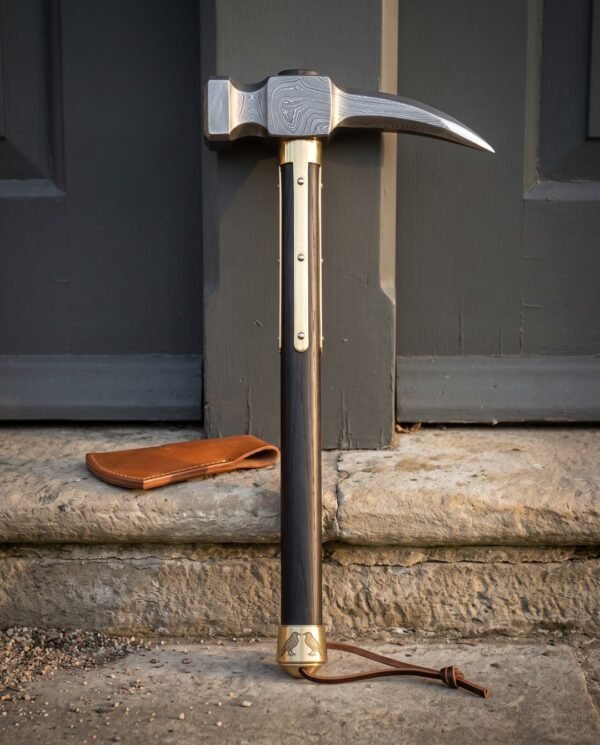
No. This one is plain 1095 high carbon steel taken to a bright polish. If you want a layered pattern welded head, look at the Damascus hammers in the same category.
Will the haft loosen over time
It should not. The head is hung on a tapered eye and wedged, and the steel collar supports the throat. If a haft ever does move, that is a fitting defect and the lifetime warranty covers it.
Does it come with something to hang it on
It comes with a leather lanyard through the butt, which will take a peg or a hook. There is no wall bracket included.
How long before it ships
One to two weeks of processing in the shop, then free shipping inside the United States. Engraving adds a few days.
What is in the box
- Hand forged 1095 steel war hammer with rune cut head
- Ash haft with steel throat collar, steel butt ferrule and leather lanyard
- Shaped leather head cover
- Care card for high carbon steel and ash
- Lifetime warranty against defects in forging, grind, heat treat and fittings
- Forged and finished in the Czech Republic
Explore the range
See more in Thors hammers, the Norse arms and the engraved and personalised pieces, or read the guides on Elder and Younger Futhark.
If this one is not it
Another in the same line is the Anvilwake Thor hammer, forged from 1095. Next along the rack is the Thunderhide Thor hammer, 16 inches overall. For a straight comparison, see the Ladderpeen Thor hammer, 15 inches overall.
The Ravenbeak mace covers the other half of the same kit. Pick the steel, the length and the fittings yourself on the custom Norse arms page.

Does the job but I wasn’t blown away. Fine for display though the haft felt a little light. Decent for the price but not the heaviest build I’ve seen. It’s Czech made and US shipped. Packaging was just okay though. Neutral on this one overall.
This war hammer is a genuine work of art. Finish on the metal is even and clearly hand forged. Great buy overall.
My husband was speechless when he opened this. Steel head is heavy in a good way. You can tell it’s not hollow. Can’t recommend this enough.