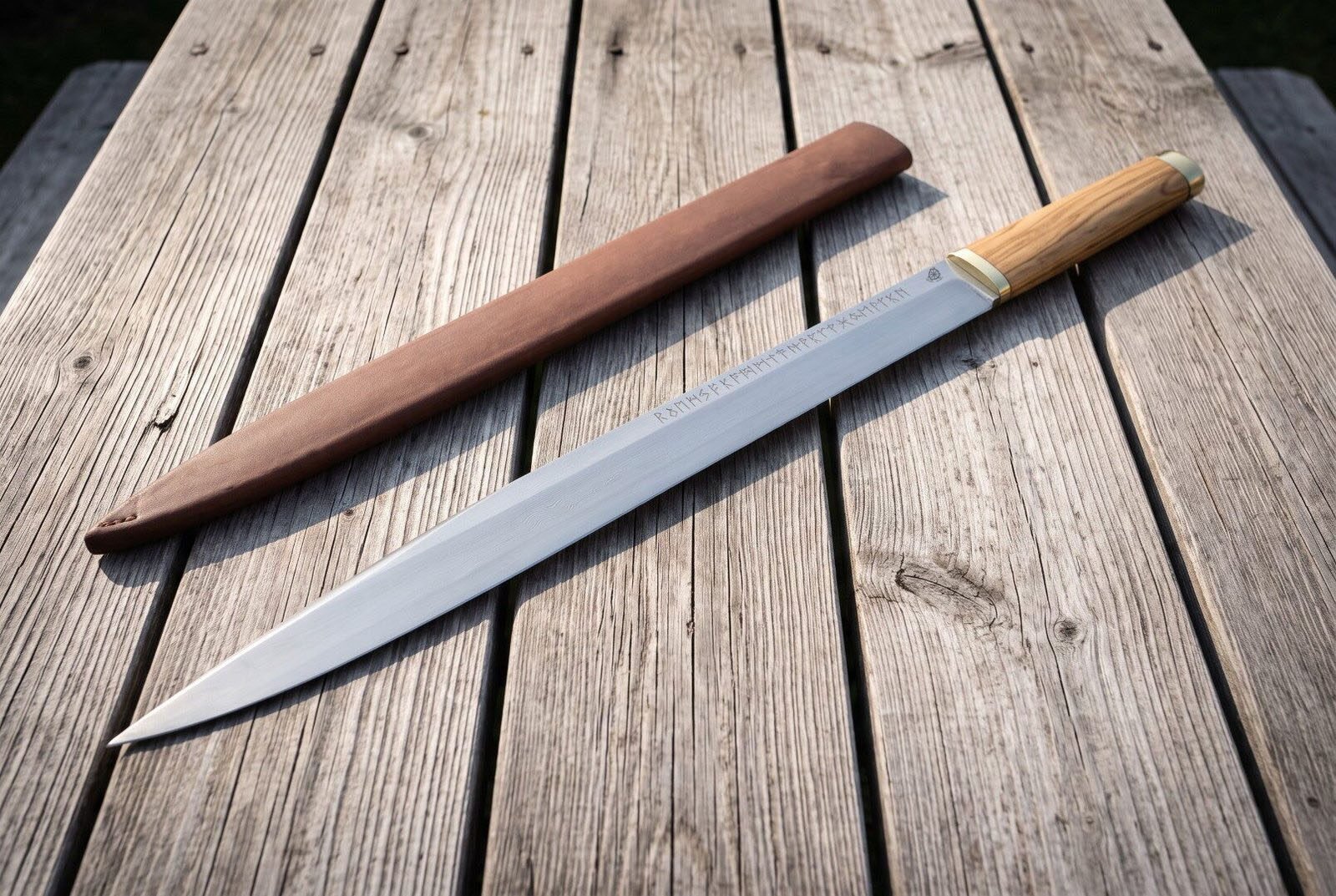
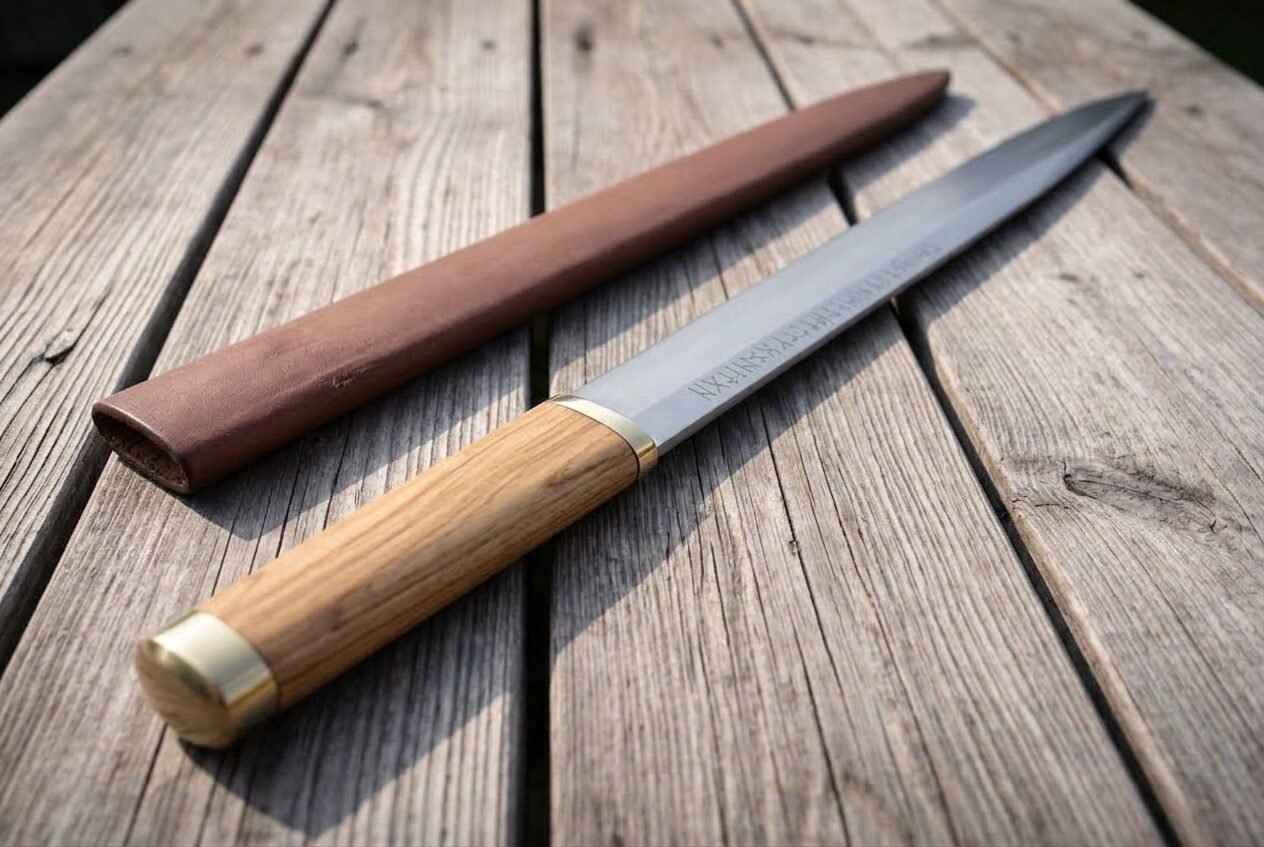
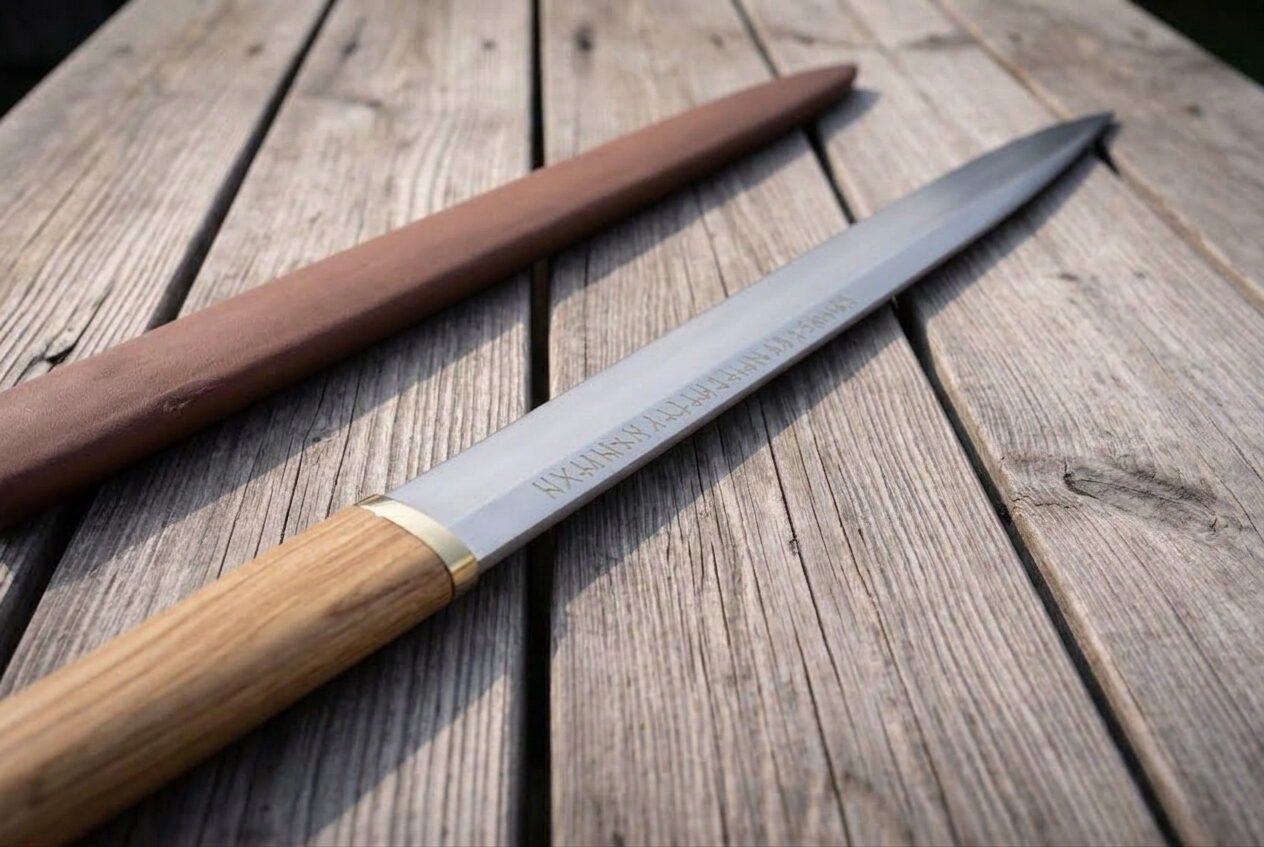
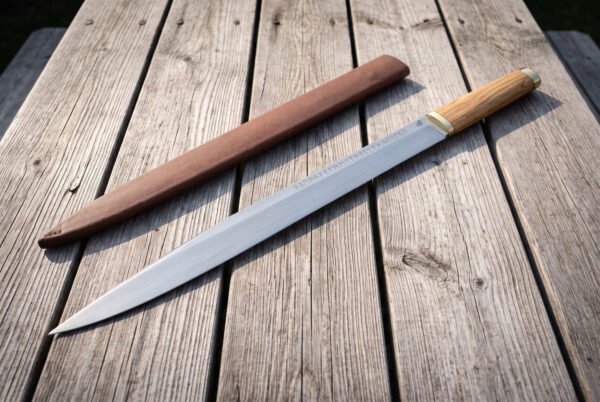
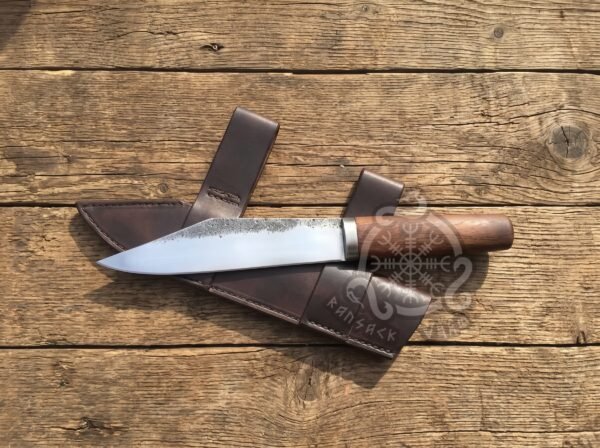
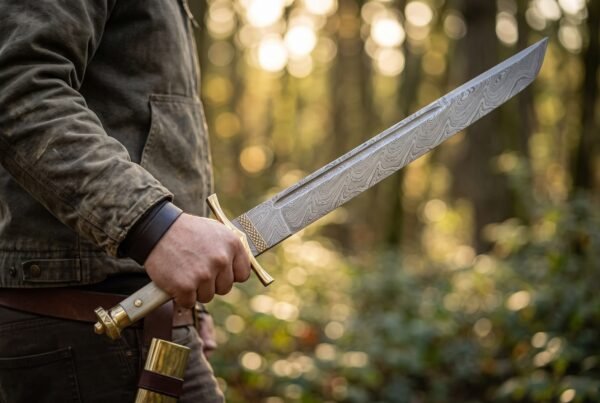
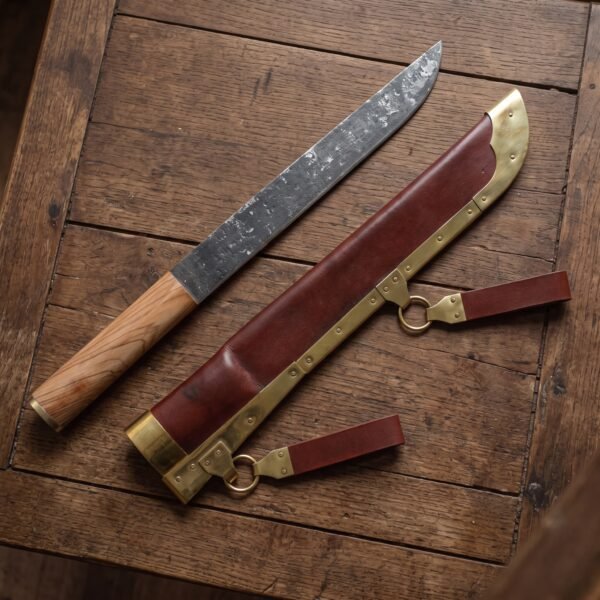
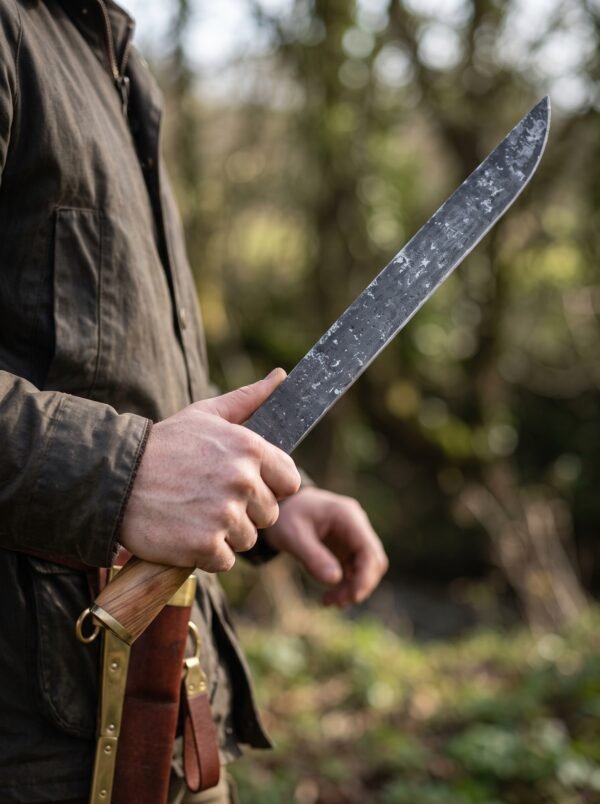
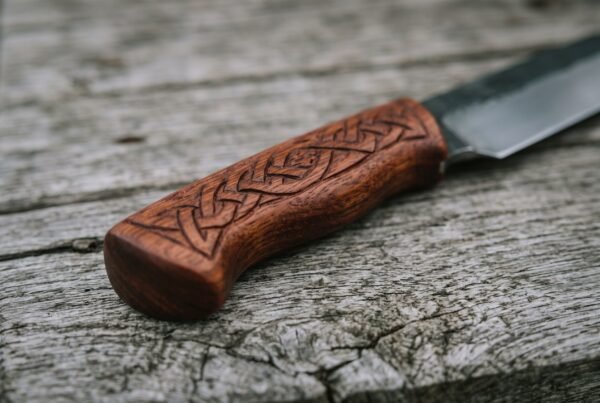
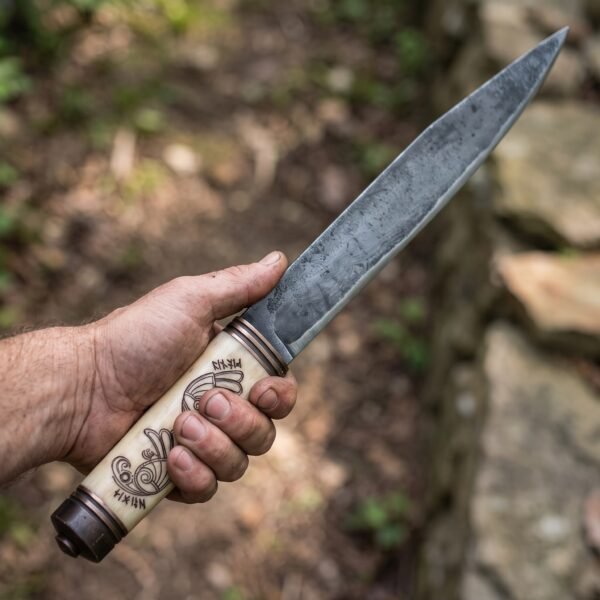
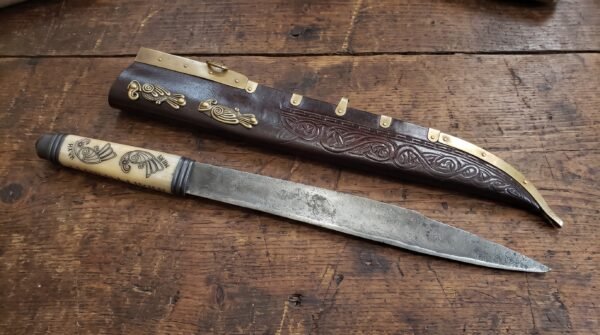
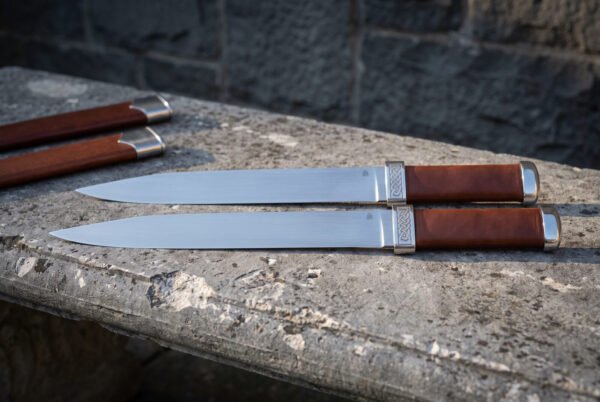
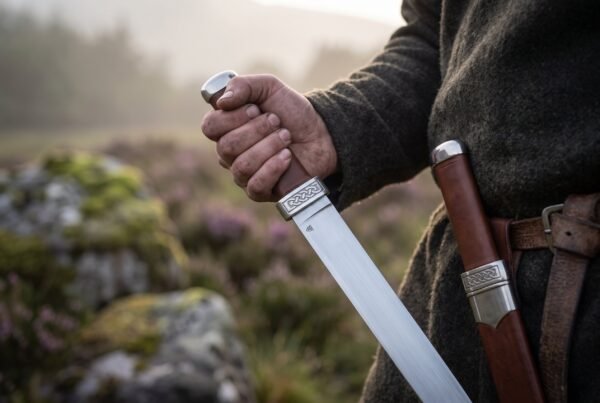
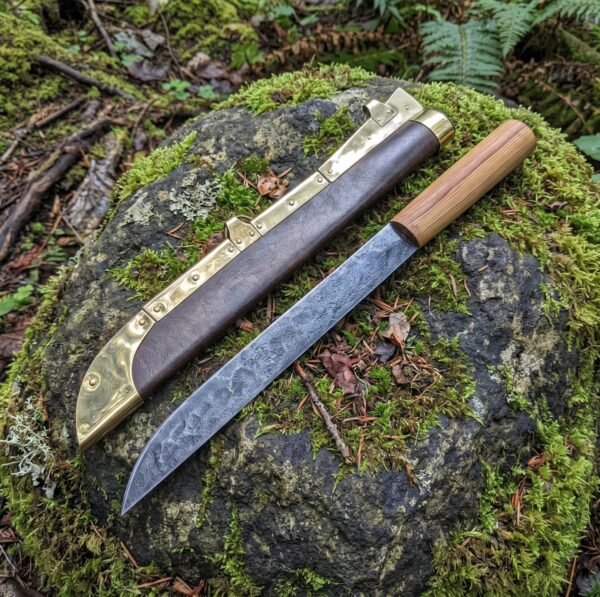
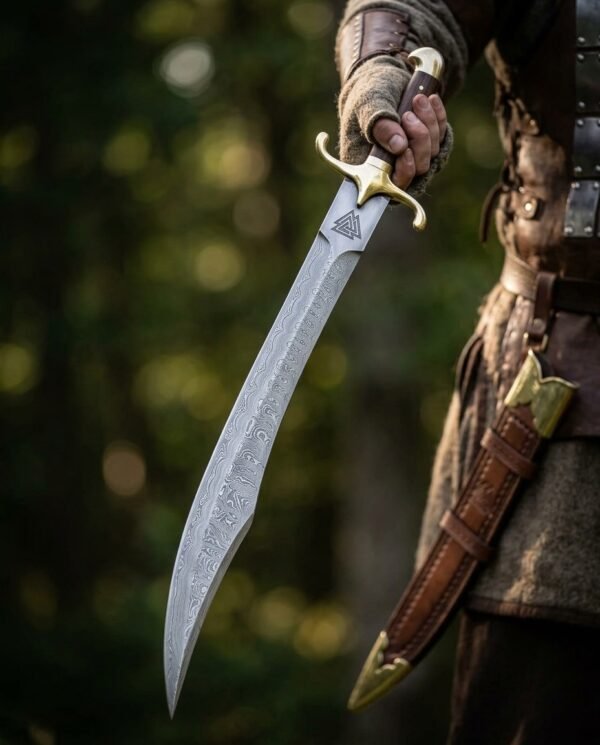
The Runescar is a langseax, the long form of the single edged knife that gives the Saxons their name. Fifteen inches of 1095 high carbon steel, straight along the spine for most of its length and then dropping in a long clip to the point, with a single edge that runs the whole way and a full line of Elder Futhark cut just below the spine. The handle is olive wood with a brass ferrule, and it comes with a shaped leather sheath.
The most famous surviving example of this class is the Seax of Beagnoth in the British Museum, a tenth century blade found in the Thames with the complete Anglo Saxon futhorc inlaid in silver and brass along one side, followed by a name. It is the only complete futhorc inscription of its kind that has ever been found, and it makes a plain point about these knives. A seax was worn horizontally at the belt where everyone could see it, so it was a place to put your name. The Runescar is forged, ground, heat treated, engraved and fitted in a Czech Republic workshop, with our lifetime warranty against defects in forging, grind, heat treat and fittings, no end date and no receipt needed. Filed under the seax knives, and the Bowie knives are the other half of that shelf.
Specifications
| Blade material | 1095 high carbon steel, 54 to 58 HRC |
|---|
| Blade length | Approximately 15 inches |
|---|
| Overall length | Approximately 20 inches |
|---|
| Blade width | Approximately 1.6 inches at the widest |
|---|
| Grind | Single edge with a broad flat bevel and a straight spine |
|---|
| Handle | Olive wood over a full length tang, oil finished |
|---|
| Fittings | Brass ferrule and a brass butt collar |
|---|
| Engraving | Elder Futhark line cut along the flat below the spine |
|---|
| Included | Shaped leather sheath |
|---|
| SKU | RK-1596 |
|---|
What makes a seax a seax
Three things, and none of them is decoration. The first is the single edge. A seax has one cutting edge and a thick unsharpened spine, which puts all the available steel behind the cut. Weight for weight it will chop and split better than a double edged blade of the same length, and it is far easier to sharpen because there is only one bevel to keep track of.
The second is the spine geometry. Some seaxes have the famous broken back, where the spine runs dead straight and then turns down at a sharp angle to meet the point. Others, like this one, keep the straight spine and bring the drop in as a long gentle clip. Either way the intent is the same. You get a strong straight spine for most of the blade, so it can be hammered or leaned on, and a point that sits close to the centreline so it drives forward rather than skidding.
The third is how it was carried. Seax sheaths were worn horizontally across the front of the belt with the edge upward, hung by two or three suspension points along the spine side. That is why so many blades in the record are heavily worn on one flat. They spent their lives being drawn against the leather in one direction. It also meant the blade sat where the wearer could reach it with either hand while sitting down, which a vertically hung knife cannot manage.
1095 steel and an olive wood handle
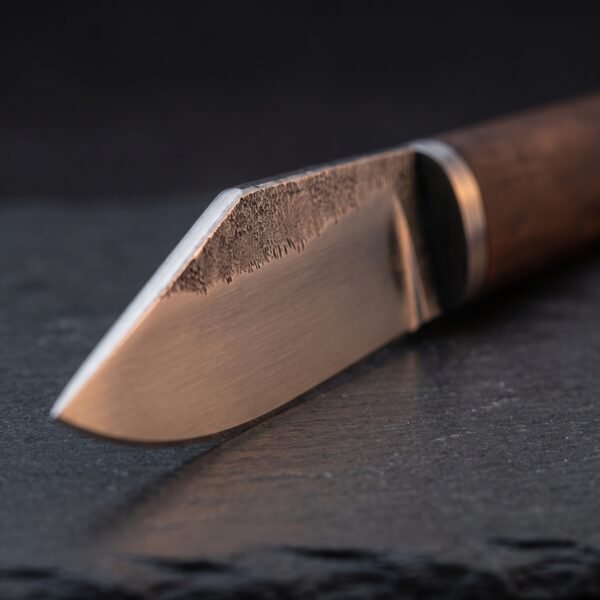
The blade is 1095 high carbon steel, forged, normalised, quenched in oil and tempered to 54 to 58 HRC. On a blade this long that hardness range is a deliberate compromise. Fifteen inches of steel takes real bending load when you chop, and a blade run to knife hardness through its whole length would be brittle where it matters. At this hardness the edge still takes a fine finish on a stone and the spine will bend before it breaks.
The grind is a broad flat bevel running from close to the spine down to the edge, which is the historically correct geometry and also the best geometry for cutting through anything thicker than paper. The rune line is cut after heat treat so the strokes stay sharp edged. The handle is olive wood, chosen because it is dense, oily and figured, so it wants very little finish and it does not swell or shrink the way an open grained wood does. It is fitted over a full length tang and capped in brass at both ends. The sheath is vegetable tanned leather, wet formed to the blade so it holds without a strap.
Engraving, runes and your own design
Use the rune converter on this page to turn a name, a date or a short phrase into Elder Futhark and we will cut it into the steel, the leather or the wood. If you would rather have a Viking pattern than a rune line, choose your own design in the engraving option above the add to cart button and tell us where it goes. Where a piece already carries an engraved design, your chosen engraving replaces it rather than sitting alongside it. On the Runescar the stock futhark line runs the length of the blade flat, so a custom line has plenty of room and takes its place. Details are on the engraving page.
Balance and handling
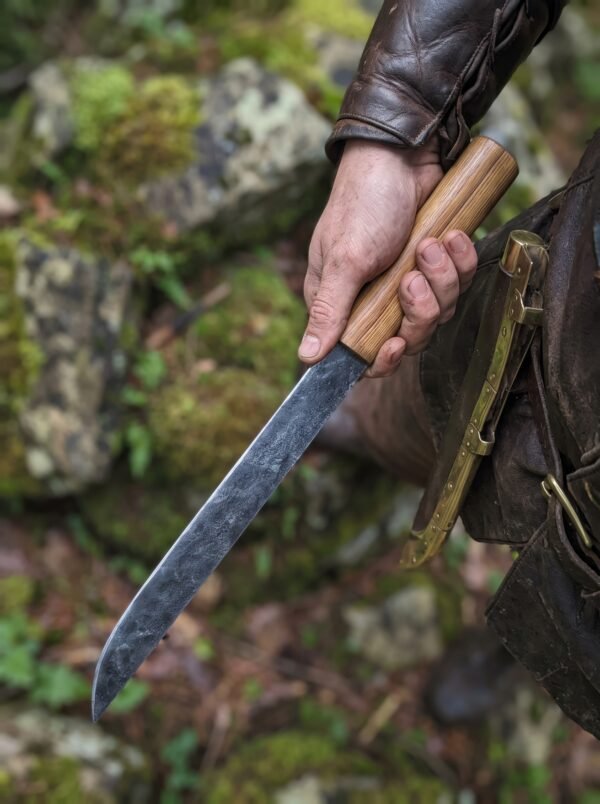
The Runescar balances about an inch and a half forward of the ferrule, which is enough to give it authority in a chop without making it tiring to hold. The olive handle is a simple straight barrel with a slight swell, so it works in a hammer grip for cutting and rolls comfortably into a forward grip for finer work. Twenty inches overall means this is a camp and utility blade at the large end rather than a belt knife.
It arrives sharp. This is a forged working blade, not a wall hanger, but we do not sell it for battle ready or full contact sparring and it should not be used against another person. For bushcraft, camp work, kitchen butchery of large cuts, reenactment kit and display it is exactly what it looks like.
Care
1095 is not stainless and a blade with this much surface area shows neglect fast. Wipe it after every use, particularly after cutting anything acidic, and keep a thin film of mineral oil, camellia oil or paste wax on the steel. Do not leave it stored in the leather sheath for months, because vegetable tanned leather is slightly acidic and holds damp. If a patina forms, that is normal and protective. If orange rust appears, take it off with oil and a green pad. Our steel care page has the routine. Feed the sheath with a little leather balm twice a year and wipe the olive handle with Danish oil when it looks dry.
Made in the Czech Republic
The work behind this piece happens in a Czech Republic workshop that has kept to the old methods. Steel is forged and heat treated by hand, the grind is taken down by eye rather than by machine, and the handle, fittings and sheath are cut and finished one at a time. Because of that, every piece carries small marks of the hand that made it.
Ransack Viking is a United States company. We import direct, check each piece when it reaches us, and ship from our Chicago, Illinois warehouse. Engraving is added here in the United States after arrival, so the piece you receive is finished to your order.
A note on handmade variation
This is hand made, not machine made or bulk produced, so what arrives will not be a pixel for pixel copy of the photograph. Olive wood is the most variable material we use, running from pale cream to deep gold with black streaks, and no two handles look the same. The clip on the spine and the exact width of the flat shift a little because they are ground by eye. Leather takes dye differently on every hide. The dimensions, the material and the build are the same every time. The character is not. There is a longer piece on the seax guide, and another on choosing a Viking knife.
Frequently asked questions
Is it sharp when it arrives
Yes, sharpened and stropped before it goes in the sheath. Fifteen inches of sharp single edge deserves respect when you unbox it.
Is a seax a knife or a sword
At this length it sits between the two. Archaeologists usually call anything over about fourteen inches a langseax and treat it as a fighting and utility blade rather than a belt knife.
Can I baton with it
Yes. The straight thick spine is exactly what makes that possible, and the tempering range we use is chosen partly for that reason. Strike the spine, not the handle fittings.
How is the sheath worn
It is a simple wet formed sheath with a belt slot. If you want the historical horizontal carry with spine suspension, tell us in the order notes and we will build it that way.
Will the runes on mine say the same thing
The stock line is a fixed futhark sequence. If you want your own words, order with custom engraving and yours replaces it rather than joining it.
How long does delivery take
One to two weeks of processing, then free shipping inside the United States. Engraved orders take a few days longer.
What is in the box
- One Runescar 1095 Viking seax with an olive wood handle
- One wet formed vegetable tanned leather sheath
- Care card and lifetime warranty note
- Forged and finished in the Czech Republic
Explore the range
Browse the Viking seax range, the Viking knives, the Viking swords, or read the guides.
Compare it with these
Another in the same line is the Knotbolster Viking seax, 15 inches overall. Next along the rack is the Ravenspine Viking seax, 12 inches overall. For a straight comparison, see the Emberfang Viking seax, 13 inches overall.
The Nightraven throwing knife covers the other half of the same kit. Pick the steel, the length and the fittings yourself on the custom seax page.

Reviews
There are no reviews yet