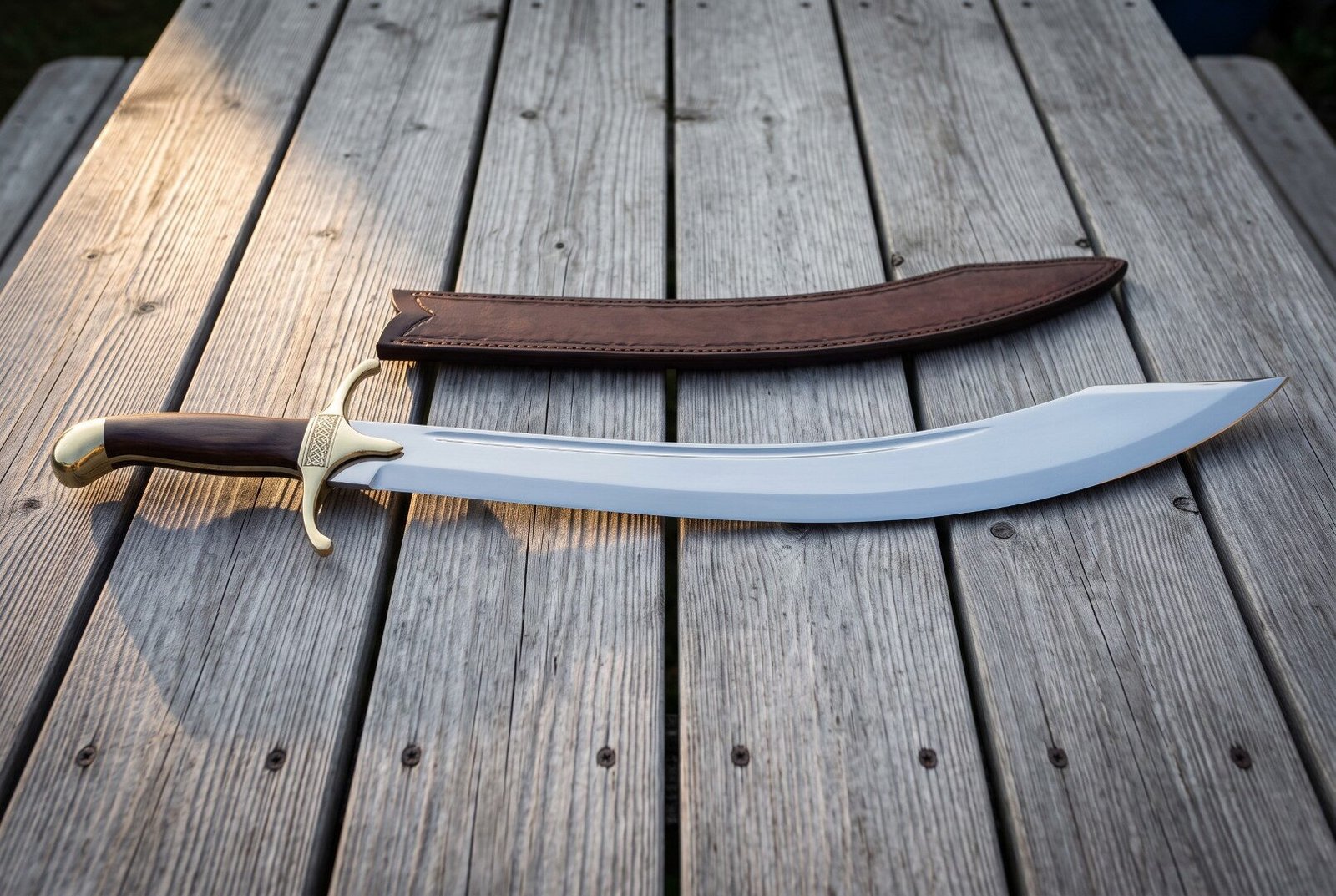
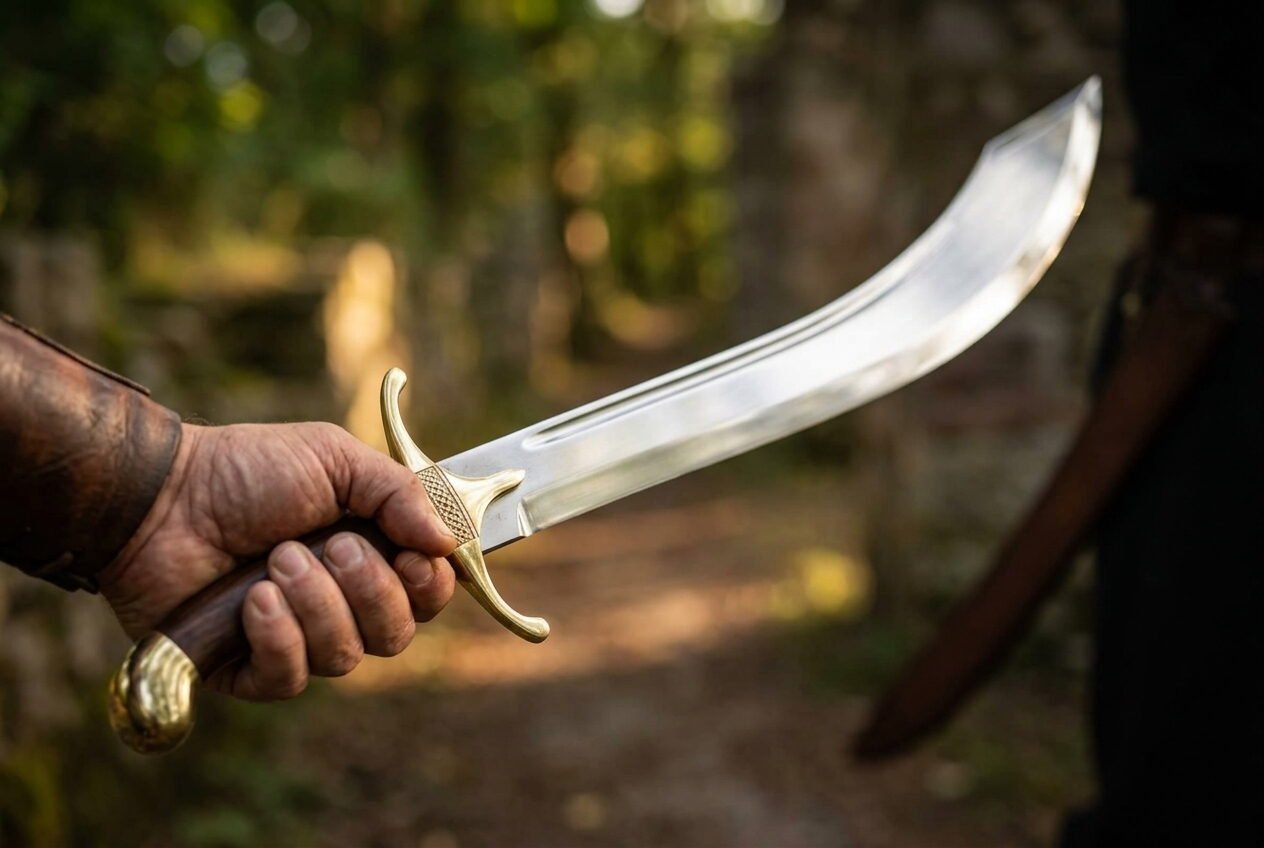
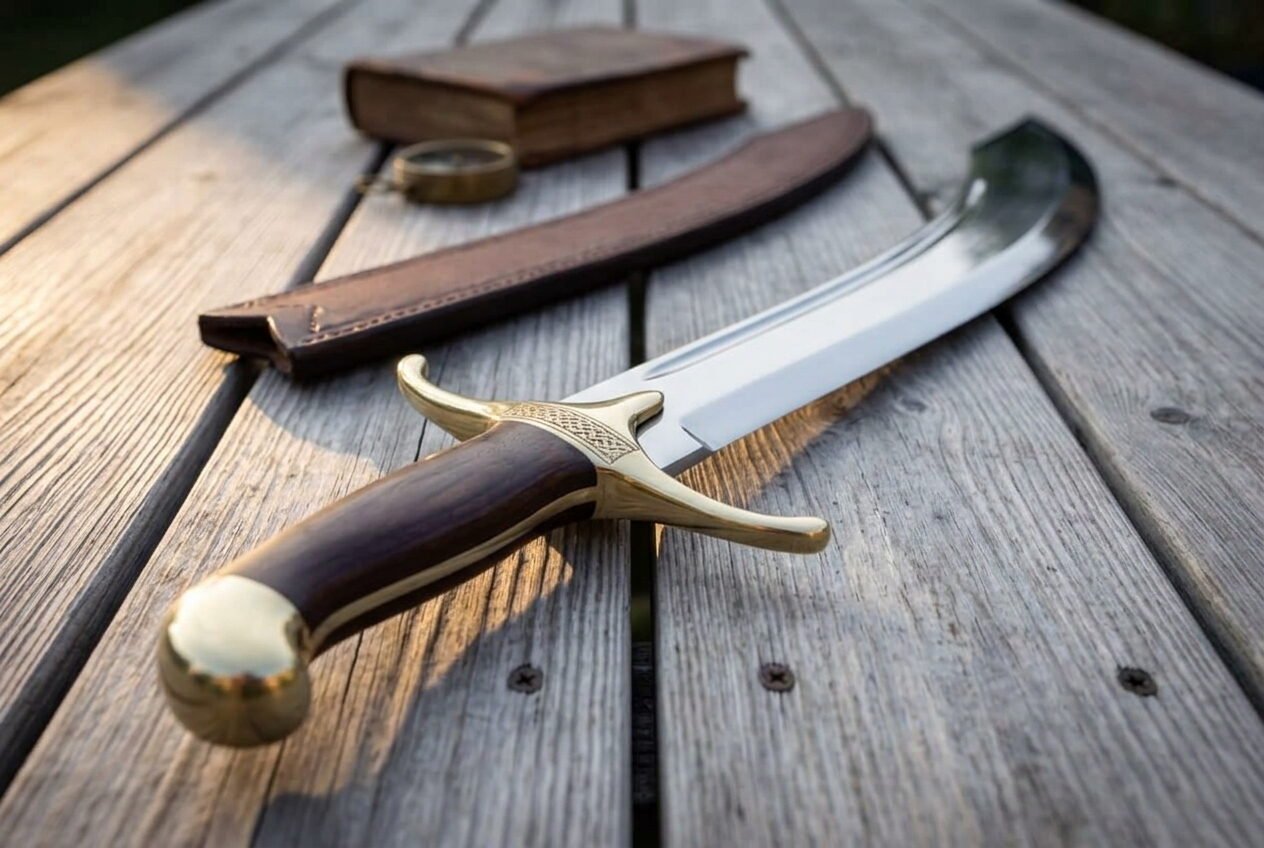
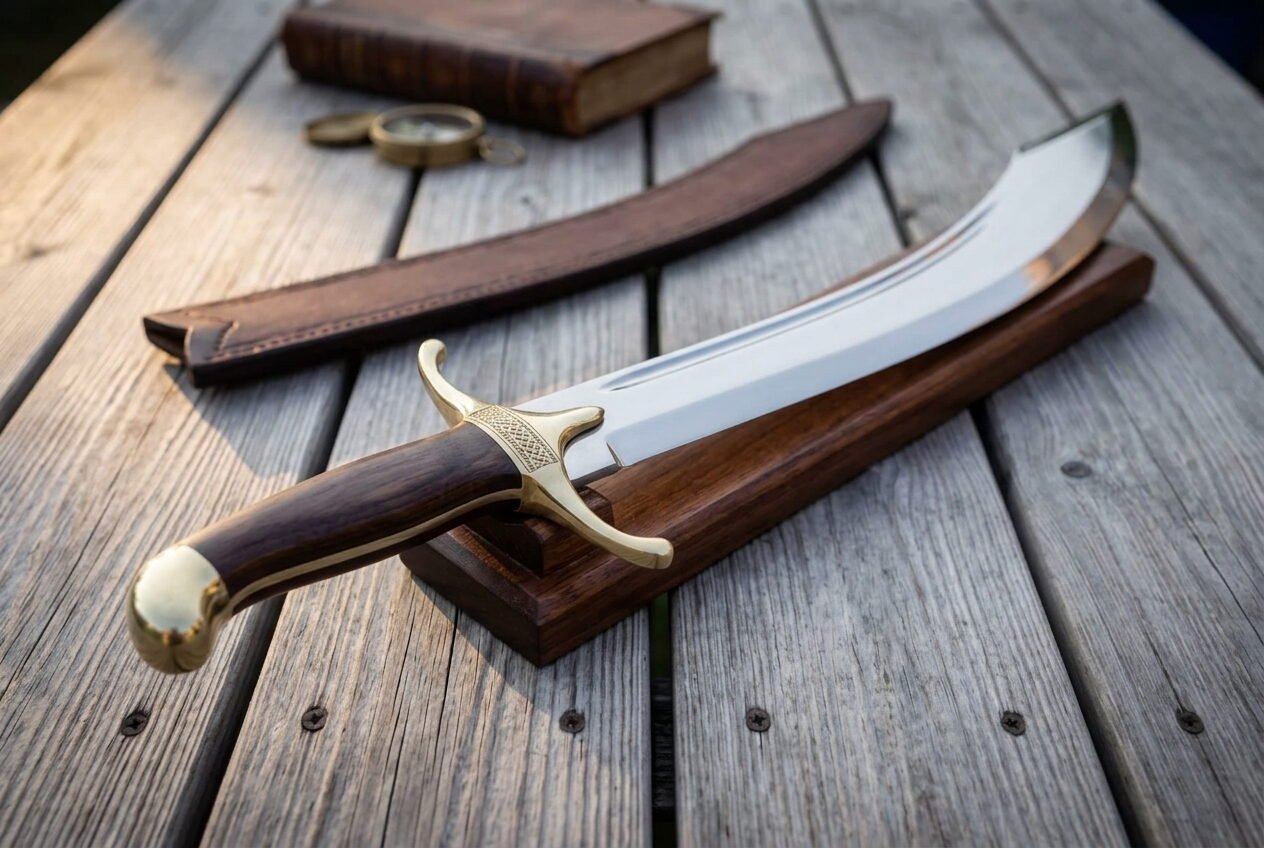
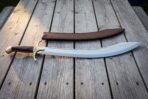
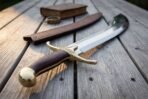
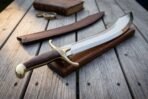
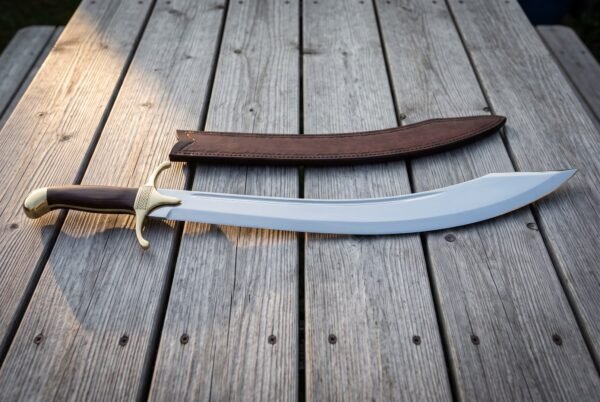
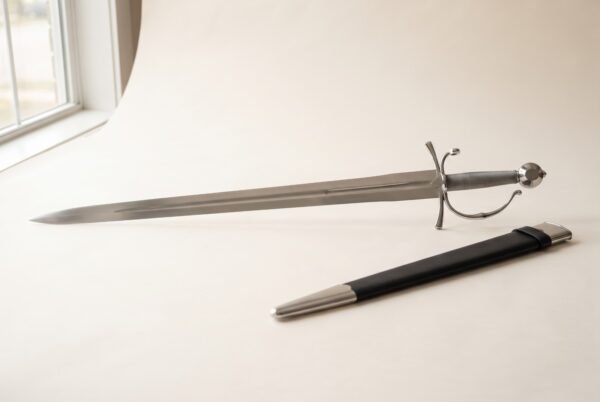
The Duneglint is a scimitar. A deeply curved single edged blade in bright polished high carbon steel, widening through the last third and sweeping up to the point, with a narrow fuller following the spine. The hilt is a brass cross guard with quillons drooping toward the blade and a small forward hook, and the grip is dark rosewood. It comes with a curved brown leather scabbard shaped to the blade.
The curve is the whole argument of this sword and it exists for a specific reason. A straight edge meets a target square and has to be driven through it. A curved edge meets the same target at an angle, so the point of contact travels along the edge as the blade passes, and that travel turns a chop into a slice. Cavalry across the Islamic world, the steppe and eventually most of Europe adopted curved swords because a rider does not get to push a cut through, only to place an edge and let the horse supply the movement. A curved blade takes that fleeting contact and makes it into a long draw. This one is forged, ground, polished and hilted in a Czech Republic workshop. It is catalogued with the short swords, and the gladius blades sit one click away.
Specifications
| Blade steel | 1095 high carbon, hardened to 54 to 58 HRC |
|---|
| Type | One handed scimitar |
|---|
| Blade | Deeply curved single edge, widening through the last third and sweeping up to the point, with a narrow fuller along the spine |
|---|
| Guard | Brass cross guard with quillons curving toward the blade and a crosshatch engraved centre langet |
|---|
| Grip | Dark rosewood, shaped and finished smooth |
|---|
| Pommel | Rounded brass cap pommel |
|---|
| Scabbard | Plain brown leather, stitched and curved to follow the blade, with a hanging loop |
|---|
| Finish | Bright polished blade, satin brass, oiled rosewood |
|---|
| Edge | Ground and sharpened by hand along the curve, arrives keen |
|---|
| Included | Sword and matching leather scabbard |
|---|
| SKU | RK-1625 |
|---|
Why a curved blade cuts differently
Put a straight blade against a target and every point of the edge in contact hits at the same instant. All the force goes into pushing the edge through the material, and the depth of the cut depends almost entirely on how hard you swing.
Put a curved blade against the same target and something else happens. Because the edge is an arc, only a short section touches at first, and as the blade continues its own arc the contact point slides along the edge. That sliding is a draw cut, and a draw cut is far more efficient at parting fibrous material than a straight push, which is exactly why every kitchen knife skill starts with learning to pull the blade rather than press it.
The widening through the last third of this blade adds the second half of the equation. Moving mass out toward the tip puts the centre of percussion further from the hand, which means more energy is delivered at the part of the edge that is travelling fastest. Together the curve and the flare give you a blade that cuts far above what its weight suggests. The cost is thrusting. A deeply curved sword points poorly, and that trade was accepted by everyone who carried one.
The steel, the brass and the wood
The blade is 1095 high carbon, hardened and tempered to 54 to 58 HRC. For a long curved cutting blade that is the right window. Harder and the edge would be more prone to chipping when a cut goes wrong, softer and it would roll. In the mid fifties you get an edge that takes a fine finish, holds it through real cutting, and can be brought back on a stone without specialist equipment.
It is finished bright and polished, with no etch or coating, which means the grinding has to be honest all the way through the grits because a mirror surface hides nothing. The narrow fuller running along the spine takes a little weight out of the back of the blade, high up where it does the least work, and it gives the eye a line to follow along the curve.
The guard is brass, filed and finished by hand. Brass on a hilt is a practical choice as much as a decorative one, because it does not rust against a wooden grip and it wears in rather than out. The drooping quillons and the forward hook are there to catch a blade sliding down the edge and to keep an opponent’s point off your hand. The grip is rosewood, a dense oily hardwood that holds a polish, does not swell and shrink much with humidity and does not get slippery when your hand is warm.
Engraving, runes and your own design
Use the rune converter on this page to turn a name, a date or a short phrase into Elder Futhark and we will cut it into the steel, the leather or the wood. If you would rather have a Viking pattern than a rune line, choose your own design in the engraving option above the add to cart button and tell us where it goes. Where a piece already carries an engraved design, your chosen engraving replaces it rather than sitting alongside it. On this sword the workable surfaces are the ricasso just forward of the guard, the flat of the brass guard itself, and the leather of the scabbard, which will hold a long line comfortably. See the engraving page.
Handling and balance
This is a one handed sword and it is meant to be held loosely. Clamp down on a curved blade and you fight its own arc. Let it hang in a relaxed grip with your index finger behind the guard and the sword will swing through its curve on its own, which is the whole feel of the type.
Because the mass sits forward, the balance point is further from your hand than on a straight arming sword, so the tip is slower to start and slower to stop but hits much harder when it lands. Cuts want to be delivered on a diagonal, following the curve, rather than chopped straight down. Recovery comes from rolling the wrist rather than from muscling the blade back.
Be clear about what it is. This is a sharp functional sword and it will cut a soft target cleanly. It is not for sparring. No blade on blade contact, no hard targets, nothing with a hidden core, and never test the edge on bone or metal. Hardened carbon steel chips, and a chipped edge on a swinging blade is how people get hurt.
Care
A bright polished carbon blade is the most demanding surface we make, because there is no etch and no coating to hide anything. Wipe it down after every handling session, since a fingerprint left overnight in a humid room will etch itself into the polish and only repolishing takes it out. Keep a light film of mineral oil or blade oil over both flats and along the fuller. Detail is in steel care.
Do not store the sword in the leather scabbard for months at a time. Vegetable tanned leather is slightly acidic and holds moisture against steel. For long storage, oil the blade and keep it out on a rack with the scabbard stored separately. Feed the scabbard leather with a conditioner once or twice a year. Rosewood wants a light wipe of oil occasionally, and the brass can be polished bright or left to darken to a warm honey tone.
Made in the Czech Republic
This is a handmade piece from the Czech Republic, made in a workshop that still forges, grinds and finishes by hand instead of stamping parts out. The smiths there have kept the older way of working, and the wood, horn and leather are shaped and fitted by hand as well. Two pieces of the same design will never be identical, and that is part of what you are buying.
Ransack Viking is a United States company. We handle the import ourselves, look over every piece when it lands and ship from our warehouse in Chicago, Illinois. Engraving is done in the United States after the piece arrives, so your design goes on before we send it out.
A note on handmade variation
This is hand made, not machine made and not bulk produced, so what arrives will not be a pixel for pixel copy of the photograph. Grain, tone, hammer texture and exact profile vary because each piece is worked by hand from natural materials. Rosewood runs from a light red brown to a deep near purple depending on the board, the exact depth of the curve shifts a fraction between blades, and brass photographs cooler or warmer than it looks in the hand. The dimensions, the material and the build are the same every time. The character is not. If you want the longer version, look at what counts as a scimitar and then at buying a first sword.
Frequently asked questions
Is it sharp out of the box
Yes. The full curve is ground and sharpened by hand and it arrives keen. Treat it as a live blade from the moment the box opens.
Is this a display piece or a working sword
It is a functional forged sword with a real heat treat and a real edge, not a wall hanger. That said it is not for sparring and should never be used in blade on blade contact.
Can I thrust with it
Not well, and that is true of every deeply curved sword. The curve trades point control for cutting power. Use it as a cutting sword and it will do what it was designed to do.
Is the blade damascus
No. This one is deliberately plain 1095 high carbon, polished bright, so the curve and the grind carry the piece rather than a pattern.
Does the scabbard have a belt fitting
The scabbard is leather, stitched and curved to the blade, with a hanging loop. It ships as a scabbard rather than as a full belt rig.
How long does shipping take
Processing is one to two weeks in the shop plus transit. Shipping within the United States is free.
What is in the box
- One Duneglint scimitar with a 1095 blade, brass cross guard and rosewood grip
- One brown leather scabbard curved to the blade
- Care card covering blade oiling, leather feeding and storage
- Forged and finished in the Czech Republic
Explore the range
See more in swords, short swords, scabbards and sheaths and sword stands and displays, or read the guides.
Also in this part of the catalogue
If this one is not quite right, there is the Knotlobe short sword, 26 inches overall. Also in this group is the Trinecrown short sword, 31 inches overall. Sitting beside it in the catalogue is the Sawfeather short sword, 24 inches overall.
From the same corner of the shop, there is the Sandreaver scimitar. Or start from a blank sheet on the custom Viking sword page.


My whole family was impressed when I unboxed it. The rosewood handle feels amazing and the balance is perfect. Even the small engravings are crisp and clean. This shop clearly takes pride in their work.
This sword is fine. Just didn’t wow me. Not bad, not amazing either.
Knew this sword was special the second I opened the box. 10/10 would buy again. Ransack Viking is quickly becoming my go to shop for anything Norse themed.