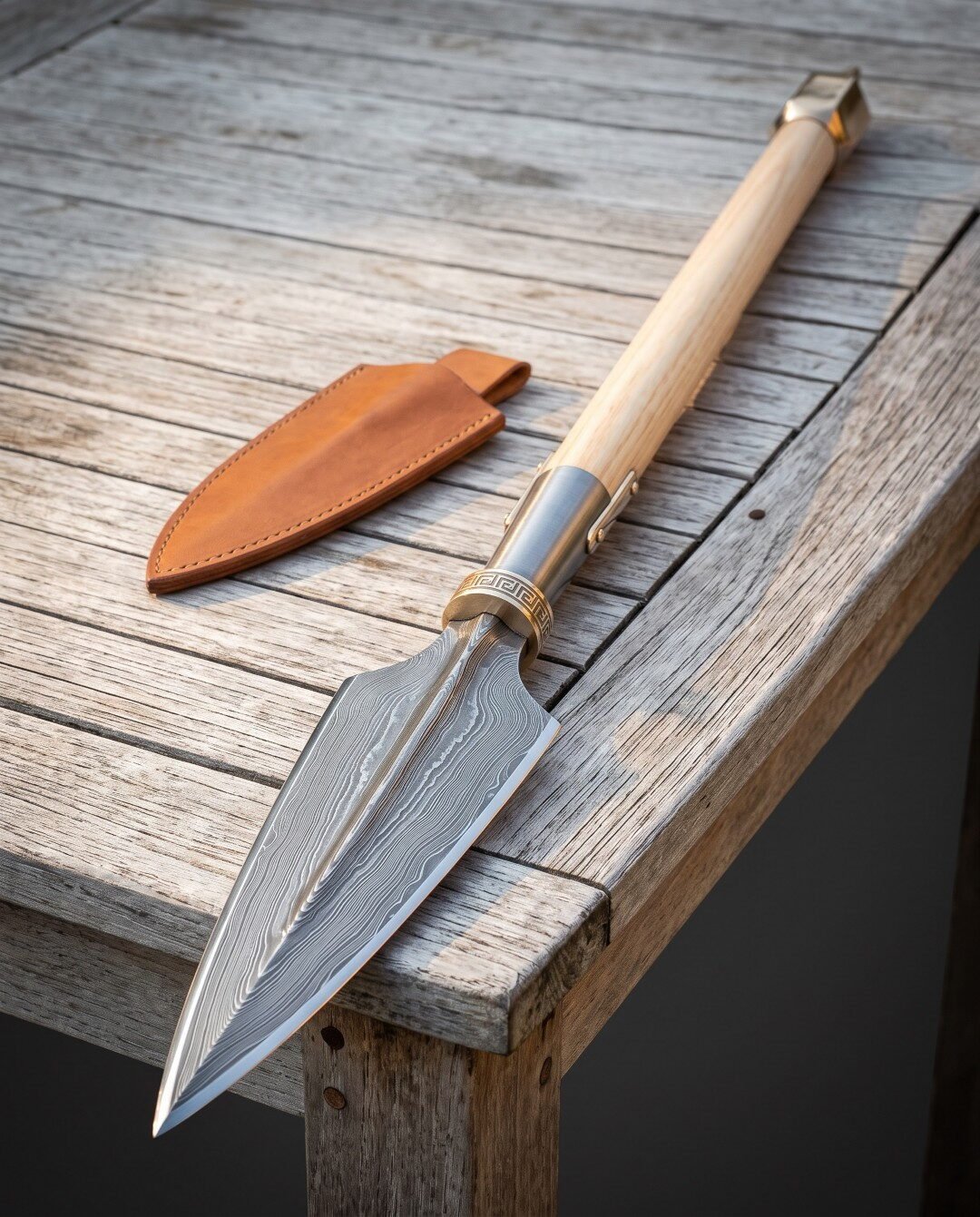
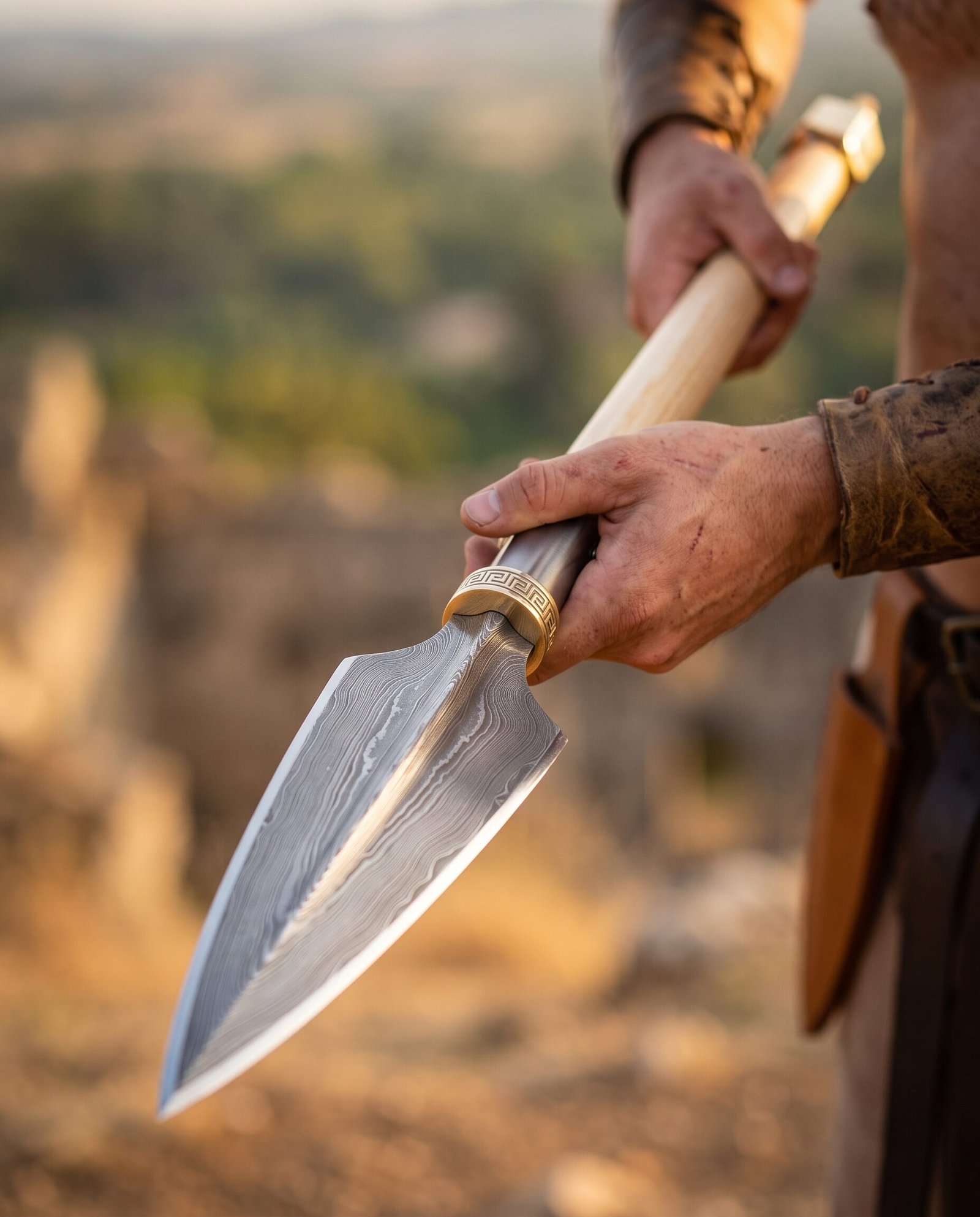
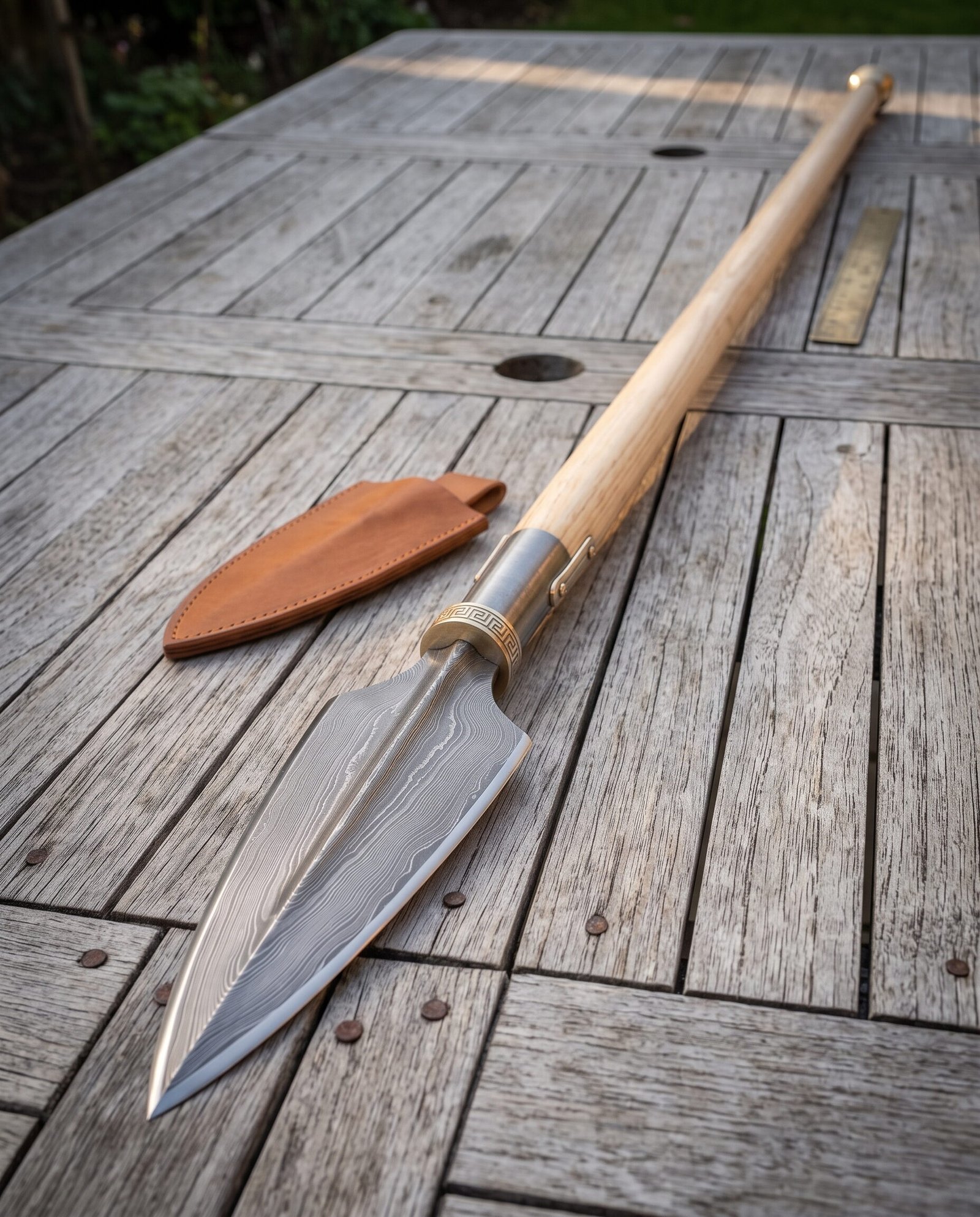
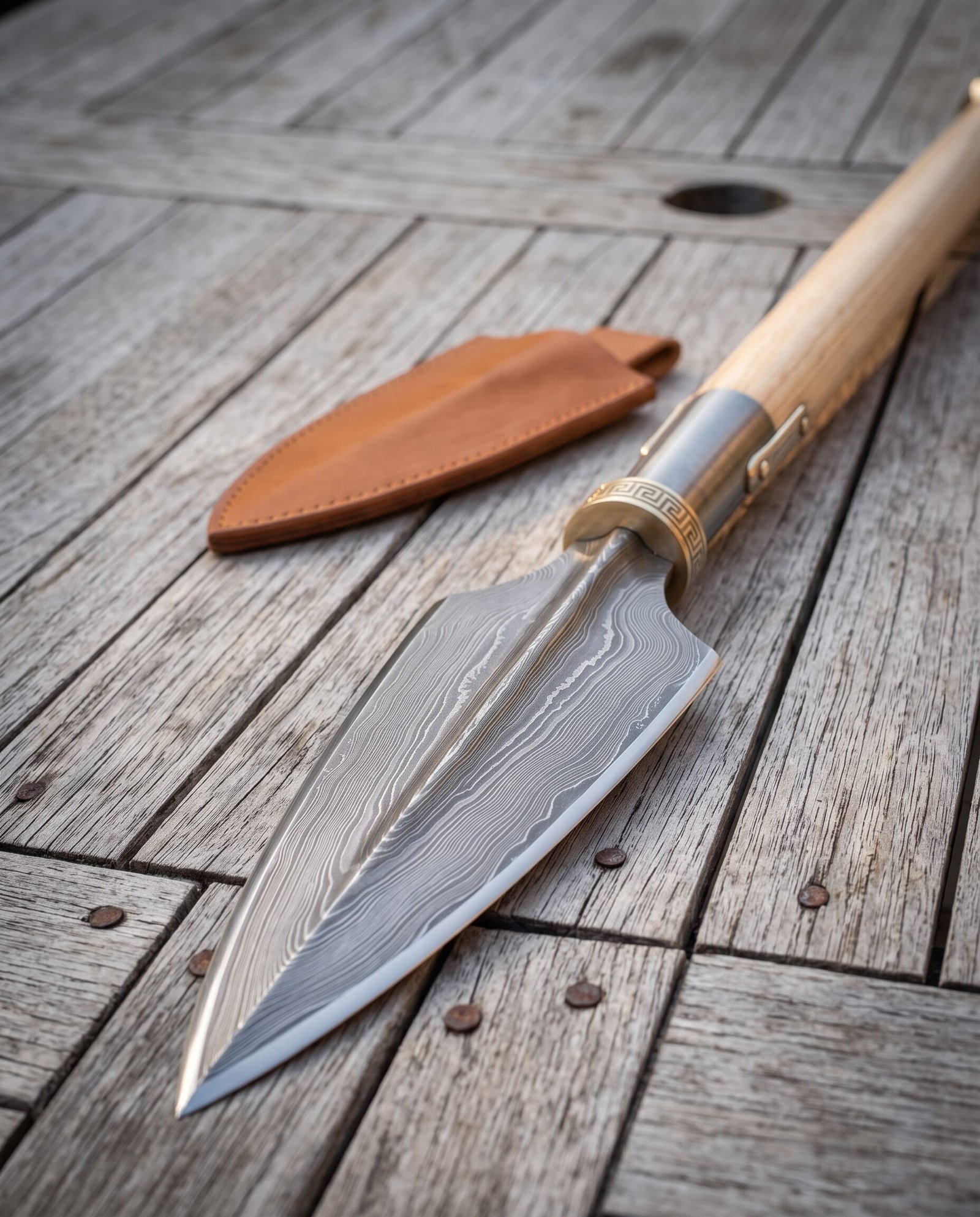
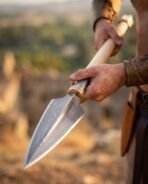
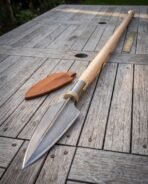
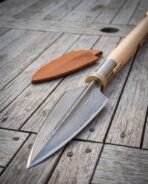
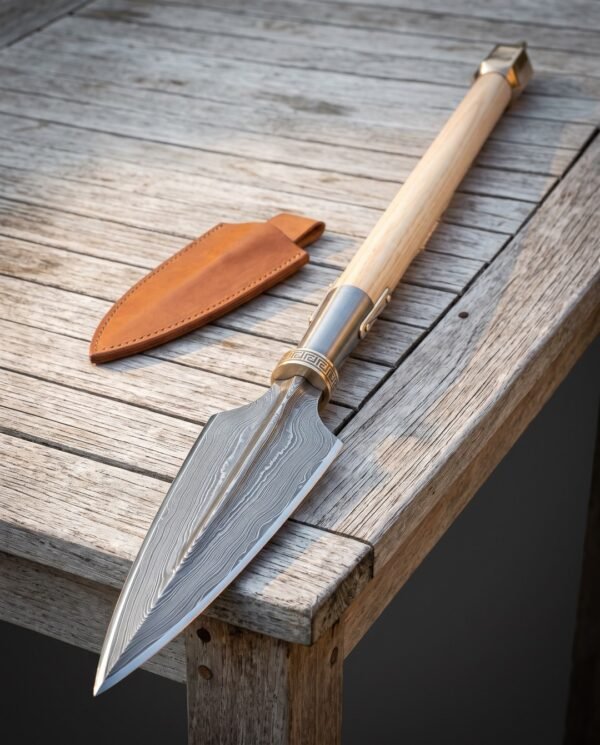
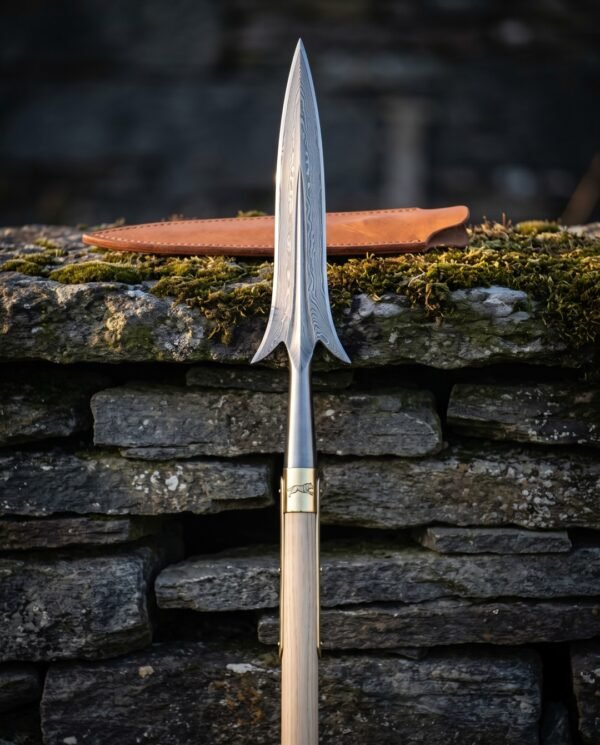
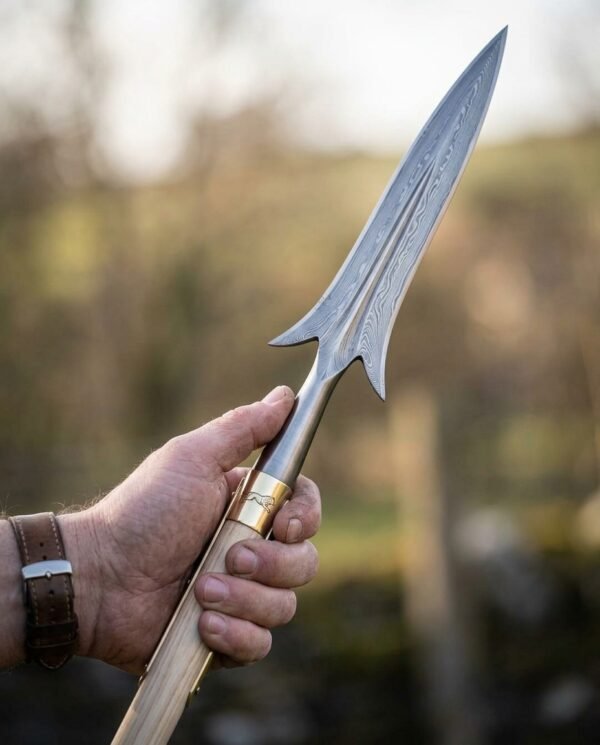
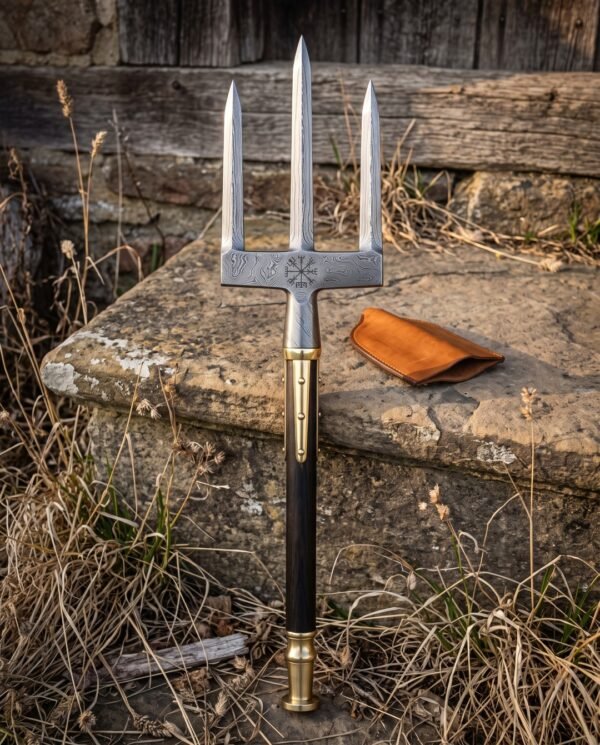
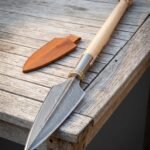
A Viking spear with a broad leaf shaped head forged from 1095 and 15N20 pattern welded steel, set on a pale ash shaft. The head runs into a long steel socket secured with a single rivet through the shaft, and the joint is finished with a brass collar cut with a running Greek key band. A squared brass cap closes the butt. A shaped leather cover slips over the blade for storage and transport.
The spear, not the sword, armed the Norse world. Swords are what survive in museum cases and in stories, but in the burial record spears outnumber them heavily, and the reason is simple economics. A sword swallows a great deal of good steel and weeks of a smith’s time. A spear needs a fist sized piece of steel and a length of ash cut from a hedgerow, and it gives a farmer more reach than any sword ever will. The status of the spear shows in the mythology too: Odin carries Gungnir, and the ritual described in the sagas of casting a spear over an enemy army to give them to him has no equivalent involving a sword. This spear is forged, ground, heat treated, etched and fitted in the Czech Republic. It sits in the glaives and polearms. The battle axes cover the same ground from a different angle.
Specifications
| Head steel | 1095 and 15N20 pattern welded damascus, hardened to 58 to 60 HRC |
|---|
| Head length | Approximately 12 inches including the socket |
|---|
| Head shape | Broad leaf with a raised central rib, double edged |
|---|
| Overall length | Approximately 28 inches as supplied |
|---|
| Shaft | Straight grained pale ash, sanded and oiled |
|---|
| Socket | Polished steel, held to the shaft with a riveted side strap |
|---|
| Collar | Brass, cut with a running Greek key band |
|---|
| Butt | Squared brass butt cap |
|---|
| Finish | Etched damascus head, polished brass, oiled shaft |
|---|
| Included | Spear and a shaped tan leather blade cover |
|---|
| SKU | RK-1744 |
|---|
Why the head has a socket and not a tang
Almost every spear head in the Norse world is socketed, and the reason is a piece of structural thinking worth explaining. A tang, the arrangement used on knives and swords, is a spike of steel pushed into the wood. Under a thrust the tang is trying to split the shaft from the inside, and the wood is the weakest part of the joint. A socket does the opposite. It is a tube of steel wrapped around the outside of the shaft, so under load the steel is in compression around the wood and the wood is supported rather than wedged apart.
The socket is forged from a flat tongue of steel drawn out behind the blade and then wrapped hot around a tapered mandrel. On many original finds you can still see the seam where the two edges came together, sometimes closed by a forge weld and sometimes left open, which is a good way to tell a genuinely forged socket from a rolled tube that has been fitted afterwards. The rivet through the shaft is the last piece of the puzzle. It stops the head from creeping forward off the wood under repeated thrusts and, just as importantly, from being pulled off if the point sticks in something.
The brass collar covers and finishes the join between the mouth of the socket and the shaft. It is not structural but it does keep water out of the end of the socket, which is where a spear rots and rusts first.
Damascus steel and an ash shaft
The head is pattern welded from 1095 and 15N20, stacked and forge welded into a billet, drawn, folded and welded again until the layers number in the hundreds, then forged out to the leaf profile. The etch darkens the 1095 and leaves the nickel bearing 15N20 bright, which is why the pattern flows around the shape of the blade rather than running in straight lines: the layers follow the metal as it is spread under the hammer, so a wide leaf shows the pattern opening out towards the edges. Heat treated together the head comes out at 58 to 60 HRC.
The shaft is ash and there is no better wood for it. Ash is ring porous, so it absorbs shock instead of transmitting it, and it is unusually good at bending a long way and returning straight, which is exactly what a shaft needs to do. It has been the European spear and tool handle timber since antiquity, so much so that the Old Norse word for ash, askr, was used as a poetic word for a spear itself, and the world tree Yggdrasil is an ash. The shaft here is straight grained stock, sanded and finished with oil rather than varnish, so it grips a hand rather than polishing itself slippery.
The head is sharp and it is sold as a collector and display piece. It is not made for throwing, and a pattern welded head driven into hard ground will chip.
Engraving, runes and your own design
Use the rune converter on this page to turn a name, a date or a short phrase into Elder Futhark and we will cut it into the steel, the leather or the wood. If you would rather have a Viking pattern than a rune line, choose your own design in the engraving option above the add to cart button and tell us where it goes. Where a piece already carries an engraved design, your chosen engraving replaces it rather than sitting alongside it. On this spear the brass collar is the natural panel and your text would take the place of the Greek key band, or the runes can be cut into the ash shaft below the collar, which reads well and is closer to what the originals did. See the engraving page.
Handling and balance
The reason spears dominated for a thousand years is that they are easy to use well. The balance point on a spear of this build sits well down the shaft, closer to your rear hand than to the head, so the spear is held rather than swung and the point can be placed with very little effort. Compared with a sword, which has to be moved as a whole, a spear only has to be aimed.
Held two handed the front hand steers and the rear hand supplies the drive, and the shaft slides through the front hand rather than being gripped tight. Held one handed with a shield, which is how a Norse line would have fought, you take it further back and use the length as reach rather than as leverage. Either way the oiled ash gives enough friction to control the slide without needing to squeeze.
For display, mount it horizontally on brackets or stand it in a corner with the leather cover on the head. If you stand it upright, put something soft under the butt so the end grain of the shaft is not resting on damp stone or concrete.
Care
The head is carbon steel and it will rust if left. Take the leather cover off after handling, wipe the head dry, and lay a thin film of mineral oil or blade oil over it, working around the socket mouth and under the lip of the brass collar where moisture sits. Fingerprints will etch into a damascus surface within a couple of days. There is more detail on steel care.
Oil the ash shaft once or twice a year with boiled linseed oil or a wax and oil blend, rubbed in and buffed off, and give the exposed end grain at the butt extra attention because that is where moisture enters fastest. Do not store the spear head down in a damp corner and do not leave the leather cover on a wet head, since leather holds water against steel. Feed the cover itself with a light leather balm a couple of times a year. Check the rivet occasionally and tell us if it ever moves.
Made in the Czech Republic
Every piece we sell is made by hand in the Czech Republic. The smiths there work the way the trade has been worked for a long time, heating and hammering the steel, taking the bevels down by eye, and fitting the handle and the leather one at a time. There is no automated line anywhere in it, so small differences from one piece to the next are normal and expected.
Ransack Viking is a United States company based in Chicago, Illinois. We bring the pieces in ourselves, inspect them on arrival and ship them from our own warehouse. If you add engraving, that is carried out here in the United States before your order goes out.
A note on handmade variation
This spear is hand made, not machine made and not bulk produced, so what arrives will not be a pixel for pixel copy of the photograph. A damascus billet spread into a wide leaf shape opens its pattern differently every single time, so the way the layers fan out towards the edges of your head will be its own. Ash varies from near white to a warm biscuit and can carry an olive streak through the heart, so the tone and the figure of your shaft will not match the one in the picture. The leather cover takes dye at its own depth. The dimensions, the steel and the build are the same every time. The character is not. We go further into it in the Viking spear, and pick it up again in how steel and hardness actually work.
Frequently asked questions
Can I throw it
No. This is a thrusting spear with a pattern welded head, sold as a collector and display piece. Throwing it will chip the edges and can split the shaft.
How long is the shaft
The spear is supplied at roughly 28 inches overall. If you want it longer or shorter, say so in the order notes and we will cut the shaft before it ships.
Is the head sharp
Yes. It arrives sharpened on both edges, which is why it comes with a leather cover.
Is the head removable
Not without drilling out the rivet. The socket is fitted to the shaft and riveted through, which is how original spears were built and it is what keeps the head from creeping off.
Does it ship in one piece
Yes, it ships assembled with the leather cover on the head, packed in a long carton.
Can I have runes on it
Yes. They can be cut into the brass collar in place of the Greek key band, or into the ash shaft below the collar. Use the rune converter above.
What is in the box
- Dawnleaf hand forged damascus Viking spear on an ash shaft
- Shaped leather blade cover
- Head wiped and oiled for transit
- Lifetime warranty against defects in the forging, the grind, the heat treat and the fittings, with no end date and no receipt needed
- Forged and finished in the Czech Republic
Explore the range
See the rest of the Viking spears, the glaives and polearms, the Norse arms and the guides.
Others in the same line
If this one is not quite right, there is the Thornwake polearm, pattern welded Damascus. Also in this group is the Boarcleft polearm, pattern welded Damascus. Sitting beside it in the catalogue is the Boarhelm polearm, forged from 1095.
From the same corner of the shop, there is the Wyrmfang Viking spear. You can have this made your way instead on the custom Norse arms page.
Photos don’t do this polearm justice at all. Haft feels sturdy and well balanced for the size of the head. Steel head is heavy in a good way. You can tell it’s not hollow. Great buy overall.
Can’t stop showing this off to everyone who comes over. Finish on the metal is even and clearly hand forged. Great for reenactment or just display. Either way it looks amazing. Haft feels sturdy and well balanced for the size of the head. Already telling my friends to check this out.
Been eyeing this polearm for months and it did not disappoint. Couldn’t be happier with this.
This one was a letdown compared to the listing. Felt flimsier than expected for the price. Not the experience I expected from Ransack Viking given their reputation. Would not recommend based on my experience.
Nice piece for the price. Second time ordering from Ransack Viking and still happy overall. Haft is solid though a touch shorter than I pictured. Head is well made. Just wish the wood grain was a bit more even. Would still tell others to give this a try.