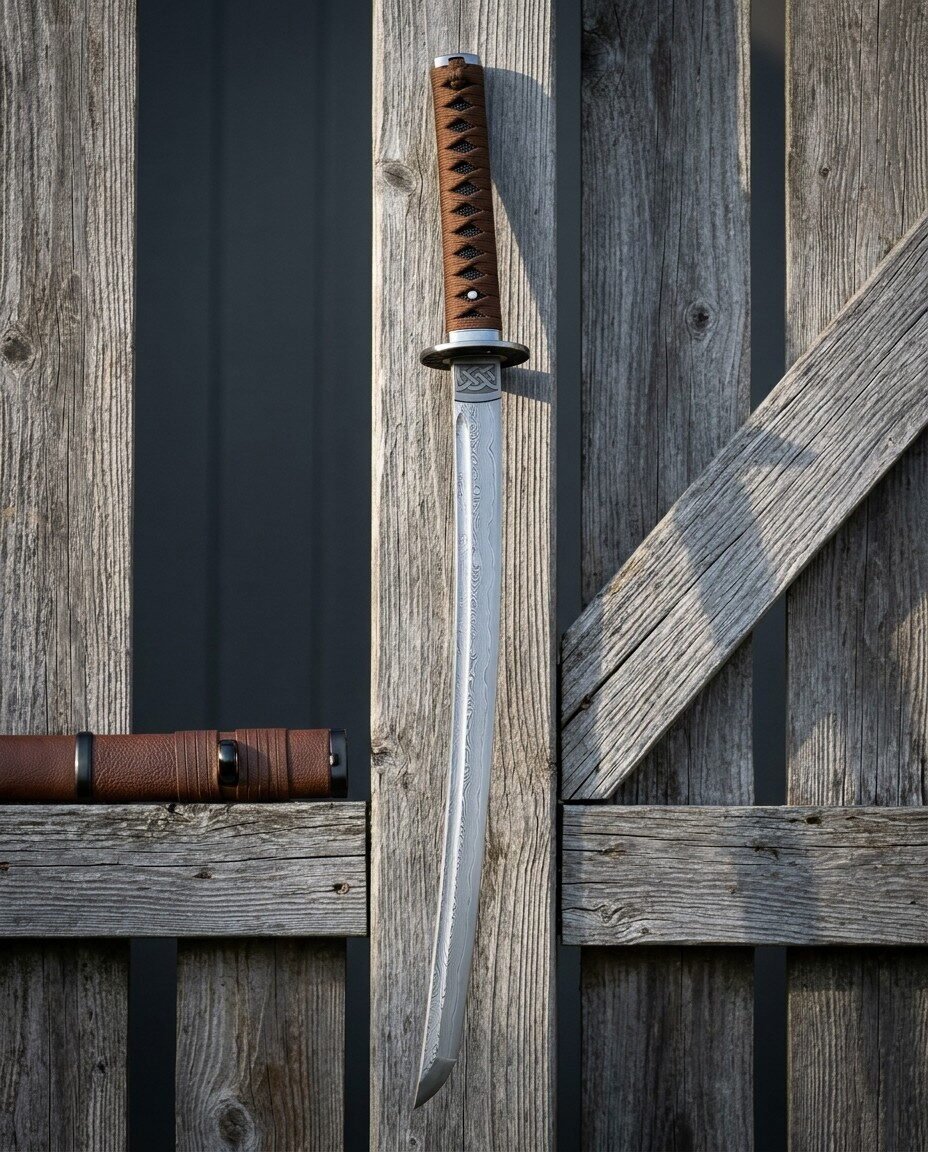
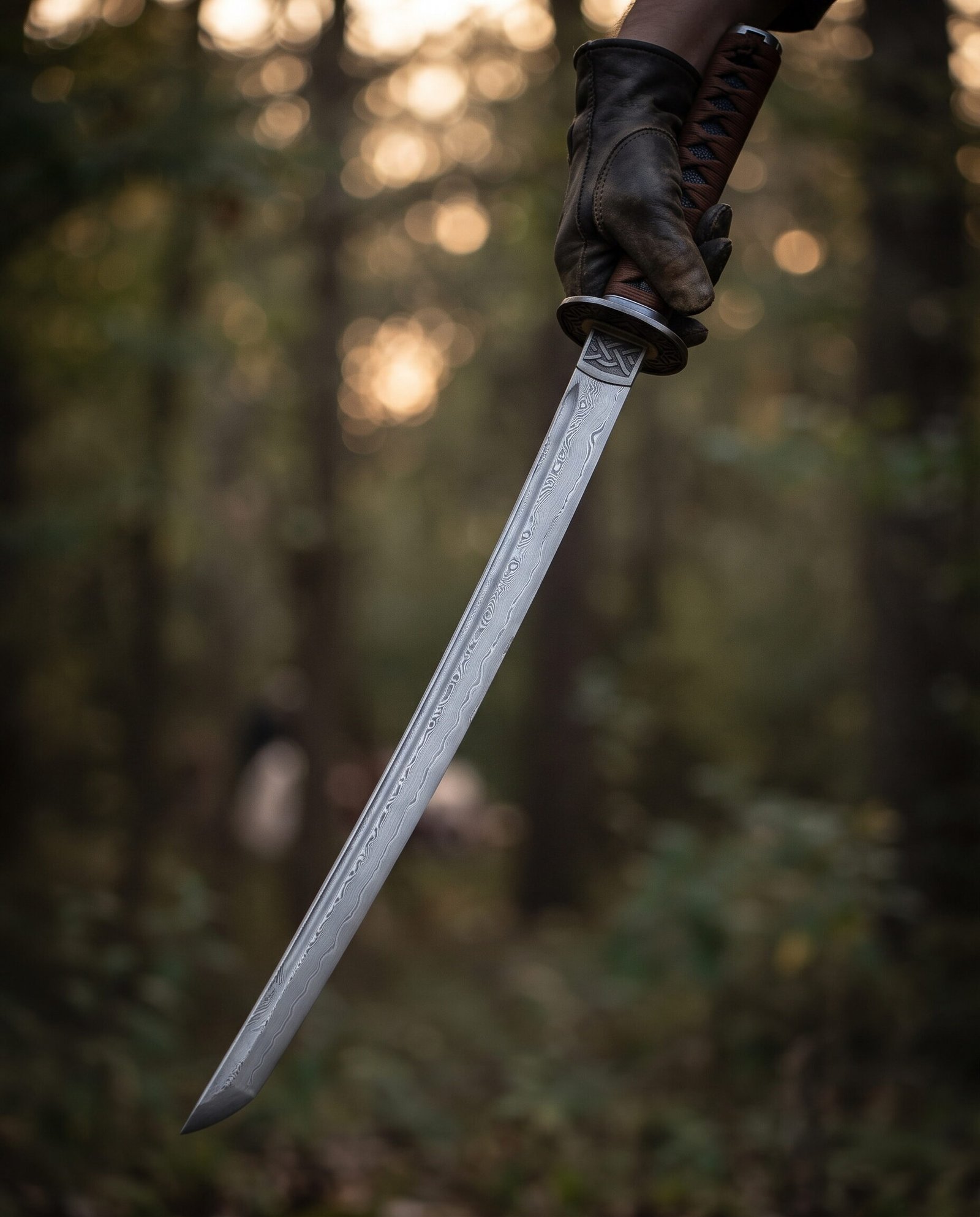
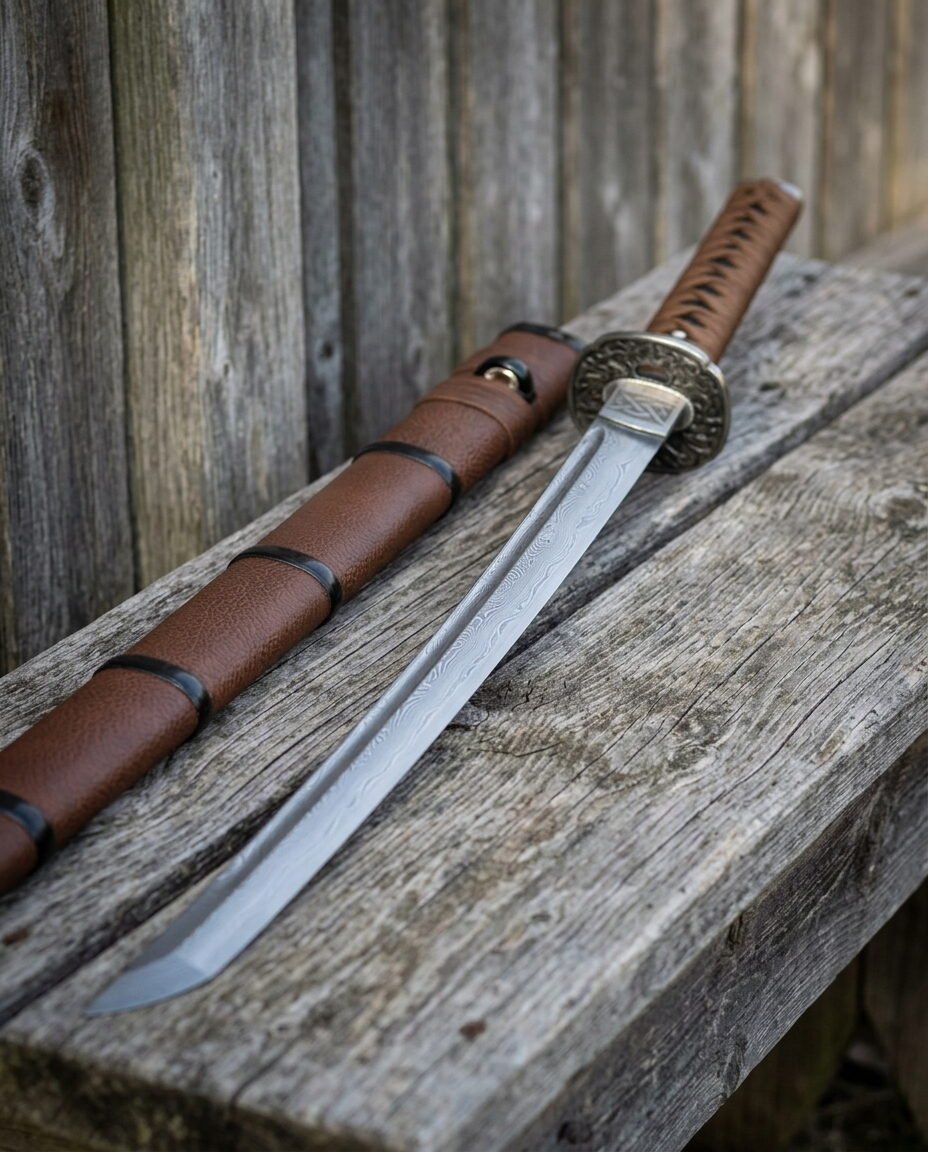
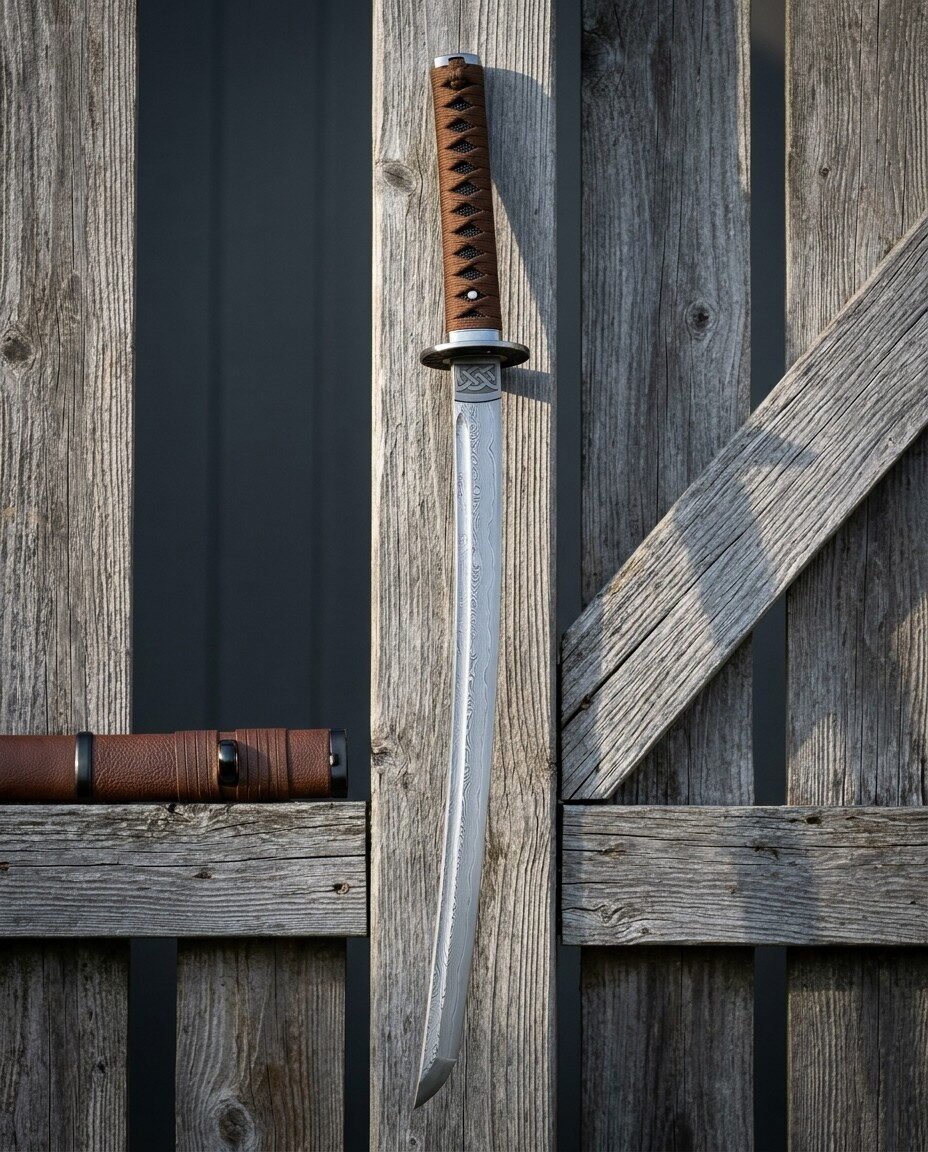
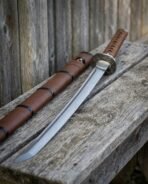
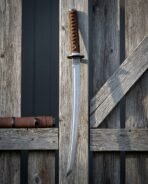
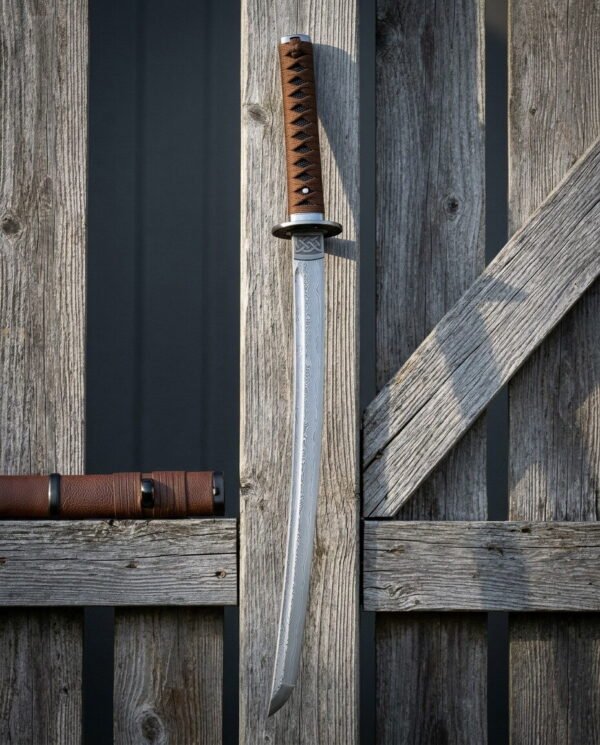
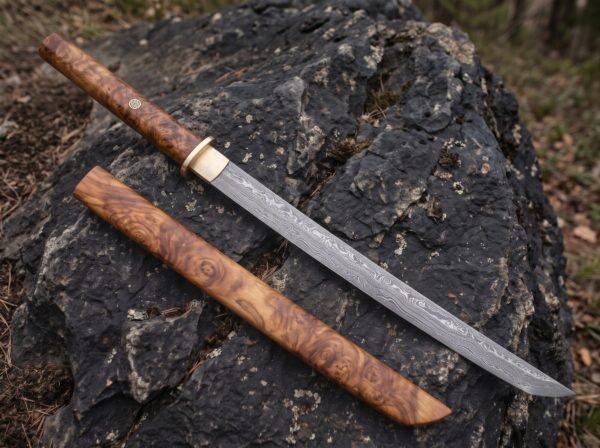
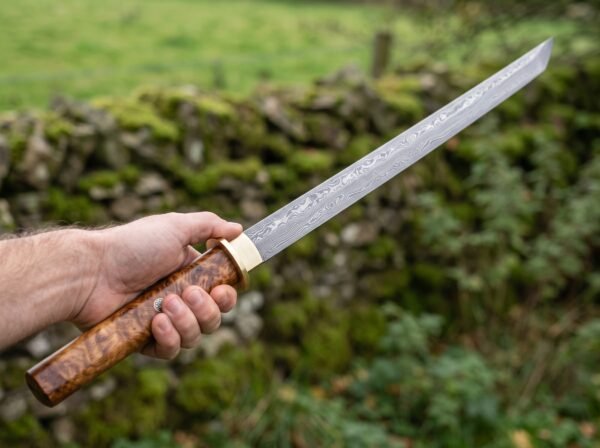
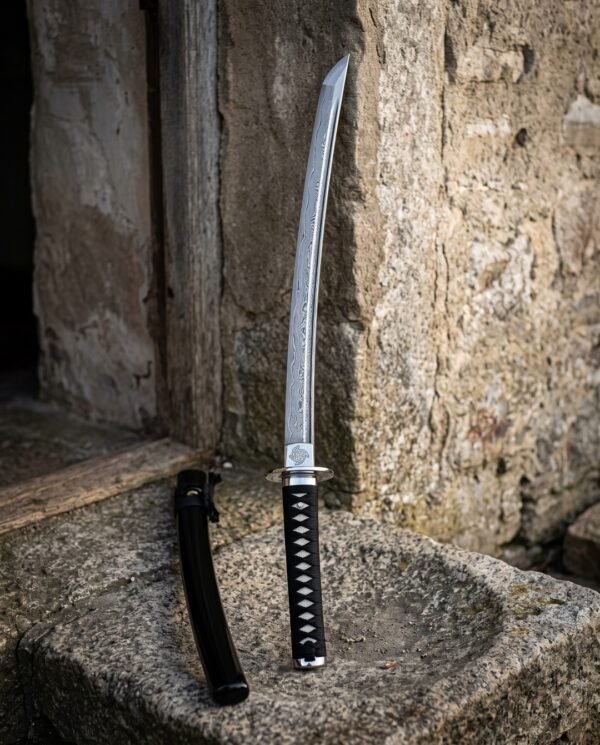
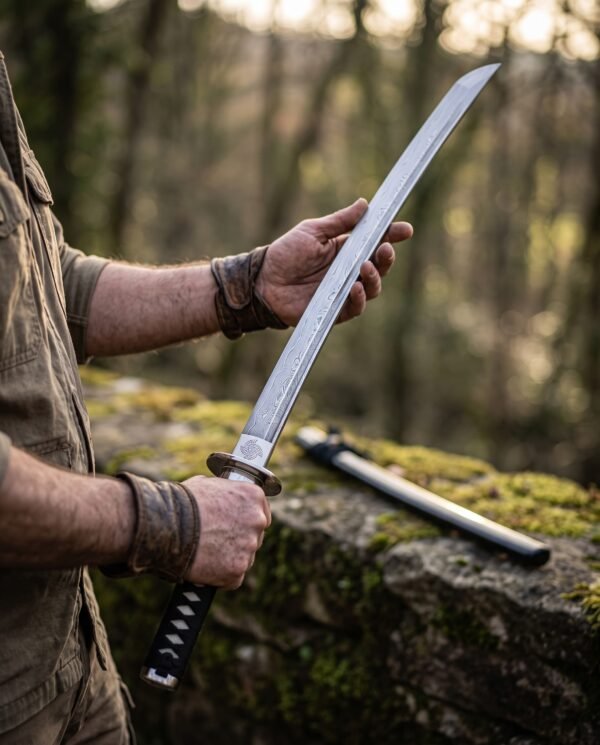
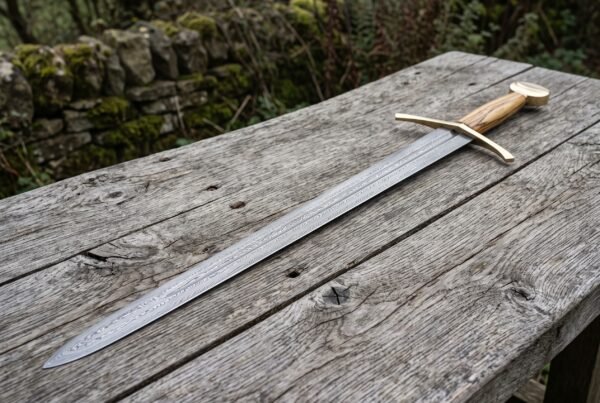
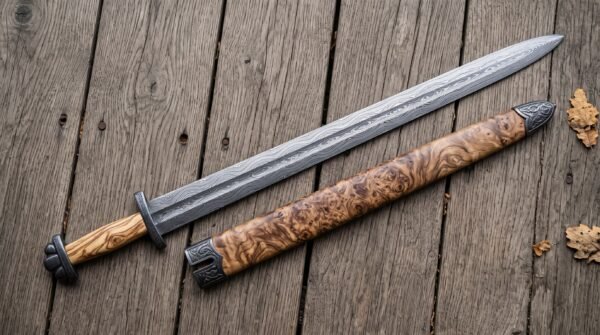
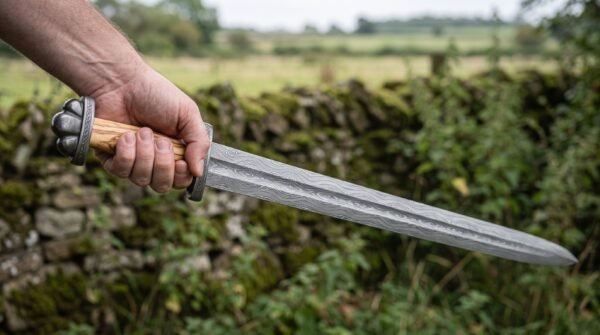
The Rippleguard is a wakizashi with a pattern welded blade. The Damascus runs in tight horizontal rungs from the collar to the point, the handle is wrapped in brown leather over a hardwood core, the guard is a round plate cut with Norse knotwork, and the scabbard is a wooden saya covered in matching brown leather with dark bands.
The rungs are not an accident of the forging. That figure is called a ladder pattern and it is made deliberately, by damaging the billet on purpose. Once the layers have been welded and drawn out, the smith cuts or presses a series of parallel grooves across the flat of the bar, biting down through several layers at a time, and then forges the whole thing flat again. Flattening pushes the interrupted layers sideways and up to the surface, so where each groove was you now get a band where deep layers have surfaced. Grind and etch it and those bands read as rungs running across the blade. The technique is old, it appears on Merovingian and Viking age blades and again in Persian and Indian work, and there is no way to fake it convincingly because the pattern goes all the way through. Ours is stacked, welded, laddered, ground, hardened and etched by hand in the Czech Republic. This one is kept with the wakizashi, and the Damascus swords sit right beside it.
Specifications
| Blade material | 1095 and 15N20 pattern welded Damascus |
|---|
| Hardness | 58 to 60 HRC |
|---|
| Pattern | Ladder pattern, hand cut into the billet and etched to bring up the layers |
|---|
| Blade type | Single edged and curved, with a bright hardened edge |
|---|
| Overall length | Approximately 28 inches |
|---|
| Blade length | Approximately 20 inches |
|---|
| Handle | Brown leather cross wrap over dark ray skin diamonds on a hardwood core, with a mekugi peg |
|---|
| Fuchi and kashira | Steel collar and steel butt cap |
|---|
| Habaki | Steel collar engraved with knotwork |
|---|
| Guard | Round steel tsuba cut with interlaced Norse knotwork |
|---|
| Scabbard | Wooden saya covered in brown leather with dark bands |
|---|
| SKU | RK-1839 |
|---|
Why a laddered pattern is harder on a curved blade
Any pattern welded blade is a gamble, because you only find out what the figure looks like at the very end, after the grinding is done and the acid has been on it. On a straight blade of even thickness that gamble is manageable. On a curved single edged blade it is a great deal worse, because the geometry is asymmetric. The spine is thick, the edge is thin, and the grind sweeps through different depths of the billet as it follows the curve.
What that means in practice is that the ladder rungs do not surface evenly. Near the spine you are cutting through shallow layers and the bands sit wide. Near the edge you are cutting deep and the same rungs pinch in tight. The result is a pattern that stretches and compresses across the width of the blade rather than sitting in neat parallel stripes, which is what gives a laddered wakizashi its characteristic look and why it cannot be reproduced by rolling a texture onto a surface.
The other consequence is that the grinding has to be right first time. Take too much off one side chasing a scratch and the pattern shifts and stops matching the other face. That is the real reason a pattern welded blade costs more than a plain one of the same size. Not the material. The number of ways it can go wrong late.
The two steels and the etch
The billet is alternating layers of 1095 and 15N20. Both are high carbon steels and both harden, so there is no soft layer anywhere in the blade and no weak line running into the edge. The visible difference between them is nickel: 15N20 carries about two percent of it, and nickel resists the acid used to etch the finished blade. The bright layers are the nickel bearing ones that the etch could not touch. The dark layers are plain carbon steel that the acid has taken. The whole pattern is a controlled, arrested corrosion, which is why looking after Damascus is a slightly different job from looking after plain steel.
We take the blade to 58 to 60 HRC. That is harder than we run a plain 1095 blade, because the laminated structure resists crack propagation better than a monosteel of the same hardness does, and it lets the edge hold longer without becoming brittle.
Engraving, runes and your own design
Use the rune converter on this page to turn a name, a date or a short phrase into Elder Futhark and we will cut it into the steel or the leather. If you would rather have a Viking pattern than a rune line, choose your own design in the engraving option above the add to cart button and tell us where it goes. Where a piece already carries an engraved design, your chosen engraving replaces it rather than sitting alongside it. On this sword the knotwork on the guard is the existing design, and a rune line is usually better placed in the leather of the saya than in the blade, since cutting into an etched Damascus surface interrupts the pattern. The engraving page shows both options side by side.
Handling and balance
A twenty inch blade on a twenty eight inch sword gives you a handle long enough for two hands at a squeeze and comfortable for one. Balance sits close in, two to three inches ahead of the guard, which is what makes a short curved sword feel quick rather than heavy. The mass that is there is concentrated in the forward third of the blade where the curve deepens, so the cut still has something behind it.
Leather on the handle behaves differently from cord. It is a continuous surface rather than a series of raised diamonds, so it fills the hand more evenly and grips more by friction than by texture. It also gets better as it takes up the oils from your hand. Draw the sword by rotating the saya rather than pulling the blade straight, and take that slowly the first few times.
Care
Damascus wants more attention than plain steel because the etch and rust are the same chemistry at different speeds. Wipe the blade after every handling and keep a thin film of mineral or camellia oil on it. Never put it away damp, and never leave it in a leather covered saya after handling it with wet hands. If the pattern begins to look flat and grey rather than contrasted, it has not been damaged, it has simply lost etch, and a light re-etch brings it straight back. We will do that for you if you would rather not. Feed the leather on the handle and the saya with a neutral conditioner once or twice a year. Sharpen on waterstones along the existing bevel and follow the curve. Our page on steel care covers etching, oiling and rust removal in detail.
Made in the Czech Republic
This piece is made by hand in the Czech Republic, in a workshop that still works the old way. The steel is forged, ground, heat treated and finished by smiths who learned the trade from the people before them, and the wood, horn and leather are cut and fitted by hand rather than pressed out on a line. That is also why no two pieces come out exactly the same.
Ransack Viking is a United States company. We import these pieces ourselves, check every one when it lands and ship from our warehouse in Chicago, Illinois. Engraving is done here in the United States after the piece arrives, so your runes or your own design go on before it leaves for you.
A note on handmade variation
This sword is hand made rather than machine made or bulk produced, so what arrives will not be a pixel for pixel copy of the photograph. Damascus makes that unavoidable. The rungs are cut into the billet by hand, so their spacing is never identical twice, and the grind decides how they surface, so the two faces of the same blade do not match each other let alone another blade. The etch strikes at its own contrast. Leather is a natural material and takes colour unevenly, so the handle and saya will have their own tone and grain. The dimensions, the steels, the heat treat and the build are the same every time. The character is not. Read the gap between a display sword and a battle ready one when you have a minute, and what makes a katana a katana if you are still comparing.
Frequently asked questions
Is the ladder pattern real Damascus
Yes. It is forge welded from alternating layers of 1095 and 15N20, laddered by cutting into the billet and forging it flat again, and etched. The pattern runs through the blade rather than sitting on the surface.
Is it sharp when it arrives
Yes, it ships with a working edge. Pattern welded steel takes and holds a keen edge because both constituent steels are high carbon.
Does the pattern make it weaker
No. Properly welded, a laminated blade resists crack propagation better than a single steel of the same hardness, which is why we can run it a little harder.
Can I get runes on it
Yes. We usually recommend putting them in the leather of the saya rather than the blade, so the etched pattern stays unbroken, but we will cut into the steel if that is what you want.
What do I do if the pattern fades
Nothing has gone wrong. Etch contrast fades with handling and oil over time. A light re-etch restores it, and we will do it for you.
How long until it ships
One to two weeks of processing, then free shipping inside the United States. Engraved orders sit at the longer end.
What is in the box
- Rippleguard wakizashi with a 1095 and 15N20 ladder pattern Damascus blade
- Wooden saya covered in brown leather with dark bands
- Care card covering Damascus oiling, etching and storage
- Lifetime warranty against defects in forging, grind, heat treat and fittings
- Forged and finished in the Czech Republic
Explore the range
See the rest of the wakizashi, the Damascus swords, the katanas, or read the guides for how a ladder pattern is cut into a billet.
Close to this one
Closest to this in the range is the Duskmere wakizashi, pattern welded Damascus. If this one is not quite right, there is the Reedcurve wakizashi, 28 inches overall. Also in this group is the Tidefold wakizashi, 29 inches overall.
If you are putting a set together, the Nightreed Japanese sword sits alongside it. Nothing here exactly right, build one to your own spec on the design your own page.

This sword is well made. Just a couple small things kept it from 5 stars. Nice that it ships from a US warehouse even though the craftsmanship is Czech.