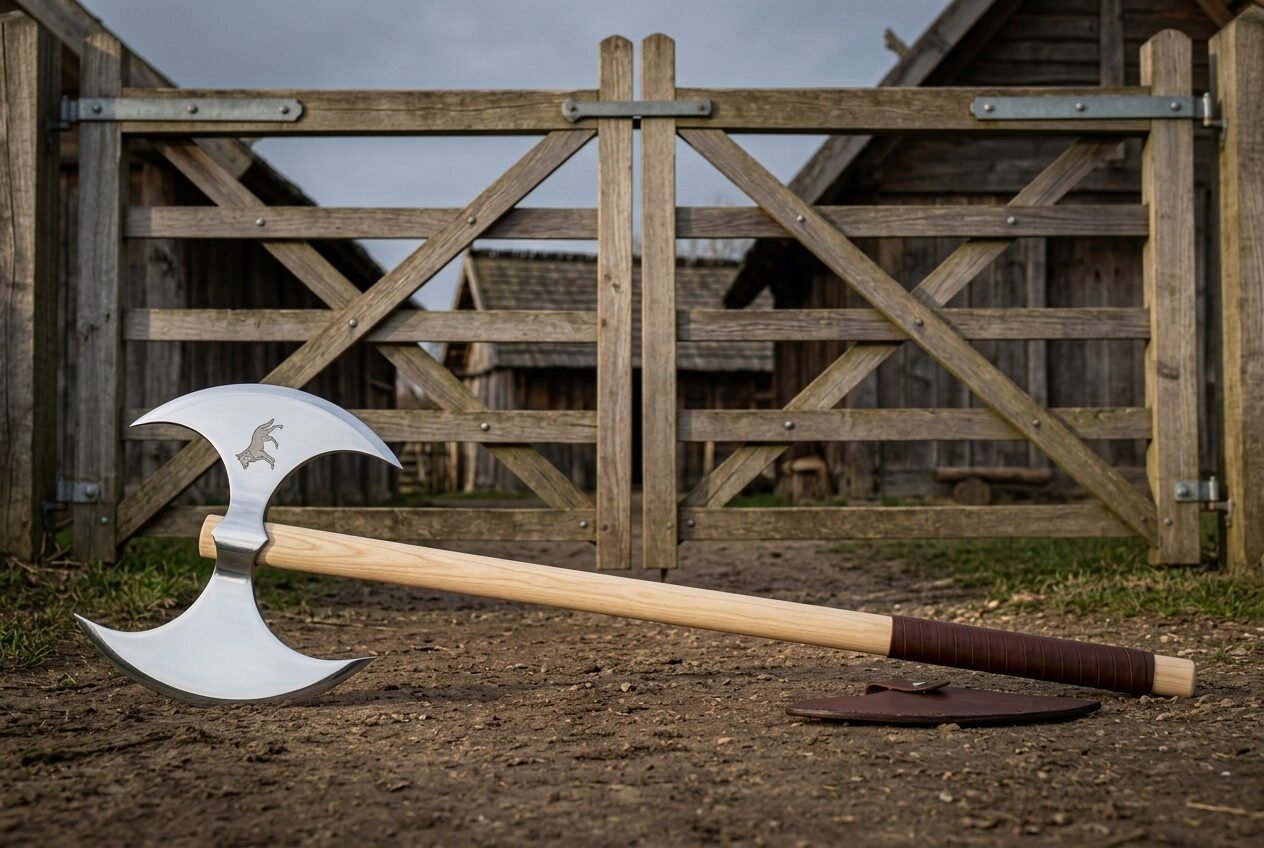
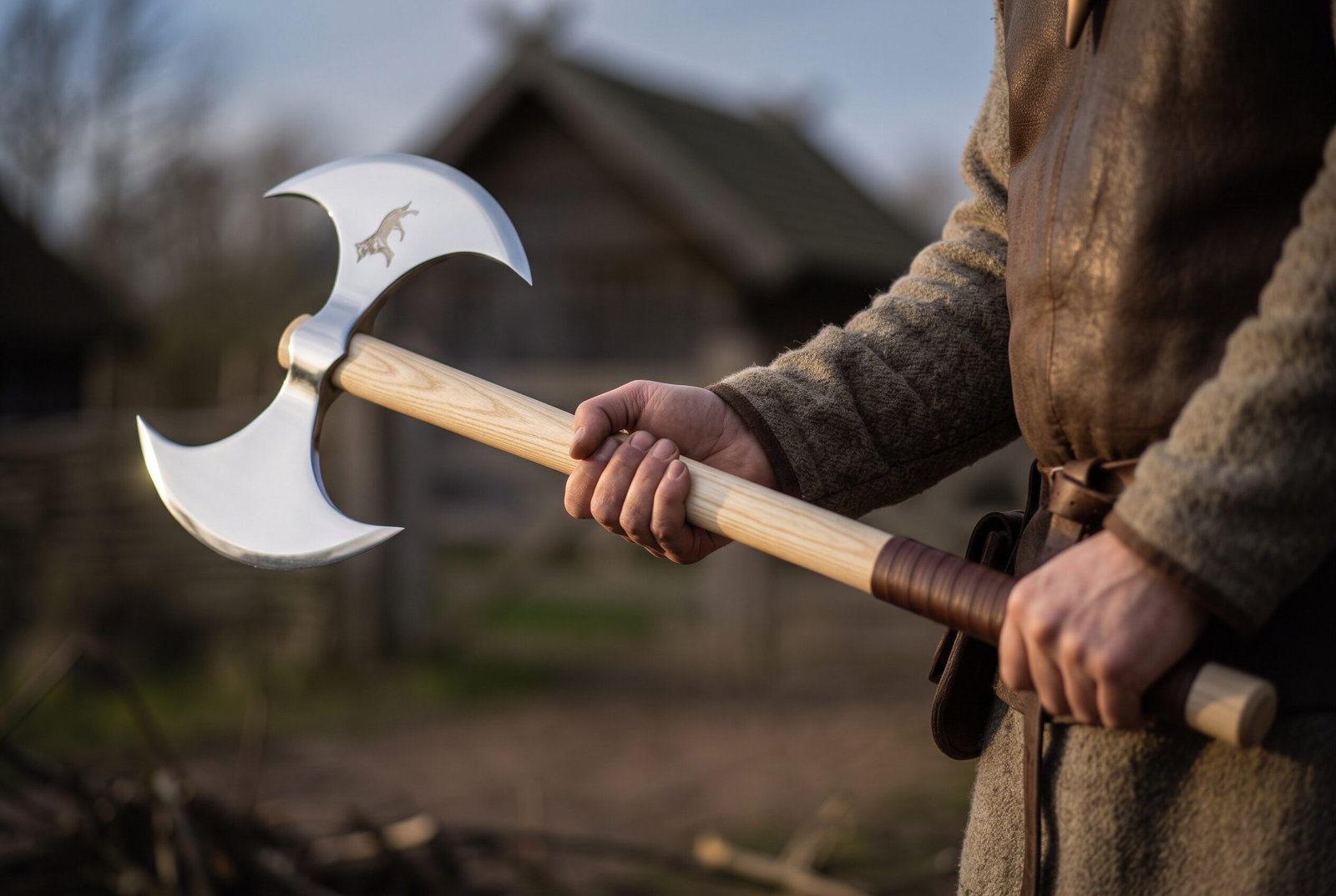
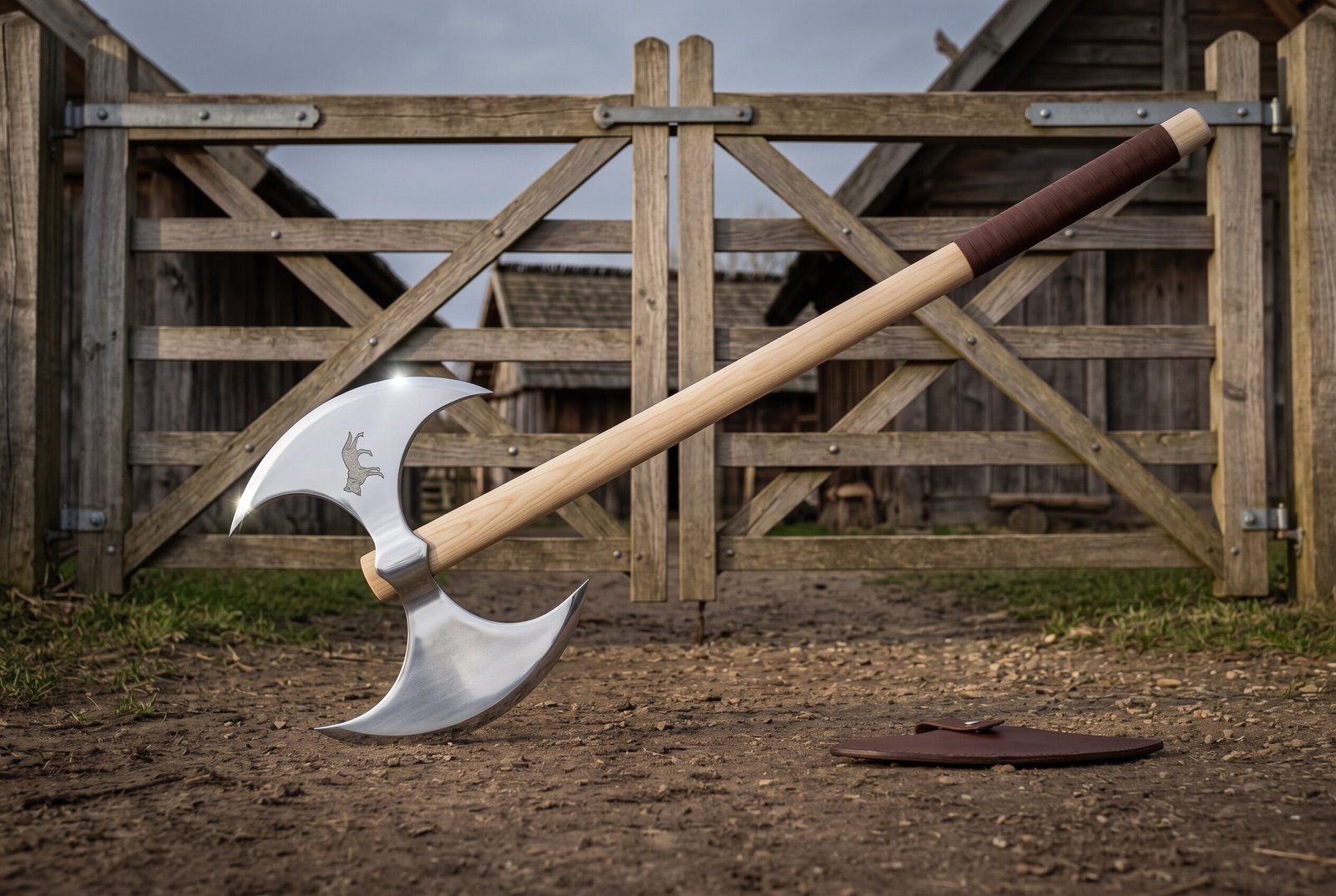
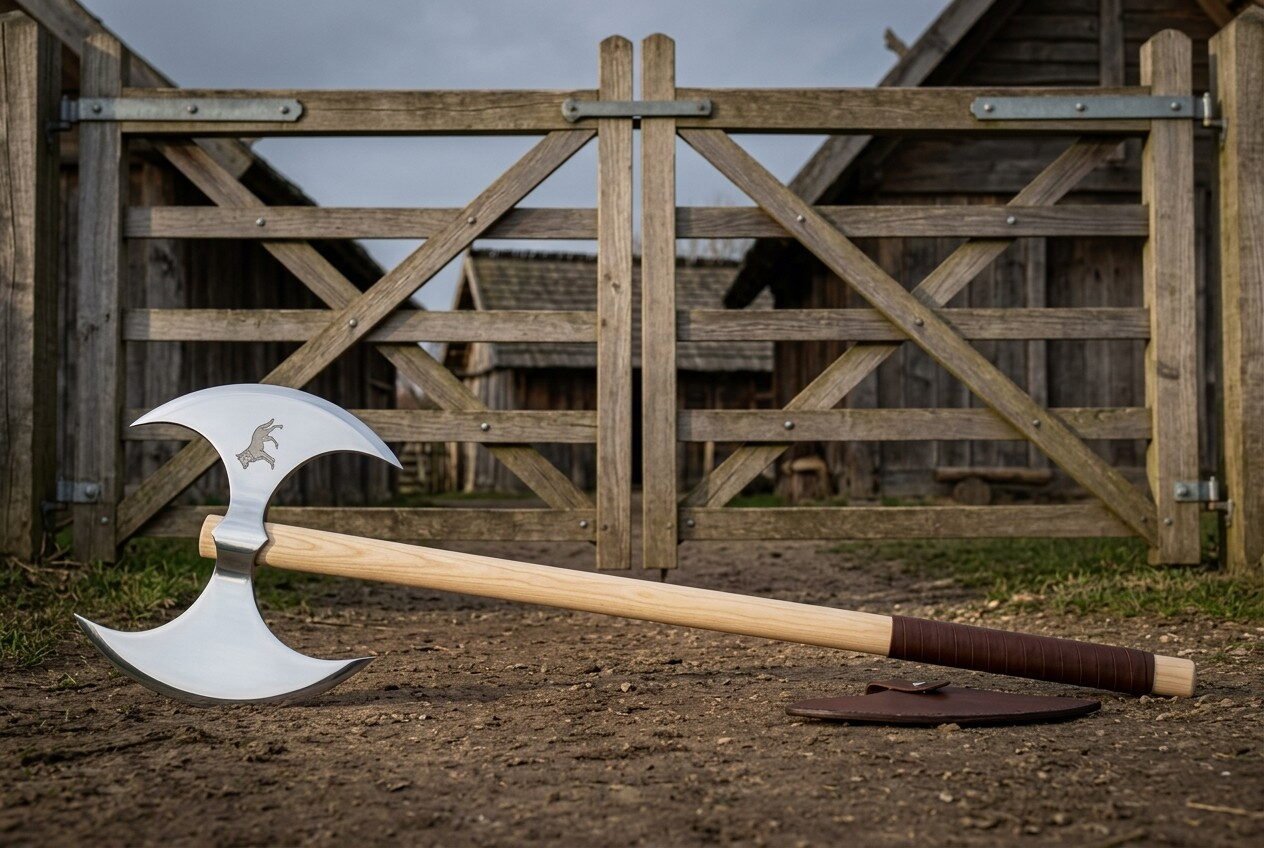
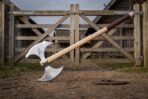
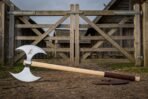
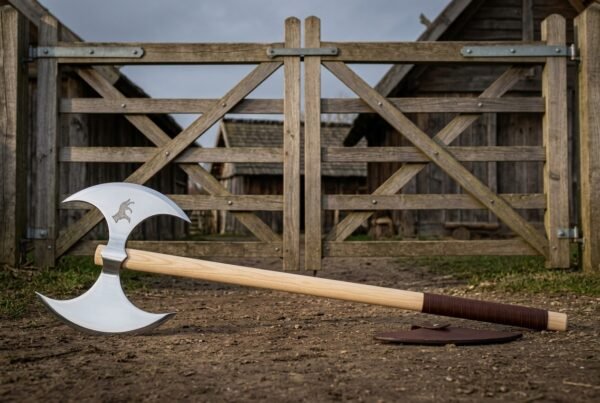
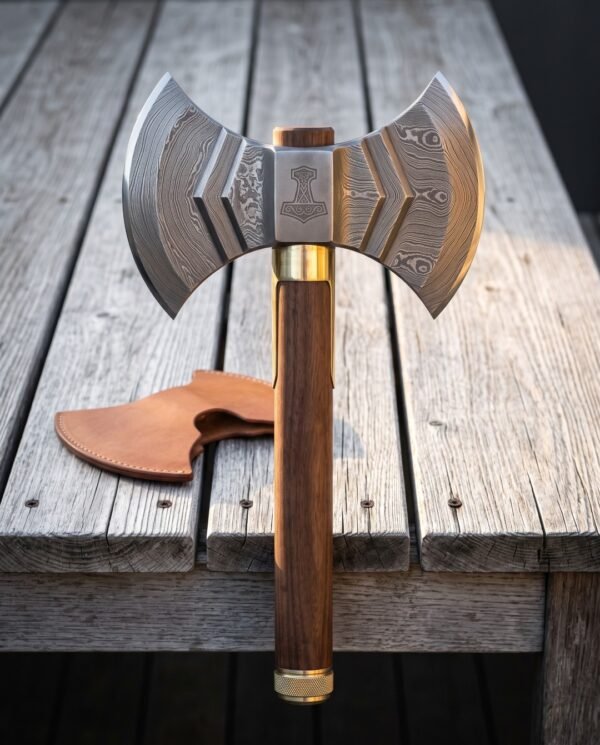
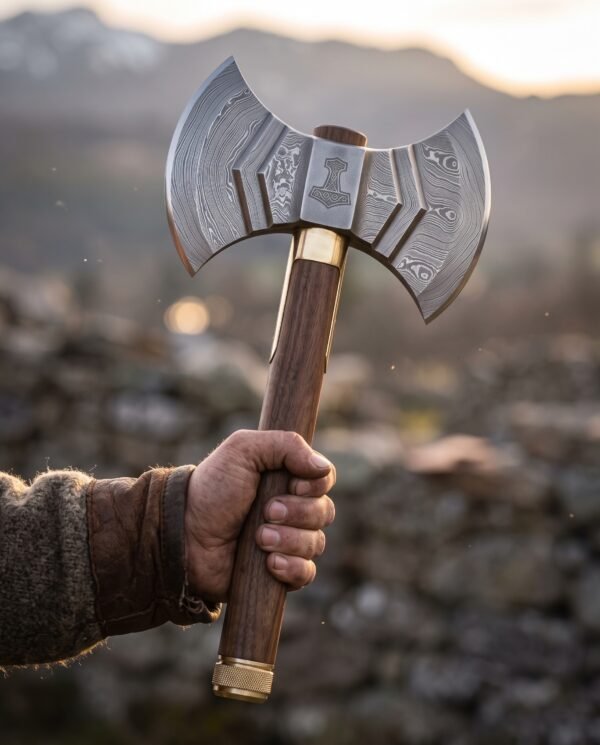
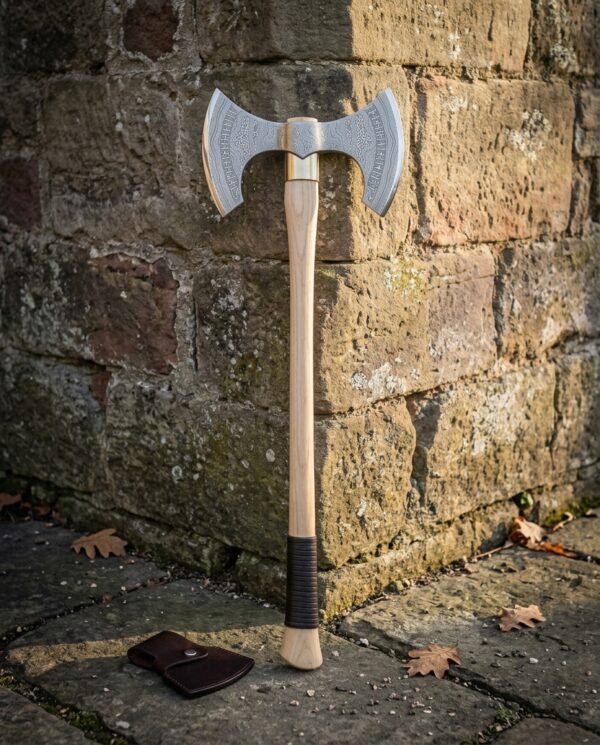
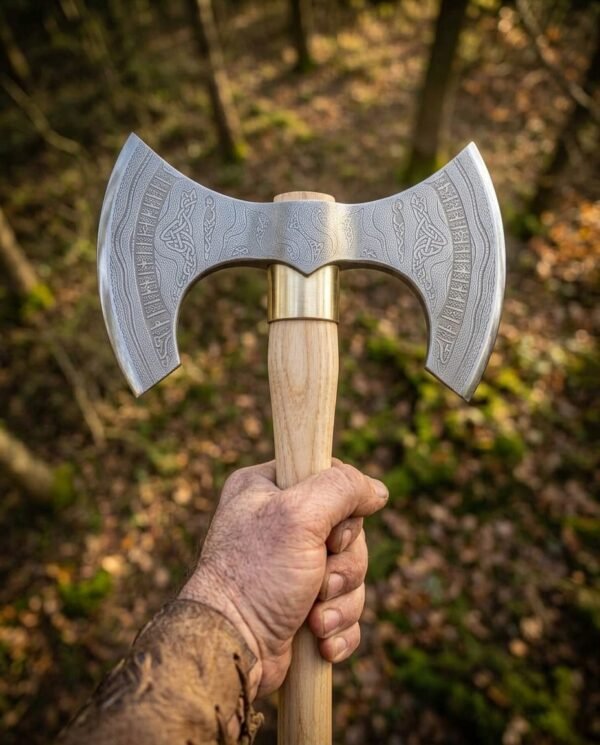
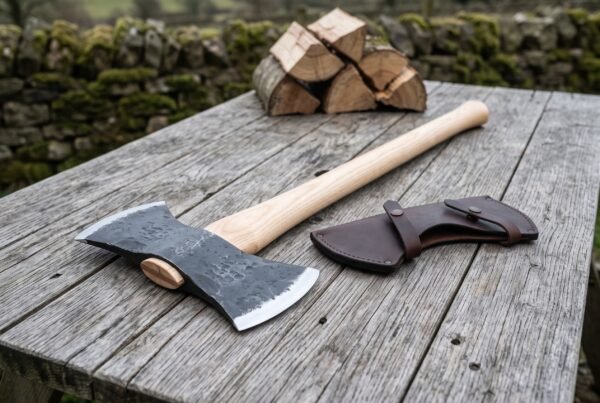
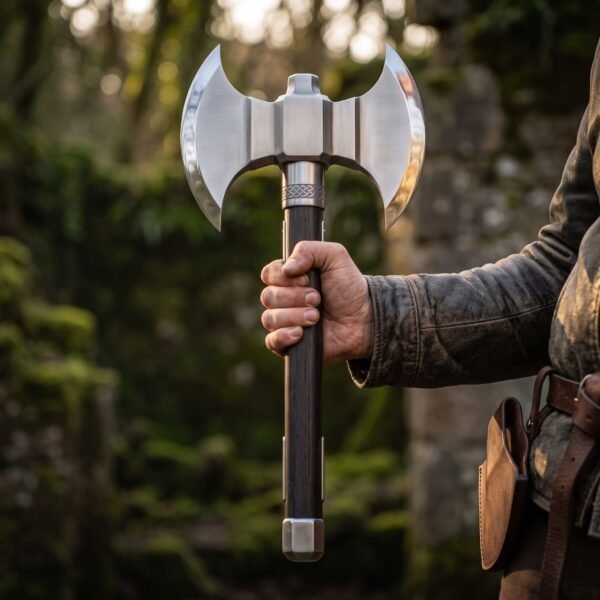
Twincrescent is a double headed axe with two crescent bits sweeping out from a single central eye, each one drawn to a fine horn at both tips so the head reads as two opposed moons. The steel is 1095, polished bright, with a Norse animal ornament etched into the upper bit. The haft is straight grained white ash, thirty four inches long, left bare through most of its length and wrapped in brown leather at the butt where the hand sits. A leather cover is included for the bits.
Be honest about what a double headed axe is, because the history matters. Vikings did not carry them. Every axe head recovered from a Norse grave is single bitted with a poll on the back, because a working axe needs somewhere to hammer and a second edge behind your hands is a liability in a fight. The two headed axe is genuinely ancient, but it belongs to Minoan Crete, where the labrys was a ceremonial and religious object rather than a battlefield axe. Twincrescent is forged, ground, heat treated, hafted and finished by hand in the Czech Republic.
Double headed axes are a later idea than most people think, and the history of the Viking axe covers what the graves actually held. For where 1095 sits on the hardness scale and what that buys you, see the steel and hardness page. Lighter heads meant for a target sit in the throwing axes.
Specifications
| Head material | 1095 high carbon steel, hardened to 54 to 58 HRC at the edges |
|---|
| Overall length | 34 inches |
|---|
| Head | Double headed, two opposed crescent bits drawn to fine horns |
|---|
| Head width | 11 inches from horn to horn across the crescents |
|---|
| Cutting edge | Two crescent bits, each roughly 7 inches of arc |
|---|
| Engraving | Norse beast ornament etched into the upper bit |
|---|
| Collar | Short steel collar below the head |
|---|
| Haft | Straight grained white ash, oiled, bare along most of its length |
|---|
| Grip | Brown leather wrap at the butt |
|---|
| Head fixing | Wedged through the eye and secured with a steel cross wedge |
|---|
| Finish | Bright polished head, oiled haft |
|---|
| Weight | Approximately 4 lb 8 oz |
|---|
| Included | Brown leather cover for the bits |
|---|
| SKU | RK-1903 |
|---|
Why two bits change the balance completely
A single bitted axe is unbalanced by design. The head hangs to one side of the haft, so the axe wants to rotate as you swing it, and a large part of learning to use one is learning to control that twist. Put a matching bit on the other side and the mass sits symmetrically about the haft, which means the axe tracks straight through a swing without any correction from the wrists. That is why the double head survived as a ceremonial form. It looks and feels controlled. The price you pay is that the head is now nearly twice as heavy for the same cutting edge, there is no poll to hammer with, and there is a live edge behind your hands at all times. Twincrescent is built as a display and collector piece for exactly that reason.
The steel and the haft
The head is forged from 1095, punched and drifted for the eye rather than folded, then ground to shape and heat treated so the edges finish at 54 to 58 HRC while the body around the eye stays softer and tougher. That is the correct arrangement for an axe. A uniformly hard head cracks at the eye. The haft is white ash chosen for grain running straight the whole length, because ash with grain running out at an angle fails at that point under load. It is fitted, wedged from the top and locked with a steel cross wedge, then oiled rather than lacquered, so the finish can be topped up forever instead of chipping.
Engraving, runes and your own design
Use the rune converter on this page to turn a name, a date or a short phrase into Elder Futhark and we will cut it into the steel, the leather or the wood. If you would rather have a Viking pattern than a rune line, choose your own design in the engraving option above the add to cart button and tell us where it goes. Where a piece already carries an engraved design, your chosen engraving replaces it rather than sitting alongside it. On Twincrescent the etched beast on the upper cheek gives way to your line, and there is room on the opposite cheek for a second short line if you want both. A rune line also burns well into the ash haft. See the engraving page.
Handling and display
At four and a half pounds with a thirty four inch haft this is a two handed object and it needs real space around it. The balance sits well forward, as it must with a head this size, and the leather wrap at the butt marks where the rear hand belongs. Held vertically it is dramatic, which is why most owners mount it. Two hooks taking the haft, or a bracket that cradles the head and the butt, will hold it flat on a wall. Fix into a stud or a masonry anchor, since five pounds on a drywall plug will pull out eventually. We sell Twincrescent as a display and collector axe. It is not a splitting or felling tool and it is not for full contact use.
Care
The head is bare high carbon steel and it will rust. Wipe it down after handling, especially the etched cheek where fingerprints sit, and keep a light film of oil or a paste wax on the polished surfaces. The ash haft should be re oiled once or twice a year with a penetrating furniture oil, which keeps the fibres from drying and shrinking away from the wedge. Do not store the axe leaning in a damp garage, since a humidity swing is what loosens a head. If a head ever works loose, we will re wedge it under the warranty. Rust removal notes are in the guide to steel care.
Keep the head dry and the edge oiled, and the axe care guide covers sharpening and haft upkeep.
Made in the Czech Republic
Every piece we sell is made by hand in the Czech Republic. The smiths there work the way the trade has been worked for a long time, heating and hammering the steel, taking the bevels down by eye, and fitting the handle and the leather one at a time. There is no automated line anywhere in it, so small differences from one piece to the next are normal and expected.
Ransack Viking is a United States company based in Chicago, Illinois. We bring the pieces in ourselves, inspect them on arrival and ship them from our own warehouse. If you add engraving, that is carried out here in the United States before your order goes out.
A note on handmade variation
This axe is hand made, not machine made or bulk produced, so what arrives will not be a pixel for pixel copy of the photograph. The two crescents are ground by eye so they are close mirrors rather than identical, the horns finish at their own points, the etched beast sits at its own depth, and the ash haft varies from near white to warm honey with its own grain figure. The dimensions, the steel, the heat treat and the build are the same every time. The character is not.
Frequently asked questions
Did Vikings actually use double headed axes?
No. Every Norse axe head found in a grave is single bitted with a poll. The double bit is Minoan in origin and it became a Viking image through film and television rather than through archaeology.
Are both edges sharp?
Yes, both crescents are sharpened. That is worth remembering, because one of them is always behind your hands when you hold it.
Can I chop with it?
We sell it as a display and collector axe. It is real forged steel on a real ash haft, but there is no poll, the head is heavy for its edge, and a rear live edge makes it unsuitable as a working tool.
How do I hang it on a wall?
Two hooks under the head and around the haft, fixed into a stud or a masonry anchor and rated for at least ten pounds between them. Do not rely on drywall plugs alone.
Can the haft be replaced?
Yes. The head is wedged in the traditional way, so a haft can be driven out and a new one fitted. We will do it for you if you ever need it.
What is the animal on the cheek?
It is a Norse animal ornament, a four legged beast drawn in the interlacing style that runs through Scandinavian metalwork. We do not claim it as a specific named creature, because that style is deliberately ambiguous.
What is in the box
- Twincrescent double headed axe in 1095 high carbon steel on a white ash haft
- Leather cover for the bits
- Care card covering oiling the head and the haft
- Lifetime warranty against defects in forging, grind, heat treat and fittings
- Forged and finished in the Czech Republic
Explore the range
See the other double headed axes, the Viking axes, the battle axes, and the guides.
Near neighbours in the shop
If this one is not quite right, there is the Twinfell double headed axe, forged from 1095. Also in this group is the Twinvane double headed axe, high carbon steel. Sitting beside it in the catalogue is the Stormcleave double headed axe, pattern welded Damascus.
From the same corner of the shop, there is the Langhewer Medieval axe. You can have this made your way instead on the custom Viking axe page.


Feels way more premium than the price suggests. Came in a nice gift box which made it feel even more special. Worth every penny.