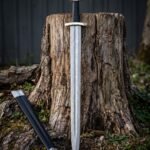
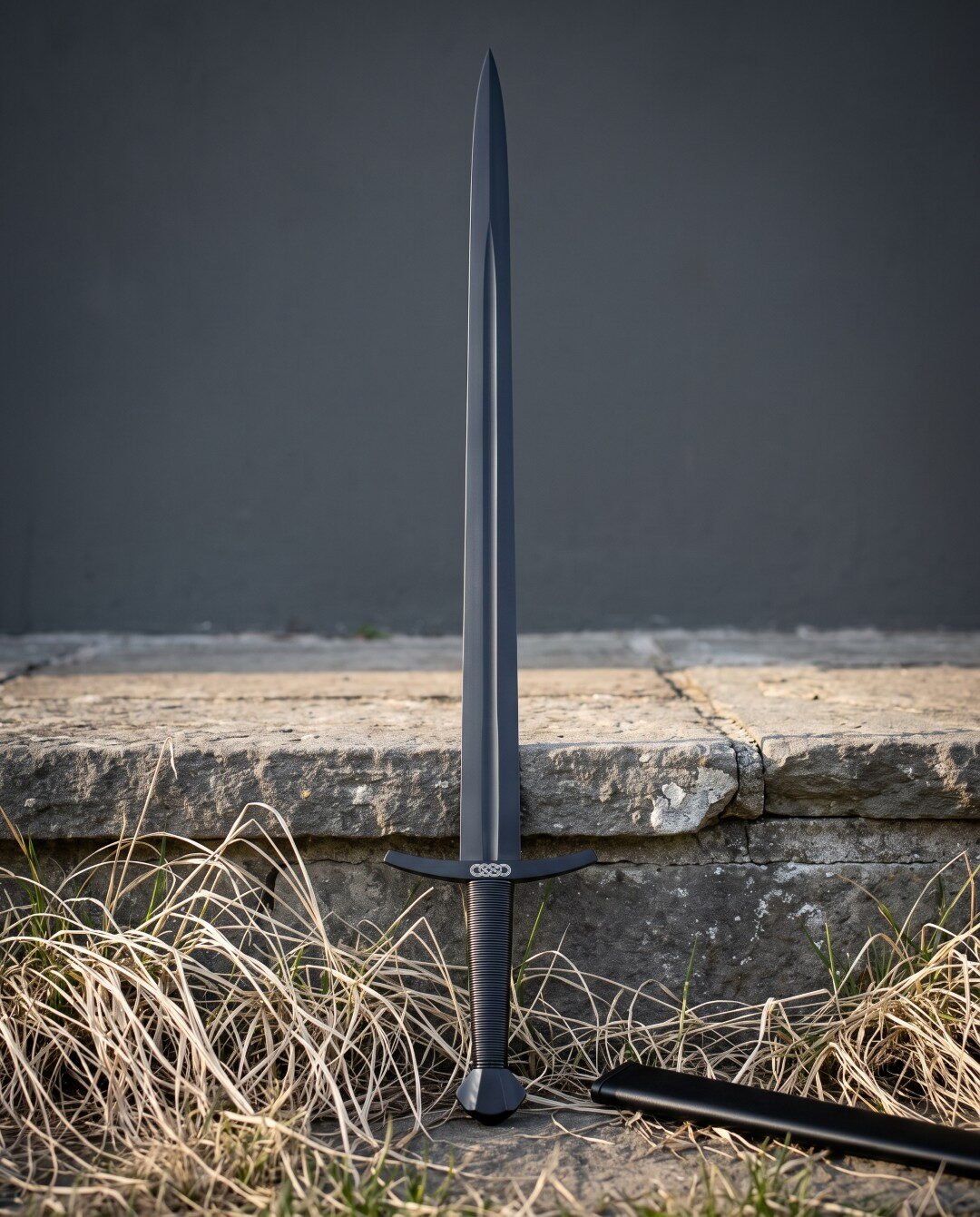
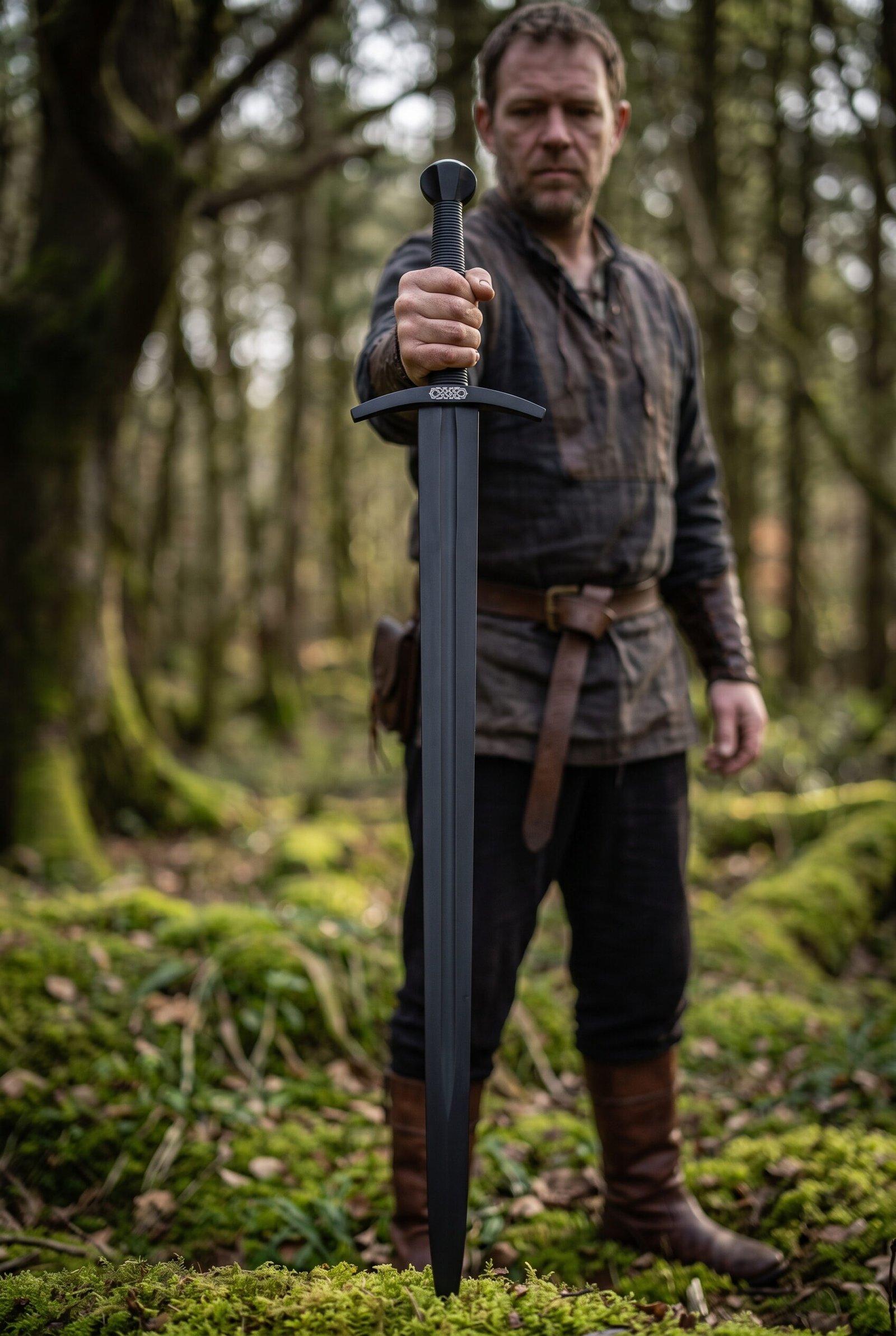
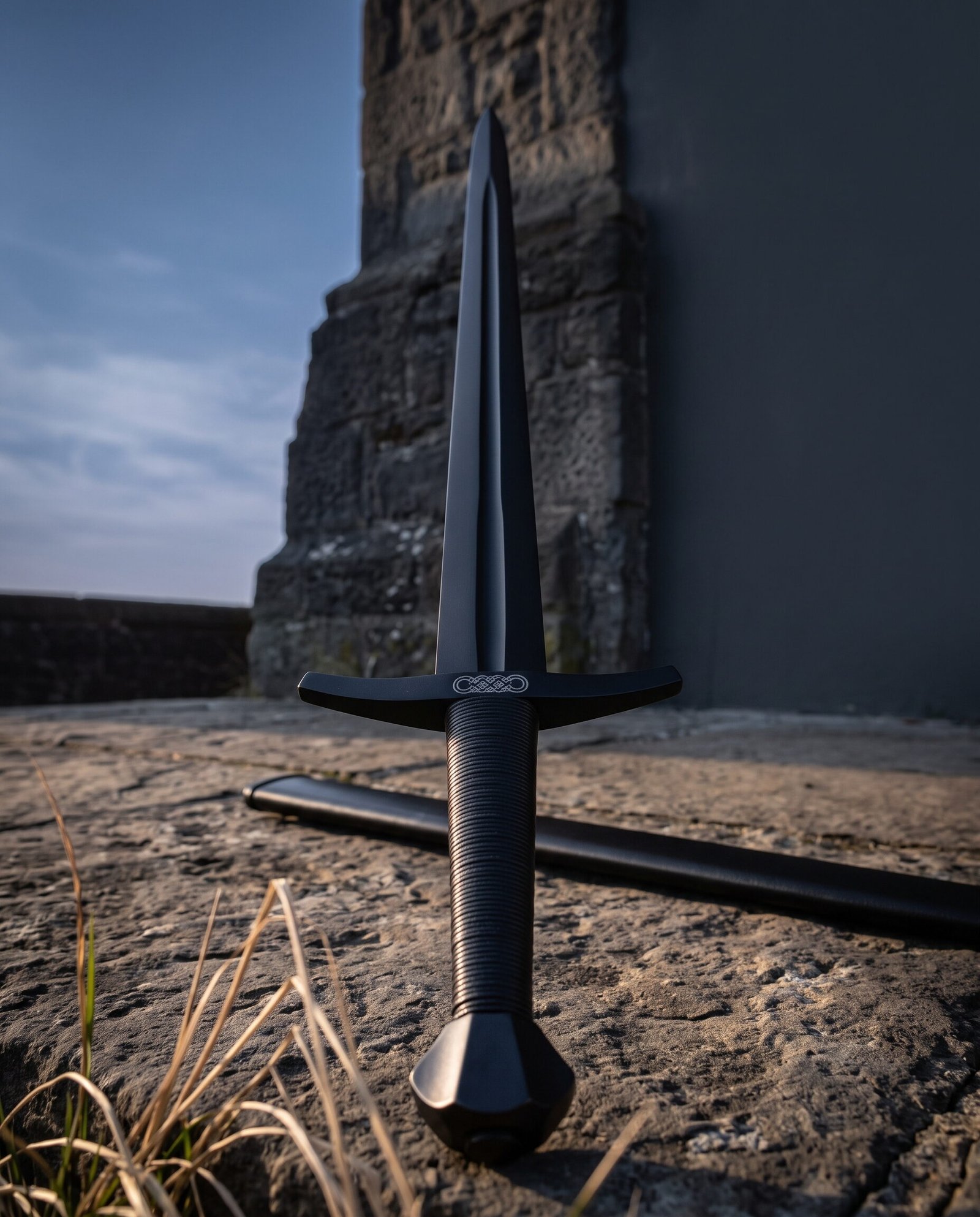
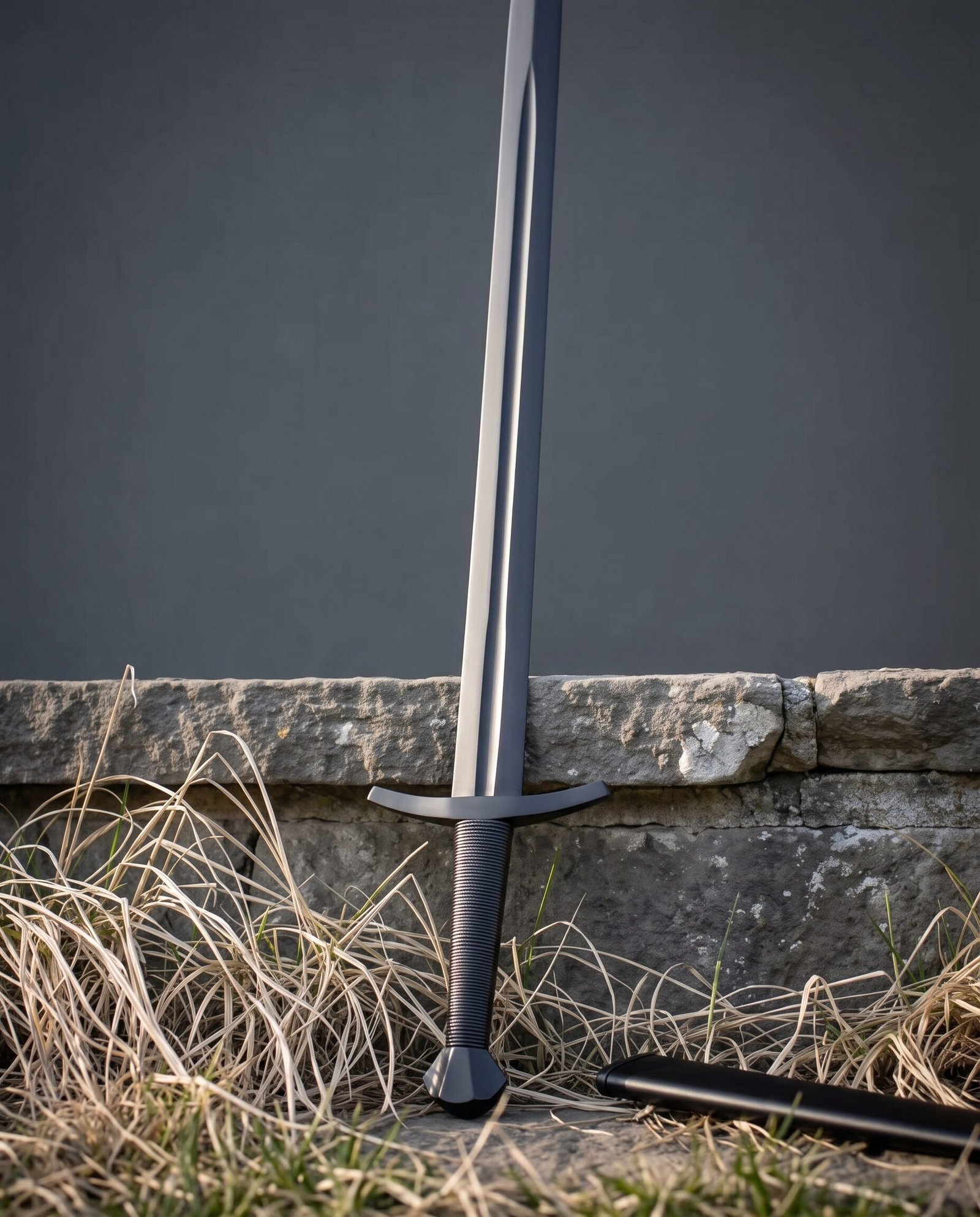
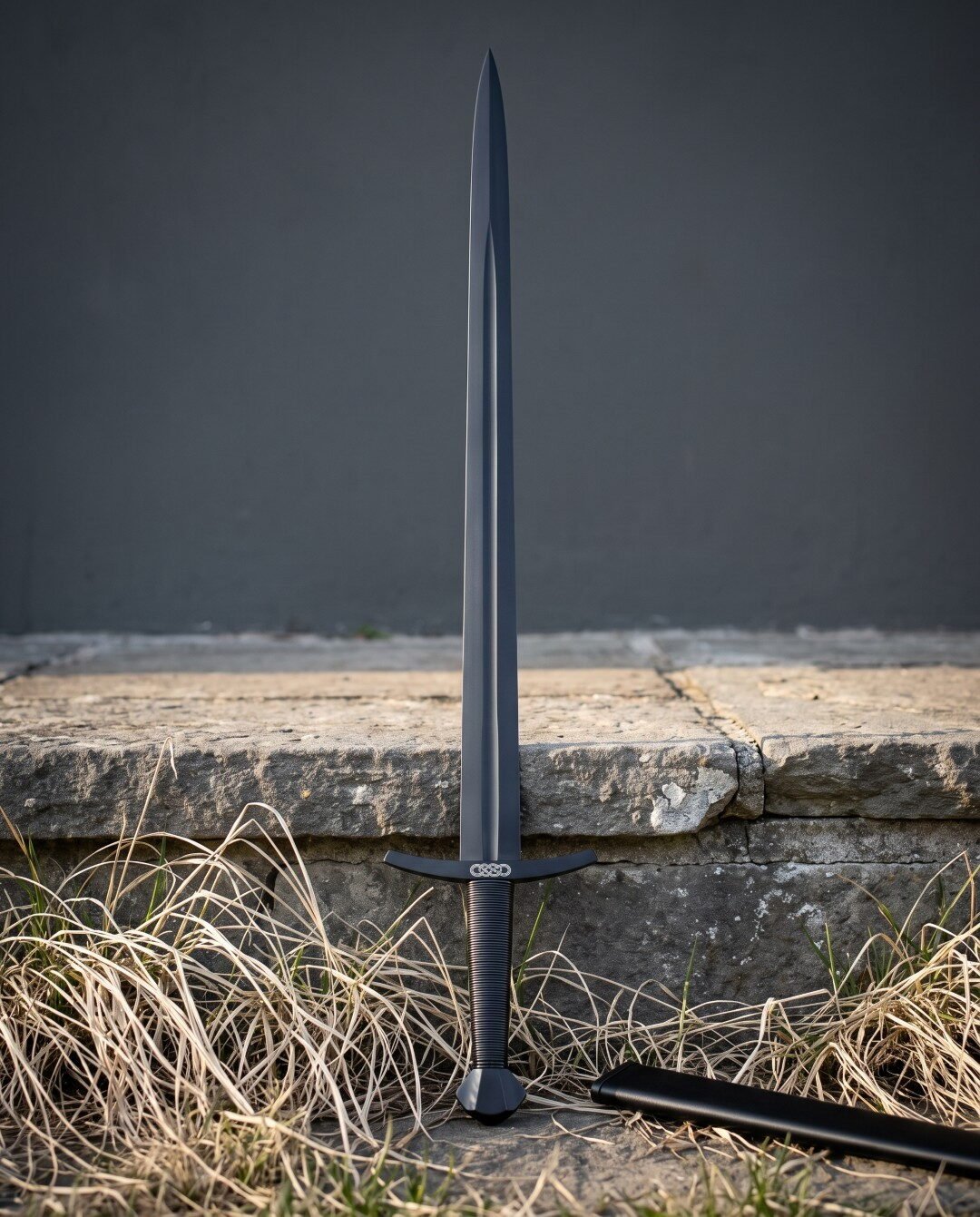
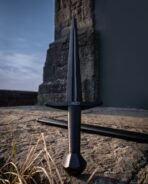
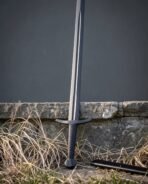
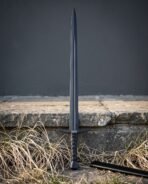
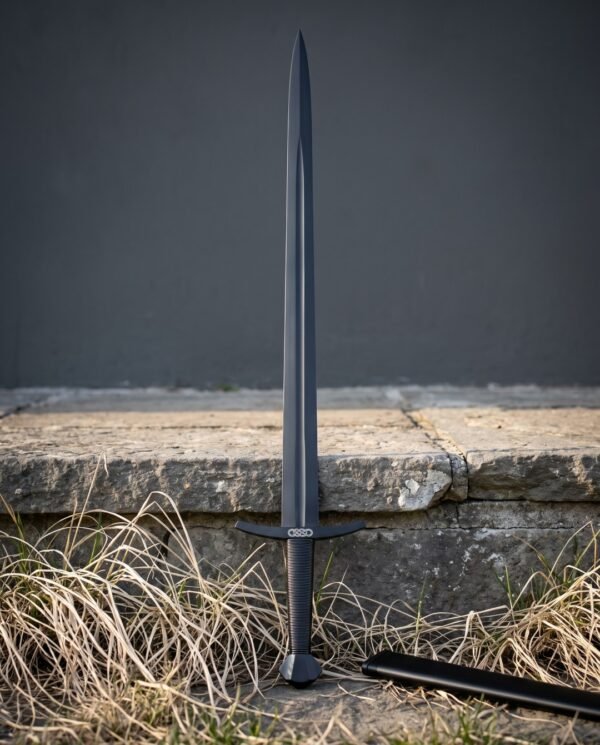
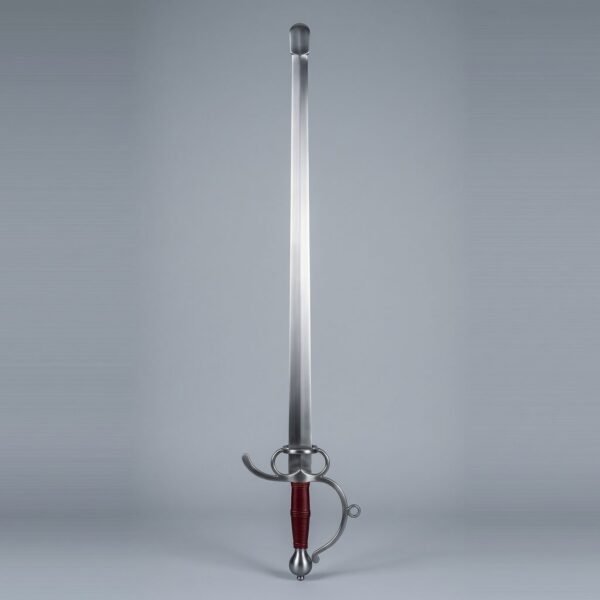
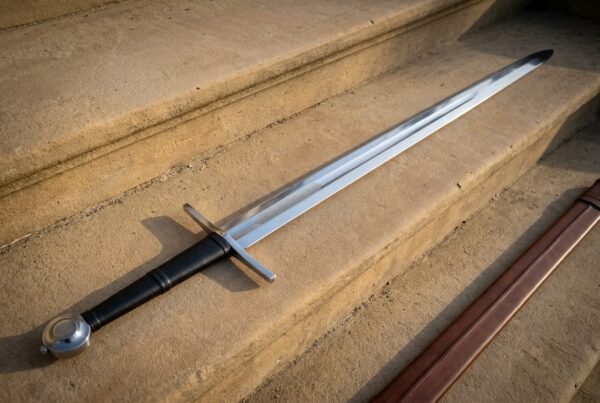
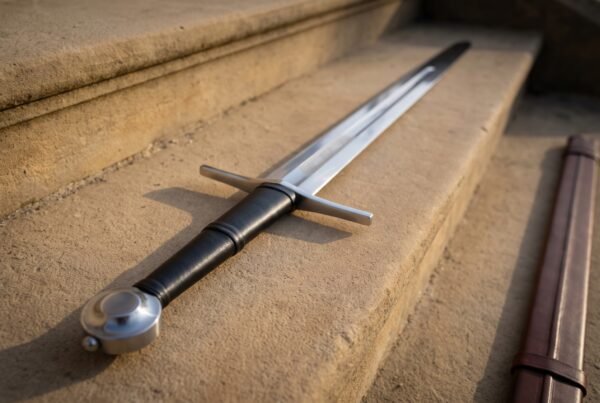
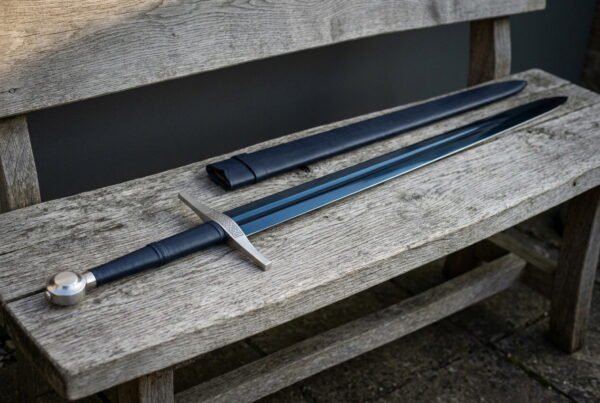
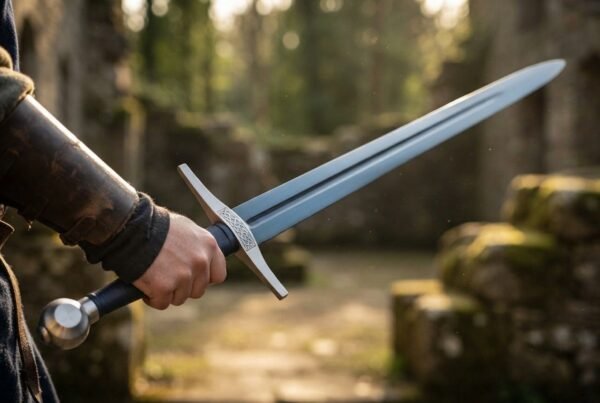
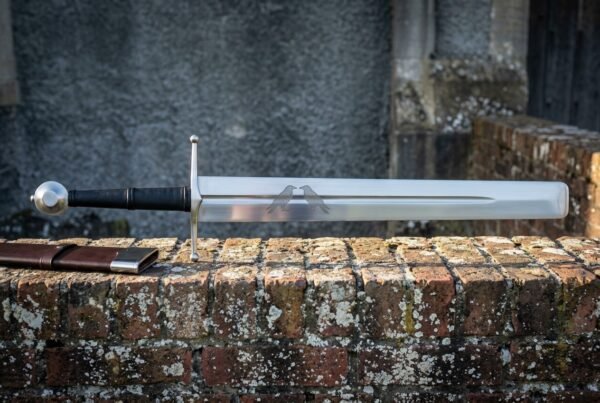
The Pitchknot is a blackened arming sword with a narrow, hard tapering blade, quillons that curve down toward the point, and a heavy faceted pommel. A band of interlaced knotwork is etched across the centre of the guard where the blade meets it. The grip is close wound wire over a shaped core and takes a single hand. A plain black scabbard is included.
Quillons that curve are a later idea than most people expect. The earliest medieval crossguards are straight bars, and they stay straight for two hundred years. Curved quillons show up as fencing moves off the battlefield and onto the ground, when swordsmen start binding blade against blade rather than hacking past a shield. Bend the arms of the cross toward the enemy point and two useful things happen at once, both covered below. This sword is forged, ground, heat treated, blacked and assembled by hand in the Czech Republic, and it ships with the fitted scabbard shown along with our lifetime warranty against defects in forging, grind, heat treat and fittings.
A single handed sword is the piece reenactors ask about most, and what reenactors actually want covers what gets used and what gets shelved. Interlace of this kind was the standard decorative language of the period, and the symbols guide covers the patterns that keep coming back. The medieval helmets are the obvious thing to hang beside it.
Specifications
| Material | 1095 high carbon steel, hardened to 54 to 58 HRC |
|---|
| Overall length | About 32 inches |
|---|
| Blade length | About 25 inches |
|---|
| Blade type | Double edged with a narrow central fuller and a strong profile taper to an acute point |
|---|
| Guard | Blackened steel quillons curved toward the point, etched knotwork band at the centre |
|---|
| Grip | Close wound black wire over a shaped core, single hand grip |
|---|
| Pommel | Heavy faceted steel pommel, peened over the tang |
|---|
| Finish | Black oxide across blade, guard and pommel |
|---|
| Scabbard | Plain black scabbard with a plain mouth |
|---|
| Included | Sword and scabbard |
|---|
| SKU | RK-1954 |
|---|
What curved quillons are for
The first thing a curve does is cover your hand. On a straight cross, an opposing blade that slides down yours runs along a flat bar and can skip over the end of it. On a curved cross the arms lean forward, so a sliding blade runs into a rising wall instead of a flat one and is turned outward before it reaches your fingers. The deeper the curve, the more hand it hides.
The second thing is that a curved quillon catches. In a bind, where two blades are pressed together and both fencers are trying to win the leverage, a forward hook gives you somewhere to trap the other blade for a fraction of a second while you turn your point in. Straight quillons will do this too, but they let the other blade slide out of the trap far more easily. This is why curved and later strongly recurved guards spread across Europe alongside the rise of civilian fencing.
The cost is that a curved cross is worse at simply shoving. A straight bar can be driven forward into an opponent as a blunt tool. A curved one deflects along itself. Every guard shape is a trade, and this one trades a little bludgeon for a lot of hand protection.
Steel, taper and finish
The blade is 1095 high carbon steel taken to 54 to 58 HRC. What defines this particular blade is not the alloy but the taper. It narrows in profile from about two inches at the guard to an acute point, and it also thins through its thickness from the ricasso toward the tip, which is called distal taper and is the part most reproduction swords skip. Distal taper is expensive in grinding time and it is the single biggest reason a sword feels alive rather than like a crowbar. Removing thickness at the far end takes weight off the longest lever on the whole piece, so the sword accelerates and stops far more easily.
The black is a chemical conversion of the surface rather than a coating over it, so it will not chip, and it changes the edge geometry by nothing measurable. It is not rust proof. Think of it as a head start and keep oil on it.
Engraving, runes and your own design
Use the rune converter on this page to turn a name, a date or a short phrase into Elder Futhark and we will cut it into the steel, the leather or the wood. If you would rather have a Viking pattern than a rune line, choose your own design in the engraving option above the add to cart button and tell us where it goes. Where a piece already carries an engraved design, your chosen engraving replaces it rather than sitting alongside it. On the Pitchknot the knotwork band across the guard is the existing design, and a rune line can either take its place there or run down the blade flat below the guard where there is a good clean panel. There is more on the engraving page.
Handling and balance
This is a point oriented sword rather than a chopper. The acute tip and the strong profile taper put the balance close to the hand, roughly two to three inches ahead of the guard, and that is what you feel first when you pick it up. It changes line quickly and it recovers fast from a committed thrust. It is not the sword you would pick to hack through a shield rim.
The faceted pommel is a different feel from a round wheel. Flats give your palm something to index against, so you always know where the edge is without looking, which matters more than it sounds. The wire grip is grippy and hard wearing. It is a sharp forged blade, not for sparring or reenactment, and it must not be used in contact work against another person or another blade.
Care
Wipe it down after handling and keep a light film of mineral, camellia or gun oil across the blade, guard and pommel. Sweat is the enemy of a black finish, more so than rain. Watch the wire wrap in particular, because moisture likes to sit in the grooves between the turns. A cotton bud with a drop of oil run along the wrap once in a while will keep it clean. Full guidance is in our steel care notes.
Do not store the sword in the scabbard for long periods. Take it out, oil it, and hang or lay the sword separately. Sharpen on a stone. A powered wheel will burn the temper out of an acute point faster than anything else you can do to it.
If it is going on a wall, hanging swords and axes safely covers mounts, fixings and what not to do.
Made in the Czech Republic
This piece is made by hand in the Czech Republic, in a workshop that still works the old way. The steel is forged, ground, heat treated and finished by smiths who learned the trade from the people before them, and the wood, horn and leather are cut and fitted by hand rather than pressed out on a line. That is also why no two pieces come out exactly the same.
Ransack Viking is a United States company. We import these pieces ourselves, check every one when it lands and ship from our warehouse in Chicago, Illinois. Engraving is done here in the United States after the piece arrives, so your runes or your own design go on before it leaves for you.
A note on handmade variation
This is hand made rather than machine made or bulk produced, so what arrives will not be a pixel for pixel copy of the photograph. The exact sweep of the quillons, the number of turns in the wire wrap, the crispness of the knotwork etch and the depth of tone in the black finish vary from sword to sword because a person shaped each one. The blade length, the steel, the heat treat and the construction stay the same. The character does not, and that is the trade you make when you buy something forged instead of stamped.
Frequently asked questions
Is it sharp when it arrives
Yes, with a working edge and a live point. The point on this one is acute, so treat it with more respect than you would a rounded cutting sword.
What is the difference between this and a straight guard sword
Hand protection and blade catching. Curved quillons cover more of your hand and give you somewhere to trap an opposing blade in a bind. A straight cross is simpler and better at being shoved forward as a blunt tool.
Is the black finish painted on
No. It is a conversion finish, meaning the surface of the steel itself has been chemically turned black. There is nothing to peel or flake. It will brighten on high spots with use.
Can I use this at a reenactment event
Not in combat. Sharp swords are not permitted in contact reenactment anywhere. It is fine as a display or dress piece where the group allows sharps to be carried peace bonded.
Will the knotwork be exactly like the photograph
It will be the same pattern but etched individually, so the depth and the contrast against the black will differ slightly on every sword.
What is the lead time
One to two weeks of processing plus transit, and free shipping inside the United States. Engraved orders sit at the longer end.
What is in the box
- Pitchknot blackened arming sword in 1095 high carbon steel
- Fitted black scabbard
- Protective oil film on the blade for transit
- Care card and lifetime warranty against defects in forging, grind, heat treat and fittings
- Forged and finished in the Czech Republic
Explore the range
More in arming swords, longswords and swords, or read the guides on blade taper, balance and finish.
Other pieces in this group
Another in the same line is the Sootbrand arming sword, 31 inches overall. Next along the rack is the Cloverhilt arming sword. For a straight comparison, see the Ashenroot arming sword, 36 inches overall.
The Weavecrest longsword covers the other half of the same kit. Nothing here exactly right, build one to your own spec on the custom Viking sword page.
For partner drills and sparring we carry the Aurnvik langes messer, and our HEMA messer range is a good place to start.


Nice piece for the price. Blade quality is solid. Arrived a bit less sharp than expected but a few passes on a strop fixed it. Wood handle looks great though it’s a little smaller than I imagined. Made in the Czech Republic but ships from the US. Delivery was quick even so. Would still tell others to give this a try.