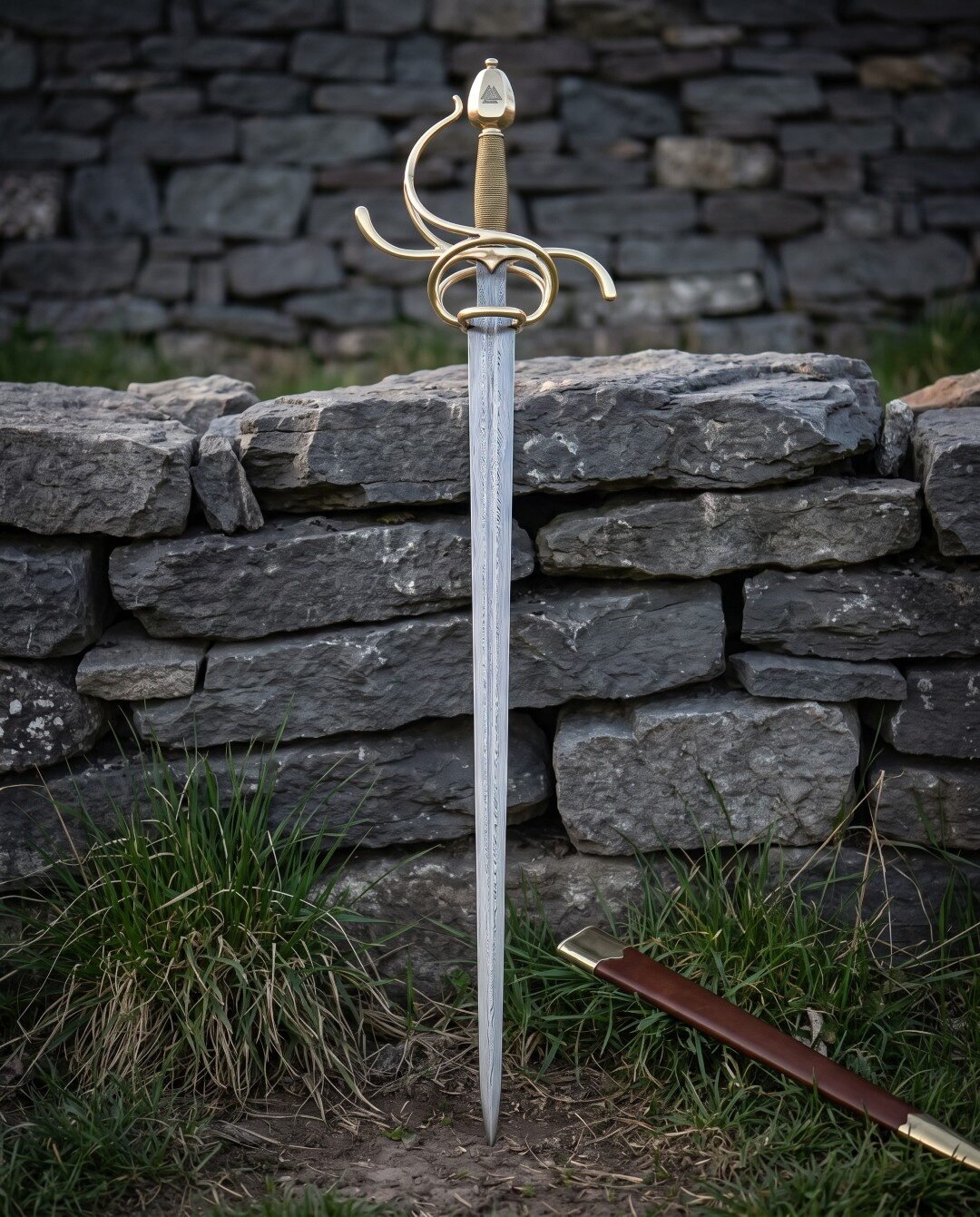
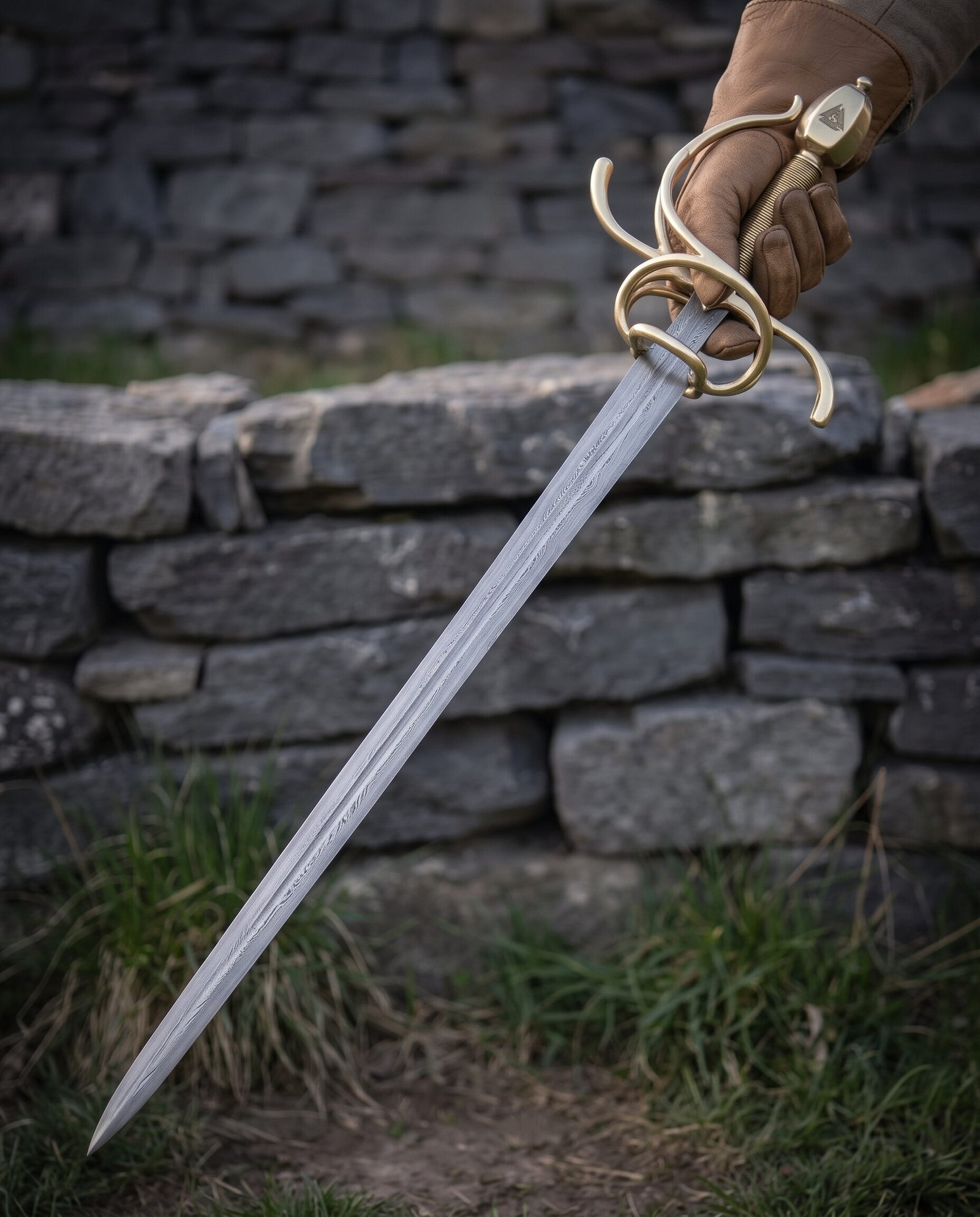
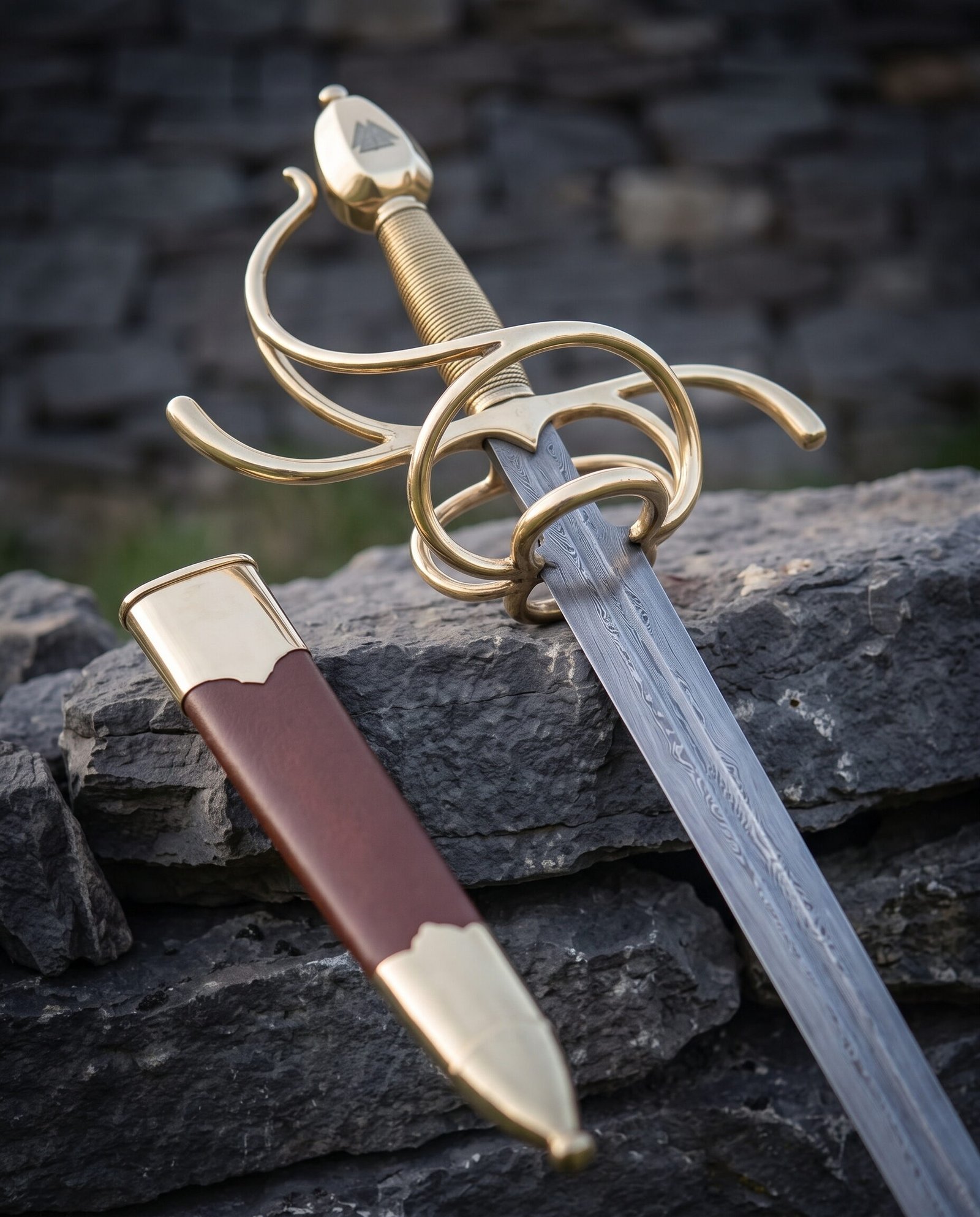
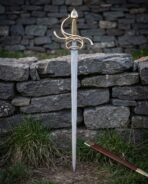
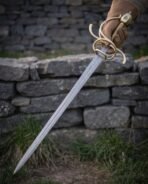
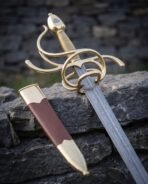
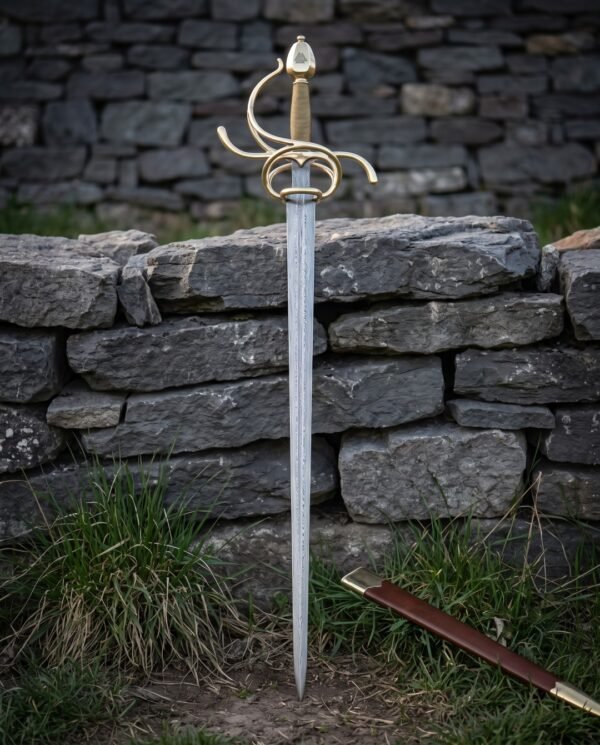
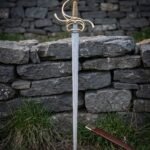
The Gildcage is a swept hilt rapier built with a brass guard and a pattern welded blade. The hilt is a cage of brass bars, a long knuckle bow rising to a faceted brass pommel engraved with a Valknut, twin side rings standing proud of the guard, and quillons that curve away in opposite directions. The grip is wound in fine brass wire. Below all that runs a long narrow blade of diamond section in folded Damascus, patterned in tight regular bands that step down the whole length of the steel. It ships with a brown leather scabbard mounted with a brass throat and chape.
The rapier arrived as a civilian sword rather than a military one, worn in town with ordinary clothes, and that changed what it was allowed to look like. A battlefield blade is dressed for war and mostly bare of ornament. A sword worn to church, to court and to dinner is a piece of clothing, and it got the same treatment as a good buckle or a hat badge. Brass and gilt hilts, wire wrapped grips and figured blades all belong to that world. The blade underneath still had to be entirely serious, because civilian did not mean decorative in a century when a quarrel in the street was settled where it started. Gildcage is forged, welded, ground, heat treated and assembled by hand in the Czech Republic.
A rapier is built around the point rather than the edge, and how to buy a first sword covers what that means for a buyer. Damascus here means 1095 and 15N20 forge welded and etched, and what Damascus steel actually is covers how the layers get there. Cutting blades with a similar guard sit in the sabres.
Specifications
| Material | 1095 and 15N20 pattern welded Damascus, hardened to 58 to 60 HRC |
|---|
| Overall length | Approximately 43 inches |
|---|
| Blade length | Approximately 36 inches, straight, narrow diamond section |
|---|
| Grip | Approximately 4 inches, fine brass wire wound over a shaped core |
|---|
| Guard | Swept brass hilt with a knuckle bow, twin side rings and curved quillons |
|---|
| Pommel | Faceted pear shaped brass pommel with an engraved Valknut, peened over the tang |
|---|
| Scabbard | Reddish brown leather over a shaped core with a brass throat and brass chape |
|---|
| Finish | Etched and hand polished Damascus blade, polished and lacquered brass |
|---|
| Weight | Approximately 2 lb 8 oz bare |
|---|
| Included | Rapier, fitted leather scabbard, care card |
|---|
| SKU | RK-1980 |
|---|
How the pattern is made to run in bands
A plain forge welded billet, stacked and folded and then ground flat, gives a loose wandering figure that follows wherever the layers happened to move. That is random pattern Damascus and it is what most people picture. The tight regular banding on this blade is something else. It is a directed pattern, and the smith puts it there deliberately by deforming the surface of the billet before the final grind.
There are two common ways to do it. One is to cut or press a series of grooves across the face of the bar and then forge the whole thing flat again, which drags the deeper layers up to the surface in the line of each groove and leaves a ladder of bands. The other is to twist the whole bar like a stick of barley sugar and then flatten it, which spirals the layers so they surface as repeating chevrons and rings. Either way the pattern you see is not carved into the steel. It is the internal layering being pushed around inside the bar and then intersected by the grinder. On a long narrow blade like this one a directed pattern reads far better than a random one, because a wandering figure gets lost on a surface only three quarters of an inch wide.
The steel and the brass
The blade is welded from alternating layers of 1095 and 15N20. The 1095 is plain high carbon steel that etches dark and the 15N20 carries around two percent nickel, resists the acid and stays bright, so the contrast is real metallurgy rather than a coating. It is hardened and tempered to 58 to 60 HRC. That is at the upper end of the range for a blade, and it suits a thrusting sword, where the working stress is compression along the centre line rather than the shock of a heavy cut. The section is a shallow diamond, thickest along the middle, which is what stops a long narrow bar from whipping when it is driven forward.
The hilt is solid brass, bent and filed to shape and fitted around this individual blade. Brass is the right material for a swept hilt in a way that steel is not always, because a hilt this complex has a lot of surface and a lot of tight internal corners, and brass will not sit and rust in them. It is polished and lacquered here so it stays bright without regular attention, and the lacquer can be stripped later if you would rather let it patinate. The grip is fine brass wire wound under tension over a shaped core, which stays grippy in a damp hand and never gets slick the way smooth leather can.
Engraving, runes and your own design
Use the rune converter on this page to turn a name, a date or a short phrase into Elder Futhark and we will cut it into the steel, the leather or the wood. If you would rather have a Viking pattern than a rune line, choose your own design in the engraving option above the add to cart button and tell us where it goes. Where a piece already carries an engraved design, your chosen engraving replaces it rather than sitting alongside it. On this rapier the best surface is the brass pommel, where your engraving takes the place of the Valknut, or the leather of the scabbard. We would steer you away from engraving the blade itself, since a cut line across a directed Damascus pattern interrupts the banding rather than sitting on it. See the engraving page.
Handling and balance
Balance sits close in, roughly two to three inches ahead of the guard, which is what a thrusting sword wants. The sword pivots near your wrist, so the tip answers instantly to very small movements of the hand and corrections cost almost nothing. There is very little forward mass, and there is not meant to be. This is not a cutting sword and a hard swing with it is simply the wrong tool used the wrong way.
The classic grip puts the index finger over the quillon inside the ring, with the thumb and forefinger pinching the flats just below the guard and the other fingers loose on the wire. The rings exist to protect that fingered index, so if you hold it any other way the hilt is doing less than it could. This is a sharp functional blade for display and solo handling. It has a live point and a rigid blade, so it is not a fencing trainer, and it must never be used against another person or another blade.
Care
Keep the blade lightly oiled at all times. An etched Damascus surface has more texture than a mirror polish and it will hold moisture from a hand if you let it, so wipe fingerprints off promptly rather than at the end of the week. Draw an oiled rag along the flats from guard to point. Do not use metal polish or abrasive pads on the blade, since they will cut the etch back and flatten the contrast between the layers.
The brass needs almost nothing while the lacquer is intact, just a soft dry cloth. If the lacquer wears through in a handled spot the brass will darken there, which some people like. If you want it uniform again, strip the lacquer fully with acetone, polish and leave it bare, and expect to polish it occasionally from then on. Feed the leather scabbard with a neutral cream twice a year. Our steel care page has the detail on rust and re oiling.
Damascus wants oil more than plain steel does, because the etch that shows the pattern also opens the surface, and caring for a Damascus pattern covers what to use.
Made in the Czech Republic
The work behind this piece happens in a Czech Republic workshop that has kept to the old methods. Steel is forged and heat treated by hand, the grind is taken down by eye rather than by machine, and the handle, fittings and sheath are cut and finished one at a time. Because of that, every piece carries small marks of the hand that made it.
Ransack Viking is a United States company. We import direct, check each piece when it reaches us, and ship from our Chicago, Illinois warehouse. Engraving is added here in the United States after arrival, so the piece you receive is finished to your order.
A note on handmade variation
This rapier is hand made and not machine made or bulk produced, so what arrives will not be a pixel for pixel copy of the photograph. No two Damascus billets pattern identically, and on a directed pattern the spacing and regularity of the bands depend on how the billet took the work, so yours will be its own. The sweep of the brass bars is formed by hand over a former, so the exact curve and ring spacing vary slightly. Polish depth, etch contrast and the tone of the leather all vary. The dimensions, the material and the build are the same every time. The character is not.
Frequently asked questions
Is the Damascus genuine
Yes. The blade is forge welded from alternating 1095 and 15N20 layers, patterned in the bar and then ground and etched. The figure runs off both edges and through the point, which is something no printed or laser marked pattern does.
Can I fence or spar with it
No. It has a live point and a rigid blade. Sport and historical fencing need a blunt trainer with a flexible foible and a button. Use this for display and careful solo handling only.
Will the brass tarnish
It is lacquered, so it stays bright with nothing more than a dry cloth. If the lacquer wears through at a handled spot that area will darken. Stripping the lacquer entirely and polishing gives an even finish if that happens.
How stiff is the blade
It has noticeable spring, as a narrow thrusting blade should. It flexes under load and returns straight. A blade of this section that did not move at all would be brittle.
Does the scabbard have a hanger
It is supplied as a fitted scabbard with a brass throat and chape and no belt fittings. Ask before ordering if you want rings or a frog and we will quote for it.
When will it arrive
One to two weeks of processing because the hilt is fitted by hand to each blade, then free tracked shipping inside the US from Chicago.
What is in the box
- Gildcage Damascus rapier with a brass swept hilt
- Fitted brown leather scabbard with a brass throat and chape
- Care card and lifetime warranty note
- Forged and finished in the Czech Republic
Explore the range
See more in Damascus swords, swords, arming swords and scabbards and sheaths, or read the guides for how a pattern is directed in the bar.
If this one is not it
In the same category sits the Ashbraid short sword, 38 inches overall. A near match for this one is the Wyrmfall Viking sword, 37 inches overall. Closest to this in the range is the Skaldbone Viking sword, 36 inches overall.
Fitting out further, the Swiftcoil rapier belongs with it. Pick the steel, the length and the fittings yourself on the custom Viking sword page.

Solid sword. Glad I ordered it. Good to know it ships domestically from the US despite being made overseas. Blade quality is solid. Arrived a bit less sharp than expected but a few passes on a strop fixed it. Minor nitpicks aside, good quality piece.