
Blog
How to Display Swords and Axes on a Wall Safely

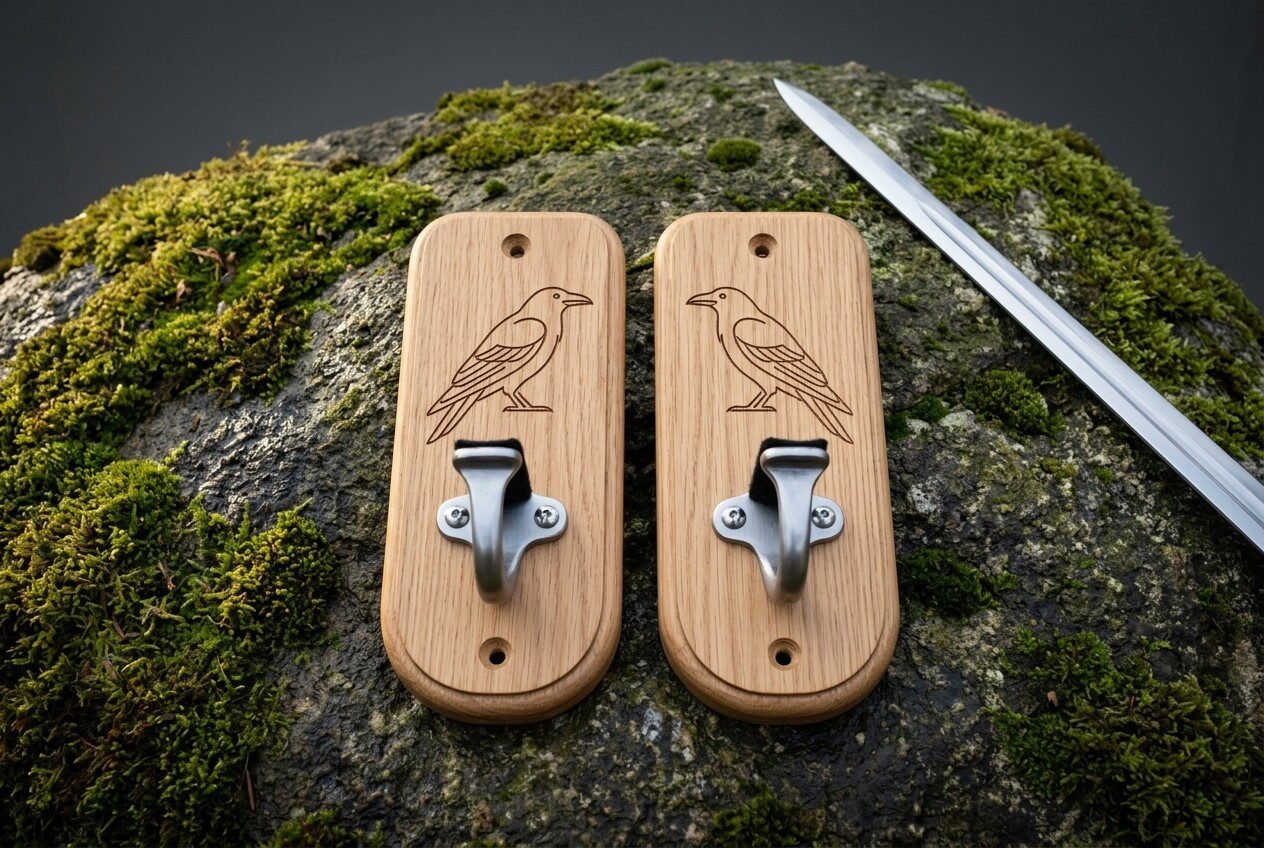
Hang a sword or an axe from fixings driven into a stud or into rated wall anchors, never into bare plasterboard. Use two mounting points, support the piece rather than balancing it, keep edges and points above head height and away from doorways and traffic, and secure anything within reach of children. A dropped sword is the injury nobody plans for, because nobody expects the wall to be the weak part.
Most wall mounting goes wrong for one of two reasons: the fixing was never strong enough, or the piece was resting rather than held. Both are easy to avoid, and neither one announces itself in advance. This is the full method, from choosing the wall to the final check.
Before you pick up a drill
Weigh the piece and add a margin
Put the sword or axe on a bathroom scale and note what it actually weighs, then plan your fixings for at least four times that figure. Guessing is how people end up buying their anchors twice. The load on a wall mount is not static: it spikes every time someone knocks the piece, every time a door slams nearby, and every time you take it down and put it back. Rated anchors are cheap, and the failure you are designing against is sudden.
Find out what your wall is made of
Tap along it. A hollow sound means plasterboard over a cavity; a dull solid sound means masonry, brick or concrete. On plasterboard, run a stud detector and mark the centres of the timbers behind it, usually spaced at regular intervals. On masonry you can fix almost anywhere with the right plug, but avoid drilling near sockets, switches or anything directly above or below them, because cables run vertically from fittings inside walls.
Choose the height and the line
Two rules cover most rooms. Put the cutting edge or point above the height of an adult head, so nobody can walk into it, and keep the piece out of the swing arc of any door and clear of the corridor people take through the room. A sword above a mantel is a classic position because the fireplace itself keeps people at a distance. A sword in a hallway at shoulder height is an accident with a date on it.
Fixings, by wall type
 Ravenperch Hand Made Oak Sword Wall Mount Hooks | Matched Pair of Engraved Raven Plaques | Brushed Steel Hooks and Wall Fixings | Norse Display Gift | RK-1771
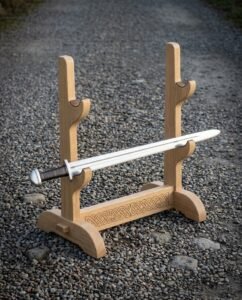 Oakrest Hand Made Oak Sword Display Stand | Two Tier Table Top Rack | Knotwork Engraved Crossbar with Wide Footed Oak Base | Norse Display Gift | RK-1783
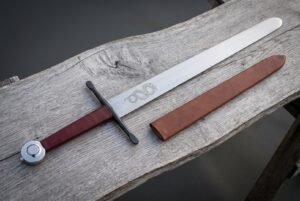 Serpentward Hand Forged High Carbon Display Sword with Serpent Etched Blade | Rounded Unsharpened Point | Wheel Pommel and Burgundy Leather Grip | Wall Display Gift | RK-2176
Into a stud
This is the best case. Drill a pilot hole and drive a wood screw of decent gauge directly into the timber, at least an inch and a half of thread into solid wood. A single stud fixing will hold far more than any sword you are likely to own. Where a bracket has two holes and only one lands on a stud, use the stud for the load bearing point and a proper anchor for the other.
Into plasterboard with no stud
Never use a plain plastic wall plug in plasterboard. Use a metal toggle, a spring toggle or a self drilling metal anchor rated for the load, and read the rating on the packet rather than guessing. Plasterboard fails progressively: the anchor works loose, the hole enlarges, and one day the whole thing comes out of the wall with a piece of the wall attached.
Into brick, block or concrete
Drill with a masonry bit on hammer setting, blow the dust out of the hole, and use a plug matched to the screw. Drill into the brick rather than the mortar joint where you can, since mortar crumbles under load. Concrete screws that bite directly into the material are excellent and avoid plugs entirely.
Mounting a sword
Use two points, not one
A sword hung from a single hook rotates. Every time it rotates it slides, and eventually it slides off. Use a matched pair of hooks or a bracket set: one supporting the blade near the guard and one further down the blade, or one under the guard and one under the scabbard tip. The distance between them should be at least a third of the sword’s length.
Cradle the piece, do not pinch it
Good mounts have a cradle or a hook deep enough that the sword sits into it rather than balancing on it, and the contact surface should be felt, leather or a soft liner. Bare steel hooks scratch a polished blade and mark a scabbard. Where a hook has no liner, a wrap of adhesive felt takes a minute and saves the finish.
Horizontal or vertical
Horizontal is easier, safer and reads better in most rooms. The load is shared evenly between two points and there is nothing to slide. Vertical mounting, point down, puts everything on the upper fixing and turns the sword into a spear if it lets go, so only do it with a mount designed for it and a fixing into a stud. Point up is safer than point down and looks wrong to most eyes.
Scabbard on or off
Leave the scabbard on for display where you can. It protects the blade from dust and from casual hands, it gives the mount a wider surface to grip, and it removes the exposed edge from the room. Take it off only for pieces where the blade itself is the point of the display, and then hang the scabbard alongside rather than leaving it in a cupboard where it will warp.
Mounting an axe
Support the head, not the haft
An axe carries almost all its weight in the head, so the head is what the mount has to hold. A pair of cradles with the upper one taking the head just under the blade and the lower one steadying the haft is the standard arrangement, and it puts the load where the fixing is strongest. Hanging an axe from the haft alone lets the head swing and pull.
Watch the edge orientation
Turn the cutting edge upward or against the wall, never out into the room at the height of a passing hand. On a bearded axe, the drawn down lower corner is the part that catches sleeves and knuckles, so give it clearance. A plaque or board mount, where the axe sits on a wooden panel that is itself fixed to the wall, is the tidiest solution for this because the board holds the edge back off the surface.
Long hafted pieces
A Dane axe or a poleaxe is a different problem, mostly because it is a lever. The length works against you, so a knock at the bottom of the haft multiplies at the top fixing. Use three points for anything past about four feet, and mount it low enough that you can reach the top fixing to check it without a ladder.
Shields, and using them as a backdrop
A round shield makes an excellent backing panel for a pair of crossed axes or a single sword, and it also solves the edge problem by putting a broad surface between the steel and the wall. Shields are usually heavier than they look, so fix them into a stud or use two rated anchors, and mount the shield first, then the pieces in front of it.
Crossed pieces, and why they are harder than they look
Two swords crossed behind a shield is the arrangement everyone wants and the one that fails most often, because people fix the top piece, let the lower one lean on it, and call that mounted. Mount each piece independently on its own fixings, then adjust the angles. Nothing in the arrangement should be holding anything else up.
What ruins a piece on a wall
Damp is the enemy, and walls are where damp lives. Do not mount carbon steel on an exterior wall that gets cold, in a bathroom, in a kitchen directly above a hob, or in an unheated garage. Condensation forms on cold steel and sits there. If the only wall available is an exterior one, leave an air gap behind the piece and check it monthly.
Direct sunlight is the second problem: it fades leather grips and scabbards, dries out wooden hafts and can lift a finish. Third is the slow one, which is simply forgetting the piece is there. Steel on a wall still needs wiping and oiling a few times a year, and a wooden haft will shrink in a dry heated room until the head loosens. Take everything down twice a year, wipe it over, check the fixings, and put it back.
Safety, plainly
Anything with an edge or a point that is within reach of a child is a hazard regardless of how well it is fixed. Mount high, or mount in a room that gets closed, or use a locking display case. Tell guests what is on the wall before somebody decides to take it down and swing it, because a sword handed to an untrained person in a living room is how furniture and people get hurt. Check every fixing after any earthquake, any building work, or any time you notice the piece hanging out of true.
What we carry
Our sword stands and displays range covers walnut and oak wall mount pairs with felt lined cradles and brass hooks, table top racks holding two or three pieces, and axe wall plaques with leather lined steel cradles. The pieces themselves live in the sword range and the Viking axe range, with backing panels available in Viking shields and covers in scabbards and sheaths. Every piece is handmade in the Czech Republic the old way, then imported, inspected and shipped from Chicago, Illinois, with engraving done in the US after arrival, so a mount plaque can be cut with a name or a rune band to order.
A ten minute check before you commit
Hold the piece against the wall where you intend it to go and stand back. Walk the route people actually take through the room and see whether anything is at head or shoulder height. Open every door fully. Check that you can reach the fixings later without moving furniture. Then mark, drill and mount. The five minutes spent on this is the difference between a display you forget about and one you keep worrying at.
For choosing what goes on the wall in the first place, our guides to the best Viking swords for collectors and the best Viking axes are the place to start, and Viking shields explained covers the backing panel option.
Shields need a different fixing again, covered in choosing a shield to hang. Before you mount anything it helps to know whether the piece is a display build or a battle ready one, and the cleaning routine is in our care guide.
Blades that come off the wall for club night every week want a mount you can reach in one movement, and the HEMA sword range is where those pieces live.
Questions people ask
Can I hang a sword on plasterboard?
Yes, but only into a stud or with metal anchors rated for the weight. Plain plastic plugs are not adequate and will work loose over time as the hole enlarges. Find the studs with a detector and use them where you can. Where you cannot, use spring toggles or self drilling metal anchors and check the load rating on the packaging rather than guessing, since the packet is the only part of this that has been tested.
How high should a sword be mounted?
High enough that the point and edge sit above adult head height, and clear of any doorway swing or walking route. Above a mantelpiece is the classic position because the fireplace keeps people at a distance. A hallway at shoulder height is the worst choice, since people brush past it constantly and eventually one of them catches it.
Should I display a sword with the scabbard on?
Usually yes. The scabbard keeps dust off the blade, removes the exposed edge from the room and gives the mount a broader surface to grip. Take it off only when the blade itself is what you want people to see, and hang the scabbard nearby rather than storing it in a cupboard, where leather can dry out and warp unseen.
Is it safe to hang an axe by the haft?
Not on its own. Almost all the weight sits in the head, so a haft only mount lets the head swing and pull against the fixing. Support the head just under the blade with the upper cradle and use a lower cradle to steady the haft. A wooden plaque mount that holds the head against a board is the tidiest and safest arrangement.
Will steel rust hanging on a wall?
It can, and the wall is usually more to blame than the steel. Particularly on a cold exterior wall, in a bathroom, above a hob or in an unheated garage, where condensation forms on the metal and sits. Choose an interior wall in a heated room, leave a small air gap behind the piece, and wipe the steel over with a light oil a few times a year. Take it down twice a year to check.
How do I keep a wall display safe around children?
Mount it out of reach, ideally in a room that can be closed, and check that nothing climbable sits below it. A locking display case is the safest option for a room children use daily. Tell visitors what is on the wall so nobody takes a piece down casually, and check the fixings any time you notice the display hanging out of true.
The shop side of this
Ready to ship, the Stavecradle sword display stand and the Oakrest sword display stand. The Runeledge wall mount pair and the Oakhewn axe wall plaque are the other two.
A slimmer thing to hang
Not every wall needs a broad blade. A smallsword takes up a fraction of the space and looks faintly disapproving of everything else up there, which some people enjoy. What a smallsword is covers the type, the Hrafnstede smallsword trainer is the blackened one, and the rest live under smallswords and spadroons.
Shop the range
Ravenperch Hand Made Oak Sword Wall Mount Hooks | Matched Pair of Engraved Raven Plaques | Brushed Steel Hooks and Wall Fixings | Norse Display Gift | RK-1771Oakrest Hand Made Oak Sword Display Stand | Two Tier Table Top Rack | Knotwork Engraved Crossbar with Wide Footed Oak Base | Norse Display Gift | RK-1783Serpentward Hand Forged High Carbon Display Sword with Serpent Etched Blade | Rounded Unsharpened Point | Wheel Pommel and Burgundy Leather Grip | Wall Display Gift | RK-2176 Grimwake Hand Forged Damascus Steel Falchion Sword | 30 Inch Overall with 24 Inch Blade | Dark Hardwood Grip and Brass Disc Guard and Pommel | Collector and Display Gift | RK-1290
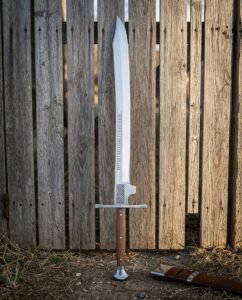 Gravewind Hand Forged High Carbon Steel Messer Sword | 27 Inch Overall with 18 Inch Blade | Collector and Display Gift | RK-1300
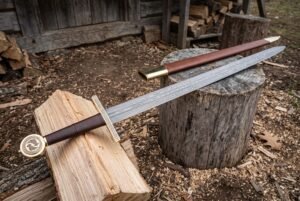 Stormcairn Hand Forged Damascus Arming Sword | 37 Inch Overall with 30 Inch Blade | Collector and Display Gift | RK-1301