
Blog
The Nine Realms of Norse Cosmology

The nine realms are the most famous thing about Norse cosmology and the least well supported. No surviving source lists them. Not one. The tidy diagram with Asgard at the top, Midgard in the middle and Hel at the bottom, arranged around the trunk of a tree, is a modern reconstruction assembled from scattered mentions, and it has been repeated so often that it now looks like scripture.
This page gives the nine names that the reconstruction uses, says where each one actually comes from, and is honest about which are solid and which are thin. If you want the tree itself rather than the worlds hung on it, that is on the page for Yggdrasil, and the sources everything here rests on are set out on the page about what Norse mythology actually is.
What the sources actually say about nine
Voluspa says the seeress remembers nine worlds, and nine giantesses or wood-dwelling beings. Vafthrudnismal has a giant claim he has travelled through all nine worlds and down to Niflhel below. Neither poem then enumerates them. Snorri repeats the number without a list of his own.
Nine is doing symbolic work throughout the material. Odin hangs for nine nights, Hermod rides nine nights to Hel, Thor takes nine steps before dying, Heimdall has nine mothers, a great sacrifice at Uppsala ran for nine days with nine of each kind of victim according to Adam of Bremen. The number carries weight on its own. It is entirely possible that nine worlds meant something closer to all the worlds there are than to a countable set.
So the list below is a scholarly convention. It is a useful one, and every name in it is genuinely attested somewhere. What is not attested is the grouping.
The nine, one at a time
 Wayfarrow Hand Forged Long Handled Viking Axe with Bearded Head & Etched Vegvisir | About 35 Inch Haft | Leather Grip Wrap and Fitted Leather Blade Cover | Norse Gift | RK-2204
 Oakhewn Hand Forged Viking Axe Wall Plaque | Bearded Axe on Carved Oak Board | Celtic Knotwork Band and Leather Lined Steel Cradles | Norse Wall Gift | RK-1683
 Slatestave Hand Made Engraved Pale Grey Rune Stone with Full Elder Futhark Row & Knotwork Arch | 10 Inch Standing Height | Solid Oak Display Base | Norse Home Decor Gift | RK-1705
Asgard
Asgard is the enclosure of the Aesir. The name splits into ass, meaning one of the Aesir gods, and gardr, meaning an enclosure, a yard, a fenced piece of ground. That second element is the same word as in Midgard and it is the ancestor of the English yard and garden. So Asgard means, quite literally, the gods’ yard.
That plainness matters, because the usual translation as heavenly city or celestial realm imports a scale the word does not have. A gardr is a defended farmstead, and the mental picture behind it is a very large hall complex with a wall around it, not a sky kingdom.
Snorri gives Asgard the most detail of any world. It holds Valhalla, the hall of the slain, described on the page for Valhalla. It holds Odin’s watchtower Hlidskjalf, from which he can see all worlds. It holds Idavoll, the plain where the gods meet, and where the survivors gather again after the world is remade. It is reached by Bifrost, the burning bridge Heimdall guards, which the sons of Muspell break under them at Ragnarok.
Snorri also does something strange with it. In the Prologue to the Prose Edda and in Ynglinga saga he identifies Asgard with Troy and makes the Aesir migrants from Asia Minor. That is a medieval Christian author giving pagan gods a respectable classical pedigree, and it tells you nothing about what anyone believed in the ninth century. It does tell you a great deal about the position Snorri was writing from.
The wall around Asgard has its own story: a builder offers to raise it in exchange for the sun, the moon and Freyja, Loki arranges for him to fail, and in the process Loki gives birth to Sleipnir. The gods break the bargain when it suits them, which is a recurring habit and one that Voluspa treats as consequential.
What Asgard means, in one line
The gods’ enclosure. Not a heaven, not an afterlife destination for ordinary people, and not a city in any sense the word had at the time.
Midgard
Midgard is the middle enclosure, where people live. This is the best attested name of the nine by a wide margin, and it is not confined to Norse. Old English has middangeard, Old Saxon has middilgard, Gothic has midjungards. The concept is common Germanic and considerably older than the Viking Age.
Snorri says the gods made it from the body of the giant Ymir, using his flesh for earth, his blood for the sea, his bones for mountains and his skull for the sky. The defensive wall around it was built from his eyebrows. Around the outside lies the ocean, and in the ocean lies the Midgard serpent, holding its own tail.
Jotunheim
The home of the jotnar, usually translated giants, though the word means something closer to devourers and the beings themselves are not necessarily large. Old Norse usually has it in the plural, Jotunheimar, giant-lands, which suggests a region rather than a single world.
It is attested across the Poetic Edda. Thor goes there constantly. It lies east, and east in this material is reliably where trouble comes from. Utgard, the outer enclosure, is either part of it or another name for the same idea.
Vanaheim
Home of the Vanir, the second family of gods. Vafthrudnismal names it and says Njord was raised there and sent to the Aesir as a hostage. Ynglinga saga mentions it. Beyond that there is nothing at all: no description, no geography, no events.
The Aesir and Vanir and their war are covered on the page for the Norse gods.
Alfheim
Home of the elves. Grimnismal says the gods gave Alfheim to Freyr in the distant past as a tooth-gift, the present given when a child cuts its first tooth. That single stanza is essentially the whole attestation.
What elves were is genuinely unclear. They are grouped with the gods in formulaic phrases, they receive offerings in at least one saga account, and they are clearly not the small winged things of later folklore. Snorri divides them into light elves and dark elves, but that division appears only in him and may be his own systematising.
Svartalfheim
Home of the dark elves, or of the dwarves, depending on which passage you read and how much you trust Snorri. The name occurs only in the Prose Edda. The Poetic Edda instead has Nidavellir, the dark fields, where Voluspa places a hall of gold belonging to the dwarves.
Whether dark elves and dwarves are the same beings under two words is one of the standing arguments in the field. The reconstruction usually treats Svartalfheim and Nidavellir as one world with two names, and that is a decision, not a fact.
Niflheim
The world of mist and cold, in the north, and the older of the two cold-and-dark locations. Snorri makes it the place that existed before the world, where the well Hvergelmir sends out eleven rivers, and where Nidhogg gnaws at a root of the tree.
Niflheim as a name appears only in Snorri. The Poetic Edda has Niflhel, mist-Hel, in Vafthrudnismal and Baldrs draumar, which is a related but not identical idea. This is one of the cases where the standard list depends on the Prose Edda alone.
Muspelheim
The world of fire in the south, hot and bright and impassable to anyone not born there, ruled by the giant Surt with his flaming sword. In Snorri’s creation account, the meeting of Muspelheim’s heat and Niflheim’s ice in the void of Ginnungagap produces the first living thing.
The Poetic Edda knows Muspell and the sons of Muspell, who arrive at Ragnarok, but does not clearly use the compound Muspelheim as a place name. Snorri built the fire world out of what he had.
Helheim
Where the dead go, other than the battle dead. It is ruled by Hel, Loki’s daughter, and in Snorri’s description it lies down and north, behind a river called Gjoll crossed by a covered bridge, with a gate that Hermod jumps on Sleipnir when he rides to bargain for Baldur.
The name is almost always simply Hel in the sources, for both the place and the being. Helheim as a compound is rare. And nothing in the Norse material makes it a place of punishment. It is where you go. The moral sorting is a Christian import, and the case is set out on the page for Valhalla and where the dead actually went.
Where the diagram came from
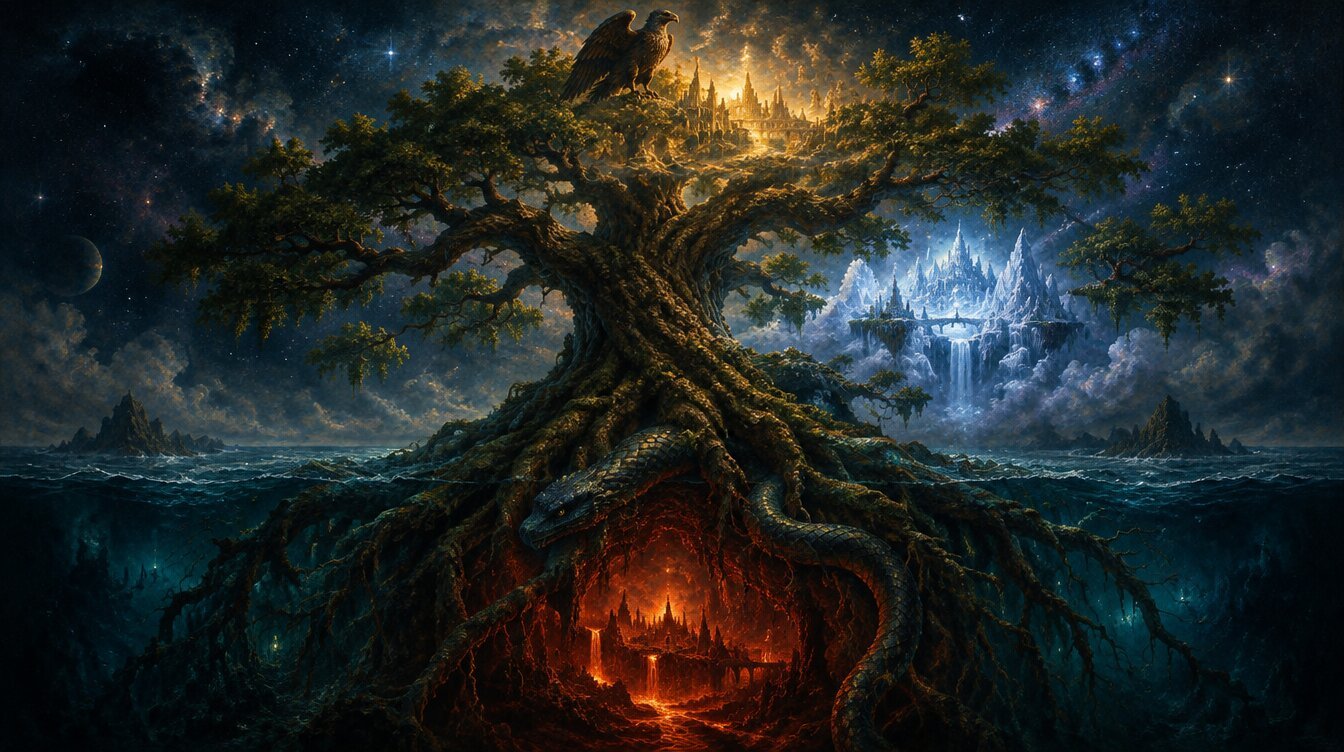
The vertical arrangement, with three neat levels and nine worlds hung on the tree like ornaments, is nineteenth and twentieth century work. It draws on genuine material, and it is a reasonable teaching aid, but it resolves contradictions the sources leave open.
The sources cannot even agree on the roots of the tree. Grimnismal gives three roots reaching to Hel, to the frost giants and to humans. Snorri gives three roots reaching to the Aesir, to the frost giants and to Niflheim. Those are different arrangements, and they are the closest thing to a map anyone left behind.
Popular culture has since fixed the nine-realm list in place. That is not a complaint. It is only worth knowing which parts came from an Icelandic manuscript and which parts came from a diagram someone drew in a book about Icelandic manuscripts.
Carrying it
The world tree is one of the genuinely old motifs and one of the better engraving choices for that reason. Ransack Viking is a US company in Chicago, Illinois. Pieces are handmade in the Czech Republic, then imported, inspected and shipped from Chicago, with engraving cut here after arrival. Plain 1095 runs 54 to 58 HRC and Damascus of 1095 and 15N20 runs 58 to 60. US orders ship free and tracked with no import duty, and everything carries a lifetime warranty against defects. The relevant ranges are Viking axes, Norse pendants and runestones and rune sets. The rest of the writing is in the guides.
Questions people ask
What are the nine realms of Norse mythology?
The conventional list is Asgard, Midgard, Jotunheim, Vanaheim, Alfheim, Svartalfheim, Niflheim, Muspelheim and Helheim. Every one of those names is attested somewhere, but no surviving Norse source ever lists them together. Voluspa and Vafthrudnismal mention nine worlds without saying which nine, so the list is a modern reconstruction.
What does Asgard mean?
The enclosure of the Aesir. Ass means a god of the Aesir family and gardr means a yard or fenced enclosure, the same word behind English yard and garden and the same element in Midgard. It is a defended farmstead writ large rather than a heavenly city, and translating it as a celestial realm imports a scale the word does not carry.
Is Asgard a heaven?
No. It is where the gods live, not where good people go. Ordinary Norse dead went to Hel, and the battle dead were divided between Odin’s Valhalla and Freyja’s Folkvang. Asgard contains Valhalla but is not itself an afterlife destination, and there is no moral entry requirement anywhere in the system.
Do the sources really never list the nine worlds?
They really never do. Voluspa says the seeress remembers nine worlds and Vafthrudnismal has a giant claim to have travelled all nine, and both then move on. Snorri repeats the number without enumerating it. Every list you have seen was assembled by a modern editor from scattered mentions.
What is the difference between Niflheim and Helheim?
Niflheim is the primordial world of mist and cold that Snorri places in the north, containing the well Hvergelmir. Helheim is where the dead go, ruled by Loki’s daughter Hel. Snorri sometimes brings them close together, and the Poetic Edda has Niflhel, mist-Hel, which blurs the line further. The separation is not clean in the sources.
Are Svartalfheim and Nidavellir the same place?
The reconstruction treats them as one world under two names, but that is a modern decision. Svartalfheim appears only in Snorri’s Prose Edda and Nidavellir only in the Poetic Edda. Whether dark elves and dwarves are the same beings is a long-running argument that the surviving evidence does not settle.
Where is Midgard?
In the middle, which is what the name says: the middle enclosure, where people live. It is surrounded by ocean, and the Midgard serpent lies in that ocean encircling it. The concept is common Germanic rather than specifically Norse, appearing as middangeard in Old English and midjungards in Gothic.
Where did the standard nine realms diagram come from?
Nineteenth and twentieth century scholarship and popularisation, refined further by fiction and games. It is built from real material but it settles questions the sources leave open, including the arrangement of the tree’s roots, which Grimnismal and Snorri describe differently. Any picture of the worlds around Yggdrasil is somebody’s interpretation.
On the shelf
Pieces in the catalogue that fit, the Yggdrasil handcrafted Viking shield and the Nightbough arming sword. So are the Rootspire sword and the Rootcrown arming sword.
Shop the range
Wayfarrow Hand Forged Long Handled Viking Axe with Bearded Head & Etched Vegvisir | About 35 Inch Haft | Leather Grip Wrap and Fitted Leather Blade Cover | Norse Gift | RK-2204Oakhewn Hand Forged Viking Axe Wall Plaque | Bearded Axe on Carved Oak Board | Celtic Knotwork Band and Leather Lined Steel Cradles | Norse Wall Gift | RK-1683Slatestave Hand Made Engraved Pale Grey Rune Stone with Full Elder Futhark Row & Knotwork Arch | 10 Inch Standing Height | Solid Oak Display Base | Norse Home Decor Gift | RK-1705 Wayrune Hand Made Silver Finish Vegvisir Pendant with Knotwork Border & 24 Inch Curb Chain | Norse Wayfinder Gift | RK-1784
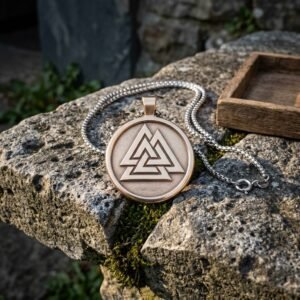 Kinbound Hand Made Bronze Tone Valknut Pendant with Raised Triple Triangle & 22 Inch Box Chain | Norse Memorial Gift | RK-1601
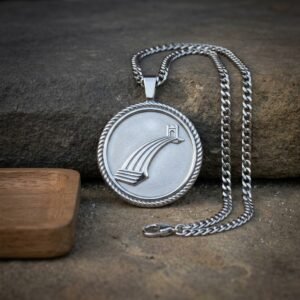 Skybridge Hand Made Silver Tone Bifrost Pendant with a Rope Twist Border & Heavy Curb Chain | Norse Necklace Gift | RK-1664