Blog
The Norns in Norse Mythology: Fate, the Well, and the World Tree

What the Norns Are
The Norns are the figures who determine fate in Norse mythology. They sit at the base of Yggdrasil, the world tree, beside the Well of Urd, and they carve the destiny of every living thing into the wood of the tree itself. There are three of them: Urd (what has happened), Verdandi (what is happening), and Skuld (what must happen). Between them, they cover all of time.
The Old Norse word norn is related to a Swedish dialect word meaning “to communicate secretly,” and some scholars connect it to a verb meaning “to twine” or “to weave.” Both associations fit. The Norns work with hidden knowledge, and their most common metaphor is textile: they spin thread, carve marks, and lay down the shape of lives the way a weaver lays down a pattern. Fate in the Norse world is not abstract. It is something made, with tools, by specific hands.
The Three at the Well
The Voluspa, the most important poem in the Poetic Edda, describes three maidens who came from the lake that stands beneath the tree. They are named Urd, Verdandi, and Skuld. The poem says they “laid down laws” and “chose lives” for the children of mankind. This is not gentle guidance. This is legislation. The Norns decide, and what they decide holds.
Snorri Sturluson expands the picture in the Gylfaginning. He says the Norns draw water from the Well of Urd every day and pour it over the roots of Yggdrasil so the tree does not rot. They also apply a white clay from the well. The tree would die without them. This means the Norns are not just fate spinners. They are the maintenance crew for the entire cosmos. Without their daily work, the structure that holds the nine worlds together would collapse.
The Well of Urd is where the gods hold their daily council. They ride across Bifrost to reach it. The Norns are already there, permanently, doing the work that makes the council possible. The gods govern. The Norns sustain. It is worth asking which job matters more.
Urd, Verdandi, Skuld
The three names correspond to past, present, and future, but that description flattens what the Norse actually meant. Urd comes from a word meaning “fate” or “that which has become.” It points to everything that has already happened, the accumulation of all prior events that shapes the present. Verdandi is a present participle: “that which is becoming.” It is the active moment, the thing in motion. Skuld is related to “shall” or “debt,” and it carries obligation. What Skuld represents is not prediction. It is necessity. What must be, because of what has been.
This is a different model from simple prophecy. The Norse did not think of fate as a script written in advance and read off by a bored narrator. Fate was an ongoing process. Urd feeds Verdandi, and Verdandi feeds Skuld, and the whole cycle continues. Every action becomes part of Urd the moment it is done, which changes what Verdandi is working with, which shifts what Skuld requires. Fate is dynamic. It accumulates.
Skuld also appears in some sources as a valkyrie. This is not necessarily a contradiction. The Norns decide who lives and dies. The valkyries collect the dead from battlefields and bring them to Valhalla. If Skuld operates in both roles, she is present at both ends of the process: the decision and the collection.
Norns Beyond the Three
The three named Norns are not the only ones. Snorri says that many norns come to every child at birth to shape its life. Some of these norns are of the race of the gods, some are elves, and some are dwarves. The good norns give good fates. The bad ones cause misery. This means that norn is not just a proper title for three cosmic figures. It is a category. There are many norns, of many origins, and their quality varies.
The Fafnismal, a poem in the Poetic Edda, confirms this. When Sigurd asks the dying dragon Fafnir about the Norns, Fafnir says they are “born of different races” and are not of one kin. This scatters fate across the entire mythological population. Fate is not centralised in one location. It is distributed. Different beings shape different lives, and the results are uneven because the shapers themselves are uneven.
This explains something the Norse understood about the world: why good people suffer and worthless people prosper. It is not that fate is unjust. It is that the norns themselves are not all the same. Some are skilled, some are careless, and the lives they shape reflect that. The system is honest about its own imperfection.
What the Norns Do
The Norns carve. Several sources use the verb “to score” or “to carve” when describing how fate is set. The Voluspa says they “carved on wooden slips.” This connects them to the runic tradition, where meaning is physically inscribed in material. Fate is not whispered. It is written, with a blade, into wood. You can touch it. You can, in principle, read it, though no one in the sources manages to.
They also water the tree. This is the less dramatic job, but it may be the more important one. Yggdrasil connects the nine worlds. Its roots reach into different wells and realms. Its branches hold up the sky. If the tree dies, everything dies with it. The Norns’ daily watering is what stands between the cosmos and total structural failure. The serpent Nidhogg chews at the roots from below. The Norns repair the damage from above. It is a race they are always winning and never finished with.
The combination of fate carving and tree maintenance gives the Norns a double role. They shape individual destinies and they sustain the physical cosmos. No other figures in Norse mythology hold both responsibilities. Heimdall watches. Odin seeks knowledge. Thor fights. The Norns do the structural work that makes all of that possible.
Fate in Norse Thought
The Norse concept of fate is not the same as predestination. In the Christian model that most English speakers inherit, predestination means God has decided everything in advance, and free will is either an illusion or a theological problem. The Norse model is different. Fate accumulates. Every action adds to Urd, the sum of what has been, and that growing total shapes what comes next. You are not reading a script. You are adding to one, and the weight of everything already written constrains what the next line can be.
This produces a culture that values action even when the outcome is known. The Norse did not think you could escape fate. But they thought you could face it well or face it badly, and the difference mattered. A warrior who fights knowing he will die earns a kind of respect that a warrior who avoids the fight does not. Fate removes the question of “what will happen.” It leaves the question of “how will you handle it,” which the Norse considered the only question worth answering.
The Norns sit at the centre of this worldview. They are not villains. They are not even antagonists. They are the mechanism. Blaming the Norns for a bad fate would be like blaming gravity for falling. The system works the way it works. The Norns maintain it.
The Norns and Ragnarok
The sources do not say what happens to the Norns at Ragnarok. The Voluspa describes the death of gods, the burning of the world, and the rise of a new earth from the sea, but the Norns are not mentioned in the destruction sequence. This is a significant silence. The Norns maintain the tree. The tree survives Ragnarok (Snorri says two humans shelter in it and survive to repopulate the world). If the tree endures, perhaps the Norns endure with it.
Or perhaps their absence from the Ragnarok account means they stand outside the cycle entirely. They shape fate. Ragnarok is fate. The event is their product, not their enemy. It would be odd for the weavers to be destroyed by their own cloth. The sources leave this open, and the silence is more interesting than any answer would be.
The Norns in the Sources
The Norns appear in the Voluspa, the Fafnismal, the Helgakvida Hundingsbana, and in Snorri’s Gylfaginning. The Voluspa provides the core image: three figures at the well, carving fate. Snorri adds the tree watering, the well’s white clay, and the distinction between the three great Norns and the many lesser ones. The Fafnismal confirms the variety of norn origins. The Helgakvida describes norns appearing at a hero’s birth to set his fate, twisting threads of fate and stretching golden strings across the sky.
The total body of source material is small but consistent. The Norns carve. They water the tree. They sit at the well. They determine fates. No source contradicts another on the essentials, which is unusual in Norse mythology, where different poems routinely give different accounts of the same event. The Norns’ portrait is one of the most stable in the entire tradition.
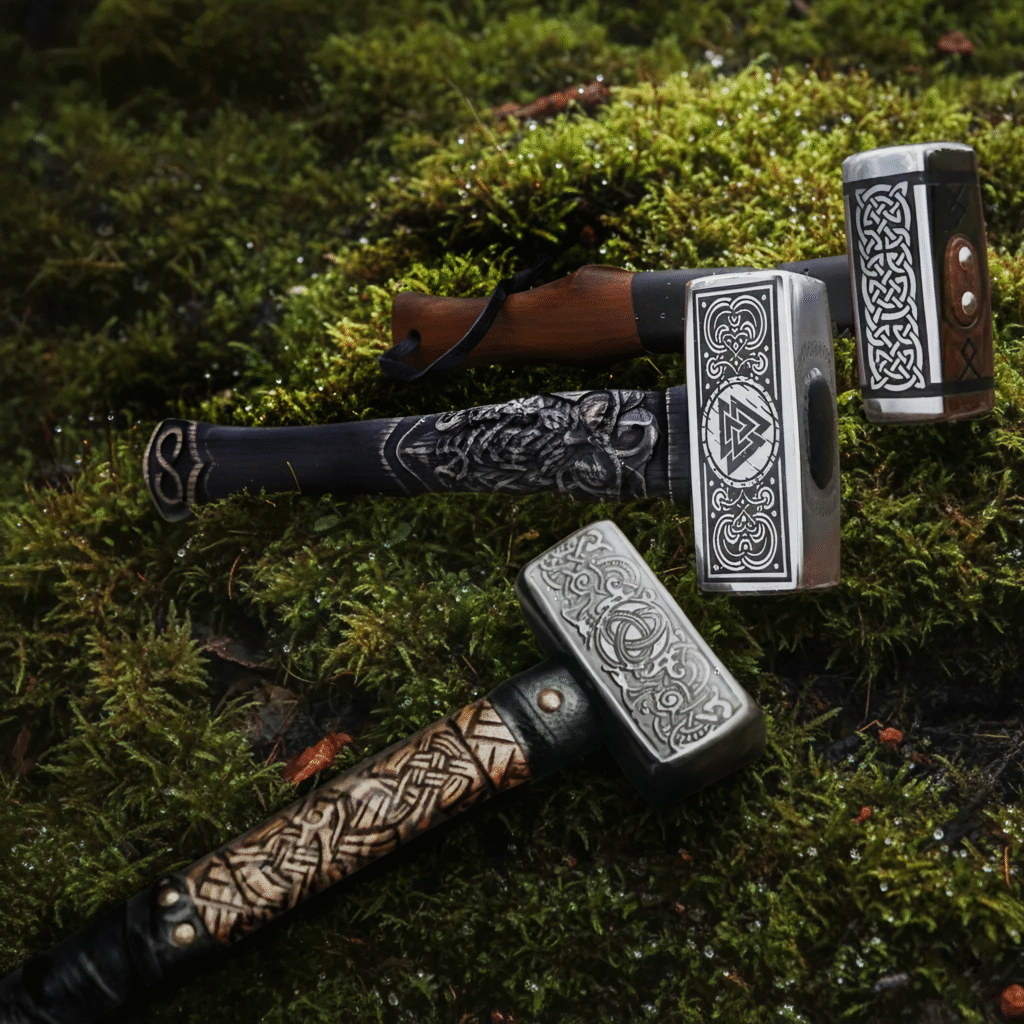
The Norse craft tradition carried the same seriousness about shaping material. A hand forged axe or a Damascus blade is shaped with intention, and its quality depends on the skill of the maker. The Norns would have understood the principle.
For more on the world the Norns sustain, read our guides on Bifrost, Heimdall, Sleipnir, Loki, the Valkyries, and Elder Futhark runes.
Frequently Asked Questions
Who are the three Norns?
Urd (the past, or “what has become”), Verdandi (the present, or “what is becoming”), and Skuld (the future, or “what must be”). They sit at the Well of Urd beneath Yggdrasil and determine the fate of every living thing.
Are the Norns the same as the Greek Fates?
They are structurally similar. Both traditions have three female figures who control destiny, and both use textile metaphors (spinning, weaving, cutting). Whether the resemblance reflects a shared Indo-European root or independent development is debated. The Norse version emphasises accumulation and obligation rather than a fixed thread that gets cut.
Do the Norns control the gods too?
Yes. The sources say the Norns determine the fates of all beings, not just humans. The gods themselves are subject to fate, which is why Ragnarok happens. Odin spends much of the mythology trying to learn what fate has in store, which would be pointless if he could overrule it.
What is the Well of Urd?
A well or spring at the base of Yggdrasil where the Norns live and the gods hold their daily council. The Norns draw water from it to nourish the tree. The well is also associated with wisdom and the accumulated record of all events.
Do the Norns survive Ragnarok?
The sources do not say. The Norns are not mentioned in the Ragnarok destruction sequence, and since Yggdrasil survives the cataclysm (sheltering the humans who repopulate the world), some scholars speculate the Norns may endure as well. The silence in the sources leaves the question open.
From the shop
If you want a piece that carries this, the shop has the Stonecast Elder Futhark rune and the Slatestave slate rune stone. The Thundermark slate rune plaque and the Runeclasp Viking rune ring are in the same corner.