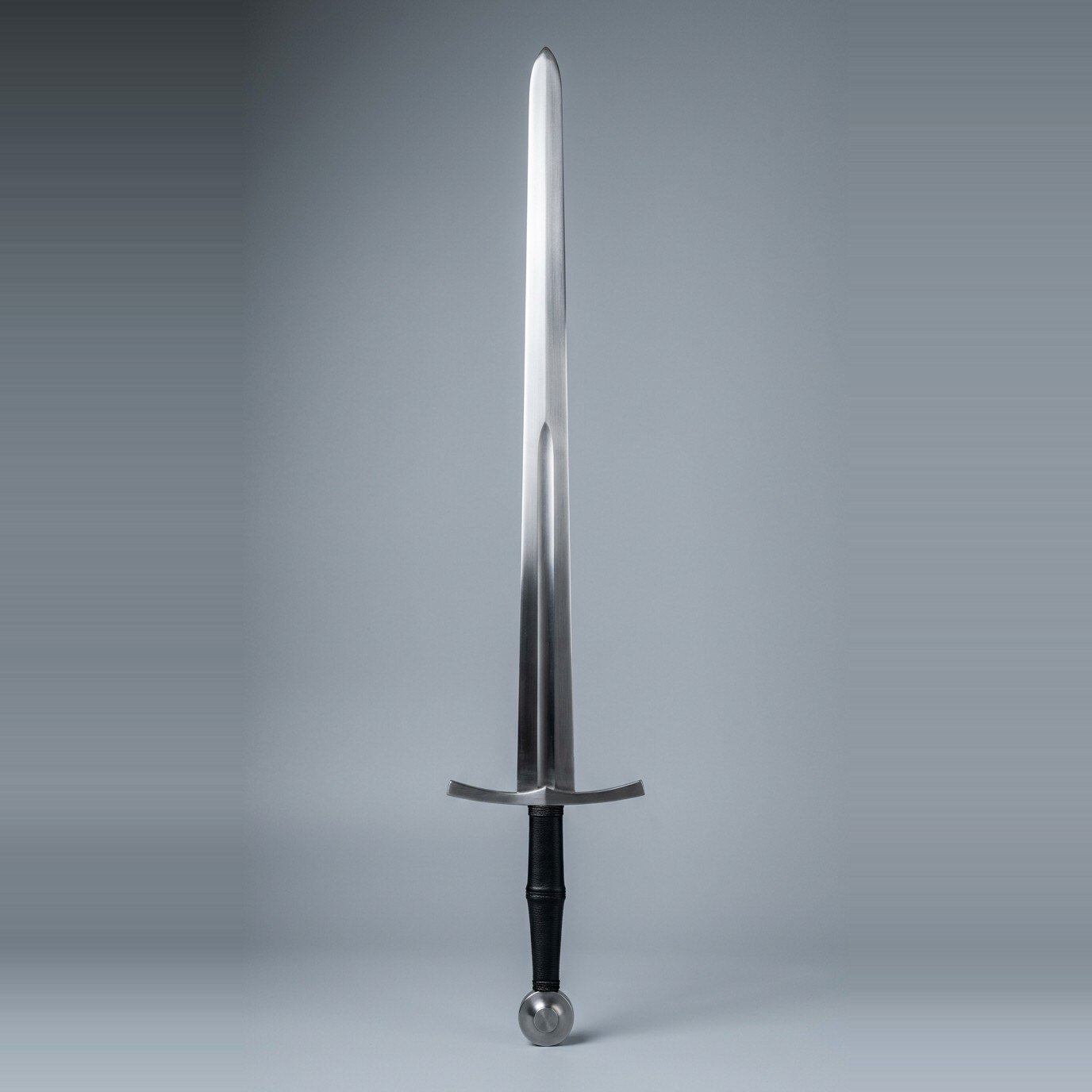
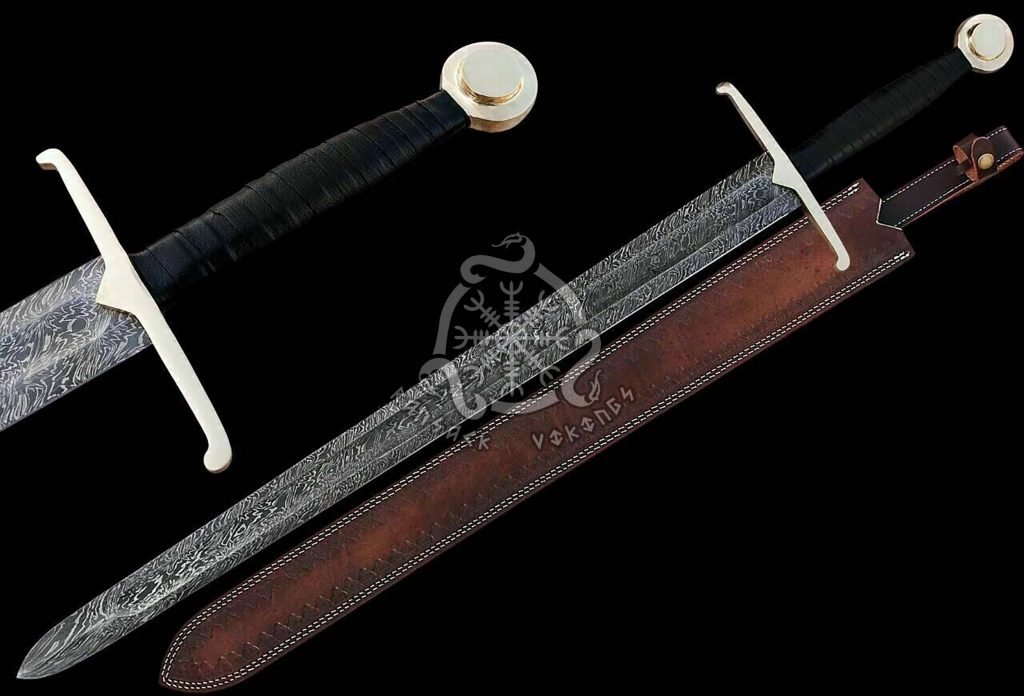
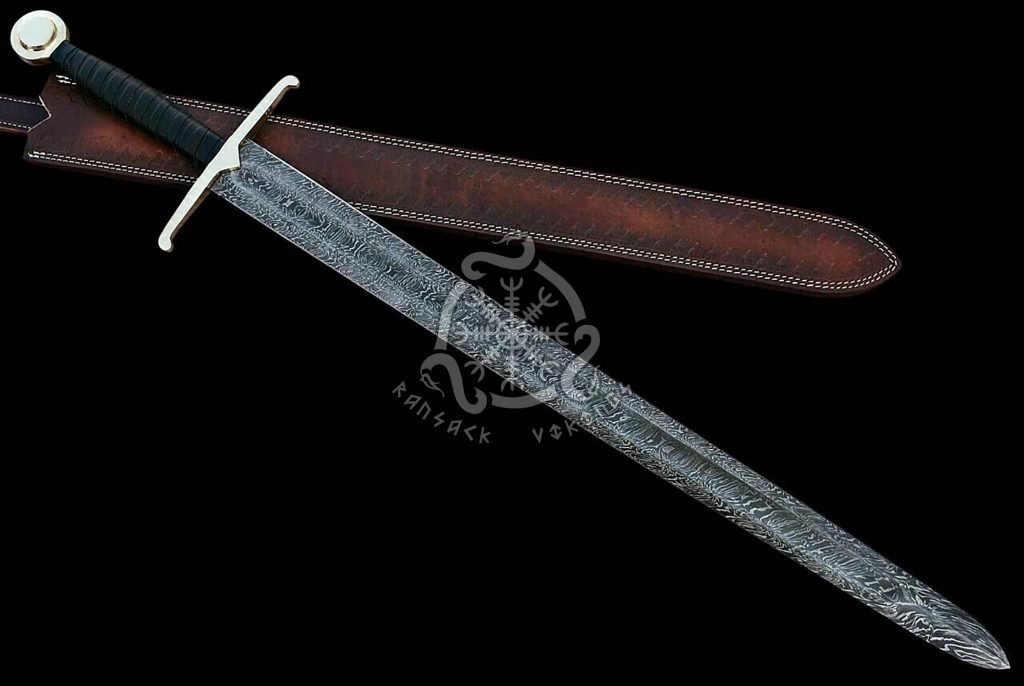
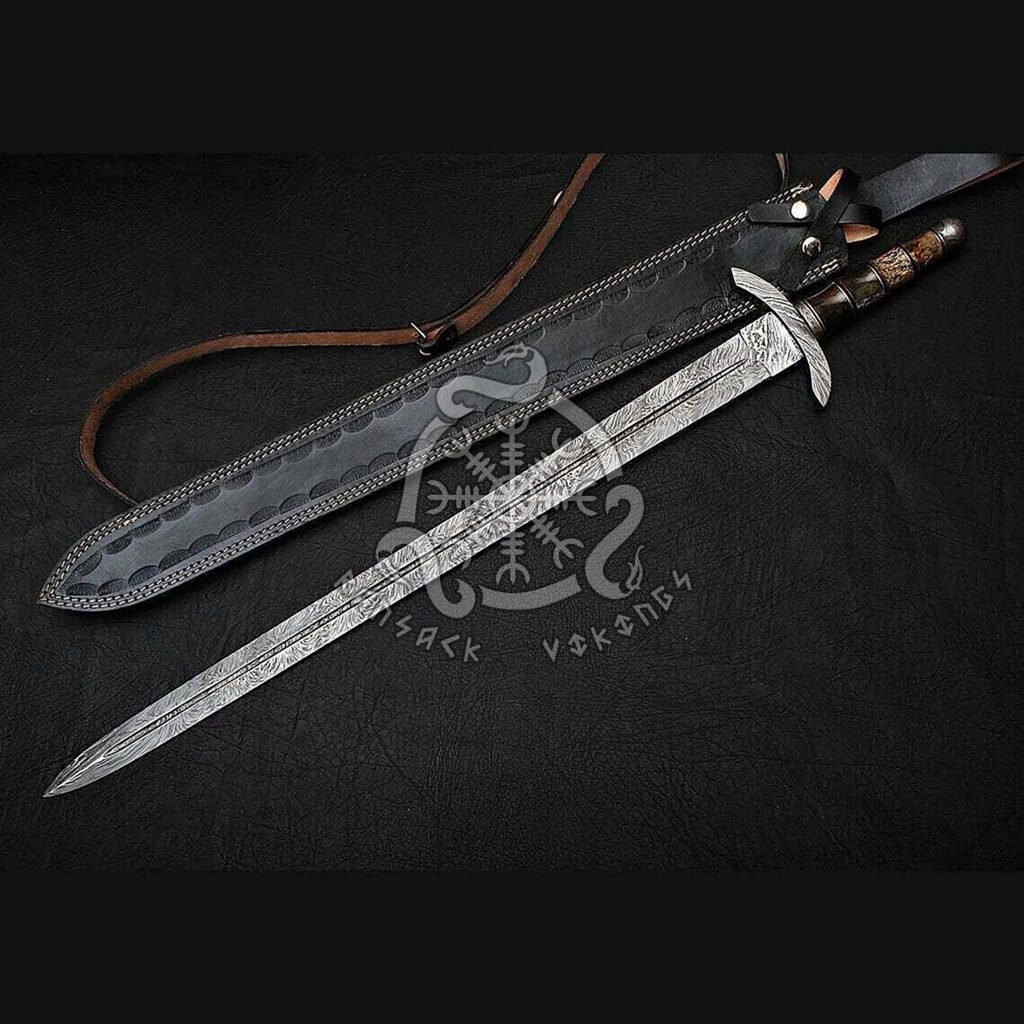
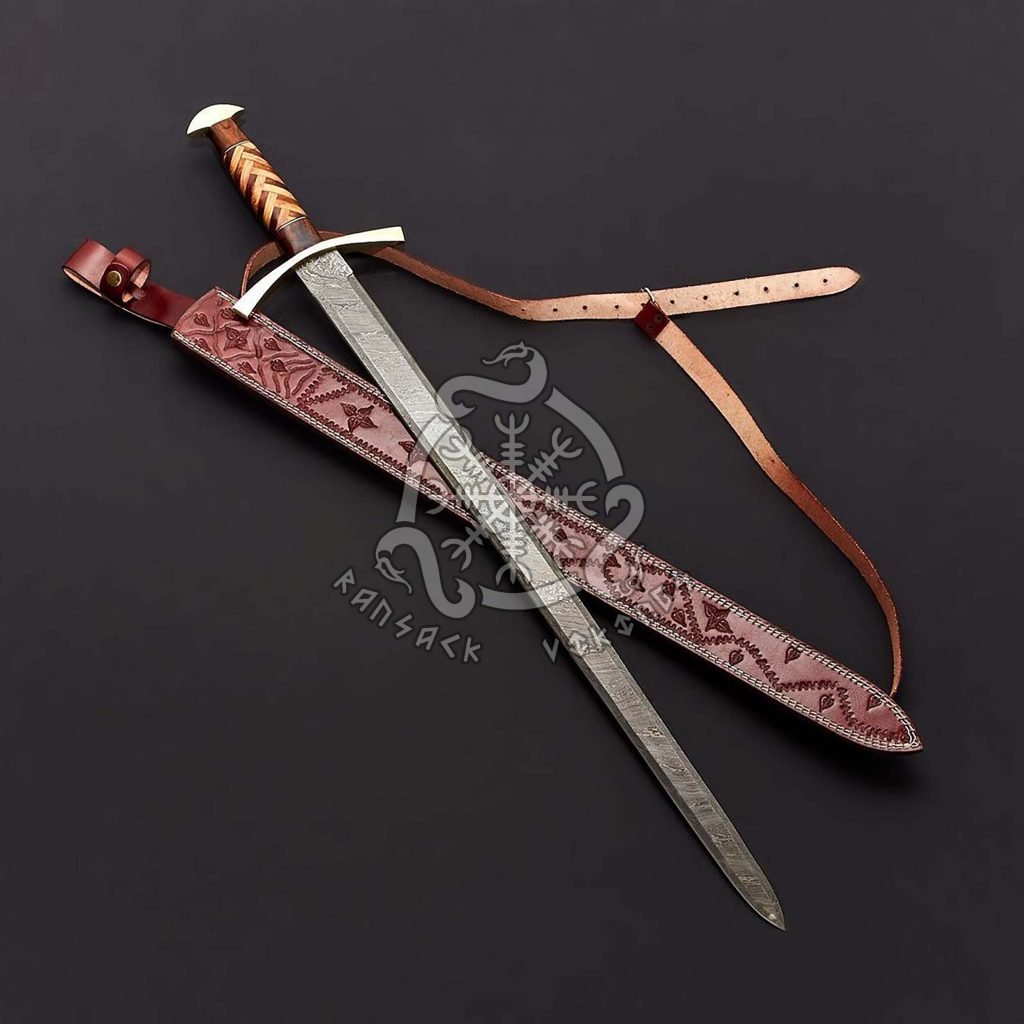
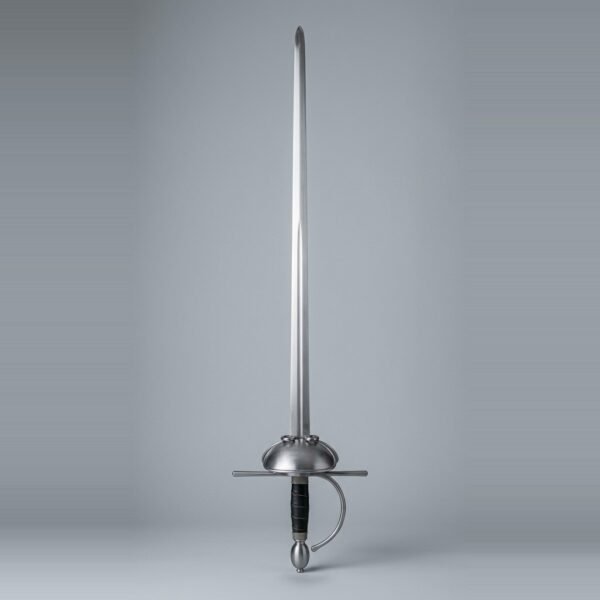
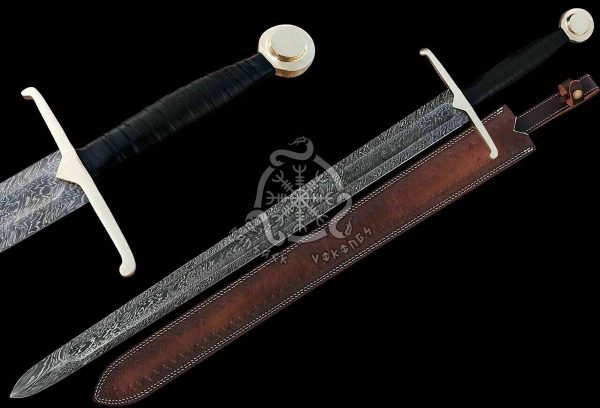
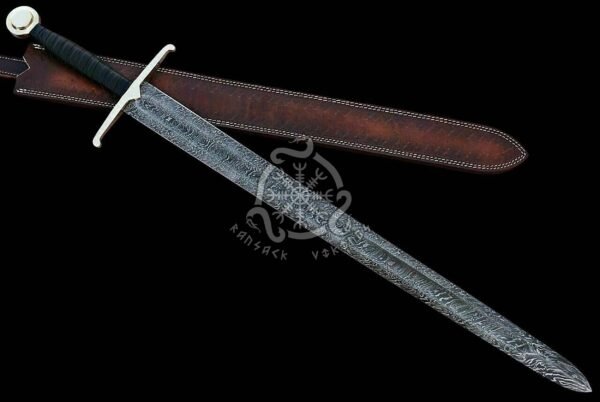
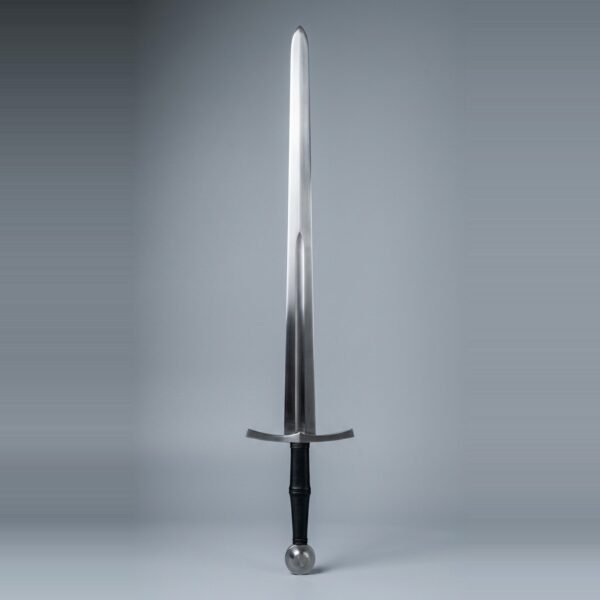
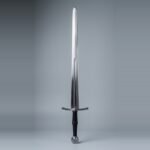
This is a full two handed longsword, longer in the blade and longer in the grip than the hand and a half pieces beside it. Both hands live on the sword all the time, the rear one working the pommel end, and the extra length buys reach in the bind and leverage in every wind. It is blunted along the full edge for paired drill and free play.
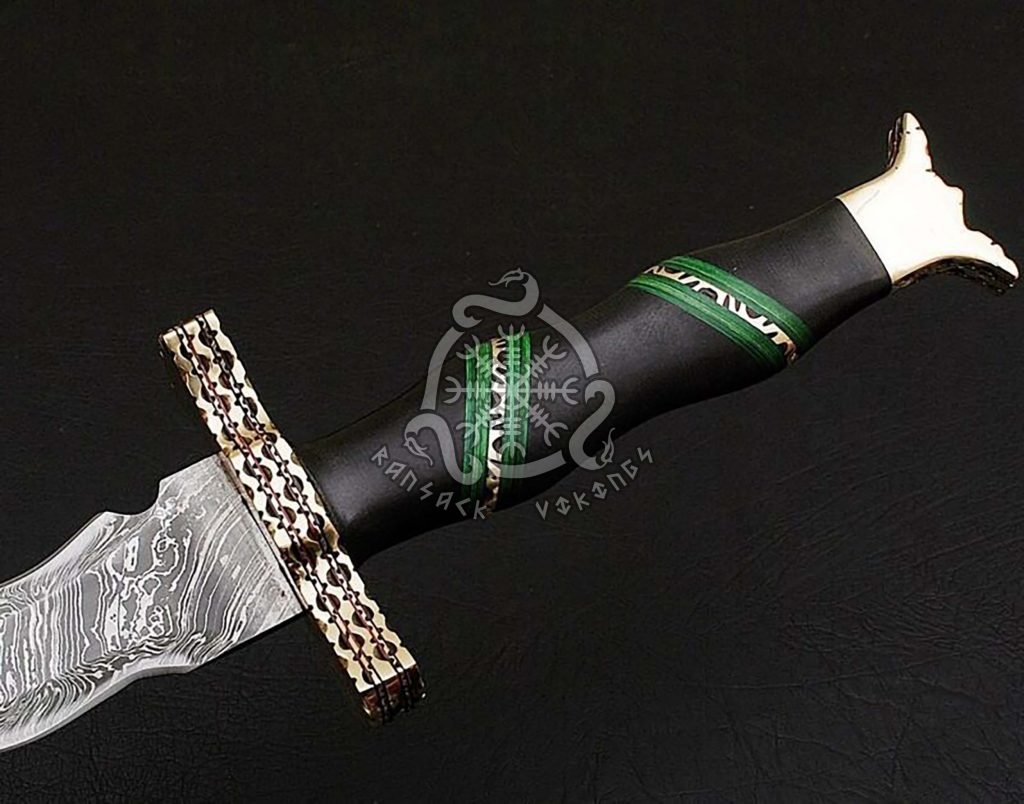
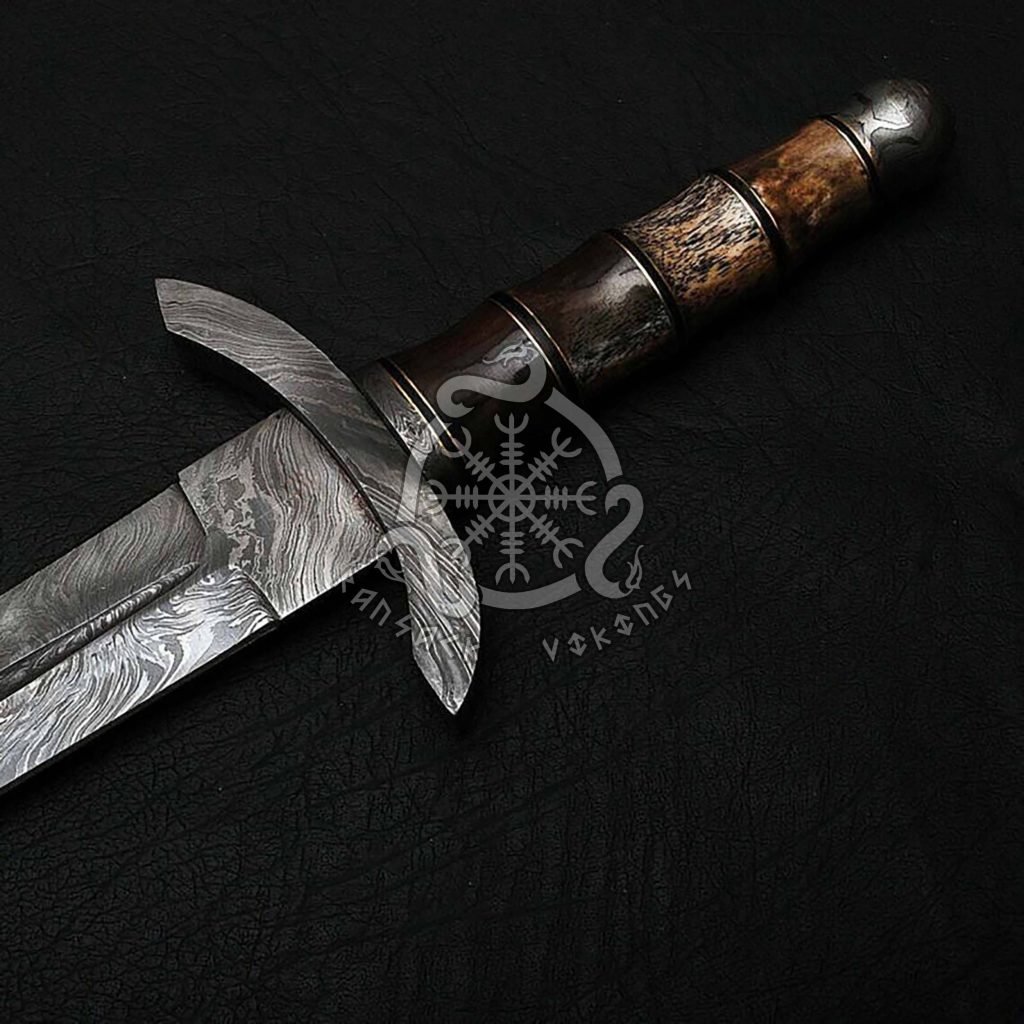
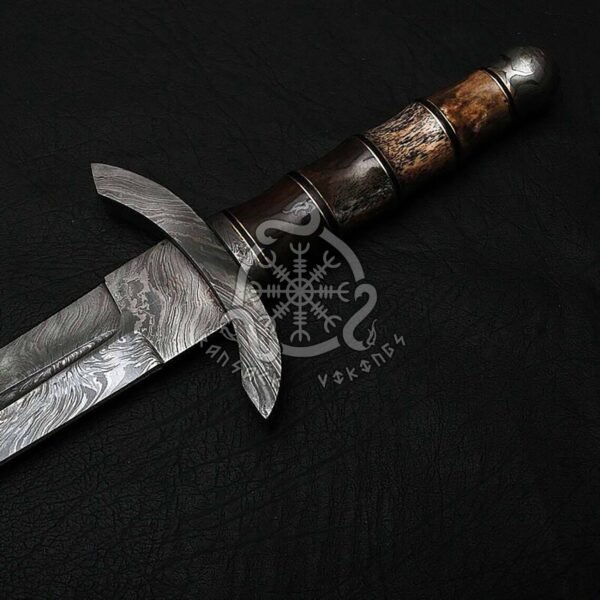
The fuller starts at the base and runs to about the middle of the blade, then the profile flattens out and carries on to the tip as solid stock. The cross is a long straight bar, which gives the hands real cover and a proper hook for winding. The pommel is a steel wheel peened over the tang, and the grip below it is black leather over a wood core, cut long enough for two hands with room to slide.
If you are sizing your first longsword, read how to choose your first HEMA sword and what HEMA actually is before buying. The rest of the two handed steel is in HEMA longswords. Why a club will often hand you a feder instead is covered in what a feder actually is, and the edge question in blunt against sharp.
Specifications
| Material | 51CrV4 spring steel, hardened to 49 to 52 HRC |
|---|
| Overall length | About 49 inches, hand made so it varies a little piece to piece |
|---|
| Blade length | About 38 inches |
|---|
| Blade type | Double edged blunt with a fuller from the base to mid blade |
|---|
| Edge | Blunted, about 3 mm flat land, not sharpened |
|---|
| Tip | Rolled and flared, about 15 mm across |
|---|
| Guard | Long straight cross of plain bar stock |
|---|
| Pommel | Steel wheel, peened over the tang |
|---|
| Grip | Black leather over wood, two handed with room to slide |
|---|
| Flex | Medium tier, the working range for two handed sparring |
|---|
| Included | Sword only. No scabbard. |
|---|
| SKU | RK-3013 |
|---|
Two handed sparring and the blunt against feder question
Every fencer who trains longsword runs into this choice. A feder is a purpose built training sword with a schilt above the ricasso, a thin flexible middle and a wide flat tip, made from the start to be thrust with. A blunt is a sword profile with the edge taken off. They teach different things and neither is a substitute for the other.
What a blunt gives you is honesty about mass. The blade has the section and the distribution a sword actually had, so a schielhau lands with the weight you would expect, a bind sits where a sword’s bind sits, and bad edge alignment shows up immediately instead of being hidden by a flexible blade. Fencers who drill only on feders are often surprised by how differently a blunt behaves in the same play.
What a blunt does not give you is free rein at competition. Many longsword tournaments now exclude blunts from the longsword pool and accept only purpose built feders or sword shaped feders, so read the gear requirements of the event before you pack. For club nights, for Liechtenauer drill under an instructor and for controlled free play this is the better teacher. Fence it in gloves, mask with back of head protection, gorget and a rated jacket.
Where the fuller stops, and what that does to the last half of the blade
The fuller runs from the base to about the middle and then ends. Everything above that point is solid stock. That single decision shapes how this sword feels. The lower half is lightened where the hands have the most leverage anyway, and the upper half keeps its stiffness where the thrust and the point work happen.
The practical result is a blade that stays quiet at the point. A fuller that ran the whole length would give a livelier blade and a softer thrust, and a blade with no fuller at all would feel dead in the hand. Ending the groove at mid blade is the compromise most surviving longswords made, and it is why winding at the bind works so cleanly with this shape: the strong half bends less than the fencer expects and the point stays where it was put.
Steel is 51CrV4 hardened to 49 to 52 HRC. Our cutting swords run 1095 at 54 to 58 HRC, and this is deliberately softer because spring steel at this hardness bends and returns instead of taking a set or snapping under a hard bind. Flex is in the medium tier. The market bands run light around 15 to 21 lb, medium around 25 to 29 lb, strong or tournament grade around 30 to 43 lb, and stiff for harnischfechten. We give the tier and not a number, because we do not put every blade on a jig. The edge land is over the 2 mm club gear lists ask for, and the tip is rolled and flared to about 15 mm across, which matches the at least 1.5 cm rolled or spatulated tip in the Berlin HEMA Cup requirements.
Engraving, runes and your own design
Use the rune converter on this page to turn a name, a date or a short phrase into Elder Futhark and we will cut it into the steel or the grip. On this one the flat beside the fuller takes a rune line well, and so does the face of the wheel pommel where it catches the light.
Text and runes are $19, a symbol is $39 and a family crest is $49, and the work is done in the United States after the piece has landed and passed inspection. If you would rather have your own design than a rune line, choose your own design in the engraving option above the add to cart button and tell us where it goes. Where a piece already carries an engraved design, your chosen engraving replaces it rather than sitting alongside it. More on the engraving page.
Handling and balance
A long cross changes a longsword more than people expect. It gives the hands real cover in the bind, it gives you something to hook with when you wind an opponent’s blade off line, and it puts a little mass just forward of the grip that steadies the blade through a cut. Paired with a wheel pommel behind the hands, the sword turns around a point between them rather than dragging on the wrists.
The grip is long enough that the rear hand can sit high for control or drop back onto the pommel for reach, and black leather over wood copes with a sweaty hour better than cord does. We do not publish a weight or a point of balance. The photograph carries no scale and every blade leaves the hammer a little different, so any number printed here would be a guess.
Care
Wipe the blade down after every session, especially where gloves have been on the ricasso end and where sweat runs off the hands, and leave a thin film of oil on before it goes back in the bag.
Burrs raise on the edge land after hard play. Take them back flat with a fine file and finish with wet and dry paper, and do not chase it into an edge. Check the cross and the pommel for movement every few sessions and stop fencing with it if the hilt rattles. The full routine for oiling, rust and long storage is in our care guide.
Made in the Czech Republic
Made by hand in the Czech Republic and imported by Ransack Viking. Nothing here is drop shipped out of an importer catalogue straight to a customer. Every one is checked for hilt tightness, pommel seating and blade straightness at our North Babylon, New York warehouse, and ships from there. Shipping in the United States is free, returns run for seven days, and the lifetime warranty against defects in the forging, the grind, the heat treat and the fittings has no end date and needs no receipt.
A long cross puts more leverage on the shoulder of the tang than a short one does, so cross fit and pommel seating are both checked when the crate is opened, along with the straightness of a blade that is long enough to show any bend clearly.
A note on handmade variation
This is hand forged. It is not machine made, not cast and not bulk produced, so what arrives will not be a pixel for pixel copy of the photograph on this page. The point where the fuller stops moves an inch or so across a batch because it is cut by eye and not by machine, the wheel pommel is filed to shape, and black leather takes dye unevenly, so the grip can read warmer or cooler than the photograph shows.
The standard does not move with it. Every one leaves the workshop straight, tight and blunted to the same spec, and anything that fails the check at the warehouse never gets boxed.
Frequently asked questions
Whether this is allowed at longsword tournaments
Read the ruleset. Many longsword tournaments accept only purpose built feders or sword shaped feders and exclude blunts from the longsword pool. We will not call any piece tournament legal without naming the ruleset it passes.
How it differs from the hand and a half swords in this range
Blade and grip are both longer here, so both hands stay on the sword the whole time and the reach in the bind is greater. A hand and a half is quicker to bring back online and easier to use in one hand for a moment. Neither is better, they suit different fencers and different halls.
Whether a beginner can start on this
With an instructor, yes. On your own, a synthetic trainer is the safer first purchase while measure and control are still being learned, and steel makes far more sense once you are drilling in a club.
Whether a scabbard is included
No. This ships as the sword alone and we do not sell a scabbard for it. Carry it in a padded sword bag with the blade wiped down and oiled.
Why the fuller stops halfway
To keep the last half of the blade stiff. A fuller running the full length gives a livelier blade and a softer thrust, and stopping it at mid blade is the compromise most surviving longswords made.
Whether the blade can be sharpened
Do not sharpen it. 51CrV4 at 49 to 52 HRC is chosen for sparring rather than cutting, and an edge would hold badly while turning a safe trainer into something else.
What is in the box
- The Draugmoor two handed blunt longsword, blunted along the full edge.
- A protective film of oil on the steel, which comes off with a rag.
- A printed card covering oiling, burrs and storage between sessions.
- The lifetime warranty against defects in the forging, the grind and the fittings.
Explore the range
There is more two handed steel in HEMA longswords, purpose built flexers in feders, single handed blades in HEMA arming swords, and the whole training line under HEMA swords. The rest of our writing is in the guides.
Close to this one
The nearest pieces by size and handling are Valkspire hand and a half, about 48 inches overall, Vardholt hand and a half, about 47 inches overall, Drakvend longsword, about 49 inches overall and Rundholm montante, about 66 inches overall.
The rest of the group is in the HEMA longsword category and across the HEMA sword hub, and the custom sword builder takes a custom order.








Reviews
There are no reviews yet