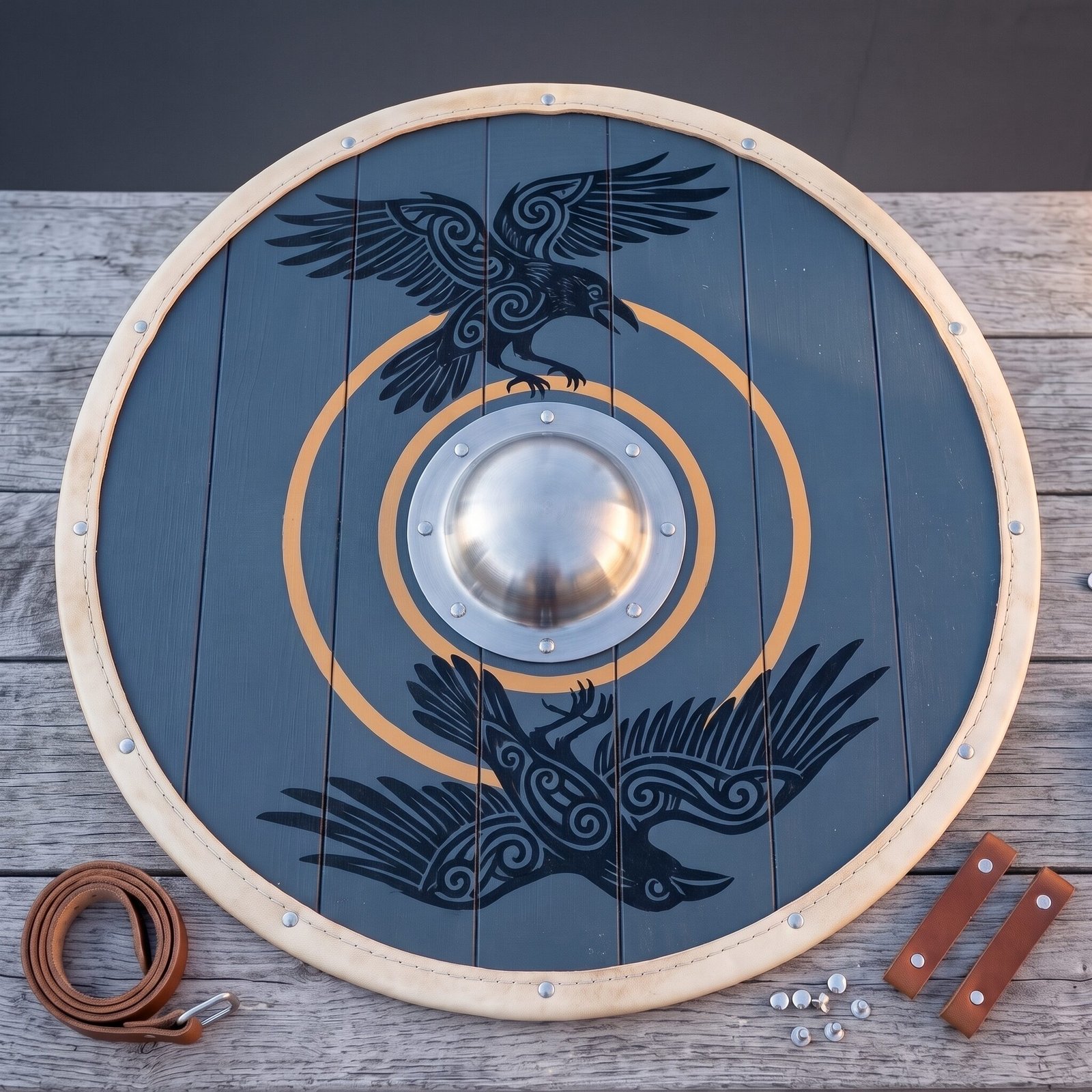
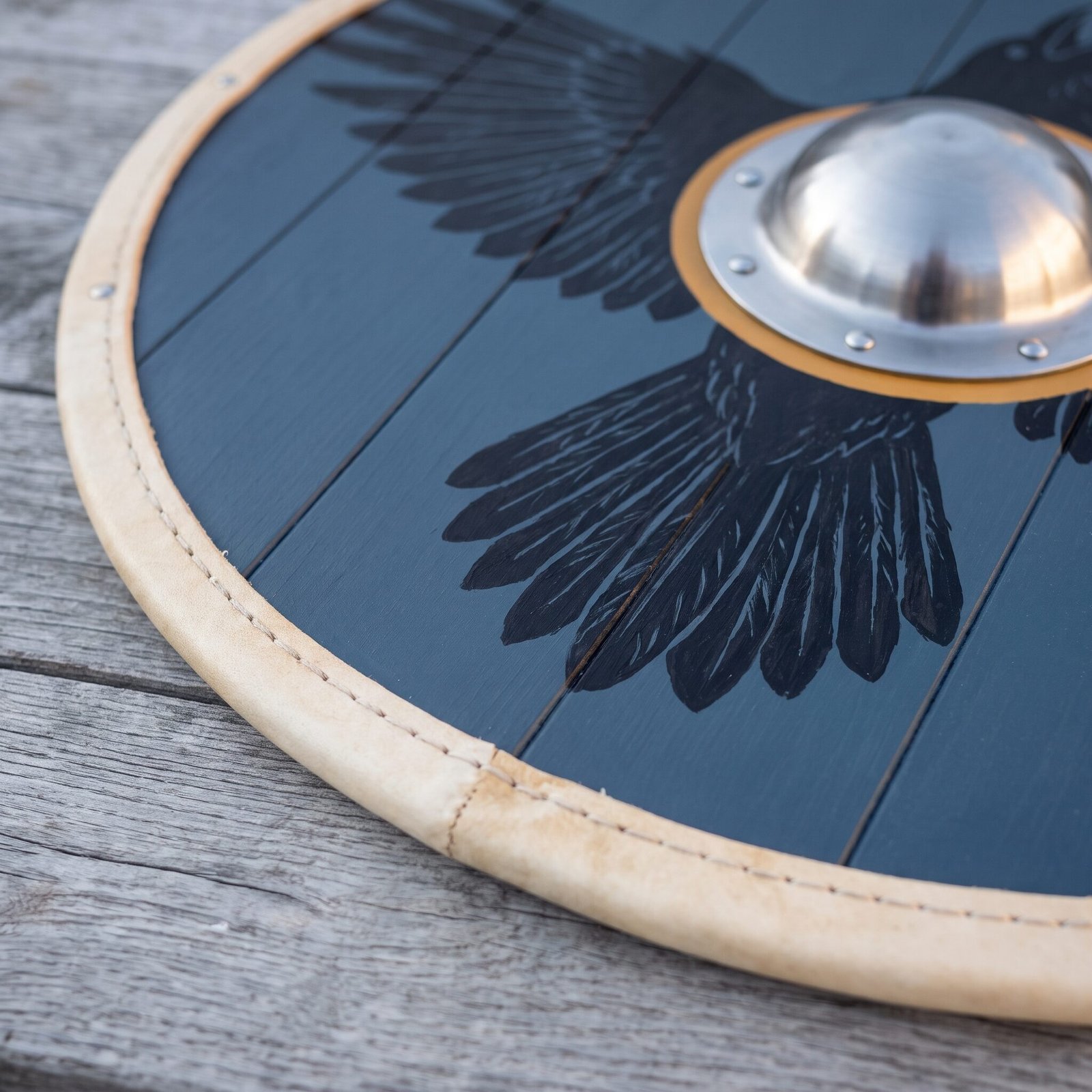
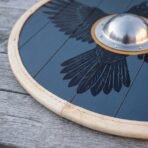
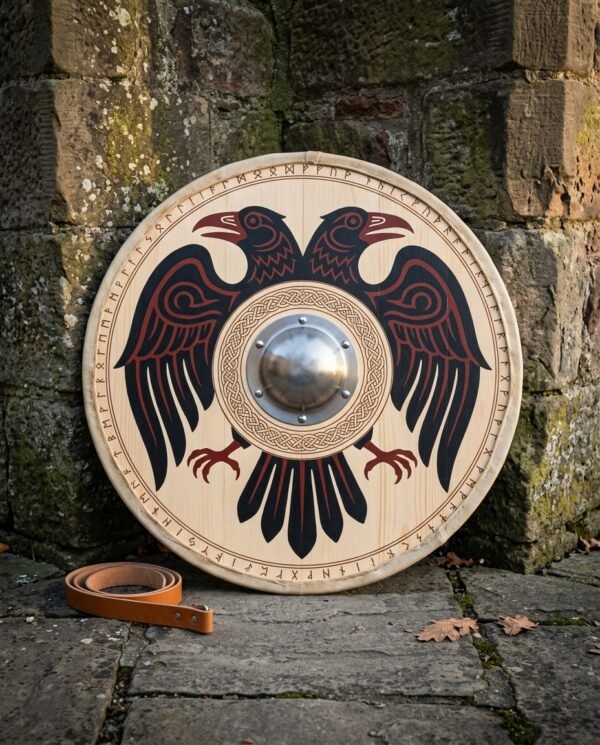
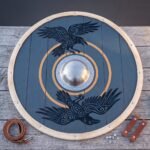
Twinflight is a hand made Viking round shield painted with Odin’s two ravens, Huginn and Muninn. The face is 24 inches across and built from wooden planks laid edge to edge, painted a deep slate blue, with the two black birds circling the steel boss in flight, one above and one below, their beaks turned toward each other across a thin ochre ring. The rim is bound in pale rawhide and stitched through, and the boss is a polished steel dome riveted over the centre hole.
We wanted a raven shield that looked like the birds were working. Most raven designs sit the birds down, perched and heraldic. These two are mid flight on their daily circuit, which is the part of the story people tend to forget. Odin did not keep them as ornaments. He sent them out every morning to fly over the whole world and come back with the news, and he worried every day that one of them would not return. If you want the sources behind that, our piece on Odin’s ravens Huginn and Muninn in the sources goes through the poems line by line.
The shield is planked, painted, rimmed and bossed by hand in a Czech Republic workshop and shipped from our warehouse in Chicago, Illinois. It comes with the leather arm strap, a leather hand grip and a set of rivets supplied loose so you can fit them to your own arm. For how these shields were built and held in the first place, read our guide to Viking shields.
Specifications
| Material | Wooden planks butted and glued edge to edge, about 12 mm thick, hand painted face |
|---|
| Diameter | 24 inches |
|---|
| Design | Huginn and Muninn, two black ravens in flight around the boss on a slate blue ground with a thin ochre ring |
|---|
| Boss | Polished steel dome, riveted through the flange over the centre hole |
|---|
| Rim | Pale rawhide edging, hand stitched around the circumference |
|---|
| Fittings supplied | Leather arm strap with steel buckle, leather hand grip, shield rivets |
|---|
| Grip type | Centre grip behind the boss, in the Viking age manner |
|---|
| Intended use | Display, wall mounting, costume and light reenactment |
|---|
| SKU | RK-2221 |
|---|
Thought and memory, and why Odin feared for one more than the other
The names do most of the work. Huginn comes from the Old Norse word for thought or mind, and Muninn from the word for memory, or close to it. In the poem Grimnismal, Odin says that every day the two of them fly out over the wide earth, and that he fears Huginn may not come home, but he fears more for Muninn. A god who can see across all the worlds from his high seat still lies awake worrying about losing his memory. That line has aged rather well.
Snorri Sturluson, writing in Iceland in the thirteenth century, fills in the routine. The ravens sit on Odin’s shoulders and tell him everything they have seen and heard. He sends them off at daybreak and they are back by the first meal of the day, which says something about either the speed of the birds or the size of the known world. Snorri also notes that this is why Odin is called the raven god.
Outside the poems, ravens turn up wherever Norse armies went. English chroniclers describe a raven banner carried by the Danish host in the ninth century, and later Norse kings flew their own. A raven on a shield was a statement about whose side you were on. On a wall in a modern house it makes a quieter statement, mostly that you have read past the first page of the mythology.
How the ravens are painted
Each shield is painted by hand after the planks are glued, sanded and sealed. The slate blue ground goes on first in thin coats so the grain of the wood still reads through it. The ochre ring is laid around the boss opening next, and then the two ravens are drawn freehand and filled in black, with the feather lines added in a second pass so the wings have some depth instead of sitting flat like a sticker.
Because a person is holding the brush, no two pairs of ravens come out exactly alike. One shield may have a slightly longer tail on the upper bird, another a wider wingspan on the lower one. The layout, the colours and the size stay the same from shield to shield. The handwriting changes, which is rather the point of having it painted by hand.
The finish over the paint is a clear sealer with a soft sheen rather than a high gloss. A gloss coat would make the ravens look printed and throw glare across the room from any window.
The planks, the boss and the rawhide rim
Surviving shields from the Viking age were made from planks, often around a centimetre thick, butted together and held by a facing, a rim and the boss. This shield follows the same layout. The plank joints are visible on the face under the paint and they are meant to be. They show where the wood was joined, and they tell anyone looking that this is a board shield and not a disc of sheet material.
The boss covers the hole cut through the centre for your fist. On a centre grip shield your hand sits right behind that hole, so the domed steel is there to keep the knuckles under cover and to spread a knock out into the planking through its flange. It is polished bright and will spot if handled with damp hands and left, which is easy to deal with and covered in the care notes below.
The rim is bound in rawhide and stitched through. Rawhide goes on wet and tightens as it dries, clamping the ends of every plank together. On the original shields this mattered because the edge took the most punishment. On yours it mostly means the edge looks right and the board stays true over the years.
Engraving, runes and your own design
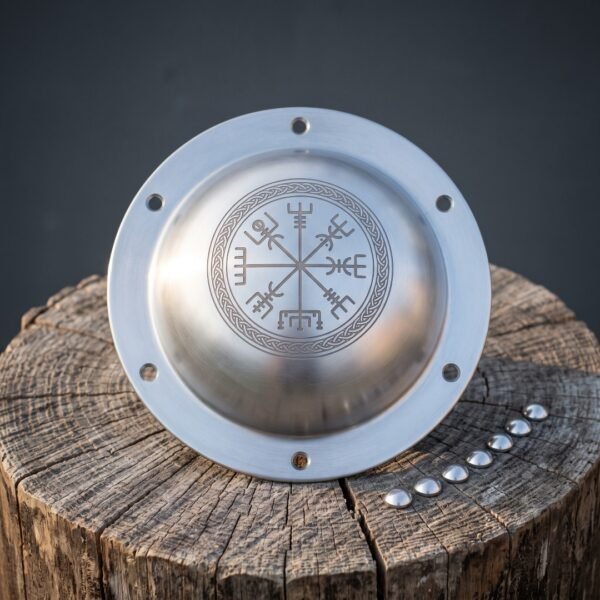
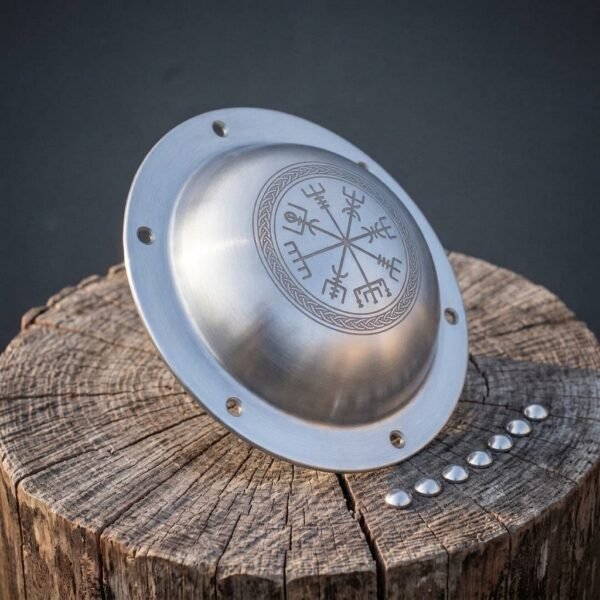
Use the rune converter on this page to turn a name, a date or a short phrase into Elder Futhark and we will cut it into the steel boss. If you would rather have a Viking pattern than a rune line, choose your own design in the engraving option above the add to cart button and tell us where it goes. Where a piece already carries an engraved design, your chosen engraving replaces it rather than sitting alongside it. The boss on this shield is plain, so your engraving goes onto clean steel and the painted ravens stay as they are. More on the engraving page.
Carrying it at an event
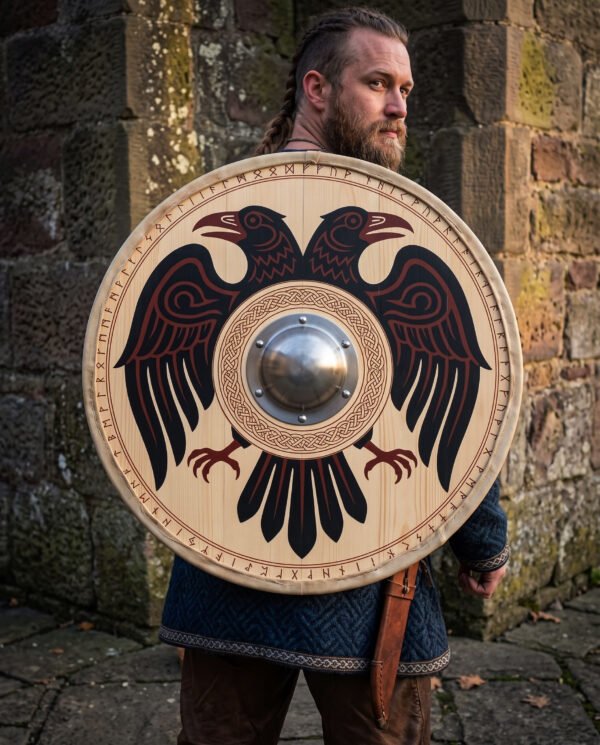
If you are taking Twinflight into a living history camp, a costume event or a photo shoot, fit the strap and grip before you go. Lay the shield face down on a blanket, put your forearm across the back with your fist at the centre hole, and mark where the strap should sit so the shield hangs level when your arm is relaxed. Rivet from there. Fitting it to your own arm is the reason the fittings arrive loose.
A 24 inch shield on a centre grip is comfortable for most adults over a full day of standing about looking Norse. It is not built for full contact steel combat. Groups that fight full contact set their own standards for board thickness, rim and boss, and they inspect for them. This shield is not made to those standards and we would rather say so now than have it turned away at a weapons check.
Hanging it on a wall
On a wall, a round shield is happiest at eye height or a little above, where you can see the paint without craning. Over a fireplace, a desk or a headboard works well at this size. Hang it from two strong hooks or a pair of brackets catching the rim at the left and right so the weight is shared and the shield cannot swing. Do not hang it from the arm strap. Leather stretches, and the day it gives up is never a convenient one.
Keep it out of strong direct sun if you can. Black and blue pigments hold up well, but any painted wood left in a south facing window for years will fade more on one side than the other. If you are still deciding on size or placement, choosing a shield for display walks through it.
Care
Dust it now and then with a soft dry cloth. Do not use furniture polish or anything with solvent in it on the painted face. Keep it indoors and dry, because painted wood and rawhide both dislike long spells of damp, and a winter in a cold garage will lift paint and soften the rim.
The steel boss wants a thin film of light oil or paste wax a couple of times a year. If a spot of rust appears, take it off with fine steel wool and a drop of oil, then wax it again. The steel care notes apply to the boss and the rivets just as they do to a blade.
Choosing between our raven shields
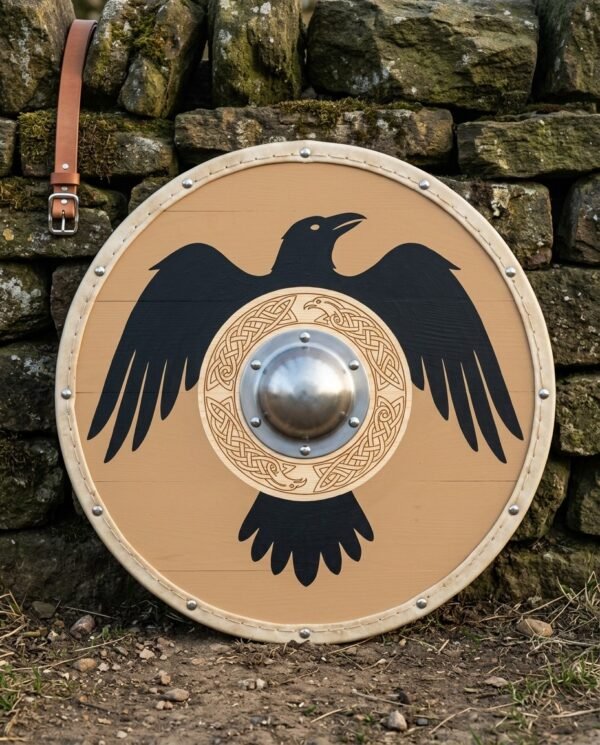
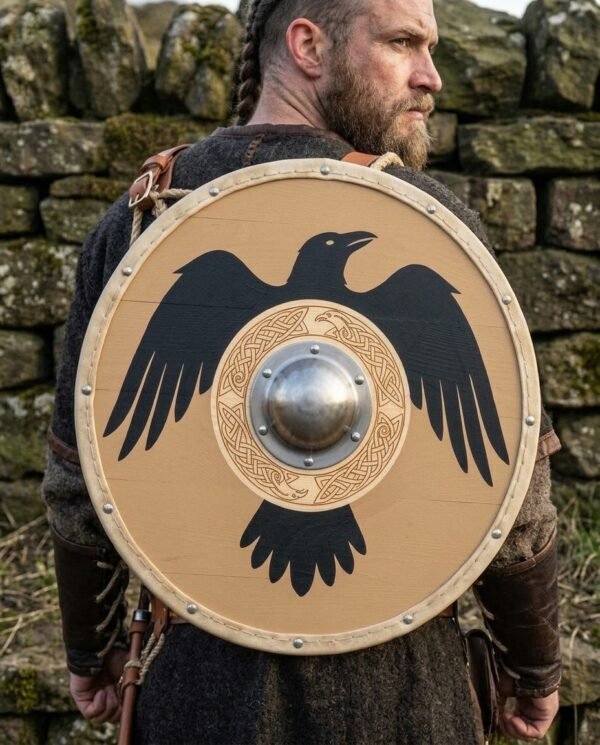
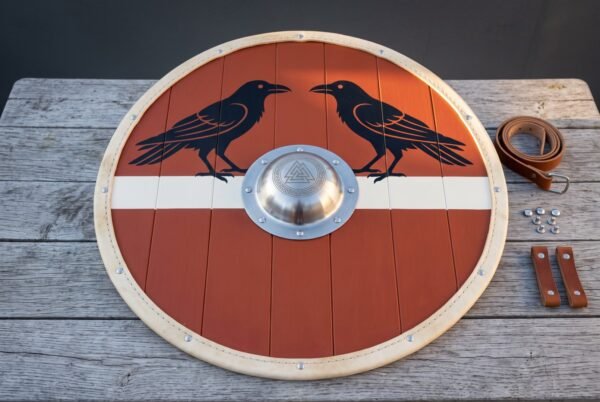
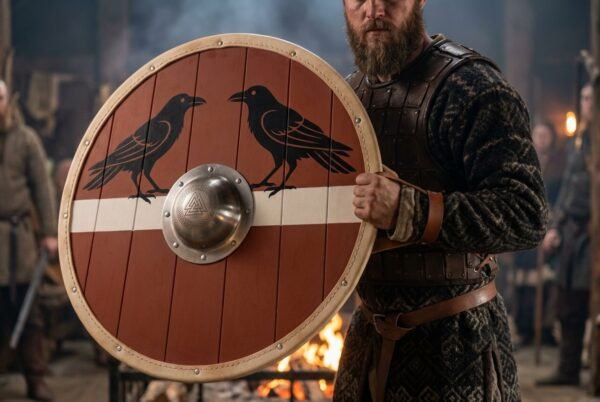
Ravens are popular on this site, so it helps to know how the three raven shields differ. The Ravenhold has a pair of ravens standing on a rust red field with a white band and a valknut engraved boss. The Huginward carries a single large raven on a tan ground. Twinflight is the one with both birds in the air, on a cooler slate blue, with a plain boss left free for your own engraving.
If the shield is going into a room with warm wood and leather, the blue tends to sit better than another red. If it is going alongside other red shields on a wall, it breaks the run up nicely. Either way it is the one to pick if the story of the two ravens out on their morning flight is the part you care about.
Made in the Czech Republic
Twinflight is made in a Czech Republic workshop that still does this kind of work by hand. The planks are cut and glued, the face is sanded and painted, the rawhide is soaked and stitched on, and the boss is fitted, all at the bench rather than on a line. Ransack Viking is a United States company. We check every shield when it reaches us and ship it from our Chicago, Illinois warehouse.
A note on handmade variation
This shield is made and painted by hand, so the one that arrives will not be a pixel perfect copy of the photographs. The plank joints fall where the boards fall, the ravens’ feathers are laid on by brush, and the rawhide dries to its own shade of pale. The size, the build and the design stay the same every time. The small details are the shield’s own.
Frequently asked questions
Which raven is which
The poems never say which bird sits on which shoulder or which one flies higher, so the shield does not pretend to know either. Most people decide the upper one is Huginn because thought tends to fly off first. You are welcome to settle it your own way.
Can I use this for full contact reenactment
No. It is built for display, wall mounting, costume and light reenactment. Full contact groups set their own board, rim and boss requirements and this shield is not made to any of them.
Does it arrive ready to hold
The boss is riveted on and the shield is finished, but the arm strap, the hand grip and the rivets come loose in the box so you can fit them to your own forearm. With a hammer and a solid surface it takes about twenty minutes.
Can the background colour be changed
The slate blue ground is part of this design. If you want the ravens on a different colour, ask us before ordering and we will tell you honestly whether the workshop can do it and how long it adds.
Can I hang it outside
We would not. Painted planks and a rawhide rim take on damp, and weather will lift the paint and soften the binding. Treat it as an indoor piece, and if you carry it at an event, bring it in at night.
How long does it take to ship
Processing is one to two weeks because each shield is planked, painted and bound to order, then shipping is free within the United States. Returns are accepted within seven days. Custom boss engraving adds a few days.
What is in the box
- One 24 inch planked Viking round shield, hand painted with Huginn and Muninn and rawhide bound
- Polished steel dome boss, riveted in place
- Leather arm strap with buckle and leather hand grip, supplied loose
- Set of shield rivets for fitting the strap and grip
- Made in the Czech Republic
Explore the range
See more in round shields and viking shields, or read the guides. The same planked build is painted with the world tree on the Ashcrown Yggdrasil shield and with the Midgard serpent on the Coilmark Jormungandr shield. If you like your ravens perched rather than flying, the Ravenhold round shield has them standing on red and white.



Reviews
There are no reviews yet