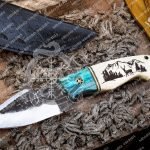
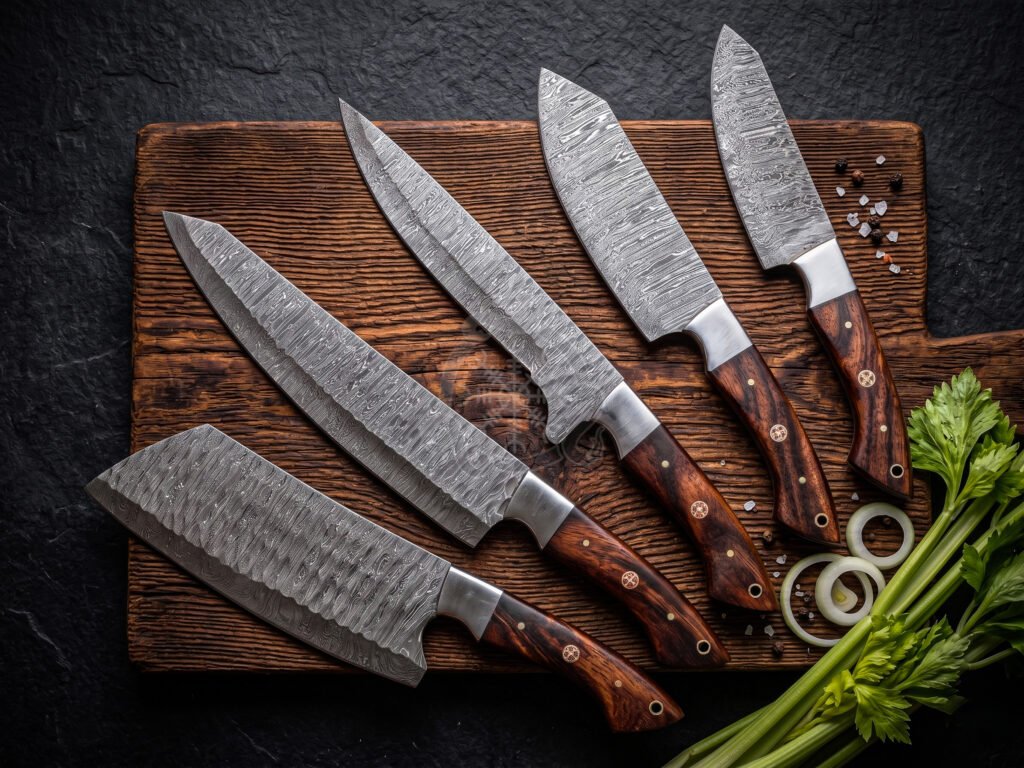
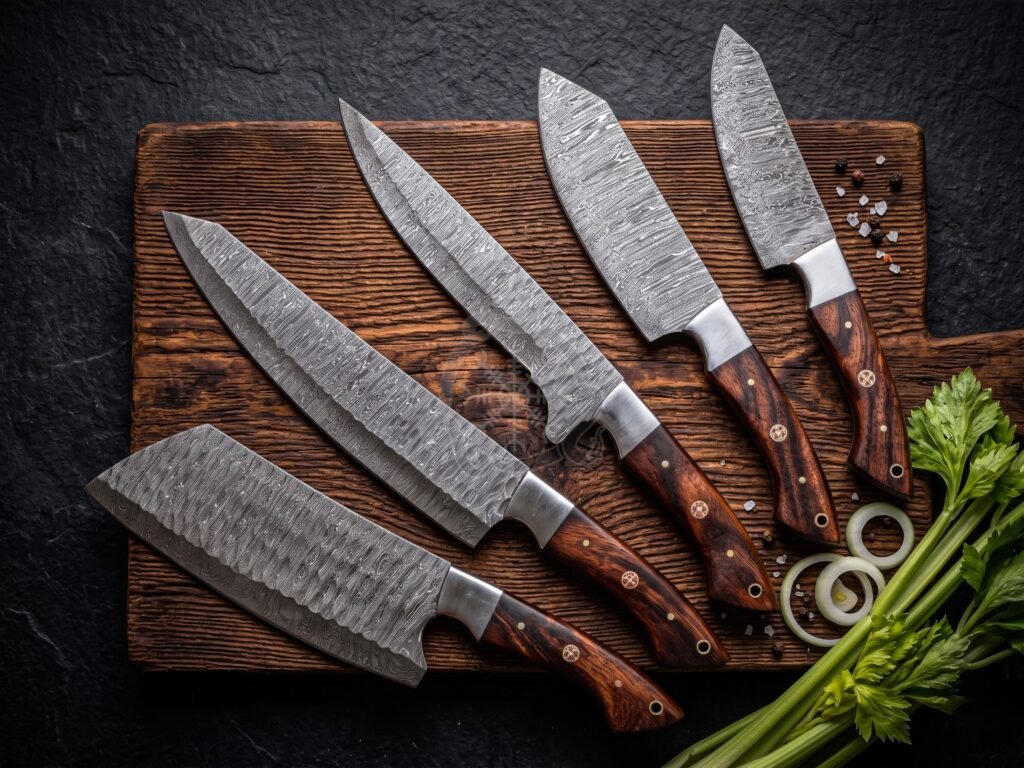
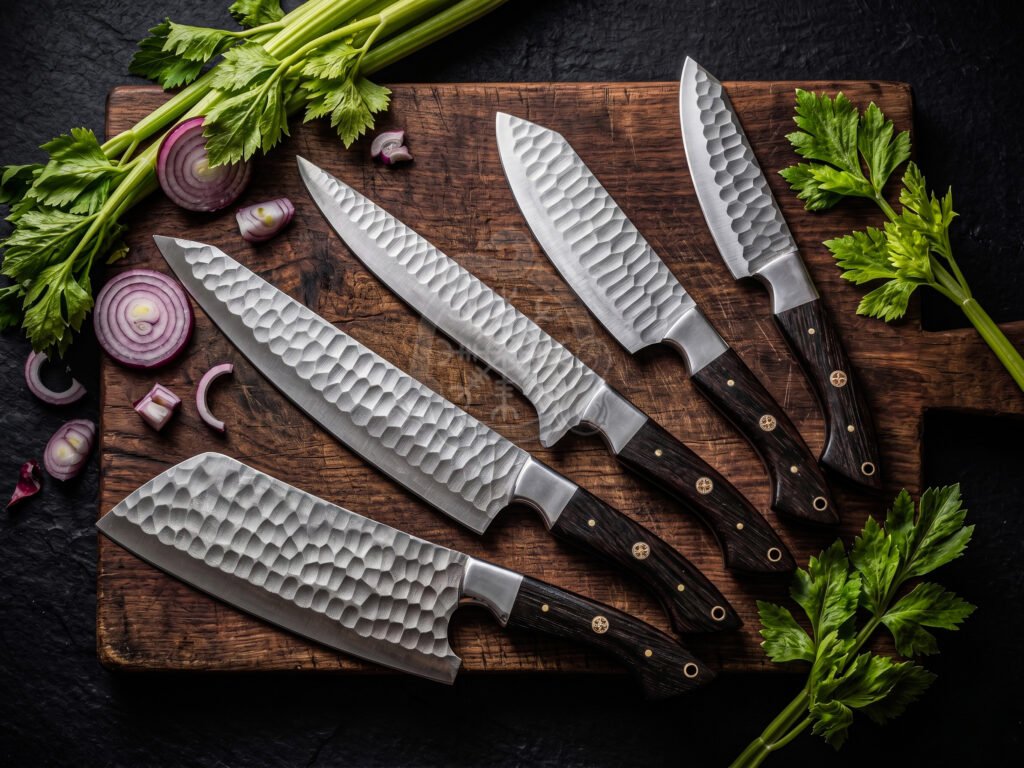
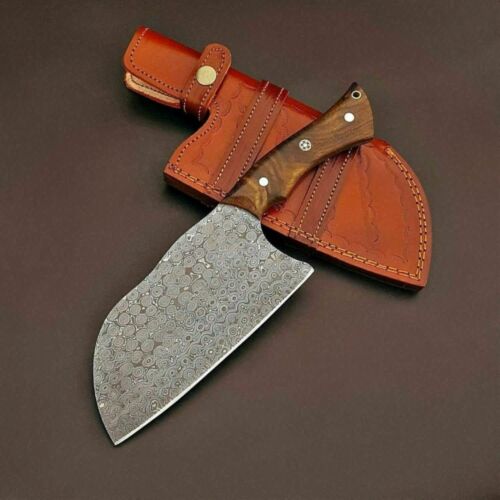
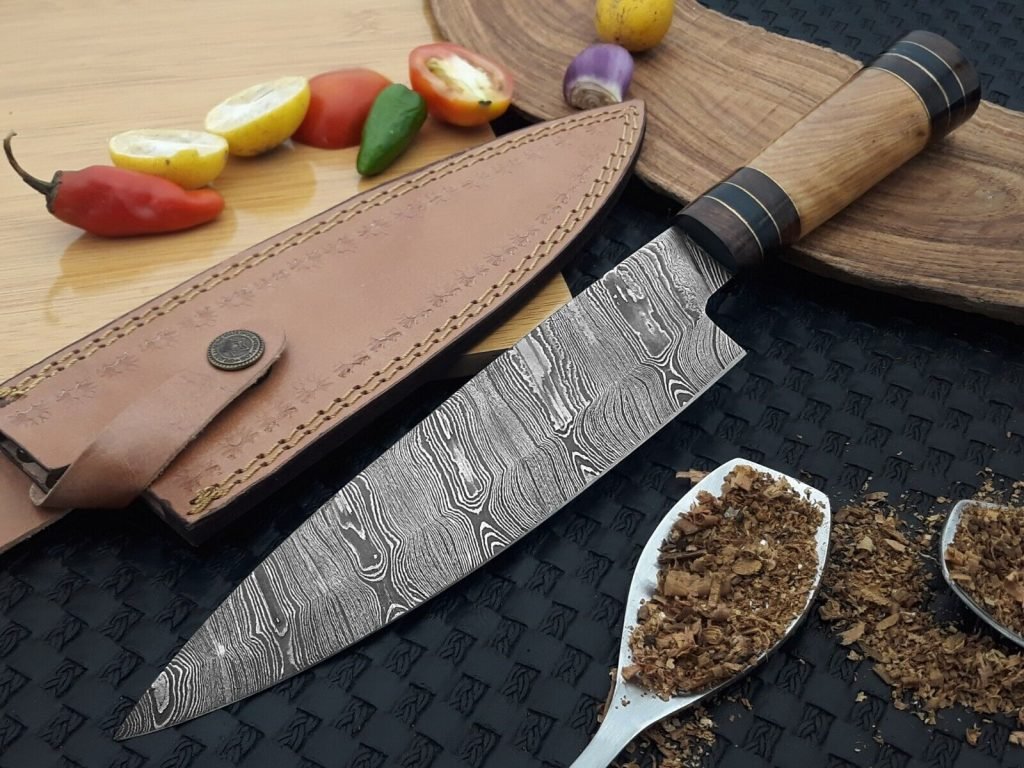
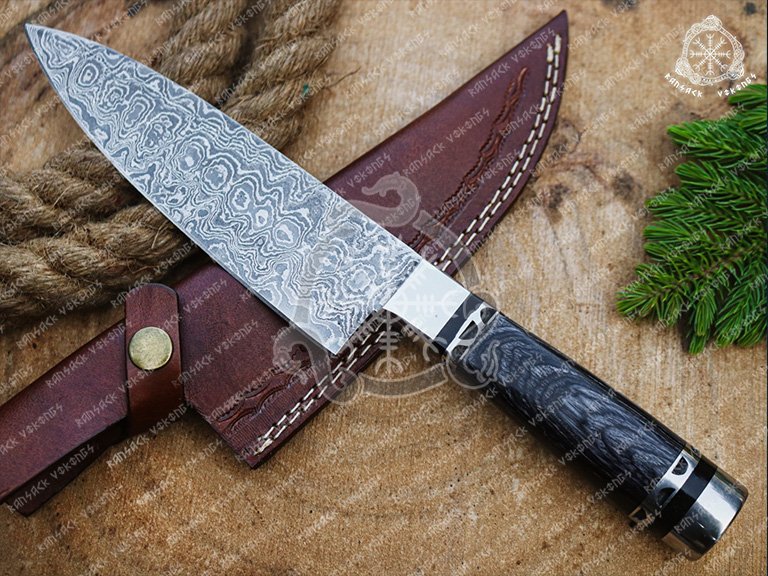
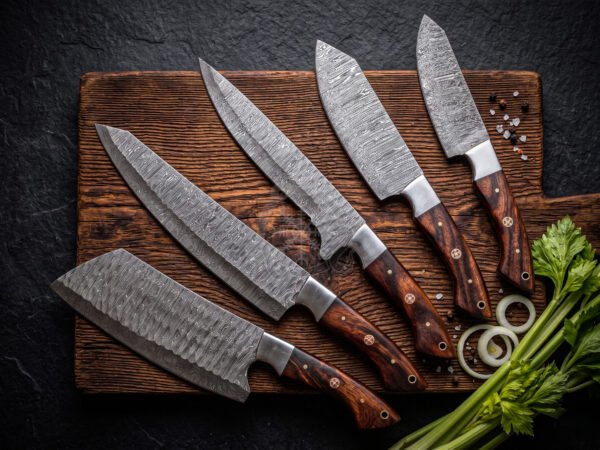
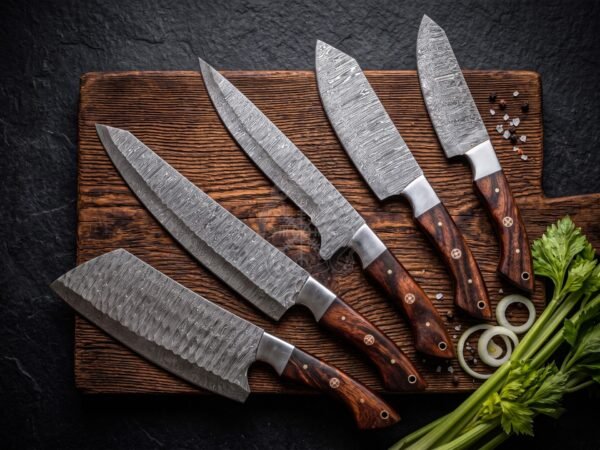
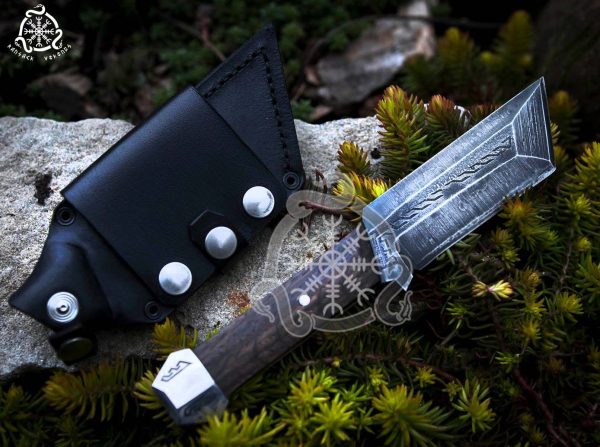
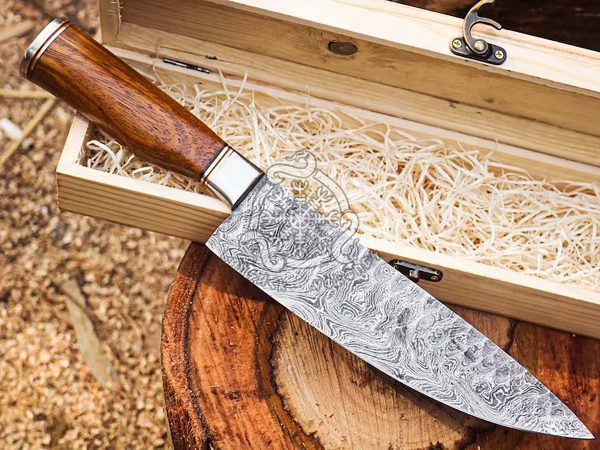
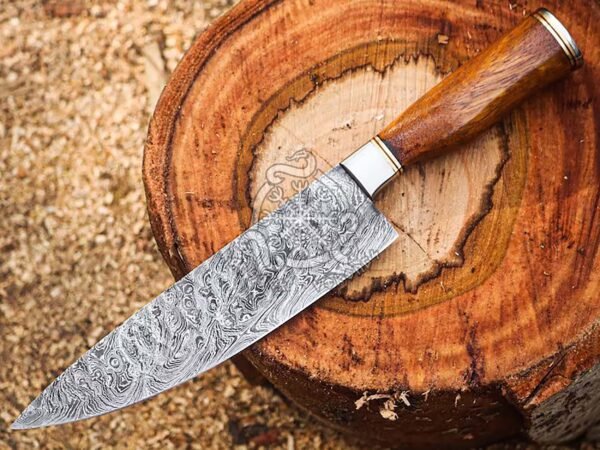
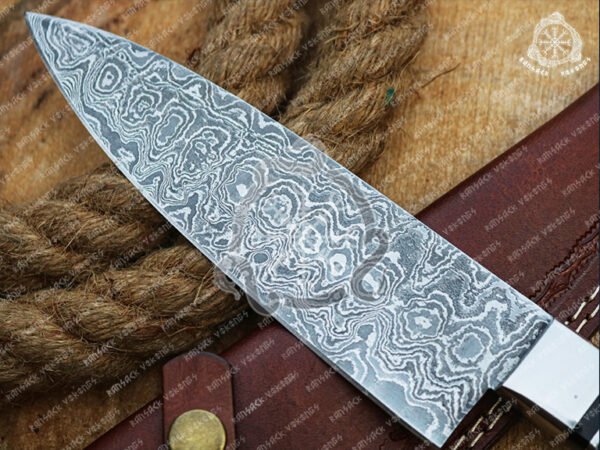
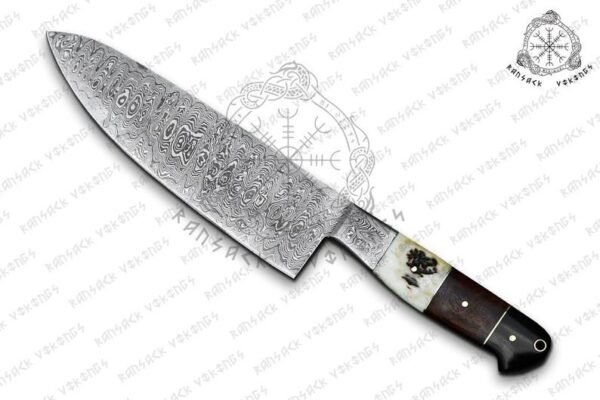
The Hornsmith is an 8 inch Damascus chef knife with a buffalo horn and pakka wood handle, a brass bolster and a mosaic pin through the scales. Twelve and a half inches overall, oil tempered to 58 to 60 HRC, and ground thin enough behind the edge that it parts an onion instead of splitting it. This is a knife for a working board rather than a knife block that never gets opened. For washing, drying and storage without staining, see kitchen knife care.
The Western chef knife arrived in Japan later than most people assume, and its Japanese name records the shock. Gyuto, the standard term for a chef pattern in a Japanese kitchen, translates literally as cow sword, because the shape came in during the Meiji era after the government lifted the long standing prohibition on eating beef in 1872 and Japanese cooks suddenly needed a knife built for large cuts of red meat. The old kitchen knives were tuned to fish and vegetables and single bevelled; the new one was double bevelled with a long curving belly and a point, and within a generation it had become the most used knife in the country that invented the deba. A good chef knife is one of the few tools that has won that argument in every cuisine it has met.
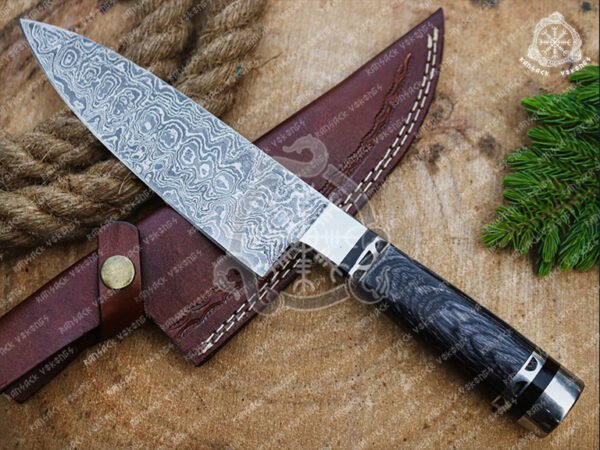
Forged and finished in the Czech Republic. It ships with a leather sheath, protective packaging and an edge that is already cutting.
Specifications
| Steel | Hand forged Damascus, 1095 and 15N20 |
|---|
| Hardness | Oil tempered to 58 to 60 HRC |
|---|
| Pattern | Fire pattern Damascus, six pattern options |
|---|
| Overall length | 12.5 inches |
|---|
| Blade length | 8 inches |
|---|
| Blade width | 1.75 inches at the heel |
|---|
| Handle | Buffalo horn and pakka wood, brass bolster, mosaic pin |
|---|
| Handle length | 4.5 inches |
|---|
| Sheath | Leather sheath |
|---|
| SKU | RK-378 |
|---|
What makes a chef knife work
Almost everything that separates a good chef knife from a bad one happens in the last two millimetres behind the edge. A blade can be sharp and still cut badly, because sharpness is only the width of the apex; what decides whether the knife slides through a carrot or wedges it apart is how thin the steel is immediately behind that apex. Thick shoulders push the food sideways and the carrot cracks. Thin shoulders let the blade pass through. This one is ground thin behind the edge and left with enough spine thickness for stiffness, which is the balance the whole pattern is trying to hit.
The second thing is the profile. An 8 inch blade with 1.75 inches of height at the heel gives you knuckle clearance over the board, which sounds trivial until you have spent twenty minutes chopping with a knife that does not have it. The curve through the front third lets you rock the tip and mince, the flatter section towards the heel lets you push cut and get full board contact, and the height carries food off the board when you scoop. The brass bolster adds weight just behind the pinch grip so the knife balances at your fingers rather than out at the tip.
Why Damascus and not stainless
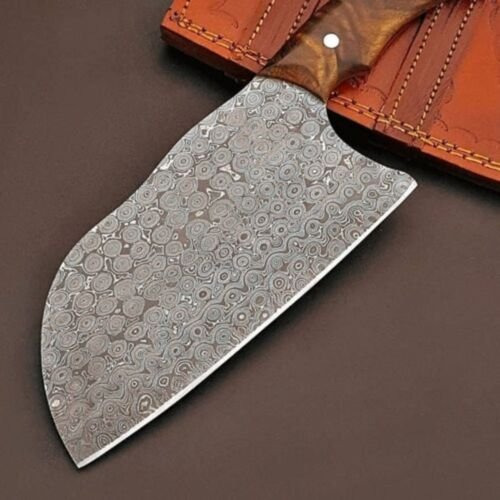
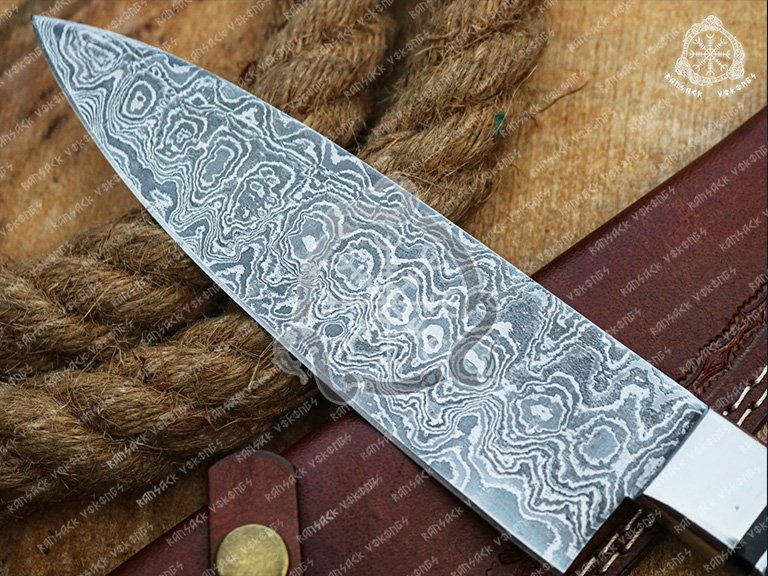
This is real pattern welded Damascus, not an etched print. Layers of 1095 high carbon and 15N20 nickel steel are forge welded, folded and drawn out, so the pattern runs through the blade instead of sitting on the surface. Oil quenched and tempered to 58 to 60 HRC, it takes a finer edge than kitchen stainless and holds it through far more work between sharpenings.
In a kitchen the trade off is more visible than anywhere else, because kitchens are wet and acidic. Carbon steel will darken where it meets tomato, lemon or onion, and that grey blue film is patina rather than rust. Leave the knife wet in a sink and it will spot properly. Wipe it as you cook and it will not. Most cooks who make the switch stop noticing the extra ten seconds within a week and never go back to a soft stainless edge. The full argument is in Damascus versus stainless.
The buffalo horn and pakka wood handle
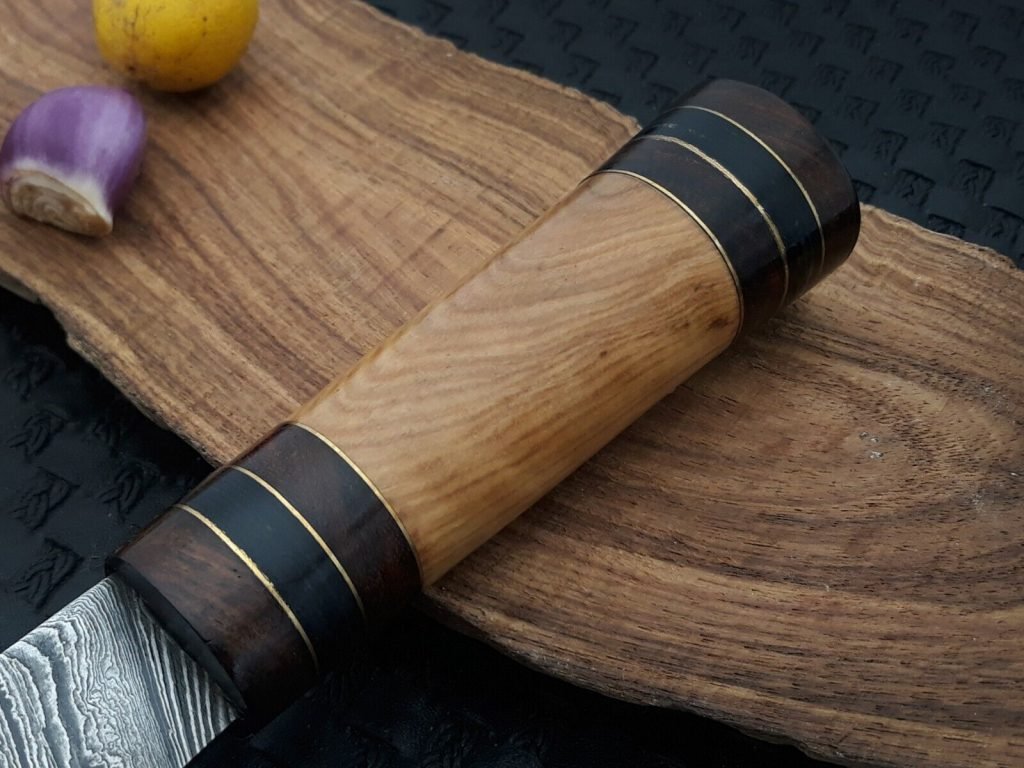
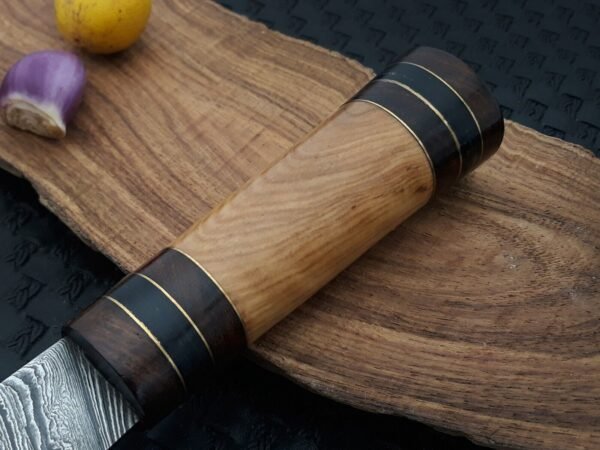
The handle pairs buffalo horn with pakka wood, joined at a brass bolster with a mosaic pin set through the scales. Buffalo horn is dense, so it counterweights the blade and keeps the balance point back at the pinch, and it takes a deep polish that no synthetic reproduces. Pakka wood is hardwood veneer impregnated with resin under heat and pressure, which makes it dimensionally stable in a room that is constantly humid. Between them you get the depth of a natural material and the stability of an engineered one. The mosaic pin is not just decoration; it is a bundle of brass and steel rod set in epoxy, cut and ground flush, and every one shows a slightly different face.
Horn and wood both want the same care. Keep the handle out of standing water, never leave the knife soaking in a sink, and give the scales a light coat of mineral oil once or twice a year to stop them drying and shrinking away from the pins. The routine is in wooden handle care.
Engraving, runes and your own design
Use the rune converter on this page to turn a name, a date or a short phrase into Elder Futhark and we will cut it into the steel or the handle. If you would rather have a Viking pattern than a rune line, choose your own design in the engraving option above the add to cart button and tell us whether it goes on the blade or the handle. Where a piece already carries an engraved design, your chosen engraving replaces it rather than sitting alongside it. On a chef knife the flat above the bevel takes lettering cleanly and the engraving sits well clear of the cutting edge. See the engraving page for layouts.
Care and sharpening
Hand wash only, in warm water with a little mild soap, and dry it immediately including the join between the bolster and the scales. A dishwasher will strip the finish off the handle and pit the steel, so keep it out of one entirely. Before the knife goes into a drawer or a block for any length of time, wipe the blade with a thin film of mineral or camellia oil.
Keep it off bone, frozen food and anything that needs a cleaver, and use a wood or composite board rather than glass, stone or steel. Sharpening is ordinary stone work: a 1000 grit to raise a burr, a 3000 to refine it, then a strop or a few passes on a smooth steel to realign between sharpenings. Hold the existing angle rather than reprofiling. Both jobs are covered in steel care and sharpening with a whetstone.
Made in the Czech Republic
Every piece we sell is made by hand in the Czech Republic. The smiths there work the way the trade has been worked for a long time, heating and hammering the steel, taking the bevels down by eye, and fitting the handle and the leather one at a time. There is no automated line anywhere in it, so small differences from one piece to the next are normal and expected.
Ransack Viking is a United States company based in Memphis, Tennessee. We bring the pieces in ourselves, inspect them on arrival and ship them from our own warehouse. If you add engraving, that is carried out here in the United States before your order goes out.
A note on handmade variation
The Hornsmith is hand forged, not machine made and not bulk produced, so the knife that arrives will not be a pixel for pixel copy of the photograph on this page. Buffalo horn varies enormously in tone, from near black through to grey with pale streaking, and no two pieces are alike. The pakka wood carries its own figure, the mosaic pin shows a different face on every knife, and the Damascus pattern falls out of the billet differently every time.
The dimensions, the steel, the hardness and the build stay the same from one to the next. The character does not, because every part of this was worked by hand from natural materials.
Frequently asked questions
Is the Hornsmith sharp enough to use straight away
Yes. It is finished on stones by hand before packing and will slice a tomato without pressure on arrival. No breaking in period and no factory edge to grind off.
Can it go in the dishwasher
No. Heat and detergent will dry and crack the buffalo horn and pit the carbon steel. Hand wash, dry immediately, and it will last decades.
Why has the blade gone grey where I cut a lemon
That is patina, which is a stable oxide layer forming on carbon steel. It is protective and it is what the blade does with age. If you dislike the look, a light pass with a scouring pad and oil will lift it.
How does this compare with the hardwood handled chef knife in the range
Same steel and the same job. The buffalo horn version is a little heavier at the handle and balances further back, and the horn has more visual depth. A plain hardwood handle is more uniform and slightly more forgiving if it gets knocked about.
Which Damascus pattern should I choose
All six perform identically, since the pattern is a consequence of how the billet was manipulated rather than a change in the steel. Pick on looks. The tighter twist patterns show more movement on a wide blade like this one.
Does it come with a way to store it safely
Yes, a leather sheath is included. Keep the knife out of the sheath for long term storage in a humid kitchen, since leather holds moisture against steel, and use the sheath for transport and blade protection.
What is in the box
- One Hornsmith Damascus chef knife
- Leather sheath
- Protective packaging
- Care notes for carbon steel, horn and pakka wood
- Forged and finished in the Czech Republic
Explore the range
Look through the rest of the chef knives, or across to the fish fillet knives and the Viking knives. Sharpening, steel and handle care are all covered in the guides.








Been eyeing this knife for months and it did not disappoint. Damascus blade holds a razor edge right out of the box. Weight and balance make it feel like a real functional piece not some cheap replica. This is going straight into my display case.