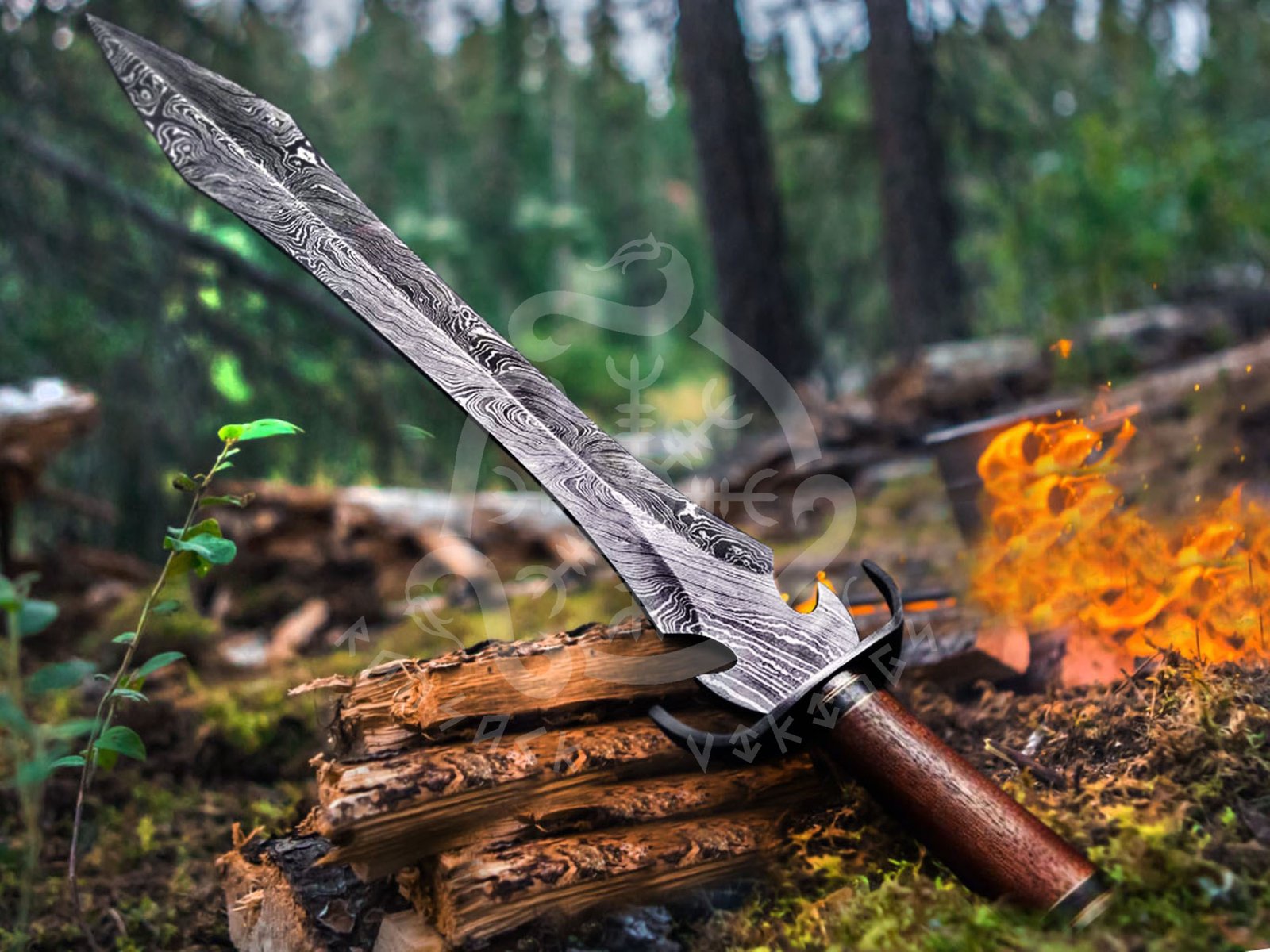
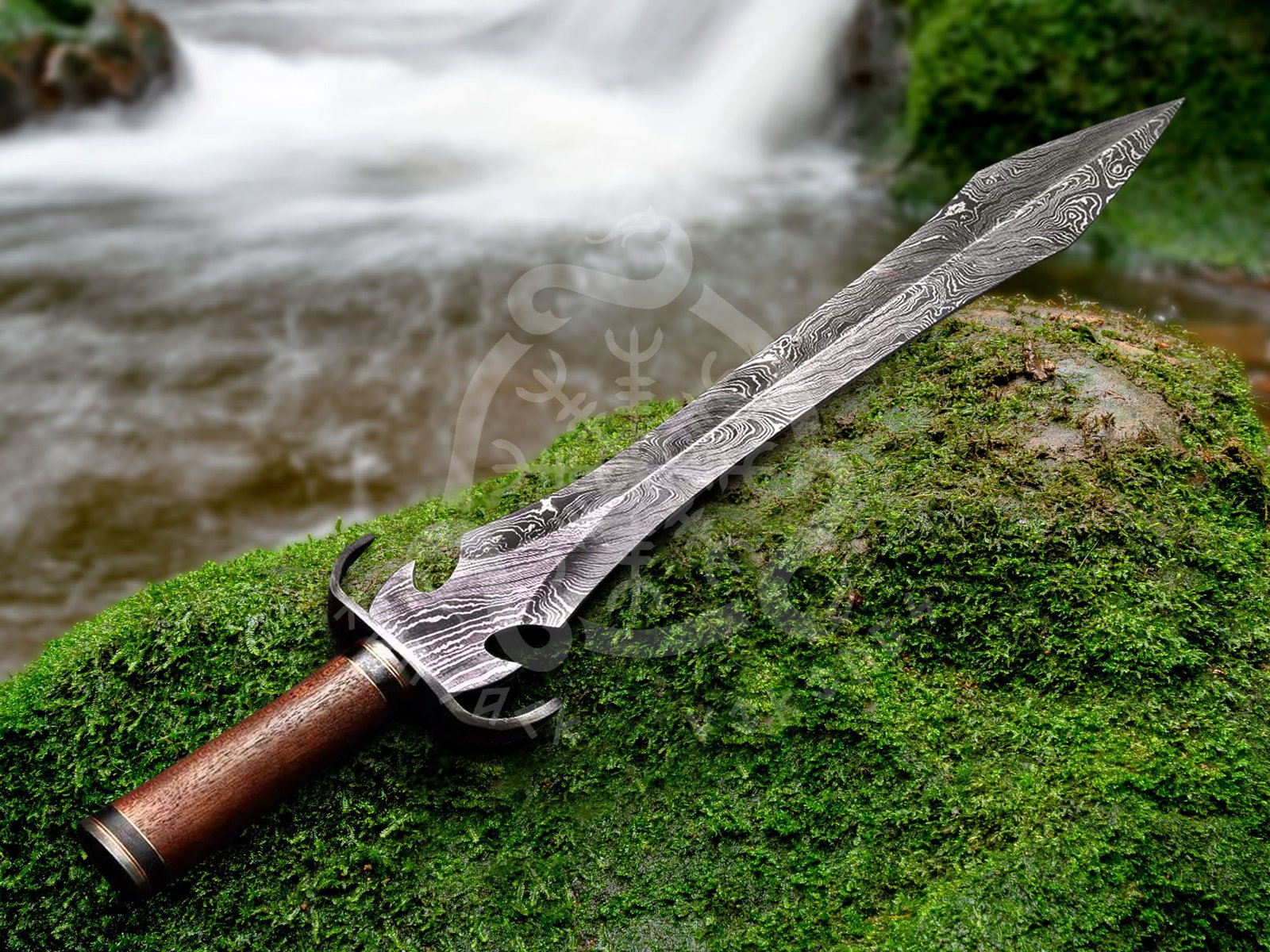
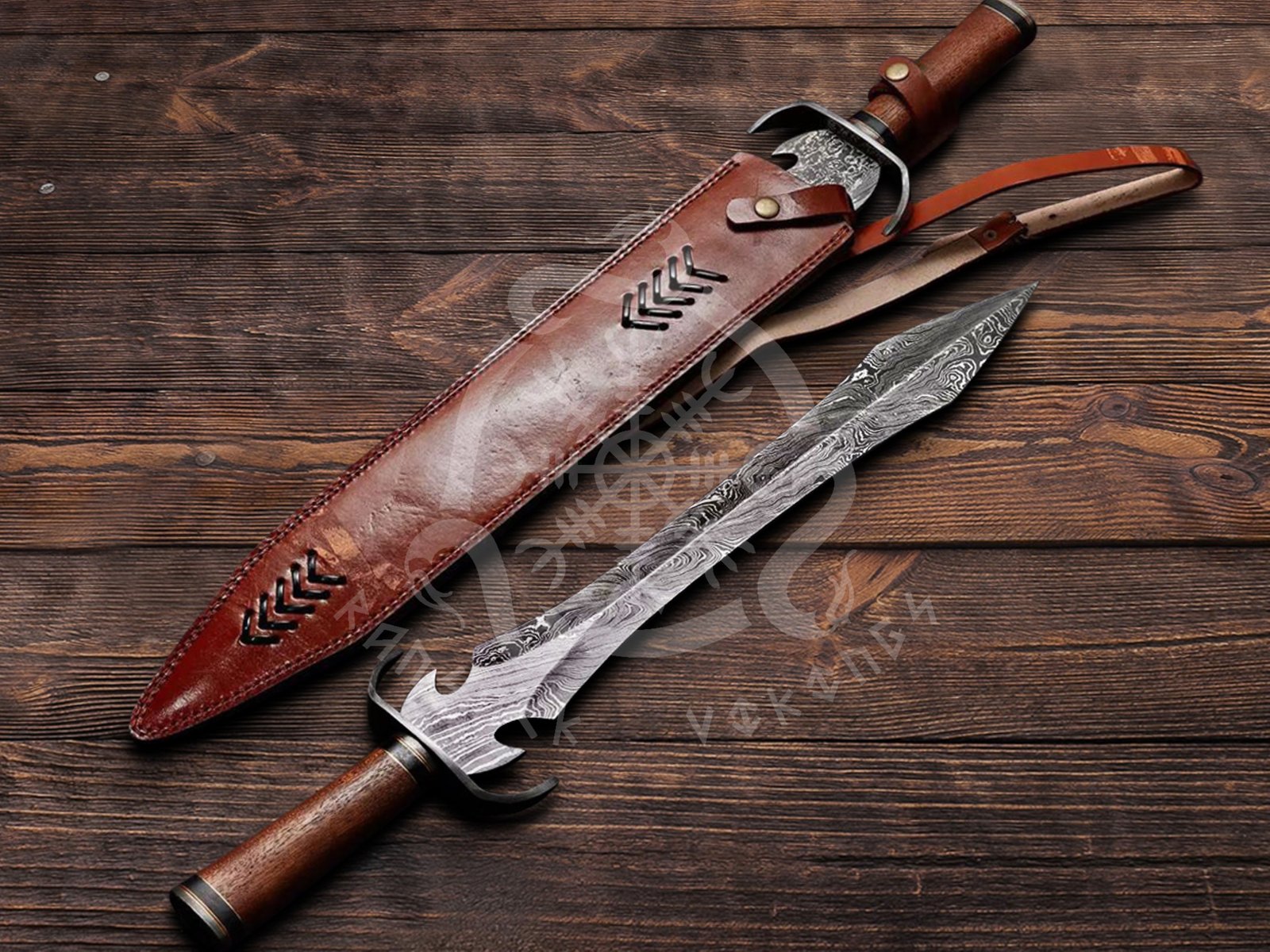
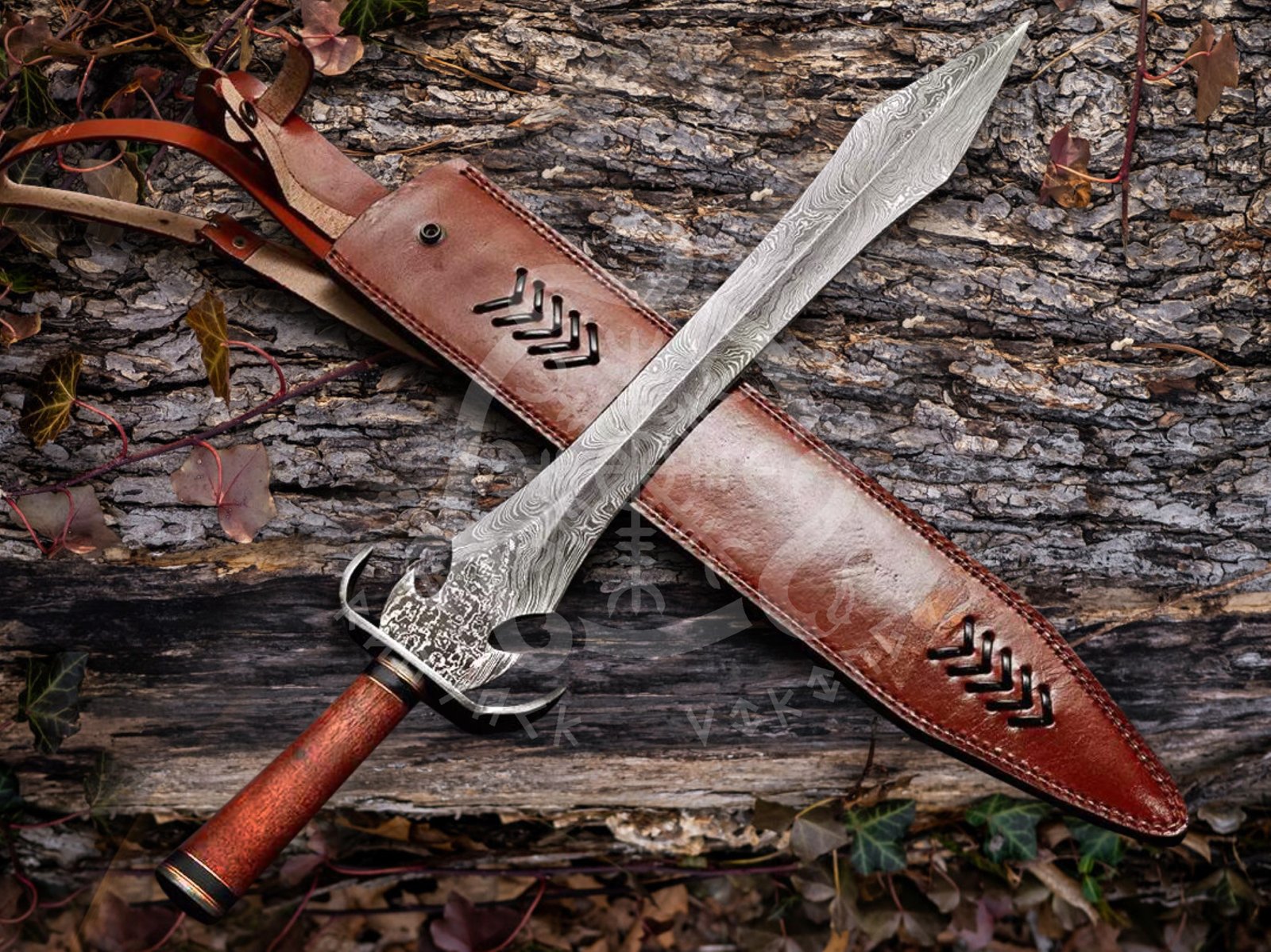
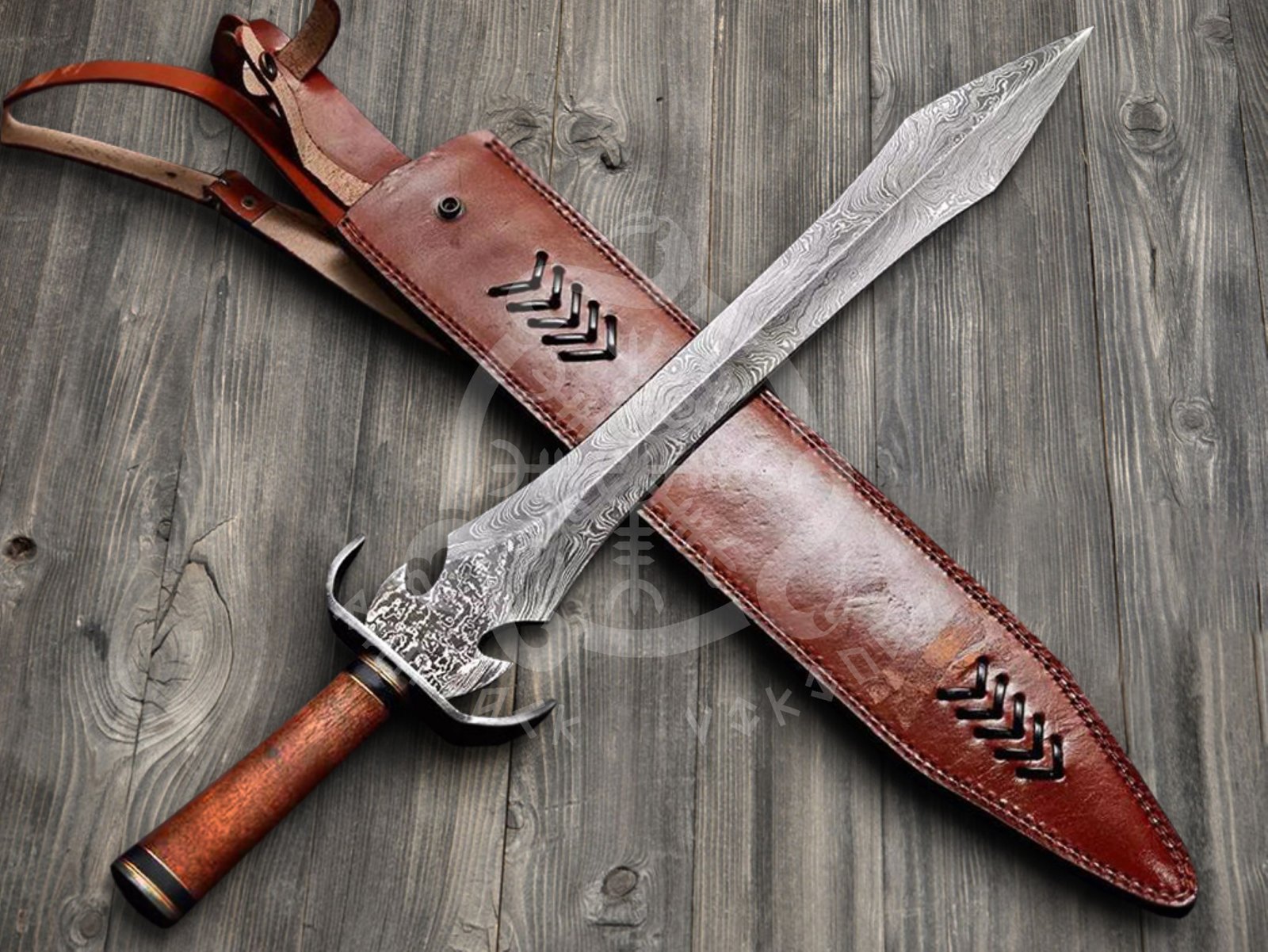
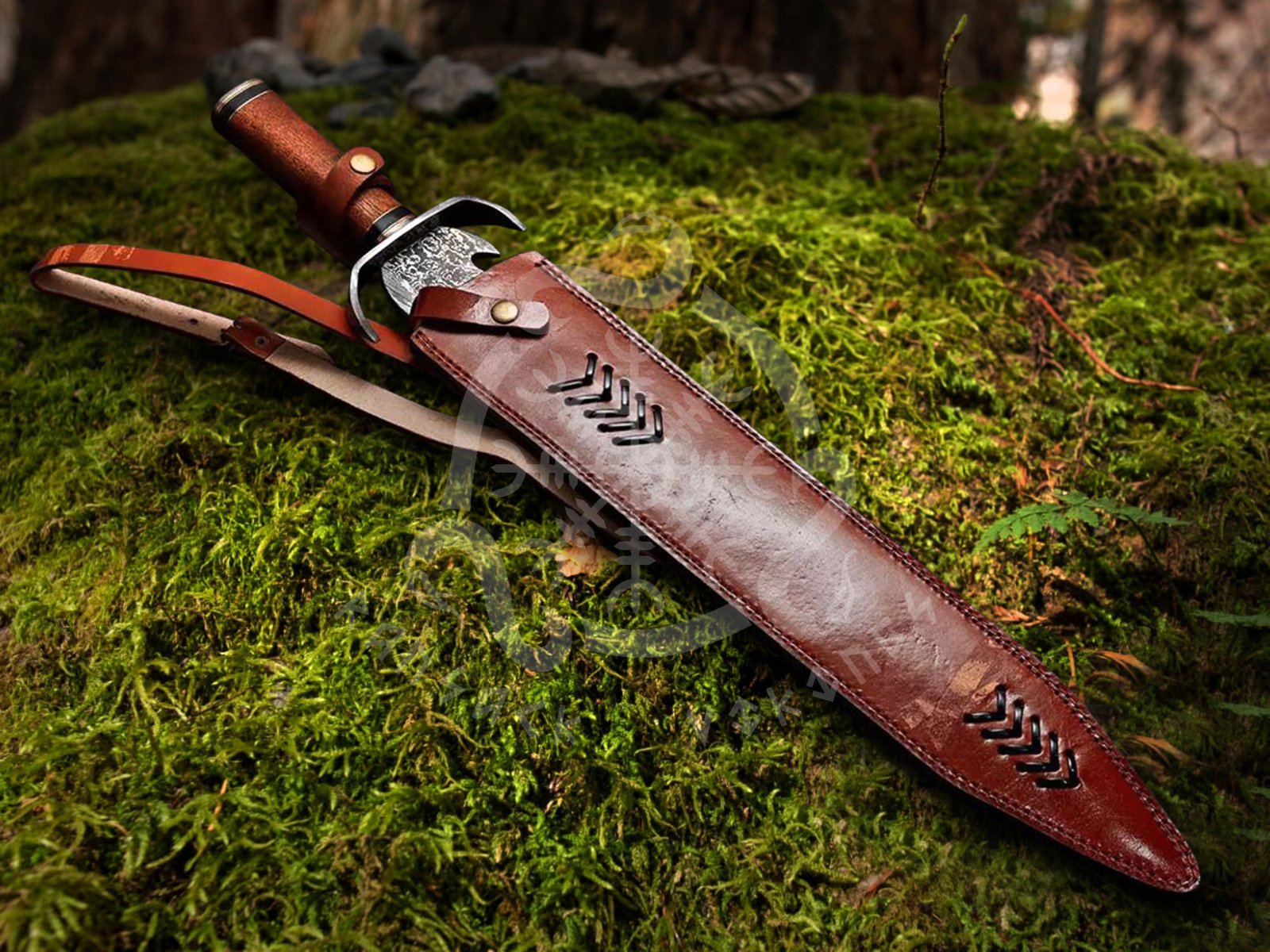
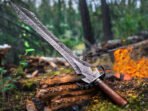
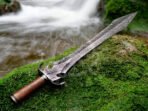
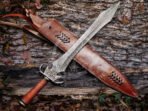
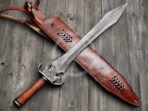
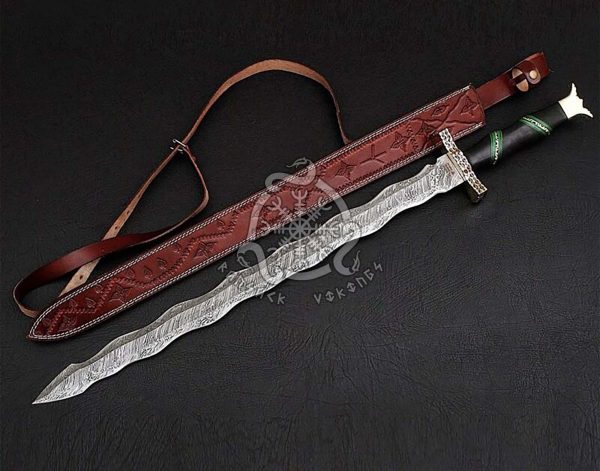
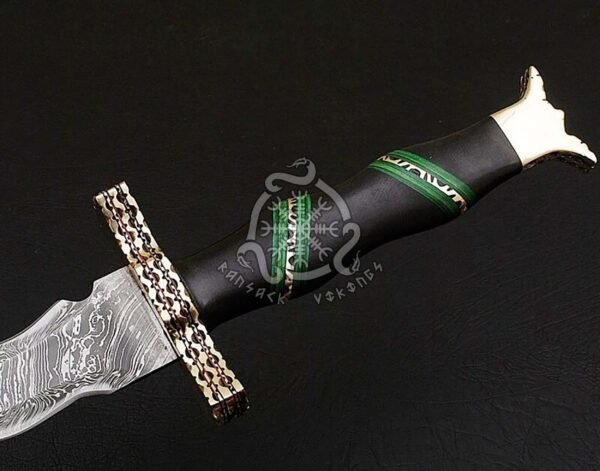
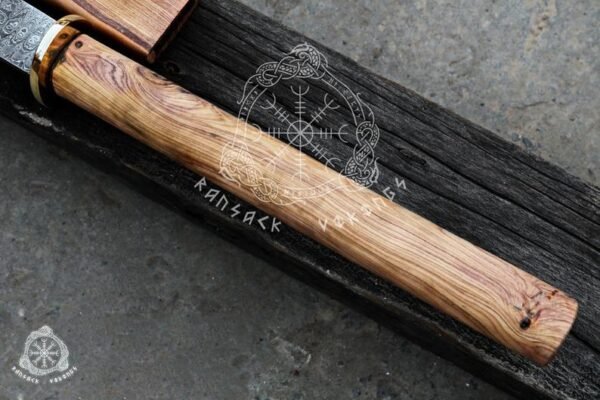
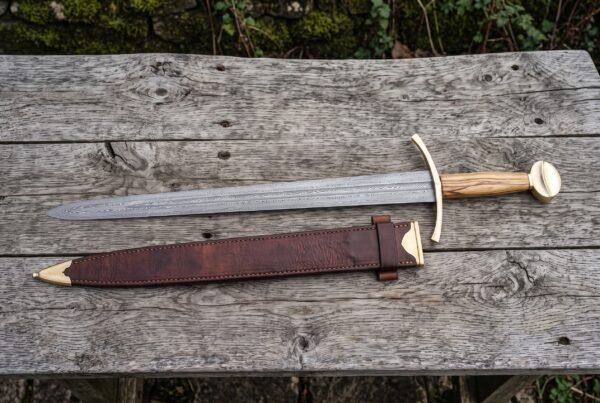
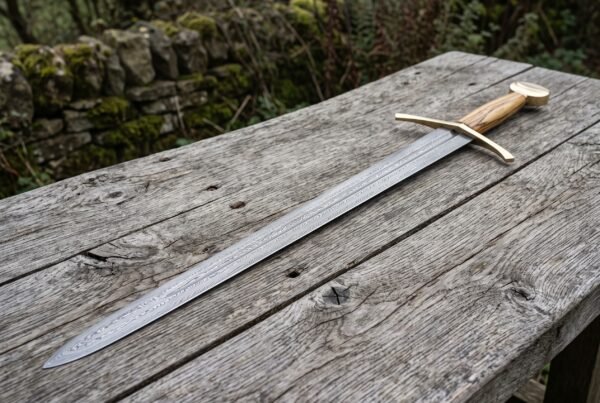
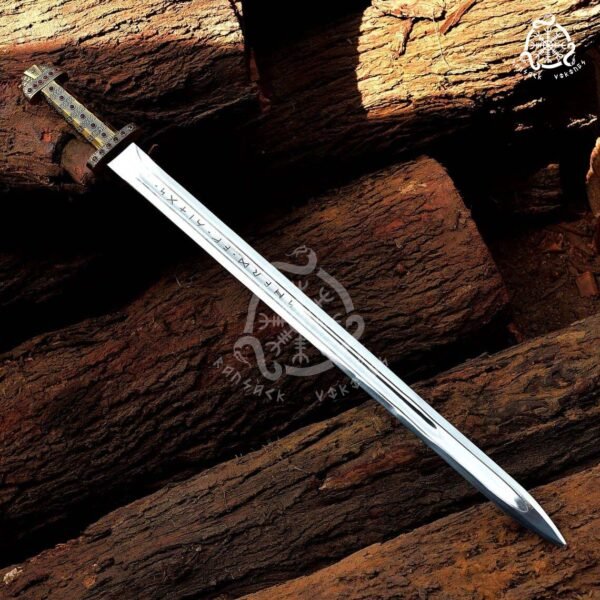
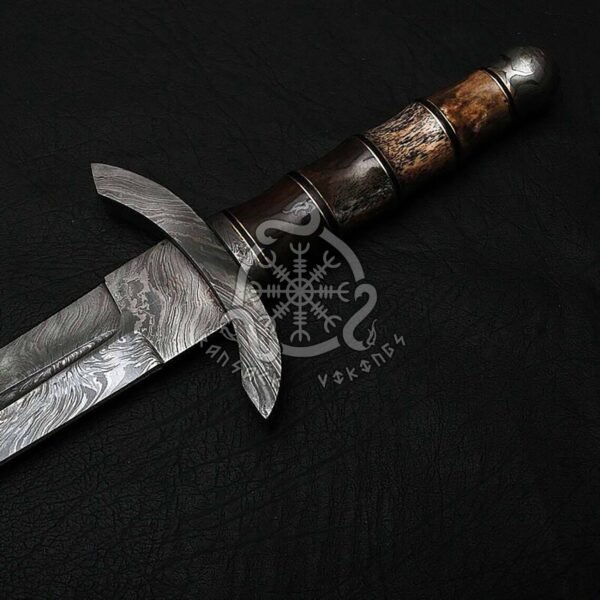
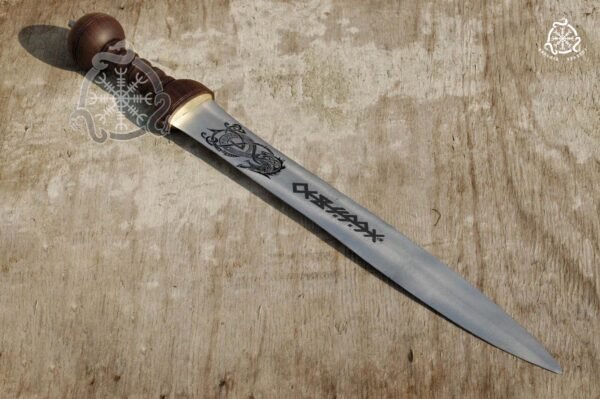
The Rosecrest is a hand forged Damascus sword measuring twenty eight inches overall, with a twenty three inch blade set into a five inch rosewood grip. It is a compact sword by historical standards, closer in length to a Viking era side arm than to a two handed war sword, and that is what makes it pleasant to hold rather than tiring. The billet is forge welded from 1095 and 15N20, so the pattern in the steel runs all the way through the blade instead of sitting on the surface. Keeping the pattern bright over years is a maintenance question, answered in looking after Damascus.
Pattern welding was not invented to look decorative, although it does. In the migration period and through the Viking age, smiths across northern Europe had no reliable way to make a large, uniform, high quality bar of steel. What they had were small bloomery blooms of wildly variable carbon content. The answer was to take rods of harder and softer iron, twist them, forge weld them together into a core and then weld harder edge steel onto the outside. That gave a blade with a tough spine and a hard edge out of materials that individually would have made a poor sword. The visible pattern was a side effect of the metallurgy, and only later did it become the point.
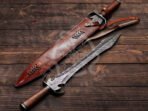
This sword is forged and finished in the Czech Republic, from the welding of the billet through to the final edge. It ships as a bare sword in protective packaging. There is no scabbard or sheath supplied with this piece, so if you want it on a wall, plan for a stand or a set of brackets.
Specifications
| Steel | Hand forged Damascus, 1095 and 15N20 |
|---|
| Hardness | 58 to 60 HRC |
|---|
| Overall length | 28 inches |
|---|
| Blade length | 23 inches |
|---|
| Handle length | 5 inches |
|---|
| Handle | Rosewood |
|---|
| Sheath | Not included |
|---|
| SKU | RK-676 |
|---|
What a twenty three inch blade does that a longer one cannot
Sword length is not a ranking. It is a set of trade offs, and the twenty three inch blade sits at a very specific point on that curve. Because the mass is close to the hand, the point of balance sits only a few inches forward of the guard, which means the sword changes direction quickly and does not fight you when you hold it out at arm’s length for a photograph or a display check. A thirty five or forty inch blade of the same section has far more rotational inertia, and you feel every bit of it in the wrist.
Historically this is the length of a great many single handed swords that were carried rather than paraded. A blade you wear on a belt has to clear a scabbard without an absurd draw stroke, and it has to be manageable indoors and on a boat. That is why so many surviving Viking age and early medieval blades cluster in the high twenties and low thirties rather than running much longer. Shorter also means stiffer for a given thickness, so the blade resists flexing at the tip, which is what you want in a piece that will be handled by visitors and hung on a wall for years.
Why Damascus and not stainless
Damascus here means two real steels, 1095 and 15N20, forge welded into a single bar and worked down together. The 1095 brings the carbon that lets the edge harden properly. The 15N20 carries nickel, which resists the etchant and gives the bright lines you can see running through the finished blade. Hardened and tempered, the result sits around 58 to 60 HRC, which is harder than the stainless used in most decorative swords.
The price of that is rust. This is high carbon steel with a pattern in it, and if you leave it wet or store it in a damp garage it will spot. A stainless sword would let you ignore it completely, at the cost of a softer blade and a flat, characterless surface with nothing going on in the steel. We lay the whole comparison out, including how to spot an etched print pretending to be forge welded Damascus, in Damascus versus stainless.
The rosewood grip
The handle is rosewood, shaped and sanded by hand to fill the palm rather than to look neat in a photograph. Rosewood is dense and naturally oily, which is why it has been used for tool and instrument handles for centuries. It resists moisture better than most timbers, it takes a deep finish, and it warms to the hand within seconds rather than staying cold like a metal or resin grip.
Being natural, it moves a little with temperature and humidity. A light coat of oil once or twice a year keeps it fed, stops it drying out and keeps the fit between wood and tang tight. It takes a couple of minutes and the method is in wooden handle care. What you must not do is leave it against a radiator or in a car through a summer, because sustained dry heat is what shrinks a wooden grip.
Engraving, runes and your own design
Use the rune converter on this page to turn a name, a date or a short phrase into Elder Futhark and we will cut it into the steel or the handle. If you would rather have a Viking pattern than a rune line, choose your own design in the engraving option above the add to cart button and tell us whether it goes on the blade or the handle. Where a piece already carries an engraved design, your chosen engraving replaces it rather than sitting alongside it. On a sword this size the broad flat of the blade near the guard is the usual place for a rune line, and it is the one people ask for at weddings and retirements. See the engraving page for lettering and layout.
Care and sharpening
Wipe the blade down after handling. Fingerprints are slightly acidic and on high carbon steel they will etch themselves into the surface within days if left. Before the sword goes on a wall or into storage, put a thin film of mineral or camellia oil over the whole blade with a cloth. Repeat once or twice a year, more often in a humid climate. Do not store it wrapped in a sealed plastic bag, which traps moisture against the steel. Full detail is in steel care.
The edge is set before the sword leaves the shop. If you ever need to bring it back, work it the same way you would a large knife: hold the existing bevel, work heel to tip in overlapping passes, raise a burr, turn over and match it, then strip the burr. A long blade simply takes more passes. The sequence is in sharpening with a whetstone.
Made in the Czech Republic
Every piece we sell is made by hand in the Czech Republic. The smiths there work the way the trade has been worked for a long time, heating and hammering the steel, taking the bevels down by eye, and fitting the handle and the leather one at a time. There is no automated line anywhere in it, so small differences from one piece to the next are normal and expected.
Ransack Viking is a United States company based in Chicago, Illinois. We bring the pieces in ourselves, inspect them on arrival and ship them from our own warehouse. If you add engraving, that is carried out here in the United States before your order goes out.
A note on handmade variation
Every Rosecrest is hand forged, not machine made and not bulk produced, so the sword that arrives will not be a pixel for pixel copy of the photograph on this page. The Damascus pattern is different on every blade because it depends on how that particular billet folded and where the blade was cut from it. The rosewood grain, the tone of the wood and the exact profile of the taper all shift a little. The dimensions, the steel and the build are the same every time. The character is not.
Frequently asked questions
Does it come with a scabbard?
No. This piece ships as a bare sword in protective packaging. If you want it displayed, a wall bracket or a table stand is the usual solution, and if you want a fitted scabbard it has to be made to the individual blade rather than pulled off a shelf.
Is the Damascus pattern real or etched on?
Real. The blade is forge welded from alternating layers of 1095 and 15N20, so the layers run through the whole thickness of the steel. An etched or printed pattern sits on the surface and disappears the moment you take a file to it. Ours does not.
How heavy is it in the hand?
Lighter and livelier than most people expect from a sword. At twenty three inches of blade the balance point sits close to the guard, so it feels controllable rather than nose heavy. It is a piece you can hold out and turn without your forearm complaining.
Can I have a name or a date engraved on the blade?
Yes. Use the rune converter for an Elder Futhark line or choose your own design in the engraving option, and tell us whether you want it on the blade or the grip. The flat near the guard is the most legible place on a sword of this width.
What is the difference between this and a longer Viking sword?
Reach and handling. A twenty nine or thirty three inch blade gives you presence on a wall and historical proportion, but it also carries much more mass away from the hand. This one is easier to hold, easier to display in a smaller room and easier to pass around without anyone finding it heavy.
How long before it ships?
Processing takes one to two weeks because the piece is made and finished rather than picked from a shelf. Shipping within the United States is free. Returns are accepted within seven days of delivery.
What is in the box
- One Rosecrest hand forged Damascus sword
- Protective packaging
- Forged and finished in the Czech Republic
Explore the range
Compare it against the rest of the forge in Damascus Swords, Viking Swords, Short Swords and Arming Swords. The background on steels, patterns and care is collected in the guides.
Near neighbours in the shop
If this one is not quite right, there is the Powerblade sword, 40 inches overall. Also in this group is the Runecage sword, 42 inches overall. Sitting beside it in the catalogue is the Rosewarden sword, 35 inches overall.
From the same corner of the shop, there is the Knotwake broadsword. You can have this made your way instead on the custom Viking sword page.







I collect stuff like this and this sword is on another level. This shop clearly takes pride in their work. It’s handmade in the Czech Republic but ships from a US warehouse so it arrived quicker than I expected.
This sword beat every expectation I had. Fit and finish is museum quality. You can tell real craftsmen made this by hand. So worth it.
I collect stuff like this and this sword is on another level. Made overseas in the Czech Republic yet shipped from a US location so no long customs wait.