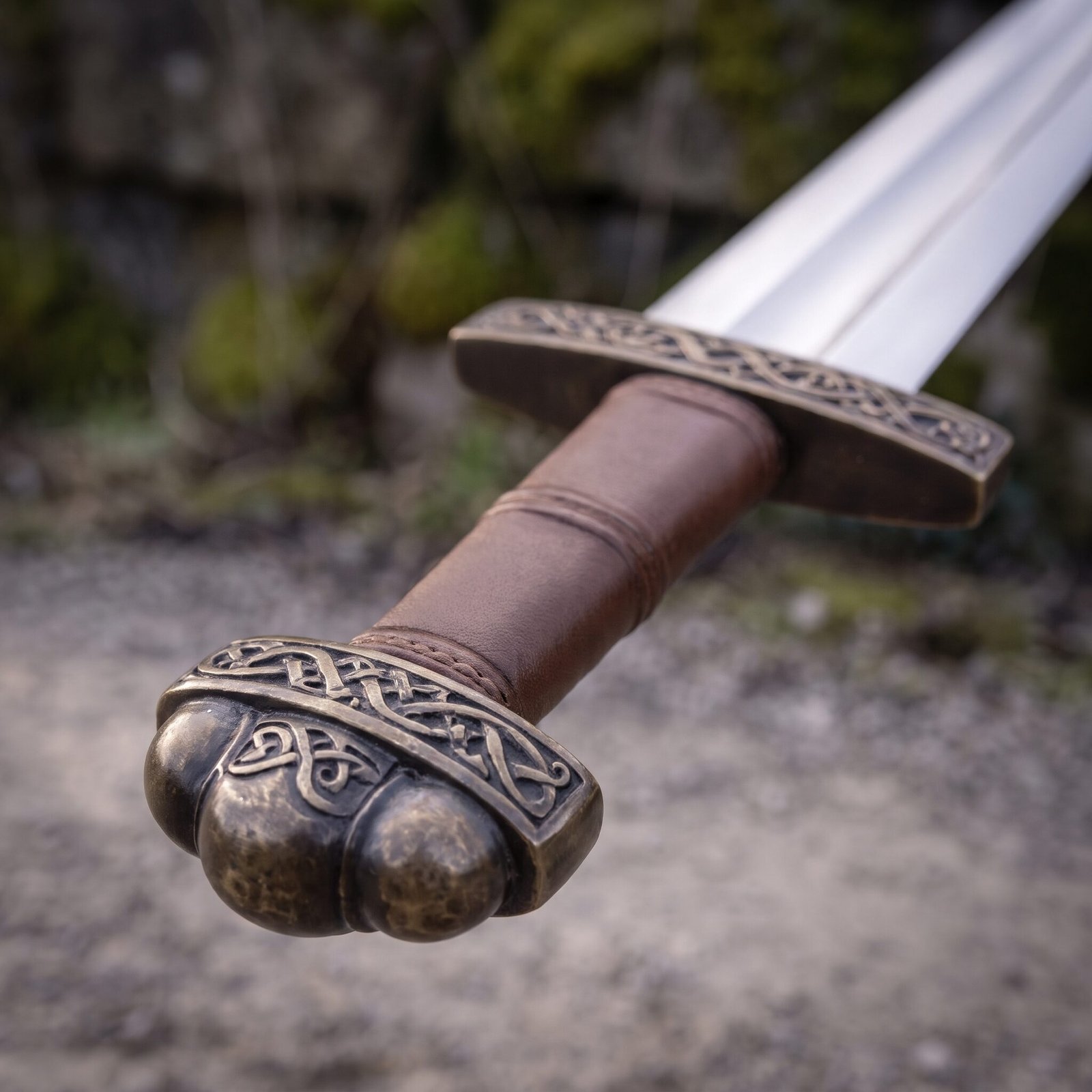
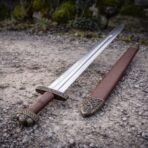
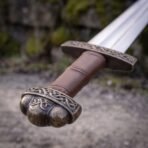
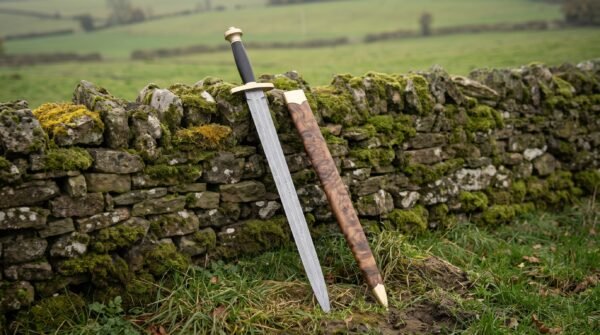
A thirty seven inch Viking sword with a broad fullered blade and a hilt covered in Urnes style interlace, the last and most elegant of the Viking animal styles. The guard and the lobed pommel are finished in a dark bronze tone and carved all over with long, thin, ribbon bodied beasts that loop over and under each other in open figures of eight. The carving is crisp at the high points and darker in the recesses, so the animals stand out when the light comes across them.
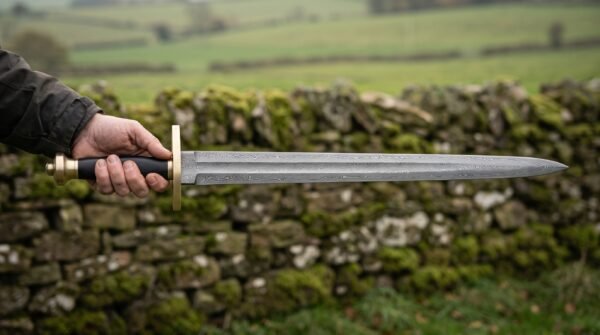
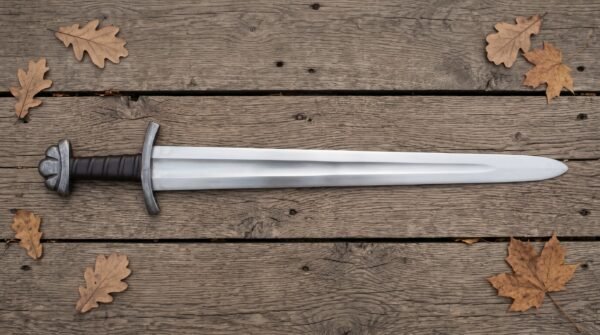
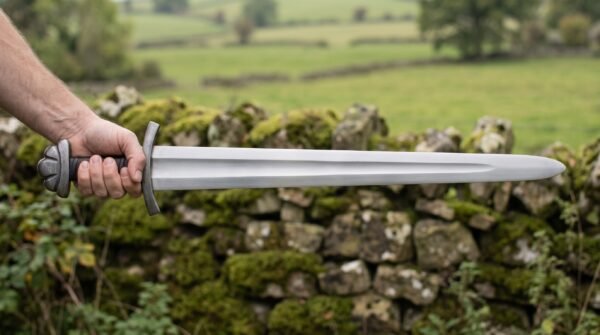
The blade is 1095 high carbon steel, hand forged and hardened to 54 to 58 HRC, with a wide fuller running most of its length and a rounded point in the way most Viking age blades finished. Between the guard and the pommel is a brown leather grip for one hand. It comes with a brown leather scabbard whose chape carries a matching band of interlace.
If you are comparing Viking swords, best Viking swords for collectors sets out what is worth paying for and what is not. The best Viking blades of all are the subject of Ulfberht swords, and the rest of the range is under Viking swords.
Specifications
| Blade steel | 1095 high carbon steel, hand forged |
|---|
| Hardness | 54 to 58 HRC |
|---|
| Overall length | Approximately 37 inches |
|---|
| Blade length | Approximately 30 inches |
|---|
| Blade | Broad, double edged, wide central fuller, rounded point |
|---|
| Guard | Short straight guard in a dark bronze tone with carved Urnes style interlace |
|---|
| Pommel | Lobed pommel in a dark bronze tone with carved Urnes style interlace |
|---|
| Grip | Brown leather over a wooden core, single hand |
|---|
| Scabbard | Brown leather with an interlace carved chape, included |
|---|
| Edge | Finished edge, not honed to shaving sharpness |
|---|
| Type | Collector, display and reenactment display piece |
|---|
| SKU | RK-2213 |
|---|
What Urnes style is
Viking art moved through a run of styles over about three hundred years, and art historians name each one after a find spot. Urnes is the last of them. It takes its name from the stave church at Urnes in western Norway, on the Lustrafjord, where carved wooden panels from an earlier church were reused in the walls of the one that stands today. Those panels are the best known example of the style and still on the building.
The style belongs to the middle of the eleventh century and runs into the early twelfth, by which point Scandinavia was Christian and the Viking age proper was winding down. It grew out of the busier Ringerike style that came before it, and the change is easy to see once you know to look. Ringerike crowds the surface with plant tendrils and thick bodied animals. Urnes thins everything out.
The animals in Urnes work are long and slender, almost like ribbons, with narrow almond shaped eyes, small heads and limbs that trail off into tendrils. They bite and loop through each other in open figures of eight, and the carver plays thick lines against thin ones so the whole design has a rhythm to it, swelling and narrowing as it goes. There is space between the loops. That open, airy quality is what makes the style look so different from the dense knotwork most people picture when they hear the word Viking.
Why the hilt carries the decoration
On a Viking sword the blade was the expensive part and the hilt was where you showed what you were. Many surviving hilts are plain iron, but the richer ones were inlaid, plated or decorated, and a fine hilt said as much about its owner as the cut of his cloak. The decoration on this sword follows that thinking and stays off the blade. The steel is left bright and the guard and pommel do the talking.
The lobed pommel is the classic Viking shape. Its lobes sit above a lower bar, which is why it reads as a crown when you look at it from the flat of the blade. The guard is short and straight, as Viking guards were. They were never meant to stop a blade sliding down your own, and a long cross guard of the later knightly kind would look out of place here.
The blade and the fuller
The fuller is the wide channel down the middle of the blade. It takes steel out of the centre, where it does least work, and leaves it at the edges and along each side of the channel. The result is a broad blade that stays light and stiff instead of becoming a heavy slab. Viking blades almost always carried a fuller for exactly that reason. It has nothing to do with blood, whatever you may have heard.
The rounded point is right for the period. Viking swords were first and foremost cutting swords used alongside a shield, and most of them finish in a rounded or only gently tapered tip. The taper toward a sharper point came later, as armour changed and swords had to thrust as well as cut.
1095 is a plain high carbon steel, easy to harden well and good at holding an edge, and it rusts if you neglect it. At 54 to 58 HRC it is tough enough for a long blade. More on the steel is in the steel glossary.
Engraving, runes and your own design
Use the rune converter on this page to turn a name, a date or a short phrase into Elder Futhark and we will cut it into the steel. Runes on a Viking sword are about as natural a choice as there is. If you would rather have a different design, choose your own in the engraving option above the add to cart button and tell us where it goes. Where a piece already carries an engraved design, your chosen engraving replaces it rather than sitting alongside it. The best place for a rune line on this sword is inside the fuller just below the guard, where a lot of Viking blades carried their own inscriptions. More on the engraving page.
Handling and display
This is a collector and display sword, and a reenactment display piece for a costume or a stand. It arrives with a finished edge that is not honed to shaving sharpness. It is not built or sold for sparring or for cutting practice and should not be used for either.
Hang it so the light falls across the hilt rather than straight at it. Raking light, from a window to one side or a lamp set off to the left or right, is what brings out the carving. Light from directly in front flattens it. Two hooks, one under the guard and one toward the point, will hold it level. How to display swords and axes on a wall safely has more on fixings and heights.
Care
Wipe the blade after you handle it and give it a thin coat of light machine oil or mineral oil every couple of months. Skin salt on 1095 turns into a brown fingerprint faster than you would expect.
Do not polish the hilt. The darker recesses in the carving are part of the finish and are what make the interlace readable. A metal polish will brighten the high points, then lodge white residue in every groove and spoil the look. A dry soft cloth is all the hilt needs. If it has been handled a lot, a cloth with a trace of oil, wiped and then buffed dry, is enough.
Condition the leather grip and scabbard once or twice a year and keep the sword out of the scabbard in a damp room. There is more in the care guide.
Made in the Czech Republic
This sword is made by hand in the Czech Republic, in a workshop that still forges, grinds and fits its swords one at a time in small runs. It is not drop shipped out of someone else’s catalogue. Ransack Viking brings the swords in, checks each one for a tight hilt, a straight blade and a properly fitting scabbard, and keeps them in our Chicago, Illinois warehouse until they sell. Processing takes one to two weeks, and an engraved order sits at the longer end because we agree the layout with you first. Shipping inside the United States is free. Returns are accepted for seven days. The lifetime warranty against defects in forging, grind, heat treat and fittings has no end date and needs no receipt.
A note on handmade variation
This sword is made by hand, not machine made or bulk produced, so what arrives will not be a pixel for pixel copy of the photograph. The carving on the guard and pommel is finished by hand, so the depth of each recess and the exact run of each loop will be its own, and the dark tone in the recesses sits a little differently on every hilt. The leather of the grip and scabbard takes dye unevenly by nature. The length, the steel, the heat treat and the build are the same every time. The character is not.
Frequently asked questions
Is this a copy of a real Viking sword
No. It is our own design that uses Urnes style decoration on a Viking sword shape. The carving follows the look of the style rather than copying any single object.
What metal is the hilt
The guard and pommel are finished in a dark bronze tone, left darker in the recesses so the carving reads clearly. The blade is 1095 high carbon steel.
Is it sharp
It arrives with a finished edge that is not honed to shaving sharpness. It is a display and collector piece and should be handled like any long blade.
Why is the point rounded
Because most Viking swords were. They were cutting swords used with a shield, and a sharply tapered point came into fashion later.
Is the scabbard included
Yes. A brown leather scabbard with an interlace carved chape comes with it.
Can I have runes added
Yes. Use the rune converter and engraving option on this page. The fuller just below the guard is the traditional spot.
What is in the box
- One hand forged 1095 high carbon steel Viking sword with Urnes style carved hilt, approximately 37 inches overall
- Brown leather scabbard with interlace carved chape
- Rune or custom engraving where ordered
- Care card for the steel, the hilt and the leather
Explore the range
See the rest of the Viking swords, the Damascus swords and the whole sword collection. For a hilt drawn to your own design, the custom sword page explains how it works.
Close to this one
For a Viking sword with knotwork on the blade instead of the hilt, see the Knotdrift Damascus Viking sword. In plain 1095 with a lobed steel pommel there is the Braidfuller Viking sword, and the Trinefold Viking sword carries a triquetra on a lobed pommel.



Reviews
There are no reviews yet