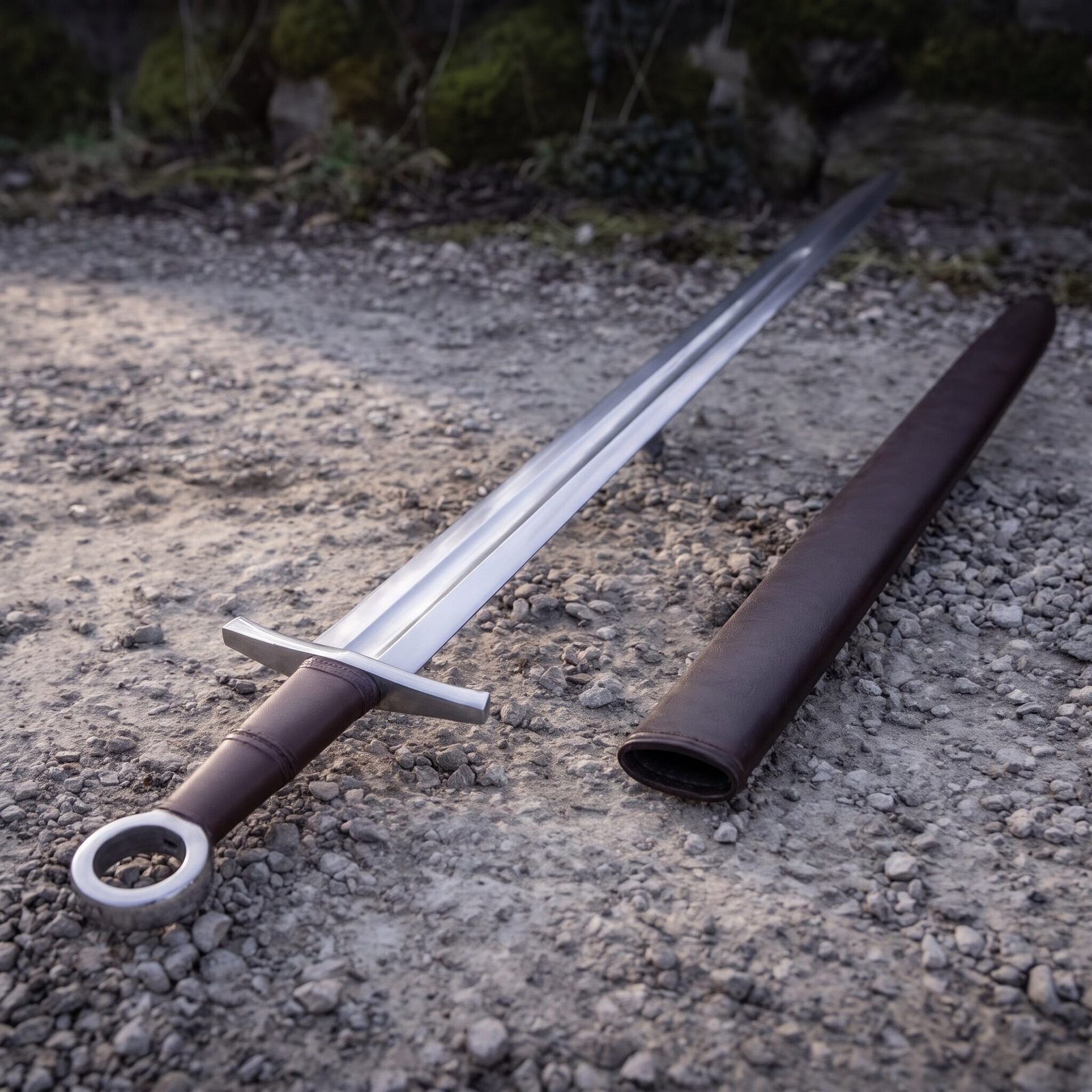
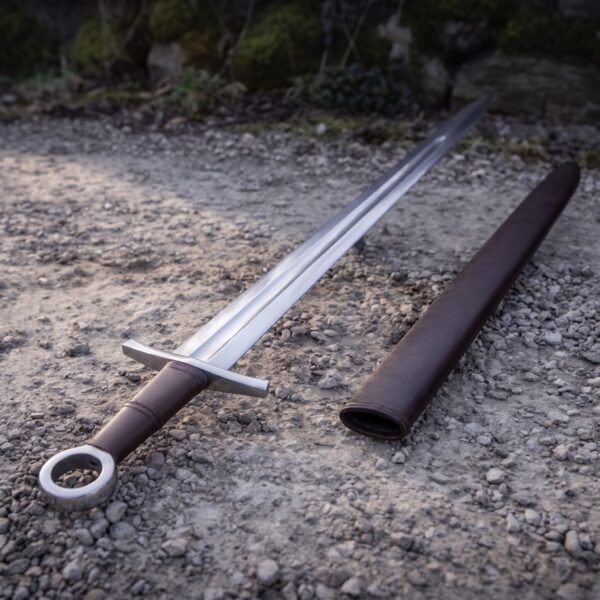
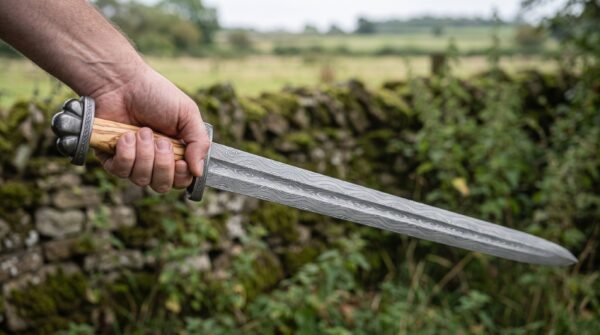
A thirty six inch sword in the late medieval Gaelic Irish style, built around the one feature that makes these swords recognisable from across a room: an open ring for a pommel. Where most European swords of the period finish in a solid wheel or a heavy disc, the Irish swordsmiths closed the hilt with a flat steel ring you can see straight through. It looks light and slightly odd at first, and then you stop being able to picture the sword any other way.
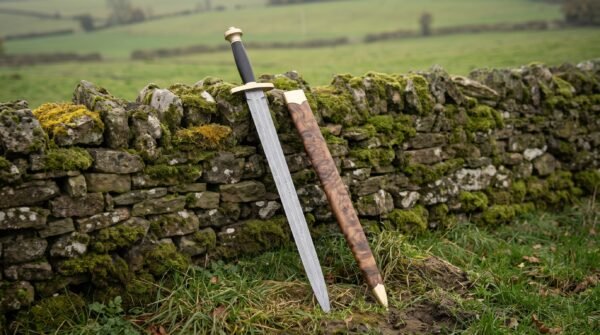
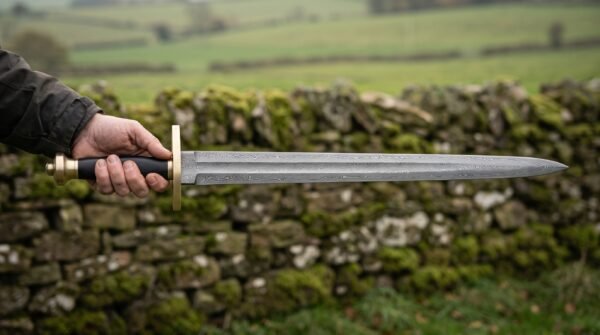
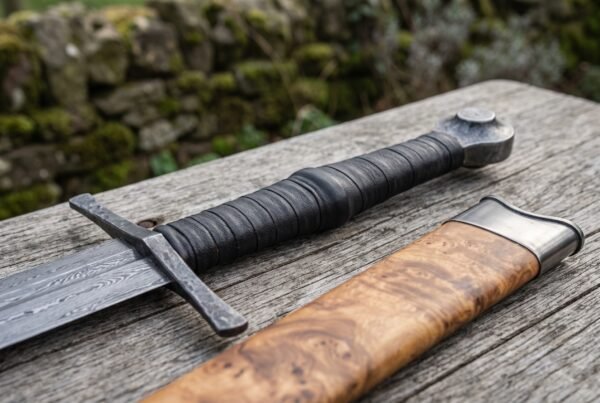
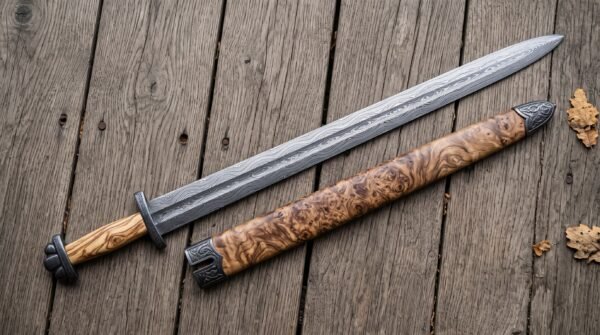
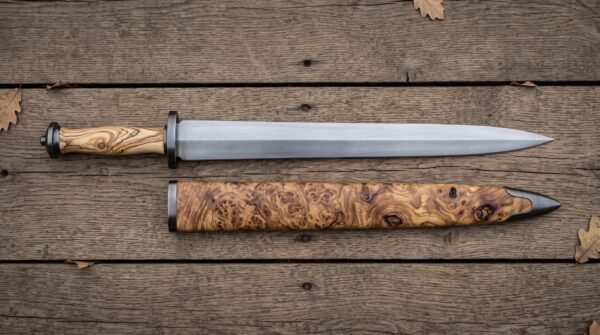
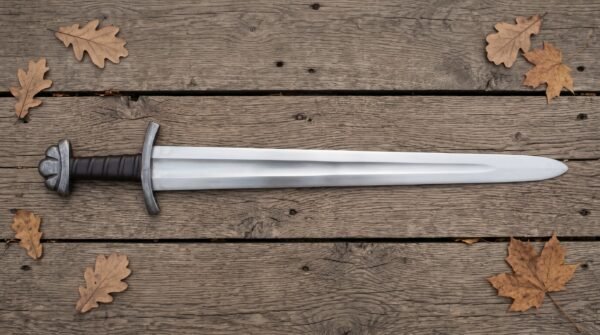
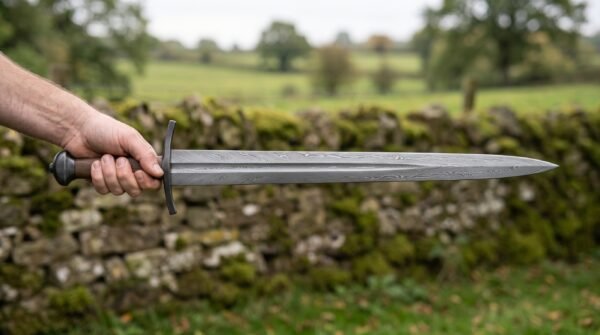
The blade is 1095 high carbon steel, hand forged and hardened to 54 to 58 HRC. It is narrow, straight and double edged with a shallow central fuller and a sharp profile at the point. Above it sits a slender cross guard whose arms drop slightly and end in small flat lozenge terminals, then a brown leather grip for one hand, then the ring. A dark brown leather scabbard comes with it.
Irish and Highland pieces sit together in our Anglo Saxon and Celtic section. If you are weighing up a first sword, how to buy your first sword covers what to look for, and the longer explanation of the steel is in the steel we use, and how hard it is.
Specifications
| Blade steel | 1095 high carbon steel, hand forged |
|---|
| Hardness | 54 to 58 HRC |
|---|
| Overall length | Approximately 36 inches |
|---|
| Blade length | Approximately 29 inches |
|---|
| Blade | Narrow, straight, double edged, shallow central fuller |
|---|
| Guard | Slender steel cross guard, arms dropping slightly to small lozenge terminals |
|---|
| Grip | Brown leather over a wooden core, single hand |
|---|
| Pommel | Open steel ring set in the plane of the blade |
|---|
| Scabbard | Dark brown leather, included |
|---|
| Edge | Finished edge, not honed to shaving sharpness |
|---|
| Type | Collector, display and reenactment display piece |
|---|
| SKU | RK-2212 |
|---|
Where the ring hilt comes from
The ring hilted sword belongs to Gaelic Ireland in the later middle ages and into the sixteenth century, the world of the Irish lordships outside the reach of the English Pale. It is one of the very few sword types that can be pinned to a single country with real confidence. Nobody else made swords quite like it, and the handful of originals that survive are kept in museum collections, so most of what we know comes from a small number of real swords and from carvings and drawings of the period.
The hilt is the giveaway. The pommel is a flat open ring, usually set in the same plane as the blade, so that seen from the edge it is almost invisible and seen from the flat it frames the air behind it. On the originals the tang typically runs across the ring and is fixed at its outer rim. The guards on these swords tend to be slender and often drop slightly at the ends, sometimes finishing in small expanded terminals, and the blades are often narrow and well suited to the point.
Why a ring? The honest answer is that nobody wrote it down. It saves weight at the back of the hand compared with a heavy wheel, which moves the balance forward and gives the sword more authority in the cut. It also makes an easy, strong fixing for the end of the tang. And it is distinctive, which in a society that cared a great deal about lineage and status was no small thing. Any of those could be the reason, and quite possibly all of them were.
How it handles compared with a wheel pommel
A pommel is a counterweight. On most knightly swords a heavy wheel or disc sits behind the hand and pulls the balance back toward the guard, which makes the sword quick to turn but takes some of the weight out of the blade. An open ring weighs less than a solid wheel of the same diameter, so the balance on a ring hilt sword sits further down the blade.
What that means in your hand is a sword that feels a little more committed when you lift it. It does not feel heavy, because the blade is narrow and the overall weight is modest, but it wants to keep moving in the direction you started it. People who handle a ring hilt sword for the first time usually describe it as feeling more like a tool than a toy, and they are not wrong.
The narrow blade and the drooping guard suit a sword that was used a good deal on the point. A slender blade gets through a gap more easily than a broad one, and a guard that bends slightly toward the blade gives your hand a little more cover without getting in the way.
The steel and the fittings
The blade is 1095, a plain high carbon steel with no chromium to speak of. That makes it easy to heat treat well and good at holding an edge, and it also means it rusts if you leave it wet. At 54 to 58 HRC it is tough enough to flex slightly and come back, which is what you want from a long thin blade. Harder would chip. Softer would bend and stay bent. The numbers are explained in the steel glossary.
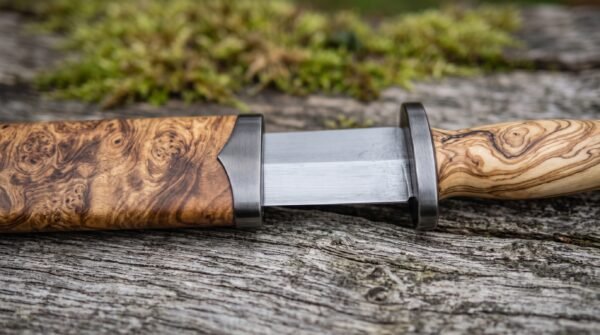
The guard and the ring are plain steel with a brushed finish. The grip is brown leather over a shaped wooden core, closed neatly at the guard and at the ring.
Engraving, runes and your own design
Use the rune converter on this page to turn a name, a date or a short phrase into Elder Futhark and we will cut it into the steel. If you would rather have a Celtic knot or a line of plain text, choose your own design in the engraving option above the add to cart button and tell us where it goes. Where a piece already carries an engraved design, your chosen engraving replaces it rather than sitting alongside it. A narrow blade leaves less room than a broad one, so a short name or a single line below the guard works best. There is more on the engraving page.
Handling and display
This is a collector and display sword, and a reenactment display piece for a costume or a stand. It arrives with a finished edge that is not honed to shaving sharpness. It is not built or sold for sparring or for cutting, and it should not be used for either.
The ring pommel makes this an easy sword to hang. A single hook through the ring with a second rest under the blade holds it securely at an angle with the hilt high, and the ring reads well against a plain wall. If you would rather lay it flat, two hooks under the guard and toward the point do the job. How to display swords and axes on a wall safely has the details on fixings and heights.
Care
Wipe the blade after you handle it, because skin leaves salt behind and 1095 notices. A soft cloth with a few drops of light machine oil or mineral oil down both faces every couple of months is enough on a wall. Do it straight away after the sword has been handled.
Pay a little attention to the inside of the ring. It is easy to oil the blade and forget the hilt, and dust and moisture sit in the inner curve. A twist of oiled cloth run round it once in a while keeps it bright.
Condition the grip and scabbard leather once or twice a year, and do not leave the sword in its scabbard for months in a damp room. There is more in the care guide.
Made in the Czech Republic
This sword is made by hand in the Czech Republic, by a workshop that forges, grinds, hardens and fits its swords in small runs. It is not drop shipped from somebody else’s catalogue. Ransack Viking brings each piece in, checks it for a tight hilt, a straight blade and a scabbard that fits, and holds it in our Chicago, Illinois warehouse until it sells. Processing runs one to two weeks, and an engraved order sits at the longer end because the layout is agreed with you before anything is cut. US shipping is free, returns are accepted within seven days, and the lifetime warranty against defects in forging, grind, heat treat and fittings has no end date and needs no receipt.
A note on handmade variation
This sword is made by hand, not machine made or bulk produced, so what arrives will not be a pixel for pixel copy of the photograph. The ring is forged and dressed by hand and its exact thickness and roundness will be its own. The droop of the guard arms and the shape of the small terminals vary slightly from sword to sword. Leather takes dye differently on every hide, so the brown of your grip and scabbard may run a shade lighter or darker. The length, the steel, the heat treat and the build are the same every time. The character is not.
Frequently asked questions
Is this a copy of a museum sword
No. It is our own sword in the Gaelic ring hilt style, not a measured copy of any one original. The ring pommel, the slender guard and the narrow blade follow what the surviving swords show.
Is the ring strong enough
Yes, for what this sword is for. The ring is solid steel and fixed to the tang. It will take normal handling, hanging and display without trouble. It is not built for contact.
Is it sharp
It arrives with a finished edge that is not honed to shaving sharpness. It is a display and collector piece and should be handled like any long blade.
Is it one handed
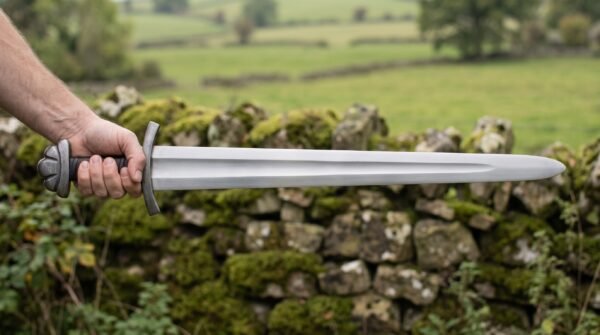
Yes. The grip is sized for one hand, with the ring sitting just behind the heel of the palm.
Is the scabbard included
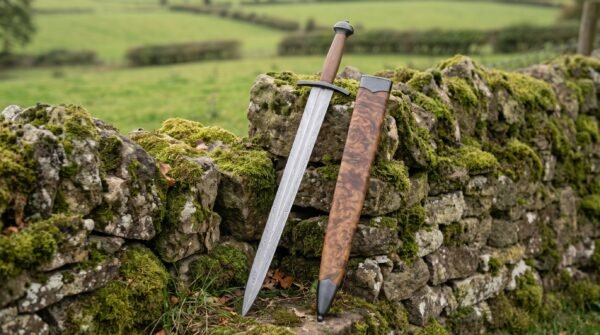
Yes. A dark brown leather scabbard comes with the sword.
Can I add a name or a knot
Yes. Use the engraving option on this page. Short names and single lines work best on a blade this narrow.
What is in the box
- One hand forged 1095 high carbon steel Irish ring hilt sword, approximately 36 inches overall
- Dark brown leather scabbard
- Engraving where ordered
- Care card for the steel and the leather
Explore the range
See the rest of the arming swords, the Anglo Saxon and Celtic pieces and the full sword collection. For a sword drawn to your own idea, see the custom sword page.
Close to this one
For the Scottish side of the Gaelic world, the Glenbrand Highland claymore is the big two handed sword of the same culture, and the Bramblehilt basket hilt broadsword is what came after it. For a smaller Celtic piece, the Knotbone Celtic dagger is worth a look.






Reviews
There are no reviews yet