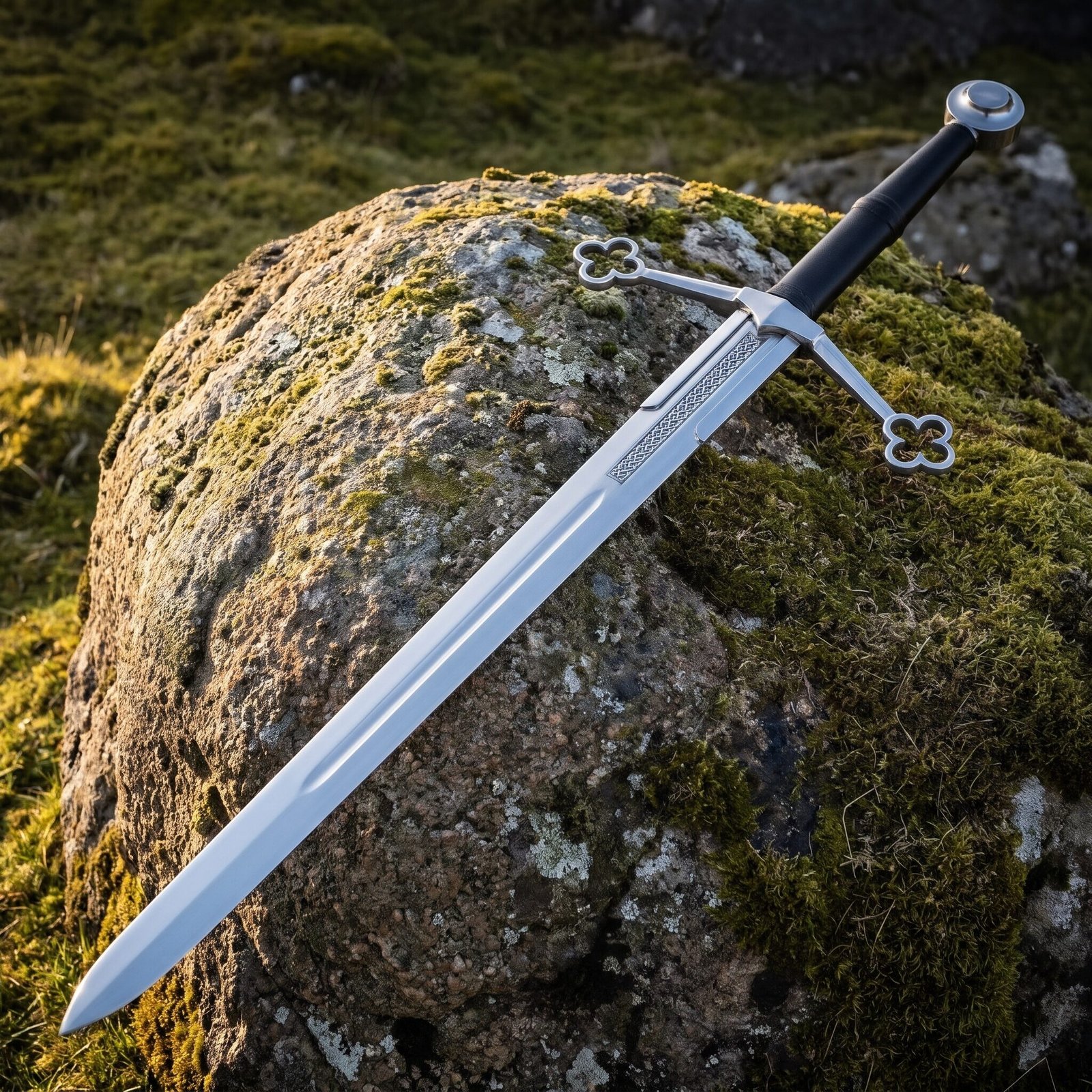
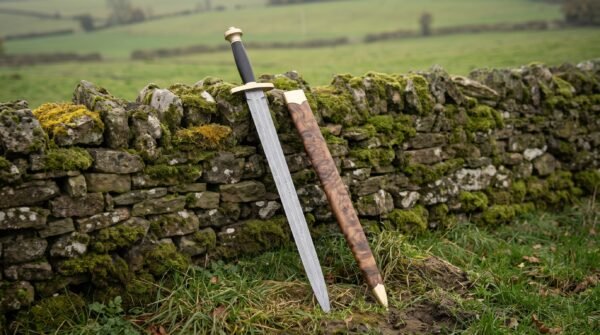
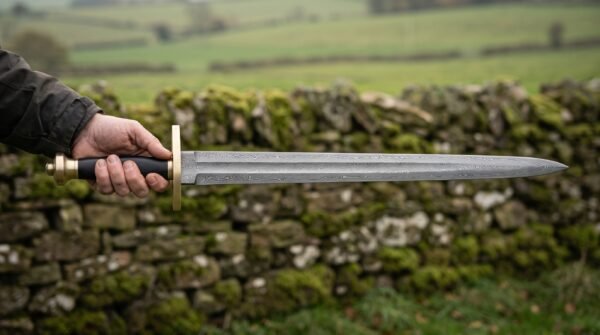
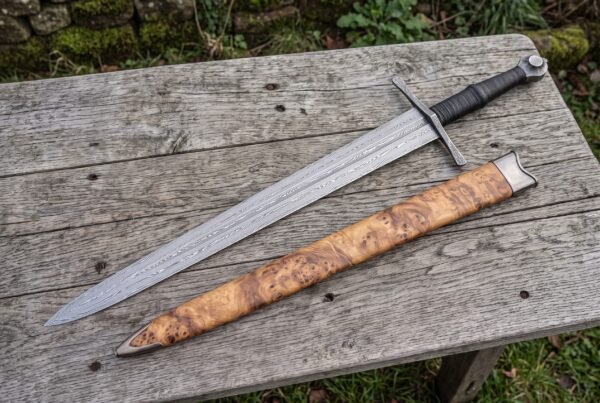
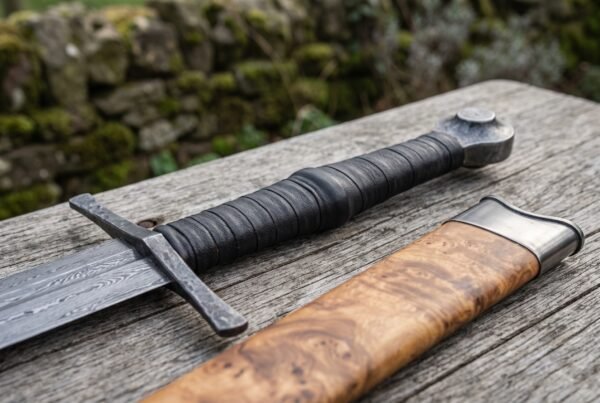
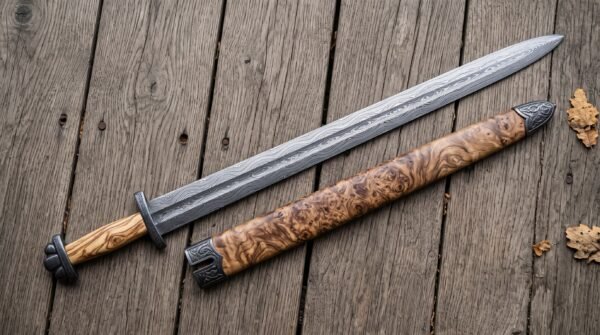
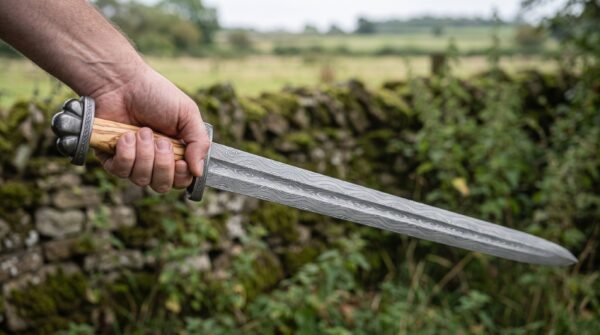
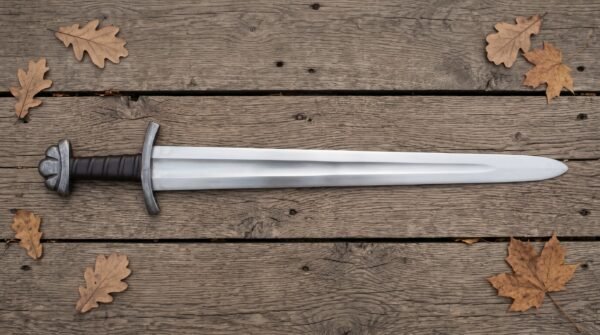
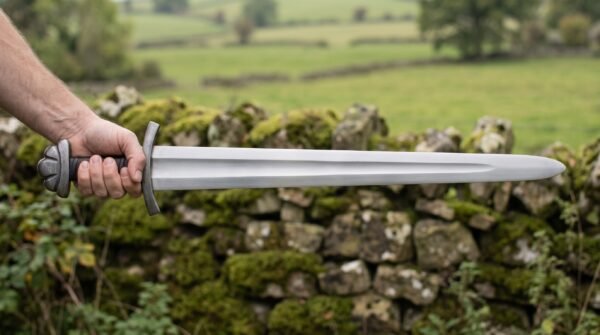
A fifty four inch Scottish Highland claymore, the great two handed sword of the Gaels, with the hilt that makes the type easy to spot: long quillons that slope forward toward the blade and finish in open quatrefoils, four small rings set together like a four leaf clover. Short langets run down onto the blade below the guard, and just under them a band of Celtic knotwork is etched into the steel. The grip is long black leather for two hands, closed by a round wheel pommel.
The blade is 1095 high carbon steel, hand forged and hardened to 54 to 58 HRC, about forty one inches long, straight and double edged with a short fuller at the base. It is a big sword. Standing on its point, the pommel comes up to roughly the chest of an average adult, and it looks every inch of that on a wall.
There is no better time to read display sword vs battle ready than before buying a sword this size. The rest of the big two handers are under claymores and longswords, and Scottish and Irish pieces sit together in Anglo Saxon and Celtic.
Specifications
| Blade steel | 1095 high carbon steel, hand forged |
|---|
| Hardness | 54 to 58 HRC |
|---|
| Overall length | Approximately 54 inches |
|---|
| Blade length | Approximately 41 inches |
|---|
| Blade | Straight, double edged, short fuller at the base, Celtic knot band etched below the guard |
|---|
| Guard | Steel quillons sloping forward toward the blade, ending in open quatrefoils, with short langets |
|---|
| Grip | Black leather over a wooden core, two handed |
|---|
| Pommel | Round steel wheel pommel |
|---|
| Edge | Finished edge, not honed to shaving sharpness |
|---|
| Type | Collector, display and reenactment display piece |
|---|
| SKU | RK-2214 |
|---|
Which claymore this is
The word claymore comes from the Gaelic claidheamh mòr, which simply means great sword. It has been stuck on two quite different weapons, and it saves a lot of confusion to know which one you are looking at.
The first is the one here: the two handed sword of the Scottish Highlands and Islands, in use from roughly the fifteenth century into the seventeenth. It is a long, straight, double edged sword with a long grip for two hands and a very particular guard, the quillons angled forward toward the blade and usually ending in quatrefoils or simple rounded terminals. Langets, the short tongues of steel running down from the guard over the blade, are common.
The second is the basket hilted broadsword of the late seventeenth and eighteenth centuries, a one handed sword with an enclosed steel basket around the hand. By the time of the Jacobite risings that was the sword most Highlanders carried, and the name claymore moved across to it. Collectors argue about which use is correct. Both have long history behind them, and the sword trade has never been tidy about it. If the basket hilt is what you are after, the basket and shell hilt swords are the place to look.
Reading the hilt
The forward sloping quillons are what make a Highland two hander recognisable. On most European swords the guard runs straight across or curves gently. On the claymore it is swept down toward the blade at a definite angle, which puts the quillons between your hands and anything sliding down your blade, and gives the hilt that distinctive sharp V when you look at it from the flat.
The quatrefoils on the ends are a Highland signature. Each one is four small rings joined into a single open terminal. Shaping them is fiddly work, and on originals they vary from neat rings to looser lobes depending on the maker. On this sword they are open, so you can see the wall through them when it hangs.
The langets do two jobs. They help lock the guard to the blade, and they cover the base of the blade just under the guard, where an opponent’s edge might otherwise slide down. Below them is the Celtic knot band, etched into the steel rather than cut deep, so it reads as a darker pattern on bright metal.
Handling a sword this long
A two handed sword works differently from a one handed one. The long grip lets your two hands sit apart, and that spacing turns the sword into a lever. Push with one hand and pull with the other and the point moves fast for very little effort, which is how a sword of this length is controlled without being exhausting. Holding it with your hands bunched together the way you would hold a baseball bat is the quickest way to find out how heavy fifty four inches of steel can feel.
The wheel pommel at the end is a counterweight and a handhold. It brings the balance back toward the guard and gives your rear hand something to close against.
Picking it up, carrying it and putting it on a wall all take more care than with a shorter sword. Lift it by the grip with both hands, keep the point low, and give yourself plenty of room. Doorways, ceiling lights and other people are all closer than they look when you are holding something this long.
The steel
1095 is a plain high carbon steel with about ninety five hundredths of one percent carbon. It hardens cleanly and holds an edge well, and it rusts if you neglect it. On a long blade the heat treat matters more than on a short one, because a forty inch blade has to flex and return rather than stay bent or break. Keeping it at 54 to 58 HRC rather than harder is a deliberate choice for exactly that reason. The numbers are explained in the steel we use, and how hard it is.
Engraving, runes and your own design
Use the rune converter on this page to turn a name, a date or a short phrase into Elder Futhark and we will cut it into the steel. If you would rather have a clan motto or a plain line of text, choose your own design in the engraving option above the add to cart button and tell us where it goes. Where a piece already carries an engraved design, your chosen engraving replaces it rather than sitting alongside it, so on this sword the usual place for a name is the other face of the blade or further down below the knotwork. See the engraving page for more.
Display
This is a collector and display sword, and a reenactment display piece for a costume or a stand. It arrives with a finished edge that is not honed to shaving sharpness. It is not built or sold for sparring or for cutting and should not be used for either.
A sword this long looks best hung horizontally above a fireplace or a wide piece of furniture, or on a tall vertical mount beside a doorway. Use proper fixings into a stud or a masonry plug, not a picture hook. Two or three supports along the length are better than two at the ends. How to display swords and axes on a wall safely covers it in detail, including what not to fix to a plasterboard wall.
Care
Wipe the blade after handling and keep a thin coat of light machine oil or mineral oil on it, renewed every couple of months. Pay attention to the etched knot band and the area under the langets, where moisture can sit. A soft brush with a drop of oil gets into the etching better than a cloth.
Feed the leather grip with a leather conditioner once or twice a year. If the sword lives near a fireplace, check the leather more often, because dry heat shrinks it.
If light rust appears, oil the spot and work it gently with a fine nylon pad, then oil again. Wire wool will scratch the finish. More in the care guide.
Made in the Czech Republic
This sword is made by hand in the Czech Republic, in a workshop that forges, grinds, hardens and fits its swords in small runs. It is not drop shipped out of a catalogue. Ransack Viking brings the swords in, checks each one for a tight hilt and a straight blade, and holds them in our Chicago, Illinois warehouse until they sell. A sword this size ships in an oversized box. Processing runs one to two weeks, longer when there is engraving to agree with you first. US shipping is free, returns are open for seven days, and the lifetime warranty against defects in forging, grind, heat treat and fittings has no end date and needs no receipt.
A note on handmade variation
This sword is made by hand, not machine made or bulk produced, so what arrives will not be a pixel for pixel copy of the photograph. The quatrefoils are formed by hand and each ring will be its own shape. The angle of the quillons and the length of the langets vary slightly. The etched band takes the acid at its own depth every time. Leather is a natural material, so the grip may carry a warmer or cooler black. The length, the steel, the heat treat and the build are the same every time. The character is not.
Frequently asked questions
Is this a Braveheart sword
No. It is our own Highland two handed sword, not a replica of anything from a film. It follows the shape of the historical claymore, which is what the film swords were loosely based on in the first place.
How heavy does it feel
It is a two handed sword fifty four inches long, so it is a serious piece of steel, but used with both hands spaced on the grip it handles far better than its size suggests. Held with one hand at arm’s length it will feel heavy, as any sword this long does.
Is it sharp
It arrives with a finished edge that is not honed to shaving sharpness. Treat it with the care any long blade needs and keep it away from children.
Why does it ship oversized
Anything forty inches and longer travels in an oversized box so it arrives straight and undamaged. Shipping within the United States is still free.
Can I engrave a clan motto
Yes. Use the engraving option on this page and tell us the wording and where you want it.
What is in the box
- One hand forged 1095 high carbon steel Highland claymore, approximately 54 inches overall
- Engraving where ordered
- Care card for the steel and the leather
Explore the range
See the rest of the claymores, the longswords, the basket hilt swords and the full sword collection. For a sword made to your own drawing, see the custom sword page.
Close to this one
For the later Highland sword that took over the claymore name, see the Bramblehilt basket hilt broadsword. For a hand and a half sword with a Highland look, there is the Ringwolf hand and a half sword. From the Irish side of the Gaelic world, the Ringcairn Irish ring hilt sword is a good companion.



Reviews
There are no reviews yet