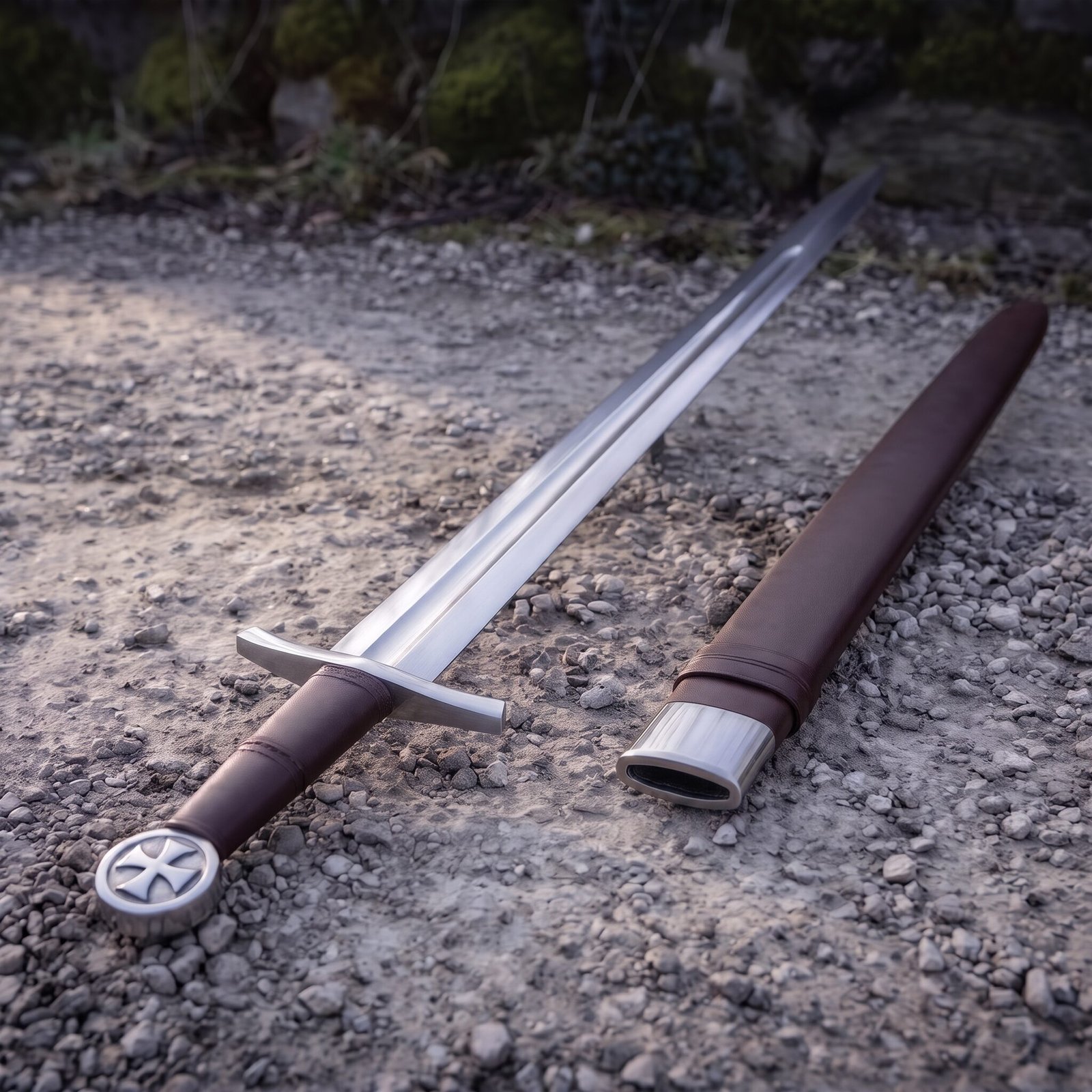
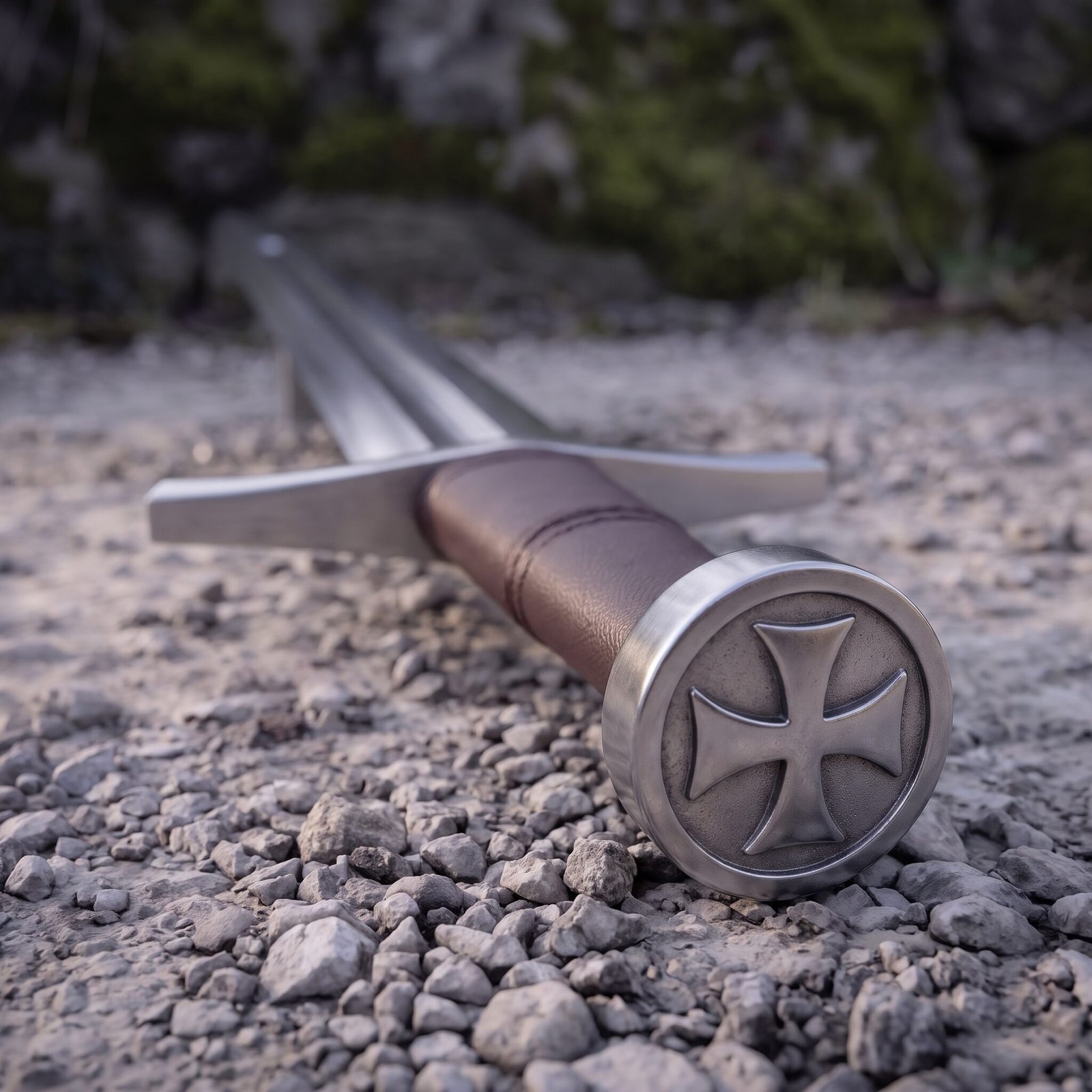
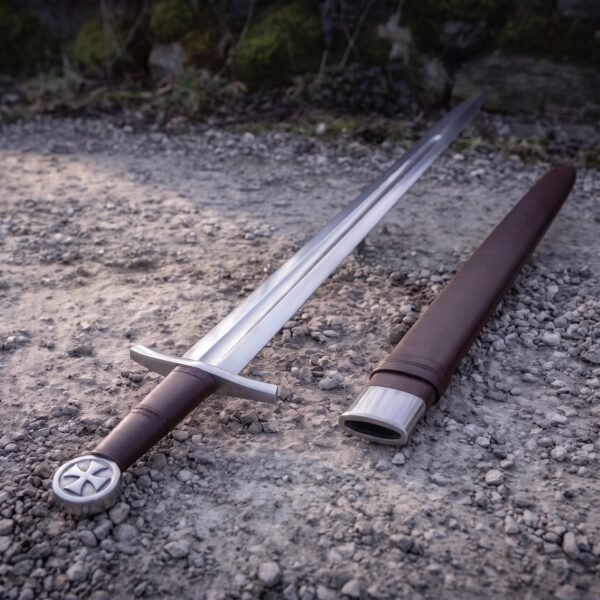
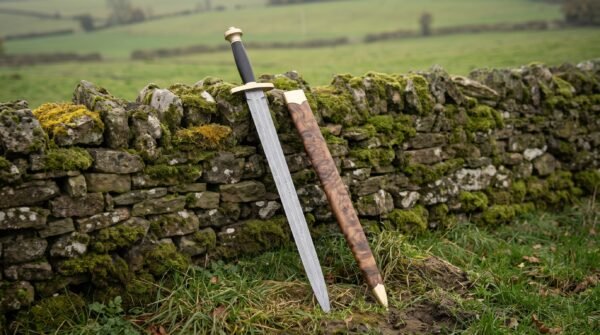
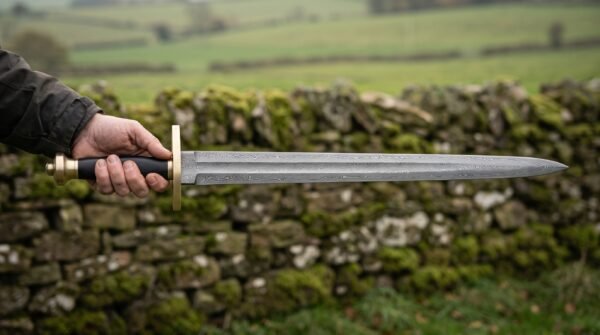
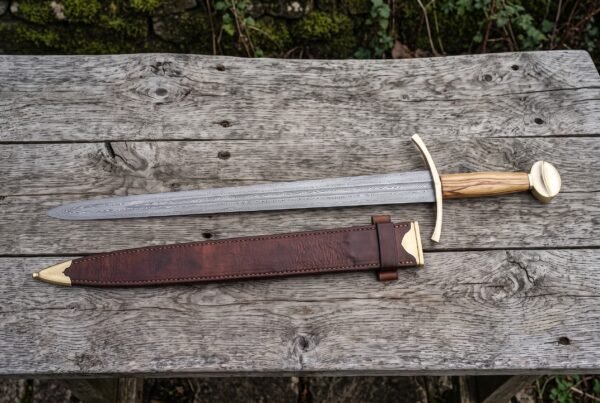
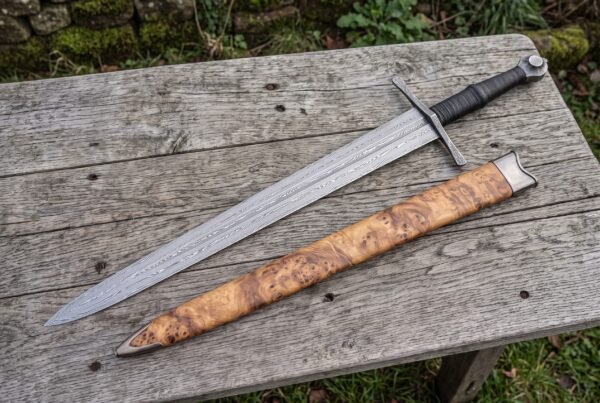
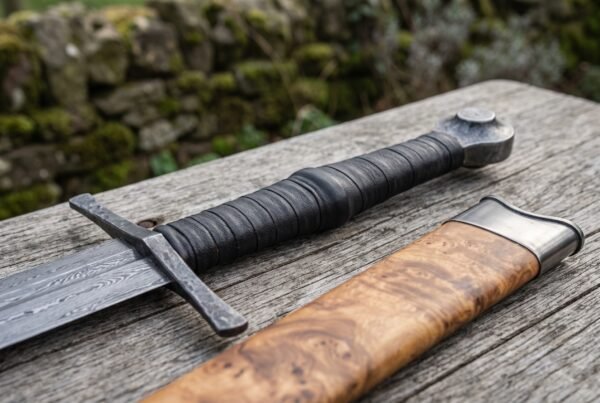
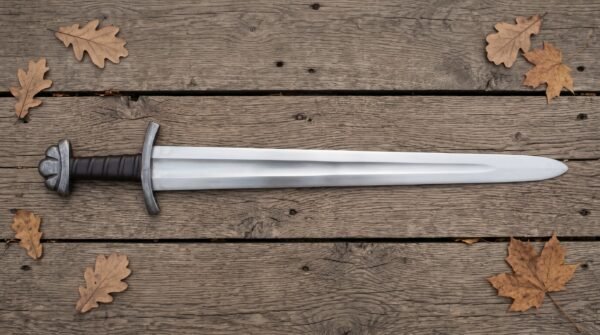
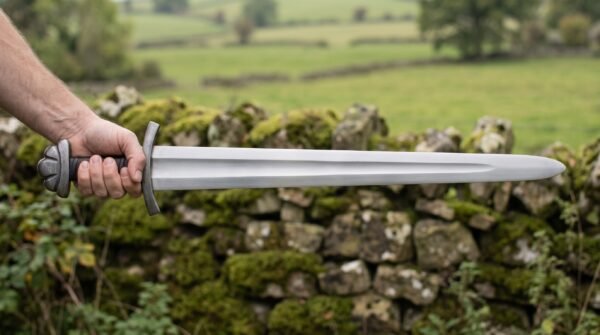
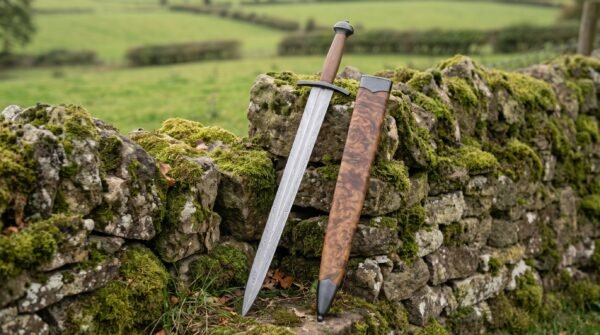
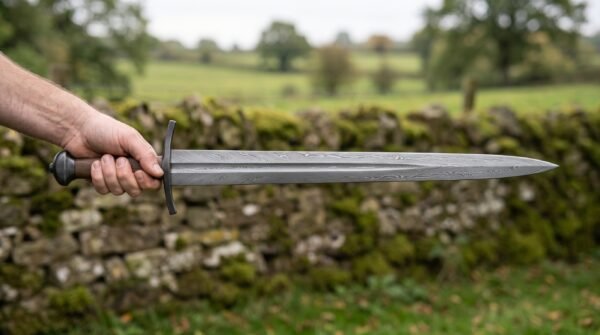
A thirty nine inch knightly sword in the style of the Knights Templar, with a flat disc pommel carrying a raised cross pattee, the cross whose four arms are narrow at the centre and flare wide at the ends. Below it is a dark brown leather grip for one hand, a straight steel guard with gently flared ends, and a long straight blade tapering to a point. It comes with a dark brown leather scabbard with a steel chape.
The blade is 1095 high carbon steel, hand forged and hardened to 54 to 58 HRC, with a fuller down the centre. Everything about the sword is restrained except the pommel, which is where the eye goes first and where the cross sits right under your hand.
If the military orders interest you, our Templar kite shields, the Crossmarch and the Palecross, both carry the red cross pattee. The other knightly swords are under arming swords, and display sword vs battle ready explains what the edge on a piece like this is and is not for.
Specifications
| Blade steel | 1095 high carbon steel, hand forged |
|---|
| Hardness | 54 to 58 HRC |
|---|
| Overall length | Approximately 39 inches |
|---|
| Blade length | Approximately 32 inches |
|---|
| Blade | Straight, double edged, central fuller, tapering point |
|---|
| Guard | Straight steel cross guard with slightly flared ends |
|---|
| Grip | Dark brown leather over a wooden core, single hand |
|---|
| Pommel | Flat steel disc with a raised cross pattee on the face |
|---|
| Scabbard | Dark brown leather with a steel chape, included |
|---|
| Edge | Finished edge, not honed to shaving sharpness |
|---|
| Type | Collector, display and reenactment display piece |
|---|
| SKU | RK-2215 |
|---|
The Templars in brief
The Order of the Poor Fellow Soldiers of Christ and of the Temple of Solomon began around 1119 or 1120 in Jerusalem, as a small group of knights who undertook to protect pilgrims on the roads of the Holy Land. They took their name from their quarters on the Temple Mount. The Church gave them a rule at the Council of Troyes in 1129, and from there they grew fast, with houses and estates across Europe feeding money, men and horses east.
They were fighting monks. A brother knight took vows of poverty, chastity and obedience, lived under a strict rule and was expected to fight. They wore white mantles, and the red cross came to be their mark, most often said to have been granted by Pope Eugenius III in 1147.
The end was sudden. In 1307 King Philip IV of France had the Templars in his kingdom arrested on a single morning, and after years of trials and forced confessions the Pope suppressed the Order in 1312. The last Grand Master, Jacques de Molay, was burned in Paris in 1314. That ending has kept the Templars in books and films ever since, usually with a lot more treasure and secret knowledge than the evidence supports.
What a Templar sword actually was
Here is the plain truth that most Templar sword listings skip. There is no surviving sword anyone can prove belonged to a Templar, and there was no special Templar pattern. A brother knight carried the same kind of sword as any other knight of the twelfth and thirteenth centuries: a straight, double edged, single handed sword with a cross guard and a heavy pommel. The Order’s rule had a good deal to say about plainness of equipment and nothing about a house design.
So a Templar sword today means a knightly sword of the right period dressed with the Order’s symbol. That is what this is, and we would rather tell you so than pretend it was dug up somewhere.
The cross pattee
The cross pattee takes its name from the French for paw, because the arms spread out at the ends like a foot. It is narrow at the centre and broad at each tip, and the outer ends of the arms are usually straight or very slightly curved. It is the cross most people now picture when they think of the Templars, although medieval images show the Order’s cross in several shapes. It has had a long life since, in heraldry, on military decorations and as a general symbol of the crusades.
On this sword it is raised in relief on the face of the disc pommel, so it catches light across its edges and stays readable from across a room. It is kept simple on purpose. The pommel is the part of a sword that gets gripped, knocked and rubbed the most, and a bold raised shape wears far better there than fine detail would.
The blade and the balance
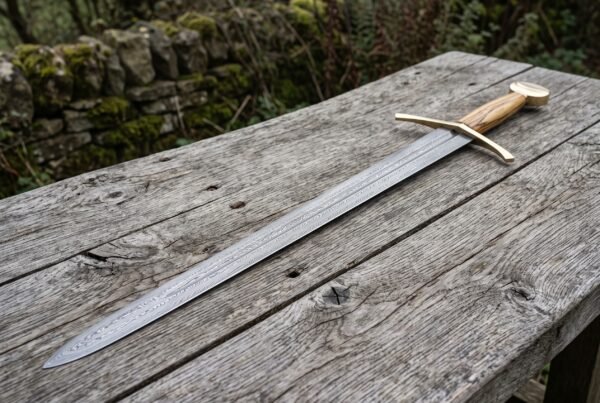
The blade tapers evenly from a broad base to a point, which gives a sword that cuts well and can still thrust. That shape suits the period, when knights faced mail rather than plate and needed a sword that could do a bit of both.
The fuller is the channel down the middle. It lightens the blade without making it floppy by taking steel out of the centre, where it does least work. It is not a blood groove. The disc pommel is the counterweight, pulling the balance back toward the hand so the sword comes round quickly and stops where you mean it to.
The steel is 1095, a plain high carbon steel with no chromium to speak of. It hardens well and holds a good edge, and it rusts if neglected. At 54 to 58 HRC it is tough enough for a long blade to flex and return. More in the steel glossary.
Engraving, runes and your own design
Use the rune converter on this page to turn a name, a date or a short phrase into Elder Futhark and we will cut it into the steel. If you would rather have a Latin motto or a plain English line, choose your own design in the engraving option above the add to cart button and tell us where it goes. Where a piece already carries an engraved design, your chosen engraving replaces it rather than sitting alongside it. A line down the fuller just below the guard is the traditional spot on a sword of this kind. More on the engraving page.
Handling and display
This is a collector and display sword, and a reenactment display piece for a costume or a stand. It arrives with a finished edge that is not honed to shaving sharpness. It is not built or sold for sparring or for cutting practice and should not be used for either.
Hang it with the pommel facing the room so the cross is the first thing people see. A pair with a Templar kite shield behind it is the obvious arrangement, and it works. Use two hooks into a stud or a proper wall plug, one under the guard and one toward the point. How to display swords and axes on a wall safely covers the details.
Care
Wipe the blade after handling and keep a thin coat of light machine oil or mineral oil on it, renewed every couple of months. Fingerprints on 1095 become rust spots quickly in a damp house.
Wipe the pommel with an oiled cloth now and then and buff it dry, paying attention to the corners where the cross meets the disc. Dust and moisture collect there.
Feed the grip and scabbard leather once or twice a year, and do not store the sword in its scabbard for months in a damp room. More in the care guide.
Made in the Czech Republic
This sword is made by hand in the Czech Republic, in a workshop that forges, grinds, hardens and fits its swords in small runs. It is not drop shipped out of a catalogue and it is not stock we have never seen. Ransack Viking brings the pieces in, checks every one for a tight hilt, a straight blade and a scabbard that fits, and keeps them in our Chicago, Illinois warehouse until they sell. Processing takes one to two weeks, and engraved orders sit at the longer end because the layout is agreed with you first. Shipping inside the United States is free. Returns are accepted for seven days. The lifetime warranty against defects in forging, grind, heat treat and fittings has no end date and needs no receipt.
A note on handmade variation
This sword is made by hand, not machine made or bulk produced, so what arrives will not be a pixel for pixel copy of the photograph. The cross on the pommel stands a fraction higher or lower from sword to sword, and its edges are dressed by hand. The flare at the ends of the guard varies slightly. Leather is a natural material and the dark brown of the grip and scabbard runs a shade warmer or cooler between batches. The length, the steel, the heat treat and the build are the same every time. The character is not.
Frequently asked questions
Is this an authentic Templar sword
It is an authentic hand forged sword in the knightly style of the Templar period, with the Order’s cross on the pommel. No sword can honestly be called an original Templar pattern, because the Order did not have one.
Is it sharp
It arrives with a finished edge that is not honed to shaving sharpness. It is a display and collector piece. Handle it as you would any long blade.
Is it one handed
Yes. The grip is sized for a single hand, with the disc pommel resting against the heel of the palm.
Is the scabbard included
Yes. A dark brown leather scabbard with a steel chape comes with it.
Can I add a motto
Yes. Latin mottos work well. Use the engraving option on this page and tell us the wording and the placement.
What is in the box
- One hand forged 1095 high carbon steel Knights Templar style sword, approximately 39 inches overall
- Dark brown leather scabbard with a steel chape
- Engraving where ordered
- Care card for the steel and the leather
Explore the range
See the rest of the arming swords, the kite shields and the full sword collection. If you want something drawn to your own idea, the custom sword page explains how it works.
Close to this one
For the other great military order, see the Ordenmark Teutonic knight sword with its cross wheel pommel. For a plainer knightly sword of the same period there is the Discthane knightly arming sword, and the Wynthorn arming sword is worth a look beside it.

Reviews
There are no reviews yet